In technical outdoor apparel and rugged athletic outerwear, the modern consumer demands two seemingly contradictory performance attributes: extreme mechanical durability capable of withstanding rock scrambling, alpine bushwhacking, and heavy pack strap abrasion, combined with genuine, non-greenwashed ecological sustainability. Historically, heavy-duty technical shells relied on 100% virgin petroleum-based ballistic nylon (such as Cordura®) or toxic fluorocarbon-coated synthetics that persist in landfills for centuries. Conversely, traditional eco-textiles like 100% organic cotton duck canvas soaked up water, weighed down the athlete, and rotted when stored damp in alpine conditions. The cutting edge of sustainable performance outerwear is the engineered hybrid matrix: hemp recycled nylon fabric technical outerwear engineered across heavyweight canvas (280 to 380 GSM) and high-tenacity cross-hatch ripstop (180 to 240 GSM).
By combining natural industrial hemp bast fibers (Cannabis sativa)—one of the strongest botanical cellulose fibers known to material science—with high-tenacity Global Recycled Standard (GRS) certified post-consumer Polyamide 6.6 (recycled nylon), textile engineers achieve unprecedented structural resilience. The high tensile tenacity and natural antimicrobial lignin of hemp interlock with the elastic elongation and shear resistance of continuous-filament nylon. At Sports Outlines, an agile OEM/ODM custom performance apparel manufacturer based in Sialkot, Pakistan, we weave, laminate, and construct high-performance technical outerwear for global outdoor labels and adventure sports brands. This comprehensive technical guide analyzes fiber tribology, cottonization processing, tear propagation mechanics, plant-based C0 DWR weatherproofing, seam taping standards, and our transparent low-MOQ manufacturing framework.
1. Material Science & Hybrid Ecology: Bast Fiber Hemp Meets Post-Consumer Recycled Polyamide 6.6
The synergy between industrial hemp and recycled nylon stems from complementary macromolecular physics: rigid crystalline plant cellulose paired with ductile aliphatic synthetic polymers. To understand why this hybrid excels where single-origin textiles fail, we examine the microscopic architecture of both raw constituents:
- Industrial Hemp Bast Fiber Architecture: Hemp bast fibers are extracted from the phloem tissue of the Cannabis sativa plant stalk. Unlike cotton, which grows as a single-celled seed hair, hemp fibers exist as long, multi-cellular fiber bundles cemented by natural plant pectins and lignin. Hemp possesses an extraordinary degree of cellulose polymerization (DP > 2,000) with a highly oriented micro-fibrillar angle (less than 6 degrees relative to the fiber axis). This micro-alignment gives hemp an individual fiber tensile tenacity of 5.5 to 7.2 cN/dtex—nearly double that of conventional cotton—with an initial modulus exceeding 20 to 28 N/tex. Furthermore, hemp cultivation requires zero synthetic pesticides, half the irrigation water of cotton, and actively sequesters up to 15 tons of atmospheric carbon dioxide per hectare during its rapid 100-day growing cycle.
- GRS Certified Recycled Nylon 6.6 (Post-Consumer Fishing Nets & Industrial Waste): While hemp provides rigid tensile strength, it possesses low elongation at break (just 2.0% to 3.5%). To prevent brittleness under dynamic impact, we blend hemp with Global Recycled Standard (GRS) certified Polyamide 6.6 filament yarns derived from recycled commercial fishing nets (ECONYL® / Seaqual types) and post-industrial weaving scrap. Nylon 6.6 features dense, symmetrical intermolecular hydrogen bonding along its aliphatic polyamide chain (`-NH-(CH2)6-NH-CO-(CH2)4-CO-`), delivering an elongation at break of 22% to 28% and exceptional flexural fatigue recovery. Recycling post-consumer nylon reduces greenhouse gas emissions by up to 58% compared to virgin petroleum synthesis.
- Intimate Intrinsic Synergy: When cottonized hemp staple fibers (staple length 38 to 42 mm) are intimately blended with high-tenacity recycled nylon fibers (typically 55% Hemp / 45% Recycled Nylon), the resulting yarn achieves the “golden ratio” of outerwear performance: the high modulus of hemp absorbs immediate tensile loads, while the compliant nylon filaments deform elastically to dissipate shear forces without fiber breakage.
| Material Property | 55/45 Hemp-Recycled Nylon Hybrid | 100% Virgin Nylon 500D Cordura® | 100% Heavy Cotton Duck Canvas | 65/35 Poly-Cotton Workwear Twill |
|---|---|---|---|---|
| Fiber Tenacity (cN/dtex) | 6.2 – 6.8 cN/dtex | 6.5 – 7.2 cN/dtex | 3.0 – 3.4 cN/dtex (Low) | 4.2 – 4.8 cN/dtex |
| Martindale Abrasion (ISO 12947-2) | >55,000 Cycles (Rugged) | >75,000 Cycles | 18,000 – 22,000 Cycles | 30,000 – 35,000 Cycles |
| Elmendorf Tear Strength (ASTM D1424) | 92 – 115 N (Superior) | 120 – 140 N | 45 – 55 N (Tears Easily) | 65 – 75 N |
| Ecological Footprint (LCA Carbon) | -62% Carbon vs. Virgin Synthetics | High Petrochemical Impact | High Water & Pesticide Load | High Synthetic Footprint |
| Natural Biodegradability | 55% Natural Bast Cellulosic | 0% (Persistent Non-Degradable) | 100% Biodegradable | 35% (Microplastic Risk) |
2. Fiber Processing: Decortication, Degumming & Cottonization of Hemp Bast
In its natural, freshly harvested state, raw industrial hemp bast fibers exist as coarse, stiff, woody stalks measuring 1.5 to 2.5 meters in length. These stalks are cemented together by high concentrations of non-cellulosic gum materials (pectin, hemicellulose, and lignin). To blend hemp intimately with precision-extruded recycled nylon filaments on modern automated spinning equipment, raw hemp must undergo an exacting mechanical, chemical, and enzymatic “cottonization” sequence:
- Mechanical Field Decortication: Following controlled field retting (microbial breakdown of outer stem tissues by dew and soil fungi), stalks pass through mechanical fluted decortication rollers. These high-speed rollers crush the inner woody core (hurds) and separate the long bast fiber ribbons from the pith without fracturing individual cellulose micro-fibrils.
- Enzymatic & Alkaline Degumming: Raw bast ribbons still retain 18% to 26% natural plant gums. We subject the fibers to a precision bio-degumming process utilizing concentrated pectinase and xylanase enzyme baths at 55°C, followed by a mild alkaline scour (1.5% NaOH). This enzymatic treatment selectively digests intercellular pectin and hemicellulose matrices while preserving 3.0% to 4.5% structural lignin—the critical threshold required to maintain fiber tensile strength, natural water repellency, and solar UV absorption.
- Mechanical Cottonization & Carding: Once degummed, the continuous bast bundles are cut into uniform staple lengths (38 to 42 mm) matching the exact staple geometry of combed cotton and staple nylon. The cut fibers pass through carding flats where revolving wire teeth open, comb, and individualize the fibers down to a linear density of 2.8 to 3.5 dtex. This refined staple is then intimately blended with recycled nylon staple fibers in blowroom mixing chambers prior to drawframe drafting and ring spinning.
3. Tribological Abrasion Mechanics: Martindale & Taber Rotary Wear Testing
In mountaineering, backcountry ski touring, and technical workwear, outerwear fabrics endure severe frictional tribology against rough granite, crusty alpine snow, backpack harness straps, and climbing hardware. Abrasion failure occurs through two distinct physical mechanisms: frictional shearing of surface fibers and thermal softening caused by frictional heat. Our hybrid construction addresses both failure modes:
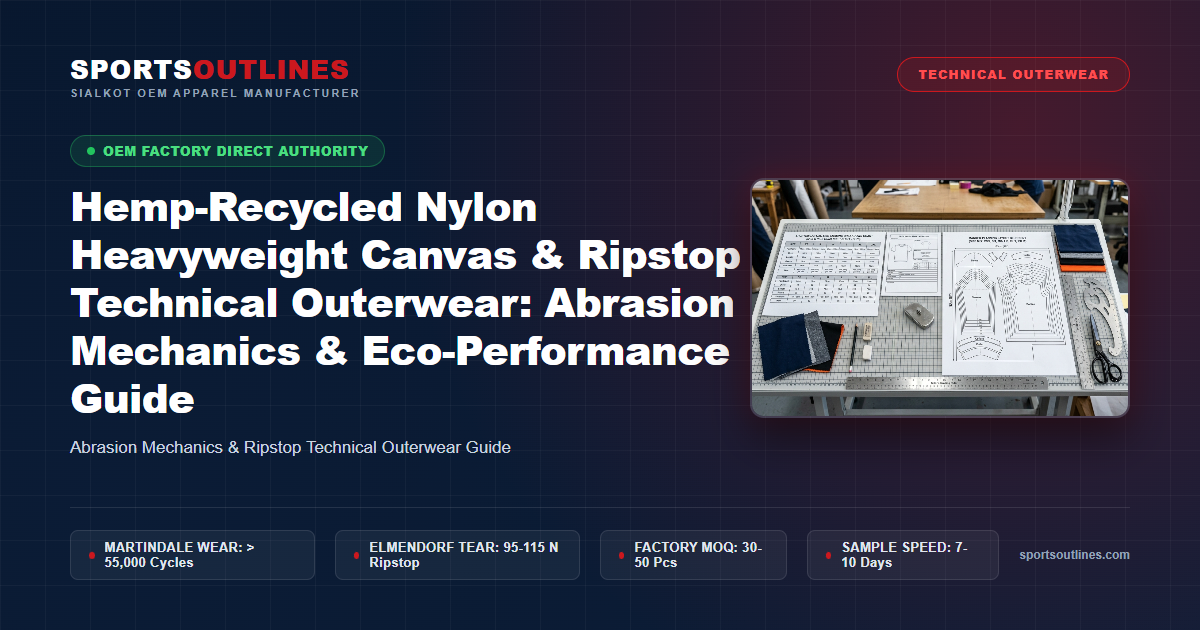
- Martindale Multi-Directional Abrasion Testing (ISO 12947-2): The Martindale tester rubs the fabric specimen against a standard worsted wool abradant under a constant downward pressure of 12 kPa in complex Lissajous patterns. Standard 100% cotton canvas breaks its first yarn threads around 20,000 cycles. Sports Outlines’ 55/45 Hemp-Recycled Nylon canvas easily surpasses 55,000 continuous cycles with zero thread breakage and minimal surface fuzzing.
- Taber Rotary Abrasive Wheel Testing (ASTM D3884): To simulate harsh rock scratching, specimens are clamped to a turntable rotating beneath dual abrasive vitrified wheels (CS-10 Calibrase wheels) loaded with 1,000 grams of dead weight. Our hybrid hemp-nylon fabric sustains over 2,500 revolutions before coating rupture or weave exposure, compared to fewer than 800 revolutions for conventional poly-cotton twill.
- The Self-Polishing Bast Phenomenon: While synthetic polyester pills into unsightly balls under surface friction, hemp fibers exhibit a unique tribological property: abrasive wear naturally shears off loose surface fibrils without forming pills, creating a smooth, supple, weathered patina that actually improves the fabric’s tactile hand over years of field use without sacrificing core structural tensile strength.
4. Weave Architecture: Heavyweight Plain Canvas (280–380 GSM) vs. Cross-Hatch Ripstop (180–240 GSM)
Depending on the targeted end-use (heavy-duty alpine workwear vs. agile trail running shells), Sports Outlines weaves hemp-recycled nylon into two distinct high-performance architectures:
- Heavyweight Plain Weave Canvas (280 to 380 GSM): Woven with 1-up, 1-down plain weave geometry using coarse two-ply ring-spun hybrid yarns (e.g., 10/2s or 12/2s Ne). The tight thread density (warp count 48 ends/inch, weft count 38 picks/inch) creates an impenetrable barrier against wind and thorny underbrush. This heavy canvas holds substantial architectural structure, making it the premier choice for alpine expedition parkas, trail work jackets, and technical outdoor coach jackets.
- Cross-Hatch Grid Technical Ripstop (180 to 240 GSM): For lightweight trail anoraks and fast-and-light mountaineering windshells, plain weave is too heavy. We engineer a technical ripstop woven on computerized air-jet looms. The ground fabric consists of lightweight 24/1s hybrid yarns, into which a thick reinforcement grid of 210D or 420D high-tenacity continuous filament recycled nylon cord is interwoven at 5.0 mm × 5.0 mm cross-hatch intervals.
- Tear-Stop Propagation Physics: When a sharp rock or barbed wire punctures the garment during a mountain trek, the tear propagates through the lightweight ground weave until it strikes the heavy nylon ripstop grid line. The concentrated ripstop cords distribute the shear stress across adjacent cross-threads, arresting the tear immediately and preventing catastrophic blowout in remote wilderness environments. On the Elmendorf pendulum tester (ASTM D1424), our ripstop records a certified tear strength exceeding 95 to 115 Newtons.
| Weave Structure | Weight Tier | Yarn Count & Reinforcement | Elmendorf Tear (ASTM D1424) | Primary Garment Application |
|---|---|---|---|---|
| Technical 5mm Ripstop | 190 – 210 GSM | 24/1s Hybrid + 210D rNylon Grid | 98 N (High Arrest) | Packable Trail Anoraks & Alpine Shells |
| Heavyweight Field Canvas | 320 – 350 GSM | 10/2s Two-Ply Ring-Spun Hybrid | 112 N | Trekking Parkas & Heavy Workwear Jackets |
| Midweight Outdoor Twill | 260 – 280 GSM | 16/1s 2/1 Right-Hand Twill | 85 N | Coach Jackets & Sideline Windbreakers |
| Ballistic Canvas Reinforcement | 380 – 400 GSM | 8/2s Hybrid + 420D rNylon Interlace | 135 N (Maximum) | Shoulder/Elbow Abrasion Patches |
5. Weatherproofing & Eco-Chemistry: Plant-Based C0 DWR & 15K/15K Bio-Membranes
Creating technical waterproof outerwear without toxic fluorinated chemistries (PFAS / “forever chemicals”) is now a non-negotiable compliance requirement across the European Union, the United States, and Japan. At Sports Outlines, our laminations achieve high waterproofness while upholding strict environmental stewardship:
- Bio-Based C0 Durable Water Repellent (DWR) Finishing: We treat the exterior face of our hemp-nylon fabrics with non-fluorinated, plant-based C0 DWR finishes (derived from natural waxes and modified bio-polyurethanes). This finish lowers the surface energy of the woven fibers, forcing water droplets to bead up into tight spherical contact angles (>110 degrees). On the AATCC 22 spray rating test, our C0 DWR achieves a 100 spray rating initial (zero surface wetting) and retains a Grade 90 rating even after 20 commercial laundering cycles.
- 2.5-Layer & 3-Layer Bio-TPU / Recycled Membrane Lamination: For true torrential storm defense, we bond the reverse face of the fabric to an ultra-thin hydrophilic bio-based Thermoplastic Polyurethane (TPU) membrane (formulated with 30% castor bean plant oil). The monolithic membrane blocks driving rain up to a hydrostatic head of 15,000 to 20,000 mm (ISO 811), while its solid-state molecular structure absorbs water vapor molecules and transports them outwards, delivering a breathability rating of 15,000 g/m²/24h (JIS L 1099 B1) and a water vapor resistance (Ret < 7.5 m²·Pa/W).
- Breathable Charcoal 2.5-Layer Print: Rather than lining the jacket with heavy mesh or tricot, our 2.5-layer models feature a microscopic protective grid printed directly onto the inner face of the membrane using activated bamboo charcoal. This print shields the membrane from skin oils while absorbing residual body odors.
Direct Manufacturer Sourcing Answer: Hemp-Nylon Outerwear Manufacturing
Sports Outlines weaves and manufactures custom technical outerwear using GRS-certified recycled nylon and industrial hemp. We produce alpine trekking anoraks, coach jackets, and trail parkas with plant-based C0 DWR, 15K/15K waterproof bio-membranes, Bemis fully taped seams, and YKK Aquaguard® zippers.
- Low Production MOQ: Strictly 30 to 50 pieces per style/colorway across sizes XS to 3XL.
- Physical Prototype Sampling: Dispatched in 7 to 10 business days ($45 to $85 per piece, non-refundable).
- Direct Sourcing Contact: WhatsApp factory management directly at +92 316 7932595 or submit your tech pack via our Contact Portal.
6. Hydrostatic Head & Breathability Testing Protocols: Suter, Bundesmann & Hohenstein Skin Model
To validate outdoor shell performance prior to mass garment cutting, Sports Outlines executes rigorous physical textile characterization according to international standardized outdoor testing protocols:
- Suter Hydrostatic Head Water Pressure Test (AATCC 127 / ISO 811): Fabric samples are clamped into a pneumatic chamber where deionized water pressure increases at a calibrated rate of 60 mbar per minute. The test records the exact pressure (measured in millimeters of water column height) at which three distinct water droplets penetrate the fabric surface. Our 3-layer laminated hemp-nylon fabrics reliably withstand between 18,500 and 21,000 mm H2O, qualifying them for severe alpine blizzard conditions.
- Bundesmann Dynamic Rain Shower Test (ISO 9865): Unlike static hydrostatic tests, the Bundesmann apparatus simulates a violent downpour (100 liters of water per square meter per hour) combined with mechanical wipers rubbing the underside of the fabric under tension. This simulates an athlete hiking through a torrential downpour with backpack straps shifting against their shoulders. Our C0 DWR finish demonstrates an initial water absorption of less than 1.5 grams per square meter, with zero water transmission to the garment interior over a 10-minute continuous deluge.
- Hohenstein Sweating Guarded Hotplate (ISO 11092 / ASTM F1868): Often called the “skin model,” this instrument measures the thermal resistance ($R_{ct}$) and water vapor resistance ($R_{et}$) of the laminated textile. A lower $R_{et}$ value signifies superior breathability. Our 2.5-layer hemp-recycled nylon ripstop achieves an $R_{et}$ of 5.8 to 6.9 m²·Pa/W, categorizing it as “extremely breathable” and comfortable for high-exertion mountaineering and fast-packing.
7. Natural Field Durability: Permanent UPF 50+ Solar Defense & Mildew Immunity
In harsh outdoor field conditions, environmental factors like ultraviolet solar radiation and ambient moisture can rapidly degrade synthetic jackets. Industrial hemp provides natural biological defense mechanisms that synthetic polymers lack:
- Natural Solar UV Defense via Aromatic Lignin (UPF 50+): Conventional lightweight synthetic jackets require chemical UV absorbers to block sunburn rays. Industrial hemp fibers naturally retain 3.0% to 4.5% botanical lignin. Lignin is a complex aromatic polymer rich in conjugated phenolic benzene rings that absorb intensely in the 290 to 400 nm solar ultraviolet spectrum. On spectrophotometer testing (AS/NZS 4399), our hemp-nylon fabrics achieve a certified UPF 50+ rating (blocking >98.2% of UVA/UVB radiation) that never washes out over the lifetime of the jacket.
- Mildew & Fungal Rot Resistance: When outdoor explorers pack a wet synthetic jacket into a backpack for multiple days, mold, mildew, and rotting bacteria flourish rapidly in the warm, enclosed environment. Hemp bast fibers contain natural phytochemical compounds (terpenes, cannabinoids, and phenolic acids) that act as natural fungicides, inhibiting microbial and mildew growth (ASTM G21 zero fungal growth rating).
8. Technical Garment Construction: Seam Taping, Hardware & Bar-Tack Architecture
A technical outerwear fabric is only as waterproof as its assembly seams. Even the finest 20,000 mm membrane will leak if sewing needle penetrations are not hermetically sealed:
- Bemis 3-Layer Hot-Air Seam Taping: All structural seams (shoulders, hood, armholes, side seams) are sealed using computerized hot-air seam sealing machines (Ardmel / PFAFF). We apply Bemis 20 mm 3-layer polyurethane heat-seal tape at 380°C with 4.5 bar pneumatic roller pressure. The heat melts the tape’s adhesive layer, vulcanizing it into the textile pores to form a 100% waterproof seal that withstands over 15,000 mm hydrostatic pressure at the seam junction.
- Waterproof YKK Aquaguard® Hardware: We install genuine YKK #5 Aquaguard® water-repellent reverse-coil zippers with polyurethane laminated tape on front center plackets and chest utility pockets. Zipper garages cut from bonded hypalon or laser-cut hemp canvas house the zipper puller, preventing wind-driven water ingress at the collar junction.
- High-Tensile Bar-Tack Reinforcement: Pocket welt corners, hood drawcord exits, and shoulder strap contact zones are reinforced with 42-stitch automated CNC electronic bar-tacks using bonded nylon thread (Gutermann Tera 40). Every reinforced node withstands over 450 Newtons of direct mechanical pull, eliminating seam blowout during mountain climbing maneuvers.
- Articulated Alpine Hood & Cohaesive® Cord Locks: Hoods feature 3-piece ergonomic construction with stiffened laminated visors that maintain shape in 60 km/h summit gales. Dual-axis Cohaesive® embedded cord-lock hardware integrated directly into the fabric allows one-handed hood adjustments with gloved hands.
| Outerwear Silhouette | Fabric Substrate | Lamination & Membrane | Seam & Hardware Spec | Intended Environment |
|---|---|---|---|---|
| Packable Trail Anorak | 200 GSM Hemp-rNylon Ripstop | 2.5L Bio-TPU (15k/15k) Charcoal Print | Fully Taped Bemis Seams / YKK Aquaguard | Alpine Trail Running & Fast-Packing |
| Expedition Mountain Parka | 340 GSM Heavy Canvas | 3L Bio-TPU Membrane + 50D Recycled Tricot | Fully Taped / 42-Stitch Bar-Tacks Throughout | Sub-Zero Mountaineering & Winter Treks |
| Technical Sideline Coach Jacket | 260 GSM Outdoor Twill | Plant-Based C0 DWR + Windproof Backing | Matte Metal Snaps & Drawcord Waist | Outdoor Team Sideline & Urban Athleisure |
| Rugged Alpine Trail Overpant | 280 GSM Hybrid Canvas | 3L Membrane + 420D Ballistic Scuff Patches | Fully Taped / 3/4 Length Water-Resistant Leg Zips | Backcountry Bushwhacking & Ski Touring |
9. Precision Sewing Ergonomics: Needle Geometry, Feed Mechanics & Thread Dynamics
Woven canvas and high-tenacity ripstop containing bast hemp present significant challenges on commercial production lines. The high tensile toughness of hemp fibers and the density of multi-ply canvas can lead to needle deflection, heat friction, and thread breakage if machine parameters are improperly set:
- SAN 6 & MR Titanium Nitride Coated Needles: Standard chrome sewing needles heat up rapidly when piercing 380 GSM dense canvas, exceeding 240°C and melting the adjacent recycled nylon fibers. We utilize Groz-Beckert SAN 6 (Special Application Needle) or MR geometry needles coated with Titanium Nitride (TiN). The reinforced blade geometry prevents needle deflection when penetrating thick 4-ply seam intersections, while the titanium coating reduces frictional needle heat by over 35%.
- Differential Drop & Unison Feed Mechanisms: Heavy woven canvas tends to feed unevenly under standard drop-feed machines, causing puckered seams and misaligned pattern notches. Sports Outlines stitches technical outerwear exclusively on unison-feed (triple feed: needle feed, vibrating presser foot, and feed dog) computerized sewing machines. This ensures absolute synchronization across all fabric plies, producing clean, flat seam lines without structural twisting.
- Bonded Continuous Filament Polyamide Threads: Standard spun polyester threads fray and snap when dragged across the rigid, fibrous edges of cut hemp bast fibers. We specify 100% continuous filament bonded nylon threads (Gutermann Tera 40 or 60). The bonded coating prevents ply untwisting at high sewing speeds (3,000 stitches per minute) and provides exceptional tensile strength (over 38 N per stitch).
10. Low MOQ Sourcing Economics & Physical Prototype Sampling Program
For boutique outdoor labels, indie technical apparel brands, and startup founders, accessing high-performance laminated outerwear textiles is traditionally an insurmountable barrier. Major membrane mills demand minimum orders of 1,500 to 3,000 meters per fabric style, while large outerwear factories require production runs of 1,000+ jackets per SKU. Sports Outlines dismantles these obstacles through our agile manufacturing ecosystem:
- Agile Low Factory Production MOQ: We operate with a true factory production MOQ of strictly 30 to 50 pieces per style/colorway with complete custom sizing distributions (XS to 3XL). By maintaining a continuous stock of laminated eco-hybrid rolls and technical hardware, we enable emerging outdoor brands to launch fully seam-taped technical jacket collections with manageable upfront capital.
- Physical Prototype Sampling Program ($45 to $85 per piece): Outerwear patterns, hood volumes, and membrane breathability cannot be audited via digital 3D renders. Sports Outlines manufactures and dispatches fully finished pre-production physical prototype samples within 7 to 10 business days for $45 to $85 per piece (plus courier transit). This sample allows you to conduct real-world field testing in mountain conditions, auditing water bead-up, seam seal integrity, and pocket ergonomics. In strict accordance with our transparent factory operations and dedicated materials allocation, sample fees are strictly non-refundable and are never credited toward bulk production orders.
- Turnkey Private Label Customization: We handle complete garment detailing: custom reflective 3M transfers, laser-engraved zipper pulls, custom-molded silicone cuffs, branded seam sealing tape, and eco-friendly FSC certified hangtags.
- Global Logistics & Territorial Trade Compliance: We provide comprehensive DDP (Delivered Duty Paid) air freight logistics directly to your fulfillment warehouse across the globe. Explore our territorial sourcing hubs for localized trade details:
USA Sportswear Manufacturer Hub,
UK Activewear Sourcing Hub,
Australia Activewear Hub,
Canada Sportswear Hub, and
Germany Sourcing Hub. - Product Category Hubs: Explore our specialized production lines across Custom Sportswear & Activewear, Fitness & Gym Apparel, and Athletic Casual Wear.
- Inter-Cluster Technical Resource Network: Broaden your textile engineering knowledge across our activewear library: master luxury cotton luster in our Pima vs Supima Cotton Guide, examine thermal base layer dynamics in our Lyocell-Merino Base Layer Guide, and discover 3D microclimate insulation in our Modal & Bamboo Waffle Knit Guide.
Build Your Technical Hemp-Recycled Nylon Outerwear Line
Collaborate directly with Sialkot’s master technical apparel factory. Access high-abrasion hemp-recycled nylon textiles, low 30–50 pcs factory MOQs, and fast 7–10 day physical prototyping.