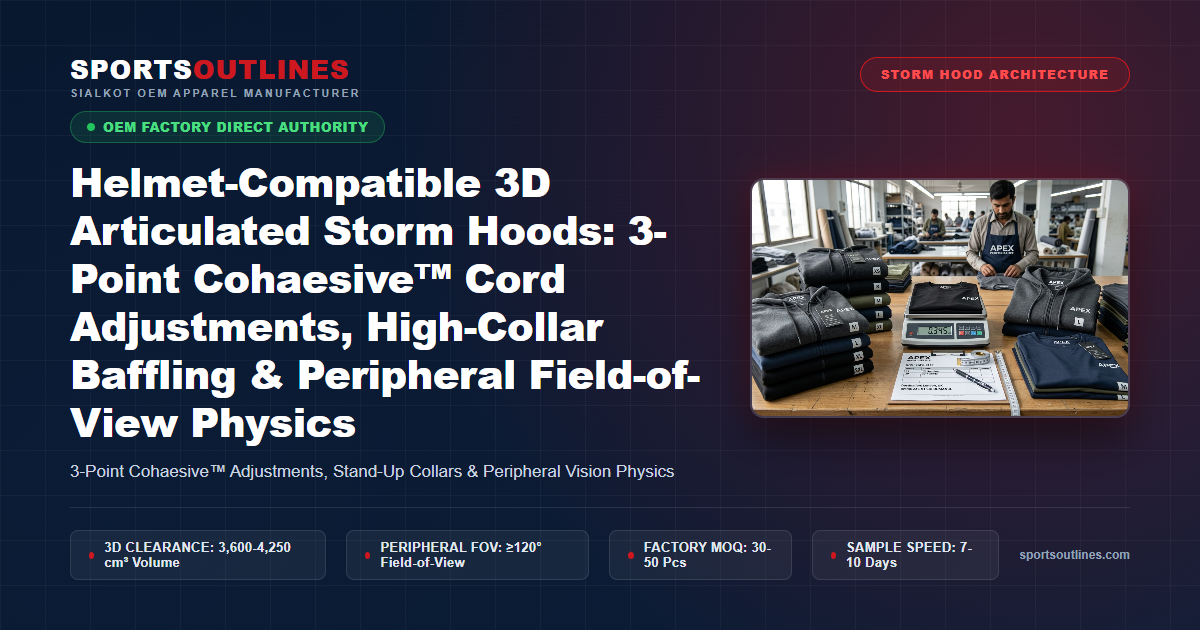
In technical alpine skiing, freeride mountaineering, and glacial ice climbing, the storm hood represents the most complex biomechanical and aerodynamic interface in outerwear design. When high-altitude blizzard winds exceed 80 km/h (22 m/s) and ambient temperatures plummet to $-30^\circ\text{C}$, an improperly engineered hood becomes a severe safety hazard. If too small, it exerts constricting downward leverage on the helmet, choking neck flexion and forcing the front zipper open; if too baggy or lacking internal tensioning, wind gusts fill the hood cavity like a parachute, blinding the skier’s peripheral vision and wrenching the neck backward.
Modern technical outerwear overcomes this aerodynamic and anatomical dilemma through Helmet-Compatible 3D Articulated Storm Hoods. By integrating volumetric sphere clearance ($V \ge 3,500\text{ cm}^3$), 3-point Cohaesive™ embedded cord-lock hardware, independent high-collar draft baffling, and laminated malleable wire visors, high-performance storm hoods provide an airtight seal around certified snowsports helmets while preserving a $\ge 120^\circ$ unobstructed peripheral field-of-view.
At Sports Outlines in Sialkot, Pakistan, our specialized outerwear engineering lines develop competition-grade alpine storm hoods, expedition parkas, and technical ski shells. We partner with performance apparel brands through accessible B2B parameters: custom physical prototype sampling at $45 to $85 per piece (non-refundable, 7–10 business days turnaround) and scalable factory production starting at strictly 30 to 50 pieces per style/colorway with complete size grading from XS to 3XL.
Helmet-Compatible Storm Hood Engineering: Technical Directory
- 1. Volumetric Clearance: Helmet Dimensions vs Kinematic Neck Flexion
- 2. Peripheral Field-of-View Physics: The 120° Optical Cone
- 3. 3-Point Cohaesive™ Hardware Integration & Lamination
- 4. Independent High-Collar Baffling & Facial Chimney Seals
- 5. Laminated Brim Stiffeners & Malleable Visor Wire Metallurgy
- 6. Crown Apex Pattern Geometry & 3D Compound Curve Seam Taping
- 7. Aerodynamic Wind Tunnel Validation & Spindrift Deflection
- 8. Technical Storm Hood Architecture Comparison Matrix
- 9. Quality Assurance: Cord Retraction, Burst Hold & Flutter QC
- 10. Manufacturing SAM Allocation & Assembly Balancing
- 11. Sialkot Manufacturing Infrastructure & Commercial Terms
- 12. Technical Storm Hood Engineering FAQ
1. Volumetric Clearance: Helmet Dimensions vs Kinematic Neck Flexion
The primary engineering constraint in alpine storm hood drafting is accommodating modern certified snowsports helmets (compliant with ASTM F2040, EN 1077 Class A/B, and Snell RS-98 standards). A bare human head has an average adult cranial volume of approximately $1,200\text{ to }1,450\text{ cm}^3$ with an occipitofrontal circumference of 56 to 60 cm. When a certified EPS (expanded polystyrene) foam ski helmet with an injection-molded ABS or polycarbonate hard-shell capping, ear pads, and goggle strap retention clips is donned, the required spherical clearance envelope expands dramatically:
Effective outer circumference expands to 74 to 82 cm, with front-to-back anteroposterior depth reaching 260 to 295 mm and lateral bi-temporal width reaching 220 to 245 mm.
Dynamic Biomechanical Constraints & Lever Torque
Static volumetric clearance alone is insufficient. When an alpine skier navigates steep terrain, the cervical spine undergoes continuous dynamic articulation that exerts extreme kinetic forces against the hood shell:
-
Neck Extension & Flexion ($\Delta \theta_{\text{flex}} \approx 45^\circ\text{ to }60^\circ$): When looking forward while tucked into a downhill racing crouch, neck hyperextension raises the helmet apex and pulls fabric taut along the posterior neck. If the hood back panel lacks sufficient arc length ($L_{\text{arc}} \ge 340\text{ mm}$), vertical tension creates a mechanical downward lever torque:\tau_{\text{neck}} = F_{\text{tension}} \cdot d_{\text{lever}} \sin \phi
This downward moment acts directly against the cervical vertebrae, forcing the chin guard downward into the larynx, choking the airway, and pulling the center-front zipper teeth apart under shear stress.
- Lateral Cervical Rotation ($\Delta \theta_{\text{rot}} \approx 70^\circ\text{ to }80^\circ$): When checking for uphill traffic or scanning backcountry avalanche release zones, lateral head rotation causes the rigid helmet visor and goggle frame to turn inside the hood. If the hood lacks 3-point anatomical tensioning, the helmet turns while the fabric remains stationary, blinding the skier.
- Dual-Use Dynamic Range (Helmet vs Bare Head): A commercial ski shell cannot be drafted solely for helmet wear. When the user removes the helmet for backcountry skinning, the hood must collapse from $4,000\text{ cm}^3$ down to $1,400\text{ cm}^3$ around a bare knit beanie without leaving flapping folds or obscuring peripheral vision.
2. Peripheral Field-of-View Physics: The 120° Optical Cone
Human binocular peripheral vision encompasses an angular arc of approximately $180^\circ\text{ to }200^\circ$ horizontally ($100^\circ$ laterally per eye). Wearing modern oversized toric or spherical ski goggles reduces the functional visual field to approximately $140^\circ\text{ to }160^\circ$ due to frame rim geometry.
When a storm hood is pulled over the helmet, lateral hood side panels must never encroach within the critical optical safety cone. International alpine safety standards mandate a minimum peripheral vision clearance of:
Achieving this optical clearance requires precise geometric drafting of the hood aperture cutback angle. If the cheek aperture profile extends forward of the external orbital margin, the hood fabric occludes peripheral vision during head rotation. Technical patterns deploy an anatomical $18^\circ\text{ to }24^\circ$ backward-swept cheek recess that mirrors the lateral curvature of standard goggle frames, maintaining zero optical obstruction across full rotational sweeps.
Furthermore, when wind stagnation pressure ($P_{\text{stag}} = \frac{1}{2}\rho v^2$) impacts the side of the hood during crosswind gusts, unreinforced cheek panels bulge inward toward the eye. To prevent fabric intrusion into the visual cone, technical patterns integrate 0.8 mm high-recovery TPU stiffener bands laminated along the aperture edge, maintaining structural arch stiffness under $60\text{ km/h}$ lateral winds.
3. 3-Point Cohaesive™ Hardware Integration & Lamination
Traditional outerwear hoods utilize dangling external plastic cord locks (barrel toggles) and exposed bungee cords. In sub-zero gale winds, loose cord ends whip violently against the skier’s face, freeze into rigid ice needles, and catch on tree branches. Furthermore, operating traditional dual-pinch cord toggles while wearing thick expedition down mitts is virtually impossible.
State-of-the-art alpine engineering resolves this through Cohaesive™ Embedded Component Technology.
The 3-Point Cinch Architecture
- Points 1 & 2: Dual Front Aperture Adjusters: Cohaesive™ cord-lock mechanisms are laminated directly into the left and right collar panels beneath the chin. When the internal 2.0 mm Dyneema®/polyester shock cord is pulled downward at the chest, the embedded mechanism grips the cord automatically. To release, the skier simply squeezes the raised tactile button molded directly into the laminated fabric sandwich—enabling instant, one-handed, gloved adjustment.
- Point 3: Rear Crown / Circumference Single-Pull Adjuster: Positioned horizontally across the occipital crown at the back of the head. This single-pull Cohaesive™ or low-profile cam lock controls two dimensions simultaneously: it reduces total hood depth (preventing the visor from sliding forward over the goggles) and cinches circumferential volume (locking the hood side walls firmly against the helmet shell so the hood rotates in lockstep with head movement).
- Ultrasonic Adhesive Lamination Protocol: Cohaesive™ components are constructed from high-impact polyoxymethylene (POM) encapsulated in a thermoplastic polyurethane (TPU) bonding flange. At Sports Outlines, our hot-press tooling applies $155^\circ\text{C}\text{ temperature at }0.45\text{ MPa}$ for 18 seconds, fusing the hardware flange directly between the outer shell laminate and inner reinforcement scrim. The hardware becomes a permanent, monolithic structural element of the garment with zero stitching and zero needle holes.
4. Independent High-Collar Baffling & Facial Chimney Seals
In low-grade ski jackets, the hood is cut as a direct continuation of the collar. Consequently, when the skier unzips the hood or drops it onto the shoulders, the front collar collapses open, exposing the neck and throat to freezing wind and spindrift.
Technical outerwear engineering mandates an Independent Stand-Up Storm Collar with Internal Draft Baffling:
- Decoupled Drop-Hood Architecture: The outer storm hood attaches to the jacket body along the base of the neck, completely outside of an independent 90 mm to 110 mm high stand-up collar. The center-front zipper can be zipped fully up to the bridge of the nose, sealing the throat, chin, and lower face inside an insulated chimney even when the hood is completely retracted.
-
Laser-Cut Exhalation Venting & Antifog Hydrodynamics: Breathing sub-zero air into an unvented collar causes warm, moist exhalation breath ($T \approx +34^\circ\text{C}, \text{RH} \approx 95\%$) to channel directly upward beneath goggle foam. When this moisture vapor contacts cold goggle lens polycarbonates ($T \le 0^\circ\text{C}$), instantaneous condensation occurs:\Delta P_v = P_{\text{sat}}(34^\circ\text{C}) – P_{\text{sat}}(0^\circ\text{C}) \approx 5.32\text{ kPa} – 0.61\text{ kPa} = 4.71\text{ kPa}
This massive vapor pressure differential flash-freezes into crystalline ice, blinding the skier. High collars feature an exhalation panel equipped with laser-cut micro-perforations (1.0 mm diameter, 3 mm hexagonal pitch) backed by hydrophobic stretch mesh. Moisture vapor exhausts forward into the atmosphere rather than rising into the goggles.
- Brushed Microfleece Chin Guard & Rolled Zipper Garage: To prevent facial frostbite, contact cold injury, and beard-hair snagging from freezing metal or plastic sliders, the inside chin contact zone is lined with an ultra-soft 140 GSM warp-knit brushed polyester microfleece with an ultrasonic bonded rolled-edge zipper garage.
- Anatomical Mandibular Relief Darts: When looking downward to adjust ski boot buckles or ski bindings, an unyielding collar digs sharply into the mandible. Our pattern incorporates dual 15° forward-slanted mandibular release gussets that allow natural jaw flexion without compromising collar wind-seal integrity.
5. Laminated Brim Stiffeners & Malleable Visor Wire Metallurgy
The hood visor (brim) must serve as a rigid aerodynamic foil that deflects driving blizzard snow, ice pellets, and dripping meltwater away from the ski goggles. In an 80 km/h wind gust, an unstiffened textile brim flutters uncontrollably, collapses backward over the helmet, or flaps downward into the visual field.
Brim Engineering & Stiffener Technologies
During extreme blizzards, wind forces on the hood visor generate dynamic lift and drag forces ($F_D = \frac{1}{2} \rho v^2 C_D A$). Without structural reinforcement, an unstiffened textile brim collapses under moments exceeding $M = F_D \cdot L_{\text{brim}}$, inverting into the skier’s eyes or fluttering at resonant aeroelastic frequencies:
-
Laminated Thermoplastic Composite Foam: The central core of the brim is laminated with a precision die-cut insert of 1.2 mm to 1.5 mm high-density cross-linked polyethylene (XLPE) or EVA foam (density 120 kg/m³) encased between Bemis Sewfree® 3415 bonding films. This composite laminate provides high flexural rigidity:D = \frac{E h^3}{12(1-\nu^2)} \approx 450\text{ to }650\text{ MPa}\cdot\text{mm}^3
This structural modulus resists aerodynamic flutter under 80 km/h gusts while maintaining sufficient elasticity to absorb crushing impacts during packing without permanent creasing.
- Malleable Core Wire Metallurgy: For extreme mountaineering shells, an encapsulated shaping wire is inserted into the outer leading edge of the visor. We deploy annealed corrosion-resistant aluminum-alloy wire (AWG 16 / 1.3 mm diameter) or shape-memory Nitinol (nickel-titanium) wire. Annealed aluminum exhibits an elongation at break $>25\%$ and can be repeatedly bent into custom parabolic arches without work-hardening fatigue fracture. Nitinol wire provides pseudoelastic superelasticity, snapping back to an engineered aerodynamic arch even after being crushed in a packed rucksack.
- Gutter Drain Hydrodynamic Geometry: The leading edge of the visor features an ultrasonic bonded single-fold hem with an internal 2.0 mm bead that forms an inverted drainage gutter. Melted snow and freezing rain are channeled laterally away to the sides of the hood, preventing water droplets from dripping across goggle lenses.
6. Crown Apex Pattern Geometry & 3D Compound Curve Seam Taping
A planar 2D textile sheet cannot wrap a 3D spherical helmet without puckering or structural tension lines. In differential geometry, a sphere possesses positive Gaussian curvature ($K = \kappa_1 \cdot \kappa_2 = 1/R^2 > 0$), making it mathematically non-developable onto a plane. Technical storm hoods solve this via a 3-piece or 4-piece anatomical pattern comprising a central coronal center panel (running from forehead to nape) joined to left and right lateral cheek panels via compound parabolic arcs.
Compound Curve Seam Sealing & Differential Feed Control
At the crown apex, multiple curved seams converge at non-zero Gaussian curvature. Seam sealing these compound 3D curves is one of the most failure-prone operations in outerwear manufacturing:
-
Post-Bed Differential Drive Hot-Air Taping: Standard flatbed seam tape machines cannot seal spherical hood crowns without wrinkling the tape edge. Sports Outlines deploys vertical post-bed seam sealing machines (Pfaff 8303 / 8320) equipped with narrow 25 mm rollers and computerized differential upper/lower drive feed:\Delta v = \frac{v_{\text{upper}} – v_{\text{lower}}}{v_{\text{lower}}} \times 100\% \approx \pm 1.5\%\text{ to }\pm 2.8\%
This differential feed tensions the inner radius while relaxing the outer curve, applying 20 mm 3-ply waterproof tape with zero edge-fluting or puckering.
- Die-Cut Apex Node Patches: Where the center crown seam intersects radial shaping darts, an abrupt 2.2 mm thickness discontinuity occurs across overlapping seam allowances. A 30 mm circular die-cut 3L waterproof patching disc is laminated over the junction at 165°C, 0.45 MPa, permanently encapsulating the 4-way step-down node against hydrostatic burst ($>35,000\text{ mm } H_2O$).
7. Aerodynamic Wind Tunnel Validation & Spindrift Deflection
During high-speed alpine descents ($v \ge 70\text{ km/h}$), aerodynamic drag and turbulence create high negative pressure eddies behind the skier’s helmet. Aeroacoustic noise generated by vortex shedding obeys Lighthill’s acoustic analogy:
If the hood perimeter fails to conform tightly to the goggle frame, aerodynamic flutter induces high-frequency acoustic buffeting ($>85\text{ dB}$) that deafens the skier and impairs spatial equilibrium.
Our CAD engineering profiles the hood aperture with an integrated elasticized internal gasket (halo cinch). When tensioned via the front Cohaesive™ cords, an internal stretch-mesh band hugs the perimeter of the helmet shell, creating an airtight, snow-proof labyrinth seal that suppresses aerodynamic whistle and completely halts spindrift ingress.
8. Technical Storm Hood Architecture Comparison Matrix
The following comparative matrix details the engineering specifications across storm hood construction tiers manufactured at Sports Outlines:
| Hood Category | Volumetric Clearance | Adjustment Hardware | Visor Reinforcement | Peripheral FOV | Target Alpine Sport |
|---|---|---|---|---|---|
| 1. Standard Resort Integrated | 2,800–3,200 cm³ | Internal Molded POM Barrel Toggles | 1.0 mm EVA Foam Lamination | 110°–115° Arc | On-Piste Ski Shells, Casual Snowboard Parkas |
| 2. Freeride 3D Cohaesive™ | 3,600–4,000 cm³ | 3-Point Embedded Cohaesive™ Components | 1.5 mm XLPE Composite + Gutter Bead | $\ge 125^\circ$ Arc | Big-Mountain Freeride, Steep Backcountry Touring |
| 3. Alpine Drop-Hood Expedition | 3,800–4,200 cm³ | 3-Point Cohaesive™ + Rear Cam Lock | Malleable Annealed Aluminum Core Wire | $\ge 130^\circ$ Arc | Himalayan Mountaineering, Glacial Ice Climbing |
| 4. Ultralight Ski-Alpinism (Skimo) | 3,200–3,500 cm³ | Elasticized Halo Cinch + Single Rear Cohaesive™ | Bonded Micro-Brim with TPU Ribbing | $\ge 120^\circ$ Arc | Skimo Racing, Fast-and-Light Alpine Traverses |
9. Quality Assurance: Cord Retraction, Burst Hold & Flutter QC
Quality control for technical storm hoods operates under ISO 17025 laboratory standards at Sports Outlines:
- Cohaesive™ Lock Holding Force (ASTM D4846 Modified): Evaluates the slip resistance of the shock cord inside the embedded Cohaesive™ hardware. Must hold a tensile pull of $\ge 45\text{ N}$ before cord slippage occurs. Release button actuation force is verified between $12.0\text{ to }18.0\text{ N}$ across $-30^\circ\text{C}$ to $+20^\circ\text{C}$.
- High-Velocity Visor Flutter Testing: Hood assemblies mounted on certified crash test headforms inside a wind tunnel are subjected to air velocity of $80\text{ km/h}$ for 30 minutes. Dynamic video analysis verifies brim deflection stays under $\pm 5\text{ mm}$ with zero structural inversion.
- Suter Head Seam Integrity Audit (ISO 811): The 3D curved crown apex seams and Cohaesive™ lamination perimeters are tested under hydrostatic pressure of $>20,000\text{ mm } H_2O$ for 2 minutes. Zero leakage or water weeping permitted.
10. Manufacturing SAM Allocation & Assembly Balancing
Building a 3D articulated helmet-compatible storm hood with embedded Cohaesive™ hardware adds 22.0 to 28.5 Standard Allowed Minutes (SAM) to technical jacket manufacturing. In modular lean assembly lines, the hood sub-assembly is built offline in a specialized cellular unit to prevent bottlenecking the main garment flow line:
-
Sub-Assembly Breakdown (25.0 SAM Average):
- Operation 1: Automated CNC laser cutting of curved 3L hood panels, visor foam cores, and internal reinforcement tabs (2.0 SAM).
- Operation 2: Pre-lamination of XLPE composite visor foam and annealed aluminum shaping wire on a pneumatic flatbed heat press (3.5 SAM).
- Operation 3: Precision positioning and thermal lamination of three embedded Cohaesive™ hardware units with chill platen quenching (5.2 SAM).
- Operation 4: 3-piece anatomical crown assembly stitching using synchronous needle-feed machines with differential bottom feed (4.5 SAM).
- Operation 5: 3D vertical post-bed hot-air seam sealing and die-cut crown apex node patch lamination (5.8 SAM).
- Operation 6: High collar exhalation panel laser micro-perforation, chin microfleece lining, and zipper garage installation (4.0 SAM).
- Dimensional Production Tolerances: Finished hood volumetric depth must match tech pack specs within $\pm 4\text{ mm}$. Aperture circumference tolerance is strictly $\pm 5\text{ mm}$. Visor wire positioning symmetry deviation across the sagittal centerline must be $\le 1.5\text{ mm}$.
- Hourly Suter Leak QA Sampling: Under ISO 9001 and AQL 1.0 inspection protocols, every production shift pulls 1 out of every 15 assembled hoods directly from the line for immediate hydrostatic Suter testing at 2.0 bar pressure. Any microscopic pinhole leak triggers an immediate calibration audit of nozzle temperature and roller pneumatic pressures.
11. Sialkot Manufacturing Infrastructure & Commercial Terms
Based in Sialkot, Pakistan, Sports Outlines operates specialized manufacturing lines dedicated to advanced technical outerwear, waterproof alpine shells, and extreme-weather apparel. We maintain certified post-bed seam taping machines, ultrasonic welders, Cohaesive™ lamination tooling, and precision laser cutting beds.
Direct B2B Manufacturing Partnership Parameters:
- Physical Prototype Sampling: Complete physical technical jacket prototyping at $45 to $85 per piece (non-refundable) with expedited 7–10 business days turnaround. Includes CAD 3D hood patterning, embedded hardware lamination, and full seam sealing.
- Low Factory MOQ: Bulk production orders starting at strictly 30 to 50 pieces per style/colorway across full size runs from XS to 3XL, eliminating the prohibitive multi-hundred unit minimums of traditional overseas factories.
- Full Technical Customization: Custom branding, OEKO-TEX® / bluesign® membrane sourcing, Cohaesive™ integration, and custom colorway blocking.
- Global Air Logistics: Factory-direct customs export clearance with DHL/FedEx courier delivery to the USA, UK, Canada, Australia, and Europe.
12. Technical Storm Hood Engineering FAQ
Q1: What is the main advantage of Cohaesive™ cord locks over standard external toggles?
Cohaesive™ technology embeds the cord-lock mechanism directly into the fabric plies via thermal lamination. It eliminates loose dangling cords and bulky plastic toggles that freeze, flap painfully in gale winds, or snag on equipment. Furthermore, Cohaesive™ hardware allows intuitive one-handed adjustment with heavy winter gloves by simply squeezing the embedded tactile button.
Q2: How does a hood achieve helmet compatibility without being oversized when worn without a helmet?
Through a 3-point cinch system and anatomical 3-piece patterning. The rear crown single-pull cord simultaneously pulls the hood volume forward and compresses the lateral cheeks. When a helmet is removed, cinching this rear cord collapses the 4,000 cm³ cavity down to 1,400 cm³, locking the fabric securely against a bare beanie and preserving peripheral vision.
Q3: What causes peripheral vision loss in ski jacket hoods, and how is it resolved?
Peripheral vision loss occurs when the cheek aperture is cut straight or when the hood fabric does not rotate with the head. If the user turns their head and the hood stays still, the eye looks directly into the inner hood wall. We draft an 18°–24° backward-swept cheek recess and use occipital crown tensioners that lock the hood against the helmet shell so the hood rotates in perfect synchronization with head movement.
Q4: Why is an independent high collar preferred over an integrated hood collar?
An integrated collar forces the front zipper down when the hood is dropped, exposing the throat to freezing weather. An independent stand-up collar allows the skier to keep the jacket zipped tightly over the chin and nose while dropping the hood onto the shoulders during high-exertion ascents or warm spring ski conditions.
Q5: What are your prototype sampling fees and MOQ for technical ski jackets?
Sports Outlines offers physical prototype development at $45 to $85 per piece (non-refundable) with an expedited 7–10 business days turnaround. Our low factory MOQ is strictly 30 to 50 pieces per style/colorway across full size runs (XS to 3XL), providing technical brands with premium small-batch manufacturing.
Engineer High-Performance Alpine Storm Hoods with Sports Outlines
From 3-point embedded Cohaesive™ cord locks and laminated wire visors to post-bed seam-sealed 3D crowns, partner with Sialkot’s leading technical outerwear manufacturer. Launch your collection with transparent $45–$85 sampling and 30–50 piece MOQs.
Explore Our Global Technical Sourcing Hubs:
USA Skiwear Manufacturing |
UK Alpine Shell Production |
Canada Mountaineering Apparel |
Germany Ski Apparel Manufacturing |
Australia Snowwear Sourcing
Related Technical Outerwear Engineering Guides:
Avalanche Safety RECCO® Integration (#337) |
Integrated Powder Skirt Engineering (#336) |
Sports Outlines Technical Jackets Catalog