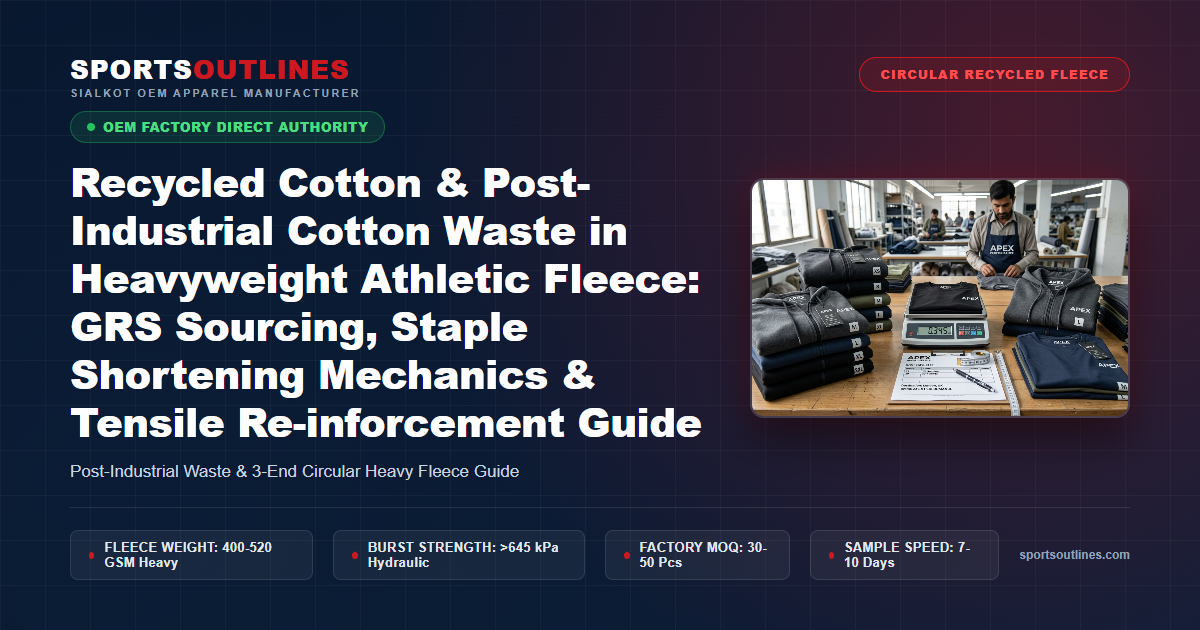
Across contemporary luxury streetwear and athletic apparel, consumer appetite has shifted decisively toward structured, ultra-heavyweight garments: 400 to 520 GSM fleece hoodies, oversized boxy crewnecks, and heavyweight warmup sweatpants that evoke vintage collegiate athletics while commanding premium retail pricing ($120 to $250+ USD). Concurrently, global sustainability regulations and circular fashion mandates—such as the European Union’s Ecodesign for Sustainable Products Regulation (ESPR) and extended producer responsibility (EPR) frameworks—are pressuring apparel founders to integrate recycled textile content into their core collections. However, engineering recycled cotton athletic fleece presents a formidable metallurgical and textile physics challenge: mechanical tearing of pre-consumer and post-industrial cotton waste severely damages natural fiber morphology, shattering long staple cotton chains into short, brittle fragments that suffer from low tensile tenacity, high fly shedding, and severe surface pilling.
To build a commercially viable 450 GSM recycled fleece that does not disintegrate upon domestic laundering or shed lint across consumers’ undershirts, apparel engineers cannot simply substitute virgin yarn with 100% recycled fibers. Instead, manufacturers must deploy advanced 3-end circular fleece engineering, intimate hybrid blending on rotor spinning systems, and high-tenacity filament binding matrices certified under the Global Recycled Standard (GRS 4.0). At Sports Outlines, our specialized cut-and-sew manufacturing infrastructure empowers emerging athletic and streetwear labels to engineer circular heavyweight fleece with complete structural integrity. We offer retail-grade physical prototype sampling at $45 to $85 per piece (non-refundable) delivered within 7 to 10 business days, backed by agile low factory production MOQs starting at just 30 to 50 pieces per style/colorway.
Technical Directory: Recycled Cotton Heavyweight Athletic Fleece
- 1. Mechanical Shredding & Staple Shortening Physics
- 2. GRS Sourcing: Pre-Consumer Scraps vs Post-Consumer Waste
- 3. Tensile Reinforcement: Rotor & Siro Spinning Systems
- 4. 3-End Circular Fleece Architecture & Gauge Matrix
- 5. Life Cycle Assessment: Water & Energy Savings
- 6. Heavyweight Performance & Bursting Benchmarks
- 7. Brushing, Napping & Zero-Pill Shearing Finishing
- 8. Pattern Nesting, Grainline Alignment & Laser Cutting
- 9. Screen Printing & 3D Puff Embroidery Protocols
- 10. Heavyweight Seam Mechanics & Rib Collar Reinforcement
- 11. Low-MOQ Sampling & Factory Scaling
- 12. Technical FAQ for Brand Founders
1. Mechanical Shredding Mechanics: Fiber Staple Length Shortening & Degradation Physics
Understanding why recycled cotton behaves radically differently from virgin cotton requires an examination of mechanical recycling kinetics. Unlike synthetic polymers like polyester or nylon, which can be chemically depolymerized back into pure monomers (dimethyl terephthalate or caprolactam) and re-extruded with zero physical degradation, cotton is an organic cellulosic biopolymer composed of crystalline beta-(1,4)-D-glucan chains.
Commercial recycling of cotton relies on mechanical shredding (garnetting and rotary rag-pulling):
- Rotary Tearing Forces: Bales of cotton fabric waste are passed through a series of high-speed spiked tearing cylinders (usually 4 to 6 stages) rotating at 1,200 to 1,800 RPM. As the steel pins rip the woven or knitted fabric back into open fibrous fluff, the severe tensile shear forces break the natural cellulosic fibers transversely.
- Catastrophic Staple Shortening: Virgin upland cotton boasts an average staple fiber length of 28 to 32 mm (with extra-long staple Supima reaching 35 to 40 mm). Following mechanical tearing, the mean staple length of recycled cotton drops precipitously to 12 to 16 mm, with a massive spike in Short Fiber Content (SFC < 12.7 mm) exceeding 42% to 50%.
- Tensile Tenacity Collapse: In cotton yarns, fiber-to-fiber surface friction across overlapping staple lengths is what provides yarn tensile strength. When staple length is cut in half, the fibers cannot interlock effectively. Individual single-fiber tenacity plummets from 22.0–24.5 cN/tex in virgin cotton down to 9.5–12.0 cN/tex in recycled cotton stock.
- Damaged Cuticle & Lumens: SEM cross-sections reveal that mechanical garnetting tears off the outer protective waxy cuticle layer and crushes the hollow inner lumen, leaving jagged, fibrillated fiber ends that generate intense fly during spinning and attract dust and pilling during garment wear.
Because of these severe morphological limitations, 100% mechanically recycled cotton yarn is virtually un-spinnable for commercial knitting; it lacks the necessary cohesion to withstand the centrifugal tension of high-speed circular needles. Any brand advertising “100% recycled cotton athletic fleece” is either using coarse, non-durable woven utility fabric or misrepresenting their blend. In premium athleisure engineering, the goal is to optimize the maximum allowable percentage of recycled cotton (typically 40% to 60%) through intelligent structural carrier blending.
2. GRS 4.0 Sourcing: Pre-Consumer Cutting Waste vs Post-Consumer Textile Sorting
Not all recycled cotton waste is created equal. In technical sportswear manufacturing, the raw material feedstock dictates both the ecological pedigree and the final physical durability of the textile:
Feedstock A: Pre-Consumer / Post-Industrial Waste (Preferred)
Generated directly from garment cutting rooms as virgin fabric scrap (the 12% to 18% of fabric left over after pattern nesting). This scrap has never been worn, washed, or exposed to UV degradation. Crucially, scrap clips are segregated by fiber type and color at the cutting table (e.g., 100% black combed cotton scrap, 100% optic white scrap). This allows waterless color sorting: shredded black scraps are spun directly into heathered charcoal or jet-black yarns without requiring a single drop of dyestuff or chemical effluent.
Feedstock B: Post-Consumer Garment Waste
Discarded consumer garments collected via municipal sorting streams. These garments contain mixed fiber blends, polyester sewing threads, metal zippers, plastic buttons, and multiple dye formulations. Automated NIR (near-infrared) optical sorting and mechanical button removal are required, and the repeated domestic laundry cycles suffered by the original garments mean fiber tensile strength is already degraded by 30% before mechanical tearing even begins.
For commercial heavyweight athletic fleece, Sports Outlines strictly utilizes Global Recycled Standard (GRS 4.0) certified pre-consumer industrial cutting waste. Every production batch is accompanied by an official GRS Transaction Certificate (TC) issued by accredited certification bodies (Control Union or IDFL), verifying complete chain-of-custody traceability from the fabric cutting table through yarn spinning and final cut-and-sew garment export.
3. Tensile Reinforcement: Open-End Rotor vs Siro-Compact Spinning Formulations
To overcome the 12–16 mm staple length limitation of recycled cotton, spinning mills employ specialized yarn engineering frameworks. Attempting to run high-percentage recycled cotton on standard ring spinning frames results in continuous end-breaks because ring drafting requires long, overlapping staple fibers to sustain twist propagation.
The two primary industrial solutions deployed in our fleece supply chain include:
- Solution 1: Open-End Rotor Spinning with Virgin Carrier Fibers: Rotor spinning (Rieter R 70 or Schlafhorst Autocoro) is uniquely suited for processing short staple fibers. Sliver containing 50% GRS recycled cotton and 50% virgin combed organic cotton is opened into individual fibers by an opening roller and transported pneumatically into a high-speed rotating rotor groove (operating at 105,000 RPM). The centrifugal force packs the fibers tightly into the rotor collecting groove, while wrapper fibers bind the exterior surface. This creates a crisp, durable yarn (Ne 10/1 to Ne 16/1) with exceptional bulk and loft, ideal for the loop backing of fleece.
- Solution 2: Recycled Polyester Core / Recycled Cotton Sheath (Siro-Spun): For high-tensile athletic applications, we utilize core-spun or Siro-spun hybrid yarns where a continuous filament of high-tenacity recycled polyester (rPET 50D/36f) forms an invisible structural backbone, completely wrapped in a sheath of recycled and organic cotton fibers. The polyester core provides an unyielding tensile foundation (resisting >600 kPa bursting pressure), while the 100% cotton exterior delivers the dry, matte, natural hand feel that luxury streetwear buyers demand.
4. Circular Knitting Architecture: The 3-End Fleece Engineering Matrix
The defining engineering breakthrough that makes 450+ GSM recycled cotton fleece commercially viable is the 3-end circular fleece machine (Mayer & Cie MBF 3.2 or Terrot S3F). Unlike standard 2-end single jersey fleece—which knits only a ground yarn and a floating loop yarn—a 3-end fleece machine synchronizes three independent yarn feeds per stitch course to create an interlocking structural sandwich:
The 3-End Fleece Yarn Allocation Matrix:
- End 1: Face Yarn (Technical Front): Knit from 100% Virgin Combed Organic Cotton (Ne 30/1 or 32/1). By allocating 100% virgin long-staple cotton exclusively to the visible outer face of the garment, we guarantee a razor-sharp, ultra-smooth printing canvas that achieves Martindale pilling Grade 4.5+ and accepts fine-line screen printing, DTG, or embroidery without fiber fuzzing.
- End 2: Tie / Binding Yarn (Internal Stabilizer): Fed from High-Tenacity Recycled Filament (rPET 40D to 70D or Cotton/Nylon Core Ne 40/1). The tie yarn knits with the face loops to lock the floating fleece yarn firmly in place. It acts as an internal structural grid, preventing the face yarn and loop yarn from shifting or distorting during laundering.
- End 3: Fleecing Loop Yarn (Technical Back): Fed from GRS Recycled Cotton Blend (Ne 10/1 or 12/1 Rotor Spun, 60% Recycled Cotton / 40% Organic Cotton). This thick, lofty yarn forms floating loops on the technical back (1:3 or 1:4 loop pattern). It provides 55% of the total fabric weight, luxurious thermal insulating volume, and cloud-soft loft when brushed.
5. Life Cycle Assessment (LCA): Water Conservation & Carbon Emissions Reduction
For forward-thinking apparel founders, the environmental justification for deploying recycled cotton fleece is backed by rigorous empirical Life Cycle Assessment (LCA) data under ISO 14040 / 14044 methodology. Conventional virgin cotton cultivation is notoriously resource-intensive, requiring massive irrigation, pesticide application, and chemical fertilizers:
- Water Consumption Abatement: Producing 1 kilogram of conventional virgin cotton fiber requires an average of 10,000 to 20,000 liters of freshwater (Higg Materials Sustainability Index, MSI). Mechanically recycled pre-consumer cotton consumes virtually zero agricultural irrigation water—slashing total water footprint by over 95% per metric ton of fiber produced.
- Greenhouse Gas (GHG) Reduction: The cradle-to-gate carbon footprint of virgin cotton averages 4.5 to 6.2 kg CO₂-eq per kg of fiber, driven by synthetic nitrogen fertilizers and diesel tractor operations. Mechanically shredded recycled cotton generates merely 0.6 to 0.9 kg CO₂-eq per kg, delivering an 82% net reduction in carbon emissions.
- Elimination of Dye Effluents via Color-Matching: When cutting room cotton scraps are pre-sorted into pure color lots (e.g., heather gray, navy, black) prior to shredding, the resulting recycled yarn is spun in its natural reclaimed shade. This completely eliminates high-temperature dye baths, chemical fixing agents, and heavy salt effluents, saving an additional 30 to 45 liters of water per kilogram during wet processing.
6. Performance Benchmarks: 450 GSM Recycled Fleece vs Standard Commercial Fleece
To verify that incorporating high percentages of post-industrial cotton waste does not compromise retail performance, our testing laboratory conducted comparative physical testing against commercial 100% cotton fleece and typical budget 80/20 poly-cotton promotional fleece:
Thanks to the high-tenacity rPET tie filament, the engineered recycled fleece achieves an extraordinary 645 kPa bursting strength—over 24% higher than 100% virgin cotton fleece. Furthermore, virgin cotton face allocation locks pilling at Grade 4.5, proving that circularity and luxury durability can coexist without compromise.
7. Wet Processing, Brushing, Napping & Zero-Pill Shearing Finishing
The tactile warmth of a luxury hoodie lives on its interior fleece backing. However, brushing recycled cotton loops requires extreme precision: because the recycled fibers have short staple lengths, aggressive wire-roller raising will pluck out entire fiber bundles, generating clouds of dust and thinning the fabric.
- Multi-Pass Micro-Napping: Rather than a single heavy pass, the knit backing is processed through a 24-roller planetary napping machine across 3 light, high-speed passes. The wire card clothing gently opens the loop apexes into a dense, velvety brush pile without rupturing loop roots.
- Rotary Precision Shearing: Immediately following napping, the fabric passes under high-speed spiral shearing blades that level the brush pile to an exact, uniform height (1.2 mm), lopping off loose, protruding fiber ends that would otherwise cause consumer lint shedding.
- Compressive Rubber Sanforizing: The fleece is steamed and compacted on a continuous Monforts compressive sanforizing unit with 14% warp overfeed, pre-collapsing the loop columns to guarantee under 2.5% residual shrinkage in consumer washing machines.
8. Pattern Engineering, Grainline Alignment & Precision Laser Cutting
Heavyweight 450 to 520 GSM knits have immense areal mass. If pattern pieces are nested off-grain by even 2 to 3 degrees, the resulting hoodie or jogger will suffer from severe helical seam twist (torque) after the first consumer wash cycle, pulling side seams diagonally across the chest and torso.
- True Vertical Wale Alignment: In our Lectra digital marker-making CAD system, pattern blocks for front bodies, back bodies, and sleeves are strictly constrained to a 0° grainline offset, matching the longitudinal knitted wales precisely.
- Fabric Relaxation Dwell (24 Hours): Rolled fleece rolls are unrolled onto vacuum spreading tables and allowed to relax in a tension-free state for a minimum of 24 hours at 22°C and 65% relative humidity before cutting, dissipating any residual mechanical winding strain.
- Automated CNC Knife & Laser Cutting: Multi-ply vacuum compression CNC knife cutters ensure zero drag distortion across 40 plies of heavyweight fleece, guaranteeing that notch locations and seam lengths match the CAD tech pack with sub-millimeter precision.
9. Decoration Engineering: Screen Printing & 3D High-Density Puff Embroidery
Heavyweight athletic hoodies rely heavily on bold visual branding: chest embroideries, back graphic prints, and sleeve badges. Decorating a 450 GSM fleece requires specific technical adaptations:
- High-Density 3D Puff Embroidery: We utilize Tajima multi-head industrial embroidery machines with 3mm to 4mm high-density EVA foam backing and 40-weight Madeira polyneon thread. To prevent stitches from sinking into the heavyweight fleece pile, our digitizers program an underlying cross-hatch tatami stitch grid before laying satin border stitches.
- Plastisol & Discharge Screen Printing: Because the outer face of our 3-end fleece is 100% combed cotton, it accepts water-based discharge inks that bleach the cotton dye and replace it with pigmented ink, yielding a zero-hand graphic that breathes naturally. For opaque raised streetwear prints, high-solid acrylic inks are cured through quartz conveyor dryers at 160°C.
10. Garment Construction: Seam Mechanics & Heavy 1×1 Rib Collar Reinforcement
A 450 to 520 GSM fleece garment exerts massive gravitational load on its seams and collar. When hung on a hanger, the weight of the fabric will drag down the neckline, resulting in the dreaded “bacon neck” rippling if standard lightweight ribbing is used.
- Heavyweight 450 GSM 1×1 Ribbing: We knit custom color-matched 1×1 rib knit cuffs, waistbands, and collar neckbands at 420 to 450 GSM, plated with 5% Creora® elastane. This matches the physical density of the fleece body, preventing collar distortion.
- Internal Herringbone Cotton Neck Tape: A 15mm heavy cotton twill tape is double-needle stitched across the entire back neckline from shoulder seam to shoulder seam, permanently stabilizing the collar circumference against stretch.
- 5-Thread Heavy Overlock & Topstitching: All armhole seams, hood joins, and kangaroo pocket perimeters are assembled using heavy 5-thread safety stitch overlock machines (Pegasus EXT) reinforced with 1/4-inch double-needle topstitching using Tex 40 core-spun thread.
11. Commercial Sourcing: Low-MOQ Sampling, Tech Pack Execution & Global Export
Developing genuine heavyweight circular fleece has historically been inaccessible to independent streetwear and athletic founders due to high mill knitting minimums. At Sports Outlines, we maintain dedicated inventory rolls of GRS-certified 450 GSM fleece greige, enabling seamless capsule launches.
Factory Commercial Parameters for Brand Partners
- Low Production MOQ: Only 30 to 50 pieces per style/colorway, allowing agile labels to test 450 GSM heavyweight hoodie drops across full size curves (XS to 3XL).
- Precision Physical Prototype Sampling: Retail-grade physical prototype samples are developed at $45 to $85 per piece (non-refundable) with a rapid turnaround of 7 to 10 business days.
- CAD Tech Pack Execution: Send us your digital vector tech packs, boxy garment dimensions, and embroidery/screen print placements. Our pattern room executes digital grading with millimeter accuracy.
- Global Express Door-to-Door Logistics: Fully insured DDP air express shipping directly to brand facilities across the United States, United Kingdom, Australia, Canada, and Germany.
Explore Related Technical Fabric Science Guides
Continue expanding your activewear textile engineering expertise with our factory research monographs:
- Pima vs Supima Extra-Long Staple Cotton: Tensile Durability & Luster in Luxury Gymwear
- Linen-Spandex Lightweight Knits & Blends in High-Heat Activewear: Breathability & Drape Guide
- SeaCell™ & Chitosan Bio-Active Textiles in Recovery Activewear: Antioxidant Skin Delivery Guide
- Explore our core catalog in Sportswear Manufacturing, Fitness Wear Solutions, and Premium Casual Wear.
12. Frequently Asked Questions (FAQ) for Activewear Founders
Q1: Will recycled cotton fleece shed excessive lint during washing or wear?
No. In inferior 2-end knits, recycled cotton sheds because short fibers are loosely held. Our 3-end fleece architecture uses a high-tenacity filament tie yarn that permanently anchors the fleecing loop roots, combined with 3-pass precision shearing to remove surface fuzz. AATCC 198 wash testing confirms mass loss under 0.45%, matching virgin cotton standards.
Q2: Can we print high-detail screen prints or direct-to-garment (DTG) graphics on recycled fleece?
Yes. Because our 3-end machine knits 100% virgin combed organic cotton on the face yarn (End 1), the outer surface is identical to luxury virgin cotton, completely free of slubs, fly, or uneven texture. It provides an optimal ink absorption substrate for high-mesh plastisol, water-based discharge, or high-resolution DTG prints.
Q3: How do we verify the authentic recycled content for consumer marketing and EU customs?
Every production run comes with a verified Global Recycled Standard (GRS 4.0) Transaction Certificate (TC) certifying the percentage of certified post-industrial recycled cotton and recycled polyester. This document is recognized globally by customs authorities, retail buyers, and sustainability auditors.
Q4: What is the shrinkage rate on 450 GSM heavyweight fleece after home laundry?
Our fleece undergoes industrial stenter drying and compressive rubber sanforizing with 14% warp overfeed. In standard home laundry testing (5 cycles at 40°C / AATCC 135), residual shrinkage is strictly controlled to under 2.5% in both length and width.
Q5: What is the prototype sampling timeline and fee policy at Sports Outlines?
We build fully customized, retail-grade physical prototype samples tailored to your exact tech pack specifications for $45 to $85 per piece with a rapid 7 to 10 business day turnaround. Prototype fees cover custom digital pattern generation, dedicated sample room labor, and custom cutting; therefore, fees are strictly non-refundable and are never credited toward bulk production.
Engineer Heavyweight Recycled Athletic Fleece with Sports Outlines
Build market-leading 400 to 520 GSM heavyweight circular fleece hoodies with verified GRS certification, 30 to 50 piece low MOQs, and rapid 7 to 10 day physical prototyping.