In high-aerobic mountain sports—such as backcountry ski touring, alpine trail running, ski mountaineering (skimo), and gravel endurance cycling—athletes face a notorious thermodynamic dilemma termed the “boil-in-a-bag” phenomenon. Traditional waterproof-breathable shells constructed with bicomponent expanded polytetrafluoroethylene (ePTFE) or solid monolithic polyurethanes (PU) excel at blocking static rain columns ($>28,000\text{ mm } \text{H}_2\text{O}$), but their zero-air-permeability architecture relies strictly on passive diffusive moisture vapor transport ($J = -D \frac{dC}{dx}$). During peak uphill exertion, human metabolic heat generation spikes from $100\text{ W}$ at rest to over $1,000\text{ W}$, producing sweat rates exceeding $1,500\text{ to }2,500\text{ g/h}$. Diffusive membranes cannot vent vapor at this rate, forcing humidity inside the microclimate to reach $100\%$, triggering severe inner condensation, fabric saturation, and devastating post-exertion conductive heat loss (flash chilling).
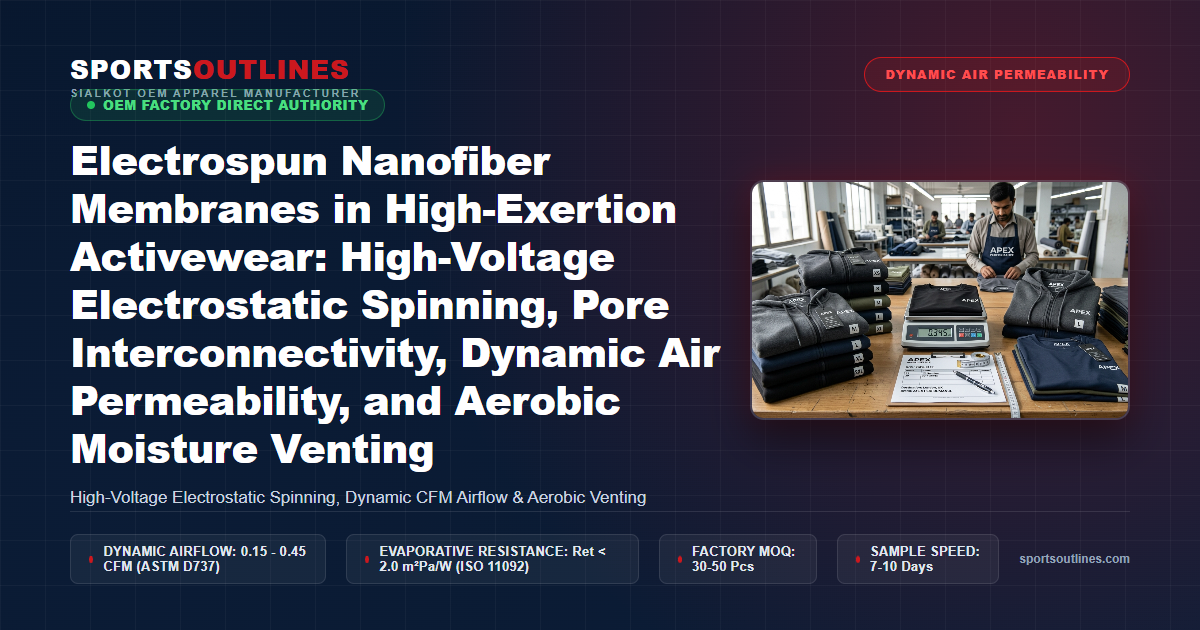
To shatter this physiological barrier, advanced technical apparel engineering has pioneered electrospun nanofiber membranes. Fabricated via high-voltage electrostatic spinning ($15\text{ to }40\text{ kV}$), these membranes consist of a random, non-woven web of continuous polymer filaments with nanoscale diameters ($100\text{ to }300\text{ nm}$). This sub-micron web generates an interconnected three-dimensional pore matrix with exceptional open porosity ($>80\%$) and microscopic pore throats ($0.2\text{ to }0.8\ \mu\text{m}$). Unlike classical membranes, electrospun lattices permit controlled dynamic air permeability ($0.1\text{ to }0.5\text{ CFM}$ / cubic feet per minute per square foot under ASTM D737). This micro-airflow powers continuous convective vapor venting, instantly sweeping sensible heat and perspiration out of the jacket cavity while maintaining stormproof hydrostatic head resistance ($10,000\text{ to }18,000\text{ mm } \text{H}_2\text{O}$). At Sports Outlines, operating our technical outerwear lamination and precision cut-and-sew facility in Sialkot, Pakistan, we provide technical performance brands with turn-key electrospun membrane sourcing, roll-to-roll reactive PUR micro-dot lamination, cleanroom hot-air seam taping, physical prototype sampling at $45 to $85 per piece (non-refundable, 7–10 business days turnaround), and scalable production starting at a low factory minimum order quantity (MOQ) of just 30 to 50 pieces per style/colorway.
Electrospun Nanofiber Membranes: Technical Navigation Directory
- 1. Physics of Electrospinning: Taylor Cone Formation & Whipping Instability
- 2. Polymer Chemistry & Dope Formulation: TPU, PAN & PVDF Systems
- 3. Nanoscale Morphology: Fiber Diameters & 3D Pore Interconnectivity
- 4. Dynamic Air Permeability: CFM Mechanics vs Static Zero-Permeability
- 5. Convective Moisture Transport: Breaking the Fickian Diffusion Bottleneck
- 6. Hydrostatic Head & Water Column Retention: Capillary Laplace Thresholds
- 7. Mechanical Durability & Delamination: Overcoming Nanoweb Fragility
- 8. Technical Benchmark Matrix: Electrospun vs ePTFE vs Solid Monolithic
- 9. 3-Layer Composite Assembly: Low-Viscosity Reactive PUR Micro-Gravure
- 10. Factory Construction: Ultrasonic Welds & Specialized Air-Permeable Seam Tapes
- 11. Target Alpine Disciplines: Backcountry Touring, Skimo, and Trail Running
- 12. Sialkot Technical Outerwear Manufacturing & Suter Testing
- 13. Low-MOQ Sourcing & Commercial Factory Terms
- 14. Technical Sourcing FAQ
1. Physics of Electrospinning: Taylor Cone Formation & Whipping Instability
Electrospinning is an electro-hydrodynamic fabrication technique that harnesses high-voltage electrostatic fields to synthesize non-woven polymeric matrices. Unlike mechanical extrusion or melt-blown spinning—which utilize pneumatic air knives to drag molten polymers into coarse fibers ($1\text{ to }5\ \mu\text{m}$)—electrospinning operates through direct electrostatic charging of a liquid polymer dope:
- Electrostatic Droplet Polarization: The polymer dope is fed through a precision spinneret capillary (or across a free-surface rotating wire/roller) connected to a high-voltage DC power supply ($15\text{ to }40\text{ kV}$). As electric charge accumulates on the droplet surface, mutual electrostatic repulsion competes against the fluid’s surface tension ($\gamma$).
-
Taylor Cone Deformation: When the applied electrostatic potential reaches a critical threshold ($V_c$), the droplet distorts from a spherical meniscus into a conical geometry known as the Taylor cone. At this critical voltage, the electrostatic repulsive force overcomes surface tension:V_c = 4 \left( \frac{H^2}{R^2} \right) \left( \ln\frac{2H}{R} – 1.5 \right) \cdot \left( \frac{\gamma R}{2\varepsilon_0} \right)^{1/2}
where $H$ is the tip-to-collector working distance ($12\text{ to }25\text{ cm}$), $R$ is the capillary radius, and $\varepsilon_0$ is the dielectric permittivity of vacuum.
- Fluid Jet Ejection & Whipping Instability: From the apex of the Taylor cone, a continuous micro-jet of charged polymer fluid accelerates toward a grounded collector drum. Within milliseconds of flight, the straight fluid jet experiences chaotic bending and whipping instabilities driven by electrostatic repulsions along adjacent segments of the charged filament.
- Ultra-Rapid Solvent Evaporation & Attenuation: During this high-velocity lateral whipping motion, the jet stretches dramatically by several orders of magnitude while the volatile carrier solvents evaporate almost instantaneously ($<10\text{ ms}$). By the time the filament impacts the grounded collector roll, its cross-sectional diameter has reduced from $500\ \mu\text{m}$ down to $100\text{ to }300\text{ nm}$, depositing an ultra-fine, continuous non-woven membrane.
2. Polymer Chemistry & Dope Formulation: TPU, PAN & PVDF Systems
The mechanical compliance, hydrolytic resilience, and hydrostatic retention of the resulting nanofiber membrane depend fundamentally on the dope formulation and chemical selection of the base polymer:
- Thermoplastic Polyurethane (TPU) Dopes: The premier choice for activewear outerwear. Polyether-based TPUs dissolved in solvent blends of dimethylformamide (DMF) and tetrahydrofuran (THF) or methyl ethyl ketone (MEK) ($10\%\text{ to }16\%\text{ solids concentration}$ by weight). Polyether soft segments provide exceptional hydrolytic stability (preventing microbial rot from perspiration), while the segmented urethane hard blocks impart high elongation at break ($>400\%$) and tensile resilience, ensuring the membrane can stretch dynamically with ergonomic jacket articulation.
- Polyacrylonitrile (PAN) Systems: Utilized in ultra-rigid, lightweight expedition shells. PAN fibers dissolved in DMF yield ultra-high modulus nanofibers with superior thermal stability ($T_g \approx 85^\circ\text{C}$) and extreme chemical inertness. However, pure PAN possesses lower mechanical flexibility, requiring plasticization or blending with elastomer dopes for garment applications.
- Polyvinylidene Fluoride (PVDF) Membranes: Fluoropolymer-based electrospun webs delivering ultra-high intrinsic hydrophobicity ($\theta > 135^\circ$) and complete chemical inertness without requiring secondary DWR topical finishes. However, PVDF dopes face the same regulatory scrutiny under evolving EU REACH and US PFAS restrictions as ePTFE, accelerating brand migration toward fluorine-free polyether-TPU electrospun formulations.
- Dope Rheology & Conductivity Tuning: To prevent “beading” (electrospraying defect where droplets form along the fiber string), the dope solution must achieve critical chain entanglement ($C > C^*$). We add trace quaternary ammonium salts (e.g., benzyltriethylammonium chloride, $0.1\text{ to }0.5\text{ wt}\%$) to elevate electrical conductivity ($\kappa > 15\ \mu\text{S/cm}$), ensuring smooth, bead-free cylindrical nanofiber morphology.
3. Nanoscale Morphology: Fiber Diameters & 3D Pore Interconnectivity
The functional magic of electrospun membranes lies in their morphological geometry under Field Emission Scanning Electron Microscopy (FE-SEM):
Morphological Architecture: Electrospun Nanoweb vs Expanded PTFE (ePTFE)
While ePTFE consists of a two-dimensional nodal lattice where dense polymer nodes are connected by parallel fibrils, an electrospun nanoweb forms a fully isotropic, three-dimensional porous scaffold:
- Average Fiber Diameter ($d_f$): $120\text{ to }280\text{ nm}$ (roughly $1/500\text{th}$ the thickness of a human hair).
- Areal Weight (Basis Weight): Just $5.0\text{ to }12.0\text{ g/m}^2$, reducing jacket membrane weight by over $60\%$ compared to standard PU films ($25\text{ to }35\text{ g/m}^2$).
- Total Void Fraction (Porosity $\varepsilon$): $80\%\text{ to }88\%$ air by volume, creating thousands of interconnected open airflow channels per cubic micrometer.
- Pore Size Distribution ($r_p$): Tightly unimodal with mean bubble point pore diameter between $0.20\ \mu\text{m}$ and $0.45\ \mu\text{m}$, with a maximum cutoff pore size below $0.80\ \mu\text{m}$ (ASTM F316 capillary flow porometry).
- Specific Surface Area ($S_{BET}$): Extraordinary surface area exceeding $25\text{ to }45\text{ m}^2/\text{g}$, facilitating rapid vapor adsorption and phase desaturation.
4. Dynamic Air Permeability: CFM Mechanics vs Static Zero-Permeability
The fundamental functional differentiator between electrospun outerwear and all legacy membrane categories is dynamic air permeability. In conventional weatherproofing:
- Zero Air Permeability ($0.00\text{ CFM}$): Both solid monolithic polyurethanes and classic bicomponent ePTFE membranes feature zero air permeability ($0.0\text{ mm/s}$ air flow at $125\text{ Pa}$). They are 100% airtight barriers. While airtightness prevents cold wind penetration, it creates a completely stagnant boundary layer against the inner face of the jacket. The only way moisture can escape is through slow, concentration-gradient-driven Fickian diffusion.
- Controlled Dynamic Micro-Airflow ($0.1\text{ to }0.5\text{ CFM}$): Electrospun membranes possess a tortuous open pore network that allows microscopic air movement through the fabric. Under ASTM D737 (measured at a pressure drop of $\Delta P = 125\text{ Pa}$), our 3-layer electrospun laminates deliver air permeability calibrated between $0.15\text{ and }0.45\text{ CFM}$ ($0.75\text{ to }2.25\text{ mm/s}$).
- The Aerodynamic Balance: This calibrated airflow rate is a masterpiece of thermal engineering: it is low enough to prevent wind chill during static pauses ($99.5\%$ of ambient wind is blocked), yet high enough to allow the natural pumping action of an athlete’s body movements to cycle fresh air through the microclimate.
5. Convective Moisture Transport: Breaking the Fickian Diffusion Bottleneck
To comprehend why electrospun jackets feel radically drier during intense physical exercise, consider the fundamental physics of moisture transport:
In a standard solid PU jacket, moisture transport is purely diffusive and governed by Fick’s first law:
Because the diffusion coefficient $D$ in solid polymers is extremely small ($10^{-7}\text{ to }10^{-8}\text{ cm}^2/\text{s}$), a massive vapor concentration gradient ($dC/dx$) must accumulate inside the jacket before moisture starts escaping. In practice, this means the microclimate humidity must spike to $85\%\text{ to }95\%$ relative humidity, causing heavy sweating, garment clamminess, and skin wetting.
In an electrospun nanofiber membrane, total moisture vapor flux ($J_{total}$) combines both diffusive and bulk convective transport:
where $v_{air}$ is the convective air velocity moving through the interconnected pores and $C_{vapor}$ is the moisture vapor concentration in the jacket cavity. Even a micro-air velocity of just $1.0\text{ mm/s}$ increases the effective moisture venting rate by over $300\%$ compared to pure diffusion. Under ISO 11092 Sweating Guarded Hotplate testing, our 3-layer electrospun laminates achieve an astonishing evaporative resistance of $R_{et} < 2.0\text{ m}^2\text{Pa/W}$ (often testing at $R_{et} \approx 1.6\text{ to }1.8\text{ m}^2\text{Pa/W}$), ranking among the most breathable waterproof activewear laminates engineered on Earth.
6. Hydrostatic Head & Water Column Retention: Capillary Laplace Thresholds
If electrospun membranes allow air to pass through, how do they prevent liquid rain from penetrating? The answer lies in the Young-Laplace capillary pressure equation:
In this thermodynamic relationship:
- $\gamma_{water}$ is the surface tension of water ($72.8\text{ mN/m}$ at $20^\circ\text{C}$).
- $\theta$ is the water contact angle on the nanofiber polymer surface ($\theta \approx 110^\circ\text{ to }125^\circ$ for hydrophobic fluorocarbon-free TPU finishes).
- $r_{pore}$ is the effective pore radius ($0.15\text{ to }0.30\ \mu\text{m}$).
Because the pore radius $r_{pore}$ is engineered at the nanoscale ($<300\text{ nm}$), the capillary pressure required to force liquid water into the pore is immense. Under standardized ISO 811 / AATCC 127 hydrostatic head testing, our production 3-layer electrospun technical shells sustain $12,000\text{ to }18,000\text{ mm } \text{H}_2\text{O}$ ($1.2\text{ to }1.8\text{ bar}$) before water breakthrough. In real-world alpine conditions, hurricane-force wind-driven rain exerts dynamic pressures of approximately $3,000\text{ to }5,000\text{ mm } \text{H}_2\text{O}$, while heavy backpack strap compression reaches $10,000\text{ mm}$. The electrospun barrier provides complete stormproof protection while venting body heat with zero condensation buildup.
7. Mechanical Durability & Delamination: Overcoming Nanoweb Fragility
Historically, the greatest technical hurdle hindering the commercial adoption of electrospun membranes was their extreme mechanical fragility. An unbonded nanofiber web has virtually zero tear strength ($\sigma_{tear} < 2\text{ N}$) and will disintegrate under minimal abrasive friction or washing machine agitation.
At Sports Outlines, our materials engineering protocol solves nanofiber fragility through a four-stage reinforcement workflow:
- Inline Ultrasonic Point-Bonding: Immediately following electrospinning deposition on the collector roll, the nanofiber web passes through an inline ultrasonic calendering roller that welds fiber crossover points at micro-junctions ($25\text{ kHz}, 120^\circ\text{C}$). This locks fiber mobility without closing the interconnected pore matrix.
- Non-Woven Scrim Support: The nanofiber web is spun directly onto a lightweight spunbond polyester or polyamide carrier scrim ($8\text{ to }12\text{ g/m}^2$), providing dimensional stability during roll winding and handling.
- Reactive PUR Micro-Dot Lamination: The reinforced web is laminated into a true 3-layer composite between a high-tenacity face fabric and an abrasion-resistant circular knit backer, encasing the delicate nanoweb inside an impenetrable structural sandwich.
- 50-Cycle Wash Validation (ISO 6330): Laminated 3-layer composites are validated through 50 continuous commercial wash-and-dry cycles. Post-wash hydrostatic head must retain $>80\%$ of baseline ($>10,000\text{ mm}$), and ASTM D903 peel strength must exceed $16\text{ N/cm}$ with zero membrane delamination or blistering.
8. Technical Benchmark Matrix: Electrospun vs ePTFE vs Solid Monolithic
The engineering matrix below benchmarks electrospun nanofiber membranes against legacy outerwear membrane architectures:
| Engineering Metric | Electrospun Nanofiber TPU | Bicomponent ePTFE / PU | Solid Monolithic Hydrophilic PU |
|---|---|---|---|
| Microstructure Architecture | 3D Non-Woven Nanofiber Web | Node-and-Fibril Lattice + Solid PU Cap | Dense Solid Polymer Film |
| Air Permeability (ASTM D737) | 0.15 to 0.45 CFM (Dynamic Flow) | 0.00 CFM (Completely Airtight) | 0.00 CFM (Completely Airtight) |
| Evaporative Resistance (ISO 11092 Ret) | Ret < 2.0 (Unrivaled Venting) | Ret 4.5 to 6.0 | Ret 5.0 to 7.5 |
| Hydrostatic Head (ISO 811) | 12,000 to 18,000 mm | >28,000 mm H₂O | 15,000 to 20,000 mm |
| Moisture Transport Mechanism | Bulk Convective + Diffusive | Fickian Solid-State Diffusion | Fickian Solid-State Sorption |
| Internal Humidity Build-Up | Near Zero (Continuous Venting) | Moderate to High (Requires ΔRH) | High (Severe Clamminess) |
| Membrane Areal Weight | 5 to 12 g/m² (Ultra-Light) | 18 to 28 g/m² | 22 to 35 g/m² |
| PFAS Regulatory Compliance | 100% Fluorine-Free (TPU Base) | High Regulatory Risk (Fluorine) | 100% Fluorine-Free |
9. 3-Layer Composite Assembly: Low-Viscosity Reactive PUR Micro-Gravure
Laminating an electrospun nanoweb requires extraordinary precision. If standard hot-melt adhesive roller coaters are utilized, adhesive resin will flood the nanoscale pores, completely clogging the open pore network and converting the breathable nanofiber web into an impermeable, heavy plastic film.
At our Sialkot manufacturing plant, we utilize high-precision micro-gravure dot lamination lines:
- Laser-Engraved Gravure Rollers ($65\text{ to }80\text{ mesh}$): Adhesive dots are applied at microscopic diameters ($180\ \mu\text{m}$ dot pitch) covering strictly $22\%\text{ to }28\%\text{ of total fabric surface area}$. Over $72\%$ of the nanofiber membrane remains completely untouched and open to dynamic airflow.
- Solvent-Free Reactive Polyurethane (PUR) Hot-Melt: We utilize low-viscosity 100% solids PUR adhesives heated to $108^\circ\text{C}\text{ to }115^\circ\text{C}$. The adhesive penetrates only $15\%\text{ to }20\%$ into the thickness of the outer facing yarns, preventing adhesive strike-through.
- Ultralight Shell Substrates: We laminate electrospun nanowebs between ultralight 10D or 20D micro-ripstop recycled nylon face fabrics ($32\text{ to }48\text{ g/m}^2$) and ultra-fine 7D circular-knit polyester tricot backers ($22\text{ g/m}^2$), producing complete 3-layer finished laminates weighing an ultra-featherweight $68\text{ to }85\text{ g/m}^2$ total.
10. Factory Construction: Ultrasonic Welds & Specialized Air-Permeable Seam Tapes
Building garments from electrospun textiles demands specialized factory equipment to maintain garment breathability without compromising seam integrity:
- Narrow-Gauge Seam Taping (13 mm / 0.5 Inch): Standard outerwear factories use bulky 20 mm to 24 mm seam tapes. Heavy tapes create stiff, unbreathable bands across shoulder yokes and chest panels. In our cleanroom taping department, we calibrate computer-controlled hot-air seam sealers ($175^\circ\text{C}, 4.5\text{ m/min}, 2.5\text{ bar}$) with ultra-narrow 13 mm 3-layer micro-tapes, cutting taped surface area by over $40\%$.
- Ultrasonic Panel Pre-Joining: Before stitching, seam edges are welded ultrasonically using rotary sonotrodes ($35\text{ kHz}$). This pre-fuses the nanofiber core to the face fabric, preventing needle punch shearing during structural lockstitching.
- Laser-Cut Pit-Vent Free Construction: Because electrospun jackets vent moisture continuously through their fabric face, designers can frequently eliminate bulky underarm pit-zips, shaving $45\text{ to }60\text{ grams}$ of hardware weight and eliminating chafing under backpack straps.
11. Target Alpine Disciplines: Backcountry Touring, Skimo, and Trail Running
Electrospun activewear fills the crucial performance gap where conventional 3-layer hardshells are too suffocating and windproof softshells lack rain protection:
- Backcountry Ski Touring & Skimo: Athletes skinning uphill for thousands of vertical meters generate massive sweat rates in freezing temperatures. Electrospun shells vent perspiration continuously, eliminating the need to constantly take off and put on layers at ridgeline transitions.
- Ultra-Trail Running in Mountain Weather: During high-altitude trail ultramarathons, athletes are legally required to carry stormproof waterproof jackets. An electrospun shell weighing under 180 grams packs down into a fist-sized pocket while providing true stormproof compliance without turning into a sweatbox.
- High-Cadence Gravel & Road Cycling: High forward cycling velocities ($25\text{ to }45\text{ km/h}$) create strong dynamic headwind pressures that actively force airflow through electrospun jackets, purging moisture vapor from the cyclist’s lower back.
12. Sialkot Technical Outerwear Manufacturing & Suter Testing
At Sports Outlines in Sialkot, every technical outerwear production run undergoes rigorous quality engineering audits:
- Suter Pneumatic Seam Audits: Finished taped seams undergo pneumatic clamp audits at $15\text{ kPa}$ ($1.5\text{ m } \text{H}_2\text{O}$) for 2 minutes to confirm zero air bubble leakage along multi-seam cross junctions.
- Sialkot Rain Tower Simulation: Finished jackets are tested on articulated mannequins under simulated high-density storm downpours ($450\text{ L/m}^2\cdot\text{h}$) for 3 continuous hours, verifying zero water ingress across taped raglan seams and waterproof zipper garages.
- Fluorine-Free Certification (EN 14582): All electrospun TPU laminates and C0 water-repellent finishes are certified to contain $<10\text{ ppm total fluorine}$, guaranteeing compliance with US California AB 1817 and EU chemical standards.
13. Low-MOQ Sourcing & Commercial Factory Terms
Historically, advanced electrospun fabrics were locked behind multi-thousand-meter minimum fabric orders from monolithic corporations. At Sports Outlines, our strategic supply chain relationships and agile Sialkot garment manufacturing democratize access for emerging outdoor and sportswear brands:
Sports Outlines Commercial Production Terms & Sourcing Terms
- Low Factory Minimum Order Quantity (MOQ): Strictly 30 to 50 pieces per style/colorway, supporting flexible size grading across XS, S, M, L, XL, 2XL, and 3XL.
- Physical Prototype Sampling: Quoted at $45 to $85 per piece (non-refundable), completed within 7 to 10 business days. Prototypes verify 3-layer electrospun lamination drape, narrow-gauge seam taping adhesion, and ergonomic alpine fit.
- Client-Furnished CAD Tech Packs: Clients provide finalized jacket tech packs, POM measurements, and pocket placement specs; our outerwear engineering team optimizes seam tape routing and hood storm articulation.
- Complete OEM/ODM Production: In-house electrospun membrane sourcing, CNC laser cutting, hot-air seam taping, waterproof zipper welding, and custom silicone branding.
- Global Express Air Delivery: 3 to 5 business days door-to-door transit to the USA, UK, Australia, Canada, and Europe via DHL/FedEx.
Explore Our Global Manufacturing Silos & Product Portfolios
We manufacture and export compliant technical activewear across major global markets:
- Custom Sportswear Manufacturer USA — Electrospun activewear shells & fluorine-free technical outerwear for US brands.
- Custom Sportswear Manufacturer UK — British fell running waterproofs & seam-taped mountain activewear.
- Custom Sportswear Manufacturer Australia — High-aerobic endurance shells & lightweight trail running jackets.
- Custom Sportswear Manufacturer Canada — Backcountry ski touring shells & breathable alpine activewear.
- Custom Sportswear Manufacturer Germany — EU REACH & PFAS-compliant technical activewear shells for Europe.
Related Technical Outerwear & Membrane Guides:
Ready to Engineer High-Aerobic Nanofiber Outerwear for Your Brand?
Consult with our outerwear textile engineering team in Sialkot. From electrospun TPU membrane sourcing and low-viscosity micro-gravure lamination to narrow-gauge 13 mm seam sealing and rapid 7–10 day physical prototyping, we deliver industry-leading performance activewear at accessible 30–50 piece MOQs.
14. Frequently Asked Questions (Technical Sourcing FAQ)
Q1: How does electrospinning create waterproof-breathable membranes?
Electrospinning uses high-voltage electrostatic charges (15 to 40 kV) to draw liquid polymer solutions into continuous nanoscale filaments (100 to 300 nm). These filaments form a random three-dimensional web with over 80% porosity and sub-micron pores (0.2 to 0.8 µm). The pores are small enough to block liquid rain via capillary surface tension, while permitting controlled dynamic airflow (0.1 to 0.5 CFM) that carries away moisture vapor through bulk convective venting.
Q2: What is dynamic air permeability, and why is it superior for high-aerobic sports?
Dynamic air permeability (measured under ASTM D737) allows a microscopic volume of air (0.15 to 0.45 CFM) to circulate through the fabric. Unlike traditional airtight membranes that require humidity to build up to 90%+ before passive diffusion begins, dynamic air permeability enables convective venting that exhausts hot, moist air continuously as the athlete moves, virtually eliminating sweat condensation and the “boil-in-a-bag” effect.
Q3: Are electrospun nanofiber membranes sufficiently durable for alpine mountaineering?
While raw nanofiber webs are fragile, our industrial composite lamination sandwiches the membrane between high-tenacity ripstop nylon face fabrics and durable circular knit backers using reactive PUR micro-dot adhesive bonding. The resulting 3-layer laminate easily withstands over 50 commercial laundering cycles (ISO 6330) and delivers peel strengths exceeding 16 N/cm, ensuring multi-season alpine durability.
Q4: Are electrospun TPU membranes compliant with global PFAS regulations?
Yes. Our electrospun membranes are formulated from 100% fluorine-free thermoplastic polyurethane (polyether-TPU), containing zero PTFE, zero fluorinated surfactants, and zero PFAS chemistries. Tested under EN 14582 Combustion Ion Chromatography, total organic fluorine is under 10 ppm, ensuring full legal compliance with California AB 1817 and EU REACH restrictions.
Q5: What are your sample turnaround time and factory MOQ terms for custom technical outerwear?
Physical prototype sampling is quoted at $45 to $85 per piece under a strict non-refundable policy, with an expedited completion turnaround of 7 to 10 business days. Commercial production starts at a low factory minimum order quantity of just 30 to 50 pieces per style/colorway, supporting custom size grading from XS to 3XL.