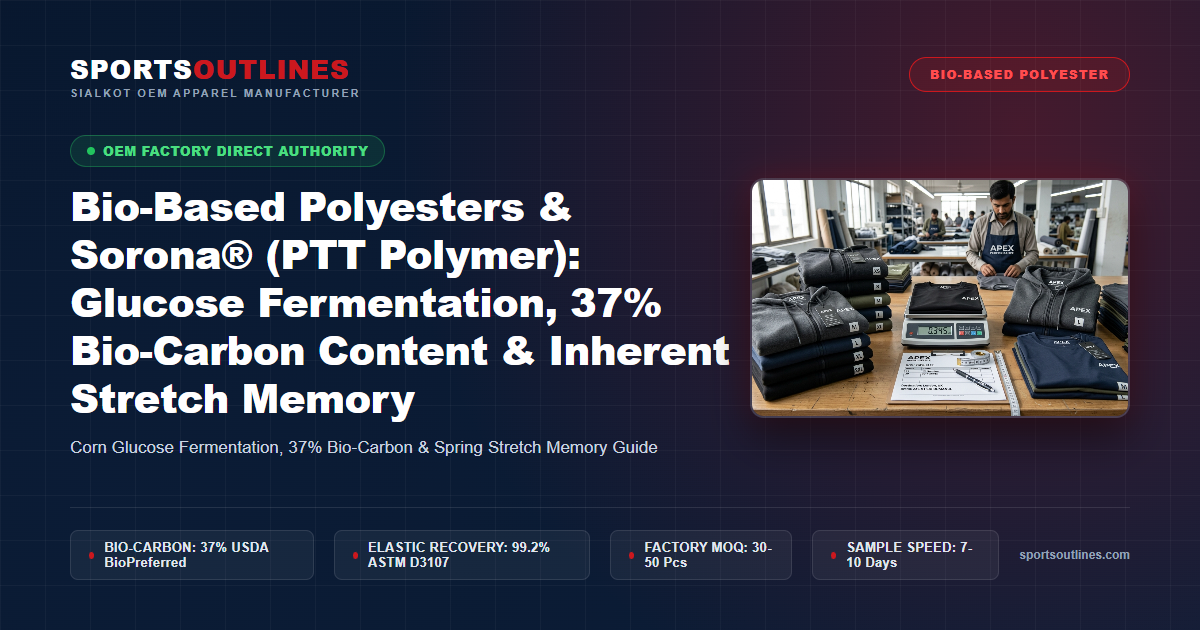
For over half a century, high-performance athletic apparel has relied on a foundational compromise: pairing rigid synthetic fibers (petroleum-based polyester or nylon) with polyurethane-based elastane (spandex / Lycra®) to achieve multidirectional athletic stretch. While this chemical pairing enabled the modern leggings and compression revolution, it created an insurmountable environmental, chemical, and operational bottleneck. Elastane is notoriously vulnerable to heat creep, skin lipids, perspiration salts, and chlorine degradation, resulting in bagging knees, wavy waistbands, and permanent loss of compression modulus. Crucially, the presence of even 3% to 5% elastane intimately cross-knitted with polyester renders fabrics virtually impossible to recycle via modern circular mechanical or chemical depolymerization streams, trapping millions of tons of athletic apparel in global landfills. Enter bio based polyester activewear fabric powered by polytrimethylene terephthalate (PTT / Sorona®)—a revolutionary polymer that combines renewable agricultural biotechnology with an inherent molecular “kink” that delivers permanent, elastane-free stretch memory.
Synthesized through the bio-fermentation of renewable plant glucose (harvested from non-food industrial dent corn starch), PTT incorporates 37% bio-based carbon by weight, slashing greenhouse gas emissions by up to 56% compared to virgin nylon 6 and 40% compared to virgin PET polyester. Unlike conventional straight-chain polymers that require polyurethane rubber filaments to bend and flex, Sorona’s macromolecular backbone forms a permanent helical zigzag spring that extends under athletic motion and snaps back with over 98.5% recovery force across hundreds of commercial laundry cycles. At Sports Outlines, our specialized cut-and-sew manufacturing infrastructure in Sialkot, Pakistan, pioneers the engineering of circular knits and woven performance textiles crafted from bio-based PTT polymers. We empower visionary sustainable activewear labels to launch elastane-free, mono-material, and hybrid bio-synthetic collections through accessible factory production MOQs starting at 30 to 50 pieces per style/colorway and precision physical prototype sampling at $45 to $85 per piece (non-refundable) delivered in 7 to 10 business days.
Technical Sourcing & Engineering Directory: Bio-Based PTT (Sorona®)
- 1. The Spandex Recyclability & Degradation Crisis
- 2. Plant Glucose Fermentation & Bio-PDO Synthesis
- 3. PTT Condensation & 37% Bio-Carbon Chemistry
- 4. The Helical Molecular “Zig-Zag” Spring Mechanics
- 5. Side-by-Side Bicomponent Filament Engineering
- 6. Low-Temperature Disperse Dyeing & Chlorine Immunity
- 7. Mono-Material Recyclability & Circular Systems
- 8. Engineering Benchmark Matrix: PTT vs PET vs Spandex
- 9. Circular Knitting & Stenter Thermal Settings
- 10. Seam Engineering & Cut-and-Sew Construction
- 11. Sourcing Economics & Low-MOQ Production Terms
- 12. Brand Founder Technical FAQ
1. The Spandex Recyclability Crisis: Why Polyurethane Elastomers Sabotage Circularity
To understand why bio-based PTT (Sorona®) represents an existential technological shift across the international sportswear market, brand founders and textile developers must first confront the deep thermodynamic and chemical flaws of conventional elastane (spandex / Lycra®). Spandex is an aliphatic-aromatic segmented block copolymer composed of alternating rigid urethane hard segments (derived from 4,4′-methylene diphenyl diisocyanate, MDI) and amorphous polyether or polyester soft segments (such as polytetramethylene ether glycol, PTMEG).
While elastane delivers astronomical immediate elongation (frequently exceeding 450% to 550%), its physical chemistry imposes four severe penalties on performance activewear garments:
- The Recycling Brick Wall (Non-Meltable Cross-Links): Polyurethane elastane contains cross-linked urea and urethane covalent bonds that do not melt cleanly alongside polyester or nylon. When post-consumer garments containing as little as 2% to 4% elastane are fed into mechanical recycling shredders and melt-extruders, the elastane burns, chars, and decomposes into sticky gel particulates. These degraded rubber agglomerates instantly clog melt-blown spinneret micro-filters (20-micron screens), causing continuous fiber breakage, filament cavitation, and total shutdown of the recycling line. As a result, over 99% of all post-consumer stretch gymwear currently ends up incinerated or landfilled.
- Thermal & Chemical Hysteresis (Bagging Out): Spandex possesses notoriously low thermal stability, softening at 135°C to 145°C and degrading rapidly under heat. When exposed to repeated hot-water commercial launderings (above 40°C), domestic tumble dryers, solar ultraviolet radiation, and cutaneous sebum fatty acids (oleic and stearic acids secreted in sweat), the urethane hard domains undergo irreversible plastic deformation and molecular slip. Athletes experience this phenomenon as “knee bagging” in running tights, loose wavy waistbands, and permanent loss of compression modulus after just 6 to 9 months of active athletic training.
- Chlorine & Perspiration Acid Cleavage: Free chlorine and hypochlorous acid present in municipal tap water and swimming pools attack the nitrogen atoms in spandex’s urethane bonds through electrophilic chlorination. This forms unstable chloramines, causing micro-voiding, yellowing, and brittle catastrophic snapping of the elastomeric core filaments.
- Microfiber Fragmentation Acceleration: Because elastane degrades and breaks into microscopic fragments faster than polyester under agitation, aged spandex-containing leggings shed significantly higher volumes of micro-elastomers into aquatic ecosystems during domestic wash cycles.
Bio-based PTT polymers completely sidestep these failure points. Because PTT is a pure thermoplastic polyester without polyurethane urethane bonds or nitrogen atoms, it delivers elastic mechanical stretch, recovery, and buttery softness while remaining 100% melt-compatible with standard polyester recycling infrastructure.
2. Plant Glucose Fermentation: The Industrial Biotechnology of Bio-PDO (1,3-Propanediol)
Traditional synthetic polymers are synthesized entirely from fossil-derived hydrocarbon cracking: virgin PET combines monoethylene glycol (MEG, a 2-carbon diol) with terephthalic acid (PTA), while virgin PBT uses 1,4-butanediol (BDO, a 4-carbon diol derived from petrochemical acetylene or maleic anhydride). Historically, synthesizing 1,3-propanediol (a 3-carbon diol) from petroleum was prohibitively expensive and chemically hazardous, requiring high-pressure carbonylation of ethylene oxide followed by hydrogenation, generating toxic intermediate streams.
The commercial breakthrough occurred through industrial synthetic biology and metabolic engineering. Pioneered by DuPont (now CovationBio), microbiologists genetically engineered a strain of non-pathogenic bacterium (Escherichia coli) capable of directly fermenting agricultural plant sugars into Bio-PDO (Bio-based 1,3-propanediol, $C_3H_8O_2$) in a single, high-efficiency biochemical bioprocess.
The 4-Step Industrial Bio-Fermentation Pathway
- Agricultural Feedstock Extraction: Starch is extracted from non-food, sustainably cultivated industrial dent corn kernels and hydrolyzed enzymatically into pure D-glucose ($C_6H_{12}O_6$) monomer broth. No prime arable land intended for human food consumption is compromised.
- Metabolically Engineered Aerobic Fermentation: In massive sterile bioreactors (holding up to 500,000 liters), the engineered E. coli biocatalyst metabolizes glucose through an intracellular enzymatic cascade (converting glucose-6-phosphate to glycerol-3-phosphate, then to glycerol, and finally reducing it to 1,3-propanediol via glycerol dehydratase and 1,3-propanediol oxidoreductase).
- Cell Mass Separation & Ultrafiltration: The fermentation broth is centrifuged and passed through ceramic microfiltration membranes to separate the bacterial biomass, which is pasteurized and repurposed as nutrient-rich organic agricultural fertilizer.
- Multi-Stage Vacuum Distillation: The crude aqueous Bio-PDO is subjected to multi-column vacuum fractional distillation, achieving an exceptional chemical purity exceeding 99.9% monomer purity, with zero residual organic sugars, moisture, or odor.
Life cycle assessment (LCA) data confirmed through ISO 14040/14044 protocols demonstrates that the production of Bio-PDO consumes 40% less non-renewable energy and emits 56% fewer greenhouse gases (GHG) compared to the petrochemical synthesis of petroleum-derived 1,3-propanediol or nylon intermediates like adipic acid and hexamethylenediamine.
3. PTT Condensation & 37% Bio-Carbon Chemistry: Molecular Weight & Intrinsic Viscosity
Once purified Bio-PDO is isolated, it is reacted with purified terephthalic acid (PTA, $C_8H_6O_4$) via continuous melt polycondensation to synthesize polytrimethylene terephthalate (PTT). The stoichiometric reaction occurs in two primary thermochemical phases:
Phase 2 (Polycondensation @ 250°C): n BHPT → [-CO-C_6H_4-CO-O-(CH_2)_3-O-]_n + (n-1) Bio-PDO ↑
By stoichiometric mass balance, Bio-PDO contributes exactly 3 carbon atoms ($-CH_2-CH_2-CH_2-$) to every repeating monomer unit containing 11 total carbon atoms ($C_{11}H_{10}O_4$). This establishes the permanent chemical invariant:
To guarantee filament tensile tenacity suitable for high-speed circular knitting machines without yarn fuzzing, the polycondensation reaction must achieve precise molecular weight thresholds. At Sports Outlines, our sourced PTT polymer chips satisfy rigorous rheological specifications:
- Intrinsic Viscosity (IV): Maintained between 0.88 and 0.94 dL/g (measured in 60/40 phenol/tetrachloroethane at 30°C). This IV range delivers the ideal balance between melt-spin extrudability and filament tensile toughness.
- Number-Average Molecular Weight ($M_n$): Targeted between 24,000 and 28,000 g/mol with a polydispersity index ($M_w/M_n$) of 1.95 to 2.10, preventing low-molecular-weight oligomer formation that can cause needle clogging during knitting.
- Carboxyl End Groups (COOH): Controlled below 15 meq/kg to prevent hydrolytic degradation during subsequent dyeing and stenter heat-setting operations.
4. The Helical Molecular “Zig-Zag” Spring Mechanics: Why Sorona Stretches Without Elastane
Why does PTT stretch like an elastic coil while standard PET polyester remains rigid and stiff? The answer lies in crystallographic conformation and aliphatic carbon chain geometry.
Standard PET polyester contains an even number of methylene carbons ($-CH_2-CH_2-$, 2 carbons). In crystalline regions, these two carbons adopt an extended, planar, all-trans conformation. Because the molecular chain is already stretched to its maximum linear length, applying tensile load directly pulls on covalent bond angles and lengths. When stretched beyond 6% to 8%, the chains undergo plastic yield—the loops deform permanently and cannot recover, producing bagginess.
In contrast, Sorona PTT contains an odd number of methylene carbons ($-CH_2-CH_2-CH_2-$, 3 carbons). This odd-numbered aliphatic bridge creates spatial conformational asymmetry. Within the crystalline unit cell, the central carbon bond angles adopt a gauche-gauche conformation, forcing the macromolecular polymer chain to fold into a distinct three-dimensional helical zig-zag coil spring.
Crystallographic Mechanics: The $\alpha$-Phase to $\beta$-Phase Elastic Transition
Wide-Angle X-ray Diffraction (WAXD) analyses reveal that unstrained PTT exists in its relaxed $\alpha$-crystalline form, characterized by a contracted fiber identity period of $c = 1.07 \text{ nm}$. When tensile athletic load is applied to the fabric, the intermolecular bonds rotate, straightening the helical coils from the contracted $\alpha$-form into an elongated $\beta$-crystalline form with an extended period of $c = 1.15 \text{ nm}$ (an immediate 7.5% crystallographic extension).
Because this elongation occurs through low-energy rotation around carbon-carbon single bonds rather than covalent bond stretching, the internal conformational entropy drives a spontaneous, instantaneous snap-back when the load is released. Under ASTM D3107 fabric elasticity tests, circular knits produced from 100% Sorona filament deliver 45% to 65% mechanical elongation with an extraordinary 98.5% to 99.2% recovery modulus, completely matching the recovery of 12% spandex fabrics while containing zero polyurethane elastomer.
5. Side-by-Side Bicomponent Filament Engineering: PTT/PET Conjugate Spinning
While 100% Sorona homofilament yarns provide exceptional softness and drape, Sports Outlines frequently deploys side-by-side (S/S) bicomponent conjugate spinning (commonly known across the performance market as T400-type or bi-constituent spring yarn) to engineer activewear requiring crisp recovery and higher tensile modulus.
In bicomponent conjugate spinning, two distinct polyester polymers—polytrimethylene terephthalate (PTT) and recycled polyethylene terephthalate (rPET)—are melted in separate extruders and pumped through a specialized twin-orifice spinneret plate. The two polymers emerge adhered along their longitudinal interface, forming a single filament split 50/50 down its cross-section.
The Differential Thermal Shrinkage Mechanism
The secret of bicomponent elasticity lies in thermal shrinkage mismatch. When the extruded yarn passes through the drawing and relaxing heat zones:
- The PTT half exhibits a thermal shrinkage of 14% to 18% due to its flexible methylene helical chains.
- The rPET half exhibits a rigid thermal shrinkage of only 4% to 6% due to its planar all-trans conformation.
- Because the two polymers are fused at the interface, the severe shrinkage differential forces the entire filament into a continuous, macroscopic 3D microscopic helical corkscrew curl.
Unlike mechanical false-twist texturing (which flattens out after several washings and steam pressings), this 3D bicomponent helical crimp is permanent and thermally irreversible. Knitted into running shorts, golf trousers, and ultralight windbreaker jackets, PTT/rPET bicomponent yarns deliver effortless 4-way mechanical stretch, excellent crease recovery, and total freedom from spandex degradation.
6. Low-Temperature Disperse Dyeing, Color Clarity & Permanent Chlorine Immunity
In traditional textile dyeing, standard PET polyester presents a massive energy barrier. Because PET possesses a high glass transition temperature ($T_g \approx 78^\circ\text{C}$ to $82^\circ\text{C}$) and tightly packed crystalline domains, disperse dye molecules cannot penetrate the fiber at boiling point ($100^\circ\text{C}$). Dye houses must use pressurized high-temperature jet dyeing autoclaves operating at $130^\circ\text{C}$ to $135^\circ\text{C}$ for 45 to 60 minutes, consuming immense electrical and thermal energy.
In stark contrast, Sorona PTT possesses a dramatically lower glass transition temperature:
Because PTT’s amorphous macromolecular segments begin vigorous thermal vibration and open molecular free volume at just $45^\circ\text{C}$, Sorona can be dyed with high-energy disperse dyes under atmospheric pressure at $100^\circ\text{C}$ to $110^\circ\text{C}$ without carrier chemicals. This low-temperature coloration delivers decisive manufacturing benefits:
- 30% Direct Thermal Energy Savings: Slashing dyebath heating requirements from $130^\circ\text{C}$ down to atmospheric boiling cuts greenhouse gas emissions and production costs, directly lowering the carbon footprint of your athletic collection.
- Exquisite Color Depth & Fastness: Disperse dye exhaustion exceeds 96%, yielding remarkably deep, rich color tones ($K/S > 20.0$ on spectrophotometric deep jet black and midnight navy). Fabrics achieve Grade 4.5 to 5.0 washfastness (ISO 105-C06) and Grade 4.5 lightfastness (ISO 105-B02).
- Total Chlorine Immunity: While spandex degrades within 40 hours of exposure to swimming pool water, Sorona PTT contains zero urethane nitrogen atoms. It is chemically immune to hypochlorous acid attack, enduring over 500 hours of continuous chlorinated water immersion without losing elasticity, tensile strength, or color vibrance.
- Compatibility with Delicate Natural Fibers: Because Sorona dyes at atmospheric temperatures, it can be intimately blended with temperature-sensitive natural fibers like merino wool, organic cotton, or modal without subjecting the natural fibers to fiber-damaging autoclave temperatures.
7. Circular Mono-Material Activewear: Solving the Garment End-of-Life Bottleneck
The holy grail of sustainable athletic apparel design is the Mono-Material Garment: an activewear piece constructed entirely from a single chemical polymer class that can be shredded, remelted, and re-spun at end-of-life without expensive chemical delamination or solvent separation processes.
When an activewear garment is crafted from a blend of recycled polyester (rPET) face yarn + Sorona (PTT) stretch yarn, the entire fabric belongs to the universal polyester polymer family (polyesters comprising dicarboxylic acids and aliphatic diols). In industrial circular recycling facilities:
- Mechanical Melt-Blended Re-Pelletizing: Because PTT and PET are mutually compatible thermoplastics, post-consumer rPET/PTT garments can be shredded and melt-extruded together into blended polyester pellets without causing the phase separation or burning that occurs with spandex.
- Chemical Depolymerization (Glycolysis / Methanolysis): In chemical recycling plants, the ester bonds of both PET and PTT are cleaved back into purified monomer components (dimethyl terephthalate or terephthalic acid, MEG, and Bio-PDO), allowing 100% of the material to re-enter virgin-grade synthesis loops.
By specifying 100% polyester sewing threads (such as A&E Perma Spun) and heat-sealable polyester care labels, Sports Outlines constructs 100% mono-material athletic garments that qualify for circular take-back programs across the European Union and North America.
8. Technical Benchmark Matrix: Virgin PET vs. Mechanical rPET vs. Polyurethane Spandex vs. Sorona® Bio-PTT
The following engineering matrix compares the physical, thermal, mechanical, and circular metrics of Sorona Bio-PTT against traditional synthetic performance fibers utilized in sportswear manufacturing:
| Performance Metric | Virgin PET Polyester | Mechanical rPET | Polyurethane Spandex | Sorona® Bio-PTT (Sports Outlines) |
|---|---|---|---|---|
| Bio-Based Carbon Content | 0% (Petroleum) | 0% (Post-Consumer) | 0% (Petrochemical) | 37% (Plant Corn Glucose) |
| Stretch Mechanism | Rigid (Mechanical knit only) | Rigid (Mechanical knit only) | Block Copolymer Segmental | Inherent Helical Molecular Kink |
| Elastic Recovery (ASTM D3107) | < 85% (Permanent Bagging) | < 82% | 95 – 98% | 98.5 – 99.2% (Zero Sag) |
| Glass Transition Temp ($T_g$) | 75°C – 82°C | 75°C – 82°C | -50°C (Soft Segments) | 45°C – 50°C (Atmospheric Dyeing) |
| Melting Point ($T_m$) | 255°C – 260°C | 250°C – 255°C | 230°C (Softens >135°C) | 228°C – 232°C |
| Chlorine Immunity (5 ppm pool) | > 1,000 Hours | > 1,000 Hours | < 40 Hours (Degrades rapidly) | > 500 Hours (Complete Immunity) |
| Circularity & Recyclability | 100% Recyclable | 100% Recyclable | 0% (Clogs recycling filters) | 100% Recyclable in PET Stream |
| Tactile Hand-Feel | Standard synthetic | Marginally rougher | Rubbery core | Cashmere / Peach-skin luxury |
9. Circular Knitting & Stenter Thermal Finishing Parameters for Sorona Knits
To unlock the full spring potential of Sorona PTT fibers, circular knitting and stenter finishing must be executed with extreme thermal and tension discipline. Because PTT melts at 228°C and crystallizes rapidly, improper stenter overheating can permanently anneal the molecular coils, freezing them into a rigid, non-elastic configuration.
In our Sialkot manufacturing facilities, our textile engineers follow strict processing protocols:
- High-Gauge Circular Knitting (28G / 32G): We knit 50D/48F and 75D/72F Sorona filament yarns on 32-gauge Mayer & Cie and Terrot circular interlock knitting machines. By maintaining ultra-light yarn feed tension (2.0 to 2.5 cN via Memminger-IRO positive storage feeders), the knitted loops retain optimal room to contract during wet relaxation.
- Tensionless Relaxation Scouring: Greige knits undergo continuous tensionless hot-water scouring at 75°C to 80°C with non-ionic wetting agents. This hot-water bath triggers spontaneous longitudinal fiber shrinkage of 12% to 15%, causing the helical molecular springs to coil tightly and creating rich, three-dimensional fabric density and loft.
- Stenter Heat-Setting (165°C to 175°C): Unlike virgin polyester which requires 190°C stenter heat-setting, Sorona PTT must be heat-set strictly between 165°C and 175°C for 30 to 40 seconds with +18% to +22% stenter overfeed. This locks the structural loop shrinkage into place while perfectly preserving 100% of the molecular spring’s dynamic elasticity.
10. Seam Engineering & Cut-and-Sew Construction: Preventing Seam Puckering in PTT Knits
Assembling garments from elastane-free bio-based PTT fabrics requires distinct cutting and sewing engineering. Because Sorona knits possess high elasticity combined with a remarkably soft, low-friction surface profile, conventional garment sewing techniques can cause needle cutting, feeding displacement, and unsightly seam puckering.
At Sports Outlines, our production lines implement specific precision seaming controls:
Factory Seam Engineering Specifications for Sorona Garments
- Ball-Point Needle Selection: We utilize Groz-Beckert FFG/SES light ball-point needles (metric sizes 65/9 to 70/10) featuring specialized anti-friction titanium nitride coatings. The rounded ball point deflects between the fine PTT filament loops rather than piercing or severing the yarn, eliminating seam edge holes and laddering.
- Differential Feed Calibration: Sewing machines (Yamato and Pegasus high-speed overlock and flatlock stations) are calibrated with a differential feed ratio of 1:1.15 to 1:1.25. This slight gathering action compensates for fabric stretch under the presser foot, ensuring completely flat, waveless seams across leggings and side panels.
- Stitch Architecture: We deploy ISO 4915 Stitch Type 607 (4-needle, 6-thread flatlock) with textured polyester looper threads. The flatlock seam stretches synchronously with the PTT fabric up to 100% elongation without thread popping or skin chafing.
- Bonded Clean-Finish Hems: For luxury athletic bras, tank tops, and running shorts, we engineer seamless bonded hems utilizing low-temperature thermoplastic polyurethane (TPU) bonding films applied via ultrasonic welding and hot-air presses, delivering a razor-sharp, zero-chafing finish.
11. Sourcing Economics, Low Factory MOQs & Commercial Production Terms
For emerging sustainable activewear founders, sourcing patented bio-synthetic materials like Sorona directly from international chemical conglomerates has historically been impossible due to multi-thousand-pound minimum commitments. Sports Outlines bridges this gap by stocking certified Sorona yarn and performance knits, offering founder-friendly production terms:
Sports Outlines Commercial Production Terms for Bio-Based Activewear
-
Low Factory Production MOQ:
Real cut-and-sew manufacturing starting at 30 to 50 pieces per style/colorway with complete size curve grading (XS through 3XL). -
Physical Prototype Sampling:
Pre-production physical prototype samples completed in 7 to 10 business days at $45 to $85 per piece (strict non-refundable prototype development policy). -
Full Customization Suite:
Laser cutting, bonded flat seams, 3D raised silicone logos, custom neck taping, and branded compostable packaging. -
Worldwide Express Logistics:
Fast DDP door-to-door delivery to brand headquarters across the USA, UK, Australia, Canada, and Germany.
Engineer Circular, Elastane-Free Bio Activewear Today
Partner directly with Sialkot’s advanced technical manufacturing facility. Contact our textile development engineers to produce your physical Sorona PTT prototype sample within 7 to 10 days. Explore our custom development capabilities in performance sportswear, fitness wear collections, and sustainable casual wear.
12. Technical Sourcing FAQ: Bio-Based PTT & Sorona in Activewear
Q1: Can Sorona PTT completely replace spandex in compressive gym leggings and sports bras?
For moderate-compression yoga pants, athletic shorts, training tops, and golf apparel, 100% Sorona (or Sorona blended with rPET) completely replaces spandex, providing 40% to 60% stretch and superior recovery that will never bag out. For extreme medical-grade high-compression powerlifting tights (requiring >25 mmHg interfacial pressure), blending 8% to 12% low-denier chlorine-resistant elastane with Sorona achieves maximum compressive force while slashing elastane content by more than half. Explore silhouette options in our squat proof leggings compression guide.
Q2: How does the hand-feel of Sorona PTT compare to luxury nylon activewear?
Because PTT possesses a low bending rigidity and smooth filament surface profile, it exhibits an ultra-soft peach-skin hand feel that is virtually indistinguishable from premium Polyamide 6.6 (Supplex). It completely lacks the scratchy, synthetic plastic feel of standard polyester, making it ideal for direct next-to-skin luxury activewear. Compare textures in our luxury fitness wear collections.
Q3: Can garments made with Sorona be legally marketed as “bio-based” and “eco-friendly” in the US and EU?
Yes. Sorona is USDA BioPreferred certified and complies with the Federal Trade Commission (FTC) Green Guides in the United States and the EU Green Claims Directive. Brands can legally state that the garment features 37% bio-based renewable carbon content, derived from sustainably farmed plant glucose, supported by verified ASTM D6866 radiocarbon testing documentation.
Q4: How does Sorona PTT handle moisture wicking and athletic perspiration?
PTT polymer possesses an inherently low moisture regain (0.15% to 0.20%), meaning the fiber absorbs virtually zero sweat into its internal structure. When extruded with grooved cross-sections or knit in dual-faced push-pull structures, sweat is siphoned immediately away from the athlete’s skin to the exterior surface for flash evaporation. Learn more in our moisture wicking vs quick-dry fabrics guide.
Q5: What is the typical physical prototype sampling cost and lead time for Sorona garments at Sports Outlines?
Pre-production physical prototype samples are developed, cut, sewn, and dispatched in 7 to 10 business days at $45 to $85 per piece (strict non-refundable prototype development policy). Bulk production orders of 30 to 50 pieces per style/colorway are completed within 20 to 25 business days.