The modern performance apparel industry faces an unprecedented existential paradox. Synthetic polymers—predominantly polyethylene terephthalate (polyester) and polyamides (nylon)—are irreplaceable engineering marvels that deliver the tensile tenacity, elastic recovery, lightweight hydrophobicity, and abrasion resistance required for elite athletic performance. Yet, these exact chemical virtues create an environmental catastrophe at end-of-life: petroleum-derived synthetics take upwards of four to five centuries to degrade in landfills and shed billions of persistent microplastic fibers into ocean gyres, aquatic food chains, and municipal water supplies with every laundering cycle. While mechanical recycling (rPET) diverts plastic bottles from waste streams, it does not solve synthetic permanence—recycled polyester garments shed microfibers at the same rate and will persist in landfills just as long as virgin synthetics once discarded.
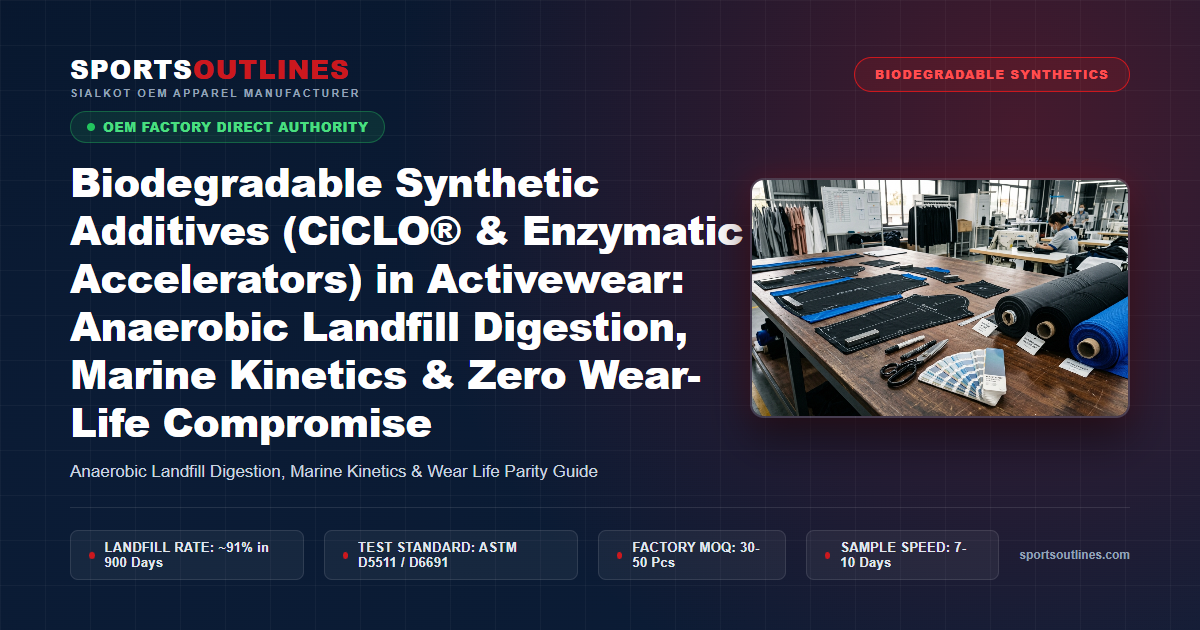
To solve this end-of-life dilemma without sacrificing the sweat-wicking modulus or durability of performance knits, forward-thinking textile chemists have engineered biodegradable synthetic additives, headlined by patented technologies like CiCLO®. By embedding bio-receptive, nutrient-rich additive masterbatches directly into synthetic polymer melt streams, fibers behave like conventional polyester during consumer wear and wash cycles, yet degrade at rates comparable to natural cellulosics when deposited in biologically active, microbial environments such as anaerobic municipal landfills or seawater sediments. At Sports Outlines, based in Sialkot, Pakistan, we help visionary activewear founders navigate the cutting edge of polymer microbiology. We integrate certified CiCLO®-infused polyester and nylon yarns into premium circular and warp knits with factory minimums of just 30 to 50 pieces per style/colorway, backed by rapid physical prototype development at $45 to $85 per piece (non-refundable) delivered in 7 to 10 business days.
Technical Sourcing & Biochemical Engineering Directory
- 1. The Synthetic Permanence Crisis & Microfiber Pollution
- 2. How CiCLO® Works: Masterbatch Chemistry & Biodegradable Spots
- 3. Dormancy During Wear Life vs Environmental Activation
- 4. Biodegradation Testing Standards: ASTM D5511, D6691 & D5988
- 5. Circular Knitting, Dyeing & Finishing Compatibility
- 6. Performance Matrix: CiCLO® vs Standard Polyester vs PLA
- 7. FTC Green Guides, EU Directives & Compliant Claims
- 8. Low-MOQ Sourcing & Commercial Factory Terms
- 9. B2B Activewear Engineering FAQ
1. The Synthetic Permanence Crisis: Microfiber Shedding and End-of-Life Realities
To understand the revolutionary necessity of biodegradable synthetic additives, one must analyze the physical chemistry that makes standard polyester so impervious to biological decomposition. Polyethylene terephthalate (PET) is synthesized through condensation polymerization into long, linear macromolecular chains featuring rigid aromatic benzene rings interconnected by ester linkages ($-COO-$). When cooled from the melt and drawn under high tension during fiber extrusion, these chains organize into tightly packed, crystalline lamellae separated by amorphous regions.
This crystalline density, combined with polyester’s inherent hydrophobicity (contact angle $\theta > 75^\circ$) and non-polar surface chemistry, prevents moisture penetration and blocks enzyme adsorption. Microorganisms naturally present in soil, wastewater, and marine environments—such as bacteria, actinomycetes, and fungal hyphae—rely on surface moisture and accessible chemical cleavage sites to excrete hydrolytic enzymes. Because native microorganisms cannot attach to or penetrate the smooth, hydrophobic crystalline surface of standard polyester, the polymer remains biological inert, requiring an estimated 400 to 500 years to degrade via slow photo-oxidative UV surface weathering.
Furthermore, the synthetic microfiber shedding crisis exacerbates this longevity. During athletic laundering, mechanical agitation in commercial washing machines shears off microscopic synthetic fibrils measuring between 10 to 500 micrometers in length. Municipal wastewater treatment plants typically capture 85% to 95% of these microfibers in sewage sludge. However, this sludge is frequently applied as agricultural fertilizer, transferring synthetic microfibers directly into terrestrial soils where they leach into groundwater and runoff into marine environments. In ocean waters, these inert microfibers absorb persistent organic pollutants (POPs) such as polychlorinated biphenyls (PCBs) and dichlorodiphenyldichloroethylene (DDE), where they are ingested by zooplankton and pelagic fish, biomagnifying up the marine food chain directly to humans.
Because synthetic microfibers possess low specific gravity ($1.38\text{ g/cm}^3$ for PET, $1.14\text{ g/cm}^3$ for PA6) and high surface-to-volume ratios, their terminal settling velocities in water columns are exceptionally slow. They remain suspended in photic ocean zones for years, blocking light penetration and disrupting phytoplankton photosynthesis. By enabling indigenous marine bacteria to digest these shed fibrils within months rather than centuries, CiCLO® technology addresses the microfiber pollution epidemic at the molecular root without forcing brands to abandon performance synthetics.
2. How CiCLO® Works: Masterbatch Chemistry and Biodegradable Spots
Developed by Intrinsic Advanced Materials (a joint venture between Parkdale Mills and Intrinsic Textiles Group), CiCLO® is a patented, sustainable additive masterbatch that permanently alters the biological receptivity of synthetic polymers without disrupting their macromolecular mechanical integrity. Unlike obsolete “oxo-degradable” technologies—which relied on transition-metal pro-oxidant additives (such as cobalt, iron, or manganese stearates) that catalytically cleaved polymer chains in the presence of oxygen and UV light, merely fragmenting large plastics into billions of invisible, toxic microplastics—CiCLO® relies on true enzyme-mediated microbial mineralisation.
The chemical architecture of CiCLO® operates through a specialized masterbatch compounding sequence:
- Melt Compounding at Dosing Concentrations of 1%: CiCLO® is formulated as concentrated polymer pellets (available in PET or PA6 carrier resins) dosed at approximately 1.0% by weight directly into the extruder throat during fiber melt-spinning alongside virgin or post-consumer recycled polymer chips.
- Creation of Biodegradable Receptor Sites: During melt extrusion at 275°C to 285°C, the CiCLO® additive distributes homogeneously throughout the molten polymer matrix. Rather than weakening the polymer backbone, the additive introduces billions of sub-microscopic, nutrient-rich, hydrophilic “biodegradable spots” embedded permanently within the amorphous regions of the synthetic matrix.
- Biofilm Formation and Microbial Colonization: When exposed to environments teeming with moisture, active microbes, and anaerobic or aerobic bacteria, these nutrient spots attract indigenous microbial colonies. Microorganisms attach to the fiber surface, colonizing the biodegradable sites and forming a protective, hydrated biological biofilm.
- Enzymatic Chain Mineralisation: The colonized bacteria excrete natural extracellular enzymes (such as cutinases, esterases, and lipases) that hydrolyze the neighboring ester linkages of the polyester or amide linkages of nylon. The microbes metabolize the cleaved oligomers as carbon and energy sources, progressively mineralizing the entire synthetic matrix into basic natural elements: methane ($CH_4$), carbon dioxide ($CO_2$), water ($H_2O$), and non-toxic biomass, leaving zero synthetic microplastic residue behind.
From an enzymological perspective, the cleavage process follows classical Michaelis-Menten kinetics. Extracellular bacterial cutinases bind specifically to the ester linkages adjacent to the hydrophilic nutrient domains. The active catalytic triad (Ser-His-Asp) of the enzyme attacks the ester carbonyl carbon, cleaving the high-molecular-weight polyethylene terephthalate into mono-(2-hydroxyethyl) terephthalate (MHET) and bis-(2-hydroxyethyl) terephthalate (BHET) intermediate monomers. Secondary intracellular enzymes then cleave these intermediates into terephthalic acid (TPA) and ethylene glycol (EG), which enter the bacterial tricarboxylic acid (TCA) cycle, transforming synthetic carbon into living bacterial biomass and metabolic respiratory gases.
3. Dormancy During Consumer Wear Life vs Environmental Activation Triggers
A primary concern for performance sportswear designers and brand founders considering biodegradable additives is product stability: Will a sports bra or compression tight degrade prematurely on a retail shelf, inside an athlete’s closet, or during strenuous workouts in high-sweat environments?
The definitive answer is no. CiCLO® technology is engineered with strict environmental activation thresholds. The additive remains 100% inert and dormant throughout the entire consumer lifecycle because ambient conditions lack the specific biological catalyst combination required to initiate enzymatic hydrolysis. The following environmental matrix illustrates the strict activation triggers:
| Operating Environment | Environmental Conditions Present | Biochemical Activity State | Fiber Tenacity & Integrity Impact |
|---|---|---|---|
| Retail Display & Warehousing | Dry air, 20°C–25°C, artificial lighting, zero soil microbes | Completely Dormant (0% activation) | 100% stability; indefinite shelf life |
| Athlete Training & Heavy Perspiration | Saline liquid sweat, lactic acid, 37°C body heat, skin flora | Completely Dormant (No soil microbes) | Zero degradation; unaffected by sweat salts |
| Home Laundering & Machine Drying | Water, detergents, bleaches, 40°C–60°C tumble heat | Completely Dormant (Chemicals inhibit bio-films) | Zero degradation across 50+ commercial wash cycles |
| Municipal Anaerobic Landfills | Sub-surface moisture, constant 35°C–52°C, methanogenic bacteria | Active Biodegradation Triggered | Progressive microbial mineralisation (ASTM D5511) |
| Marine Waters & Ocean Sediments | Saline marine seawater, pelagic microorganisms, benthic flora | Active Biodegradation Triggered | Continuous enzymatic breakdown (ASTM D6691) |
| Wastewater Treatment Sludge | Dense anaerobic sludge digester, high microbial colony density | Active Biodegradation Triggered | Rapid enzymatic digestion of shed microfibers |
This biological dual-state mechanism ensures that CiCLO®-infused activewear maintains Olympic-level physical tenacity, elongation recovery, and colorfastness throughout years of consumer use, activating only when discarded into authentic waste management ecosystems.
4. Biodegradation Testing Protocols: ASTM D5511, ASTM D6691, and Soil Metrics
Rigorous empirical verification is mandatory to establish scientific credibility and avoid regulatory penalties. Unlike informal claims of “biodegradability,” certified CiCLO® textiles undergo standardized third-party laboratory testing conducted by ISO 17025 accredited independent laboratories (such as Intertek and Eden Research Laboratory). The testing protocols evaluate carbon conversion into biogas across three primary environmental endpoints:
- ASTM D5511 (Anaerobic Landfill Biodegradation): This high-solids anaerobic digestion test simulates conditions found in modern biologically active, capped municipal landfills. Test specimens are submerged in high-solids anaerobic digestate containing active methanogenic inoculum at $52^\circ\text{C} \pm 2^\circ\text{C}$. Biogas evolution ($CH_4$ and $CO_2$) is continuously measured via gas chromatography. In certified testing, CiCLO®-treated polyester achieves upwards of 88% to 92% biodegradation in ~900 to 1,000 days, whereas standard untreated polyester controls exhibit less than 2% biodegradation over the identical duration.
- ASTM D6691 (Marine Aquatic Biodegradation): Evaluates aerobic microbial mineralisation of plastics exposed to indigenous marine microorganisms in natural seawater at $30^\circ\text{C}$. As microfibers shed from athletic knits enter coastal waters, CiCLO® polyester exhibits progressive carbon mineralisation over 18 to 24 months, preventing the multi-century marine persistence typical of virgin PET microfibers.
- ASTM D5988 / ISO 17556 (Soil Biodegradation): Measures aerobic respiration in standard agricultural soils. Evaluates the breakdown of microfibers deposited on crop lands via sewage sludge fertilisation, confirming steady biological assimilation into natural humus and carbon dioxide.
- OEKO-TEX® ECO PASSPORT & Intertek Clean: Certification confirming that CiCLO® masterbatch chemicals, intermediate degradation compounds, and metabolic byproducts are completely non-toxic to aquatic flora, earthworms, plant germination, and human skin, containing zero alkylphenol ethoxylates (APEOs), per- and polyfluoroalkyl substances (PFAS), or heavy metal catalysts.
To calculate biodegradation percentage under ASTM D5511, respirometric test vessels utilize continuous mass-flow infrared detectors coupled with thermal conductivity gas chromatography. The absolute biodegradation percentage ($BD_{\%}$) is determined using the carbon mass balance formula:
Where $C_g(test)$ represents the total carbon weight evolved as gaseous methane and carbon dioxide in the sample chamber, $C_g(blank)$ represents baseline gaseous carbon evolved by the inoculum alone, and $C_tot$ represents the initial total organic carbon (TOC) mass contained within the original polyester textile specimen.
5. Circular Knitting floor Compatibility, Wet Processing, and Dyeing Dynamics
From a textile mill operational perspective, the supreme advantage of CiCLO® technology is its seamless process compatibility. Alternative bio-polymers—such as Polylactic Acid (PLA) derived from cornstarch or Polyhydroxyalkanoates (PHA)—suffer from low thermal melting points ($T_m \approx 150^\circ\text{C} – 170^\circ\text{C}$), severe alkali sensitivity, and brittle elongation profiles, causing them to melt, distort, or snap on standard high-temperature dye machines and stenter heat-setting frames.
Because CiCLO® is dosed at just 1% into standard polyester or nylon matrices, the parent polymer retains its fundamental thermodynamic and mechanical characteristics. At Sports Outlines, our production engineering protocols maintain seamless execution across the entire wet processing and knitting workflow:
- Standard High-Temperature Disperse Dyeing: CiCLO® polyester is dyed at standard atmospheric or high-pressure temperatures ($130^\circ\text{C} \pm 2^\circ\text{C}$) in jet overflow machines. The additive does not cause dye resist, strike irregularities, or shade variances. Dye exhaustion rates and color depth ($L^*$ values) match virgin polyester identically.
- Stenter Heat-Setting Tolerances: Fabric rolls undergo pre-setting and post-setting on multi-chamber pin stenters at temperatures up to 185°C–190°C for 45 seconds without triggering additive decomposition or pre-activating biodegradation.
- High-Gauge Circular Knitting Stability: Yarns run on 28-gauge, 32-gauge, and 36-gauge circular knitting machines at full commercial rotation speeds (25–30 RPM) with zero increase in yarn breaks, lint buildup, or needle friction compared to standard DTY filament yarns.
- Elastane Blending Versatility: Seamlessly knits alongside Creora® HighClo and Lycra® elastane filaments to produce 240 to 300 GSM squat-proof leggings, athletic shorts, and compression performance tops.
Furthermore, needle lubrication oils must be thoroughly scoured prior to heat-setting. We utilize non-ionic ethoxylated alcohol scouring baths at 75°C to emulsify mineral coning oils without affecting the CiCLO® receptor sites. This prevents smoke generation in stenter exhaust ducts and guarantees optimal dyestuff strike rates across every lot.
6. Comprehensive Performance Matrix: CiCLO® Polyester vs Standard PET vs PLA Bio-Polymer
To assist apparel sourcing managers in evaluating sustainable fiber options, the following comparative engineering matrix highlights physical and environmental performance parameters across three fiber technologies in an activewear 250 GSM interlock knit:
| Performance & Environmental Property | CiCLO®-Infused Polyester | Standard Virgin / rPET | 100% PLA Bio-Polymer | Test Standard / Reference |
|---|---|---|---|---|
| Filament Tensile Tenacity | 4.3 – 4.6 cN/tex (High) | 4.4 – 4.7 cN/tex (High) | 2.5 – 3.2 cN/tex (Brittle) | ASTM D2256 / ISO 2062 |
| Melting Point ($T_m$) | 255°C – 260°C | 255°C – 260°C | 155°C – 170°C (Low heat limit) | ASTM D3418 (DSC) |
| Bursting Strength (Diaphragm) | 450 ± 15 kPa | 455 ± 15 kPa | 280 ± 25 kPa (Low durability) | ASTM D3786 |
| Martindale Abrasion Resistance | > 45,000 rubs (Grade 4-5) | > 48,000 rubs (Grade 4-5) | < 15,000 rubs (Grade 2-3) | ISO 12947-2 (9 kPa) |
| Anaerobic Landfill Degradation | ~88% – 92% in 900 days | < 2% in 900 days (Persistent) | Requires 58°C industrial compost | ASTM D5511 |
| Marine Microfiber Biodegradation | Progressive digestion (ASTM D6691) | Permanent marine persistence | Extremely slow in cold seawater | ASTM D6691 |
| Consumer Wear Life & Shelf Stability | Indefinite (Dormant outside microbes) | Indefinite | Vulnerable to humidity hydrolysis | Accelerated Aging Testing |
The matrix clearly establishes why CiCLO® is the premier choice for technical apparel: it delivers identical mechanical performance, thermal resistance, and abrasion durability to virgin polyester while neutralizing the centuries-long landfill and marine permanence crisis.
7. Navigating Regulatory Marketing Claims: FTC Green Guides and EU Green Claims Directive
When marketing activewear made with biodegradable synthetic additives, athletic brands must navigate strict international consumer protection guidelines. In the United States, the Federal Trade Commission (FTC) Green Guides (§ 260.8) prohibit unqualified claims of “biodegradable” if the product does not completely break down within one year in standard disposal conditions. Furthermore, in the European Union, the Green Claims Directive and Unfair Commercial Practices Directive prohibit generic eco-claims like “100% eco-friendly” or “biodegradable polyester” without qualified empirical disclosures.
To maintain total legal compliance and build transparent consumer trust, our regulatory team at Sports Outlines advises clients to use specific, qualified on-garment disclosures and hangtag language:
- Approved Hangtag Wording: “This garment is made with CiCLO® technology, a sustainable additive that allows synthetic fibers to biodegrade at rates comparable to natural materials when discarded in biologically active landfills (tested per ASTM D5511: up to 91% biodegradation in 900+ days) and oceans (ASTM D6691). Does not degrade during active wear or laundering.”
- Prohibited Wording: Avoid claiming “100% biodegradable in nature,” “compostable gymwear,” or “leaves zero carbon footprint,” which violate FTC and EU regulations.
- Traceability Hangtags: When sourcing through Sports Outlines, your production lot is backed by certified CiCLO® brand license numbers, enabling direct access to authentic consumer hangtags that resonate with conscious buyers.
Under the forthcoming EU Digital Product Passport (DPP) regulations, apparel brands will be required to disclose material compositions and end-of-life pathways via scannable QR codes on internal wash tags. Integrating CiCLO® allows brands to provide verified third-party laboratory test certificates directly to European customs authorities and discerning consumers, substantiating circularity claims with accredited empirical data rather than ambiguous marketing buzzwords.
8. Low-MOQ Sourcing Strategy and Factory Commercial Terms
At Sports Outlines, we understand that ambitious independent activewear founders need agile manufacturing solutions that do not tie up operational capital in massive inventories. We have integrated CiCLO® yarns directly into our agile knitting schedule, making advanced biodegradable synthetic technology accessible through realistic commercial terms:
- Low Production MOQs: Bulk production starts at an accessible minimum of 30 to 50 pieces per style/colorway, allowing your brand to launch capsule activewear drops across multiple sizes (XS to 3XL) with minimal inventory liability.
- Physical Prototype Development: Complete pre-production physical prototype samples are developed at $45 to $85 per piece (non-refundable), encompassing custom pattern drafting, grading, fabric milling, and precision construction within 7 to 10 business days.
- Global Export Capabilities: Direct door-to-door delivery and commercial customs clearance provided for brand founders in the United States, United Kingdom, Australia, Canada, and Germany.
- Comprehensive Product Categories: Full integration across our specialized apparel manufacturing divisions, including technical sportswear, gym & activewear, and athletic casualwear.
Every production batch undergoes strict in-house laboratory testing before cutting, including dimensional stability after 5 home launderings (AATCC 135 < 2.5% shrinkage), colorfastness to chlorinated pool water and perspiration (ISO 105-E04 Grade 4–5), and four-way modulus elongation tests. Bulk production orders are completed and dispatched within an agile 25 to 30 business day manufacturing window.
To expand your technical knowledge of sustainable performance fibers, review our related technical guides on Ocean-Bound Plastics (OBP) & REPREVE® Our Ocean™, Bio-Based Polyesters & Sorona® (PTT Polymer), and GRS Certified rPET vs Virgin PET.
Ready to Build High-Performance Activewear with Certified CiCLO® Technology?
Combine elite physical stretch, sweat-wicking breathability, and verified end-of-life biodegradability in your next athletic collection. Collaborate with Sports Outlines to turn sustainable textile science into high-converting consumer apparel with our accessible 30–50 piece factory MOQ.
9. Technical Frequently Asked Questions (FAQ) for Activewear Founders
Q1: Will activewear made with CiCLO® start breaking down during high-intensity workouts or frequent washing?
No. CiCLO® technology is completely dormant during active consumer use, laundering, and closet storage. It requires specific, biologically active microbial environments—such as anaerobic municipal landfills, wastewater sludge digesters, or marine sediments—where colonies of microorganisms attach to the additive’s receptor sites and secrete hydrolytic enzymes. Sweat, moisture, body oils, and washing detergents cannot trigger biodegradation.
Q2: How is CiCLO® different from banned oxo-degradable plastic additives?
Oxo-degradable plastics used transition metal pro-oxidant salts that caused polymers to fragment into invisible, persistent microplastics when exposed to oxygen and sunlight. In contrast, CiCLO® enables true enzyme-mediated microbial mineralisation: bacteria consume the polymer chains and convert them entirely into basic natural elements—methane, carbon dioxide, water, and organic humus—leaving zero persistent microplastic or toxic residue behind.
Q3: Can CiCLO® be combined with recycled polyester (rPET) and elastane/spandex?
Yes. CiCLO® masterbatch is fully compatible with post-consumer recycled polyester (rPET) chips as well as virgin polyester and nylon 6/6.6 polymers. During circular knitting, it seamlessly blends with Creora® HighClo or Lycra® elastane filaments to produce high-compression, squat-proof activewear knits with standard 4-way stretch and shape retention.
Q4: What third-party testing standards validate the biodegradation rate of CiCLO® textiles?
CiCLO® performance is empirically verified through ASTM D5511 (accelerated anaerobic landfill digestion showing ~88%–92% biodegradation in ~900 days), ASTM D6691 (aerobic marine biodegradation), and ASTM D5988 (soil biodegradation), conducted by ISO 17025 accredited testing laboratories. The additive is also certified under OEKO-TEX® ECO PASSPORT, confirming total non-toxicity to skin and ecological biomes.
Q5: What are the minimum order quantities (MOQ) and prototype terms for custom CiCLO® activewear at Sports Outlines?
We support growing brands with a low factory MOQ of 30 to 50 pieces per style/colorway across flexible size curves from XS to 3XL. Physical pre-production prototype samples are produced at $45 to $85 per piece (non-refundable), covering dedicated yarn procurement, custom pattern development, and precision assembly within 7 to 10 business days before bulk manufacturing.