Direct Manufacturer Answer: How to Manufacture Custom Tennis Polos & Match Shirts
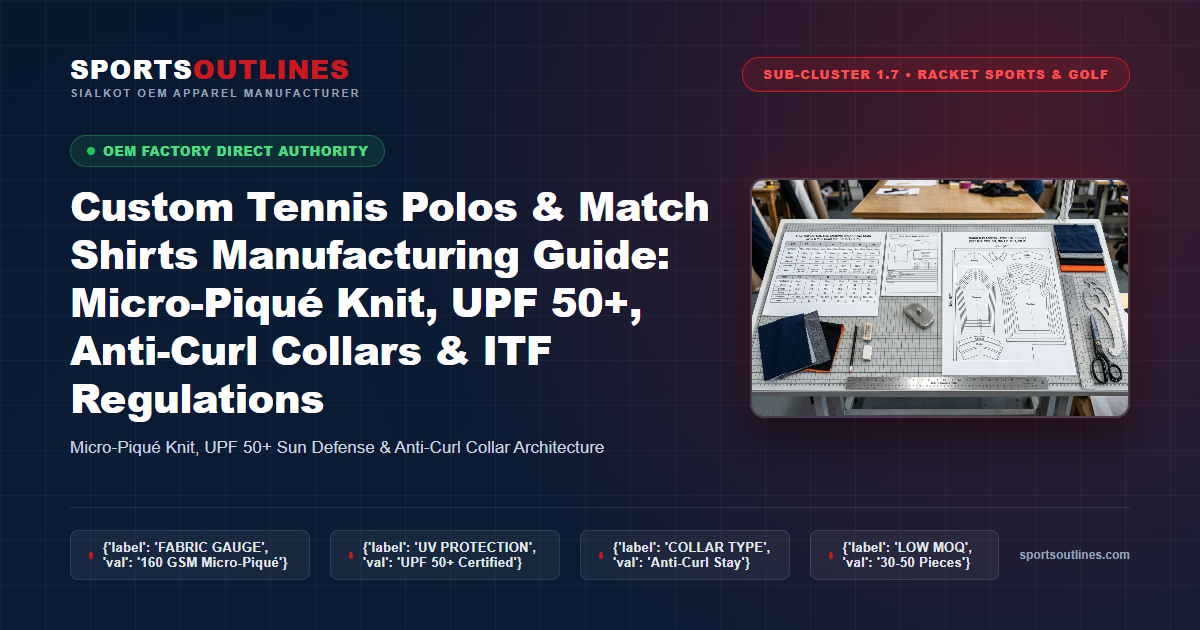
Manufacturing professional custom tennis polos and match shirts requires precision technical knitting, ergonomic upper-body tailoring for high-velocity overhead serves, and strict compliance with international tournament dress codes. Elite tennis polos are constructed from 150 to 165 GSM micro-piqué or honeycomb performance polyester (92% polyester / 8% spandex) with built-in UPF 50+ ultraviolet protection (AS/NZS 4399:2020) and hydrophilic moisture-wicking capillary yarn channels. The micro-waffle piqué knit lifts damp fabric off the skin during multi-hour matches under direct sunlight. To ensure sharp presentation through grueling sets, necklines feature an anti-curl flat-knit ribbed collar or self-fabric collar reinforced with woven fusible interlining, paired with a clean 3-button placket anchored by break-resistant 4-hole cross-stitched melamine buttons. Shoulder architecture incorporates modified raglan sleeves or underarm diamond motion gussets that eliminate fabric pulling during maximum humeral abduction on serves and smashes. Garments strictly comply with International Tennis Federation (ITF) and Grand Slam commercial regulations (limiting manufacturer logos to 19.5 cm² and commercial sleeve patches to 26 cm²) as well as traditional club all-white standards. Factory direct low MOQ at our Sialkot facility starts at 30 to 50 pieces per style/colorway with split youth (YS–YXL) and adult (S–3XL) sizing. Pre-production physical prototype samples cost $45 to $85 per custom polo delivered in 7 to 10 business days.
- Fabric Construction: 160 GSM Micro-Piqué Poly-Spandex with UPF 50+ Ultraviolet Radiation Blocker.
- Collar Architecture: Anti-curl heat-set flat-knit collar with woven fusible interlining and collar stay pockets.
- Service Motion Tailoring: Modified raglan shoulder seams with underarm ventilation motion gussets.
- Tournament Compliance: 100% compliant with ITF Rule 27 uniform branding and traditional club white rules.
- Placket Engineering: 3-button reinforced placket with cross-stitched shatterproof melamine buttons.
- Factory Direct Low MOQ: 30–50 polos per team order with split adult and youth size curves.
- Physical Prototype Sampling: $45–$85 per custom piece in 7–10 days (strict zero credit/refund policy).
- Direct Sourcing Communication: WhatsApp factory direct at +92 316 7932595 or sportsoutlines.com.
In modern competitive tennis, match play is a test of athletic stamina, explosive shoulder power, and refined aesthetic tradition. Players endure three-hour baseline wars under brutal midday summer heat, generating racquet-head speeds exceeding 120 mph on serves and lunging into deep lateral slides on clay and hard courts.
When tennis academies, country clubs, and private sportswear labels order standard promotional golf shirts or corporate polo blanks, the performance flaws are immediately obvious: heavy cotton-poly piqué fabrics soak up sweat like sponges and cling heavily to the player’s torso, cheap ribbed collars curl up into unsightly “bacon collar” wrinkles after two machine washes, and restrictive set-in armholes yank the entire polo untucked every time a player reaches for an overhead smash.
For tennis academy directors, collegiate coaches, country club apparel buyers, and sportswear entrepreneurs across the United States, Canada, the United Kingdom, and Australia, sourcing legitimate high-performance tennis polos with low factory MOQs is essential for building a premium brand reputation.
At Sports Outlines in Sialkot, Pakistan, our dedicated technical tailoring workshop crafts bespoke tennis polos, match tops, and tournament teamwear for elite academies and independent athletic brands worldwide. This comprehensive manufacturing guide breaks down micro-piqué textile physics, overhead serve sleeve mechanics, anti-curl collar engineering, ITF regulatory compliance, Points of Measure (POM), laboratory quality benchmarks, and factory direct low MOQ production economics.
1. Textile Engineering: Micro-Piqué vs. Interlock Knit for Tennis
Choosing between piqué and interlock knits determines how a tennis polo handles relentless perspiration, airflow, and tactile skin friction:
The Micro-Piqué Advantage: Capillary Cooling Chambers
Traditional tennis polos dating back to René Lacoste utilized heavy 240 GSM 100% cotton pique. Modern performance tennis requires an evolved 155 to 165 GSM micro-piqué knitted from 92% microfiber polyester and 8% spandex. The geometric waffle knit structure creates microscopic recessed pockets across the inner surface. These geometric air chambers keep the fabric slightly suspended off the player’s epidermis. Even when drenched with perspiration during grueling tiebreak sets, the polo maintains a 60% reduced contact area against the skin, preventing cling, skin chafing, and rapid hypothermic cooling during changeovers.
Hydrophilic Capillary Yarn Channels vs. Cotton Blends
Cotton fibers absorb moisture internally into their cellular lumen, swelling up to 20% in diameter and becoming heavy, soggy, and slow to dry. In contrast, our engineered microfiber polyester yarns feature multi-grooved trilobal cross-sections. Instead of trapping water within the polymer core, capillary action forces sweat along micro-grooves to the garment’s outer face, where it disperses across a wide surface area for near-instant evaporation under outdoor court breezes.
UPF 50+ Solar Radiation Defense
Unlike indoor court sports, tennis athletes play under extreme UV solar radiation for hours on end. Standard light white polyester t-shirts often offer a meager UPF rating of only 10 to 15, allowing harmful UVA and UVB rays to burn the athlete’s shoulders. We engineer our tennis micro-piqué yarn with titanium dioxide (TiO2) particles embedded directly into the extruded polymer core during yarn extrusion, achieving a certified UPF 50+ rating (AS/NZS 4399:2020) that blocks 98%+ of harmful ultraviolet rays permanently, unaffected by machine laundering.
2. Technical Fabric Comparison for Tennis Apparel
The table below illustrates the mechanical and performance metrics across the four primary fabrics evaluated in our Sialkot testing laboratory for racket sports apparel:
3. Biomechanical Sleeve Engineering for the Tennis Serve Motion
The biomechanics of a tennis serve involve full shoulder abduction (up to 180°) paired with rapid internal rotation and scapular upward elevation. Standard commercial polo shirts use traditional set-in sleeves with low armhole openings designed for stationary office wear:
- The Set-In Sleeve Trap: When a player raises their racquet arm into the “trophy position,” standard low-cut armscye seams pull upward on the torso fabric. This yanks the polo hem up past the waistband, breaks the athlete’s rhythm, and restricts full shoulder extension.
- Modified Raglan Shoulder Geometry: We engineer a curved modified raglan sleeve that extends directly from the neckline across the clavicle. By eliminating top shoulder seams, the sleeve rotates independently of the torso panel, allowing fluid 360-degree overhead racquet velocity.
- Underarm Motion Diamond Gusset: In high-performance styles, we insert an elongated diamond-shaped stretch mesh panel into the armpit. This provides dual benefits: an extra 5.0 cm of upward reach without disturbing the waist hem, and high-velocity convective airflow directly across major lymphatic sweat glands.
- Drop-Tail Hem with Side Vents: The polo hem is engineered with a 2.5 cm drop-tail back hem and reinforced herringbone tape side vents (3.5 cm split), allowing the polo to stay neatly tucked into shorts or match skirts during aggressive court slides.
4. Collar Architecture: Anti-Curl Engineering & Placket Construction
A tennis polo’s collar is its defining signature. A limp, wrinkled collar ruins an academy’s brand image. We deploy three distinct engineering defenses against collar degradation:
The Reinforced 3-Button Placket
Our plackets are engineered with internal heat-activated interfacing to ensure the front closure stays flat without puckering. Buttons are molded from high-impact melamine resin, cross-stitched with 100% bonded polyester thread, and bartacked at the base box to resist thousands of high-velocity pulls during aggressive match play.
5. International Tennis Federation (ITF) & Club Dress Code Compliance
Tennis is governed by strict commercial and aesthetic regulations across professional tournaments and historic lawn tennis clubs:
- ITF Commercial Logo Limits (Rule 27 / Code of Conduct): Manufacturer logos on the chest must not exceed 19.5 cm² (3.0 sq. inches). Two sleeve sponsor patches are permitted, each strictly capped at 26 cm² (4.0 sq. inches). We calibrate our digital embroidery and heat-transfer dies to exact dimensional tolerances to prevent player disqualifications.
- The All-White Lawn Tennis Standard: Traditional private clubs and prestigious tournaments mandate 90%+ white garments with strict limits on trim colors (typically no wider than 10 mm along collars or hems). We dye-sublimate or mill pure optical white fabrics with UV-resistant optical brighteners that never yellow under repeated solar exposure.
- Modern Academy Vibrant Colorways: For youth circuits, USTA leagues, and collegiate teams, we execute full 360-degree digital sublimation with Pantone Matching System (PMS) color accuracy for dynamic geometric graphics, gradient fades, and custom academy crests.
6. Technical Points of Measure (POM) & Size Grading Matrix
Our standardized Points of Measure (POM) chart covers adult and youth sizing curves:
7. Laboratory Quality Standards & Physical Performance Benchmarks
To verify that every polo maintains tournament-grade performance across dozens of heavy wash cycles and sun exposures, production lots are tested according to international textile protocols:
8. B2B Sourcing Economics: Unit Costs, Sampling Rules & Low Factory MOQ
Traditional overseas golf and tennis apparel factories demand 300 to 500 unit minimums per colorway. At Sports Outlines, our streamlined athletic knit division empowers independent brands, academies, and clubs to source custom tennis polos starting at only 30 to 50 pieces per style:
Physical Prototype Sampling Policy: $45–$85 in 7–10 Business Days
Before placing bulk academy or brand orders, we produce a physical prototype sample tailored to your exact tech pack specifications. Physical prototype samples cost $45 to $85 per custom polo. This fee covers digital pattern drafting, micro-piqué knitting, collar interlining fusion, embroidery or sublimation setup, and laboratory colorfastness testing over a 7 to 10 business day timeline. We enforce a firm zero-refund and zero-credit policy on all sampling fees. Once approved, the physical prototype represents the definitive production benchmark for bulk manufacturing.
Export Finishing & Boutique Retail Packaging
Every finished polo passes through automated vacuum thread-trimming tables and undergoes high-pressure steam ironing with cardboard collar supports to preserve a pristine fold. Polos are folded with acid-free tissue cards, equipped with custom printed recycled hangtags, and sealed inside 40-micron frosted zipper polybags with moisture-absorbing silica packets. Cartons are 5-ply export grade (50 units per carton, under 16 kg gross weight) ready for door-to-door air freight via DHL/FedEx to clubs and retail distribution centers globally.
8. Sustainable Recycled Polyester (rPET) & GRS-Certified Eco Options
For tennis apparel brands committed to environmental sustainability and corporate responsibility, our Sialkot facility provides Global Recycled Standard (GRS) certified 100% recycled polyester (rPET) micro-piqué knits. Derived from post-consumer recycled plastic bottles, these eco-conscious yarns undergo high-temperature purification, repolymerization, and micro-denier extrusion to achieve tactile softness, tensile burst strength, and capillary wicking channels identical to virgin performance polyester.
Integrating rPET into your tennis apparel line cuts greenhouse gas emissions by up to 45% and conserves 50% more freshwater during processing compared to conventional polyester manufacturing. Each polo consumes approximately 12 to 15 recycled plastic bottles, providing a compelling eco-marketing story for tournament directors and eco-conscious private label collections without sacrificing durability, UPF 50+ UV solar protection, or anti-curl collar integrity through 50+ industrial washes.
Manufacture Custom Tennis Polos & Match Shirts
Equip your tennis academy, country club, or designer sportswear brand with tournament-grade tennis polos engineered in Sialkot. Featuring 160 GSM UPF 50+ micro-piqué, anti-curl collars, raglan serve gussets, and ITF-compliant tailoring. Low MOQ of 30–50 pieces with 7–10 days physical sampling.
9. Frequently Asked Questions (FAQ) — Custom Tennis Polo Manufacturing
1. Why is micro-piqué preferred over standard flat polyester for tennis polos?
Micro-piqué features a raised geometric waffle weave that creates microscopic air gaps between the textile and skin. This structure reduces fabric-to-skin surface contact by over 60%, preventing cling when wet, accelerating convective evaporative cooling, and providing a sophisticated country club drape that flat interlock fabrics cannot replicate.
2. How do you prevent collar curling (“bacon collar”) on your polos?
We utilize high-twist heat-set polyester yarns with integrated Lycra edge tipping on flat-knit rib collars, and heat-fused woven interlinings on self-fabric collars. This structural reinforcement prevents the edges from rolling, curling, or sagging, maintaining a crisp professional collar stand through 50+ industrial laundry cycles.
3. What is the minimum order quantity (MOQ) for custom tennis polos?
Our factory direct low MOQ is 30 to 50 pieces per style/colorway. You can split this volume across youth (YS to YXL) and adult (S to 3XL) sizes to outfit junior academy players, varsity teams, and adult coaching staffs.
4. How much does a physical sample prototype cost, and what is the turnaround time?
A physical custom prototype sample costs $45 to $85 per piece. Prototyping takes 7 to 10 business days for CAD grading, collar knitting, logo embellishment, and lab quality audits, followed by 4 to 6 business days for air delivery. We enforce a firm zero-refund and zero-credit policy on all sampling fees.
5. Are your tennis polos compliant with International Tennis Federation (ITF) rules?
Yes. We design and calibrate manufacturer logos to strictly adhere to ITF Rule 27 guidelines (maximum 19.5 cm² for manufacturer chest logos and 26 cm² for commercial sleeve patches), ensuring your athletes never face kit disqualifications during junior ITF or pro tour events.
6. Can you manufacture all-white polos for strict lawn tennis club dress codes?
Yes. We produce 90%+ all-white match polos treated with UV-resistant optical brighteners that stay brilliant white without yellowing. Subtle club branding can be executed in tonal matte white embroidery or micro-tipping along the collar edge.
7. What is the difference between raglan and set-in sleeves for tennis?
Set-in sleeves have vertical seamlines over the shoulder joint that pull the shirt up during serves. Raglan sleeves eliminate the top shoulder seam, extending diagonally to the collar, which allows total freedom of overhead racquet elevation without disturbing the waistband.
8. Does the UPF 50+ sun protection wash out over time?
No. Our UPF 50+ sun protection is achieved by embedding inorganic titanium dioxide nanoparticles directly into the extruded polyester fiber matrix during polymer spinning. It is a permanent physical barrier that cannot wash out or degrade over time.
9. What button options do you provide for custom tennis polos?
We supply shatterproof 4-hole melamine buttons, custom logo-engraved pearlized buttons, or concealed rubber snap closures engineered to stay flat during high-intensity diving volleys.
10. Can you match polo designs with women’s tennis tops and match skorts?
Yes. We engineer complete co-ed club packages, coordinating fabric dyes, collar trims, and sublimation artwork across men’s polos, women’s sleeveless racerbacks, and pleated tennis match skorts for a unified club identity.
Explore Related Racket Sports & Teamwear Manufacturing Guides:
Complete your club uniform collection with our factory guides on Custom Sideline Rain Jackets, Custom Warmup Tracksuits, Custom Sublimated Team Jerseys, or browse our Full Sportswear Catalog.