For decades, petroleum-derived polyamides—specifically Nylon 6 and Nylon 6.6—have reigned as the gold standard in premium athleisure, high-compression leggings, and luxury activewear. Nylon’s incomparably supple hand-feel, supreme tensile tenacity ($> 5.0\text{ cN/tex}$), superior elastic recovery, and remarkable abrasion resistance make it the fiber of choice for brands competing at the highest tier of the activewear market. However, as global decarbonization mandates intensify and performance brands face growing scrutiny over fossil fuel reliance, conventional nylon has become an environmental liability. Synthesizing petrochemical nylon requires energy-intensive refining of crude oil, producing massive greenhouse gas emissions and releasing nitrous oxide ($N_2O$)—a greenhouse gas nearly 300 times more potent than carbon dioxide—during adipic acid synthesis.
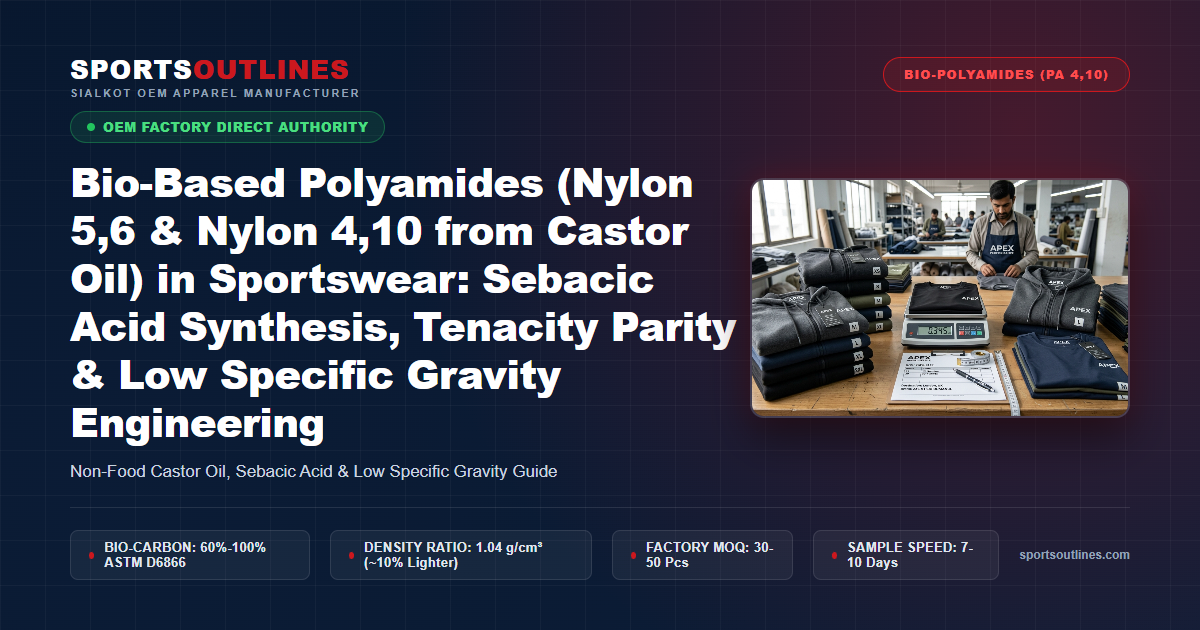
The sustainable frontier in high-performance synthetic textiles belongs to bio-based polyamides derived from non-food castor bean oil (Ricinus communis), headlined by next-generation polymers like Polyamide 4,10, Polyamide 5,6, and Polyamide 11 (commercialized in specialized yarns such as EVO® by Fulgar and Rilsan®). By replacing petroleum feedstocks with bio-based sebacic acid, these revolutionary bio-nylons achieve 60% to 100% bio-based carbon content without competing with human food crops. Even more compelling for technical apparel designers, bio-polyamides deliver extraordinary physical engineering advantages over fossil nylon: a remarkably lower specific gravity ($1.04\text{ g/cm}^3$ vs $1.14\text{ g/cm}^3$), reduced moisture regain, 50% faster dry rates, and inherent bacteriostatic odor resistance. At Sports Outlines, operating from our technical apparel manufacturing center in Sialkot, Pakistan, we engineer certified bio-nylon activewear collections with accessible factory minimums of 30 to 50 pieces per style/colorway and dedicated physical prototype sample development at $45 to $85 per piece (non-refundable) within 7 to 10 business days.
Technical Sourcing & Polymer Science Directory
- 1. Castor Bean Agronomy: Non-Food Feedstocks & Arid Soil
- 2. Chemical Synthesis: Sebacic Acid & Bio-Polyamide Polymerization
- 3. Low Specific Gravity Physics & Lightweight Garment Geometry
- 4. Moisture Regain, Drying Kinetics & Odor Immunity
- 5. Circular Knitting, Acid Dyeing & Fastness Profiles
- 6. Engineering Matrix: Bio-Nylon vs Nylon 6.6 vs PET
- 7. ASTM D6866 Carbon-14 Dating & Certification Standards
- 8. Low-MOQ Sourcing & Commercial Factory Terms
- 9. B2B Activewear Engineering FAQ
1. Castor Bean Agronomy: Non-Food Feedstocks on Marginal Arid Soils
The primary ethical critique leveled against first-generation bio-plastics (such as corn-derived PLA or sugarcane-derived bio-PET) is the “food versus fuel” conflict. Diverting fertile arable land, freshwater irrigation, and food crops to produce disposable packaging or textiles can drive food price inflation, incentivize deforestation, and accelerate biodiversity loss.
Bio-based polyamides circumvent this ethical pitfall entirely through their agronomic source: the castor bean plant (Ricinus communis). Castor is a hardy perennial shrub cultivated predominantly in arid and semi-arid regions of Gujarat, India, Brazil, and China. It possesses unique agronomic characteristics that make it the premier sustainable feedstock for industrial polymer synthesis:
- Zero Competition with Human or Animal Food: Castor seeds contain ricin (a toxic protein) and ricinine (an alkaloid), making them inedible and completely unfit for human or livestock consumption. Castor agriculture does not compete with global food security.
- Cultivation on Marginal, Degraded Soils: Castor plants flourish in dry, alkaline, marginal soils where conventional cereal crops (wheat, corn, rice) cannot survive. They require no fertile topsoil and actually contribute to soil remediation by preventing wind erosion in arid landscapes.
- Minimal Irrigation and Chemical Inputs: Castor is naturally drought-resistant, relying primarily on seasonal monsoon rains with minimal need for fossil-fueled artificial groundwater pumping, synthetic nitrogen fertilizers, or heavy pesticides.
- High Oil Yield: Castor seeds are rich in lipids, containing 45% to 55% extractable oil by weight. Upwards of 85% to 90% of this fatty acid content consists of a single, highly specialized molecule: ricinoleic acid.
2. Chemical Synthesis Routes: Ricinoleic Acid Cleavage to Sebacic Acid and Polyamide Polymerization
The chemical elegance of castor oil lies in the unique structure of ricinoleic acid (12-hydroxy-9-cis-octadecenoic acid, $C_{18}H_{34}O_3$). Unlike common vegetable oils (soybean, palm, canola) which consist of simple triglycerides with unfunctionalized hydrocarbon chains, ricinoleic acid features a natural hydroxyl group ($-OH$) at the 12th carbon position and an isolated cis-double bond between the 9th and 10th carbons. This functional hydroxyl group provides a natural chemical “handle” for precision industrial cracking.
To synthesize bio-based polyamides, castor oil undergoes alkaline thermal cleavage (pyrolysis) at 250°C to 280°C in the presence of molten sodium hydroxide ($NaOH$). This reaction splits the 18-carbon ricinoleic acid chain into two valuable industrial compounds:
- Sebacic Acid (Decanedioic Acid, $HOOC-(CH_2)_8-COOH$): A 10-carbon linear aliphatic dicarboxylic acid. Sebacic acid serves as the universal bio-monomer building block for high-performance polyamides, completely replacing fossil-derived adipic acid ($HOOC-(CH_2)_4-COOH$).
- 2-Octanol ($C_8H_{17}OH$): An 8-carbon secondary alcohol produced as a co-product, widely used as an industrial bio-solvent, plasticizer, and flavoring precursor.
Once purified through multi-stage crystallization, bio-sebacic acid is reacted with diamines to synthesize two primary performance polyamides for athletic apparel:
- Polyamide 4,10 (PA 4,10): Produced via the condensation polymerization of 1,4-diaminobutane (putrescine, a 4-carbon diamine derived from bio-fermentation of plant starches) and bio-sebacic acid (10 carbons). PA 4,10 achieves 70% to 100% bio-based carbon content. It features a high melting point ($T_m \approx 250^\circ\text{C}$), high crystallinity, and exceptional tensile modulus.
- Polyamide 5,6 (PA 5,6): Synthesized by reacting 1,5-pentamethylenediamine (cadaverine, derived from microbial fermentation of corn glucose) with adipic acid or sebacic acid. PA 5,6 delivers a luxurious, silk-like hand-feel matching or exceeding luxury Nylon 6.6, with a melting temperature ($T_m \approx 252^\circ\text{C}$) and high dye uptake at moderate temperatures.
- Polyamide 11 (PA 11 / Rilsan®): Synthesized through the thermal cleavage of ricinoleic acid methyl ester into methyl undecylenate, followed by hydrobromination and amination into 11-aminoundecanoic acid. This single amino-acid monomer undergoes self-polycondensation to yield 100% bio-based Nylon 11, prized for ultra-low moisture absorption and extreme impact toughness in technical sports footwear, windbreaker shells, and compression sleeves.
During the stoichiometric polycondensation inside stainless-steel autoclaves at 240°C to 260°C under a continuous nitrogen purge, equimolar quantities of bio-sebacic acid and diamine react to form a nylon salt intermediate. Water of condensation is continuously removed under vacuum ($P < 5\text{ mbar}$) to drive the equilibrium toward high molecular weights ($M_n > 18,000\text{ g/mol}$). The resulting bio-polyamide chips exhibit a narrow polydispersity index ($M_w/M_n \approx 1.9 – 2.1$), ensuring exceptional spin-pack stability and uniform filament diameter during high-speed take-up at 4,500 meters per minute.
3. Low Specific Gravity Physics: Engineering Ultra-Lightweight Activewear Garments
Beyond its exceptional carbon-reduction credentials, bio-based polyamide possesses a physical property that elevates it above all conventional activewear fibers: exceptionally low specific gravity (density).
Specific gravity ($\rho$) defines the mass per unit volume of a polymer. In athletic garments, a lower specific gravity means that a yarn delivers greater volumetric coverage, loft, and visual opacity at a lower physical fabric weight. Consider the comparative polymer densities:
- Petroleum Polyethylene Terephthalate (Polyester): $\rho \approx 1.38\text{ g/cm}^3$
- Petrochemical Polyamide 6.6 (Nylon 6.6): $\rho \approx 1.14\text{ g/cm}^3$
- Petrochemical Polyamide 6 (Nylon 6): $\rho \approx 1.13\text{ g/cm}^3$
- Bio-Based Polyamide 4,10 / PA 11: $\rho \approx 1.04\text{ to }1.06\text{ g/cm}^3$
This represents a massive physical engineering advantage:
| Garment Construction Parameter | Standard Polyester Activewear | Petroleum Nylon 6.6 Activewear | Bio-Based PA 4,10 Activewear |
|---|---|---|---|
| Polymer Specific Gravity ($\rho$) | 1.38 g/cm³ (Heaviest) | 1.14 g/cm³ | 1.04 g/cm³ (Ultralight) |
| Fabric Weight for Identical Opacity | 260 GSM (Standard interlock) | 240 GSM | 215 GSM (~17% lighter) |
| Leggings Garment Weight (Size M) | 245 grams | 210 grams | 185 grams (Featherlight feel) |
| Squat-Proof Opacity Retention | High density required | Good opacity | Superior coverage at lower GSM |
| Athlete Perception on Skin | Noticeable weight; warm | Silky, compressive | “Second-skin” weightless drape |
Because bio-nylon is 10% lighter than standard Nylon 6.6 and up to 25% lighter than polyester, activewear designers can engineer garments that feel completely weightless on the body while providing 100% squat-proof modesty and muscular support. For marathon runners, trail athletes, and high-intensity fitness enthusiasts, reducing apparel weight directly translates into lower metabolic energy expenditure.
In circular knitting geometry, fabric cover factor ($CF$) is mathematically proportional to the square root of yarn linear density divided by polymer density ($CF \propto \sqrt{Tex}/\sqrt{\rho}$). Because bio-polyamide has a significantly lower density $\rho$, each filament occupies a wider cross-sectional area per unit mass, producing superior optical coverage without requiring heavy yarn deniers or high machine courses per inch.
4. Moisture Regain Thermodynamics, Rapid Drying Kinetics, and Natural Bacteriostatic Odor Immunity
One of the notorious operational defects of standard petrochemical Nylon 6 and 6.6 is moisture regain. Conventional nylon possesses a standard moisture regain of 4.0% to 4.5% under standard atmospheric conditions (65% RH, 20°C). During intense athletic output, nylon fibers absorb sweat water into their amorphous core, causing the fibers to swell, become heavy and clammy, cling to the athlete’s skin, and take up to 60–80 minutes to dry completely.
Bio-based polyamides solve this through macromolecular spacing. Because bio-sebacic acid contributes an 8-methylene carbon spacer ($-(CH_2)_8-$) along the polymer backbone, the concentration of polar amide groups ($-NH-CO-$) per unit chain length is significantly lower than in Nylon 6.6 (which has only 4-methylene and 6-methylene spacers). This molecular geometry reduces hydrogen-bonding sites for water molecules, dropping the standard moisture regain of PA 4,10 to just 1.8% to 2.2%.
This tailored hydrophilicity delivers three profound physiological benefits:
- 50% Faster Evaporative Drying Rates: Tested under AATCC 195 (Liquid Moisture Management) and AATCC 199 (Drying Time of Textiles), bio-nylon knits dry in just 22 to 28 minutes, compared to 55 to 65 minutes for standard Nylon 6.6 knits, preventing post-workout evaporative chills.
- Dimensional Stability Under Perspiration: Standard nylon stretches out and loses compression modulus when saturated with wet sweat. Bio-nylon absorbs less than half the water mass, retaining tight muscular compression throughout marathon-length sessions.
- Inherent Natural Bacteriostatic Odor Control: Unlike polyester—whose lipophilic surface greedily absorbs sebum and apocrine body lipids, harboring odor-causing Corynebacterium and Staphylococcus epidermidis bacteria (the notorious “permastink” phenomenon)—bio-nylon exhibits natural bacteriostatic properties. Tested according to ISO 20743, bio-polyamide inhibits bacterial proliferation naturally without requiring toxic topical biocides, silver nanoparticle coatings, or zinc pyrithione finishes.
5. Circular Knitting Engineering, Acid Dyeing Kinetics, and Colorfastness Profiles
On the factory floor, bio-based polyamide filaments behave with pristine mechanical predictability. At Sports Outlines, our knitting technicians run bio-nylon yarns (typically DTY 40D/34F, 70D/68F, or micro-filament 30D/36F) across our high-gauge circular knitting machines (28G to 36G) and Karl Mayer warp-knit tricot machines.
When compounded with premium elastane (Creora® HighClo or Lycra®), bio-nylon produces luxurious activewear knits:
- 28G/32G High-Modulus Interlock (210–240 GSM): Constructed with 78% Bio-PA 4,10 and 22% elastane. Engineered specifically for luxury squat-proof yoga leggings and compression shorts, delivering a cool-touch liquid drape, zero grin-through, and 98% shape recovery after 500 stretch cycles.
- 36G Ultralight Running Jersey (110–135 GSM): 100% Bio-Nylon micro-filament jersey. Engineered for elite marathon race singlets, weighing under 75 grams per finished top with anti-chafe skin contact.
- 32G Warp-Knit Tricot (180–210 GSM): Ladder-proof warp-knit construction for high-impact sports bras, triathlon suits, and competitive swimwear resistant to pool chlorine and sea salt.
In the wet processing facility, bio-nylon is colored using metal-free acid dyes or reactive dyes at 98°C to 100°C under atmospheric pressure—avoiding the high temperatures ($130^\circ\text{C}$) and high pressures required for polyester disperse dyeing, thereby saving substantial thermal energy. The terminal amine end groups ($-NH_2$) of bio-polyamide provide high affinity for acid dyestuffs, achieving exhaustion rates over 95%, exceptional color depth, and flawless wash fastness (ISO 105-C06 Grade 4–5) and perspiration fastness (ISO 105-E04 Grade 5).
Because bio-nylon has a slightly lower concentration of polar amine groups per chain volume than Nylon 6, strike rates are inherently more controllable. We employ amphoteric leveling agents and buffered sodium acetate/acetic acid systems to maintain bath pH between 4.8 and 5.2. This prevents rapid surface strike and ensures uniform dye migration into the fiber core, virtually eliminating barré streaks, edge-to-center shading, and side-to-side tone variations across large dye lots.
6. Comprehensive Technical Engineering Matrix: Bio-Nylon vs Petrochemical Nylon 6.6 vs Polyester
To provide apparel directors and sourcing founders with transparent empirical data, the following matrix compares laboratory physical and environmental metrics across bio-polyamide, petroleum Nylon 6.6, and petroleum polyester:
| Physical & Environmental Metric | Bio-Based PA 4,10 (Castor) | Petroleum Nylon 6.6 | Petroleum Polyester (PET) | Governing Test Standard |
|---|---|---|---|---|
| Bio-Based Carbon Content | 60% – 100% Bio-Carbon | 0% (Fossil Feedstock) | 0% (Fossil Feedstock) | ASTM D6866 / EN 16640 |
| Specific Gravity (Polymer Density) | 1.04 – 1.06 g/cm³ (Lowest) | 1.14 g/cm³ | 1.38 g/cm³ (Heaviest) | ASTM D792 / ISO 1183 |
| Filament Tensile Tenacity | 4.8 – 5.2 cN/tex | 5.0 – 5.5 cN/tex | 4.4 – 4.7 cN/tex | ASTM D2256 / ISO 2062 |
| Standard Moisture Regain | 1.8% – 2.2% (Optimized) | 4.2% – 4.5% (High sweat cling) | 0.4% (Hydrophobic) | ASTM D1909 (65% RH, 21°C) |
| Fabric Drying Time (AATCC 199) | 24 ± 3 minutes (Fast) | 58 ± 6 minutes (Slow) | 22 ± 3 minutes (Fast) | AATCC 199 Dynamic Dry Rate |
| Martindale Abrasion Resistance | > 55,000 rubs (Grade 4-5) | > 60,000 rubs (Grade 5) | > 45,000 rubs (Grade 4-5) | ISO 12947-2 (9 kPa) |
| Odor Bacteriostatic Behavior | Inherent Natural Resistance | Moderate; absorbs moisture | Poor; lipid permastink risk | ISO 20743 Bacterial Reduction |
This matrix proves conclusively that bio-based polyamide does not compromise on mechanical tenacity or abrasion durability. Instead, it unlocks superior activewear performance by combining nylon’s luxurious softness with lower garment weight, faster drying times, and sustainable non-food agronomy.
7. ASTM D6866 Carbon-14 Dating and Chain-of-Custody Certification Standards
To validate bio-based claims and protect brands from accusations of greenwashing, bio-polyamide textiles undergo radiocarbon testing according to ASTM D6866 / EN 16640. This methodology relies on Carbon-14 ($^{14}C$) isotope ratio analysis via Accelerator Mass Spectrometry (AMS):
- Radiocarbon Scientific Principle: Living plants (such as castor beans) assimilate atmospheric carbon dioxide containing a known, natural equilibrium concentration of radioactive $^{14}C$. In contrast, fossil fuels (crude oil, natural gas) were buried millions of years ago—well past the $^{14}C$ radioactive half-life (5,730 years)—meaning fossil feedstocks contain exactly zero $^{14}C$.
- Precise Bio-Carbon Percentage Measurement: By measuring the ratio of $^{14}C$ to $^{12}C$ in a fabric specimen, accredited laboratories calculate the exact percentage of modern bio-based carbon versus fossil-derived carbon with an analytical precision of $\pm 1.0\%$.
- USDA BioPreferred® & DIN CERTCO Certification: Certified bio-polyamide fabrics qualify for the prestigious USDA Certified Biobased Product label and DIN-Geprüft Biobased certifications, providing legal, third-party verified credentials for international packaging and marketing.
The fraction of modern bio-based carbon ($f_M$) is determined via accelerator mass spectrometry by normalizing the measured $^{14}C/^{12}C$ ratio against the National Institute of Standards and Technology (NIST) Oxalic Acid Standard Reference Material (SRM 4990C). The bio-carbon percentage is expressed as:
Where the 1.05 correction factor accounts for thermonuclear weapons testing carbon-14 atmospheric enrichment. This mathematical determination provides unassailable legal proof of non-petroleum origin, allowing brands to make certified carbon-reduction disclosures on global customs declarations and consumer product hangtags.
8. Low-MOQ Sourcing Strategy and Factory Commercial Terms
At Sports Outlines, we believe that advanced, sustainable textile science should not be the exclusive privilege of multi-billion-dollar athletic conglomerates. We have optimized our Sialkot supply chain to offer direct access to premium castor-derived bio-polyamide fabrics under commercial terms tailored for high-growth athletic brands:
- Accessible Production MOQs: Bulk production orders start at just 30 to 50 pieces per style/colorway, enabling brands to produce multi-size collections (XS to 3XL) of bio-nylon leggings, sports bras, and technical tops without excessive cash tie-up.
- Physical Prototype Development: Dedicated pre-production physical prototype samples are developed at $45 to $85 per piece (non-refundable), covering specialized yarn allocation, pattern drafting, grading, and sample construction delivered within 7 to 10 business days.
- Global Export Compliance: Fully compliant export logistics and duty-paid documentation delivered directly to brand hubs across the United States, United Kingdom, Australia, Canada, and Germany.
- Multi-Category Manufacturing: Seamlessly integrated across our specialized manufacturing hubs, including technical sportswear, gym & activewear, and athletic casualwear.
In our garment assembly floor, bio-nylon panels are cut using computerized automated laser-cutting tables to prevent fraying and edge curling. We assemble garments using 4-needle 6-thread flatlock stitch machines (ISO 607) threaded with high-modulus, micro-textured bio-polyamide seam threads, ensuring zero chafing against the athlete’s skin and delivering seam bursting strengths that match the base textile (>420 kPa). Finished garments undergo 100% individual quality inspection before eco-friendly polybag packaging and carton sealing.
To explore related technical analyses of eco-performance synthetic fibers, review our engineering guides on ECONYL® Regenerated Sea Nylon 6, Bio-Based Polyesters & Sorona® (PTT Polymer), and Biodegradable Synthetic Additives (CiCLO®).
Ready to Launch Ultra-Lightweight Activewear with Bio-Based Nylon?
Differentiate your athletic label with castor-derived bio-polyamide. Deliver 10% lower garment weight, rapid drying times, and verified 60%–100% bio-based carbon credentials. Partner with Sports Outlines to build your custom collection with our accessible 30–50 piece factory MOQ.
9. Technical Frequently Asked Questions (FAQ) for Activewear Founders
Q1: How does castor-derived bio-nylon differ from conventional petroleum Nylon 6 and Nylon 6.6?
Petroleum nylon is synthesized using fossil feedstocks (crude oil derivatives like cyclohexane and benzene) and adipic acid, which generates massive nitrous oxide emissions. Castor bio-nylon replaces petroleum acids with sebacic acid derived from non-food castor bean oil (Ricinus communis), delivering 60% to 100% bio-based carbon content. Physically, bio-nylon is ~10% lighter (density 1.04 vs 1.14 g/cm³), has lower moisture regain (1.8% vs 4.2%), dries twice as fast, and possesses natural bacteriostatic odor resistance.
Q2: Does growing castor beans compete with global human food supply or cause deforestation?
No. Castor beans contain toxic ricin, making them completely inedible for humans or animals. Furthermore, the castor plant is a hardy perennial shrub cultivated on arid, semi-desert marginal land where food crops (wheat, corn, rice) cannot grow. It requires no irrigation beyond natural seasonal monsoon rains, zero fertile topsoil, and minimal agricultural chemicals, completely avoiding the “food vs fuel” conflict.
Q3: Why is low specific gravity (density) such an important advantage in athletic leggings and sports bras?
A lower specific gravity (1.04 g/cm³ for bio-polyamide vs 1.14 g/cm³ for nylon 6.6 and 1.38 g/cm³ for polyester) means that fibers provide greater physical bulk, volumetric coverage, and visual opacity at a lower fabric weight. A bio-nylon legging achieves complete 100% squat-proof opacity at just 215 GSM, compared to 240 GSM in standard nylon or 260 GSM in polyester, reducing garment weight by 15% to 25% and creating a luxurious “weightless second-skin” sensation on the body.
Q4: How is the bio-based content of castor nylon verified to prevent greenwashing?
Bio-content is scientifically measured using radiocarbon testing under ASTM D6866 and EN 16640 via Accelerator Mass Spectrometry (AMS). Because modern plants absorb radioactive Carbon-14 from the atmosphere while fossil fuels have zero Carbon-14, measuring the 14C/12C isotope ratio accurately determines the exact bio-carbon percentage (60% to 100%), qualifying fabrics for official USDA BioPreferred® and DIN CERTCO certifications.
Q5: What are the minimum order quantities (MOQ) and prototype terms for custom bio-nylon activewear at Sports Outlines?
Our low factory production minimum is 30 to 50 pieces per style/colorway, supporting custom size curves from XS to 3XL. Physical pre-production prototype samples are produced at $45 to $85 per piece (non-refundable), covering dedicated bio-yarn procurement, custom pattern grading, and precision construction delivered within 7 to 10 business days before bulk manufacturing.