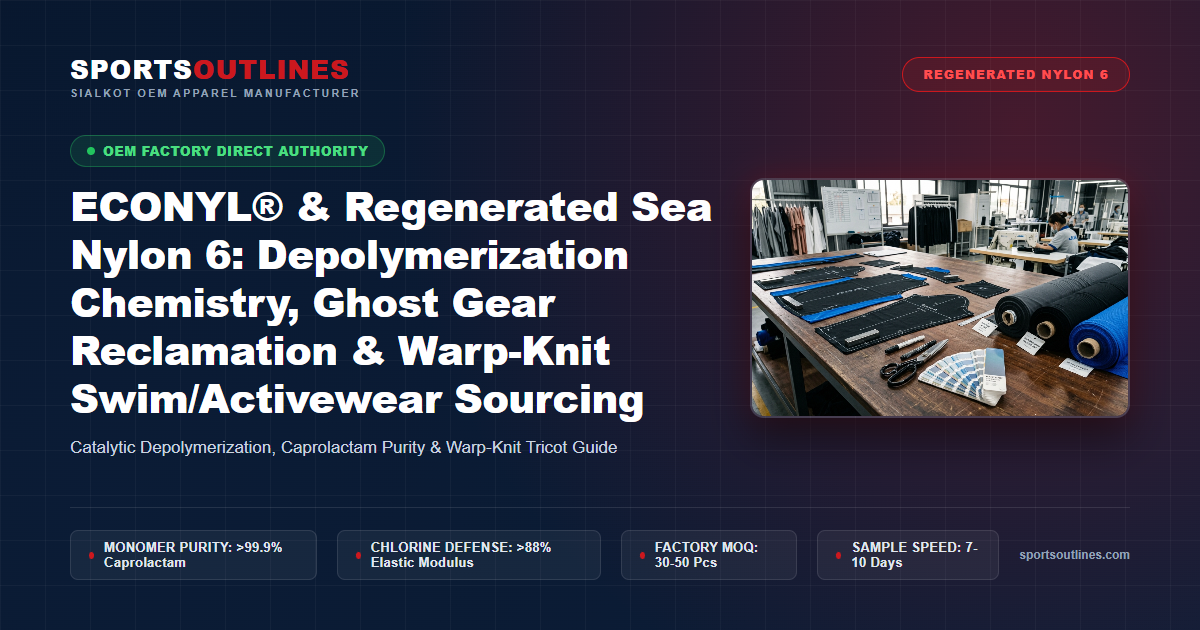
In the specialized sectors of high-performance swimwear, triathlon competition apparel, and ultra-luxury compressive athleisure, nylon (polyamide) reigns supreme over polyester. Polyamide’s unique molecular anatomy—characterized by recurring amide linkages ($-CONH-$) capable of forming inter-chain hydrogen bonds—confers unmatched mechanical abrasion resistance, silky liquid hand-feel, low flexural rigidity, and supreme recovery elasticity. However, as international athletic labels face escalating consumer demand for verifiable ocean-positive environmental stewardship, traditional virgin nylon 6 (derived from crude oil-based caprolactam) faces intense sustainability headwinds. The challenge for technical apparel developers is finding a reliable recycled nylon activewear manufacturer capable of engineering closed-loop regenerated polyamide that delivers the identical tensile elasticity and chlorine durability of virgin nylon without mechanical degradation.
Unlike polyester, which can be mechanically melted down from post-consumer beverage bottles with relative ease, nylon is notoriously thermal-sensitive: mechanical remelting of nylon scrap induces severe thermo-oxidative chain scission, severe yellowing, and dramatic loss of tenacity. The revolutionary solution lies in chemical closed-loop depolymerization, pioneered globally by Aquafil’s ECONYL® regeneration process. By chemically breaking down discarded marine “ghost” fishing nets, industrial carpet fluff, and post-consumer textile waste back into pure monomeric caprolactam, textile engineers can re-synthesize virgin-equivalent Polyamide 6 infinitely. At Sports Outlines, based in Sialkot, Pakistan, our specialized cut-and-sew manufacturing facility transforms certified regenerated nylon yarns into elite warp-knit tricot and circular interlock activewear. We empower emerging athleisure labels and technical swimwear brands to source verified circular textiles with low factory production minimums of 30 to 50 pieces per style/colorway and precision physical prototype sampling at $45 to $85 per piece (non-refundable) delivered in 7 to 10 business days.
Technical Sourcing & Engineering Directory: Regenerated Nylon 6
- 1. Ghost Gear Reclamation & Pre-Consumer Sourcing
- 2. Chemical Depolymerization vs Mechanical Recycling
- 3. Re-Polymerization, Caprolactam Purity & Spinning
- 4. Karl Mayer Warp-Knit Tricot vs Circular Interlock
- 5. Acid Dye Exhaustion & Barre-Free Dyeing
- 6. Kawabata KES-FB Tactile Biophysics & Softness
- 7. Chlorine, Sunscreen & UV Degradation Defense
- 8. Laplace’s Law & Triathlon Speedsuit Dynamics
- 9. Technical Benchmark Matrix: Virgin vs ECONYL
- 10. Clean-Cut Laser Edges & Flatlock Seaming
- 11. Sourcing Economics & Factory Production Terms
- 12. Technical Activewear Sourcing FAQ
1. Ghost Gear Reclamation, Marine Debris Sorting & Pre-Consumer Waste Streams
The raw material foundation of regenerated sea nylon originates from two primary feedstock streams: post-consumer marine waste and post-industrial pre-consumer manufacturing scrap. The most ecologically celebrated feedstock consists of abandoned, lost, or discarded fishing gear—colloquially termed “ghost nets.” Commercial commercial fishing fleets predominantly deploy heavy gillnets, trawls, and aquaculture fish-farm containment pens fabricated from high-tenacity Polyamide 6 due to nylon’s high wet tensile strength, abrasion resistance against ocean rocks, and natural negative buoyancy.
When these synthetic nets are lost at sea, they drift for decades through marine ecosystems, lethally trapping marine life in perpetual entanglement cycles. Recovery organizations (such as the Healthy Seas initiative) partner with commercial dive teams, local fishing communities, and ocean cleanup fleets to salvage these marine nets from ocean floors, reefs, and harbor collection depots.
Once recovered, the marine waste is transported to central sorting and pre-treatment treatment centers where it undergoes rigorous preparation:
- Polymer Separation: Fishing gear often incorporates mixed polymers—such as polypropylene float lines, high-density polyethylene (HDPE) netting, and lead sinker weights. Optical NIR (near-infrared) spectroscopic sensors and water-bath density flotation separate the dense Polyamide 6 ($density \approx 1.14\text{ g/cm}^3$) from floating polyolefins ($density \approx 0.90 – 0.95\text{ g/cm}^3$).
- De-Contamination & Shredding: The nets are washed to extract marine encrustations, organic biomass, sand, and ocean sea salts. They are then mechanically shredded into coarse flakes.
- Industrial Feedstock Blending: To ensure continuous industrial scale, the recovered ghost nets are blended with post-consumer carpet fluff (salvaged from commercial carpet flooring, from which the nylon 6 face yarn is mechanically sheared from the polypropylene backing) and pre-consumer industrial nylon weaving and extrusion scraps.
At this stage, the material is heavily discolored, variable in molecular weight, and chemically contaminated. This heterogeneous mixture cannot be spun into premium activewear yarn via standard mechanical melting—it requires chemical deconstruction back to its fundamental molecular building blocks.
2. Chemical Depolymerization vs. Mechanical Recycling: The Polyamide Challenge
To appreciate why ECONYL® represents a technological leap forward, apparel brand founders must understand why mechanical recycling fails for nylon. In mechanical recycling (the standard method for rPET beverage bottles), plastic flakes are simply washed, melted in an extruder screw at 250°C–270°C, and pushed through spinnerets.
When this mechanical process is attempted on nylon scrap, three catastrophic polymer degradation reactions occur:
Why Mechanical Recycling Destroys Nylon Quality
- Thermal Amide Scission: Nylon’s amide linkages ($-CONH-$) are thermally vulnerable. High melt shear inside the extruder causes chain scission, cutting number-average molecular weight ($M_n$) by 30% to 45%. The resulting yarn suffers severe tenacity loss (< 3.2 cN/dtex), snapping under the high tensions of circular and warp knitting.
- Chromophore Oxidation & Irreversible Yellowing: Secondary oxidation reactions generate conjugated imine and carbonyl groups that permanently stain the polymer yellow/brown. Mechanically recycled nylon cannot achieve clean pastels, vibrant neons, or optical whites.
- Contaminant Inclusions: Melt filtration cannot remove sub-micron dirt, degraded silicone lubricants, or dye molecules trapped inside the recycled nylon. When drawn into micro-denier filaments (e.g., 20-denier swimwear yarn), these particles act as structural stress concentrators, causing microscopic pinholes and yarn breaks.
The Chemical Depolymerization Solution
Chemical depolymerization bypasses mechanical melting entirely. Polyamide 6 is a homopolymer synthesized from a single monomer: epsilon-caprolactam ($C_6H_{11}NO$), a seven-membered cyclic ring. Because of this cyclic structure, the polymerization reaction is theoretically completely reversible.
In the regeneration reactor, the shredded ghost nets and carpet fluff are subjected to high-temperature catalytic steam hydrolysis (temperatures around 250°C to 300°C under phosphoric acid catalyst and superheated steam). The steam cleaves the linear polymer bonds, unzipping the long polyamide chains backwards into gaseous caprolactam monomer:
The gaseous caprolactam is distilled and condensed into a liquid. During this multi-stage fractional distillation, all foreign contaminants—marine salts, dye pigments, dirt, PVC adhesives, and non-nylon plastics—are completely separated and discarded as heavy distillation bottoms. The resulting recovered caprolactam achieves a chemical purity of > 99.9%—indistinguishable in every analytical, spectroscopic, and chromatographic metric from virgin caprolactam derived from petroleum benzene.
3. Re-Polymerization, Caprolactam Purity & Micro-Denier Filament Spinning
Once purified, the regenerated caprolactam undergoes conventional hydrolytic ring-opening polymerization in standard VK tubes (Vereinfacht Kontinuierlich reactors) at 260°C. Water acts as a ring-opening initiator, transforming the cyclic caprolactam into 6-aminohexanoic acid, which polycondenses into virgin-grade linear Polyamide 6 chips.
Because the re-polymerization occurs from pure monomers, polymer scientists can precisely control:
- Relative Viscosity (RV): Calibrated strictly to 2.7 to 3.2 (in 96% sulfuric acid), ensuring the exact melt rheology required for high-speed spinning.
- Delusterant Incorporation: Titanium dioxide ($TiO_2$) particles (0.3% for semi-dull, 1.5% to 2.0% for full-dull) can be uniformly dispersed during the melt phase, eliminating the plastic sheen and transparency common in low-grade activewear fabrics.
- Melt Spinning into Ultra-Fine Filaments: The regenerated chips are melt-spun through micro-orifice spinnerets into fine continuous filament yarns—such as 40D/34F, 50D/48F, and 70D/68F. The individual filaments achieve a denier per filament (DPF) of < 1.0 DPF, producing the decadent, buttery tactile softness demanded by premium yoga apparel and performance swimwear founders.
Because the polymer backbone is chemically pristine, the drawn yarn achieves a breaking tenacity of 4.8 to 5.4 cN/dtex with 35% to 42% elongation at break—matching virgin Polyamide 6 with 100% parity.
4. Karl Mayer Warp-Knit Tricot vs. Circular Double-Knit Interlock
How regenerated nylon yarn is knitted dictates its compressive recovery, chlorine longevity, and structural run-resistance. Activewear brands typically choose between two knitting architectures:
1. Warp-Knit Tricot (Karl Mayer 28G / 32G)
Primary Uses: Performance Swimwear, Triathlon Speedsuits, Surfing Rash Guards, Compression Tights.
In warp knitting, thousands of parallel yarn ends form zig-zagging vertical wales and diagonal underlaps simultaneously. This interlocked architecture is inherently run-proof and ladder-resistant. If a swimmer snags the garment on a pool edge or an athlete tears a seam, the hole does not run. Warp-knit tricot provides a high modulus of elasticity (firm, body-sculpting hold) with high recovery force, and allows laser raw-edge cut hems that never fray.
2. Circular Double-Knit Interlock (32G / 36G)
Primary Uses: Buttery Soft Yoga Leggings, Athleisure Bras, High-End Studio Bodysuits.
Circular double-knit interlock employs two synchronized needle beds that knit two interlocking single jersey layers back-to-back. This creates a fabric that is smooth and identical on both the technical face and technical back. Circular interlock offers supreme multidirectional stretch (180% to 220% elongation) and an ultra-soft, peach-skin hand feel. At 240 to 280 GSM on 36-gauge machines, it delivers complete squat-proof opacity without stiffness.
At Sports Outlines, we operate both warp-knitting tricot machines (Karl Mayer HKS series) and high-gauge circular interlock machines, allowing brand founders to select the exact mechanical architecture that matches their garment’s performance intent.
5. Acid Dye Exhaustion Kinetics, dyebath pH Modulation & Barre-Free Dyeing
Unlike polyester, which relies on non-ionic disperse dyes diffused into amorphous voids under high pressure (130°C), Polyamide 6 contains terminal amine functional groups ($-NH_2$) and weakly basic secondary amide linkages ($-CONH-$). Under acidic aqueous conditions, these amine groups protonate into positively charged ammonium cations ($-NH_3^+$), creating strong electrostatic attractions for anionic acid dyes and pre-metallized 1:2 metal-complex dyes.
The challenge in dyeing regenerated nylon activewear is preventing barré—unattractive horizontal optical stripiness caused by micro-variations in yarn draw tension or terminal amino end group ($AEG$) concentrations. Because virgin nylon chips possess uniform $AEG$ values (typically 35 to 45 mmol/kg), dye uptake is uniform. In low-tier recycled nylon, fluctuating $AEG$ values create erratic dye strike rates.
In our Sialkot dyehouse facilities, we implement three precision chemical controls for regenerated nylon knits:
- Controlled pH Sliding Buffers: Dyeing initiates at a neutral pH 7.0 to 7.5 with ammonium sulfate ($ (NH_4)_2SO_4 $). As the liquor temperature slowly ramps at 1.0°C per minute toward 98°C, ammonia gas volatilizes, slowly lowering dyebath pH to 4.8 to 5.2. This gradual acidification controls the protonation rate of the amino groups, ensuring level, uniform strike across all fabric panels.
- High-Performance Amphoteric Leveling Agents: We dose betaine-based amphoteric leveling auxiliaries (1.5 to 2.0 g/L) that temporarily complex with anionic acid dye molecules, retarding rapid strike and allowing dyes to migrate smoothly through dense warp-knit wales before permanent fixation.
- Syntan Aftertreatment Fixing: To prevent dye bleeding into chlorinated pool water or adjacent contrasting panels, dyed fabrics receive an anionic syntan (sulfonated aromatic condensate) fixing treatment at 70°C for 20 minutes, followed by a cationic polymer barrier wash. This locks fastness to wet contact, achieving certified Grade 4.5 to 5.0 washfastness (ISO 105-C06) and Grade 4.5 perspiration fastness (ISO 105-E04).
6. Kawabata Evaluation (KES-FB) Tactile Biophysics & Liquid Softness
The tactile sensation of an activewear garment—frequently described by consumers as “buttery,” “silky,” or “second-skin”—is not a subjective illusion. In textile biophysics, tactile comfort is empirically quantified using the Kawabata Evaluation System for Fabrics (KES-FB), which measures surface friction, bending stiffness, shear rigidity, and compression.
When regenerated nylon 6 (ECONYL) is compared to standard polyester in identical 220 GSM 75D interlock constructions, KES-FB mechanical testing reveals the profound biophysical superiority of polyamide:
- Bending Rigidity ($B$): Regenerated nylon knits exhibit a flexural bending rigidity of $B = 0.026\text{ mN}\cdot\text{cm}^2/\text{cm}$, compared to polyester’s $0.058\text{ mN}\cdot\text{cm}^2/\text{cm}$. Polyamide fibers flex under less than half the force of polyester, draping fluidly over anatomical contours without stiff resistance.
- Mean Surface Friction Coefficient ($MIU$): Evaluated via a micro-sensor traversing the fabric surface under 50 gf contact force, regenerated nylon micro-filaments generate an $MIU$ of 0.145 to 0.160, compared to polyester’s 0.220+. This low coefficient translates to effortless glide against athletes’ skin, eliminating chafing in high-motion friction zones (inner thighs, underarms, and chest).
- Surface Roughness Fluctuation ($MMD$): Geometric surface variation across the knitted wales registers at an exceptionally low $MMD < 0.012\text{ mm}$, confirming microscopic smoothness without scratchy fiber ends or surface nep abrasions.
7. Chlorine, Sunscreen & UV Degradation Defense: Compounding with Chlorine-Proof Elastane
In swimwear and open-water activewear applications, regenerated nylon is constantly subjected to a punishing chemical cocktail: municipal swimming pool hypochlorous acid ($HOCl$, free active chlorine at 1.0 to 3.0 ppm), hydrophobic lipid-based sunscreen lotions (containing avobenzone, octinoxate, and cosmetic oils), and solar ultraviolet radiation (UVA and UVB).
While Polyamide 6 itself is moderately resistant to chlorine attack, the standard elastane (spandex) blended into the fabric (typically 18% to 22% for high-stretch swimwear) is highly vulnerable. Free chlorine radicals attack the urethane nitrogen-hydrogen bonds in standard spandex, severing cross-links and causing the elastane filaments to unravel, lose elasticity, and “bag out” within 20 to 30 pool hours. Furthermore, sunscreen oils penetrate the elastane core, accelerating thermal creep and discoloration under solar heat.
Sports Outlines Active Protection: Creora® HighClo / Lycra® Xtra Life Pairing
To guarantee professional swimwear durability, our regenerated nylon swimwear fabrics are exclusively co-knitted with chlorine-resistant polyether elastane (such as Creora® HighClo or Lycra® Xtra Life). These specialized elastanes incorporate proprietary free-radical scavengers and antioxidant stabilizers compounded directly into the polyurethane matrix. In rigorous laboratory testing (submersion in 5.0 ppm active chlorine pool water at 30°C for 240 hours), our regenerated nylon-HighClo knits retain > 88% of their original elastic recovery force, compared to standard activewear fabrics which suffer catastrophic degradation (< 35% retention).
8. Compressive Gradient Engineering, Laplace’s Law & Triathlon Speedsuit Dynamics
In high-stakes endurance sports—such as Ironman triathlons, open-water distance swimming, and marathon racing—regenerated nylon knits are called upon to deliver active physiological compression. Compressive athletic textiles do not merely squeeze muscle tissue; they regulate hemodynamics, accelerating venous blood return from distal extremities back toward the heart, reducing venous pooling, and stabilizing muscle bellies against high-frequency oscillatory vibrations that cause micro-trauma and fatigue.
The interfacial pressure exerted by a compressive garment against a limb is governed directly by Laplace’s Law for a cylinder:
Where $P$ represents the interfacial pressure in millimeters of mercury ($mmHg$), $T$ is the fabric tensile tension in Newtons per centimeter ($N/cm$), $R$ is the limb radius in centimeters, and $W$ is the width of the fabric strip. Because the human leg tapers naturally (the ankle radius $R_{ankle}$ is significantly smaller than the calf $R_{calf}$ or thigh $R_{thigh}$), a knitted fabric with uniform tension will exert higher pressure at the ankle and lower pressure at the thigh.
To achieve true medical-grade degressive compression (Medical Class I: 18 to 21 mmHg at the ankle, transitioning to 14 to 16 mmHg at the calf, and 9 to 11 mmHg at the upper quad), our textile engineers fine-tune the high-gauge warp-knit tricot structure using 22% Creora HighClo elastane. The warp-knit construction maintains a linear stress-strain hysteresis curve over 20% to 60% dynamic athletic extension, preventing pressure spikes that cut off capillary blood perfusion.
9. Technical Benchmark Matrix: Virgin Nylon 6 vs. Mechanical Recycled Nylon vs. ECONYL® Regenerated Polyamide
The following technical comparison reveals the definitive chemical and mechanical differences between virgin polyamide, substandard mechanical recycling, and premium chemically regenerated nylon:
| Technical Parameter | Virgin Polyamide 6 | Mechanically Recycled Nylon | ECONYL® / Chemically Regenerated PA6 |
|---|---|---|---|
| Recycling Process | Crude Oil Petrochemical Synthesis | Mechanical Melt Re-Extrusion | Closed-Loop Chemical Depolymerization |
| Caprolactam Monomer Purity | 99.9% | N/A (Unrefined polymer blend) | > 99.9% (Virgin Equivalent) |
| Breaking Tenacity (cN/dtex) | 4.8 – 5.4 | 3.0 – 3.4 (-35% Tenacity Loss) | 4.8 – 5.3 (100% Strength Parity) |
| Elongation at Break (%) | 38 – 42% | 24 – 28% (Brittle) | 37 – 41% |
| Martindale Abrasion (ISO 12947-2) | > 60,000 Cycles | 25,000 – 30,000 Cycles | > 55,000 Cycles |
| Color Clarity & Optical Whites | Pristine (CIE WI 80+) | Yellowed / Dull (CIE WI < 62) | Pristine (CIE WI 78–82) |
| Global Warming Potential ($kg CO_2eq$) | 6.5 – 7.2 kg / kg | 2.1 – 2.5 kg / kg | 1.2 – 1.6 kg / kg (-80% Reduction) |
10. Clean-Cut Laser Edges, Ultrasonic Welding & Flatlock Seam Assembly
Assembling premium swimwear and athleisure from regenerated nylon knits requires specialized sewing floor techniques. Because Polyamide 6 is extremely supple and slick, standard presser feet and coarse needle points cause fabric puckering and skipped stitches.
In our Sialkot manufacturing lines, we execute three precision construction protocols:
- 4-Needle 6-Thread Flatlock Seaming (ISO 607): We utilize Yamato flat-seaming machines fitted with ballpoint needles (Groz-Beckert FFG/SES size 65/9 to 70/10) to slide between regenerated micro-filaments without piercing or severing core fibers. Differential top-and-bottom feeds are adjusted to 1:1.1 to eliminate wavy lettuce seams, creating completely flat, chafing-free seams that stretch up to 120% without cracking.
- Ultrasonic Cauterized Raw-Edge Cutting: For warp-knit tricot leggings and seamless sports bras, we deploy ultrasonic cutting tables that trim fabric edges while simultaneously melting the thermoplastic Polyamide 6 fibers together in a microscopic 0.2 mm sealed bead. This produces zero-bulk, laser-clean leg hems and armholes that will never fray or unravel over years of athletic use.
- Chlorine-Proof High-Elastic Threading: All structural seams in swimwear are stitched using continuous filament texturized recycled polyester or polyamide threads paired with reinforced chlorine-resistant rubber or framilon elastic tapes inside waistbands and leg openings.
11. Sourcing Economics, Low Factory MOQs & Factory Production Terms
Boutique activewear founders are often turned away by large overseas mills that require astronomical 1,000-piece production minimums per style for genuine regenerated ocean nylon. At Sports Outlines, our integrated manufacturing model is designed to support ambitious startup labels and scaling brands through flexible, founder-friendly commercial terms:
Sports Outlines Commercial Production Terms for Regenerated Nylon
-
Low Factory Production MOQ:
Real cut-and-sew manufacturing starting at 30 to 50 pieces per style/colorway with complete size curve grading (XS through 3XL). -
Physical Prototype Sampling:
Pre-production physical prototype samples completed in 7 to 10 business days at $45 to $85 per piece (strict non-refundable prototype development policy). -
Branding & Packaging:
Sublimation prints, matte silicone badges, metallic heat transfers, custom OEKO-TEX certified neck labels, and frosted zip bags. -
Global Export Logistics:
Seamless DDP air delivery to client facilities in the USA, UK, Australia, Canada, and Germany.
Launch Your Regenerated Ocean Nylon Collection
Partner directly with our Sialkot factory floor. From technical warp-knit swimwear tricots to buttery compression interlocks, let our pattern engineers craft your physical prototype sample within 7 to 10 days. Explore our custom development capabilities in performance sportswear, fitness wear collections, and sustainable casual wear.
12. Technical Activewear Sourcing FAQ: Regenerated Nylon 6
Q1: What is the primary functional difference between recycled polyester (rPET) and regenerated nylon (ECONYL) in activewear?
While recycled polyester (rPET) is slightly more cost-effective and provides slightly faster evaporative drying times for high-heat running gear, regenerated nylon possesses vastly superior flexural softness, buttery hand-feel, higher tensile elongation, and approximately 2.5 times higher Martindale abrasion resistance. This makes regenerated nylon the undisputed gold standard for luxury yoga tights, high-support sports bras, and performance swimwear. Compare technical blends in our sportswear fabric selection and GSM engineering guide.
Q2: Can recycled nylon activewear be dyed in vibrant, neon colors or pure optical white?
Because ECONYL and chemically regenerated nylon are produced via complete chemical depolymerization and fractional distillation back to pure caprolactam monomer (>99.9% purity), all impurities, old dyes, and oxidized chromophores are removed. The resulting polymer chips are crystal clear, allowing our dye house to achieve brilliant high-chroma neons, delicate pastels, and bright optical whites (CIE Whiteness Index 80+) with zero graying or muddy undertones.
Q3: Can our clothing brand use the official ECONYL® trademark logo on our garment hangtags and marketing?
Yes. To use the official consumer-facing ECONYL® trademark and logo on your brand’s packaging, website, and hangtags, Aquafil requires brands to execute a straightforward, complimentary Co-Branding Agreement. When you manufacture your collection with Sports Outlines using genuine certified regenerated yarn, we supply the verified yarn lot tracking and mill authentication documents necessary to authorize your brand’s official co-branding license.
Q4: How does regenerated nylon perform under UV exposure and sun protection standards?
Regenerated nylon knits provide exceptional natural ultraviolet defense. When knitted at tight gauges (such as 28-gauge or 32-gauge warp-knit tricot at 190 to 240 GSM), the interlocked filament loops block more than 98% of harmful solar radiation, achieving certified UPF 50+ ultraviolet protection (AS/NZS 4399 / AATCC 183) without requiring chemical topical coatings that wash out over time.
Q5: What is the typical sampling turnaround and bulk manufacturing lead time for recycled nylon garments?
Physical pre-production prototype samples are crafted, fitted, and dispatched via express air courier within 7 to 10 business days for $45 to $85 per piece (non-refundable). Once your tech pack fit and physical prototype are approved, bulk manufacturing for production runs of 30 to 500 pieces per style requires approximately 20 to 28 business days, followed by express door-to-door air freight delivery.