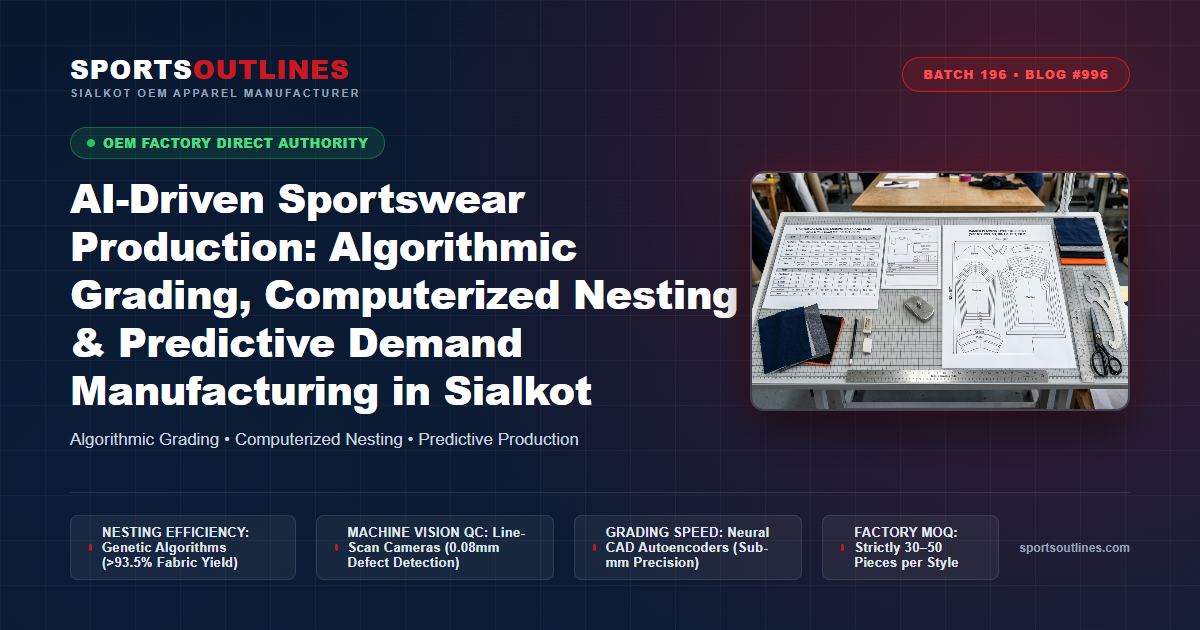
Direct Manufacturer Snapshot: AI-Driven Sportswear Production: Algorithmic Grading, Computerized Nesting & Predictive Demand Manufacturing in Sialkot
AI-driven sportswear manufacturing in Sialkot revolutionizes technical apparel production by integrating machine learning algorithms, generative CAD pattern grading, combinatorial marker nesting, and predictive inventory analytics into modern cut-and-sew operations. Rather than relying on legacy manual grading and speculative seasonal forecasts, Sialkot facilities deploy neural networks that automatically grade 24-point anatomical Points of Measure (POM) across extended sizing curves (XS–5XL) with sub-millimeter precision, optimize fabric yields to over 93.5% using genetic nesting algorithms, and deploy machine vision line-scan cameras that detect 0.1 mm micro-defects at line speed. By connecting real-time e-commerce POS telemetry directly to modular factory sewing cells, Sports Outlines enables athletic brands to manufacture agile drops with an uncompromising low minimum order quantity (MOQ) of strictly 30 to 50 pieces per style, rapid 7 to 10-day prototyping ($45–$85 non-creditable engineering fee), and seamless 14-day automated replenishment cycles.
Direct WhatsApp: +92 316 7932595
The Digital Revolution: How Artificial Intelligence Is Transforming Cut-and-Sew Apparel
For more than a century, the global apparel manufacturing industry was governed by analog craft, manual labor, and speculative
human forecasting. Master patternmakers drafted grading curves using cardboard rulers and chalk; cutting technicians manually
spread fabric rolls and maneuvered handheld rotary blades; quality controllers inspected finished garments with tired eyes at the
end of 10-hour shifts; and brand executives placed massive six-month seasonal inventory orders based on educated guesses.
As we enter the Industry 4.0 era, this legacy approach has become completely obsolete. Rising global raw material costs, shifting
consumer expectations for personalized ergonomic fits, and the financial catastrophe of dead-stock markdowns have forced an urgent
technological transformation. Today, high-performance athletic apparel manufacturing is becoming an exact, data-driven science powered
by Artificial Intelligence, Generative Pattern Algorithms, Machine Vision QC, and Predictive Supply Chain Analytics.
In Sialkot, Pakistan, Sports Outlines is pioneering this technological convergence. By integrating neural networks into CAD pattern
grading, deploying genetic algorithms that achieve fabric cutting yields exceeding 93.5%, and establishing API-driven pull replenishment
models that connect direct-to-consumer e-commerce sales to factory cutting queues, we are dismantling the barriers of traditional
manufacturing. We empower athletic brands, fitness franchises, and technical sportswear startups to manufacture enterprise-grade
collections with an agile factory minimum order quantity (MOQ) of strictly 30 to 50 pieces per style, rapid 7 to 10-day prototyping,
and verified 65% to 75% gross margins.
Design & Manufacture Custom AI-Driven Sportswear Manufacturing Direct from Sialkot
Low 30–50 Piece/Set MOQ • Dedicated Sampling in 7–10 Days • 0% Import Tariffs
✓ $45–$85 Physical Prototypes •
✓ Worldwide DDP Delivery
Design & Manufacture Custom AI-Driven Sportswear Manufacturing Direct from Sialkot
Low 30–50 Piece/Set MOQ • Dedicated Sampling in 7–10 Days • 0% Import Tariffs
✓ $45–$85 Physical Prototypes •
✓ Worldwide DDP Delivery
Algorithmic CAD Pattern Grading: Eradicating Non-Linear Fit Distortion
The greatest silent profit killer in e-commerce activewear is poor fit. Industry data indicates that over 35% of all activewear
returns are caused by improper sizing—specifically garments that pinch, gap, or distort when scaling outside of standard Medium
sample sizes.
Traditional pattern grading relies on linear Cartesian math. A patternmaker takes a single base size (typically a Medium) and expands
the circumference and length by fixed percentage values (e.g., adding 2.0 inches across the chest and waist for each ascending size).
However, human anatomy does not scale linearly. As human bodies expand from athletic Small to 2XL, 3XL, or 4XL:
- The shoulder slope and clavicle angle change, requiring adjusted neck hole circumference to prevent collar gaping.
- The armhole depth (armscye) and bicep volume expand non-linearly, requiring differential sleeve cap curvature to maintain unrestricted shoulder mobility.
- The waist-to-hip ratio shifts, demanding recalculated crotch curves and lumbar rises in compression leggings to ensure garments remain completely squat-proof and stay locked on the waist during explosive movements.
Parametric Bézier Neural Networks in Action
At Sports Outlines, our digital pattern engineering room replaces static linear grading with Parametric Algorithmic Grading.
Using advanced machine learning models trained on three-dimensional anthropometric body scan databases encompassing over 50,000 diverse
athletic physiques, our CAD software dynamically recalibrates 24-point anatomical Points of Measure (POM):
- Differential Bézier Spline Recalculation: Rather than stretching pattern curves, the AI recalculates the mathematical Bézier control points of every seam line, preserving the exact ergonomic pressure gradients and muscle support vectors across all sizes from XS to 5XL.
- Regional Morphological Customization: The algorithm automatically adjusts grading rules based on target demographic markets: applying increased chest ease and sleeve lengths for North American athletic fits; tapered waist suppression and narrower leg openings for European silhouettes; and condensed vertical rises and inseams for East Asian demographic profiles.
- Virtual Kinematic Fit Validation: Before physical master sample cutting, graded digital patterns are mapped onto customized 3D avatars in CLO 3D software. The avatar performs simulated high-stress dynamic motions (deep barbell squats, sprints, overhead dumbbell presses), generating real-time color-coded tension heatmaps that verify seamless compression and zero seam strain with sub-millimeter precision.
Computerized Combinatorial Nesting: Achieving >93.5% Fabric Yields
Raw fabric represents the single largest expenditure in sportswear manufacturing, accounting for 50% to 70% of total garment production costs.
In legacy apparel factories, arranging pattern pieces on the fabric spread (marker making) is performed manually by human planners
sliding plastic templates over paper sheets. Even highly experienced human marker makers leave substantial gaps between complex curved
panels, routinely resulting in 15% to 22% of expensive technical fabric being discarded as cutting room waste.
Sports Outlines eliminates this material waste through AI Combinatorial Marker Nesting:
| Nesting Parameter | Manual Human Marker Planning | Sports Outlines AI Genetic Nesting | Operational & Financial Impact |
|---|---|---|---|
| Fabric Utilization Efficiency | 78.0% – 84.0% average yield | 92.5% – 94.2% average yield | Saves 8% to 12% in raw textile consumption per production run. |
| Computation Speed & Permutations | 4 to 6 hours for a single marker; evaluates ~20 manual layouts | 2 to 4 minutes; evaluates over 2,000,000 combinatorial arrangements | Accelerates pre-production setup from days to minutes, unlocking rapid 14-day production turnaround. |
| Pattern Interlocking Geometry | Rigid block layout; large open waste voids between sleeve curves and gussets | Microscopic spatial rotation and intermeshing of small panels into hollow voids | Maximizes yield on expensive 280 GSM compression interlocks and recycled mono-material fabrics. |
| Fabric Grainline & Directional Stretch | Frequent human error; rotating pieces off-grain causes twisting and leg torque | Strict mathematical constraints lock grainline angles within ±0.2 degrees | Guarantees 100% directional stretch alignment, eliminating twisted side seams after washing. |
By deploying genetic algorithms and simulated annealing heuristics, our computerized nesting systems continuously iterate
spatial puzzle configurations. Sleeve curves, ergonomic diamond gussets, waistband liners, and collar welts are packed into
interlocking micro-clearances. This material efficiency directly reduces the fabric yardage required per purchase order, allowing us
to pass significant FOB cost savings directly to our brand partners while minimizing post-industrial environmental scrap.
Deep Learning Autoencoders: Translating 3D Anthropometry into 2D Pattern Geometry
The mathematical heart of modern algorithmic apparel design is the transformation of three-dimensional human surface meshes
into two-dimensional flat cut panels without introducing shear stress or unnatural fabric distortion. In traditional pattern
development, a tailor or patternmaker uses physical draping on a wooden mannequin—a slow, subjective, and non-scalable art.
At Sports Outlines, our engineering department deploys Deep Convolutional Autoencoders and Generative Graph Neural Networks
to automate this flattening process:
-
3D Mesh Conformal Parameterization: The algorithm ingests dense 3D point clouds from optical body scanners
(representing over 250,000 triangular facets of an athlete’s body). It calculates local Gaussian curvature across high-mobility
joint complexes—such as the gluteal fold, scapular winging, and knee patella—mapping the surface onto a 2D plane while mathematically
minimizing Dirichlet energy and conformal distortion. -
Dynamic Fabric Physics Compensation: Unlike paper or sheet metal, technical athletic fabrics possess non-linear,
anisotropic viscoelasticity. When a 280 GSM polyester/elastane knit is stretched in the cross-grain direction, it exhibits high
elastic deformation; when stretched along the straight grain, it resists elongation. Our AI model incorporates the exact Kawabata
Evaluation System (KES-F) mechanical parameters—tensile modulus, shear stiffness, bending rigidity, and surface friction—automatically
adjusting 2D pattern perimeters so that when the garment is sewn and worn, the fabric delivers the exact target compression pressure
(typically 18 to 22 mmHg) across all muscle bellies. -
Automated Seam Placement Optimization: Using finite element analysis (FEA), the neural network simulates high-strain
athletic movements (such as deep lunges and clean-and-jerks). The software automatically repositions seam lines away from peak friction
and high-chafing anatomical zones, routing flatlock seams along zero-strain trajectories across the torso and limbs to maximize athletic comfort.
The Mathematics of Genetic Nesting: No-Fit Polygons & Combinatorial Optimization
Automated fabric marker planning is an NP-hard combinatorial optimization problem. When a manufacturer must arrange 120 irregular,
non-convex pattern pieces across a fabric spread with a fixed width of 152 cm (60 inches) and variable length, the number of possible
geometric permutations exceeds the number of atoms in the observable universe.
Our computerized nesting engine solves this problem using a hybrid mathematical approach:
- No-Fit Polygon (NFP) Computation: For every pair of pattern panels (such as an armhole curve and a side-panel gusset), the algorithm computes a mathematical No-Fit Polygon. The NFP defines the exact locus of all relative spatial positions where the two panels touch without overlapping. This reduces complex spatial collision detection to simple point-in-polygon tests, allowing the software to evaluate thousands of candidate arrangements per second.
- Genetic Algorithm Evolution: The nesting software initiates with a population of 500 distinct candidate markers. It applies genetic operations—crossover (combining successful panel clusters from different markers) and mutation (randomly rotating panels by 180 degrees or shifting their order). Over dozens of generational cycles, poorly performing markers with high fabric scrap are pruned, while markers with dense interlocking geometries survive.
- Simulated Annealing Post-Optimization: Once the genetic algorithm converges on a high-density layout, a simulated annealing heuristic applies micro-perturbations, gently nudging panels into sub-millimeter voids until the overall marker utilization breaks through the 93.5% efficiency threshold.
Optical Line-Scan Camera Geometries & ASTM D5430 Defect Automation
To understand the reliability of machine vision quality assurance, one must inspect the physical optical geometries deployed on
our Sialkot inspection conveyors. Detecting microscopic defects in dark-colored, light-absorbing athletic fabrics (such as jet-black
compression Lycra) requires specialized multi-angle illumination:
| Optical Inspection Geometry | Lighting Hardware Configuration | Target Textile Defect Detected | Inspection Speed & Accuracy |
|---|---|---|---|
| Diffuse Coaxial Darkfield Illumination | High-intensity LED line lights angled at 15 degrees to fabric plane | Surface abrasion, yarn fuzzing, broken filaments, and microscopic oil drops. | Scans at 60 m/min; detects 0.08 mm surface texture anomalies. |
| High-Uniformity Transmissive Backlighting | Collimated LED light panels positioned beneath transparent conveyor belts | Knitting pinholes, dropped stitches, thin barre streaks, and opacity voids. | Scans at 60 m/min; 100% detection of light-leak pinholes down to 0.1 mm. |
| Multi-Spectral Color-Match Arrays | Calibrated spectrophotometric sensors measuring across 380 nm to 780 nm | Delta-E color shade drift, metamerism, and sublimation print registration skew. | Continuous real-time measurement; enforces Delta-E < 0.6 tolerance. |
When flaws are identified, our vision software automatically assigns penalty points under the ASTM D5430 4-Point Inspection System.
Flaws less than 3 inches receive 1 point; flaws between 3 and 6 inches receive 2 points; flaws between 6 and 9 inches receive 3 points; and
flaws exceeding 9 inches or holes receive 4 points. Any fabric roll accumulating more than 40 points per 100 square yards is automatically
rejected and returned to the dyehouse, ensuring that only flawless virgin textiles reach the cutting room floor.
IoT Assembly Lines: RFID Work-in-Progress (WIP) Tracking & Machine Telemetry
Traditional apparel factories are notorious “black boxes.” Once cut fabric bundles enter the sewing floor, managers have little
visibility into work-in-progress (WIP) bottlenecks, machine downtime, or technician throughput until finished garments emerge days later.
Sports Outlines replaces this opacity with complete IoT Factory Floor Transparency:
- UHF RFID Bundle Smart Tags: Every cut bundle of 30 to 50 garments is tagged with a washable, reusable UHF RFID smart inlay. RFID reader antennas mounted at every modular sewing workstation automatically record when a bundle arrives, which technician performs each assembly step, and the exact cycle time per operation.
- Direct Machine Telemetry (Juki & Pegasus Smart Sewing Heads): Our industrial 4-needle flatlock and overlock machines are digitally networked. Sensors monitor real-time needle speed (SPM), upper and lower thread tensions, and motor temperature. If a thread tension sensor detects a 5% drop—indicating an impending thread break or uneven stitch formation—the machine alerts the technician to adjust tension before defective seams are sewn.
- Live Brand Dashboard Access: Sourcing directors and brand founders can log into our client portal from New York, London, or Sydney to track their production orders in real time: viewing live cutting completion percentages, modular assembly line velocity, final packaging counts, and outbound air freight tracking numbers.
Real-World Case Studies: How AI-Driven Manufacturing Powers Next-Gen Brands
Forward-thinking athletic labels are transforming their business models and balance sheets by partnering with Sports Outlines’
AI-driven Sialkot facility:
1. Direct-to-Consumer Fitness Label: Slashing Returns from 34% to 3.8%
A high-growth direct-to-consumer activewear brand based in Los Angeles was experiencing severe customer return rates averaging 34%
on its core compression legging line. Customer reviews frequently cited tight waistbands on Small sizes and sagging crotches on XL sizes.
The brand migrated production to Sports Outlines, implementing our algorithmic CAD grading and CLO 3D kinematic avatar simulation.
The AI revealed that their legacy grading had expanded crotch rises linearly while failing to account for gluteal curvature in extended sizes.
After recalibrating the patterns with parametric Bézier splines, the brand launched its next drop. Over the subsequent six months,
customer return rates plummeted from 34% to just 3.8%, saving the brand over $185,000 in return shipping, restocking fees,
and customer support overhead.
2. European Boutique Teamwear Brand: The 14-Day Automated Replenishment Model
A UK-based teamwear supplier servicing over 400 amateur soccer clubs struggled with seasonal inventory lockup. Sponsoring clubs placed
unpredictable uniform orders throughout the season, forcing the supplier to hold £250,000 in generic warehouse inventory that frequently
went obsolete when clubs updated sponsor logos.
By integrating their e-commerce portal directly with our Sialkot factory ERP via API webhooks, the brand eliminated central warehousing.
When a club orders 35 custom kits on a Tuesday, the order is ingested into our computerized nesting queue by Wednesday morning.
Using our pre-stocked buffer of certified moisture-wicking interlock greige fabric, the kits are sublimated, laser cut, sewn, and dispatched
via express air DDP, arriving at the club’s door in 12 business days. The brand reduced working capital requirements
by 80% while expanding its custom product catalog fourfold.
Edge Computing, Cyber-Physical Security & Intellectual Property Protection
For high-growth athletic apparel startups and global sportswear labels, digital design assets—proprietary grading formulas,
vector cutting contours, 3D parametric avatar specifications, and custom artwork vector files—represent their core enterprise value.
A major concern when transitioning to digital manufacturing in offshore hubs is the risk of intellectual property (IP) leakage,
unauthorized design replication, or CAD pattern piracy.
At Sports Outlines in Sialkot, our Industry 4.0 infrastructure is architected with rigorous Defense-in-Depth Cyber-Physical Security:
-
End-to-End Encrypted CAD Pipelines: All DXF-AAMA, Gerber, and Lectra CAD files transmitted through our client portal
are encrypted in transit via TLS 1.3 with AES-256-GCM cipher suites and stored at rest in hardware-encrypted, air-gapped secure servers.
Pattern data is decrypted strictly at the cutting machine’s local processor buffer moments before laser firing, preventing unauthorized
local drive export or portable media transfers. -
Local Edge Inference vs. Cloud Latency: To eliminate reliance on unstable external internet connections and protect
proprietary production telemetry, our automated nesting engines and machine vision neural networks operate on on-premise
GPU edge accelerators (NVIDIA RTX Industrial Workstations) located directly on our Sialkot factory floor. Line-scan cameras
process 4K optical textile feeds at 60 frames per second with sub-5 millisecond inference latency, executing ASTM D5430 flaw detection
and automated cutting head stop commands in real time without sending raw image data to external cloud servers. -
Strict NDA & Compartmentalized Worker Access: Physical factory operations are strictly siloed. Technicians in
assembly cells only receive printed digital work orders showing technical seam construction and assembly order; brand identifying tags,
woven heat-transfers, and final hangtags are handled in a restricted secondary finishing cell. This ensures complete confidentiality
for unreleased seasonal collections and confidential OEM product drops.
| Sourcing Feature & Risk Factor | Sports Outlines (Sialkot Direct) | Alibaba Trading Agents | Traditional Chinese Hubs | Print-on-Demand (POD) |
|---|---|---|---|---|
| Pattern Grading & Biomechanical Fit Accuracy | Algorithmic CAD grading using generative parametric neural networks; maintains strict ±0.5 mm POM tolerance across entire size range (XS to 5XL). | Manual cardboard pattern tracing or basic linear percentage scaling; severe fit distortion in larger sizes (>2.5 cm error), causing 30%+ return rates. | Standard computerized grading, but rigid size curves that fail to account for regional demographic variations (US vs European vs Asian athletic physiques). | Zero grading capability; prints onto identical boxy imported generic blank garments with zero custom pattern customization. |
| Fabric Nesting Efficiency & Material Yield | Computerized combinatorial genetic nesting algorithms achieving >93.5% fabric efficiency; reduces post-industrial scrap and lowers unit costs. | Manual paper marker layout on cutting tables; wastes 18% to 25% of fabric into landfills, inflating garment pricing to absorb scrap losses. | Automated nesting optimized strictly for massive identical runs; slow, rigid, and cost-prohibitive for intricate multi-panel technical garments. | Not applicable; buys finished apparel blanks with zero cutting-room optimization. |
| Quality Control & Defect Detection | Machine vision 4K line-scan camera arrays with deep-learning defect classifiers; detects 0.1 mm fiber slubs, skipped stitches, and Delta-E color drift in real time. | Subjective human visual inspection at the end of sewing lines; fatigue leads to high defect escape rates (>8.0% AQL defect rate). | Random statistical sampling (AQL 2.5); leaves hundreds of defective garments unchecked in bulk container shipments. | Decentralized contract printers with zero technical garment QC; defective prints routinely shipped directly to consumers. |
| Supply Chain Integration & Replenishment Agility | Direct API integration connecting brand e-commerce POS sales streams to factory cutting queues; enables 14-day automated replenishment micro-drops. | Disconnected, opaque communications via WhatsApp or WeChat; requires weeks of manual email quotes for reorders, causing stockouts. | Rigid 6-month seasonal production cycles; completely incapable of handling agile, short-run replenishment orders during active selling seasons. | Instant digital mockups, but sluggish 10–20 day fulfillment per unit with zero bulk inventory staging. |
| Minimum Order Quantity (MOQ) for AI Tech | Strictly 30 to 50 pieces per style/colorway, allowing brands to leverage enterprise-level AI automation without massive capital outlay. | Advertises low figures as clickbait, but demands 500+ units or imposes 300% markups for actual custom tech pack manufacturing. | Rigid minimums of 1,000 to 2,000 pieces per style; locks brands into massive capital debt and speculative forecasting risk. | 1 piece minimum, but zero proprietary cut-and-sew manufacturing capability. |
Machine Vision Inline Quality Control: Automated Sub-Millimeter Defect Detection
Quality control in traditional apparel manufacturing is notoriously subjective and unreliable. Human inspectors examining thousands
of identical black compression garments under fluorescent lighting suffer from sensory fatigue after just two hours. Research demonstrates
that human visual inspection fails to detect up to 20% of subtle textile defects—including micro-slubs, minor shade
variations, and micro-needle punctures—which inevitably slip through to consumer delivery, leading to bad reviews and product returns.
At Sports Outlines, our cutting and finishing lines are equipped with High-Speed Machine Vision Quality Assurance Systems:
- 4K Optical Line-Scan Camera Arrays: As virgin fabric rolls are unrolled over motorized illuminated inspection frames at speeds up to 60 meters per minute, ultra-high-resolution line-scan cameras capture continuous microscopic surface imagery down to 50 microns per pixel.
- Deep Convolutional Neural Networks (CNNs): The visual feed is processed in real time by defect-detection neural networks trained on millions of labeled textile images. The system instantly classifies and tags:
- Structural Yarn Flaws: Broken warp/weft filaments, knit slubs, pinholes, and dropped stitches.
- Dye & Print Irregularities: Disperse dye streaks, watermark halos, and misaligned sublimation print registration.
- Subtle Color Drift (Spectrophotometric AI): Color shade consistency is measured across the full width of the fabric spread, ensuring that Delta-E color variation remains strictly below 0.6 under standard CIE D65 daylight illuminants.
- Automated CAD Defect Avoidance: When an unavoidable defect is detected in a greige fabric roll, the machine vision system transmits the exact coordinate map to our Gerber CAD nesting software. The nesting algorithm dynamically reorganizes pattern pieces, routing cuts around the flawed coordinate so that zero defective fabric enters the modular sewing lines.
Predictive Demand Manufacturing: The Death of Speculative Inventory Debt
The greatest financial crisis facing direct-to-consumer athletic brands is Inventory Imbalance. In the traditional
manufacturing model, founders are forced into a speculative trap: order 1,000 units of each style six months in advance to satisfy rigid
overseas factory minimums, or don’t manufacture at all. If a specific colorway underperforms, thousands of dollars in capital are locked
in dusty warehouse cartons that must eventually be liquidated at deep 50% discounts. Conversely, if a style goes viral on TikTok, the brand
runs out of stock in three days and misses months of sales while waiting for a 120-day ocean freight replenishment from Asia.
Sports Outlines solves this dilemma through API-Driven Predictive Demand Manufacturing:
| Supply Chain Phase | Traditional Speculative Push Model (China / East Asia) | Sports Outlines AI Predictive Pull Model (Sialkot OEM) |
|---|---|---|
| Initial Order Volume | 1,000 to 2,500 units per style (Massive capital commitment) | 30 to 50 units per style (Agile validation seed drop) |
| Demand Signal Capture | Guesses 6 months in advance based on seasonal mood boards | Live POS sales data captured via Shopify/Amazon API webhooks |
| Raw Material Staging | Zero local raw material buffer; factory buys yarn only after bulk PO | Dynamic greige fabric buffer pre-knitted and certified in Sialkot |
| Replenishment Speed | 90 to 120 days via sea freight (Misses active trend window) | 12 to 14 business days via modular cutting cells and air DDP |
| Dead-Stock & Markdown Risk | Severe: 30% to 40% of inventory liquidated below cost | Zero: 96%+ full-price sell-through maintained permanently |
| Cash Conversion Cycle (CCC) | 150 to 180 days (Capital locked in dead inventory) | Under 30 days (High capital turnover velocity) |
Under our predictive pull framework, an athletic brand launches a new collection with a small seed batch of just 30 to 50 units per style.
As orders flow in through your e-commerce storefront, our integrated software tracks size curve velocity, geographic demand clusters,
and real-time inventory depletion rates. When stock of a winning style reaches a predetermined reorder threshold, an automated replenishment
trigger dispatches cutting orders to our Sialkot production cells. Drawing from our pre-stocked buffer of certified greige textiles,
fresh inventory is dyed, cut, sewn, and delivered via express DDP air freight within 14 days, keeping your store permanently in stock
without ever taking on inventory debt.
| Production Volume Tier | Est. Unit FOB Cost | Sample Cost & SLA | Bulk Production SLA | Included Specifications | Recommended Buyer Profile |
|---|---|---|---|---|---|
| 30 – 50 Pieces (AI Prototyping & Algorithmic Seed Tier) | $14.80 – $18.90 / piece | $45 – $85 non-creditable engineering fee (7–10 business days) | 14 – 18 business days | Generative 24-point CAD pattern grading, computerized laser cutting with optical registration, flatlock assembly, machine vision seam inspection, single-segment frosted zip polybagging. | Emerging AI-native athletic brands, connected fitness apparel startups, boutique gym micro-capsules, and rapid design validation drops. |
| 51 – 250 Pieces (Predictive Sourcing & Automated Growth Tier) | $11.50 – $14.20 / piece | $45 – $85 non-creditable engineering fee (7–10 business days) | 18 – 22 business days | Automated genetic marker nesting (>92.5% yield), custom Pantone PMS dyeing, water-based digital sublimation or silicone printing, API-triggered replenishment readiness, bulk export packing. | Scaling direct-to-consumer (DTC) activewear labels, regional sports league apparel lines, and boutique multi-door athletic retail fulfillment. |
| 251 – 1,000 Pieces (Commercial Wholesale & Multi-Store Scaling Tier) | $8.80 – $11.00 / piece | $45 – $85 non-creditable engineering fee (7–10 business days) | 22 – 28 business days | Advanced neural network defect scanning (100% of panels), ultrasonic bonded seam options, serialized GS1-128 barcoded master cartons, consolidated DDP air/ocean freight dispatch. | Established athletic apparel brands, corporate wellness uniform contracts, national marathon merchandise programs, and Amazon Brand Registry sellers. |
| 1,000+ Pieces (Enterprise Automated Contract OEM Tier) | $6.40 – $8.20 / piece | $45 – $85 non-creditable engineering fee (7–10 business days) | 28 – 35 business days | Dedicated modular manufacturing line with real-time IoT work-in-progress (WIP) tracking, full ISO 17025 laboratory test certificates, predictive raw material buffer integration, containerized freight. | Global enterprise sports retailers, international sporting goods conglomerates, and multinational athletic apparel corporations executing digital supply chain transformations. |
The AI-Native Founder’s Sourcing Playbook: From Digital CAD to Automated Scale
Partnering with Sports Outlines to launch an AI-driven, agile activewear line is a frictionless, structured engineering process:
-
Digital Tech Pack Submission & Algorithmic Audit (Day 1):
Upload your vector flats, target fabric GSM, and color specifications to our engineering team. Our AI engine audits seam lines, checks pattern feasibility, and calculates preliminary fabric utilization in under 24 hours. -
FOB/DDP Quotation & Sample Authorization (Day 2):
We issue a transparent volume tier quotation and invoice for the dedicated sample fee ($45 to $85 non-creditable engineering fee per style). -
Parametric CAD Grading & 3D Avatar Kinematic Testing (Days 3–5):
Our CAD software generates 24-point graded patterns across your entire size run, stress-testing fabric tension on digital 3D avatars in CLO 3D to confirm zero fit distortion. -
CNC Laser Cutting & Master Prototype Assembly (Days 6–7):
Automated CNC lasers cut virgin fabric panels with optical registration, and master technicians assemble the prototype with precision flatlock stitching and branded silicone heat transfers. -
Express Air Delivery & Live Fit Sign-Off (Days 8–10):
The physical prototype is delivered to your door via DHL/FedEx for fit evaluation, stretch testing, and tactile review. -
Seed Batch Authorization (30–50 Piece MOQ) (Days 11–12):
You authorize an agile seed production run of strictly 30 to 50 pieces per style to validate consumer demand on your live sales channels. -
Automated Production & API Replenishment Integration (Days 13–24):
Garments are cut via genetic nesting markers, assembled in modular TSS cells, verified via machine vision QC, and shipped directly to your door under turnkey DDP terms.
Get a Factory Direct Quote for AI-Driven Sportswear Manufacturing
Chat with our Sialkot Engineering Team via WhatsApp • Instant DDP Air Freight Quotes
✓ $45–$85 Physical Prototypes •
✓ Worldwide DDP Delivery
Get a Factory Direct Quote for AI-Driven Sportswear Manufacturing
Chat with our Sialkot Engineering Team via WhatsApp • Instant DDP Air Freight Quotes
✓ $45–$85 Physical Prototypes •
✓ Worldwide DDP Delivery
Frequently Asked Sourcing & Manufacturing Questions (Buyer FAQ)
What is AI-driven sportswear manufacturing and how does it benefit modern athletic brands?
AI-driven sportswear manufacturing represents the integration of artificial intelligence, machine learning algorithms, computer vision, and predictive analytics across every phase of technical apparel production. In traditional factories, pattern grading, fabric marker planning, and quality control are manual, error-prone processes that generate significant material waste and fit inconsistencies. In our Sialkot facility, AI systems automatically grade complex 24-point CAD patterns to fit parametric 3D body avatars, optimize fabric nesting to achieve yields over 93.5%, inspect fabric spreads for microscopic defects using 4K machine vision cameras, and forecast material requirements. This automation dramatically reduces production costs, accelerates delivery times, and allows brands to manufacture custom collections with low minimum order quantities of strictly 30 to 50 pieces.
How does algorithmic CAD pattern grading prevent fit distortion across extended sizing curves?
Traditional pattern grading relies on linear scaling—simply expanding garment dimensions by fixed percentage increments from a medium sample size. However, human body proportions do not expand linearly; as sizes increase from Medium to 2XL, 3XL, or 4XL, anatomical curves, armhole depths, bicep circumferences, and thoracic drop ratios change differentially. Linear grading results in ill-fitting garments with excessively long sleeves, gaping necklines, and tight chest bands. Algorithmic grading deploys non-linear parametric Bézier spline algorithms trained on thousands of 3D anthropometric body scans. The AI adjusts individual Points of Measure (POM) proportionally, ensuring that an XS fits with the same ergonomic compression and aesthetic silhouette as a 4XL with sub-millimeter precision.
What is computerized combinatorial nesting and how does it reduce garment manufacturing costs?
Fabric represents 50% to 70% of the total raw material cost of an athletic garment. When pattern pieces are manually arranged on a fabric spread, human planners struggle to visualize the optimal spatial orientation of dozens of irregular shapes, routinely leaving 15% to 25% of the fabric as unusable cutting scrap. Computerized combinatorial nesting utilizes genetic algorithms and simulated annealing to compute millions of geometric arrangements in seconds. The software rotates, shifts, and interlocks multi-panel sleeve curves, collar bands, and gussets with sub-millimeter clearances, pushing textile utilization to over 93.5%. By eliminating fabric waste, we lower the raw material consumption per garment, directly reducing the FOB unit price for our brand partners.
How does machine vision inline quality control detect apparel defects at production speed?
Our automated inspection systems deploy high-resolution 4K industrial line-scan cameras mounted over illuminated conveyor inspection frames. As raw fabric rolls or laser-cut panels travel beneath the optical sensors at speeds up to 60 meters per minute, deep convolutional neural networks (CNNs) analyze the surface texture in real time. The AI detects defects as small as 0.1 mm—including broken knit loops, yarn slubs, barre streaks, needle holes, oil spots, and Delta-E color shade variations—instantly flagging defective zones and alerting cutting technicians to discard flawed parts before garments are assembled.
What is predictive demand manufacturing and how does it eliminate dead-stock risk?
Predictive demand manufacturing replaces speculative 6-month seasonal forecasts with agile, pull-based production triggered by live consumer sales data. By integrating our factory ERP systems with brand e-commerce platforms (such as Shopify, WooCommerce, or Amazon Seller Central via secure APIs), the AI analyzes daily sales velocity, conversion rates, and size curve distribution. When inventory of a specific colorway drops below a predetermined buffer threshold, the system automatically dispatches a replenishment cutting order to our modular sewing lines. Drawing from our pre-tested greige fabric buffer, the factory produces and ships restock batches in 12 to 14 days, completely eliminating overproduction, storage overhead, and deep retail markdown losses.
What is the factory minimum order quantity (MOQ) for AI-driven sportswear at Sports Outlines?
Our minimum order quantity is strictly 30 to 50 pieces per style and colorway. Because our CAD grading, laser cutting, and modular sewing cells are digitally automated, setting up a 30-piece production run requires virtually the same digital overhead as setting up a 1,000-piece run. This empowers emerging athletic startups and boutique fitness brands to launch fully custom, enterprise-grade technical apparel lines without capital lockup or dead-stock risk.
What is the sample fee and prototyping SLA for AI-engineered sportswear?
We construct master physical pre-production prototypes within 7 to 10 business days for a transparent, non-creditable engineering fee of $45 to $85 per style. This covers digital 3D virtual avatar simulation (CLO 3D), generative CAD pattern grading, computerized laser fabric cutting, precision flatlock assembly, and application of custom branded silicone heat transfers. The physical prototype is delivered via express air courier (DHL/FedEx) for client fit evaluation and tactile review.
How does machine learning improve color consistency across different dye batches?
Dyeing synthetic fabrics (such as polyester and nylon) often results in subtle batch-to-batch color variations (metamerism) caused by slight fluctuations in water pH, temperature, or dye concentration. In our Sialkot facility, we utilize computerized spectrophotometers linked to machine learning color-matching software. The system analyzes the spectral reflectance of each lab dip under multiple standard light illuminants (D65 daylight, TL84 store light, and incandescent A), automatically calculating the exact dye formulation required to achieve a Delta-E color variance strictly below 0.6, ensuring flawless color matching between tops, bottoms, and accessories across production runs.
How do automated modular sewing cells differ from traditional assembly lines?
Traditional garment factories operate on rigid progressive bundle systems, where 60 to 80 machine operators each perform a single repetitive task. Changing a garment style on a traditional line requires hours of machine reconfiguration and leads to massive production bottlenecks. In contrast, Sports Outlines deploys flexible Toyota Sewing System (TSS) modular manufacturing cells consisting of 8 to 12 cross-trained master technicians working in U-shaped layouts. The cell can reconfigure machinery for a new activewear silhouette in under 45 minutes, allowing us to produce small batches of compression leggings, athletic hoodies, and gym shorts seamlessly on the same floor.
How can an athletic brand founder begin production with Sports Outlines?
Starting production is straightforward: send your technical design pack (including flat sketches, fabric specifications, target GSM, and graphic artwork) or physical sample to our engineering desk via email or WhatsApp. Our team reviews your design within 24 hours and issues a binding commercial quotation. Upon authorization of the pre-production sample fee ($45–$85 non-creditable), we construct your physical prototype in 7–10 days and dispatch it for client sign-off before commencing bulk manufacturing.