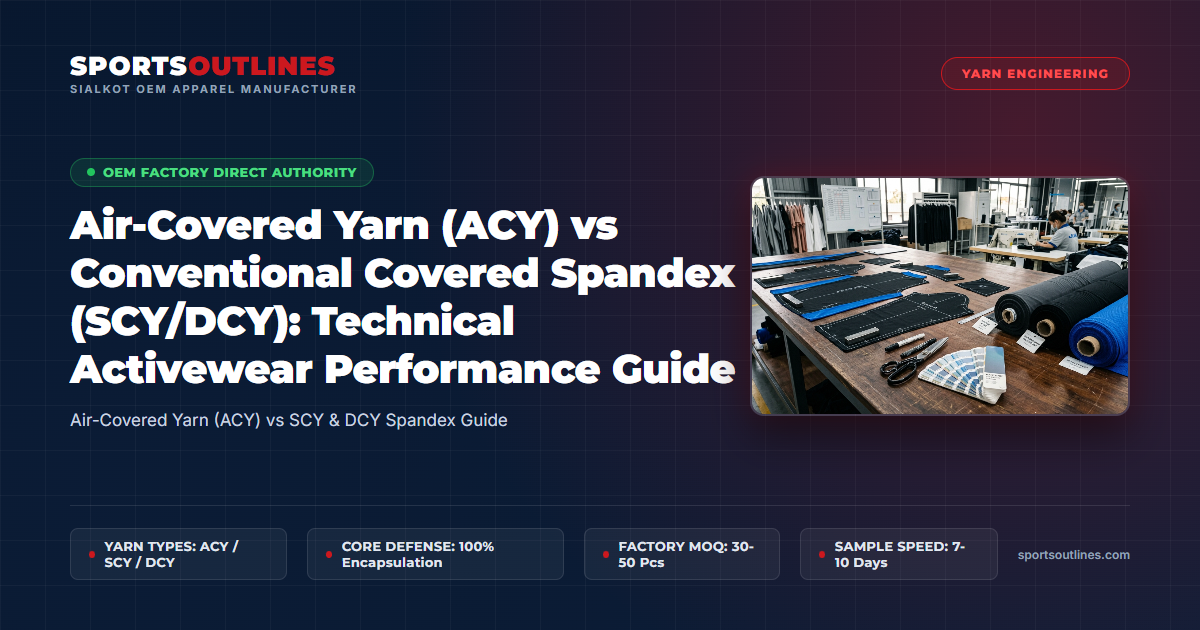
In modern high-performance activewear, compression apparel, and athletic hosiery manufacturing, bare elastane (spandex) is rarely knitted alone in its raw state. While bare elastane filament provides incredible elongation (up to 500%–700%), it possesses severe mechanical and chemical vulnerabilities: it exhibits high surface friction against metal guides, suffers needle cutting at high circular knitting speeds, degrades rapidly when exposed to human sweat lipids and pool chlorine, and creates unsightly ‘grin-through’ under biaxial stretch. To overcome these inherent flaws, textile spinning mills wrap or interlace bare elastane with protective continuous-filament synthetic yarns—primarily polyamide (Nylon 6 or Nylon 6.6) or draw textured polyester (DTY).
In global athletic apparel engineering, this yarn manufacturing process bifurcates into two distinct technological paradigms: Air-Covered Yarn (ACY), also known as air-intermingled yarn, and Conventional Covered Yarn, which encompasses Single-Covered Yarn (SCY) and Double-Covered Yarn (DCY). For technical sportswear product developers, sourcing executives, and private-label brand founders, selecting between ACY, SCY, and DCY is one of the most critical structural decisions in the development cycle. This choice directly dictates fabric hand-feel, compression modulus, breathability, production lead time, and per-yard milling cost.
Operating from our vertical textile milling, circular knitting, and cut-and-sew manufacturing facility at Sports Outlines in Sialkot, Pakistan, we produce high-performance knits engineered with certified ACY, SCY, and DCY yarn configurations. Whether your brand requires buttery-soft, breathable 36G yoga tights using 40D/34F Nylon + 30D Spandex ACY, or medical-grade, high-modulus compression tights utilizing double-wrapped 70D DCY, Sports Outlines provides the precision yarn engineering, testing transparency, and direct factory agility required to build market-dominating activewear lines. Supported by our founder-friendly low minimum order quantity (MOQ) of strictly 30 to 50 pieces per style/colorway and rapid physical prototyping turnaround (7 to 10 business days, $45 to $85 per piece, non-refundable), we empower athletic apparel brands to scale without prohibitive upfront inventory risk.
Executive Engineering Summary: Covered Elastane Yarns
- Air-Covered Yarn (ACY / Intermingled): Produced by feeding drafted elastane and textured synthetic filament through a compressed air vortex nozzle (Heberlein/SSM). The turbulent air stream entangles the fibers, creating periodic tack points (80 to 120 nips per meter). Yields soft, lofty, breathable activewear knits at high production throughput (800–1,000 m/min).
- Single-Covered Yarn (SCY): Produced by helically winding a single synthetic filament around a drafted elastane core at 400 to 900 turns per meter (TPM). Provides uniform core protection but carries inherent torsional torque (S or Z twist), requiring balanced knitting machine feeder setup to avoid fabric spirality.
- Double-Covered Yarn (DCY): Formed by wrapping two opposing helical layers (inner S-twist, outer Z-twist) around the elastane core. Achieves 100% complete core encapsulation, zero torque equilibrium, and impenetrable resistance to chemical degradation and needle friction. Standard for Olympic swimwear and medical-grade graduated compression.
- Performance Trade-Offs: ACY delivers superior breathability, moisture transport, and fabric drape at 30%–45% lower yarn cost; DCY delivers maximum holding force, surgical compression consistency, and lifetime chlorine barrier protection.
- Factory Sourcing Agility: Sports Outlines maintains low production MOQs of strictly 30–50 pieces per style/colorway and rapid 7–10 day physical prototyping ($45–$85 per piece, non-refundable).
1. The Mechanical Vulnerability of Bare Elastane: Why Covering Is Essential
To appreciate the necessity of covered yarn architectures, one must examine the physical and tribological behavior of bare elastane during high-speed textile manufacturing and athletic use:
- High Friction Coefficient (μ): Polyurethane polymers possess high natural surface tackiness. As bare elastane runs through ceramic yarn eyelets, tension gate disks, and knitting needles at speeds exceeding 25 to 30 RPM, friction generates extreme localized heating. This heat softens the polymer, causing filament snatching, uneven tension fluctuations, and dropped stitches.
- Needle Cutting & Filament Severance: Modern circular knitting machines running at 32G to 40G utilize razor-fine needle hooks. A bare elastane monofilament or coalesced multifilament has low shear resistance; if struck off-center by a closing needle latch, the elastane severs instantly, creating runs or “laddering” defects in the fabric.
- Lipid and Chemical Attack: As established in polymer science, elastane’s polyether soft segments absorb body sebum, squalene, and unsaturated fatty acids, while chlorine attacks the urethane hard segments. In bare elastane, the entire surface area of the polyurethane macromolecule is exposed to ambient chemical degradation.
- Optical Grin-Through: Bare elastane reflects specular light differently than textured nylon or polyester, creating unwanted shine or translucency under stretch.
By covering the elastane core with continuous synthetic filament yarns, textile spinners solve all four vulnerabilities simultaneously. The synthetic sheath absorbs mechanical needle friction, protects the polyurethane core from chemical exposure, eliminates optical grin-through, and stabilizes loop geometry.
2. Air-Covered Yarn (ACY): Fluid Dynamics and Vortex Intermingling Mechanics
Air-Covered Yarn (ACY), frequently referred to in technical literature as air-intermingled or air-tacked yarn, represents the modern standard for premium yoga apparel, lightweight running shirts, and athleisure knits. Unlike conventional spinning methods that physically twist yarns around a core, ACY relies on high-speed fluid dynamic intermingling:
The ACY Production Process
In an ACY machine (such as an SSM DP5-T or Heberlein system), bare elastane yarn is continuously unwound from a spool via positive feed rollers and subjected to a controlled draft ratio (typically 2.8x to 3.8x elongation). Simultaneously, a fully drawn textured yarn (DTY Nylon 6.6 or DTY Polyester) is fed alongside the stretched elastane into a precision ceramic vortex nozzle:
- Vortex Air Blast: Compressed air at 4.5 to 6.5 bar (65 to 95 psi) is injected into the yarn channel perpendicularly or at an angle. The supersonic air turbulence opens up the multifilament bundle of the textured synthetic yarn.
- Entanglement and Nip Formation: As the air swirls in a double-vortex pattern, the individual microfilaments of the synthetic yarn wrap and knot tightly around the stretched elastane core. This creates localized entanglements known as tack points, nips, or intermingling nodes.
- Node Frequency: A high-quality ACY yarn is engineered with an exact frequency of 80 to 120 nips per linear meter. Between these microscopic nodes, the textured synthetic filaments billow outward in loose, lofted micro-loops, encapsulating the elastane core like an air-cushioned sheath.
- Relaxation and Bulk Recovery: When the composite yarn exits the nozzle and tension is released, the drafted elastane contracts, compressing the synthetic filaments into an ultra-soft, voluminous, textured yarn structure.
| ACY Component | Typical Specification | Physical Role in Activewear | Performance Metric |
|---|---|---|---|
| Core Filament | 20D – 40D Polyurethane Elastane | Provides elastic elongation and rapid kinetic recovery | Drafted at 3.0x – 3.5x during air intermingling |
| Covering Sheath | 40D/34F – 70D/68F DTY Nylon 6.6 / Poly | Delivers buttery hand-feel, abrasion resistance & color depth | Micro-denier filaments (<1.2 DPF) for ultimate softness |
| Intermingling Density | 80 – 120 Nips/Meter | Prevents core slippage while maintaining loft | Tested via Rothschild Intermingling Meter |
| Production Speed | 800 – 1,000 meters/min | High manufacturing throughput and cost efficiency | Over 20x faster than mechanical hollow-spindle winding |
Key Advantages of Air-Covered Yarn
- Buttery, Peach-Skin Hand-Feel: Because the sheath filaments are not twisted tightly around the core, they form open, lofted micro-pockets. This produces fabrics that feel exceptionally soft, fluid, and comfortable against bare skin (ideal for yoga leggings and lounge athleisure).
- Superior Breathability and Moisture Transport: The lofted micro-spaces between tack points allow air and water vapor to circulate freely, accelerating capillary moisture wicking.
- Zero Torque / Low Spirality: Because ACY uses air entanglement rather than rotational twist, the finished composite yarn has zero residual torque. Knitted fabrics exhibit minimal skew or seam spirality after washing.
- Exceptional Economic Value: ACY machines operate at speeds up to 1,000 meters per minute. This high manufacturing productivity significantly lowers conversion costs compared to mechanical spindle winding.
3. Conventional Covered Yarns: Single-Covered (SCY) and Double-Covered (DCY) Mechanics
While ACY dominates casual athleisure and yoga apparel, Conventional Covered Yarns—Single-Covered (SCY) and Double-Covered (DCY)—remain indispensable for high-modulus compression tights, medical recovery wear, performance hosiery, and competitive swimwear. Conventional covering relies on mechanical hollow-spindle twisting technology (such as Menegatto or Ratti machines):
Single-Covered Yarn (SCY) Mechanics
In SCY production, the bare elastane core is continuously drafted (elongated by 3.0x to 4.2x) and guided upward through the center of a hollow rotating spindle. Mounted on the spindle is a bobbin of continuous synthetic filament yarn (e.g. 20D to 70D Nylon 6.6). As the spindle rotates at high velocity (15,000 to 22,000 RPM), the covering yarn is drawn off the bobbin and wrapped in a continuous helical spiral (either S-twist or Z-twist) around the stretched elastane core:
- Turns Per Meter (TPM): SCY is engineered with an exact twist density, typically ranging from 400 to 900 TPM. Higher TPM produces denser core coverage and higher compression modulus, but slows down machine production speed.
- Torsional Imbalance (The Torque Defect): Because the covering yarn is wrapped in a single direction (e.g. all S-twist), SCY retains high residual torsional torque. If knitted on a single-jersey circular machine without counter-balancing, the knitted loops twist in the direction of the torque, causing the finished legging leg seams to spiral around the athlete’s calf. Knitting mills must carefully alternate S-twist and Z-twist feeds or run double-jersey interlock setups to neutralize this torque.
Double-Covered Yarn (DCY) Mechanics: The Impenetrable Armor
Double-Covered Yarn (DCY) represents the gold standard of elastane core protection. A DCY machine incorporates two consecutive hollow spindles rotating in opposite directions:
- Inner Layer (S-Twist): The first spindle wraps an inner helical sheath of synthetic filament around the drafted elastane core in an S-twist direction at approximately 600 to 800 TPM.
- Outer Layer (Z-Twist): The partially covered core immediately enters a second hollow spindle rotating in the opposite direction, wrapping a second helical layer in a Z-twist direction at slightly lower turns per meter (typically 500 to 700 TPM) to balance yarn tension.
- 100% Core Encapsulation: Because the two helical layers cross each other in opposing criss-cross angles, the bare elastane core is 100% physically entombed within a dense, protective synthetic sheath. Not a single micron of bare polyurethane is exposed to external contact.
- Perfect Torque Neutralization: The opposing S-twist and Z-twist forces cancel each other out completely. DCY possesses zero residual torque, ensuring absolute geometric stability and zero seam spirality in finished garments.
| Engineering Parameter | Air-Covered Yarn (ACY) | Single-Covered Yarn (SCY) | Double-Covered Yarn (DCY) |
|---|---|---|---|
| Covering Method | Compressed air vortex entanglement (Nips) | Single helical wrapping (S or Z direction) | Dual opposing helical wrappings (S + Z) |
| Core Encapsulation Degree | 60% – 75% (Lofted sheath between nodes) | 80% – 90% (Continuous spiral) | 100% (Complete total entombment) |
| Yarn Torque & Spirality | Zero Torque (Balanced) | High Torque (Requires alternation) | Zero Torque (Self-balancing) |
| Fabric Hand-Feel & Drape | Voluminous, soft, buttery, peach-touch | Smooth, structured, moderately crisp | Firm, dense, slick, high-compression hold |
| Chlorine & Sebum Barrier | Good (Moderate chemical defense) | Very Good (Strong defense) | Maximum (Impenetrable physical shield) |
| Production Speed | 800 – 1,000 m/min | 35 – 55 m/min | 20 – 35 m/min |
| Relative Yarn Sourcing Cost | 1.0x (Highly economical) | 1.8x – 2.2x vs ACY | 3.0x – 3.8x vs ACY |
4. Stress-Strain Hysteresis and Modulus Dynamics in Activewear Knits
In biomechanical sportswear engineering, the distinction between ACY and DCY becomes starkly evident when evaluating tensile stress-strain hysteresis curves (tested via Instron 5565 tensile testers per ASTM D4964).
When an athletic textile undergoes cyclic stretching (stretching to 60% extension and returning to zero load over 1,000 cycles):
- ACY Tensile Modulus Curve: Exhibits a very low initial modulus (it stretches easily under minimal hand pressure) followed by progressive resistance as the sheath micro-loops reach extension limits. The recovery force curve is gentle and progressive. This low modulus is exactly what consumers describe as “weightless, second-skin freedom”—the fabric moves effortlessly with the athlete without feeling constrictive or tight.
- DCY Tensile Modulus Curve: Exhibits a steep, immediate resistance curve (high modulus). The dual helical wrappings lock the elastane core into a precise geometric cage. To elongate the yarn, significant tensile force (in Newtons) must be exerted. Upon release, the twin opposing helical coils exert massive kinetic recovery snap. This high modulus provides genuine muscular stabilization, venous blood flow support (graduated compression), and zero bagging over years of strenuous athletic use.
Sialkot Engineering at Sports Outlines: Precision Yarn Feeder Calibration
Knitting covered yarns requires exceptional machine calibration. At our Sialkot manufacturing plant, our high-gauge circular knitting machines (32G and 36G) are equipped with Memminger-IRO MPF positive yarn storage feeders and electronic tension sensors calibrated to ±0.5 cN accuracy. This ensures that every millimeter of ACY or DCY yarn is fed into the needle trick at uniform elongation, preventing uneven fabric barre, wavy selvedges, or differential stretch defects.
Low Factory MOQ: 30–50 Pieces
Rapid Sampling: 7–10 Days ($45–$85/pc)
Instron ASTM D4964 Certified
5. Draft Ratio Mathematics & Denier-Per-Filament (DPF) Calculations
In yarn covering, the total linear mass and mechanical elongation of the finished composite yarn are governed by precise mathematical draft ratios. The Elastane Draft Ratio (DR) represents the mechanical extension factor applied to the bare elastane core as it enters the air jet nozzle or hollow spindle:
Effective Core Denier = Nominal Bare Denier ÷ Draft Ratio (DR)
For example, if a 40D bare elastane core is fed into an ACY machine at a draft ratio of 3.2x, its effective linear density inside the composite yarn is approximately 12.5 Denier (40 ÷ 3.2). If it is paired with a 50D/48F textured nylon sheath yarn, the total unrelaxed composite yarn denier equals 62.5 Denier. However, once the finished yarn exits the machine and tension is released, the drafted elastane contracts, drawing the sheath filaments closer together and increasing the relaxed composite yarn denier to approximately 85D to 92D.
| Composite Yarn Code | Core Elastane | Draft Ratio | Sheath Synthetic Yarn | Sheath DPF | Finished Hand-Feel |
|---|---|---|---|---|---|
| ACY 40/30 N66 | 30D Creora Black | 3.1x Draft | 40D/34F DTY Nylon 6.6 | 1.18 DPF (Microfiber) | Ultra-soft, fluid, light yoga tights |
| ACY 70/40 Poly | 40D Roica Black | 3.4x Draft | 75D/72F DTY Polyester | 1.04 DPF (Microfiber) | Dry-touch, athletic jerseys & shorts |
| SCY 50/40 N66 | 40D Lycra 162B | 3.6x Draft | 50D/48F DTY Nylon 6.6 (600 TPM) | 1.04 DPF (Microfiber) | Smooth, semi-compressive training pants |
| DCY 70/70 N66 | 70D Lycra Xtra Life | 3.8x Draft | 70D/68F N66 Dual Wrap (700/600 TPM) | 1.03 DPF (Double Sheath) | Dense, surgical-grade recovery compression |
Furthermore, the tactile perception of the garment is heavily determined by Denier Per Filament (DPF). Calculated as the total yarn denier divided by the number of individual filament strands (e.g., 40D ÷ 34 filaments = 1.18 DPF), lower DPF values yield exponentially softer textiles. When DPF drops below 1.2, fibers flex effortlessly against human touch receptors, creating the luxury sensation consumers describe as “cloud-soft.” Sports Outlines strictly utilizes micro-denier sheath filaments (DPF ≤ 1.2) across all ACY and DCY activewear yarns to ensure unmatched sensory luxury.
6. Laboratory Testing Standards for Covered Yarn Integrity
To verify that covered yarns deliver consistent performance throughout their lifecycle, Sports Outlines enforces a comprehensive textile testing battery in our Sialkot QA laboratory:
- Nip Retention Under Wash Cycles (AATCC 135): Air-covered yarns must retain their intermingling nodes after repeated laundering. We test ACY fabrics across 50 commercial wash and tumble-dry cycles at 40°C. Fabrics must exhibit zero node unraveling, zero elastane delamination, and less than 3% dimensional change in both length and width.
- Tensile Recovery Hysteresis (ASTM D4964): Using calibrated Instron tensile test benches, fabric specimens are elongated to 60% extension at a constant rate of 500 mm/min, held for 60 seconds, and allowed to recover. DCY compression fabrics must demonstrate >96% immediate elastic recovery; ACY fabrics must achieve >94% recovery with zero permanent bagging.
- Abrasion Resistance & Pilling (ASTM D4970 / Martindale): Because covering sheaths absorb friction, we subject ACY and DCY fabrics to 50,000 to 70,000 Martindale abrasion cycles. Fabrics must achieve a minimum Grade 4.5 rating (no pill formation, no broken surface filaments).
- Chlorine Degradation Resistance (ISO 105-E03): For swimwear and triathlon garments utilizing DCY, fabric samples are immersed in 50 mg/L chlorinated water solutions for 240 hours. DCY fabrics engineered with Creora® HighClo™ retain >88% of their original tensile power, compared to <15% retention in generic bare spandex knits.
7. B2B Sourcing Strategy: Matching Yarn Architecture to Garment End-Use
When developing an activewear collection, sourcing executives must match yarn covering architectures to the specific functional demands of each garment category:
Category 1: Yoga Leggings, Athleisure Tights & Everyday Loungewear
Optimal Specification: 36G Interlock knit utilizing Air-Covered Yarn (ACY) (e.g. 40D/34F Nylon 6.6 + 30D Spandex).
Rationale: Delivers the coveted buttery-soft, peach-touch hand feel. The lofted ACY micro-loops enhance thermal breathability and wick sweat during hot yoga classes. Low yarn sourcing cost allows competitive retail pricing while preserving healthy brand gross margins.
Category 2: High-Performance Compression Tights & Recovery Sleeves
Optimal Specification: 32G Warp Tricot or Interlock utilizing Double-Covered Yarn (DCY) (e.g. 70D/68F Nylon 6.6 inner + outer wrap around 70D Spandex core).
Rationale: True medical-grade graduated compression (20 to 30 mmHg) requires massive elastic resistance and zero hysteresis loss. DCY prevents bagging at the knee, maintains consistent holding pressure throughout intense workouts, and resists friction from barbell knurling and turf slides.
Category 3: Competitive Swimwear & Triathlon Skinsuits
Optimal Specification: High-gauge warp-knit tricot utilizing Double-Covered Yarn (DCY) with chlorine-resistant elastane (Creora® HighClo™ or LYCRA® XTRA LIFE™).
Rationale: Chlorinated competition pools rapidly destroy bare or loosely covered elastane. DCY’s twin opposing helical layers provide a dense physical shield that locks chlorine radicals away from the polyurethane core, guaranteeing over 250+ hours of pool lifespan without fiber snap or sagging.
8. Commercial Prototyping & Factory Execution with Sports Outlines
Navigating the complexities of yarn covering, needle gauges, and tensile recovery can overwhelm emerging athletic apparel brands. Too often, overseas brokers promise “custom high-compression fabrics” but deliver cheap bare-spandex circular knits that pill, shear, and lose elasticity within three wash cycles.
At Sports Outlines, we operate with direct factory transparency. We work directly with your design and technical team to translate your desired sensory hand-feel and compression performance into precise yarn specifications:
- Rapid Physical Prototyping: We manufacture complete, production-grade physical prototypes in strictly 7 to 10 business days for $45 to $85 per piece. Our prototyping covers digital 2D CAD pattern grading, computerized fabric cutting, 4-needle 6-thread flatlocking, and full laboratory stretch testing. In accordance with sustainable factory operations, sample fees are strictly non-refundable and are never credited toward bulk production orders.
- Accessible Low MOQ Production: When you are ready to produce your commercial line, our factory MOQ starts at strictly 30 to 50 pieces per style/colorway. This allows your brand to launch with professional-grade ACY or DCY technical fabrics without locking up capital in excessive inventory.
- Full Custom Branding Integration: Direct silicone heat transfers, laser-cut bonded ventilation, branded jacquard elastics, and private-label woven neck tags are integrated seamlessly in-house.
Connect with our engineering specialists through our dedicated USA sportswear manufacturing hub or inspect our comprehensive wholesale athletic activewear catalog. For further technical insights into knitting mechanics, explore our companion technical analysis on High-Gauge Circular Knitting (32G vs 36G vs 40G).
Frequently Asked Questions (FAQ)
Q1: What is the primary difference between Air-Covered Yarn (ACY) and Double-Covered Yarn (DCY)?
Air-Covered Yarn (ACY) bonds synthetic filament to a drafted elastane core using high-pressure air vortex turbulence, creating intermittent tack points (80–120 nips/m) with lofted micro-loops. It is exceptionally soft, breathable, and economical. Double-Covered Yarn (DCY) mechanically wraps two opposing helical layers (S-twist and Z-twist) around the elastane core, achieving 100% complete encapsulation, zero torque, and maximum compression holding force at higher production costs.
Q2: Why does Single-Covered Yarn (SCY) cause spirality in knitted garments?
SCY is wrapped in a single helical direction (either S or Z twist). This imparts high residual torsional torque into the yarn. When knitted on standard circular knitting machines, the loops naturally twist toward the torque direction, causing side seams on leggings or shirts to twist diagonally around the body after washing. DCY and ACY eliminate this problem by maintaining balanced or zero torsional torque.
Q3: Which yarn is superior for buttery-soft yoga leggings?
Air-Covered Yarn (ACY) is the undisputed choice for buttery-soft yoga leggings. The lofted, untwisted microfilaments of the synthetic sheath create an open, peach-skin surface texture that feels weightless and fluid against human skin, closely mirroring the sensory feel of market-leading luxury athleisure lines.
Q4: Why is Double-Covered Yarn (DCY) required for competitive swimwear?
In swimming pools, chlorinated water and skin lipids rapidly degrade the polyurethane chemical structure of elastane. In DCY, two opposing helical layers of nylon physically entomb the elastane core, preventing direct chemical contact. When combined with chlorine-resistant elastane (such as Creora® HighClo™ or LYCRA® XTRA LIFE™), DCY fabrics withstand more than 250 pool hours without loss of elastic snap.
Q5: What are your factory MOQs and physical sampling lead times?
Sports Outlines provides direct factory production with a low MOQ of strictly 30 to 50 pieces per style/colorway across standard and plus size runs (XS to 3XL). Pre-production physical prototypes are produced and dispatched in 7 to 10 business days for $45 to $85 per piece. Our sample fees are strictly non-refundable and are never credited toward bulk production orders.