B2B Apparel Legal Engineering & Factory Contract Governance
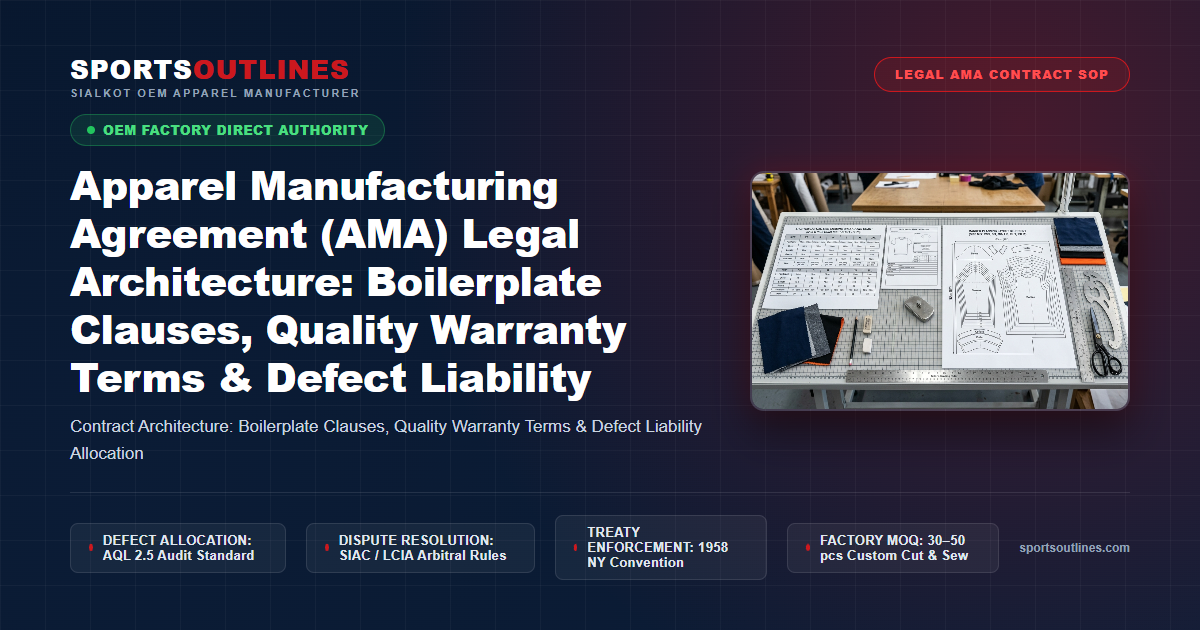
Relying on informal WhatsApp chats and basic pro-forma invoices (PI) is the single greatest structural vulnerability in overseas athletic apparel manufacturing. When defect disputes, shipment delays, or color mismatches arise, brands without a formal Apparel Manufacturing Agreement (AMA) absorb 100% of the financial damage. This institutional guide decodes the legal anatomy of a production contract for custom sportswear: boilerplate provisions, Points of Measure (POM) dimensional warranty terms, ISO 2859-1 AQL 2.5 defect liability remedies, payment milestone escrow mechanics, and cross-border arbitration enforcement in Sialkot, Pakistan.
1. Why Handshake Sourcing Deals Fail: The Legal Vulnerability of Pro-Forma Invoices
In early-stage private label sportswear sourcing, emerging athletic founders routinely confuse an commercial Pro-Forma Invoice (PI) with an enforceable bilateral contract. A pro-forma invoice is fundamentally a quotation and customs customs notification—it specifies SKU quantities, unit FOB pricing, packaging summaries, and receiving bank coordinates (IBAN/SWIFT). However, a standard PI contains virtually zero legal protections regarding raw material specifications, dimensional manufacturing tolerances, defective unit remedies, intellectual property (IP) assignment, or liquidated damages for unapproved delivery delays.
When a consignment arrives with 8% shade variance across dyed French terry panels, broken flatlock coverstitches, or waistbands exceeding measurement specs by ±2.5 cm, an importer holding only a signed PI has zero contractual recourse. The factory can legitimately claim that no specific quality baseline or inspection threshold was ever agreed upon in writing.
A professional Apparel Manufacturing Agreement (AMA) establishes an ironclad legal firewall. It transforms subjective commercial expectations into objective, measurable, and contractually binding engineering milestones. At Sports Outlines, we operate on complete institutional transparency, encouraging our international brand partners across the USA, UK, Australia, and Europe to execute structured manufacturing contracts that protect both brand capital and factory production schedules.
Table 1: Legal Comparison: Pro-Forma Invoice (PI) vs. Master Apparel Manufacturing Agreement (AMA)
| Governance Dimension | Pro-Forma Invoice (PI) Only | Master Apparel Manufacturing Agreement (AMA) | Risk Allocation |
|---|---|---|---|
| Quality Baseline Definition | Vague description (“Premium Gym Hoodie”) | Incorporates Tech Pack, BOM & Sealed Golden Sample | PI puts 100% risk on Brand; AMA creates objective standard |
| Defect Acceptance Standard | Silent (Subjective factory discretion) | ISO 2859-1 Level II AQL 2.5 Major / 4.0 Minor | AMA establishes statistical pass/fail inspection gates |
| Defect Liability & Remedies | Undefined; factory offers minor credit on next run | Mandatory factory rework, replacement, or cash refund | AMA eliminates unrecoverable working capital losses |
| Delivery Schedule & Delay Penalty | Estimated date only; zero legal penalty | Liquidated damages (0.5%–1.0%/week) or air freight shift | Factory covers courier freight if production lapses |
| Intellectual Property (IP) Protection | Completely absent; patterns can be resold | Work-for-hire assignment; patterns & CAD owned by brand | Guarantees exclusive ownership of patterns & designs |
| Dispute Resolution Forum | Unspecified; expensive local litigation | Neutral international arbitration (SIAC / LCIA / SCCI) | Provides fast, cost-effective binding legal settlement |
2. Contract Preamble & Structural Status: Independent Contractor vs. Joint Venture
The opening clauses of your agreement set the legal boundaries of the business relationship. In international manufacturing, the agreement must unequivocally characterize the relationship as that of a Buyer and Independent Manufacturer, explicitly disclaiming any partnership, joint venture, agency, or fiduciary relationship:
- Entity Verification: Exact registered corporate names, registration numbers, tax IDs (NTN for Pakistan entities, EIN for US LLCs, Companies House CRN for UK entities), and registered physical factory addresses. Never execute agreements with informal trading names or personal WhatsApp contacts.
- No Authority to Bind: The manufacturer must have no legal power to enter into agreements, incur liabilities, or represent themselves as an agent of the brand.
- Subcontracting Prohibition: The agreement must strictly state whether the factory is authorized to subcontract cutting, sewing, embroidery, or packaging to outside third-party workshops without prior written consent from the brand. Unauthorized sub-tier contracting is the number one cause of unexpected quality drops in offshore manufacturing.
3. Purchase Order (PO) Mechanics & Document Order of Precedence
An enterprise apparel supply agreement operates as an umbrella “Master Services Agreement” (MSA). Individual production batches are initiated via formal Purchase Orders (POs). Without an explicit “Order of Precedence” clause, conflicts between the master agreement and individual PO line items lead to costly contractual stalemates.
Table 2: Contractual Document Hierarchy & Conflict Resolution Hierarchy
| Precedence Level | Governing Document | Scope & Authority | Legal Effect During Dispute |
|---|---|---|---|
| Priority 1 (Highest) | Formal Written Amendment | Mutually signed modification amending specific clauses of the AMA or PO. | Overrides all prior documents, agreements, and standard PO conditions. |
| Priority 2 | Master Apparel Manufacturing Agreement (AMA) | The overarching legal contract governing defect liability, warranties, IP, and arbitration. | Controls over conflicting PO standard print terms unless explicitly referenced. |
| Priority 3 | Individual Purchase Order (PO) | Specific batch order defining quantities, sizes, FOB prices, ex-factory dates, and colors. | Defines batch commercial parameters within the legal framework of the AMA. |
| Priority 4 (Technical Standard) | Approved Tech Pack & Sealed Golden Sample | Technical specification sheets, POM tolerance tables, BOMs, and physically countersigned proto. | Forms the definitive factual evidence of product conformity for QC inspections. |
4. Technical Incorporation: Binding Tech Packs, BOMs & Sealed Golden Samples
A contract that describes a product merely as “1,000 units of Men’s Compression Tights” is legally unenforceable regarding product quality. The agreement must formally incorporate the complete technical development dossier as an integral, legally binding Exhibit:
The Golden Sample Verification Protocol (Clause Spec)
“Bulk manufacturing shall not commence until Buyer and Manufacturer have executed mutual signoff on two identical physical Pre-Production Samples (‘PPS’ / ‘Golden Samples’). One sample shall be sealed with a tamper-evident serial security tag and retained at Manufacturer’s quality control laboratory; the second identical sample shall be retained by Buyer. All bulk units delivered must conform in cut, sewing workmanship, fabric hand-feel, shade, weight, and dimensional measurements to the Sealed Golden Sample within the agreed Points of Measure (POM) tolerance table set forth in Exhibit B.”
Physical prototype development at Sports Outlines is conducted through our structured sampling program ($45–$195 development fee per custom piece/pair/set, completed within 7 to 10 business days). This pre-production engineering fee ensures master patterns, custom grading, and dedicated single-ply cutting are executed with surgical accuracy before bulk fabric cutting.
5. Payment Milestone Architecture & Capital Protection Mechanisms
In international cut-and-sew manufacturing, payment milestones are the primary financial lever to maintain alignment between factory output and brand specifications. Never agree to 100% upfront wire transfers or full payment before third-party quality verification:
Table 3: Institutional Payment Milestone Schedule for Custom Sportswear Manufacturing
| Payment Stage | Percentage | Trigger Event & Verification Prerequisite | Factory Deliverable |
|---|---|---|---|
| Milestone 1: Deposit | 30% TT Wire | Written approval of Tech Pack, BOM, and physical Golden Sample ($45–$195 prototype fee signed off). | Milling custom yarn, knitting greige fabric, and ordering branded custom trims. |
| Milestone 2: Inline Inspection | 40% Progress | Completion of fabric cutting and 50% assembly sewing; passing Inline DUPRO inspection. | Providing unedited high-resolution video and photo dossier of cut panels and sewing lines. |
| Milestone 3: Final Balance | 30% Balance | 100% garment packaging complete; passing ISO 2859-1 Level II AQL 2.5 final inspection. | Release of Commercial Invoice, Packing List, Certificate of Origin, and Bill of Lading (B/L). |
6. Quality Warranty Terms & Defect Classification Taxonomy
The heart of any apparel contract is the Quality Warranty. The agreement must define what constitutes a “Defect” with mathematical precision. In international apparel manufacturing, defects are categorized into three distinct classes:
Table 4: Master Apparel Defect Classification & Acceptance Quality Limit (AQL) Matrix
| Defect Classification | Target AQL Standard | Operational Definition | Real-World Sportswear Examples |
|---|---|---|---|
| Critical Defect | AQL 0.0 (Zero Tolerance) | Any condition causing physical injury to consumer, legal non-compliance, or biohazard. | Broken needle tip embedded in fabric; sharp metal burr on zipper; missing mandatory care/origin label. |
| Major Defect | AQL 2.5 (Acceptable Limit) | Defect causing product return, structural failure, or noticeable aesthetic impairment. | Measurements outside POM tolerance (> ±1.5 cm); open seams (> 3 mm); visible oil stains; crooked logos (> 5 mm). |
| Minor Defect | AQL 4.0 (Acceptable Limit) | Minor imperfection not affecting structural utility, garment fit, or consumer salability. | Untrimmed loose thread (< 10 mm); slight stitch tension unevenness; minor removable chalk marks. |
7. Defect Liability & Financial Remedy Protocols: The Three Escalation Paths
When an inspection fails or customer defect rates exceed contract thresholds, the contract must define exact, self-executing financial remedies. Leaving remedies to post-dispute negotiation guarantees zero recovery. The AMA should specify three sequential escalation tiers:
-
Tier 1: Factory Rework at Origin (Pre-Shipment Failure).
If an AQL 2.5 final pre-shipment random inspection fails, the manufacturer is contractually required to sort 100% of the production lot, repair or remake non-conforming garments at its sole expense, and re-present the lot for secondary inspection within 7 business days. If the re-inspection delays scheduled vessel departure, the factory must absorb the cost differential to ship the order via commercial air freight. -
Tier 2: Direct Replacement or Cash Refund (Post-Delivery Latent Defects).
For latent defects discovered upon domestic distribution (e.g., elastane delamination during consumer wash cycles, seam unraveling due to brittle thread, or dye bleeding in perspiration), the brand must have a 60-day latent defect notification window. The factory must either produce and air-freight identical replacement units at zero cost or issue an immediate cash refund / wire credit against the balance of future orders. -
Tier 3: Landed Cost Indemnification (Catastrophic Lot Failure).
If an entire batch is rendered commercially unmarketable due to gross factory negligence (e.g., non-compliant fiber content leading to customs seizure, toxic chemical levels exceeding REACH/Prop 65, or catastrophic fabric pilling below Grade 2.0), the manufacturer’s liability must not be limited merely to FOB purchase price. The contract must indemnify the buyer for sunk international freight, import duties, and 3PL disposal fees.
Table 5: Contractual Defect Remedy & Cost Allocation Schedule
| Scenario | Discovery Timing | Required Factory Action | Financial Burden Allocation |
|---|---|---|---|
| AQL 2.5 FRI Failure | Pre-Shipment (Factory Floor) | 100% Lot Re-sorting & Seam Repair within 7 days. | 100% Factory Cost (including $299 re-inspection fee). |
| Missed Ex-Factory Date | Production Stage (> 10 days late) | Upgrade delivery from Ocean Freight to DHL Express Courier. | Factory covers freight difference ($6.50/kg vs $1.20/kg). |
| Latent Fabric Pilling / Bleed | Post-Delivery (Within 60 days) | Immediate replacement run or direct wire cash refund. | 100% Factory reimbursement of FOB unit cost. |
| Regulatory Non-Compliance | Customs Border Inspection | Immediate remanufacture of compliant run with correct labeling. | Factory reimburses customs penalties, storage & disposal. |
8. Intellectual Property (IP), Pattern Ownership & Anti-Circumvention Covenants
In private label cut-and-sew manufacturing, your intellectual property consists not merely of your registered trademark logo, but your digital CAD graded pattern nests, technical size charts, proprietary fabric knit constructions, and custom hardware tooling molds (zipper pullers, aglets, silicone badges).
Your contract must include explicit Work-for-Hire & Complete Assignment of Intellectual Property provisions:
- Ownership of Digital Patterns: All CAD patterns, Gerber/Lectra files, grading blocks, and tech packs drafted by or provided to the manufacturer are the exclusive property of the buyer. The factory receives only a limited, revocable license to use the patterns exclusively for producing the buyer’s purchase orders.
- Physical Mold & Tooling Rights: Molds developed for embossed aglets, silicone chest patches, or custom metal snaps (paid for by the brand) belong 100% to the brand. The factory is strictly prohibited from using these molds for any third-party brand or catalog sample.
- Anti-Circumvention & No-Ghost Production: The manufacturer covenants that it will never produce unauthorized extra units (“ghost shifts” or “overruns”) of the buyer’s designs for resale on B2B wholesale portals, domestic markets, or third-party liquidators. Any overproduction units with factory defects must be destroyed or de-branded in the presence of an inspector.
9. Force Majeure & Liquidated Damages for Unapproved Production Delays
Overseas apparel manufacturing operates on tight seasonal retail release windows. Missing a Black Friday or Spring athletic launch because an ex-factory date slipped by 4 weeks causes devastating commercial damage.
The contract must define an objective Ex-Factory Date—the exact date when garments must be finished, inspected, and handed over to the nominated freight forwarder under Incoterms 2020 rules (FOB Karachi / CIF / DDP).
Liquidated Damages Clause (Production Delays)
“Except in cases of documented Force Majeure, if the Manufacturer fails to complete ex-factory dispatch by the agreed PO completion date, the Buyer shall be entitled to liquidated damages equal to 0.5% of the total FOB PO value for each full calendar day of delay, up to a maximum cap of 15% of the PO value. Furthermore, if the delay exceeds ten (10) calendar days, the Manufacturer shall, at its sole expense, ship the affected goods via commercial air express (DHL / FedEx) to ensure timely retail delivery, absorbing 100% of the cost differential between ocean and air freight.”
Force Majeure clauses must be tightly drafted. General power outages, raw material price spikes, or routine holiday closures (e.g., seasonal Eid or holiday slowdowns) must be explicitly excluded from Force Majeure defense.
10. Governing Law, Choice of Forum & International Arbitration Enforceability
A contract is only as valuable as its enforceability. A common error made by American or European founders is drafting a contract governed by the laws of California, New York, or England, specifying local state or county courts as the exclusive forum. If a legal dispute arises with a Pakistani manufacturer, obtaining a US state court default judgment is virtually worthless because Pakistani courts do not automatically enforce foreign civil court judgments.
The gold standard for international manufacturing agreements is Binding International Commercial Arbitration under the 1958 New York Convention on the Recognition and Enforcement of Foreign Arbitral Awards (to which Pakistan, the United States, the UK, and 160+ nations are signatories):
- Arbitration Venue: Singapore International Arbitration Centre (SIAC), London Court of International Arbitration (LCIA), or the Sialkot Chamber of Commerce & Industry (SCCI) Arbitration Tribunal for expedited local settlement.
- Language & Rules: Arbitration conducted in English under UNCITRAL rules by a single neutral arbitrator with expertise in textile manufacturing.
- Direct Enforcement: Under Pakistan’s Recognition and Enforcement (Arbitration Agreements and Foreign Arbitral Awards) Act 2011, a foreign arbitral award rendered under the New York Convention can be filed directly in a Pakistani High Court for immediate enforcement against factory bank accounts and assets.
11. The Ten Mandatory Boilerplate Clauses Every Sportswear Contract Must Include
Ensure your legal counsel verifies that your contract contains these ten standard protective provisions:
- Severability: If any single provision is found invalid, the remainder of the agreement remains in full legal effect.
- Entire Agreement (Merger Clause): Supersedes all prior WhatsApp chats, Skype logs, verbal discussions, and preliminary email exchanges.
- Counterparts & Digital Signatures: Confirms that DocuSign, Adobe Sign, and PDF exchange constitute legally binding signatures.
- Non-Waiver: Failure to enforce a strict remedy on one late batch does not forfeit the right to enforce it on subsequent orders.
- Confidentiality & NDA: Protects all tech packs, costing structures, customer lists, and proprietary artwork for a minimum of 5 years.
- Notice Provisions: Specifies formal email addresses and registered physical addresses for legal dispute notifications.
- Audit & Inspection Rights: Guarantees the buyer’s designated inspectors (SGS, QIMA, Intertek) access to the factory floor during business hours.
- Ethical Compliance & Labor Standards: Strict prohibition of child labor, forced labor, and hazardous working conditions, conforming to ILO conventions.
- Survival: Ensures confidentiality, IP ownership, and dispute resolution clauses survive contract termination.
- Language: Declares English as the official controlling language for all contract interpretation and technical exhibits.
12. Points of Measure (POM) Quality Tolerance Gateways Across Athletic Garment Classes
Contractual quality warranties are only enforceable if dimensional measurement tolerances are explicitly stipulated in the technical schedules appended to the AMA. In commercial athletic apparel, garments cut and sewn from high-stretch elastane blends or heavy French terry fleece undergo natural relaxation during bulk processing. If your contract simply states “measurements must conform to tech pack,” any variation within ±2.5 cm will be defended by the factory as normal industrial variance.
The AMA must incorporate a binding Points of Measure (POM) Schedule defining the maximum allowable dimensional tolerance (in centimeters or fractions of an inch) for each critical structural dimension before a piece is classified as a Minor or Major dimensional defect.
Table 6: Contractual Points of Measure (POM) Quality Tolerance Specifications
| Garment Category | Critical POM Dimensions | Contractual Tolerance (cm) | Defect Classification Threshold | Operational Rectification Protocol |
|---|---|---|---|---|
| High-Stretch Compression Leggings (80/20 Nylon/Spandex) | Waistband Width Relaxed, Inseam Length, Front Rise | ±0.75 cm (Waist) / ±1.0 cm (Inseam) | Variance > 1.5 cm = Major Defect | Lot rejected; factory re-steams, re-sets waistband, or replaces lot |
| Heavyweight Overhead Fleece Hoodies (420–460 GSM Cotton) | Chest Circumference (1″ below armhole), Body Length, Sleeve Length | ±1.25 cm (Chest) / ±1.5 cm (Length) | Variance > 2.2 cm = Major Defect | Post-wash dimensional verification; steam reshaping or unit credit |
| Technical Moisture-Wicking Running Tees (160 GSM Poly/Elastane) | Across Shoulder, Neck Opening Width, Bottom Hem Sweep | ±0.75 cm (Neck) / ±1.0 cm (Shoulder) | Variance > 1.5 cm = Major Defect | Re-collar neck ribbing or reject non-conforming batch units |
| Sublimated MMA & BJJ Fight Shorts (4-Way Stretch Microfiber) | Waist Elastic/Drawstring Width, Outseam Length, Leg Opening Sweep | ±0.75 cm (Waist) / ±1.0 cm (Outseam) | Variance > 1.5 cm = Major Defect | Re-stitch velcro waistband or full panel remake |
| High-Impact Supportive Sports Bras (Molded Cups & Elastic Band) | Underbust Band Tension Relaxed, Strap Length, Cup Depth | ±0.5 cm (Underbust) / ±0.5 cm (Strap) | Variance > 1.0 cm = Critical Defect | Zero tolerance for poor fit; mandatory unit replacement prior to release |
13. Financial Chargeback Mechanics & Factory Defect Settlement Formulas
When an unacceptably defective shipment slips through the destination port, the financial loss extends beyond the initial manufacturing FOB cost. The importer has incurred non-refundable import customs duties, port container drayage fees, inbound 3PL warehouse receiving costs, and customer returns processing costs.
A sophisticated Apparel Manufacturing Agreement incorporates a mathematical formula for contractual defect indemnification:
Contractual Defect Indemnification Formula (Post-Import Discovery)
Total Factory Defect Liability = (Defective Units × Landed Unit Cost) + Domestic 3PL Sorting Fees + Return Handling Surcharge
Where Landed Unit Cost includes FOB unit price + allocated ocean/air freight + import customs duty. By incorporating this explicit definition into the contract, the manufacturer agrees that defect compensation is not capped at raw production costs but reflects true financial restitution.
14. Frequently Asked Questions: Apparel Manufacturing Agreements (AMA)
Q1: Do overseas factories in Pakistan actually sign formal manufacturing contracts?
Yes! Institutional, export-licensed cut-and-sew manufacturers like Sports Outlines routinely execute formal bilateral manufacturing contracts with international brands. Hesitation to sign a standard agreement is a major red flag indicating an informal broker or unregulated trading company.
Q2: Can I use an off-the-shelf online legal template for my apparel manufacturing contract?
Generic SaaS templates lack essential textile-specific clauses: ISO 2859-1 AQL defect limits, Points of Measure (POM) tolerance bands, sealed Golden Sample verification protocols, and New York Convention arbitration clauses. Always customize your contract to cut-and-sew manufacturing realities.
Q3: How does Sports Outlines structure sampling and development fees?
We charge a transparent physical prototyping fee of $45 to $195 per piece/pair/set, completed in 7 to 10 business days. This pre-production engineering fee covers pattern drafting, single-ply laser cutting, and technician setup, ensuring dedicated focus before bulk cutting.
Q4: What is the standard factory minimum order quantity (MOQ) at Sports Outlines?
Our low MOQ is strictly 30 to 50 pieces/pairs/sets per style or colorway. This allows emerging athletic and fightwear brands to launch custom private label collections with minimal capital risk while maintaining full custom cut-and-sew manufacturing quality.
Q5: What happens if garments arrive damaged due to moisture or humidity during sea freight?
Your AMA must specify that the factory enforces pre-pack moisture audits (≤ 10% moisture content) and installs industrial calcium chloride desiccant poles in export cartons. If mold damage occurs due to factory packing negligence, the factory’s defect liability terms apply.
Q6: Who owns the digital CAD patterns developed during the prototyping phase?
Under our work-for-hire provisions, the buyer owns 100% of all custom grading blocks, CAD vector files, and tech pack specifications. Sports Outlines never resells, reproduces, or shares client designs with third-party competitors.
Q7: How do liquidated damages for shipment delays work in practice?
If production slips beyond the agreed ex-factory completion date without written agreement, the contract docks 0.5% of PO value per day of unapproved delay. If delay exceeds 10 days, the factory upgrades delivery to air courier at its expense.
Q8: Does a manufacturing contract protect against unauthorized factory overruns?
Yes! Strict anti-circumvention covenants make it illegal for a manufacturer to produce or liquidate excess units branded with your trademark. Any overproduced garments must be destroyed or de-branded in the presence of an inspector.
Q9: Can third-party inspection agencies (SGS, QIMA, Intertek) audit the factory under the contract?
Yes. Our agreements explicitly provide an Open-Door Inspection Clause, guaranteeing third-party quality control auditors full access to inline sewing lines and pre-shipment packed cartons under ISO 2859-1 standards.
Q10: How do I initiate a contract-backed manufacturing run with Sports Outlines?
Submit your tech pack or vector sketches via our website or directly message our technical export desk on WhatsApp at +92 316 7932595. We will provide an open-book BOM quotation, initiate physical prototyping ($45–$195/piece), and provide our formal manufacturing contract.
Partner with a Legally Compliant, Factory-Direct Cut-and-Sew Manufacturer
Protect your brand equity, intellectual property, and working capital. Partner directly with Sports Outlines in Sialkot, Pakistan. Enjoy transparent contract governance, agile 30–50 piece minimums, and rapid pre-production prototyping ($45–$195/piece).
Direct sourcing desks: USA Sourcing Desk | UK Sourcing Desk | Australia Sourcing Desk | Sportswear Catalog.