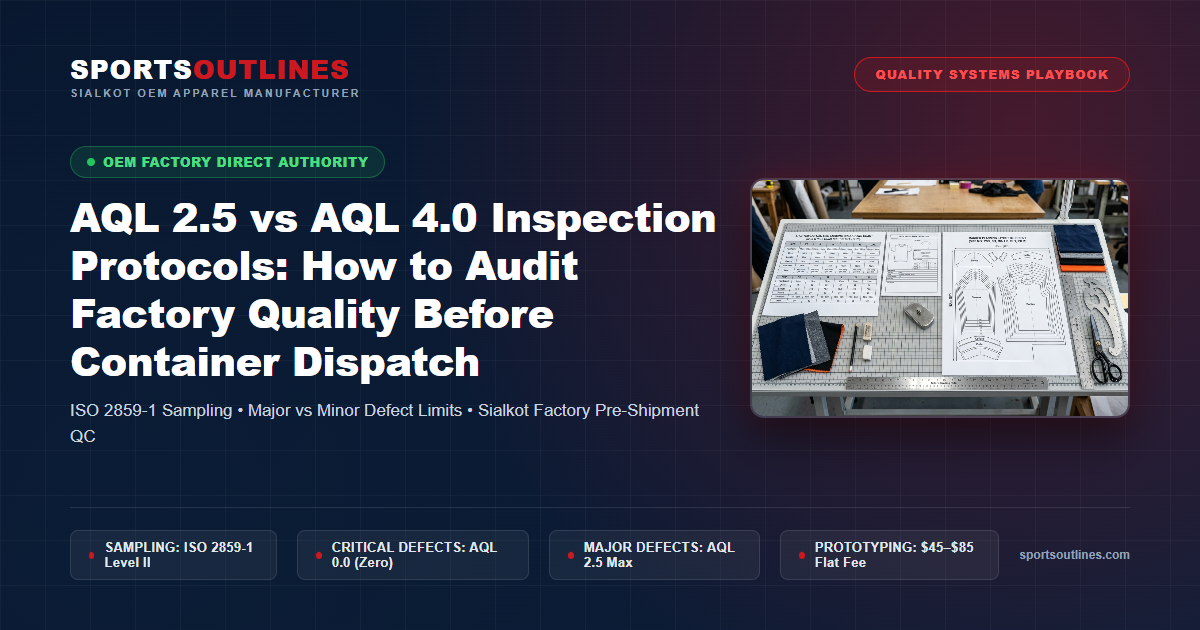
Direct Manufacturer Snapshot: AQL 2.5 vs AQL 4.0 Inspection Protocols: How to Audit Factory Quality Before Container Dispatch
The Acceptance Quality Limit (AQL) is the international statistical sampling standard (governed by ISO 2859-1 and ANSI/ASQ Z1.4) used by commercial apparel brands and factories to objectively evaluate production lot quality before shipping. In global garment manufacturing, quality auditors classify defects into three distinct severity tiers: 1) Critical Defects (AQL 0.0 — zero tolerance for broken needles, sharp staples, or mold); 2) Major Defects (AQL 2.5 — functional or visual flaws that impair wearability, such as open seams, holes, zipper jamming, or size dimensions exceeding ±0.5cm tolerances); and 3) Minor Defects (AQL 4.0 — slight cosmetic variances that do not affect function, such as untrimmed loose threads under 1cm or minor packaging creases). Under General Inspection Level II for a 300-piece production batch, an auditor randomly draws a statistical sample of 50 garments, rejecting the entire lot if more than 3 major defects or 5 minor defects are discovered. Sports Outlines International in Sialkot, Pakistan, executes mandatory AQL 2.5 General Inspection Level II protocols across all production batches with 7–10 day prototyping.
Direct WhatsApp: +92 316 7932595
Introduction: The Statistical Science of Garment Quality Control
For independent fashion brands, athletic teamwear providers, and combat sports distributors, there is no moment fraught with higher anxiety than unboxing a master shipping container or pallet of finished garments arriving from overseas. If the stitching is unraveling at stress points, if the sleeves are graded two centimeters too short, or if broken needle tips remain embedded in fleece cuffs, the commercial fallout is catastrophic: thousands of dollars in customer refund requests, ruined retail partnerships, and lethal chargeback penalties on Shopify or Stripe.
Novice founders mistakenly believe that quality control is a matter of luck or good factory intentions. In professional industrial manufacturing, quality is not an emotional aspiration; it is an exact mathematical discipline governed by Acceptance Quality Limit (AQL) Statistical Inspection Protocols.
Operating from Sialkot, Pakistan—the export epicenter of high-performance sportswear, technical combat apparel, and luxury heavyweight streetwear—Sports Outlines International manufactures for leading brands worldwide under strict ISO 2859-1 standards. In this comprehensive technical guide, we break down The AQL 2.5 vs. AQL 4.0 Inspection Masterclass. We dissect the mathematics of ANSI/ASQ Z1.4 sampling tables, examine the three defect severity tiers, provide an exhaustive factory inspection checklist, and demonstrate how our rigorous pre-shipment quality gates ensure zero defect leakage into your customer fulfillment pipeline.
Review Your Quality Control Standards with Sialkot QC Directors
Send us your defect tolerance specifications or tech pack on WhatsApp for a professional AQL 2.5 quality control inspection protocol.
✓ $45–$85 Physical Prototypes •
✓ Worldwide DDP Delivery
The Mathematics of AQL: How Statistical Sampling Works
In a large production run of 300, 500, or 1,000 garments, inspecting every single seam, zipper tooth, and dimension across 100% of the inventory is operationally impossible without doubling production lead times and labor costs. To balance rigorous quality assurance with commercial efficiency, the international apparel industry relies on the ISO 2859-1 / ANSI/ASQ Z1.4 Acceptance Sampling Standard.
Under this standard, an auditor selects a statistically valid random sample based on total batch volume and a designated Inspection Level (with General Inspection Level II being the universal commercial benchmark for consumer apparel):
| Total Production Batch Size | Sample Size Code (Level II) | Number of Garments Inspected | AQL 2.5 Max Major Defects (Pass/Fail) | AQL 4.0 Max Minor Defects (Pass/Fail) |
|---|---|---|---|---|
| 16 to 50 Garments | Code D | 8 Garments (or 100% full-piece) | Accept: 0 | Reject: 1 | Accept: 1 | Reject: 2 |
| 51 to 90 Garments | Code E | 13 Garments | Accept: 1 | Reject: 2 | Accept: 1 | Reject: 2 |
| 91 to 150 Garments | Code F | 20 Garments | Accept: 1 | Reject: 2 | Accept: 2 | Reject: 3 |
| 151 to 280 Garments | Code G | 32 Garments | Accept: 2 | Reject: 3 | Accept: 3 | Reject: 4 |
| 281 to 500 Garments | Code H | 50 Garments | Accept: 3 | Reject: 4 | Accept: 5 | Reject: 6 |
How to Read the Table: If you order 300 custom streetwear hoodies (which falls into the 281–500 tier), an auditor randomly pulls exactly 50 garments from across all master cartons. The auditor inspects every millimeter of those 50 garments. Under the AQL 2.5 standard for major defects, the batch passes if 3 or fewer major defects are discovered. If the auditor finds 4 major defects, the entire 300-piece production batch is formally rejected, placed in quarantine, and returned to the sewing line for 100% manual sorting and repair.
The 3 Defect Severity Tiers: Critical, Major & Minor
To audit an apparel factory effectively, one must classify defects according to standardized international severity tiers:
Tier 1: Critical Defects (AQL 0.0 — Zero Tolerance)
Critical defects represent conditions that violate consumer safety regulations, pose a risk of physical injury, or render the product legally unsellable. Finding even a single critical defect in a shipment results in an immediate, automatic batch rejection:
- Broken Needle Fragments: Any microscopic piece of broken sewing machine needle embedded in fabric layers or seams.
- Sharp Metal Burrs: Rough, razor-sharp edges on drawcord aglets, zipper stops, or metal snap fasteners.
- Mold or Bio-Contamination: Fungal growth or mildew resulting from packing damp garments into unventilated polybags.
- Missing Legal Country of Origin / Care Labels: Absence of mandatory FTC / EU customs labels (“Made in Pakistan”, 100% Cotton).
Tier 2: Major Defects (AQL 2.5 — Functional & Commercial Impairment)
Major defects represent flaws that directly impair garment wearability, structural integrity, or perceived value, causing consumer returns or customer complaints:
- Open Seams & Skipped Stitches: Incomplete seam joining, thread unraveling, or dropped stitches exceeding 6mm along stress zones.
- Dimensional Tolerance Drift: Any key Point of Measure (Chest Width, Body Length, Sleeve Length) deviating by more than the contractual ±0.5 cm limit.
- Fabric Holes & Punctures: Any needle cuts, runs, or punctures in the base knit or woven fabric.
- Mechanical Fastener Failure: Broken zipper teeth, non-functioning zipper sliders, or detached snap buttons.
- Graphic Placement & Embellishment Distortion: Screen print cracking, peeling heat transfers, or logos placed more than 1.0 cm off-center.
- Severe Color Shading & Dye Streaks: Mismatched color tones between front body and sleeves exceeding 0.8 Delta-E.
Tier 3: Minor Defects (AQL 4.0 — Cosmetic Imperfections)
Minor defects are superficial cosmetic variances that do not affect the garment’s functional life or structural performance:
- Untrimmed Loose Threads: Clean loose thread tails measuring between 5mm and 15mm that can be quickly snipped by hand.
- Slight Packaging Wrinkles: Minor creasing of polybags or carton scuffing during domestic trucking.
- Minor Hand-Feel Stiffness: Slight starch buildup from iron pressing that washes out in the initial customer laundry cycle.

Raw Material Gate: The ASTM D5430 4-Point Fabric Roll Audit
In high-precision manufacturing, quality control does not begin at the sewing machine; it begins the moment raw knitted fabric rolls arrive at our Sialkot warehouse from the textile mill. If defective fabric containing yarn slubs, barre streaks, or pinholes is allowed onto the cutting table, the entire production batch is compromised before sewing even begins.
At Sports Outlines, 100% of incoming fabric rolls undergo the international ASTM D5430 Standard 4-Point Inspection System mounted on illuminated inspection rolling frames:
| Defect Length / Size | Assigned Penalty Points | Defect Description / Examples |
|---|---|---|
| Defects up to 3 inches (75 mm) | 1 Point | Minor yarn knots, small lint spots, isolated broken loop stitches |
| Defects 3 to 6 inches (75–150 mm) | 2 Points | Medium slubs, dye blotches, horizontal course streaks |
| Defects 6 to 9 inches (150–230 mm) | 3 Points | Heavy horizontal drop-stitches, oil stains, color banding |
| Defects over 9 inches (230 mm) or Holes | 4 Points | Punctures, holes of any size, selvage tears, severe shade variation |
The Mathematical Acceptance Formula: Penalty points are calculated per 100 square yards of inspected fabric: Points / 100 sq yds = (Total Points Found × 3,600) ÷ (Fabric Width in inches × Roll Length in yards). If the score exceeds 28 points per 100 square yards, the entire fabric roll is rejected and returned to the spinning mill for replacement before cutting markers are generated.
In-Line (IQC) vs. End-of-Line (EQC) Factory Quality Gates
A fatal flaw of low-tier factories is relying exclusively on final post-production checks. If an assembly error occurs early in the process—such as a sewing machine with a bent looper creating skipped stitches on the inner sleeve seam—inspecting only at the end means hundreds of garments must be scrapped or unstitched.
Sports Outlines deploys a continuous, multi-station quality assurance architecture:
1. Station 1: In-Line Quality Control (IQC)
Rooving QC inspectors audit sewing cells every 45 minutes during live assembly. They verify thread tension on 4-needle flatlock machines, measure seam elasticity using tension pull gauges, and check stitch density (ensuring a consistent 10–12 SPI). Any machine experiencing thread friction or skipped loops is halted immediately for mechanical recalibration.
2. Station 2: 100% End-of-Line Trimming & Iron Audit
Every single garment coming off the assembly line passes through our dedicated finishing department. Trained specialists manually snip all thread tails using micro-blade scissors, steam-press the garment under heavy commercial vacuums, and verify that collar ribbing and waistbands sit completely flat without waving.
3. Station 3: Final Pre-Pack AQL 2.5 Audit
Once garments are ironed and prepped, our independent Quality Assurance Director conducts the formal ANSI/ASQ Z1.4 Level II statistical audit, randomly sampling garments from sealed master export cartons. The batch cannot be released for DDP freight booking until the formal Certificate of Inspection (COI) is signed.
Third-Party Inspection Coordination (SGS, Intertek & Bureau Veritas)
For international retail brands and commercial athletic leagues that mandate third-party verification for corporate governance, Sports Outlines provides open, unrestricted access to third-party inspection agencies. We regularly host certified inspectors from SGS, Intertek, Bureau Veritas, and QIMA at our Sialkot manufacturing plant.
Our quality engineering team prepares a dedicated inspection bay with calibrated light booths, steel granite measurement tables, and digital scales, providing third-party auditors with full documentation, approved Golden PPS reference samples, and master packing lists for seamless verification.
The 6-Point Garment Inspection Gauntlet
During an AQL 2.5 audit at our Sialkot facility, our certified quality inspectors subject sampled garments to an exhaustive 6-point verification gauntlet:
- Conveyorized Metal & Needle Detection Tunnel: Every finished garment passes through a 9-sensor magnetic detection tunnel calibrated to detect ferrous metal particles as small as 0.8mm, ensuring 100% child-safe, consumer-safe delivery.
- Full Points of Measure (POM) Dimensional Audit: The garment is laid relaxed on a calibrated granite inspection table. Auditors measure all 18 POM dimensions using steel tapes, recording measurements in a digital inspection spreadsheet.
- Four-Way Seam Tensile Load Testing: The auditor aggressively stretches the armhole, crotch gusset, and collar ribbing to 180% elongation. Seams must snap back with zero popped threads, dropped loops, or structural distortion.
- Hardware Engagement & Crimp Check: Zippers are cycled 10 times under tension. Zinc alloy aglets are pulled with a mechanical force gauge to confirm they withstand at least 20 kg of direct pull force.
- Color Shading & Metamerism Evaluation: Body, rib, and trim fabrics are evaluated inside a Macbeth light booth under D65 daylight and TL84 store lighting to verify zero shade deviation.
- Packaging & Barcode Scan Validation: Polybags, hangtags, and carton shipping marks are audited. Barcodes are scanned with handheld optical readers to verify 100% SKU readability.
| Production Volume Tier | Est. Unit FOB Cost | Sample Cost & SLA | Bulk Production SLA | Included Specifications | Recommended Buyer Profile |
|---|---|---|---|---|---|
| 30 Units (Micro MOQ) | $22.50 – $24.50 All-Inclusive | $65–$85 (7–10 days) | 12–15 Days | 100% full-piece physical inspection, stock certified fleece, polybag packing | Pilot brand proof-of-concept founders demanding 100% defect-free garment runs |
| 50 Units (Capsule Drop) | $18.50 – $20.00 All-Inclusive | $55–$75 (7–10 days) | 14–18 Days | 100% pre-pack dimensional audit, custom lab dips, damask woven label | Streetwear capsule releases requiring flawless out-of-the-box unboxing |
| 100 Units (Commercial Tier) | $15.20 – $16.50 All-Inclusive | $45–$65 (7–10 days) | 18–21 Days | Formal AQL 2.5 Level II statistical sampling, automated laser cut marker, QC report | Growing e-commerce brands demanding documented third-party-grade inspection reports |
| 300 Units (Enterprise Scale) | $12.10 – $13.50 All-Inclusive | $45 (7–10 days) | 25–30 Days | Full AQL 2.5 Level II audit, zero hardware mold fees, hybrid air/ocean DDP freight | Wholesale distributors and athletic teams requiring institutional quality certification |
| Sourcing Feature & Risk Factor | Sports Outlines (Sialkot Direct) | Alibaba Trading Agents | Traditional Chinese Hubs | Print-on-Demand (POD) |
|---|---|---|---|---|
| Quality Inspection Protocol | Strict ISO 2859-1 / ANSI AQL 2.5 General Inspection Level II with comprehensive multi-point audit checklist | Subjective visual check by packing staff with zero statistical sampling; damaged garments packed into cartons | AQL 2.5 offered, but third-party audit firms must be hired at client expense ($350–$500 per inspector day) | Automated digital printer with zero human tactile pre-shipment quality or dimensional inspection |
| Defect Classification Transparency | 100% transparent: Critical (0.0), Major (2.5), and Minor (4.0) defects itemized in formal pre-shipment report | Ambiguous defect policy: Open seams and broken zippers dismissed as ‘minor normal production variance’ | Standard defect definitions, but high acceptable defect thresholds that allow up to 6.5% minor flaws | Zero defect categorization — customer must initiate returns directly after receiving flawed garments |
| Dimensional Measurement Audit (POM) | Every sampled garment measured across 18 POMs; strict ±0.5cm tolerance threshold enforced before packing | Measurements checked on 1 single sample only; bulk production exhibits 2cm to 4cm size grading drift | Measurements checked, but loose ±1.5cm tolerances that cause noticeable fit inconsistency | Variable sizing depending on which blank supplier is in stock at fulfillment center |
| Needle Detection & Metal Safety | 100% metal detection pass through conveyorized 9-point sensor tunnel to guarantee zero broken needle fragments | Rarely tested — broken sewing needle tips frequently left embedded in fleece cuffs and collars | Metal detection included on export orders, but documentation requires extra certification fees | Blanks are pre-sewn by wholesalers with no secondary metal scan after DTG printing |
| Pre-Production Sample (PPS) Alignment | Every bulk unit evaluated against physical Golden Seal PPS approved by client before bulk cutting | Bulk garments sewn with substitute fabric or cheaper thread if original sample rolls run out | PPS referenced, but color shade variations up to 1.5 Delta-E permitted under standard terms | No pre-production checkpoints or physical sample approvals exist in on-demand models |
The Pre-Production Milestone: $45–$85 Physical Sample Gate
The ultimate prerequisite for a successful AQL audit is establishing an unambiguous physical baseline before mass production begins. At Sports Outlines, we never cut bulk production fabric without prior physical pre-production prototype approval.
For a flat, transparent non-creditable engineering fee of $45 to $85 per style, our Sialkot atelier constructs a complete, finished physical prototype delivered via DHL Express to your door in 7 to 10 business days. Once approved, this prototype receives our Golden Seal, serving as the physical master against which your bulk AQL 2.5 audit is executed.
Manufacture with Guaranteed AQL 2.5 Quality Assurance Standards
Direct Sialkot factory direct pricing • Free pre-production tech pack review • Transparent $45–$85 physical sample prototyping.
✓ $45–$85 Physical Prototypes •
✓ Worldwide DDP Delivery
Conclusion: Demand Documented Quality Control Standards
In the global apparel marketplace, customer trust is painstakingly built over years and instantly destroyed by a single shipment of defective garments. Never leave your product quality to casual promises or unverified factory claims. By mandating AQL 2.5 General Inspection Level II Standards, you establish objective mathematical boundaries that protect your brand reputation, eliminate customer return friction, and secure your long-term commercial success.
At Sports Outlines International in Sialkot, Pakistan, our factory floor is engineered around uncompromised quality assurance. Our certified inspection personnel, automated metal detection tunnels, and master pattern tailors are dedicated to delivering perfection on every stitch. Contact our senior quality assurance engineering desk on WhatsApp today to review your tech pack specifications and begin manufacturing with absolute confidence.
Frequently Asked Sourcing & Manufacturing Questions (Buyer FAQ)
What does AQL stand for in clothing manufacturing?
AQL stands for Acceptance Quality Limit (or Acceptable Quality Level). It is a standardized statistical measurement defined under ISO 2859-1 and ANSI/ASQ Z1.4 that dictates the maximum number of defective units considered acceptable in a randomly drawn sample size during a garment quality inspection.
What is the difference between AQL 2.5 and AQL 4.0?
AQL 2.5 and AQL 4.0 represent different tolerance thresholds for defect severity. In commercial apparel, AQL 2.5 is the global standard for Major Defects (flaws that affect garment function, fit, or salability, such as holes, open seams, broken zippers, or size errors). AQL 4.0 is the standard for Minor Defects (minor cosmetic imperfections that do not affect wearability, such as untrimmed loose threads under 1cm or slight packaging wrinkles).
How is the sample size determined in an AQL inspection?
The sample size is determined using standard AQL tables based on total order quantity and Inspection Level (typically General Inspection Level II). For example, in an order of 300 garments, Level II mandates a random sample of exactly 50 garments. Under AQL 2.5, the batch is accepted if 3 or fewer major defects are found, and rejected if 4 or more are found.
What are the three defect categories in garment inspection?
Garment defects are categorized into: 1) Critical Defects (AQL 0.0 — hazards that risk consumer injury, such as broken needle fragments, sharp metal burrs, or toxic chemical odors); 2) Major Defects (AQL 2.5 — flaws causing customer returns, such as skipped stitches, seam holes, asymmetrical sleeves, or wrong color shades); and 3) Minor Defects (AQL 4.0 — slight cosmetic variances).
What happens if a production batch fails an AQL inspection?
If the number of defects exceeds the allowable AQL threshold, the entire production batch is placed on hold. The factory must unbox all garments, conduct 100% full-piece sorting, repair or replace defective garments, and submit the batch for a complete re-inspection before container dispatch.
What tools are used by garment quality control inspectors?
Quality control inspectors utilize flexible steel measuring tapes (calibrated in millimeters), analytical fabric GSM cutters, digital gram scales, high-intensity inspection lamps, multi-illuminant light booths (for metamerism checks), digital spectrophotometers, and conveyorized needle detection tunnels.
Why is needle detection mandatory in apparel manufacturing?
High-speed industrial sewing needles (operating at 4,000 stitches per minute) can break under friction. If a microscopic needle tip breaks off and lodges inside a fleece cuff or collar, it poses a severe laceration hazard to consumers. Conveyorized magnetic needle detectors scan 100% of finished garments to verify zero ferrous metal contamination.
How does Sports Outlines conduct quality control in Sialkot?
Sports Outlines implements a three-tier quality assurance protocol: 1) In-line inspection (monitoring fabric tension, stitch density, and seam alignment during assembly); 2) 100% end-of-line inspection (thread trimming, iron pressing, and visual inspection); and 3) Final AQL 2.5 General Inspection Level II audit prior to polybag sealing and master carton packout.
What is the pre-production prototype fee at Sports Outlines?
Sports Outlines manufactures a complete physical pre-production prototype for a flat non-creditable engineering fee of $45 to $85 per style. Dispatched via DHL Express within 7 to 10 business days, the sample serves as the physical golden standard against which bulk production is inspected.
How do I request a formal AQL inspection report with my production order?
When placing your production order via WhatsApp (+92 316 7932595) or email, specify your target inspection standard (AQL 2.5 Level II is standard). Our quality control department will generate a comprehensive digital inspection certificate—complete with high-resolution measurement photographs and defect logs—prior to container dispatch.