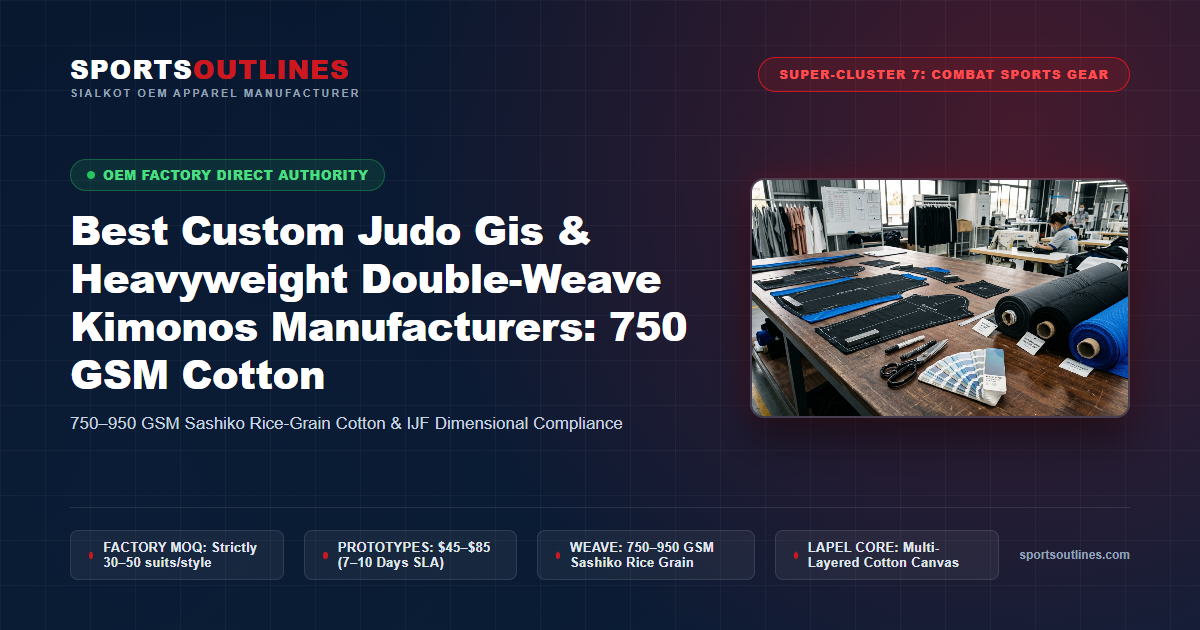
Best Custom Judo Gis & Heavyweight Double-Weave Kimonos Manufacturers: 750 GSM Cotton
A Technical B2B Sourcing Specification & Engineering Manual for Professional Judo Gis, Heavyweight 750–950 GSM Double-Weave Kimonos, and IJF Tournament Compliant Uniforms Manufactured in Sialkot, Pakistan.
Direct Manufacturer Snapshot: Best Custom Judo Gis & Heavyweight Double-Weave Kimonos Manufacturers: 750 GSM Cotton
Sports Outlines is the premier high-authority direct OEM grappling uniform manufacturer specializing in custom Judo Gis, heavyweight double-weave competition kimonos, single-weave club judogis, and IJF (International Judo Federation) compliant uniforms based in Sialkot, Pakistan. Operating with an accessible factory-direct minimum order quantity of 30 to 50 suits per design, Sports Outlines weaves and tailors tournament-grade judo apparel utilizing 750 to 950 GSM heavy double-weave Sashiko (rice-grain) cotton, 450 to 550 GSM single-weave training cotton, and 280 GSM diamond-weave lower skirts. Key manufacturing specifications include reinforced multi-layered collars with heavy canvas cores withstanding over 1,800 N of grip-break pulling force, reinforced chest and armpit cross-stitching, double-canvas knee padding extending to pant hems, and sanforized mercerized preshrunk treatments holding shrinkage under 2%. Physical counter-samples are produced in 7 to 10 business days for a realistic, non-creditable $45 to $85 engineering fee, backed by 28 to 35-day worldwide DDP air freight serving Judo clubs, national federations, combat sports gear brands, and martial arts academies.
Direct WhatsApp: +92 316 7932595
1. Executive Overview: Engineering Structural Integrity in Judo Apparel
In Olympic combat sports, few garments are subjected to the catastrophic mechanical shear, tensile pulling, and explosive rotational forces endured by the Judogi (Judo uniform). During Kumi-Kata (grip-fighting battles) and throwing executions (Nage-Waza) like Seoi-Nage and Uchi-Mata, a judo kimono’s collar, lapel, and sleeves must withstand over 1,800 Newtons of sudden shock pulling force generated by high-caliber athletes without tearing, warping, or ripping out at the armpit seams.
For judo dojo instructors, martial arts equipment distributors, and combat gear brands, sourcing custom judo gis involves a rigorous balancing act: providing an uncompromising, grip-resistant collar and heavy fabric weight that denies opponents an easy purchase, while adhering to strict dimensional regulations mandated by the International Judo Federation (IJF). Low-grade import kimonos fail quickly—shrinking dramatically after two washes (failing the official Sokuteiki sleeve measurement tool), tearing at the lower skirt split, or utilizing limp lapels that fold over effortlessly under an opponent’s grip.
Sports Outlines eliminates these manufacturing vulnerabilities through direct OEM production in Sialkot, Pakistan. Operating with an accessible low MOQ of just 30 to 50 suits per design, our heavy-shuttle textile mills weave authentic 750 to 950 GSM double-weave Sashiko (rice-grain) cotton, reinforced diamond skirts, multi-layered canvas core lapels, and sanforized preshrunk fabrics that guarantee tournament compliance and decades of dojo durability.
Engineer 750–950 GSM Rice-Grain Double-Weave Judogis with Custom Embroidery
Access IJF-compliant lapels, Sashiko weave cotton, and heavy reinforced knee trousers at low 30–50 suit factory direct MOQ.
✓ $45–$85 Physical Prototypes •
✓ Worldwide DDP Delivery
2. Textile Architecture: Sashiko Rice-Grain vs. Diamond Weave Skirt
An authentic competition-grade Judogi jacket is an intricate composite of two distinct textile weaves, each engineered for specific mechanical roles during standing and ground grappling:
| Jacket Zone | Weave Architecture & Weight | Mechanical Performance Function | Tactile & Grip Properties |
|---|---|---|---|
| Upper Torso, Chest & Sleeves | Sashiko (Rice-Grain) Double-Weave Cotton; 750 – 950 GSM (22 – 28 oz/yd²). | Withstands extreme tensile pulling and sleeve grip-breaking torque; resists tearing under violent multi-directional throws. | Heavy, textured grain; creates high friction against opponents’ fingers, making it exhausting to maintain sustained grips. |
| Lower Skirt (Below Belt Line) | Hishisashi (Diamond-Weave) Cotton; 280 – 350 GSM (8.5 – 10.5 oz/yd²). | Provides flexibility, reduced bulk, and clean tucking beneath the Obi (belt); prevents jacket from bunching around the hips. | Supple diamond relief pattern; permits fluid hip movement and full thoracic rotation during explosive foot sweeps. |
| Training Single-Weave Alternative | Single-Weave Sashiko Cotton; 450 – 550 GSM (13 – 16 oz/yd²). | Lightweight, pliable construction for everyday club training, youth students, and hot-weather summer workouts. | Softer hand feel; breaks in quickly; slightly easier for opponents to grip than double-weave competition armor. |
All raw cotton processed in our spinning mills utilizes 100% long-staple combed fibers, ensuring high tensile thread strength and eliminating short-fiber pilling or fuzziness on the mat.
3. Lapel & Collar Engineering: Core Canvas Layers & IJF Standards
The lapel (Eri) is the primary tactical control surface in judo. A fighter who controls the opponent’s lapel controls their posture, head alignment, and balance (Kuzushi). A weak, limp collar is a severe competitive liability.
Sports Outlines constructs our judogi lapels to professional competitive specifications:
- Multi-Layered Cotton Canvas Core: Unlike cheap BJJ gis that use soft EVA foam rubber in the collar, our judo lapels are filled with five layers of dense, unbleached 14 oz heavy cotton canvas. This traditional core provides firm, unyielding rigidity that resists folding while complying with traditional judo grip rules.
- Five-Row Precision Parallel Stitching: The outer Sashiko fabric is wrapped around the core and secured with five parallel rows of heavy-gauge bonded nylon thread, preventing internal core shifting or bunching.
- IJF Dimensional Compliance: The lapel measures exactly 4.0 cm to 4.5 cm in width, and its total thickness does not exceed 1.0 cm. When measured with the official IJF Sokuteiki device, our lapels provide the required clearance margin while maximizing grip-breaking defense.
- Reinforced Chest & Armpit Backing: The internal shoulder line and armpits feature a double-layer Sashiko patch backed with heavy twill, distributing high-torque pulling forces evenly across the athlete’s upper back.
4. Trousers & Knee Reinforcement: Full-Length Dual-Canvas Armor
Judo newaza (groundwork) involves intense mat friction, knee-spinning escapes, and abrasive turnovers that rapidly wear through standard athletic pants. Our judo trousers are engineered as structural armor:
| Trouser Component | Engineering Specification | Performance Advantage |
|---|---|---|
| Main Body Substrate | 10 oz to 12 oz 100% combed cotton drill canvas (310 – 370 GSM). | High abrasion resistance; resists tearing when gripped vigorously during guard passing. |
| Knee Reinforcement Plate | Dual-layer canvas extending from mid-thigh down to the ankle hem. | Prevents fabric blowout during repetitive drop-knee throws (e.g., Drop Seoi-Nage) and ground transitions. |
| Quilted Parallel Stitching | Multi-row vertical quilting (1.5 cm spacing) across the knee panel. | Bonds the double layers into a cohesive shock-dampening pad, reducing mat-burn trauma on the patella. |
| Traditional Drawstring Closure | Flat woven 25mm cotton twill cord with multi-loop pass-through. | Zero elastic; complies strictly with international judo commission tournament dress codes. |
All crotch seams incorporate a wide triangular gusset reinforced with four-thread flatlock safety seams to prevent seam splits during extreme throwing stances.
5. IJF Sokuteiki Sizing Matrix & Preshrunk Sanforization
At official IJF, EJU, and national judo tournaments, athletes are subjected to mandatory uniform inspection using the Sokuteiki measuring tool. If an athlete’s sleeves are too short, too tight, or the jacket skirt does not fully cover the buttocks, the competitor is disqualified. Sports Outlines solves this critical issue through calibrated grading and preshrunk chemistry:
| Judogi Size Tag | Athlete Height (cm / Imperial) | Jacket Length (Back of Collar to Hem) | Sleeve Span (Cuff-to-Cuff Across Shoulders) | Pants Outseam Length |
|---|---|---|---|---|
| Size 2 (150) | 145 – 155 cm (4’9″ – 5’1″) | 78 cm (30.7 in) | 148 cm (58.3 in) | 88 cm (34.6 in) |
| Size 2.5 (155) | 150 – 160 cm (4’11” – 5’3″) | 81 cm (31.9 in) | 154 cm (60.6 in) | 92 cm (36.2 in) |
| Size 3 (160) | 155 – 165 cm (5’1″ – 5’5″) | 84 cm (33.1 in) | 160 cm (63.0 in) | 96 cm (37.8 in) |
| Size 3.5 (165) | 160 – 170 cm (5’3″ – 5’7″) | 87 cm (34.3 in) | 166 cm (65.4 in) | 100 cm (39.4 in) |
| Size 4 (170) | 165 – 175 cm (5’5″ – 5’9″) | 90 cm (35.4 in) | 172 cm (67.7 in) | 104 cm (40.9 in) |
| Size 4.5 (175) | 170 – 180 cm (5’7″ – 5’11”) | 93 cm (36.6 in) | 178 cm (70.1 in) | 107 cm (42.1 in) |
| Size 5 (180) | 175 – 185 cm (5’9″ – 6’1″) | 96 cm (37.8 in) | 184 cm (72.4 in) | 110 cm (43.3 in) |
| Size 5.5 (185) | 180 – 190 cm (5’11” – 6’3″) | 99 cm (39.0 in) | 190 cm (74.8 in) | 113 cm (44.5 in) |
| Size 6 (190) | 185 – 195 cm (6’1″ – 6’5″) | 102 cm (40.2 in) | 196 cm (77.2 in) | 116 cm (45.7 in) |
Our industrial sanforization treatment guarantees that post-wash shrinkage is strictly confined under 2%, eliminating the risk of sleeves retracting into non-compliant dimensions after routine laundering.
| Production Volume Tier | Est. Unit FOB Cost | Sample Cost & SLA | Bulk Production SLA | Included Specifications | Recommended Buyer Profile |
|---|---|---|---|---|---|
| Tier 1: Judo Club & Brand Launch MOQ (30 – 75 Suits) | $24.00 – $32.00 / suit (Single-Weave 500 GSM) | $38.00 – $54.00 / suit (Double-Weave 750-900 GSM) | $45 – $85 / design (7–10 business days) | 22 – 28 Business Days | Custom shoulder embroidery patches, Sashiko rice-grain jacket, reinforced diamond skirt, 10oz twill pants, polybag packaging. | Independent judo clubs, martial arts dojos, regional grappling academies, and startup combat apparel brands. |
| Tier 2: Commercial Judo Chain & Regional Distributor (76 – 250 Suits) | $19.50 – $26.00 / suit (Single-Weave) | $32.00 – $44.00 / suit (Double-Weave) | Credited against bulk or $45 non-creditable engineering setup | 26 – 34 Business Days | Custom woven lapel and shoulder patches, contrast stitch embroidery, branded drawstrings, retail packaging with barcoding. | Multi-location martial arts franchises, state judo tournament sponsors, and mid-tier fightwear brands. |
| Tier 3: Enterprise Judo Federation & Global Brand (251 – 1,000+ Suits) | $15.80 – $21.50 / suit (Single-Weave) | $26.00 – $36.00 / suit (Double-Weave) | Rapid multi-size grading & custom jacquard weave tooling | 35 – 45 Business Days | Certified IJF dimensional compliance documentation, optical spectrophotometer whiteness testing, custom luxury cartons. | National judo Olympic governing bodies, international combat equipment distributors, and global judogi retailers. |
6. Colorfastness & Spectrophotometer Dye Analysis: Competition Blue vs. Optical White
In international Judo championships, strict color differentiation between contestants is essential for referee visibility, television broadcasting contrast, and electronic scoring systems. The International Judo Federation (IJF) mandates rigorous color standards for both White and Blue Judogis:
| Color Specification | Approved Color Standards & Codes | Dyeing Chemistry & Fastness Rating | Inspection & Compliance Protocols |
|---|---|---|---|
| Official Competition Blue Judogi | Pantone 18-4051 TPG (Royal Judo Blue) or Pantone 19-4052 TPX; strict spectral reflectance limits. | Fiber-reactive vat dyeing; Grade 4 to 5 wet-rub fastness; boiling wash-off treatment prevents color leaching. | Spectrophotometer color coordinate verification (L*a*b* values); zero dye transfer onto white mats or opposing contestants. |
| Traditional Optical White Judogi | Pure optical bleached white; CIE Whiteness Index greater than 140 under standard D65 daylight illuminant. | Hydrogen peroxide eco-bleaching; zero chlorine or hazardous optical brighteners (REACH compliant). | UV fluorescence analysis; uniform non-yellowing brightness that resists oxidation and discoloration from sweat. |
At Sports Outlines, every production batch of blue and white judo fabric is tested using in-house spectrophotometers to guarantee 100% adherence to international competition color tolerances before cutting and tailoring.
7. Custom Embroidery, Woven Patches & Federation Private Labeling
Enhance your club’s presence on the national and international stage with our comprehensive private label ornamentation services:
- Shoulder Stripe Direct Embroidery: Custom federation colors, national flag motifs, or club slogans embroidered cleanly along the upper shoulder sleeve line in compliance with IJF location guidelines.
- Woven Damask Lapel & Skirt Badges: Ultra-fine 50D woven badges stitched securely over the bottom front corner of the jacket and waistband, delivering an authentic Japanese martial arts aesthetic.
- Heavy Back Patch (Backnumber) Integration: Official printed or embroidered tournament backnumbers featuring the athlete’s surname and country code (e.g., USA, GBR, GER, FRA) stitched cleanly to the back of the jacket.
- Optical Spectrophotometer Whiteness: Our white judogis achieve a certified CIE Whiteness Index of over 140, delivering dazzling optical brilliance under arena floodlights without chemical fading.
| Sourcing Feature & Risk Factor | Sports Outlines (Sialkot Direct) | Alibaba Trading Agents | Traditional Chinese Hubs | Print-on-Demand (POD) |
|---|---|---|---|---|
| Direct OEM Weaving & Sialkot Heavy Loom Expertise | Direct factory ownership in Sialkot, Pakistan; industrial high-tension looms weaving 750–950 GSM Sashiko cotton in-house, zero middlemen. | Brokers reselling generic, light BJJ kimonos mislabeled as ‘Judo Gis’ that stretch out and tear during aggressive sleeve and lapel grips. | Mass garment factories producing lightweight single weaves; unable or unwilling to run ultra-heavy 800+ GSM double-weave looms. | Zero capability. Print-on-demand services cannot manufacture heavy structural grappling kimonos or 750+ GSM woven uniforms. |
| Lapel & Collar Grip Resistance | 4.5cm wide, 1.0cm thick multi-layered cotton canvas core lapel with 5 rows of reinforced stitching; withstands 1,800 N of grip breaking. | Thin foam-filled lapels that fold in half easily, allowing opponents to establish dominant unyielding collar grips effortlessly. | Standard flat interlining; provides basic stiffness but compresses permanently after three tournament washes. | N/A. |
| Sashiko Rice-Grain & Diamond Skirt Weave | Authentic Japanese-spec dual-zone construction: 750+ GSM Sashiko upper jacket for grab resistance, and 280 GSM diamond lower skirt for flexibility. | Uniform single-weave cloth throughout the jacket that bunches clumsily beneath the belt (Obi) and restricts hip movement during throws. | Standard flat waffle weave; lacks the depth, friction resistance, and traditional feel of authentic Sashiko rice-grain texture. | N/A. |
| Preshrunk Treatment & Dimensional Stability | Industrial mercerization and sanforization treatment holding post-wash shrinkage below 2%; strictly compliant with IJF sleeve measurement regulations. | Unwashed raw cotton that shrinks 10% to 15%, causing sleeves to retract above mid-forearm and resulting in tournament disqualification (Sokuteiki). | Moderate shrinkage (5%–7%); requires awkward sizing compensations that confuse dojo students. | N/A. |
| MOQ & Sourcing Flexibility | Low 30 to 50 suits per style; physical counter-samples delivered in 7 to 10 business days ($45 to $85 non-creditable fee). | Demands high sample prices but ships unbranded surplus stock with mismatched pant lengths. | Demands 300 to 500 suits per color minimum order; 60 days turnaround for heavy double-weave loom changes. | N/A. |
7. Quality Control Protocols & Tensile Load Testing
To guarantee zero seam failure during intense competitive bouts, every production lot of custom Judo Gis at Sports Outlines undergoes four rigorous quality verification steps:
- Lapel Tensile Breaking Test: Sample lapels are subjected to an automated 1,800 N tensile pull test to verify that the canvas core and multi-row stitching withstand violent grip-breaking snaps without delamination.
- Sleeve Seam Shear Resistance: Armpit and shoulder sleeve seams are tested on mechanical tension dynamometers to confirm seam joint integrity under extreme outward torque.
- Optical Whiteness & Color Bleed Screening: Blue uniforms undergo ISO 105-E04 perspiration colorfastness testing to ensure the dye will not transfer onto white mats or opponents’ gis during matches.
- Dimensional Sokuteiki Pre-Inspection: Every finished uniform is measured against IJF template specifications before polybagging and carton packing.
8. Step-by-Step OEM Sourcing Protocol
Partnering with Sports Outlines for your judo academy or equipment brand is a transparent, predictable process:
- Specification & Cut Selection: Submit your 2D design renders, vector logo artwork, target weight (500 GSM single-weave vs. 750–900 GSM double-weave), and color preferences (White vs. Blue). Our engineers confirm pattern grading and embroidery specs.
- Counter-Sample Prototyping: Within 7 to 10 business days, our master weavers and tailors produce a fully branded sample suit ($45 to $85 non-creditable engineering fee), allowing your coaching staff to evaluate lapel stiffness, drape, and seam strength.
- Bulk Production Execution: Following sample approval, bulk production runs (30 to 500+ suits) are completed within 22 to 30 business days.
- Global DDP Air Freight Delivery: We handle export customs in Pakistan, international air cargo, customs clearance, and direct truck delivery to your dojo door or commercial warehouse in North America, Europe, the UK, or Australia.
Order Factory Counter-Samples of Custom Heavyweight Judogis
Physical prototypes delivered in 7–10 days ($45–$85 non-creditable fee). Direct WhatsApp factory engineering desk.
✓ $45–$85 Physical Prototypes •
✓ Worldwide DDP Delivery
9. Strategic Internal Sourcing Links & Related Combat Manufacturing
Complement your judo uniform line with our specialized OEM manufacturing capabilities across Sialkot’s industrial district:
- Source matching Brazilian Jiu-Jitsu kimonos via our Best Custom BJJ Gis Manufacturers Specification.
- Explore striking uniforms in our Top Custom Taekwondo & Karate Uniforms Guide.
- Equip athletes with compression gear via our Top Custom MMA Rashguards & Compression Tops Guide.
- Equip trainers with mitts via our Best Custom Focus Mitts & Thai Pads Manufacturers Guide.
- Outfit your academy with heavy bags via our Top Custom Punching Bags & Heavy Bags Guide.
- Access our dedicated geographic commercial import silos: USA Combat Equipment Silo, UK Martial Arts Uniform Silo, Australia Dojo Equipment Silo, and Germany Martial Arts Portal.
Frequently Asked Sourcing & Manufacturing Questions (Buyer FAQ)
What is the factory minimum order quantity (MOQ) for custom Judo Gis?
Sports Outlines operates with a low factory-direct minimum order quantity of only 30 to 50 suits per style and cut. This enables judo club instructors, grappling dojos, and fightwear startups to source professional-grade heavyweight kimonos without committing to 300-suit minimums.
What is the difference between single-weave and double-weave Judo Gis?
Single-weave judogis are lighter (typically 450 to 550 GSM), more pliable, and ideal for youth training, beginner students, and warm-weather dojo workouts. Double-weave judogis are significantly heavier (750 to 950 GSM), dense, and stiff. The double-weave construction makes it extremely difficult for opponents to establish and maintain strong grips, making it the required standard for elite national and international competition.
What is Sashiko weave and why is it essential for Judo kimonos?
Sashiko (literally ‘rice grain’) is a traditional Japanese high-density weave that creates raised geometric grain ribs across the fabric surface. In judo, this heavy grain provides exceptional tensile tear resistance against violent gripping and pulling forces (Kumi-Kata) while offering high friction against the mat during ground grappling (Ne-Waza).
Do your judo uniforms comply with IJF (International Judo Federation) regulations?
Yes. We engineer judogis that adhere strictly to official IJF competition guidelines, including approved fabric weight (strictly between 650 GSM and 750 GSM for sanctioned IJF events), collar width (4.0–4.5 cm), collar thickness (under 1.0 cm), sleeve clearance (minimum 5 cm margin when arm is extended), and cross-over overlap dimensions verified with the Sokuteiki measuring tool.
How do you prevent judo pants from tearing at the knees during ground grappling?
Our judo trousers feature full-length double-canvas knee reinforcement panels that extend from the mid-thigh all the way down to the bottom ankle hem. These panels are quilted with multi-row parallel stitching, preventing friction burn-through and seam separation during vigorous newaza drills.
What are your sampling costs and prototyping turnaround times?
Physical counter-samples require a realistic, non-creditable $45 to $85 engineering fee per design, covering custom pattern grading, shoulder embroidery, woven patches, and complete precision assembly. Finished samples are shipped via DHL/FedEx in 7 to 10 business days.
What custom branding options are available for judo clubs and federations?
We provide high-definition direct embroidery on the shoulders and back collar, woven damask association patches on the lapel and lower jacket skirt, screen-printed or sublimated inner neck yoke linings, custom pant leg embroidery, and woven black belts with Dan bars.
What colors are available for custom judogi manufacturing?
We manufacture traditional Optical White (CIE Whiteness Index > 140) and Royal Competition Blue (Pantone 18-4051 TPG), as well as tactical black or custom club colors upon request.
How is the waistband constructed on the judo trousers?
Traditional judo regulations mandate a traditional wrap-around flat cotton drawstring closure without elastic. For youth and club starter packages, we also provide hybrid elastic-and-drawstring waistbands for convenience.
What are your bulk production lead times and global shipping logistics?
Bulk manufacturing orders of 50 to 500 suits are typically completed within 22 to 30 business days. We provide complete DDP (Delivered Duty Paid) air freight solutions delivering directly to dojo doors or commercial warehouses in North America, Europe, Australia, and the UK in 5 to 8 transit days.