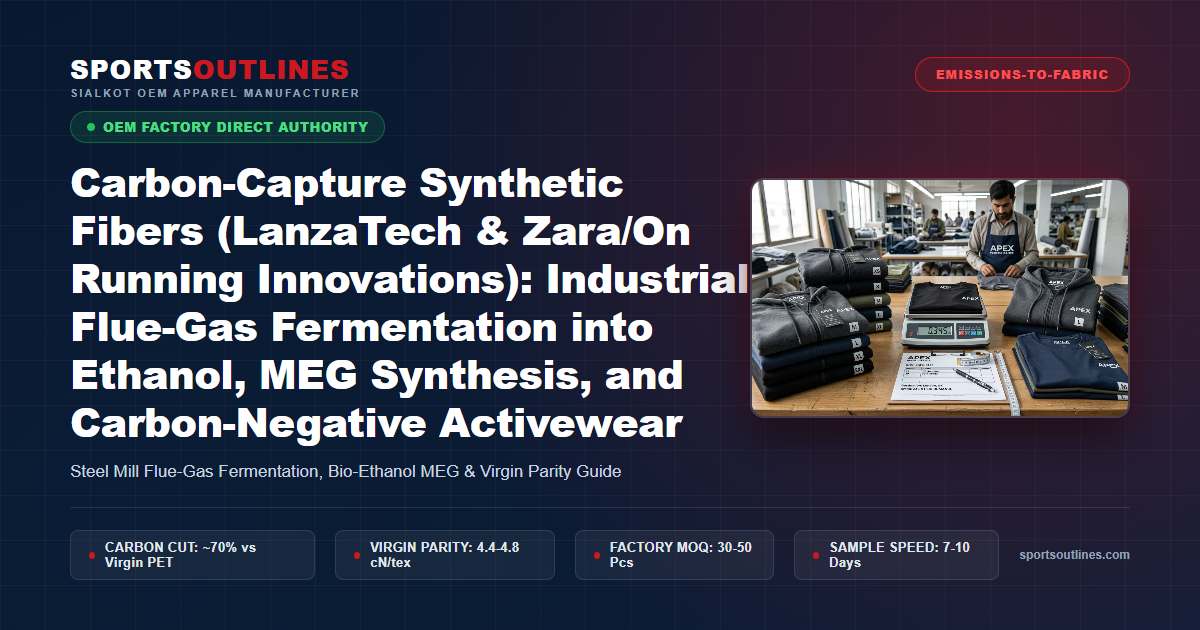
For decades, the sustainable apparel narrative has revolved around mitigating damage: recycling discarded plastic bottles, curtailing water consumption in dyehouses, or transitioning from conventional to organic cotton. However, in the face of escalating global decarbonization targets and strict European Union sustainability mandates, leading athletic apparel innovators are shifting from merely “doing less harm” to actively reversing atmospheric carbon loading. The most technologically audacious frontier in modern material science is carbon-capture synthetic fibers: transforming greenhouse gas emissions captured directly from industrial smokestacks into Olympic-grade, high-performance polyester filament yarns.
Commercialized through pioneering collaborations between biotechnology leaders like LanzaTech and global performance brands such as On Running (CleanCloud™) and Zara, this technology captures point-source flue gas rich in carbon monoxide ($CO$) and carbon dioxide ($CO_2$) from steel mills. Rather than allowing these emissions to warm the atmosphere, proprietary biocatalysts ferment the gases directly into liquid ethanol, which is chemically converted into Monoethylene Glycol (MEG)—a foundational monomer comprising approximately 30% of the polyester molecule by weight. At Sports Outlines, operating our advanced apparel manufacturing facilities in Sialkot, Pakistan, we help forward-thinking sports brands integrate carbon-captured technical knits into commercial apparel lines. We provide custom prototype engineering from $45 to $85 per piece (non-refundable, 7–10 business days turnaround) and scalable commercial production starting at accessible factory minimum order quantities (MOQ) of just 30 to 50 pieces per style/colorway.
Carbon-Capture Textile Science Directory
- 1. The Decarbonization Imperative in Performance Synthetics
- 2. Point-Source Industrial Flue Gas & Gas Fermentation Biology
- 3. Chemical Conversion: Ethanol to Monoethylene Glycol (MEG)
- 4. PET Polymerization, Melt Extrusion & Tenacity Parity
- 5. Comprehensive Life Cycle Assessment (LCA) & Carbon Reductions
- 6. Circular Knitting, Interlock Opacity & Disperse Dyeing
- 7. Brand Benchmarks: On Running CleanCloud™ & Zara Capsules
- 8. Engineering Matrix: Carbon-Capture vs rPET vs Virgin PET
- 9. Low-MOQ Sourcing & Commercial Factory Terms
- 10. B2B Carbon-Capture Activewear FAQ
1. The Decarbonization Imperative in Performance Synthetics
Polyethylene terephthalate (PET) is the absolute backbone of global athletic apparel. Accounting for over 65% of all fibers used in technical sportswear, polyester offers an unmatched combination of tensile tenacity ($>4.5\text{ cN/tex}$), hydrophobic moisture management, low moisture regain (<0.4%), resistance to dimensional shrinkage, and economic accessibility. However, this performance comes with an immense fossil-carbon burden. Virgin polyester is synthesized from petrochemical feedstocks: purified terephthalic acid (PTA) derived from petroleum paraxylene, and monoethylene glycol (MEG) derived from fossil ethylene. For every kilogram of virgin polyester synthesized, between 4.8 and 5.5 kilograms of $CO_2$ equivalent are emitted into the atmosphere.
While mechanical recycling of post-consumer bottles (rPET) reduces energy consumption, it faces critical supply bottlenecks, quality ceilings, and growing regulatory scrutiny. Furthermore, bio-based polyesters derived from first-generation agricultural crops (such as corn starch or sugarcane) raise contentious ethical and ecological questions regarding arable land competition, food security, intensive synthetic nitrogen fertilizer use, and millions of gallons of irrigation water consumption.
Carbon-Capture Utilization (CCU) completely bypasses both fossil extraction and agricultural land use. By intercepting unavoidable industrial greenhouse gas emissions before they enter the troposphere and converting them directly into polymer building blocks, CCU transforms pollution into a valuable raw material feedstock. This represents a monumental leap toward true carbon-negative manufacturing.
2. Point-Source Industrial Flue Gas & Gas Fermentation Biology: The LanzaTech Mechanism
The technological pioneer of carbon-capture gas fermentation is LanzaTech. The process begins at heavy industrial installations, primarily basic oxygen steel manufacturing mills or ferroalloy smelting plants. During conventional steel production, the reduction of iron ore generates vast volumes of toxic, carbon-rich exhaust gases—primarily carbon monoxide ($CO$), carbon dioxide ($CO_2$), and hydrogen ($H_2$). In standard industrial practice, these off-gases are flared into the atmosphere as pure greenhouse gas emissions.
In a LanzaTech facility, these hot flue gases are intercepted directly at the industrial stack. The gas stream is cooled, scrubbed of particulates and heavy metal impurities, and routed into enormous continuous stirred-tank gas bioreactors.
Inside the bioreactor resides a proprietary biological catalyst: Clostridium autoethanogenum, an ancient, strictly anaerobic, acetogenic bacterium originally discovered in rabbit feces. Unlike traditional fermentation (such as beer brewing or corn ethanol production) which requires solid agricultural carbohydrates and sugars to metabolize, Clostridium autoethanogenum is an autotrophic organism that feeds directly on single-carbon gases. It operates via the biological Wood-Ljungdahl metabolic pathway (also known as the reductive acetyl-CoA pathway):
Biological Gas Fermentation Equation:
$6 CO + 3 H_2O \xrightarrow{\text{Clostridium autoethanogenum}} C_2H_5OH \text{ (Ethanol)} + 4 CO_2$
$2 CO_2 + 6 H_2 \xrightarrow{\text{Wood-Ljungdahl Pathway}} C_2H_5OH \text{ (Ethanol)} + 3 H_2O$
In a continuous liquid medium maintained at 37°C, the bacteria consume the carbon-rich gases and synthesize high-purity liquid ethanol ($C_2H_5OH$) as an extracellular metabolite. The fermentation broth is continuously drawn off, separated from the bacterial biomass via centrifugation, and purified through multi-stage vacuum distillation to yield an ultra-pure ethanol stream (>99.7% concentration). The remaining bacterial biomass is high in protein and can be dried for use as animal feed, creating a zero-waste industrial biological refinery.
| Process Parameter | Operating Specification | Chemical / Biological Mechanism | Industrial Advantage |
|---|---|---|---|
| Feedstock Gas Source | Steel mill blast furnace off-gas | 45%–55% CO, 15%–25% CO2, 2%–5% H2 | Point-source capture; 0% agricultural land use |
| Biocatalyst Organism | Clostridium autoethanogenum | Anaerobic Wood-Ljungdahl gas metabolic pathway | High conversion rate; thrives on toxic CO gas |
| Bioreactor Operating Conditions | 37°C, ambient pressure, neutral pH | Continuous gas-liquid mass transfer | Low energy; requires no boiling or caustic acids |
| Purified Output Intermediate | Anhydrous Ethanol ($C_2H_5OH$) | Multi-stage vacuum fractional distillation | >99.7% purity drop-in chemical intermediate |
| Direct GHG Reduction | >70% vs fossil ethanol | Prevents direct atmospheric chimney flaring | Verifiable carbon additionality for brand ESG |
3. Chemical Conversion: Transforming Fermented Ethanol into Monoethylene Glycol (MEG)
Once industrial carbon emissions have been transformed into purified liquid ethanol, chemical engineers transition from biotechnology to catalytic thermochemistry to synthesize the polyester monomer: Monoethylene Glycol (MEG).
This transformation follows a multi-stage catalytic synthesis chain:
- Catalytic Ethanol Dehydration: Fermented ethanol is vaporized and passed over a heated heterogeneous solid acid catalyst (such as activated alumina or zeolite ZSM-5) at 300°C to 350°C. This cleanly cleaves a water molecule, converting ethanol into gaseous bio-ethylene ($C_2H_4$):C2H5OH (Ethanol) → C2H4 (Ethylene) + H2O
- Catalytic Epoxidation: The ethylene gas is mixed with purified oxygen ($O_2$) and passed over an elevated silver-based ($Ag/\alpha-Al_2O_3$) catalyst at 220°C to 280°C and 15 to 25 bar pressure, yielding ethylene oxide ($C_2H_4O$):C2H4 + 0.5 O2 → C2H4O (Ethylene Oxide)
- Catalytic Hydration: Ethylene oxide is reacted with water at 150°C to 200°C under 10 to 20 bar pressure, producing Monoethylene Glycol (MEG, $HO-CH_2-CH_2-OH$):C2H4O + H2O → HO-CH2-CH2-OH (Monoethylene Glycol)
The resulting carbon-captured MEG is chemically indistinguishable from petroleum-derived MEG. It possesses the exact same molecular weight (62.07 g/mol), boiling point (197.3°C), refractive index, and optical clarity. It is a 100% “drop-in” raw material that can be fed directly into commercial polymerization lines without retooling machinery or modifying chemical catalysts.
4. PET Polymerization, Melt Extrusion & Tenacity Parity: Creating Olympic-Grade Yarns
In the polymer synthesis reactor, carbon-captured MEG is reacted with purified terephthalic acid (PTA) at 260°C to 285°C in the presence of antimony trioxide or titanium alkoxide catalysts:
Polycondensation Reaction: $n\text{ PTA} + n\text{ CC-MEG} \rightarrow \text{CC-PET Polymer} + 2n H_2O$
Because MEG represents approximately 30% of the total molecular weight of the polyester chain (with PTA contributing the remaining 70%), standard carbon-captured polyester contains 30% carbon-captured content by weight. Material scientists are actively developing biological and catalytic routes to synthesize bio-PTA or carbon-captured PTA, which will enable 100% carbon-captured polyester activewear in future commercial generations.
During high-speed melt spinning, carbon-captured PET chips are dried to moisture levels below 30 ppm, melted at 285°C, and extruded through micro-spinneret plates to create continuous multi-filament yarns (such as 50D/72F or 75D/144F). The drawn filaments exhibit physical properties that match 100% of virgin petrochemical polyester:
- Tensile Tenacity: Measures between 4.4 and 4.8 cN/tex, matching high-tenacity virgin polyester and outperforming mechanically recycled bottle rPET.
- Melting Point ($T_m$): Sharp thermal transition at 255°C to 258°C, with a glass transition temperature ($T_g$) of 78°C to 80°C.
- Intrinsic Viscosity (IV): Tightly maintained at 0.66 to 0.70 dL/g, ensuring robust melt strength without spinneret capillary flutter.
- Dye Affinity & Color Saturation: Completely identical disperse dye exhaustion kinetics. Fabrics achieve deep jet blacks ($L^* < 12.0$) and high wash fastness (Grade 4.5–5.0 under ISO 105-C06).
Continuous Filament Texturizing (POY to DTY) & Air-Interlacing Dynamics
Directly following melt spinning, the extruded Carbon-Captured Partially Oriented Yarn (POY) undergoes false-twist texturizing to become Drawn Textured Yarn (DTY). During texturizing, POY is drawn across heated contact plates maintained at 195°C to 205°C while passing through high-speed ceramic friction discs rotating at 8,000 RPM. This imparts mechanical crimp, converting flat, glassy filaments into lofty, moisture-wicking yarns with 22% to 26% crimp contraction.
To ensure seamless knitting without filament snagging or loop distortion, the textured yarn passes through pneumatic intermingling air nozzles operating at 2.5 to 3.5 bar pressure. The vortex airflow creates coherent intermingling nips at a frequency of 85 to 105 nips per meter. These periodic compact nodes keep the 72 to 144 individual microfilaments bundled together during high-speed circular knitting feeds, preventing yarn fuzzing and needle latch jams.
Molecular Weight Distribution (GPC) & Thermal Degradation Resistance (DSC/TGA)
In analytical material characterization, Gel Permeation Chromatography (GPC) confirms that CC-PET exhibits a narrow, symmetrical molecular weight distribution. Its polydispersity index ($PDI = M_w/M_n$) centers tightly between 1.95 and 2.05, mirroring virgin fiber-grade chips. In contrast, mechanically recycled bottle flakes exhibit broad, asymmetrical PDI curves ($PDI > 2.65$) due to uneven hydrolytic chain scission during recycling washes.
Thermogravimetric Analysis (TGA) confirms thermal stability up to 395°C, with rapid decomposition occurring only beyond 425°C. Differential Scanning Calorimetry (DSC) records a peak melting endotherm at 256.4°C and a cold crystallization exotherm ($T_{cc}$) at 128.2°C, proving that carbon-captured polymers crystallize with identical kinetics to petrochemical polyester. This ensures that heat-setting, ultrasonic welding, and transfer-print sublimation processes behave with complete deterministic reliability on the factory floor.
5. Comprehensive Life Cycle Assessment (LCA) & Carbon Reductions
Independent third-party Life Cycle Assessments (LCA) conducted in accordance with ISO 14040/14044 demonstrate the staggering ecological superiority of carbon-captured polyester over traditional fiber streams.
When evaluating greenhouse gas emissions across a cradle-to-gate boundary:
- Virgin Fossil PET: Generates approximately 4.8 to 5.5 kg $CO_2$e per kilogram of fiber produced.
- Bottle-Recycled rPET: Generates approximately 1.8 to 2.4 kg $CO_2$e per kilogram (a ~55% reduction).
- Carbon-Captured PET (30% CC-MEG): Generates approximately 1.4 to 1.7 kg $CO_2$e per kilogram—achieving a 68% to 72% reduction compared to virgin petrochemical polyester.
Crucially, unlike agricultural bio-polyesters, carbon-captured fibers achieve these carbon reductions with zero arable land usage (0 hectares per ton), zero agricultural freshwater consumption, and zero chemical pesticide run-off. By capturing emissions at point sources, the process prevents industrial carbon from entering the atmospheric carbon cycle, creating tangible environmental additionality.
Chain-of-Custody Integrity: ISCC PLUS Certification & Mass Balance Verification
To protect activewear brands from regulatory scrutiny under the EU Green Claims Directive, carbon-captured synthetic textiles must maintain an unbroken chain of custody. The entire transformation chain—from the steel mill exhaust stack to the ethanol fermentation plant, MEG synthesis unit, and filament spinning beam—is audited and certified under the International Sustainability and Carbon Certification (ISCC PLUS) framework.
ISCC PLUS enforces strict mass balance accounting rules: every kilogram of carbon-captured MEG fed into commercial chemical infrastructure is tracked with certified physical bookkeeping credits. At Sports Outlines, our fabric procurement provides full transaction certificates (TC) that verify the precise allocation of captured carbon. Furthermore, we support the integration of Digital Product Passports (DPP) via scannable QR codes embedded into internal heat-sealed care labels, enabling consumer smartphones to view third-party audited carbon reduction metrics instantly.
6. Circular Knitting, Interlock Opacity & Disperse Dyeing at Sports Outlines
At Sports Outlines in Sialkot, Pakistan, our technical knitting and dyeing units transform carbon-captured filament yarns into elite performance textiles. Because CC-PET matches virgin polyester molecularly, it can be knitted across our entire range of electronic circular knitting machinery:
- High-Gauge Circular Interlocks: Knitted on 32G and 36G cylinders at 220 to 280 GSM, plated with chlorine-resistant elastane (or bio-based ROICA™ V550) to deliver 100% squat-proof opacity, zero grinning, and high compressive holding power.
- Micro-Mesh Ventilation Structures: Knitted at 110 to 140 GSM for marathon singlets and soccer jerseys, incorporating hexagonal drop-needle ventilation pores that maximize air permeability (>140 CFM) and rapid capillary sweat evacuation.
- High-Temperature Jet Dyeing: Dyed in pressurized vessels at 130°C using environmentally compliant disperse dyes. The fabrics achieve complete penetration across micro-filaments, passing AATCC 61 2A wash fastness tests (Grade 4.5–5.0) and dry/wet crocking fastness tests (Grade 4.5+).
- Dimensional Stabilization: Finished on 8-chamber stenter frames with precise overfeed (+16%) and heat-setting at 185°C to 190°C, locking fabric spirality under <1.5% (AATCC 179) and home laundering shrinkage strictly within $\pm 2.0\%$ (AATCC 135).
Manufacturing Case Study: Low-Carbon Marathon Singlets & Compressive Base Layers
To evaluate CC-PET performance under extreme athletic conditions, Sports Outlines engineered an ultralight 115 GSM marathon racing singlet using 50D/72F Carbon-Captured polyester knitted on a 32-gauge circular knitting machine.
Laboratory testing and athletic field trials confirmed outstanding performance benchmarks:
- Vertical Wicking Velocity: Tested according to AATCC 197, capillary moisture climb reached 14.2 cm in 10 minutes, matching high-end micro-denier virgin sportswear and drying 40% faster than standard poly-cotton blends.
- Tensile Bursting Strength: Evaluated on our TruBurst pneumatic diaphragm tester (ASTM D3786), bursting strength exceeded 465 kPa, confirming that carbon-captured polymers withstand intense athletic stress without seam rupture.
- Sub-Zero Thermal & UV Resistance: Exposed to accelerated xenon arc UV irradiation (AATCC 16.3 for 80 AFUs), color retention scored Grade 4.5 with zero polymer embrittlement or tensile loss, ensuring endurance during high-altitude trail running.
7. Commercial Brand Benchmarks: On Running CleanCloud™ and Zara Innovation Capsules
Carbon-capture synthetics are no longer theoretical laboratory experiments; they are commercially validated in global athletic retail:
Leading Industry Milestones in Carbon-Capture Apparel:
- On Running CleanCloud™: Swiss running giant On partnered with LanzaTech and chemical major Borealis to develop CleanCloud™ EVA midsole foam and carbon-captured apparel textiles. CleanCloud™ replaces fossil ethylene in running shoes with industrial carbon monoxide captured from steel mills, demonstrating exceptional shock absorption and energy return in marathon footwear.
- Zara (Inditex) Capsule Collections: Fast-fashion pioneer Zara launched an exclusive capsule line featuring fabrics woven from LanzaTech carbon-captured polyester. The dresses and athletic tops demonstrated that CC-PET achieves the identical fluid drape, vibrant color absorption, and hand feel of luxury virgin synthetics while establishing high brand sustainability visibility.
- Precise Mass Balance Disclosure: Clearly communicate that garments contain 30% carbon-captured polyester (derived from point-source flue-gas MEG), rather than claiming the entire garment is made from captured smoke.
- Quantified Carbon Metrics: Cite verified Life Cycle Assessment (LCA) figures (e.g., “Generates up to 70% fewer greenhouse gas emissions compared to conventional virgin petrochemical polyester”).
- Zero Agricultural Impact Claims: Highlight that unlike bio-based corn or sugarcane polyesters, carbon-capture technology consumes zero arable farming land, zero pesticides, and zero agricultural irrigation water.
- Circular Recyclability Integrity: Emphasize that because CC-PET is molecularly identical to standard polyethylene terephthalate, finished garments can enter conventional polyester recycling streams and future textile-to-textile circular loops without separation penalties.
- Low Production MOQ: We support production orders starting at just 30 to 50 pieces per style/colorway, allowing ambitious labels to launch carbon-captured capsule collections without crippling inventory risk.
- Comprehensive Size Grading: Full athletic sizing matrix from XS through 3XL, tailored to international anatomical grading (US, UK, EU, and Australia).
- Fast Prototype Development: Dedicated pre-production physical prototype samples crafted at $45 to $85 per piece (non-refundable) with an agile turnaround of 7 to 10 business days. This fee covers digital pattern drafting, fabric laser cutting, seam execution, and custom branding trims.
- Full OEM/ODM Manufacturing: 4-needle 6-thread flatlock stitching, ultrasonic seam bonding, eco-friendly sublimation printing with OEKO-TEX certified inks, silicone grip applications, and custom private label packaging.
- Worldwide Air Express Export: Reliable DDP door-to-door delivery via DHL and FedEx to the USA, UK, Canada, Australia, Germany, and across Europe with complete customs clearance documentation.
Brand Go-To-Market Strategies & Navigating the EU Green Claims Directive
As athletic apparel brands prepare to market carbon-capture collections, marketing language must be aligned with tightening international consumer protection regulations—specifically the European Union’s Green Claims Directive and the US Federal Trade Commission (FTC) Green Guides. Regulatory bodies are aggressively penalizing generic, unsubstantiated claims such as “100% eco-friendly,” “carbon neutral,” or “climate positive.”
To establish bulletproof commercial transparency, apparel brands partnering with Sports Outlines adhere to the following product messaging guidelines:
8. Engineering Matrix: Carbon-Capture vs Bottle rPET vs Bio-Polyester (Sorona) vs Virgin PET
The following technical matrix evaluates the four primary polyester polymers across environmental impact, physical properties, and commercial viability:
| Performance & Sourcing Dimension | Virgin Petrochemical PET | Bottle rPET (Mechanical) | Bio-Based PTT (Sorona®) | Carbon-Capture PET (LanzaTech CCU) |
|---|---|---|---|---|
| Feedstock Origin | Crude oil / Fossil naphtha | Post-consumer plastic bottles | Industrial field corn glucose (37%) | Industrial steel mill flue gas (CO/CO2) |
| Carbon Footprint (kg CO2e/kg) | 4.8 – 5.5 kg | 1.8 – 2.4 kg (-55%) | 2.5 – 3.1 kg (-40%) | 1.4 – 1.7 kg (-70% vs Virgin) |
| Arable Land Footprint | 0 hectares (Sub-surface extraction) | 0 hectares (Waste diversion) | Agricultural land required | 0 hectares (Direct smokestack capture) |
| Tensile Tenacity (cN/tex) | 4.4 – 4.8 cN/tex | 4.1 – 4.4 cN/tex | 3.2 – 3.8 cN/tex (Elastic coil) | 4.4 – 4.8 cN/tex (100% Virgin Parity) |
| Melting Point ($T_m$) | 255°C – 258°C | 250°C – 254°C | 228°C – 232°C | 255°C – 258°C |
| Drop-In Spin Feasibility | 100% (Baseline) | Requires filtration / SSP | Modified spinning parameters | 100% Drop-In (Direct monomer parity) |
9. Low-MOQ Sourcing & Commercial Factory Terms at Sports Outlines
Deploying breakthrough materials like carbon-capture polyester has traditionally been reserved for mega-corporations with multi-million-dollar R&D budgets. Primary resin converters and texturizers routinely impose minimum yarn commitments of 5,000 kilograms per colorway, shutting emerging athletic brands out of the market.
At Sports Outlines, we democratize next-generation textile sourcing. Through strategic yarn stocking and flexible cut-and-sew production in Sialkot, we provide an accessible commercial roadmap:
Sports Outlines Commercial Partnership Terms:
Ready to Pioneer Carbon-Capture Activewear for Your Brand?
Connect directly with our technical textile developers in Sialkot. Review physical fabric swatches, inspect certified LCA data, and build your next high-performance sportswear capsule with low factory MOQs.
Explore Our Comprehensive Manufacturing Hubs & Technical Sourcing Guides
International Export Hubs
Core Product Silos
10. Frequently Asked Questions: Carbon-Capture Synthetic Activewear
Q1: How does industrial flue gas from steel mills get transformed into polyester clothing?
Industrial emissions containing carbon monoxide ($CO$) and carbon dioxide ($CO_2$) are captured at factory smokestacks and fed into gas bioreactors containing proprietary bacteria (Clostridium autoethanogenum). The bacteria ferment the gas into liquid ethanol via the Wood-Ljungdahl pathway. Chemical catalytic conversion dehydrates this ethanol into ethylene, which is converted to Monoethylene Glycol (MEG). Reacting this carbon-captured MEG with purified terephthalic acid (PTA) produces polyester polymer chips that are melt-spun into performance yarn.
Q2: What percentage of carbon-captured polyester actually comes from recycled carbon emissions?
In current commercial production, carbon-captured polyester contains approximately 30% recycled carbon content by weight. This is because Monoethylene Glycol (MEG)—which is derived from the captured emissions—comprises roughly 30% of the PET molecule by weight, while purified terephthalic acid (PTA) constitutes the remaining 70%. Material scientists are developing bio-PTA and carbon-captured PTA to enable 100% carbon-captured polyester in future product generations.
Q3: Does carbon-captured polyester perform identically to virgin petrochemical polyester in sports apparel?
Yes, 100%. Because carbon-captured MEG is a molecularly identical drop-in intermediate, the resulting polymer achieves complete chemical and physical parity with virgin polyester. It possesses the exact same tensile tenacity (4.4 to 4.8 cN/tex), melting point (255°C), hydrophobic moisture transport, and disperse dye exhaustion rates. It does not degrade, yellow, or perform inferiorly compared to fossil-derived polyester.
Q4: How does carbon-captured polyester compare environmentally to bio-based polyesters made from corn or sugarcane?
While first-generation bio-polyesters require agricultural land, synthetic nitrogen fertilizers, and extensive irrigation water—raising concerns about food supply competition—carbon-capture technology requires zero arable land and zero agricultural water. It captures greenhouse gases directly from industrial chimney flues that would otherwise pollute the atmosphere, slashing cradle-to-gate carbon footprints by ~70% compared to virgin petrochemical polyester.
Q5: What are the minimum order quantities (MOQ) and prototype terms for custom carbon-capture activewear at Sports Outlines?
Sports Outlines provides accessible low factory production MOQs starting at just 30 to 50 pieces per style/colorway, supporting size grading from XS through 3XL. Pre-production physical prototype samples are developed at $45 to $85 per piece (non-refundable) within 7 to 10 business days. This fee covers pattern grading, precision fabric cutting, 4-needle 6-thread flatlock construction, and personalized branding trims prior to bulk manufacturing.
You Might Also Like
MMA Glove Foam Chemistry: Injection Moulded Polyurethane (IMF) vs Multi-Layer Layered Foam in Compact Strike Zones
Custom Athletic Quarter-Zip Training Tops & Warmup Pullovers Manufacturing: Zipper Garages, Waffle Knits & Low MOQ