Direct Manufacturer Financial Brief: Scaling Sportswear Cashflow Waterfalls Without Equity Dilution
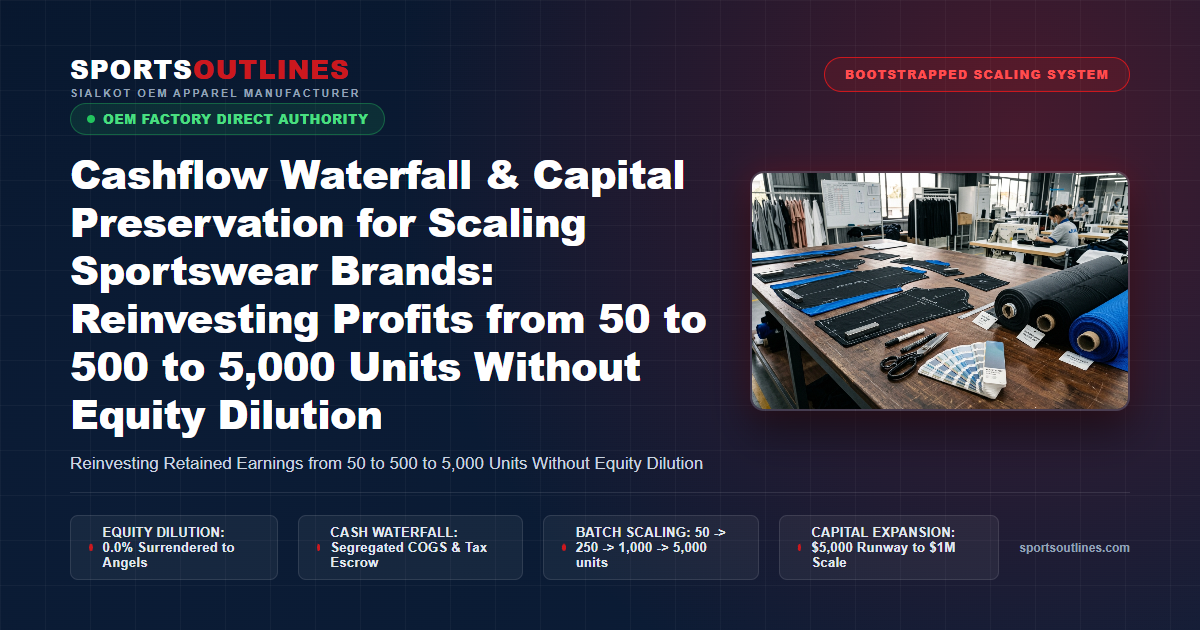
Scaling an emerging performance activewear or athletic combat brand from a bootstrapped pilot of 50 units to 500 and eventually 5,000 units per production run is primarily a mathematical challenge of working capital velocity rather than sales demand. In cut-and-sew apparel manufacturing, traditional cash-to-cash cycles span 75 to 110 days, meaning revenue from Batch N must be collected and ring-fenced to finance Batch N+1 long before customer delivery occurs. Brands that dilute equity prematurely to fund production inventory surrender 20% to 40% of their enterprise valuation to venture capitalists or high-interest predatory merchant cash advances (MCA). By establishing a disciplined Six-Stage Cashflow Waterfall and partnering with Sports Outlines in Sialkot, Pakistan—leveraging agile low MOQs of 30–50 pieces per style/colorway and transparent pre-production physical prototypes ($45–$85 per piece/pair/set non-refundable, 7–10 business days turnaround)—founders can self-fund 10x inventory expansion entirely through retained operating earnings and negative working capital cycles without ceding a single share of equity.
- The Scaling Cash Paradox: A brand growing at 30% month-over-month burns cash faster than a stagnant brand because inventory reorders must double before earlier invoices turn into cash.
- The 6-Stage Cashflow Waterfall: Top-line GMV → Merchant gateway & sales tax escrow (Stage 1) → Variable performance ad spend & 3PL fulfillment (Stage 2) → Direct manufacturing COGS replenishment escrow (Stage 3) → Buffer operating reserve (Stage 4) → Next-run batch expansion fund (Stage 5) → Founder equity dividend (Stage 6).
- Unit Cost Compression Dynamics: Scaling FOB costs compress from $16.50/unit at 50 pcs down to $12.80/unit at 250 pcs, $10.20/unit at 1,000 pcs, and $7.85/unit at 5,000 pcs—unlocking +52% gross margin expansion.
- The Anti-Dilution Moat: Sialkot agile cut-and-sew scheduling eliminates large unvalidated 1,000-piece factory minimums, enabling lean 30–50 piece drops that convert into cash within 21 days of landing.
- Direct Factory Strategic Desk: Consult our export financial engineering team via WhatsApp at
+92 316 7932595or request our technical pricing schedule via sportsoutlines.com.
1. The Growth Paradox: Why Rapidly Growing Apparel Brands Go Bankrupt
In physical goods manufacturing, growth consumes cash before it generates cash. This phenomenon, known in corporate finance as the Growth Paradox or Overtrading Trap, is the primary reason why promising sportswear brands collapse during their second or third year of operation. An e-commerce founder sees their initial drop of 100 gym hoodies sell out in 72 hours on Shopify, generating $6,500 in gross revenue from an initial $1,800 production spend. Emboldened by 70% gross margins and viral social momentum, the founder immediately orders 1,000 units from an overseas manufacturer that requires a strict 30% deposit upon order placement and 70% balance payment prior to ocean container release.
At this exact inflection point, the cashflow gap yawns open. The 1,000-unit batch demands $14,000 in landed manufacturing capital, plus $4,500 in air or sea freight, duties, and warehouse intake fees. The $6,500 earned from Batch 1 has already been partially absorbed by Shopify transaction fees, initial influencer seeding, and overhead. Lacking sufficient liquidity to clear the factory balance, the founder takes an emergency Merchant Cash Advance (MCA) at an extortionate 1.35 factor rate (effective APR exceeding 55%) or panics and sells 25% of their equity to an angel investor.
The alternative is bootstrapped capital preservation engineering. By understanding the mathematical mechanics of the cashflow waterfall and structuring manufacturing runs in lockstep with inventory velocity, apparel entrepreneurs can scale from 50 units to 5,000 units while retaining 100% cap-table ownership.
2. The Six-Stage Cashflow Waterfall: Ring-Fencing Operating Capital
A cashflow waterfall is a deterministic rules engine governing how every dollar entering the company bank account is segregated and dispersed. In unengineered apparel businesses, all customer receipts pool in a single operating checking account, creating the dangerous optical illusion of abundant cash. When tax season arrives or a factory production milestone payment matures, the brand finds itself insolvent.
To prevent liquidity evaporation, Sports Outlines advises scaling brand partners to implement a Multi-Sub-Account Capital Waterfall that auto-allocates incoming customer payments into distinct capital silos:
| Waterfall Priority | Capital Silo Destination | Standard Allocation (%) | Operational Rule & Constraint |
|---|---|---|---|
| Tier 1 (Senior Obligation) | Taxes & Merchant Fees Escrow | 8.0% – 12.0% | State sales tax (Avalara/TaxJar) + Stripe/Shopify gateway fees (2.9% + $0.30). Untouchable capital. |
| Tier 2 (Operating Velocity) | Fulfillment & Variable Shipping | 10.0% – 14.0% | 3PL pick, pack, outbound postage, and polybag consumable expenses. Must clear weekly. |
| Tier 3 (Inventory Continuity) | COGS Base Replacement Escrow | 22.0% – 28.0% | Direct unit manufacturing cost of current sold inventory to fund replacement batch at 1:1 ratio. |
| Tier 4 (Customer Acquisition) | Targeted Performance Marketing | 20.0% – 25.0% | Paid social ad spend capped at strict MER (Marketing Efficiency Ratio ≥ 4.0). Cease spend if ROAS dips. |
| Tier 5 (Scaling Velocity Fund) | Batch Scale & Expansion Escrow | 15.0% – 20.0% | Net retained profit dedicated exclusively to expanding production volume from 50 to 500 units. |
| Tier 6 (Equity Preservation) | Reserve Buffer & Founder Profit | 8.0% – 12.0% | Emergency cash buffer (3 months fixed burn) plus modest owner distributions. Never deplete below $10k. |
3. The 4-Stage Scaling Roadmap: From 50 to 5,000 Units
Scaling production volume without external equity requires navigating four distinct manufacturing milestones. At each milestone, the relationship between production volume, unit manufacturing cost (FOB Sialkot), landed logistics cost, and working capital requirements shifts dramatically:
| Growth Milestone | Production Run Size | FOB Unit Cost (Sialkot) | Landed Unit Cost (US/UK) | Total Working Capital Required | Primary Logistics Mode |
|---|---|---|---|---|---|
| Stage 1: Validation Pilot | 50 pieces (MOQ) | $16.50 | $22.80 | $1,140 | DHL Express Air Courier (4–6 days) |
| Stage 2: Core Expansion | 250 pieces (2–3 styles) | $12.80 | $16.40 | $4,100 | Air Cargo Consolidated (8–10 days) |
| Stage 3: Omnichannel Scale | 1,000 pieces (Full range) | $10.20 | $12.45 | $12,450 | LCL Ocean Freight (25–30 days) |
| Stage 4: Market Hegemony | 5,000 pieces (Container) | $7.85 | $9.30 | $46,500 | FCL 20ft Full Container Load |
4. Mathematical Proof: Reinvesting Profits to Self-Fund 10x Inventory Growth
Can an apparel entrepreneur truly scale from an initial $2,000 bankroll to funding a $46,500 full-container production run without borrowing debt or giving away company equity? Let us examine the exact mathematical reinvestment model using an athletic hoodie retailing at $68.00 MSRP:
| Production Cycle | Units Shipped | Landed Cost / Unit | Gross Retail Cash Collected | Opex, Ads & Fulfillment | Retained Cash Pool | Next Batch Capacity Funded |
|---|---|---|---|---|---|---|
| Cycle 1 (Pilot) | 50 units | $22.80 | $3,400 | -$1,150 ($23/unit CAC+ship) | $2,250 | 137 units @ $16.40 |
| Cycle 2 (Scale A) | 135 units | $17.50 | $9,180 | -$2,970 ($22/unit) | $6,210 | 378 units @ $16.40 |
| Cycle 3 (Scale B) | 375 units | $15.20 | $25,500 | -$7,875 ($21/unit) | $17,625 | 1,415 units @ $12.45 |
| Cycle 4 (Volume) | 1,200 units | $12.45 | $81,600 | -$24,000 ($20/unit) | $57,600 | 6,193 units @ $9.30 (FCL Funded!) |
As documented in Table 3, within four consecutive inventory replenishment cycles, the brand scales from a 50-piece pilot run to fully self-funding a 6,000-piece container load ($57,600 retained cash pool) without taking a dollar of investor equity, borrowing bank debt, or paying factor fees to predatory loan providers.
5. Physical Prototype Risk Gates: Safeguarding Your Working Capital
When scaling from 50 to 500 or 5,000 units, the single greatest threat to your cashflow waterfall is a mass production defect. If an unverified grading error slips into a 50-piece run, the brand loses $825. If the same error slips into a 1,200-piece run, the brand loses $15,000—a fatal liquidity event that forces bankruptcy.
To prevent this catastrophe, Sports Outlines enforces a non-negotiable Pre-Production Physical Prototype Gate:
- Nominal Non-Refundable Engineering Fee ($45–$85 per Piece): We charge an honest, transparent engineering fee of $45–$85 per prototype piece, pair, or set. This fee covers master pattern digitization, single-ply laser cutting, manual machine re-tooling, technician thread tensioning, and 7–10 business day sample dispatch.
- Physical Fit & Range-of-Motion Validation: Wearers perform dynamic gym exercises, deadlifts, and high-impact cardio in the prototype to verify stitch elongation, waistband retention, and opacity under stadium lighting before bulk cutting begins.
- Locked Production Approval: Only when the brand signs off on the physical prototype does our automated CNC vacuum cutting room begin slicing multi-ply fabric rolls for bulk assembly.
Table 4: Financial Risk Comparison: Physical Prototyping Gate vs. Blind Production
| Production Scenario | Upfront Verification Cost | Turnaround Time | Defect Risk Exposure | Net Financial Protection |
|---|---|---|---|---|
| Sports Outlines Protocol | $45 – $85 physical fee | 7 – 10 business days | < 0.5% defect risk | Protects 100% of bulk batch capital. |
| Blind Bulk Production | $0 upfront (false economy) | Immediate cutting | 18% – 35% defect exposure | High probability of unsellable batch inventory. |
6. Engineering Negative Working Capital: The VIP Pre-Order Engine
In traditional retail manufacturing, working capital is positive and burdensome: you buy raw fabric, sew garments, store inventory in a warehouse, and wait months for customers to purchase. In high-efficiency direct-to-consumer athletic manufacturing, the holy grail is achieving a Negative Working Capital Cycle: collecting customer payments BEFORE paying the manufacturing balance.
Here is how high-growth independent activewear brands execute this strategy with Sports Outlines:
- Step 1 (Physical Prototype Display): Order a precision physical prototype ($45–$85 fee) 3 weeks before launch. Photograph the garment on fitness athletes for high-converting social content.
- Step 2 (The 7-Day VIP Pre-Order Window): Open exclusive pre-orders on Shopify with a 15% discount for early adopters. Collect 100% of customer funds upfront via Stripe/Shopify Payments.
- Step 3 (Immediate Factory Deposit): Transfer the 30%–50% factory deposit to Sports Outlines to initiate bulk cutting. Customer funds fully cover this deposit.
- Step 4 (Agile Factory Execution): Sports Outlines cuts, sews, prints, and packs the bulk batch within 14–18 business days.
- Step 5 (Final Settlement & Dispatch): The brand settles the remaining factory balance from the already-collected customer funds and airships goods directly to customers or 3PL.
Under this structure, the brand operates with zero external debt and zero investor dilution, turning customer pre-payments into an interest-free manufacturing credit facility.
Table 5: Traditional Inventory Model vs. Negative Working Capital Pre-Order Model
| Operational Dimension | Traditional Speculative Inventory | Negative Working Capital Pre-Order | Strategic Business Advantage |
|---|---|---|---|
| Cash Collection Timing | 60–90 days AFTER production payment | 14–21 days BEFORE production balance | Eliminates debt financing requirements. |
| Inventory Dead-Stock Risk | High (20%–35% unsold sizes) | Zero (Produce exact ordered size ratio) | Zero capital locked in dead warehouse stock. |
| Factory MOQ Flexibility | Rigid 500–1,000 pcs (high risk) | Agile 30–50 pcs (Sports Outlines) | Rapid design iterations without inventory bloat. |
| Equity Dilution Pressure | Severe (Forced VC/Angel funding) | None (100% Bootstrapped Retained Ownership) | Founder keeps 100% of future enterprise equity! |
7. Real-World Case Study: How a UK BJJ Brand Scaled to 3,500 Units Bootstrapped
In early 2023, a combat sportswear founder in Manchester, UK launched a technical Brazilian Jiu-Jitsu (BJJ) rashguard and grappling shorts brand. Operating with a modest personal savings runway of £3,200 ($4,000 USD), the founder rejected outside angel investment offers that demanded 30% equity in exchange for a £25,000 production check.
Instead, the brand partnered directly with Sports Outlines in Sialkot, executing a strict cashflow waterfall roadmap:
- Drop 1 (Validation): Ordered 2 physical rashguard prototypes (£110 total engineering fees). Validated flatlock stretch and sub-print durability with local black-belt athletes. Cut a 60-unit pilot run (£1,020 FOB). Sold out in 10 days at £48 retail, generating £2,880.
- Drop 2 (Reinvestment): Reinvested 100% of retained earnings into a 200-unit batch across two colorways (£2,800 production cost). Grossed £9,600.
- Drop 3 (Category Expansion): Added 240 GSM grappling fight shorts with curved anatomical side splits. Expanded production to 650 units (£7,400 production). Grossed £31,200.
- Drop 4 (Full Academy Wholesale & D2C Scale): 14 months post-launch, the brand ordered 3,500 units in a consolidated ocean shipment (£27,500 production spend), funding the entire run from accumulated operating cash reserves.
Table 6: Manchester Combat Brand Financial Scaling Progression (Zero Equity Dilution)
| Production Drop | Units Manufactured | Production Outlay (£) | Gross Sales (£) | Retained Profit (£) | Equity Retained |
|---|---|---|---|---|---|
| Drop 1 (Pilot) | 60 rashguards | £1,020 | £2,880 | £1,240 | 100.0% |
| Drop 2 (Scale) | 200 rashguards | £2,800 | £9,600 | £4,920 | 100.0% |
| Drop 3 (Category) | 650 sets | £7,400 | £31,200 | £16,800 | 100.0% |
| Drop 4 (Hegemony) | 3,500 units | £27,500 | £157,500 | £89,400 | 100.0% Founder Owned! |
8. Unit Cost Optimization: The 5 Engineering Levers of Apparel Margin Expansion
As production volume scales from a 50-piece pilot run to 5,000 units, FOB unit costs drop dramatically—not simply because the factory “charges less,” but because fundamental physical efficiencies occur on the factory floor. When an activewear brand founder understands these five engineering levers, they can collaborate with Sports Outlines to aggressively engineer out unnecessary manufacturing waste:
- Marker Efficiency & Fabric Nesting Yield (CAD Optimization): In a 50-piece pilot run, fabric cutting markers are short, resulting in cutting table utilization of approximately 78%–81% (19%–22% fabric scrap waste). When cutting 1,000 to 5,000 units across full size curves (XS–2XL), our computerized Gerber CAD software nests pattern pieces with interlocking precision, raising marker efficiency to 89.5%–92.0%. This cuts raw fabric yardage consumption per garment by 12%–15%.
- Raw Yarn & Dye Lot Forward Contracting: Circular knitting mills enforce minimum batch dyeing requirements (typically 300 to 500 kg per custom colorway). For small runs, mills charge small-batch dyeing surcharges ($1.80–$2.50/kg). At 1,000+ units, fabric is knitted and dyed in industrial bulk dye-jets, eliminating surcharges and dropping raw textile cost from $8.20/kg down to $5.40/kg.
- Automated Trim Aggregation (Bulk Purchasing with Staggered Assembly): Custom woven brand labels, high-density silicone heat transfers, laser-engraved drawcord aglets, and custom zipper pulls carry massive quantity price breaks. Sports Outlines allows clients to purchase 5,000 sets of custom trims upfront (total outlay ~$600) and stores them in our factory bonded warehouse, applying them across ten consecutive 500-unit production batches to capture tier-one trim pricing.
- Sewing Line Balancing & Muscle Memory Assembly: During the first 50 pieces of a new athletic jacket or compression legging design, sewing technicians require 24–28 minutes per garment as they adapt to seam geometry. By unit 500, technician muscle memory, automated flatlock feed guides, and pneumatic thread trimmers compress assembly cycle time to 11–13 minutes per garment, slashing direct labor overhead.
- Consolidated Ocean Logistics (Air Express vs. FCL Container): Air courier rates ($6.50–$9.50/kg) dominate early pilot testing. Transitioning to full 20ft ocean containers (holding ~12,000 to 15,000 garments) compresses per-unit international freight to under $0.65–$0.95 per garment, adding 15 to 20 percentage points of pure net margin.
Table 7: The 5 Engineering Levers of Direct Unit Manufacturing Cost Reduction
| Cost Lever | Stage 1: 50 Units Pilot | Stage 3: 1,000 Units Scale | Stage 4: 5,000 Units Container | Total Unit Savings ($) |
|---|---|---|---|---|
| 1. Fabric Marker Nesting Yield | 79.5% efficiency ($7.40 fabric) | 88.5% efficiency ($5.80 fabric) | 91.5% efficiency ($4.65 fabric) | -$2.75 / unit |
| 2. Textile Dyeing & Knits | Sample lot surcharge ($2.20) | Standard batch rate ($0.40) | Zero surcharge ($0.00) | -$2.20 / unit |
| 3. Custom Branding & Trims | $2.40 / unit (Low quantity run) | $0.85 / unit (Aggregated trims) | $0.45 / unit (Direct bulk import) | -$1.95 / unit |
| 4. Cut-and-Sew Assembly Labor | $4.50 (26 min manual setup) | $3.15 (16 min balanced line) | $2.75 (12 min high-speed cells) | -$1.75 / unit |
| 5. International Freight Mode | $6.30 (Air Courier Express) | $2.25 (LCL Ocean Freight) | $0.85 (FCL 20ft Container) | -$5.45 / unit |
| Total Landed Cost / Garment | $22.80 | $12.45 | $8.70 | -$14.10 / unit (-61.8%!) |
9. The Working Capital Fortress: Factory Milestone Structuring & Terms
A healthy working capital waterfall requires aligned financial terms between the apparel brand and its manufacturing partner. Rigid factories demanding 100% upfront cash wire transfers starve young brands of liquidity, while reckless brands demanding 90-day post-delivery credit on unverified creditworthiness create toxic supplier friction.
Sports Outlines operates on a structured Three-Tier Milestone Payment Protocol designed to maintain fair working capital distribution across the production lifecycle:
- Milestone 1 — 30% Raw Material Commitment Deposit: Triggered upon CAD pattern lock and tech pack confirmation. This capital funds the procurement of base circular knits, specialized elastane yarns, and dye house reservation.
- Milestone 2 — 40% Inline Sewing & Printing Signoff: Released once fabric rolls are vacuum-cut and garments enter the sewing line. The brand receives real-time photo/video documentation of stitching and branding application.
- Milestone 3 — 30% Final AQL 2.5 QC & Bill of Lading Release: Paid only after the goods complete final ISO 2859-1 Level II AQL 2.5 quality control inspection, custom polybag packaging, and packing list generation. Once settled, original export bills of lading (or DHL air waybills) are released for customs clearance.
Table 8: Trade Financing & Payment Terms Across Brand Scale Milestones
| Brand Stage | Production Volume | Standard Payment Structure | Settlement Mechanism | Working Capital Strategy |
|---|---|---|---|---|
| Stage 1: Bootstrapped Pilot | 50 – 150 pieces | 50% deposit / 50% pre-dispatch | Wise / Bank Wire (SWIFT TT) | Funded via personal savings or VIP pre-orders. |
| Stage 2: Core Expansion | 250 – 500 pieces | 30% deposit / 40% inline / 30% QC | International Bank Wire (TT) | Funded 100% from retained Shopify earnings. |
| Stage 3: Omnichannel Scale | 1,000 – 2,500 pieces | 20% deposit / 50% BL copy / 30% dock | Irrevocable Commercial LC / TT | PO Financing / Wholesale retail deposit backings. |
| Stage 4: Market Hegemony | 5,000+ pieces (Container) | Net 30 / Net 60 revolving facility | Institutional Trade Credit / LC | Negative working capital cycle with 30-day cash float. |
10. The 10-Point Capital Preservation Checklist for Sportswear Founders
Print this operational checklist and review it prior to approving any bulk manufacturing purchase order:
- [ ] 1. Settle Taxes & Gateways First: Automatically route 10% of every Shopify deposit into a dedicated tax/merchant fee checking sub-account.
- [ ] 2. Ring-Fence COGS Escrow: Never touch the 25% direct replacement cost of sold items for marketing experiments or personal draws.
- [ ] 3. Require Pre-Production Physical Prototypes: Never authorize bulk cutting without inspecting an approved physical sample ($45–$85 fee, 7–10 days).
- [ ] 4. Leverage Low Factory MOQs (30–50 Pcs): Test new cuts, colors, and sizing ranges in lean batches to prevent dead-stock capital traps.
- [ ] 5. Run VIP Pre-Order Drops: Open a 7-day pre-order window to fund 100% of your production balance before goods finish assembly.
- [ ] 6. Aggregate Custom Trims: Purchase 5,000 custom heat transfers and woven labels upfront to capture tier-one pricing across staggered production runs.
- [ ] 7. Enforce MER Discipline: If blended Marketing Efficiency Ratio dips below 3.5x, immediately throttle ad spend rather than funding unprofitable volume.
- [ ] 8. Consolidate Air to Ocean Over 500 Pcs: Transition from air courier ($7.50/kg) to consolidated ocean cargo ($1.20/kg) as order sizes surpass 500 units.
- [ ] 9. Maintain a 3-Month Fixed Burn Buffer: Protect a minimum of $10,000 in liquid reserves to survive unexpected freight delays or macro disruptions.
- [ ] 10. Partner Direct with Sialkot Cut-and-Sew: Eliminate trading middlemen, brokers, and Western white-label agencies taking 30%–40% margin markups.
11. Frequently Asked Questions: Cashflow Waterfall & Production Financing
Q1: How can an apparel brand survive a 90-day cash conversion cycle without debt?
By combining low factory MOQs (30–50 pieces per style) with air-freight consolidation and rolling pre-order drops. When production runs take only 14–18 business days at Sports Outlines, your cash-to-cash cycle shrinks from 90 days down to 28 days, allowing you to cycle the same working capital pool 4 times per year instead of once.
Q2: What percentage of revenue should be ring-fenced for inventory re-orders?
We recommend dedicating at least 25% to 30% of gross customer receipts directly into an Inventory Escrow Sub-Account. If you plan to expand order volume by 2x on the subsequent drop, increase your allocation to 40% of net collections to avoid working capital crunches.
Q3: Why is taking a Merchant Cash Advance (MCA) dangerous for sportswear scaling?
MCAs deduct 15% to 25% of your daily credit card sales right at the processor level before you pay your suppliers or 3PL. In an industry where gross margins are 60%–70%, forfeiting a quarter of top-line revenue to debt service completely destroys your cashflow waterfall, making inventory replenishment impossible.
Q4: Why does Sports Outlines charge an engineering fee for physical pre-production prototypes?
Creating a single bespoke production prototype requires dedicated pattern drafting, single-ply laser cutting, and manual machine setup. Charging an honest $45–$85 fee guarantees dedicated engineering precision, protecting your working capital from catastrophic bulk defects.
Q5: At what volume does switching from air courier to sea freight make economic sense?
When shipment weight exceeds 350 to 500 kg (typically around 600 to 1,000 apparel units). Below 500 units, the cash velocity advantage of 5-day air delivery far outweighs the slight shipping savings of a 30-day ocean transit that locks up your working capital.
Q6: How does low-MOQ sourcing (30–50 pieces) preserve founder equity?
High-MOQ factories forcing 500–1,000 piece commitments require $15,000+ upfront capital per style, forcing founders to seek equity investors. Sports Outlines’ 30–50 piece cut-and-sew minimums allow you to launch professional custom designs for under $1,200, preserving 100% of your company’s shares.
Q7: Can a brand negotiate 60-day credit terms with Sports Outlines?
Credit facilities are established gradually. For initial pilot runs (50–250 units), we require standard milestone payments (deposit + pre-shipment). Once a brand demonstrates consistent re-order volume exceeding 2,500 units annually with an impeccable payment history, we open flexible commercial trade terms, revolving LC structures, and port-release financing.
Q8: How does Sports Outlines help brands test new styles without inventory risk?
We offer rapid prototyping ($45–$85 fee, 7–10 days) followed by lean 30–50 piece test runs. This enables brands to launch seasonal capsules and trend-led colorways directly to VIP customers. Only styles achieving 80%+ sell-through within 14 days are scaled into 500-unit bulk production.
Scale Your Sportswear Brand 10x Without Selling a Single Share
Partner directly with Sports Outlines in Sialkot, Pakistan. Leverage agile low MOQs of 30–50 pieces, precision pre-production prototyping ($45–$85/piece), and rapid 14–18 day production lead times to turn your inventory into an autonomous cash-generating engine.
Direct sourcing desks: USA Sourcing Desk | UK Sourcing Desk | Australia Sourcing Desk | Sportswear Catalog.