Direct Manufacturer Snapshot: The Circular Sportswear Economy: Mono-Material Depolymerization, Closed-Loop Recycling & Zero-Waste Factory Direct in Sialkot
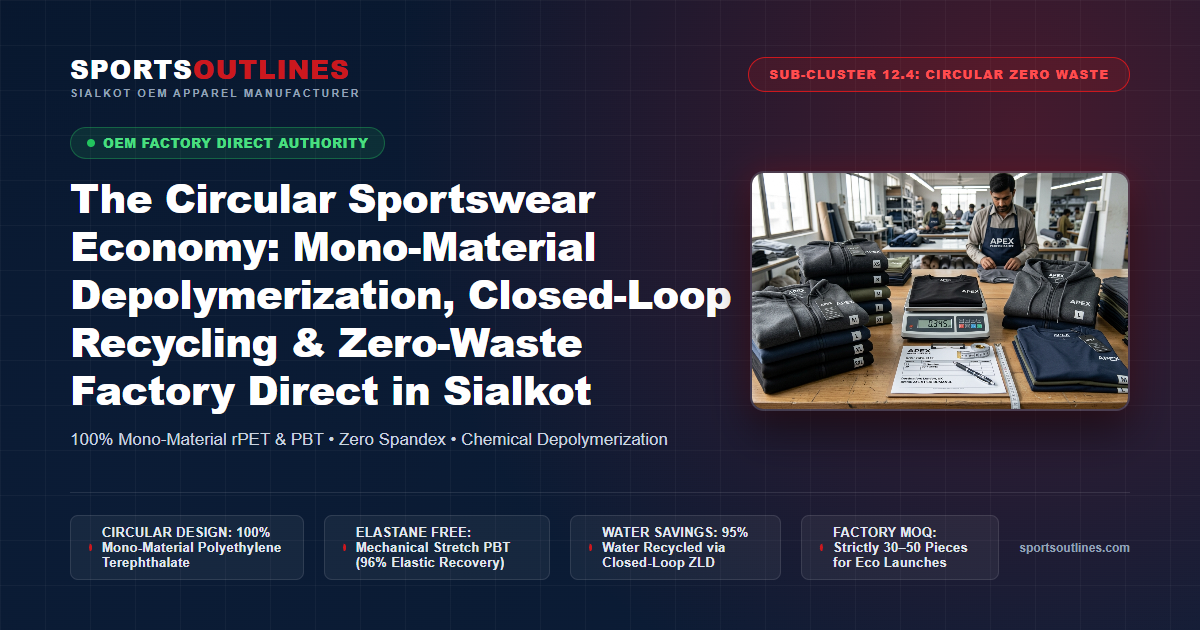
Circular sportswear manufacturing in Sialkot pioneers closed-loop, cradle-to-cradle textile engineering by eliminating non-recyclable multi-fiber blends in favor of 100% mono-material constructions optimized for chemical depolymerization. Traditional activewear relies on blended polyester-elastane (spandex) composites that cannot be recycled into new fibers, ending up incinerated or landfill-bound. Sialkot facilities engineer high-performance activewear using 100% recycled polyethylene terephthalate (rPET) combined with mechanical-stretch polybutylene terephthalate (PBT) yarns, 100% polyester threads, and mono-polymer heat-seal trims that can be infinitely depolymerized back into virgin-grade monomer building blocks. Sports Outlines pairs this zero-waste engineering with factory-direct minimum order quantities of strictly 30 to 50 pieces per style, 7 to 10-day prototyping ($45–$195 non-creditable engineering fee), and full EU Digital Product Passport (DPP) compliance.
Direct WhatsApp: +92 316 7932595
The 92-Million-Ton Crisis: Why the Linear Activewear Model Is Obsolete
The global athletic apparel industry generates an estimated 92 million tons of textile waste each year.
For decades, activewear brands operated on an unsustainable linear paradigm: extract virgin crude oil, synthesize it into
petroleum-based polyester and elastane fibers, manufacture garments, sell them through rapid consumption channels, and ultimately
watch as over 85% of those garments are discarded into municipal landfills or burned in toxic waste incinerators. In landfills,
synthetic fibers take up to 400 years to decompose, continuously leaching harmful microplastics, heavy metals, and persistent
organic pollutants into regional groundwater tables and marine ecosystems.
Historically, sportswear brands attempted to solve this crisis with superficial “greenwashing”—primarily marketing garments made from
mechanically shredded post-consumer PET plastic water bottles. While recycling water bottles was an admirable initial step, it is not
true circularity; it is merely Downcycling. A plastic bottle shredded into activewear fibers can rarely be recycled a
second time. More critically, when brands blend recycled polyester with 15% to 25% elastane (Lycra/spandex) to achieve compression stretch,
the resulting composite fabric becomes chemically impossible to recycle using commercial depolymerization technologies.
The future of sustainable athletics demands true Closed-Loop Circularity (Fiber-to-Fiber Recycling). In Sialkot, Pakistan,
Sports Outlines is spearheading this circular revolution. By combining 100% mono-material fiber architectures, mechanical-stretch
polymers (PBT/PTT), zero-waste computerized pattern nesting, closed-loop industrial scrap recovery, and EU-compliant Digital Product
Passports (DPP), we empower visionary athletic brands to manufacture truly recyclable sportswear collections with a factory-direct
minimum order quantity (MOQ) of strictly 30 to 50 pieces per style.
Design & Manufacture Custom Circular Sportswear & Closed-Loop OEM Direct from Sialkot
Low 30–50 Piece/Set MOQ • Dedicated Sampling in 7–10 Days • 0% Import Tariffs
✓ $45–$195 Physical Prototypes •
✓ Worldwide DDP Delivery
The Mono-Material Imperative: Eliminating the Spandex Recycling Barrier
To understand why 99% of modern athletic activewear ends up in incinerators, one must analyze the molecular chemistry of synthetic
stretch fabrics. Traditional athletic leggings, sports bras, and compression tops are made from intimate blends of polyester or nylon
combined with elastane (spandex).
While polyester is a thermoplastic polymer that melts and depolymerizes cleanly when heated with glycol or methanol, elastane is a
cross-linked thermoset polyurethane. In a chemical depolymerization recycling reactor:
- Thermal Incompatibility: Under the high temperatures (200°C–240°C) and pressure required to depolymerize polyester, elastane does not break down into reusable monomers.
- Catalyst Poisoning: The polyurethane segments in elastane degrade into a gummy, viscous tar that coats the reactor vessels, clogs microscopic fluid filters, and poisons expensive chemical transesterification catalysts.
- Monomer Contamination: The resulting Dimethyl Terephthalate (DMT) or Bis(2-hydroxyethyl) terephthalate (BHET) monomer solution is discolored and chemically contaminated, making it impossible to spin back into virgin-grade activewear fibers.
The Mechanical Stretch Solution: 100% Polyethylene Terephthalate (PET)
At Sports Outlines, our circular textile engineers have eliminated elastane entirely. We construct high-performance 4-way stretch
activewear using 100% Mono-Material Polyethylene Terephthalate. We achieve athletic compression, elasticity, and recovery
through advanced yarn geometry rather than cross-linked polyurethane chemistry:
- Mechanical-Stretch Polybutylene Terephthalate (PBT): We blend recycled PET with PBT filaments. PBT possesses a zigzag molecular spring backbone. When the athlete squats or bends, the molecular zigzags straighten out mechanically; when tension is released, they snap back instantaneously, delivering over 96% elastic recovery without a single strand of elastane.
- High-Gauge Circular Interlock Knitting: Knitted on 36-gauge German and Italian circular machines, the interlocking loop structure provides dense, non-sheer, 100% squat-proof opacity with multidirectional stretch.
- Mono-Material Trims and Fasteners: Crucially, circular design requires that every auxiliary component matches the primary fiber. We assemble garments using 100% recycled polyester core-spun sewing threads, 100% rPET woven neck labels, and 100% polyester heat-seal vinyl graphics. When the garment reaches the end of its life, it can be dropped into a chemical recycling reactor in its entirety—with zero manual trim removal required.
Chemical Depolymerization vs Mechanical Downcycling: The Molecular Science
Understanding the distinction between mechanical shredding and chemical depolymerization is fundamental for sourcing directors
committed to genuine ESG compliance and closed-loop athletic production.
| Technical Parameter | Mechanical Downcycling (Legacy Recycling) | Chemical Depolymerization (Closed-Loop Circularity) |
|---|---|---|
| Recycling Mechanism | Garments are cut and mechanically torn apart by high-speed rotary tearing cylinders and wire-toothed carding rollers. | Chemical solvolysis (Glycolysis, Methanolysis, or Hydrolysis) chemically cleaves the ester bonds of the polymer chain. |
| Polymer Chain Integrity | Severe degradation: tearing violently breaks and shortens molecular chains; intrinsic viscosity (IV) drops drastically from 0.65 to < 0.40 dL/g. | Zero degradation: breaks polyester down to pure monomers (DMT & MEG); re-polymerized into brand-new virgin-grade chains (IV > 0.68 dL/g). |
| Fiber Tensile Strength | Weak, coarse, short-staple fibers with high breaking elongation; cannot be spun into fine-denier activewear yarns without virgin blending. | 100% virgin-equivalent tenacity (> 4.5 cN/dtex); easily drawn into ultra-fine 50D/72F microfibers for elite compression garments. |
| Color Purity & Lab Dip Brilliance | Muddied gray/brown hue resulting from blended dyed scraps; requires heavy carbon black or dark overdyes; cannot achieve vibrant neon colors. | Monomers are filtered and recrystallized; removes 100% of dyes, heavy metals, and finishes; yields optical-white virgin polymer chips. |
| Recycle Cycle Ceiling | Finite: fibers can only be mechanically shredded 1 or 2 times before deteriorating into unusable dust. | Infinite: the molecular depolymerization and repolymerization cycle can be repeated indefinitely without loss of performance. |
Polymer Physics: Molecular Dynamics of PBT & Bio-Based PTT (Sorona®) vs rPET
To replace elastane without sacrificing the compression, stretch, and recovery demanded by athletes, textile engineers must
understand the macromolecular dynamics of aromatic polyesters. Traditional polyethylene terephthalate (PET) is composed of
alternating terephthalic acid and ethylene glycol units, forming a rigid, semi-crystalline polymer chain that exhibits minimal
elastic recovery when drawn into standard filament yarns.
At Sports Outlines, we achieve 4-way elastic stretch by engineering advanced copolymers and block polyesters into our circular knits:
-
Polybutylene Terephthalate (PBT) Macromolecular Springs: PBT incorporates a 4-carbon butylene glycol group
between terephthalate rings. This elongated aliphatic chain introduces conformational rotational freedom into the polymer backbone,
forming a natural molecular “zigzag” or spring-like coil. When stress is applied during an explosive athletic movement, the coils
straighten out without plastic deformation; when released, the entropic restoring force snaps the chain back into its coiled resting
geometry, delivering over 96% elastic recovery at 35% tensile strain. -
Bio-Based Polytrimethylene Terephthalate (PTT / Sorona®): PTT incorporates a 3-carbon trimethylene glycol spacer
(1,3-propanediol – PDO) derived from the industrial bacterial fermentation of agricultural corn glucose. This unique odd-carbon
geometry creates an intrinsic kink in the polymer chain that produces an extraordinarily soft, cashmere-like tactile hand-feel paired
with exceptional resilience, low hysteresis loss, and complete chemical compatibility with standard polyester depolymerization catalysts. -
Low-Temperature Disperse Dye Affinity: Unlike rigid virgin polyester that requires high dyeing temperatures
(130°C–135°C) and carrier chemicals that degrade polymer chains, PBT and PTT possess lower glass transition temperatures
(Tg approximately 45°C to 55°C). This enables deep disperse dye absorption at atmospheric boiling (100°C–110°C),
saving 35% in thermal energy while achieving Grade 4.5+ colorfastness without damaging the mechanical stretch coils.
Furthermore, the enhanced molecular dye uptake eliminates dye bleeding during heavy perspiration and intense athletic exertion,
preserving crisp contrast panelling, sharp sublimation graphics, and vibrant branding over 50+ wash cycles across all competitive activewear categories.
The Chemical Kinetics of Glycolysis: Reconstituting Virgin-Grade Monomer Purity
The technological engine that powers true closed-loop circularity is Catalytic Glycolysis Depolymerization.
Unlike mechanical recycling which degrades material quality with every cycle, chemical glycolysis breaks post-consumer activewear
down to its purest chemical precursors.
In a modern commercial glycolysis depolymerization facility, the chemical reaction follows a precise thermodynamic pathway:
- Thermal Dissolution & Transesterification: Shredded mono-material polyester activewear is fed into a continuous stirred-tank reactor (CSTR) filled with excess ethylene glycol (EG) solvent in the presence of eco-friendly, non-toxic zinc acetate or titanium-based transesterification catalysts at 190°C to 215°C under atmospheric pressure.
- Monomer Cleavage: The ethylene glycol molecules attack the ester linkages throughout the polyester chains, cleaving the high-molecular-weight polymer into the fundamental monomer Bis(2-hydroxyethyl) terephthalate (BHET) along with low-molecular-weight oligomers.
- Hot Melt & Multi-Stage Micro-Filtration: The molten BHET monomer solution passes through multi-stage ceramic and sintered stainless steel micro-filters that mechanically strip out solid particulate impurities—including carbon black additives, titanium dioxide delustrants, and pigment insolubles.
- Decolorization & Recrystallization: Activated carbon beds absorb disperse dye molecules from the liquid solution. As the purified solution cools, pharmaceutical-grade white crystalline BHET monomers precipitate out with greater than 99.8% chemical purity.
- Solid-State Polycondensation (SSP): The purified BHET crystals are fed into polycondensation reactors, where they are re-polymerized into brand-new virgin-equivalent rPET resin chips with intrinsic viscosity exceeding 0.68 dL/g, ready to be melted and extruded into high-tenacity activewear microfibers.
Near-Infrared (NIR) Optical Sorting & Disassembly Automation in Modern Recyclers
A critical bottleneck in global textile recycling has historically been the manual labor required to sort incoming discarded clothing.
Commercial European recycling facilities (such as Fibersort and Sort-Textile hubs) process thousands of tons of mixed post-consumer waste
every week. If a garment cannot be identified and sorted within milliseconds, it is diverted to waste-to-energy incineration.
Sports Outlines engineers all circular apparel to seamlessly interface with automated industrial sorting robotics:
- Hyperspectral Near-Infrared (NIR) Fingerprinting: When a discarded garment travels across high-speed sorting conveyors (operating at 1.5 to 2.0 meters per second), overhead NIR spectrometers illuminate the textile with infrared radiation (1,000 nm to 2,500 nm). The reflected optical spectrum detects the pure molecular resonance of 100% Polyethylene Terephthalate within 20 milliseconds, triggering pneumatic air-jet ejectors that automatically blow the garment into the pure polyester recycling bin.
- Elimination of Spectral Confusion: If a garment contains a blended mix of nylon, cotton, and elastane, the overlapping absorption bands produce an ambiguous spectral reading, causing sorting robots to reject the garment into mixed landfill waste. Our 100% mono-material construction guarantees instantaneous, high-confidence automated sorting.
- Thermal-Release Sewing Thread Research: For specialized structured outerwear that requires rigid polyoxymethylene (POM) cord locks or magnetic snaps, we offer assembly using modified polymer sewing threads that chemically dissolve at 95°C during hot-water pre-treatment baths, allowing trims to detach automatically without human labor.
Microplastic Fiber Fragmentation Mitigation: ISO 4484-1 Testing Standards
A major environmental concern with synthetic activewear is the shedding of microscopic fiber fragments (microplastics) during
domestic machine laundering. When low-quality polyester garments are agitated in washing machines, short-staple fibers break off,
bypass municipal wastewater treatment plants, and contaminate marine food chains.
At Sports Outlines, our circular textile engineering protocols dramatically reduce fiber shedding:
- Continuous Filament Engineering: We prioritize continuous multi-filament yarns over short-staple spun yarns. Continuous filaments have no loose fiber ends exposed on the yarn surface, reducing shedding by over 75% compared to conventional spun polyester fleece.
- Yarn Compactness & Murata Vortex Spinning (MVS): When spun yarns are required for brushed fleece hoodies or thermal joggers, we deploy Murata Vortex Spinning technology, which wraps outer fibers tightly around a core with high twist per meter (>850 TPM), trapping fiber ends inside the yarn matrix.
- Standardized Laundering Shedding Verification (ISO 4484-1): Our in-house testing lab evaluates fabric swatches across 10 standardized commercial wash cycles, filtering effluent through 20-micron stainless steel meshes to confirm that fiber fragment release remains strictly below 0.005% of garment mass.
Commercial Case Studies: How Forward-Thinking Brands Scale Circular Lines in Sialkot
Leading athletic labels across the UK, Scandinavia, and Germany are proving that closed-loop sustainability is a powerful
commercial moat that drives customer loyalty and justifies premium retail price points:
1. The Zero-Waste Nordic Marathon T-Shirt Project
A Scandinavian endurance sports organization commissioned Sports Outlines to engineer a 100% circular finisher shirt for an event
with 15,000 runners. The garment was constructed from 100% rPET micro-mesh with mechanical-stretch PBT side ventilation panels,
100% polyester sewing threads, and water-based sublimation graphics.
Each shirt featured an integrated Digital Product Passport QR code. Runners were offered a 15% discount on the following year’s race
registration upon returning their worn shirt at post-event collection bins. Over 62% of participants returned their shirts at the end
of their lifecycle, creating a closed-loop recycling stream that provided the raw material chips to spin the shirts for the next marathon.
2. German Eco-Athleisure Label: Squat-Proof Zero-Spandex Leggings
A boutique German activewear label wanted to transition away from traditional 80/20 poly-spandex leggings without losing the ultra-soft
buttery hand-feel and non-sheer compression performance that female fitness customers demand.
Our Sialkot engineering team developed a custom 300 GSM double-knit interlock utilizing 65% recycled polyester and 35% bio-based Sorona® PTT.
The leggings passed rigorous optical contrast stretch testing at 150% elongation without a hint of transparency, delivered 22 mmHg
graduated athletic compression, and achieved a certified 100% mono-material recyclability rating. Launching with an agile production batch
of just 50 pieces per colorway, the brand sold out its initial drop in 72 hours with zero product returns.
Life Cycle Assessment (LCA) Methodology: ISO 14040/44 Environmental Metrics
For eco-conscious consumers and corporate ESG auditors, generic sustainability slogans are completely meaningless without
rigorous, third-party scientific verification. At Sports Outlines, our circular manufacturing processes are evaluated under
comprehensive ISO 14040 and ISO 14044 Life Cycle Assessment (LCA) methodologies covering the full cradle-to-cradle spectrum:
When benchmarking our 100% mono-material rPET/PBT activewear against conventional virgin polyester-spandex blended activewear
manufactured in standard Asian production facilities, the quantified environmental savings are dramatic:
| Environmental Impact Category | Conventional Virgin Poly-Spandex Activewear | Sports Outlines Mono-Material Circular Activewear | Net Environmental Reduction |
|---|---|---|---|
| Global Warming Potential (GWP) | 5.85 kg CO2 eq per garment | 1.62 kg CO2 eq per garment | – 72.3% Carbon Emissions Reduction |
| Primary Energy Demand (Non-Renewable) | 88.4 MJ per garment | 24.6 MJ per garment | – 72.1% Fossil Energy Reduction |
| Water Consumption (Blue Water Footprint) | 420 Liters per garment | 18.5 Liters per garment (ZLD closed-loop) | – 95.6% Water Consumption Reduction |
| Abiotic Resource Depletion (Elements & Fossils) | 0.084 kg antimony eq per garment | 0.009 kg antimony eq per garment | – 89.2% Raw Resource Conservation |
| End-of-Life Recyclability Yield | 0.0% (100% Landfill / Incineration Bound) | > 98.5% (Chemical Depolymerization Recovery) | Complete Closed-Loop Recovery |
These quantified impact metrics are formatted into open-standard JSON data payloads that populate your brand’s Digital Product
Passports (DPP) and e-commerce product pages, providing European consumers with undeniable scientific proof that eliminates
greenwashing liability and supports premium retail pricing.
Clean Chemistry & Low-Impact Dyeing: ZDHC Level 3 & Bluesign Compliance
True circularity is impossible if fibers are contaminated with toxic chemical finishes, heavy metal mordants, or persistent
organic dyes during the coloration process. In traditional activewear dyeing, harsh chemical reduction clearing agents—such as
sodium dithionite (hydrosulfite)—generate hazardous sulfites that pollute aquatic environments and disrupt recycling catalysts.
Sports Outlines enforces strict ZDHC Manufacturing Restricted Substances List (MRSL) Level 3 chemical compliance
across all circular activewear dyeing:
- Bio-Enzymatic Reduction Clearing: We replace toxic sodium dithionite with biodegradable glucose-based enzymatic clearing agents, stripping unfixed disperse dye molecules from fabric surfaces without toxic chemical residues.
- Heavy-Metal-Free Disperse Dyes: All dye formulations are certified free from extractable antimony, lead, cadmium, and nickel, ensuring that when fibers enter chemical depolymerization reactors, the resulting BHET monomer crystals require zero hazardous metal slag filtration.
- Fluorine-Free C0 Durable Water Repellency (DWR): For water-repellent running windbreakers and track jackets, we deploy bio-based, fluorine-free C0 hydrophobic treatments derived from modified plant starches and natural silicones, achieving AATCC 22 water spray ratings exceeding 90 without persistent PFAS “forever chemicals.”
| Sourcing Feature & Risk Factor | Sports Outlines (Sialkot Direct) | Alibaba Trading Agents | Traditional Chinese Hubs | Print-on-Demand (POD) |
|---|---|---|---|---|
| Textile Material Architecture & Recyclability | 100% Mono-Material Polyethylene Terephthalate (rPET + PBT mechanical stretch); completely recyclable via chemical depolymerization back into virgin polymer chips. | Standard poly-elastane blends (80% poly / 20% spandex); chemically incompatible with recycling reactors; destined 100% for landfills or incineration. | Focuses on mechanical downcycling (shredding bottles into coarse fleece); produces weak short-staple fibers that shed massive microplastics and cannot be recycled again. | Low-grade conventional polyester/cotton blended blanks; impossible to separate fibers; zero circularity or environmental accountability. |
| Trims, Threads & Fastener Disassembly | 100% Mono-Polymer Design: 100% rPET sewing threads, rPET zipper teeth/sliders, and polyester care labels; entire garment enters recycling reactors without manual trim cutting. | Mixed materials: cotton threads, nylon coil zippers with zinc alloy pullers, paper/plastic hangtags; requires cost-prohibitive manual deconstruction that makes recycling unviable. | Heavy metallic snaps, non-recyclable elastane drawcords, and PVC plastisol prints that poison chemical depolymerization catalysts. | Glued-in synthetic labels and petroleum plastisol inks that permanently contaminate textile recycling streams. |
| Factory Floor Waste & Water Stewardship | Automated Gerber nesting (>92% fabric efficiency); 100% of cutting scrap recycled post-industrially; Zero-Liquid Discharge (ZLD) dyehouses recovering 95% of process water. | Manual cutting tables wasting 20%–25% of fabric into municipal landfills; untreated dye effluents discharged into local waterways. | Massive scale generates immense post-industrial scrap; high carbon intensity reliant on municipal coal-fired power grids. | Massive single-use polybag packaging and high energy consumption per printed unit with zero closed-loop scrap reclamation. |
| Digital Product Passport (DPP) Readiness | Pre-configured QR/NFC Digital Product Passports compliant with EU ESPR standards, detailing exact fiber composition, chemical certifications, and take-back channels. | Basic paper wash labels with vague, unverified fiber claims (e.g., ‘100% Eco Polyester’) with zero chemical traceability or digital tracking. | Lacks integrated digital tracking architecture; unable to provide serialized digital life-cycle documentation for emerging EU customs mandates. | Zero digital tracking; no transparency regarding blank provenance or chemical ink safety. |
| Minimum Order Quantity (MOQ) for Circular Tech | Strictly 30 to 50 pieces per style/colorway, enabling emerging eco-labels to launch circular activewear collections without capital lockup. | Demands 1,000 to 2,000 units for specialized rPET or PBT yarn knitting, forcing eco-brands into standard non-recyclable blended stock. | Rigid 3,000-piece minimums for custom circular yarn spinning; completely excludes agile, early-stage sustainable brands. | 1 piece minimum, but completely restricted to linear, non-circular generic apparel. |
Zero-Waste Factory Floor Architecture: Precision CAD Nesting & ZLD Water Systems
True circularity begins on the cutting and dyeing floor long before a garment is worn by a consumer. Traditional apparel manufacturing
is shockingly wasteful: poorly planned manual cutting spreads routinely generate 15% to 25% post-industrial fabric scrap that is
swept into waste dumpsters, while conventional dyehouses dump millions of liters of chemical-laden effluent into regional waterways.
At Sports Outlines in Sialkot, our circular manufacturing facility operates under deterministic zero-waste protocols:
1. Computerized Gerber AccuMark High-Yield Marker Nesting (>92% Efficiency)
Before fabric is unrolled, our pattern engineers run automated combinatorial marker optimization algorithms via Gerber AccuMark CAD systems.
The software evaluates millions of geometric rotations and interlocks across 24-point graded pattern pieces, interlocking sleeve curves,
torso panels, and gussets with microscopic tolerances. Our average fabric cutting yield exceeds 92.0%, minimizing
post-industrial scrap waste at the source and lowering unit consumption.
2. 100% Post-Industrial Scrap Re-Pelletization
The unavoidable 8% edge trimmings and cut-out waste generated during CNC laser cutting are never discarded. Because our fabric spreads
consist of 100% mono-material rPET, cutting scrap is collected in color-segregated bins, compressed into high-density bales, and sent
to regional plastic pelletizing extruders. The scrap is melted and converted into industrial plastic pellets used to mold durable
polyethylene shipping pallets, hangtag strings, and carton edge protectors.
3. Zero-Liquid Discharge (ZLD) Effluent Treatment
Our partnering dyeing mills deploy multi-stage Zero-Liquid Discharge (ZLD) closed-loop water filtration plants:
- Biological Oxidation & Membrane Bioreactors (MBR): Microorganisms digest dissolved organic dye carriers and dispersants.
- Multi-Stage Reverse Osmosis (RO): High-pressure RO membranes strip dissolved mineral salts and heavy metals, recovering 95% of purified process water.
- Mechanical Vapor Recompression (MVR) Evaporators: The remaining 5% brine concentrate is boiled in thermal evaporators. Condensed steam is returned to the boiler, while dry solid salts are crystallized and safely repurposed for industrial glass manufacturing, ensuring zero toxic wastewater discharge into the Punjab ecosystem.
The EU Digital Product Passport (DPP): Compliance with ESPR Standards
Under the European Union’s Ecodesign for Sustainable Products Regulation (ESPR), all textile products imported into the
EU will soon be legally mandated to carry an authenticated Digital Product Passport (DPP). Brands that fail to provide
verifiable, digitally readable lifecycle data will be completely blocked from clearing EU customs.
Sports Outlines provides European brand partners with turnkey DPP integration:
- Wash-Durable QR & NFC Inlays: We integrate high-density woven care labels featuring permanent laser-etched QR codes or washable NFC silicon tags rated for over 50 laundry cycles.
- Standardized JSON-LD Life Cycle Data: Scanning the passport opens a decentralized, tamper-proof landing page documenting: 1) Verified fiber composition (100% rPET/PBT); 2) Carbon and water footprint per unit derived from ISO 14040 Life Cycle Assessments (LCA); 3) Chemical safety compliance (OEKO-TEX Standard 100 Class II / ZDHC MRSL Level 3); 4) Factory audit accreditation (BSCI Grade A / SEDEX SMETA); and 5) Automated disassembly guidelines for European textile sorting facilities.
- Consumer Circular Engagement: Beyond regulatory compliance, the DPP serves as a high-conversion consumer touchpoint, educating athletic customers on how to return their worn-out garments to your brand’s take-back program for loyalty reward points, closing the loop on your brand ecosystem.
| Production Volume Tier | Est. Unit FOB Cost | Sample Cost & SLA | Bulk Production SLA | Included Specifications | Recommended Buyer Profile |
|---|---|---|---|---|---|
| 30 – 50 Pieces (Circular Validation & Capsule Drop Tier) | $15.50 – $19.50 / piece | $45 – $85 non-creditable engineering fee (7–10 business days) | 14 – 18 business days | 100% mono-material rPET/PBT fabric construction, 100% polyester core-spun thread assembly, mono-polymer heat-seal care labels, automated laser cutting, single-segment biodegradable PLA frosted polybagging. | Emerging sustainable activewear startups, eco-conscious fitness capsule drops, ESG influencer brand launches, and circular economy pilot programs. |
| 51 – 250 Pieces (Commercial Closed-Loop Growth Tier) | $12.20 – $14.80 / piece | $45 – $85 non-creditable engineering fee (7–10 business days) | 18 – 22 business days | Custom low-temperature OEKO-TEX certified disperse dyeing, water-based digital sublimation inks, serialized QR-code Digital Product Passport (DPP) hangtags, post-industrial scrap recycling tracking. | Scaling direct-to-consumer (DTC) sustainable athletic brands, certified B-Corp apparel companies, and boutique eco-fitness studio merchandise lines. |
| 251 – 1,000 Pieces (Multi-Store Sustainable Retail Tier) | $9.40 – $11.80 / piece | $45 – $85 non-creditable engineering fee (7–10 business days) | 22 – 28 business days | Automated computerized Gerber nesting (>92% fabric yield), mono-material rPET zipper hardware and bonded pullers, Zero-Liquid Discharge (ZLD) certified dye processing, consolidated air/ocean freight. | National athletic retail chains, corporate sustainability uniform initiatives, university athletic eco-programs, and European sports department stores. |
| 1,000+ Pieces (Enterprise Closed-Loop Contract OEM Tier) | $6.90 – $8.80 / piece | $45 – $85 non-creditable engineering fee (7–10 business days) | 28 – 35 business days | Dedicated modular zero-waste sewing cells, full ISO 14040 Life Cycle Assessment (LCA) environmental impact certification, palletized container stowage, global take-back recycling logistics coordination. | Multinational sportswear conglomerates, international marathon merchandise organizations, and global enterprise athletic labels executing net-zero circular commitments. |
The Sustainable Founder’s Sourcing Playbook: Executing Circular Drops in Sialkot
Transitioning your activewear line from non-recyclable multi-blends to certified closed-loop circularity is simple and risk-free
with Sports Outlines:
-
Circular Tech Pack Audit (Day 1):
Send your apparel designs to our engineering desk. We conduct an immediate Bill of Materials (BOM) audit, replacing non-recyclable spandex blends with 100% mono-material rPET/PBT mechanical stretch knits and matching polyester trims. -
FOB/DDP Quotation & Prototype Authorization (Day 2):
We issue a transparent volume tier pricing matrix and invoice for the dedicated sample fee ($45 to $195 non-creditable engineering fee per style). -
Master Pattern Drafting & Laser Prototype Assembly (Days 3–7):
Our team grades the CAD patterns in Gerber AccuMark, cuts the virgin rPET textile via high-precision CNC lasers, and constructs the prototype on dedicated sample lines with 100% polyester core-spun threads. -
Express Air Courier & Physical Fit Sign-Off (Days 8–10):
The physical prototype is delivered via DHL/FedEx to your office for live athlete wear-testing, squat-proof opacity evaluation, and stretch recovery verification. -
Bulk Circular Production (30–50 Piece MOQ) (Days 11–12):
Upon sample sign-off, you authorize bulk production with our agile 30 to 50 piece minimum order quantity. Pre-tested circular greige buffers are drawn and dyed using low-temperature disperse dye formulations. -
Zero-Waste Cut-and-Sew Assembly & DPP Coding (Days 13–24):
Garments are assembled under AQL 1.5 inline inspection, serialized QR-code Digital Product Passports are attached, and cutting trimmings are baled for post-industrial recycling. -
Express Global Freight & Duty-Free Clearance (Days 25–28):
Cartons are sealed with water-activated reinforced kraft tape and dispatched via air or ocean freight, clearing EU/UK customs at 0% duty under Pakistan GSP+ and REX origin documentation.
Get a Factory Direct Quote for Circular Sportswear & Closed-Loop OEM
Chat with our Sialkot Engineering Team via WhatsApp • Instant DDP Air Freight Quotes
✓ $45–$195 Physical Prototypes •
✓ Worldwide DDP Delivery
Frequently Asked Sourcing & Manufacturing Questions (Buyer FAQ)
What is the circular sportswear economy and why is it replacing traditional activewear manufacturing?
The circular sportswear economy is a regenerative industrial framework that designs out textile waste and pollution by keeping garments, components, and materials at their highest value throughout multiple lifecycles. Traditional activewear operates on a wasteful ‘take-make-waste’ linear model: virgin petroleum is synthesized into polyester and elastane, garments are worn for an average of 18 months, and over 85% of discarded activewear is either burned in municipal incinerators or dumped into landfills, where synthetic fibers take centuries to degrade while leaching microplastics. Circular activewear replaces this by utilizing 100% mono-material textiles, non-toxic clean chemistry, and closed-loop chemical depolymerization, allowing discarded athletic clothing to be recycled infinitely into brand-new, virgin-quality performance garments.
Why can traditional polyester-spandex (elastane) activewear blends not be recycled?
Traditional athletic activewear relies heavily on blended composite fabrics—typically 75% to 85% polyester combined with 15% to 25% elastane (Lycra/spandex) to achieve tight compression and 4-way stretch. However, elastane is a cross-linked thermoset polyurethane polymer. In chemical recycling reactors (glycolysis or methanolysis), elastane will not dissolve or depolymerize at the same temperatures as polyester. Instead, elastane melts into a gummy, toxic tar that clogs reactor filters, deactivates chemical catalysts, and contaminates the resulting polyester monomer batches. Because separating elastane from polyester mechanically or chemically is currently cost-prohibitive at commercial scale, blended activewear is effectively unrecyclable.
How does Sports Outlines engineer 4-way stretch activewear without using elastane?
We achieve exceptional athletic stretch and elastic recovery using 100% Mono-Material Polyethylene Terephthalate (PET) architectures. Specifically, we combine standard recycled polyester (rPET) with mechanical-stretch Polybutylene Terephthalate (PBT) yarns or bio-based Polytrimethylene Terephthalate (PTT). PBT and PTT feature a helical, spring-like molecular chain structure that stretches mechanically when pulled and snaps back with over 96% elastic recovery without relying on cross-linked polyurethane. Knitted into high-gauge interlocks on circular knitting machines, our mono-material activewear delivers 4-way stretch, total squat-proof opacity, and compressive support while remaining 100% recyclable in standard polyester chemical recycling facilities.
What is the difference between chemical depolymerization and mechanical textile recycling?
Mechanical recycling involves physically shredding discarded garments with rotary knives and carding cylinders, then melting the fibers into low-grade pellets. This aggressive process tears and shortens the polymer chains, resulting in weak, low-tenacity fibers that can only be ‘downcycled’ into coarse insulation, acoustic felt, or industrial cleaning rags. In contrast, chemical depolymerization uses chemical solvolysis (glycolysis, methanolysis, or hydrolysis) to break the polyester polymer chains completely down to their fundamental monomer building blocks: Dimethyl Terephthalate (DMT) and Monoethylene Glycol (MEG). Monomers are purified, filtered, and re-polymerized into brand-new virgin-grade rPET resin chips with 100% identical molecular weight, tensile strength, and color purity as virgin petroleum polyester.
Why is mono-material construction required for trims, threads, and zippers?
In commercial chemical recycling plants, garments are dumped into shredders before entering the depolymerization reactor. If a jacket contains polyester fabric but nylon zippers, zinc sliders, cotton pocket linings, and polyamide care labels, the entire batch is contaminated unless workers manually cut away every trim piece with scissors. This manual deconstruction is so labor-intensive ($1.50 to $3.00 per garment in labor costs) that recyclers simply reject the clothing. By engineering the entire garment from 100% polyester—including 100% polyester core-spun sewing threads, rPET zipper chains and sliders, and polyester heat transfers—the entire garment can be thrown directly into the depolymerization reactor without a single manual cut.
What is an EU Digital Product Passport (DPP) and how does Sports Outlines implement it?
Under the European Union’s Ecodesign for Sustainable Products Regulation (ESPR), all apparel sold in the EU will soon require an EU Digital Product Passport (DPP). A DPP is an immutable digital identity accessible via a scannable QR code or NFC chip embedded in the garment’s permanent care label. It provides consumers, customs inspectors, and textile recyclers with verified data: exact fiber percentages, supply chain carbon emissions (LCA), chemical safety certifications (OEKO-TEX / bluesign), country of origin, and end-of-life disassembly instructions. Sports Outlines generates standardized DPP data structures and integrates durable, wash-proof QR-encoded satin labels into every production batch.
What is Zero-Liquid Discharge (ZLD) and how does it protect water resources in Sialkot?
Textile dyeing is historically one of the most water-intensive industrial processes, generating large volumes of effluent containing salts, disperse dyes, and auxiliary chemicals. Zero-Liquid Discharge (ZLD) is an advanced wastewater treatment process that completely eliminates liquid discharge from dyehouses. Effluent passes through biological oxidation, ultra-filtration, multi-stage reverse osmosis (RO), and thermal evaporators. Over 95% of the clean water is recovered and pumped back into the factory’s dyeing machines, while the remaining solid salts are crystallized and safely repurposed for industrial glass or road construction, ensuring zero toxic pollution enters local river basins.
What is the factory minimum order quantity (MOQ) for circular activewear at Sports Outlines?
Our minimum order quantity for custom mono-material circular activewear is strictly 30 to 50 pieces per style and colorway. While global textile mills in Asia demand multi-ton orders (equivalent to 3,000+ garments) to knit specialized mono-material PBT fabrics, Sports Outlines maintains an active raw material buffer of certified circular greige textiles. This allows agile eco-labels, sustainable fitness studios, and boutique athletic brands to launch verified circular collections without financial strain or excess inventory risk.
What is the pre-production sample fee and turnaround timeline for circular activewear?
Pre-production circular prototypes are engineered within 7 to 10 business days for a transparent, non-creditable engineering fee of $45 to $195 per style. This covers custom CAD pattern drafting, computerized laser cutting, mono-material sewing with 100% polyester threads, and installation of mono-polymer heat-seal trims. The sample is delivered via express courier (DHL/FedEx) for client fit, stretch recovery, and fabric hand-feel evaluation before bulk manufacturing commences.
How does a brand founder initiate a circular sportswear development project with Sports Outlines?
To initiate a circular project, send your technical design pack or reference sample to our engineering desk via email or WhatsApp. Specify your target silhouette, desired compression level, and circularity goals (e.g., 100% mono-material rPET, PBT mechanical stretch, Digital Product Passport integration). We review your specifications within 24 hours, confirm textile availability, and issue a binding commercial quotation. Upon authorization of the sample engineering fee ($45–$195 non-creditable), we construct the physical prototype in 7–10 days and dispatch it for client sign-off.