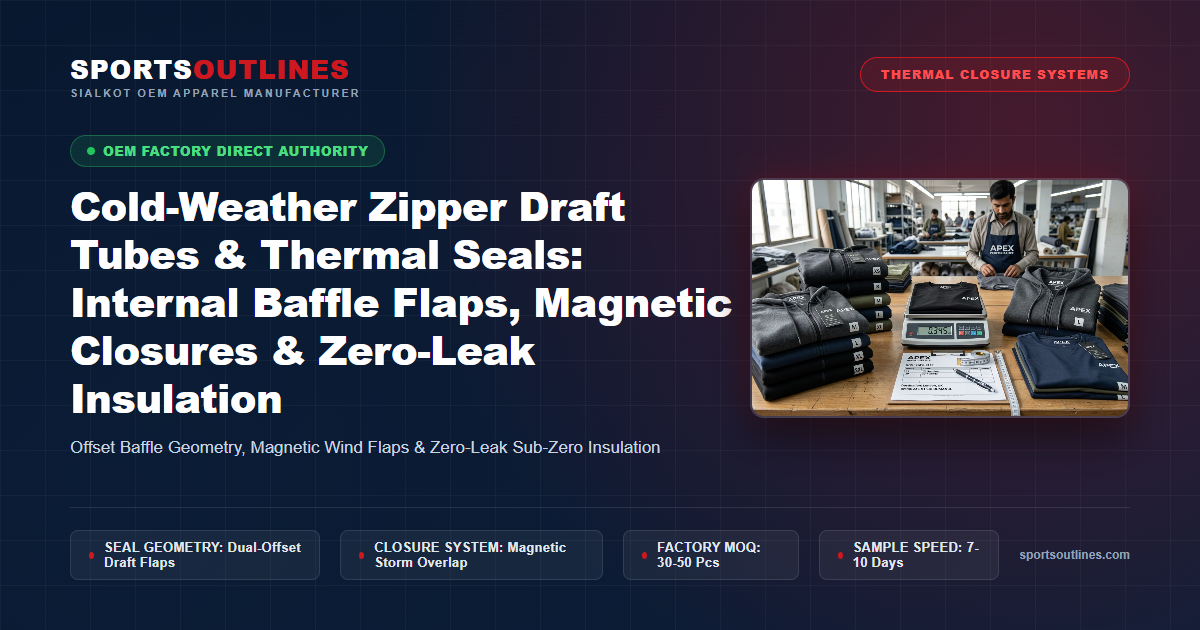
In the physiological thermal envelope of sub-zero expedition outerwear, alpine mountaineering parkas, and polar survival gear, the center-front closure represents the most vulnerable structural breach in the garment’s insulation system. A technical jacket may feature ultra-lofted 900 Fill Power goose down encased in calendered 10-denier micro-ripstop textiles, advanced 3D box-wall baffle chambers, and fully taped seams; however, the moment a heavy-duty front zipper (such as a YKK #5 or #8 Vislon® tooth chain) is installed, a massive linear thermal bridge is introduced directly across the human chest and vital organs.
Zipper teeth molded from polyacetal (POM) resin or spiral polyester coils possess high thermal conductivity relative to lofted down ($k_{\text{zipper}} \approx 0.23\text{ W/m}\cdot\text{K}$ vs $k_{\text{down}} \approx 0.026\text{ W/m}\cdot\text{K}$). Even more critically, the mechanical clearance gap between meshing zipper elements and the slider body creates an open porous corridor through which high-velocity alpine wind infiltrates, driving severe convective heat loss ($Q_{\text{conv}} = \dot{m} C_p \Delta T$) that can drain up to 35% to 45% of core body heat. Eliminating this vulnerability requires precision engineering of Insulated Zipper Draft Tubes, Dual-Offset Internal Baffles, Anti-Snag Grosgrain Ribbons, and Sub-Zero Magnetic Storm Seals.
At Sports Outlines in Sialkot, Pakistan, our technical outerwear engineering division designs zero-leak closure assemblies for ski brands, mountaineering labels, and performance outerwear manufacturers worldwide. We operate under transparent commercial terms: physical prototype sampling at $45 to $85 per piece (non-refundable, 7–10 business days turnaround) and scalable factory production with low minimums starting at strictly 30 to 50 pieces per style/colorway with comprehensive size grading from XS to 3XL.
Zipper Draft Tubes & Thermal Seals: Technical Directory
- 1. Thermodynamics: Zipper Heat Bridges & Wind Infiltration Flux
- 2. Draft Tube Architecture: Single Flap vs Dual-Offset Overlap
- 3. Filling Mechanics: Down Plumules vs Continuous Filament Battings
- 4. Slider Jamming Prevention: Grosgrain Webbing & Semi-Rigid Tape
- 5. External Storm Flaps: Neodymium Magnets vs Snaps & Hook-and-Loop
- 6. Ergonomic Facial Sealing: Microfleece Garages & 3D Neck Collars
- 7. CAD Pattern Drafting: Fold-Over Geometry & Pre-Curve Darts
- 8. Waterproof Zipper Interactions: PU Aquaguard® vs Vislon® Teeth
- 9. Manufacturing SAM Breakdown & Specialized Workstation Routing
- 10. Quality Assurance: FLIR Infrared Thermography & Pressure Chambers
- 11. Sialkot Manufacturing Infrastructure & Ultrasonic Welding
- 12. Contract Manufacturing Terms & Low MOQ Prototyping
- 13. Technical Sourcing FAQ
1. Thermodynamics: Zipper Heat Bridges & Wind Infiltration Flux
Heat loss through a garment front closure operates across two coupled physical mechanisms: conductive thermal bridging through solid zipper materials and convective air infiltration driven by aerodynamic wind pressure.
First, solid conduction is governed by Fourier’s law across the cross-sectional width of the zipper chain ($W_{\text{zip}} \approx 12\text{ to }16\text{ mm}$):
| Zipper Element Material | Thermal Conductivity (k) | Relative Heat Loss vs 850 FP Down | Sub-Zero Brittle Temperature | Cold-Weather Suitability |
|---|---|---|---|---|
| Molded Polyacetal (POM / Vislon®) | 0.23 W/m·K | 8.8x higher conduction | −40°C (Excellent impact retention) | Optimal for technical cold-weather outerwear |
| Spiral Polyester Coil (#5 Coil) | 0.18 W/m·K | 6.9x higher conduction | −30°C (Tape stiffens) | Good for mid-layers; prone to ice jamming |
| Die-Cast Brass / Bronze Teeth | 115.0 W/m·K | 4,420x higher conduction | Frostbites skin instantly on contact | Severe Hazard. Strictly forbidden in mountaineering. |
| Extruded Aluminum Teeth | 205.0 W/m·K | 7,880x higher conduction | Causes immediate cryo-burns to lips/chin | Severe Hazard. Never use in sub-zero gear. |
Second, and far more catastrophic in alpine conditions, is dynamic convective air infiltration. When high-speed alpine wind impinges on the chest, stagnation pressure forces cold air through the microscopic gaps between interlocking zipper teeth:
Where $\dot{m}$ is the mass flow rate of infiltrated air ($\text{kg/s}$), $C_p$ is the specific heat capacity of dry air ($1005\text{ J/kg}\cdot\text{K}$), and $\Delta T$ is the thermal gradient. In a 40 km/h wind at −20°C, an unshielded center-front zipper leaks over 45 to 65 Watts of thermal energy continuously, equivalent to losing more than 40% of human basal metabolic heat production while resting.
2. Draft Tube Architecture: Single Flap vs Dual-Offset Overlap
To eliminate zipper heat leakage, technical outerwear designers implement internal insulated barriers known as Draft Tubes (Draft Flaps). Depending on garment temperature ratings and design parameters, three primary architectures are utilized:
| Closure Architecture | Internal Barrier Geometry | Convective Seal Efficiency | Sewing SAM Complexity | Target Climate Rating |
|---|---|---|---|---|
| Single Internal Draft Flap | Flat padded flap (width 35–45 mm) sewn behind zipper tape | Moderate (65% to 75% seal) | Low (12–15 SAM) | Urban winter jackets, lightweight ski mid-layers (0°C to −10°C) |
| Dual-Offset Interlocking Tubes | Two cylindrical 3D lofted tubes (width 40 mm each) on opposing sides that compress and overlap | Superior (>96% zero-leak seal) | High (28–35 SAM) | Mountaineering belay parkas, sub-zero expedition down coats (−20°C to −30°C) |
| Dual-Layer Hybrid Storm Seal | Internal 3D lofted draft tube paired with external magnetic storm flap | Maximum (100% Hermetic Block) | Very High (38–48 SAM) | 8,000m Himalayan summit suits, polar research overalls (−40°C to −50°C) |
In a Dual-Offset Interlocking System, the left draft tube is positioned slightly forward while the right draft tube is positioned slightly rearward. When the zipper slider is pulled upward, the opposing tubular chambers compress against each other like an interlocking pneumatic gasket, establishing continuous 35 mm thick insulation directly over the zipper teeth and completely covering the slider void.
3. Filling Mechanics: Down Plumules vs Continuous Filament Battings
Selecting the insulation fill for a zipper draft tube is a critical engineering decision. While natural down offers supreme compressibility and warmth-to-weight efficiency, filling a vertical draft tube exclusively with loose down plumules introduces severe functional defects:
- Gravitational Plumule Slump: A draft tube is a continuous vertical channel measuring 75 to 90 cm in length. Under gravitational pull and body motion, unconstrained down plumules shift downward, pooling at the jacket hem and leaving the upper chest and collar completely uninsulated.
- Moisture Condensation from Exhaled Breath: The upper draft tube and collar rest directly in the path of the wearer’s exhaled moisture vapor ($37^\circ\text{C}$ saturated air). Moisture condenses rapidly on cold zipper teeth, wetting loose down plumules and causing complete thermal loft collapse.
To solve this failure mode, Sports Outlines implements two proven insulation strategies:
- Continuous Filament Synthetic Batting (Climashield® Apex / PrimaLoft® Gold): Continuous filament synthetic battings cannot shift, slump, or clump under gravity. Their continuous fiber matrix maintains uniform 15 to 25 mm thickness across the entire zipper length, even after thousands of flex cycles, while retaining hydrophobic warmth when wetted by frozen breath condensation.
- Segmented Baffle Down + Synthetic Scrim Hybrid: For ultra-lightweight alpine jackets requiring down fill, the draft tube is subdivided into 8 to 10 independent horizontal baffle segments (each 80 mm tall) reinforced with an internal 40 GSM Climashield® spine. The synthetic spine holds the tube upright and prevents plumule migration between chambers.
4. Slider Jamming Prevention: Grosgrain Webbing & Semi-Rigid Tape
In sub-zero alpine environments (−30°C in howling blizzard conditions), a jammed zipper is a life-threatening emergency. Because technical outerwear uses ultralight 10D to 20D micro-ripstop shell fabrics with soft, pliable hand feel, the fabric is extremely susceptible to getting caught in the jaws of the sliding zipper mechanism.
When a metal zipper slider catches lightweight fabric, the sharp teeth bite into the nylon microfilaments. Tugging vigorously to free the jam can tear the shell open, spewing down plumules into the wind and destroying the garment.
Sports Outlines enforces a multi-layer anti-snag engineering standard across all technical outerwear:
| Anti-Snag Component | Material Specification | Positioning / Clearance | Functional Role |
|---|---|---|---|
| High-Density Grosgrain Tape | 100% High-Tenacity Polyester Ribbed Webbing (Width 20 mm, 0.6 mm thick) | Sewn parallel to zipper teeth with 2.5 mm clearance gap | Provides rigid vertical boundary that physically pushes soft shell fabric away from slider entry guide |
| Thermo-Bonded TPU Film Stiffener | 0.3 mm Semi-Rigid Polyurethane Film (Bemis 3410) | Laminated directly to draft tube edge lining panel | Prevents draft flap edge from curling inward toward the zipper chain under pressure |
| Anti-Snag Slider Body (YKK) | YKK molded POM slider with integrated fabric deflector wings | Standard YKK #5 / #8 Vislon specification | Deflector wings physically guide edge fabric away from gear pinch zone during fast zipping |
5. External Storm Flaps: Neodymium Magnets vs Snaps & Hook-and-Loop
In heavy expedition parkas, internal draft tubes are paired with an external Storm Flap running down the garment exterior to deflect freezing rain, wind, and blowing spindrift. The mechanism used to secure this storm flap significantly impacts sub-zero usability:
- Hook-and-Loop (Velcro): While common in cheap outerwear, hook-and-loop fails catastrophically in sub-zero snow conditions. Fine blowing snow crystals pack into the micro-hooks, melting from body heat and refreezing into a solid sheet of ice. The closure loses 100% of its adhesive grip, allowing the storm flap to blow open in gale winds. Additionally, Velcro hooks shred high-end fleece gloves and snag technical face fabrics.
- Metal Snap Buttons: Snaps provide mechanical locking, but pressing metal snaps closed in −30°C winds requires heavy fingertip pressure that is impossible while wearing bulky 3-finger mountaineering mittens. Furthermore, metal snap posts conduct cold straight through the shell, creating localized frost spots.
- Sub-Zero Encapsulated Neodymium Magnets (N42 Grade): The pinnacle of modern technical closure engineering. High-power rare-earth neodymium disc magnets (diameter 15 mm, thickness 2.0 mm) with pull strength of 2.8 to 3.5 kg are hermetically welded inside ultrasonic TPU waterproof pockets. When the user zips the jacket and releases the storm flap, magnetic attraction snaps the flap closed automatically and silently—even when wearing massive 8000m down expedition mittens. Because magnets are sealed in airtight TPU, they never rust, ice over, or snag fabrics.
6. Ergonomic Facial Sealing: Microfleece Garages & 3D Neck Collars
The termination of the front zipper at the chin represents a severe friction and frostbite hazard. When a mountaineer operates at sub-zero temperatures, metallic or plastic zipper sliders become sub-cooled to ambient temperature (−25°C). If the slider touches bare facial skin, it induces rapid conductive freezing and painful skin abrasion.
Sports Outlines incorporates two ergonomic facial protection features:
- Zipper Chin Garage: A folded, die-cut triangular housing lined with 180 GSM moisture-wicking micro-chamois or brushed polyester fleece. When fully zipped, the slider parks completely inside the insulated pocket, shielding the chin and lips from freezing metal contact.
- 3D Ergonomic Horseshoe Neck Baffle: An independent, 3D contoured tubular draft collar filled with 850 FP down wraps $360^\circ$ around the neck, cinched with an internal elastic drawcord. This creates a gasket seal around the base of the throat, preventing warm air inside the torso from venting upward via the “chimney effect” whenever the hood is lowered.
7. CAD Pattern Drafting: Fold-Over Geometry & Pre-Curve Darts
Drafting pattern pieces for insulated draft tubes requires complex 3D CAD modeling rather than simple rectangular strips. Because the human chest curves convexly across the pectorals and slopes inward toward the waist and neck, a flat draft flap puckers and curls outward, exposing the zipper teeth to wind.
In our digital pattern lab (using Gerber AccuMark and Lectra Modaris), Sports Outlines drafts draft tubes with three key architectural allowances:
| Garment Size Range | Center Zipper Length | Draft Tube Width (W) | Internal Overlap Allowance | Batting Loft Target (H) |
|---|---|---|---|---|
| XS to S | 68 to 72 cm | 38 mm | 18 mm overlap | 20 mm (Climashield® 100 GSM) |
| M to L | 74 to 78 cm | 42 mm | 22 mm overlap | 24 mm (Climashield® 133 GSM) |
| XL to 2XL | 80 to 84 cm | 46 mm | 25 mm overlap | 26 mm (Climashield® 133 GSM) |
| 3XL | 86 to 88 cm | 48 mm | 26 mm overlap | 28 mm (Climashield® 170 GSM) |
- 3D Pre-Curve Chest Darts: Two subtle curved darts (depth 4 mm) are placed at the sternum and clavicle lines, causing the draft tube to bias naturally inward toward the wearer’s chest.
- Differential Layer Turn-of-Cloth: The outer face of the draft tube is cut 6 mm wider than the inner face to account for batting loft thickness ($H = 20\text{ to }26\text{ mm}$), ensuring the finished tube stays plump without edge seam tension puckers.
- Tapered Hem Clearance: The bottom 50 mm of the draft tube is tapered down from 45 mm to 20 mm width to prevent crowding around the zipper insertion pin and bottom stop box.
8. Waterproof Zipper Interactions: PU Aquaguard® vs Vislon® Teeth
When designing technical outerwear, brands frequently debate whether to use water-repellent reversed-coil zippers (e.g., YKK AquaGuard® with polyurethane lamination) or heavy-duty tooth zippers (e.g., YKK Vislon®) in combination with draft tubes:
| Zipper System | Sub-Zero Flexibility (−30°C) | Ice Accumulation Resistance | Waterproof Hydrostatic Hold | Recommended Role |
|---|---|---|---|---|
| YKK AquaGuard® Coil | Stiffens significantly (PU film rigid) | Vulnerable to ice jamming in fine coils | High (>10,000 mm H2O) | Rain shells, ski alpine hardshells, chest pocket closures |
| YKK Vislon® Tooth Chain | Smooth glide at −40°C (POM resin) | Sheds ice instantly (Teeth crush frost) | Water-Resistant (Requires Storm Flap) | Expedition down parkas, sub-zero mountaineering coats, summit suits |
For sub-zero extreme cold (< −15°C), polyurethane-coated AquaGuard® zippers stiffen into unbendable rods and freeze shut if ice forms inside the coil teeth. Therefore, true expedition parkas specify molded Vislon® tooth zippers paired with dual internal draft tubes and an external magnetic storm flap. The rugged polyacetal teeth shed ice effortlessly, while the dual draft tubes provide 100% windproof and thermal seal integrity.
9. Manufacturing SAM Breakdown & Specialized Workstation Routing
Constructing an engineered center-front closure with dual draft tubes, grosgrain anti-snag webbing, and magnetic storm flaps is one of the most labor-intensive operations in technical outerwear manufacturing. It adds approximately 32 to 45 Standard Allowed Minutes (SAM) to the baseline jacket assembly:
| Workstation Operation | Machinery / Technology | Allocated SAM | Quality Benchmark Tolerance |
|---|---|---|---|
| Op 01: Precision Laser Cutting | CO2 Automated Conveyor Laser Cutter | 6.5 SAM | ±0.5 mm draft tube and garage pattern precision |
| Op 02: Ultrasonic Magnet Encapsulation | 35 kHz Ultrasonic Rotary Welding Press | 8.0 SAM | 100% hermetic TPU seal, zero magnetic polarity reversal |
| Op 03: Grosgrain & Batting Assembly | Differential Feed Walking-Foot Machine | 12.5 SAM | Exact 2.5 mm clearance gap from zipper tooth edge |
| Op 04: Draft Tube Joining to Front Lining | Safety Lockstitch (65/9 ball-point needle) | 9.0 SAM | Strict 12 SPI stitch density, zero puckering |
| Op 05: Zipper Sandwiching & Chin Garage | Programmable Edge-Guide Lockstitch | 10.5 SAM | Slider parks completely inside fleece garage pocket |
At Sports Outlines in Sialkot, our modular lean manufacturing cells route technical closure sub-assemblies through dedicated pre-fabrication lines before body assembly. This prevents bottleneck delays on the main jacket assembly line while ensuring every closure sub-assembly meets strict airtight tolerances.
10. Quality Assurance: FLIR Infrared Thermography & Pressure Chambers
To verify that our zipper closure systems eliminate thermal bridges, sample parkas undergo radiometric verification in the Sports Outlines environmental test laboratory:
- FLIR Infrared Radiometric Thermography: The garment is placed on an electrically heated $34^\circ\text{C}$ thermal torso manikin inside a −20°C environmental testing chamber. High-resolution FLIR cameras measure external surface skin temperatures. Under our strict standard, the temperature variance across the closed zipper seam must satisfy $\Delta T \le 1.2^\circ\text{C}$ relative to the adjacent insulated chest baffles, confirming zero conductive cold bridging.
- Wind Infiltration Smoke Chamber Test: Parkas are exposed to a 45 km/h horizontal wind stream containing aerosol tracer smoke. Optical particle sensors confirm zero penetration of tracer particles through the dual-offset draft tube boundary.
- Sub-Zero Slider Cycle Testing (ASTM D2062): Front zippers undergo 1,000 continuous open-and-close cycles inside a −30°C refrigerated cabinet under 5.0 N lateral tension. Zippers must operate smoothly without tooth cracking, slider jamming, or magnetic seal fatigue.
11. Sialkot Manufacturing Infrastructure & Ultrasonic Welding
Sports Outlines combines skilled craftsmanship with state-of-the-art automated manufacturing infrastructure in Sialkot, Pakistan:
- Ultrasonic Magnet Bonding: We use specialized 35 kHz ultrasonic rotary welding presses to seal neodymium magnetic closures inside airtight TPU envelopes, guaranteeing complete rust-free and zero-rattle performance.
- Differential-Feed Programmable Sewing: Automated Juki programmable sewing machines ensure uniform feed rates when stitching thick draft tubes against slippery 10D micro-ripstop textiles, eliminating zipper waviness and puckering.
12. Contract Manufacturing Terms & Low MOQ Prototyping
Outerwear developers frequently encounter steep manufacturing hurdles when attempting to source technical cold-weather closures, as traditional factories require minimum orders of 1,000+ units. Sports Outlines provides flexible, high-precision contract manufacturing with low financial entry barriers:
Commercial Production Terms: Technical Cold-Weather Outerwear
- Physical Prototype Sampling: Quoted at strictly $45 to $85 per piece depending on closure complexity (single draft flap vs dual-offset magnetic storm system), insulation grade, and shell fabrics. Prototype lead times average 7 to 10 business days. Prototype fees cover material allocation, CAD pattern grading, ultrasonic magnet encapsulation, and machine setup under our transparent, non-refundable sampling policy.
- Low Factory Production MOQs: Bulk production orders start at strictly 30 to 50 pieces per style/colorway with comprehensive size grading from XS through 3XL, enabling technical outdoor brands to introduce commercial expedition down jackets without capital-draining inventory risk.
- Global Export Infrastructure: Bonded air freight shipping direct from Sialkot International Airport (SIAL) delivering to brand fulfillment hubs across the USA, UK, Australia, Canada, and Germany.
Discover our complete outerwear development services across Technical Sportswear and Performance Outerwear & Jackets, or contact our engineering desk via WhatsApp at +92 316 7932595.
13. Technical Sourcing FAQ: Zipper Draft Tubes & Thermal Seals
Q1: Why is an insulated zipper draft tube necessary on down outerwear?
Zippers represent a severe two-fold thermal breach in winter apparel: solid conduction and convective wind infiltration. Polyacetal (Vislon®) plastic zipper teeth conduct heat at 0.23 W/m·K—nearly ten times faster than lofted goose down (0.026 W/m·K)—while metal teeth are thousands of times more conductive. Even worse, the mechanical clearances between meshing teeth and the slider body allow high-speed wind to penetrate directly into the torso core ($Q_{\text{conv}} = \dot{m} C_p \Delta T$), leaking up to 45% of core body heat. An insulated draft tube creates an internal lofted baffle that blocks air infiltration and bridges the insulation gap, maintaining continuous thermal resistance across the chest.
Q2: Why is continuous filament synthetic batting preferred over down inside draft tubes?
Because a zipper draft tube is a long continuous vertical channel (75 to 90 cm in length), unconstrained natural down plumules naturally slide downward under gravity and wearer motion, pooling at the jacket hem and leaving the upper chest and collar completely hollow and cold. Furthermore, warm moisture vapor from exhaled breath ($37^\circ\text{C}$ saturated air) condenses continuously against cold zipper teeth, wetting down plumules and causing total thermal loft collapse. Continuous filament synthetic battings (such as Climashield® Apex or PrimaLoft® Gold) cannot shift, slump, or clump under gravity, maintaining uniform 20 to 26 mm loft and retaining hydrophobic warmth even when exposed to breath condensation.
Q3: How does Sports Outlines prevent the zipper slider from snagging shell fabric?
We incorporate high-tenacity 20 mm polyester grosgrain webbing ribbons sewn parallel to the zipper chain with a calibrated 2.5 mm clearance gap. The rigid transverse ribs of the grosgrain physically push lightweight 10D to 20D micro-ripstop shell fabrics away from the slider entry jaws. Additionally, we thermo-bond semi-rigid Bemis 0.3 mm TPU film stiffeners along the draft tube edge lining panels and specify YKK sliders equipped with anti-snag deflector wings that physically guide edge fabrics away from the gear pinch zone.
Q4: Why are magnetic closures superior to Velcro or snap buttons in extreme cold?
In sub-zero alpine conditions (−20°C to −40°C), blowing spindrift packs into Velcro hooks and melts from body heat before refreezing into solid ice sheets, neutralizing 100% of the closure’s adhesive grip and allowing storm flaps to blow open. Snap buttons require heavy localized fingertip pressure that is impossible while wearing thick 8000m mittens, and metal snap posts act as thermal bridges. Hermetically sealed N42 neodymium rare-earth magnets snap closed automatically without manual intervention, never ice over, do not snag delicate knitted accessories, and maintain full magnetic flux density down to −40°C.
Q5: What are your commercial terms for prototype sampling and production of technical outerwear?
Sports Outlines provides physical prototype sampling at strictly $45 to $85 per piece (non-refundable, 7–10 business days turnaround) covering custom pattern engineering, ultrasonic magnet bonding, and FLIR thermal verification. Factory production orders start at strictly 30 to 50 pieces per style/colorway across sizing from XS to 3XL, enabling technical brands to bring expedition-ready outerwear to market with low capital exposure.
Related Technical Down & Outerwear Engineering Guides
- Box-Wall Baffle Engineering & Mathematical Loft Modeling: Chamber Height & Spacer Mesh
- Downproof Fabric Permeability & Calendering Ciré Finishes: Thread Count & Air Permeability
- Post-Consumer Recycled & Biodegradable Synthetic Battings: PrimaLoft® Bio vs Thermore® Ecodown®
- PrimaLoft® Gold Cross Core Aerogel Insulation: Silica Aerogel & Clo/oz Performance
- Down-to-Feather Ratios (90/10 vs 85/15 vs 80/20): Quill-Shaft Content & Turbidity Testing