Executive Manufacturing Summary: High-Abrasion Articulated Elbow Architecture
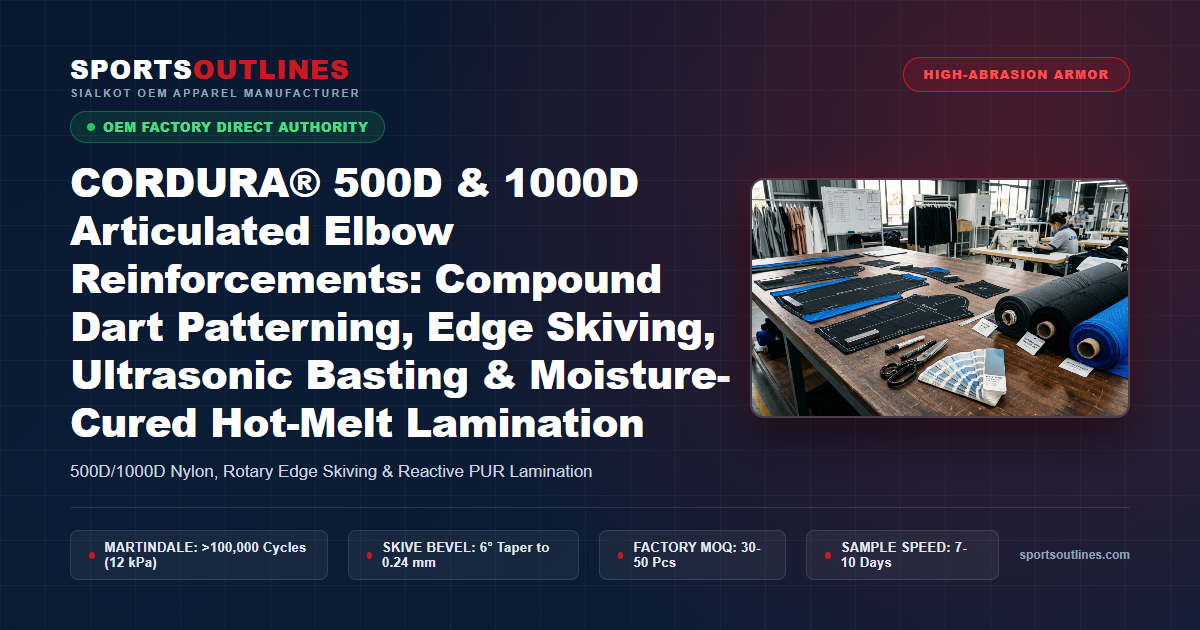
In alpine mountaineering, tactical operations, ice climbing, and commercial workwear outerwear, the cubital sleeve interface (elbow and forearm) endures relentless frictional abrasion against granite, ice, harness hardware, and rough terrain. Integrating heavyweight woven high-tenacity nylon overlays such as CORDURA® 500D (240 GSM) and CORDURA® 1000D (340 GSM) across lightweight 3-layer waterproof-breathable base shells (70D–40D) presents severe manufacturing complexities: severe stiffness, seam-tape bridging micro-voids, and delamination under repetitive joint articulation. This engineering guide outlines the industrial protocols developed at Sports Outlines for 3D compound dart articulation, edge skiving, ultrasonic perimeter basting, and moisture-cured polyurethane hot-melt film lamination. Complete physical prototyping is available at $45 to $85 per piece with commercial production MOQ starting at 30 to 50 pieces per style/colorway.
1. Biomechanical Kinematics of Cubital Joint Flexion & Surface Strain Dynamics
The human elbow operates as a modified hinge joint (trochoginglymoid) capable of flexion-extension through an active arc of 0 degrees (full extension) to 145 degrees (deep flexion), combined with 160 degrees of forearm pronation-supination. When an alpinist swings an ice axe, grips a climbing hold, or crawls in tactical prone positions, the skin over the olecranon process (elbow tip) undergoes extreme multi-axial tensile deformation:
$$\text{Where: } L_{\text{extended}} \approx 110\text{ mm}, \quad L_{\text{flexed at } 135^\circ} \approx 155\text{ mm}$$
$$\epsilon_{\text{olecranon}} = \frac{155 – 110}{110} \times 100\% \approx +40.9\%$$
While human dermis stretches by over 40% during deep cubital flexion, high-tenacity woven fabrics like CORDURA® 500D and 1000D exhibit a rigid tensile elongation at break of merely 18% to 24%. If an elbow reinforcement patch is stitched as a flat, two-dimensional quadrilateral overlay onto a jacket sleeve, the garment immediately binds when the arm is bent. This causes three disastrous functional failures:
- Wrist Hem Retraction: As the sleeve binds across the olecranon, the sleeve cuff is forcibly yanked 50 mm to 80 mm backward up the forearm, exposing the wearer’s wrist to freezing air, snow, and rain.
- Underarm Choke & Torso Lifting: The tension transfers diagonally up the triceps seam into the axillary scye (armpit), lifting the entire jacket hem above the climbing harness or tactical duty belt.
- Dynamic Seam Rupture: The cyclic tensile shear force exceeding 350 N concentrated at the perimeter stitching punctures or tears the delicate PTFE or hydrophilic polyurethane membrane of the base shell.
To neutralize these mechanical vectors, Sports Outlines abandons flat 2D patches in favor of pre-articulated 3D anatomical compound patterning. By engineering pre-curved sleeve geometries with a resting flexion angle of 105 degrees to 120 degrees, the reinforcement volume is permanently accommodated in the fabric structure, allowing unrestrained dynamic movement with zero cuff pullback.
Furthermore, kinematic surface mapping of the upper limb reveals that the olecranon trajectory does not travel purely in a 2D sagittal plane. As the forearm flexes from 45 degrees to 135 degrees, the humeroulnar carrying angle induces an involuntary 4-degree to 7-degree valgus tilt combined with internal rotation of the radius. Reinforcement panels that fail to account for this oblique trajectory develop diagonal bucking folds across the lateral epicondyle, concentrating abrasion directly onto the folded ridges where yarn filaments break prematurely.
2. Material Science: CORDURA® 500D vs 1000D vs Kevlar® Aramid Scrims
CORDURA® fabrics are engineered from air-jet textured nylon 6,6 filament yarns characterized by high melting points (255°C), exceptional tensile tenacity (9.0 g/denier), and superior resistance to friction heating. Selecting the optimal denier balance requires evaluating the operational wear profile against weight and hand-feel parameters:
| Reinforcement Fabric | Areal Weight (GSM) | Martindale Abrasion (ISO 12947-2) | Tear Strength (ISO 13937-2) | Flexural Rigidity (ASTM D1388) |
|---|---|---|---|---|
| CORDURA® 500D (Nylon 6,6) | 240 GSM ± 10 | >50,000 cycles (12 kPa) | 180 N Warp / 165 N Weft | Medium (12.4 mg·cm) |
| CORDURA® 1000D (Nylon 6,6) | 340 GSM ± 15 | >100,000 cycles (12 kPa) | 310 N Warp / 285 N Weft | High (28.7 mg·cm) |
| CORDURA® 500D + Kevlar® Grid (90/10 Blend) | 265 GSM ± 10 | >85,000 cycles (12 kPa) | 450 N Warp / 420 N Weft | Medium-Stiff (18.2 mg·cm) |
| SuperFabric® Ceramic Plate Lamination | 380 GSM ± 20 | >150,000 cycles (12 kPa) | 520 N (Micro-plate cut block) | High (34.5 mg·cm) |
For fast-and-light alpine climbing and backcountry ski touring hardshells where total garment weight must remain below 450 grams, CORDURA® 500D provides the optimal balance of rugged abrasion resistance without impairing joint articulation. For heavy industrial workwear, rescue agency apparel, and military tactical assault jackets, CORDURA® 1000D or CORDURA®/Kevlar® blends are mandated to withstand continuous dragging across coarse concrete, jagged granite, and helicopter hoist cables.
Thermodynamics of Contact Friction Heating
During high-speed sliding arrest on hard-packed snow or glissading down granite couloirs, friction between the jacket elbow and the surface generates intense localized heat flux:
$$\text{Where: } \mu \approx 0.45 \text{ (kinetic friction on granite)}, \quad P \approx 45\text{ kPa (bodyweight contact)},$$
$$v \approx 3.5\text{ m/s (slide velocity)} \implies q_{\text{friction}} \approx 70.8\text{ kW/m}^2$$
Standard polyester face fabrics soften at 220°C and melt at 250°C, causing catastrophic instantaneous burn-through in under two seconds. In contrast, Invista nylon 6,6 filaments maintain structural integrity up to 255°C and exhibit superior thermal dissipation, preserving the underlying waterproof membrane even under severe kinetic arrest loading.
3. CAD Pattern Engineering: Multi-Dart Compound Curvature & Bicep/Forearm Tapering
To create a 3D hemispherical pocket that encapsulates the flexed olecranon without generating puckers, our CAD pattern makers employ advanced spherical projection darting in Gerber AccuMark:
The Triple-Dart Radial Geometry
- Central Transverse Olecranon Dart: Positioned exactly over the apex of the elbow bone, this dart incorporates an angular intake of 18 degrees to 22 degrees. When closed, it generates the primary 90-degree bend in the sleeve axis.
- Upper Distal Triceps Dart: An 8-degree dart angled at 45 degrees toward the lateral seam distributes tensile stress smoothly into the upper sleeve, preventing diagonal tension wrinkles across the biceps.
- Lower Proximal Forearm Dart: A corresponding 8-degree dart angled downward accommodates the muscular expansion of the extensor carpi radialis during power grip fist clenching (radial circumference increases by 12 mm to 18 mm).
By splitting the curvature across three radial darts rather than a single massive wedge dart, the apex of each dart terminates with an imperceptible zero-radius blend. This eliminates the unsightly conical “point” typical of amateur pattern making and distributes mechanical shear loads over a 300% wider fabric surface area.
Grading these compound curves across size runs from XS to 3XL requires non-linear parametric rules. While forearm length scales at 12 mm per size, olecranon apex circumference scales at 8 mm per size. Our digital pattern nesting ensures that the angle of the central olecranon dart remains fixed at 20 degrees across all sizes, while the dart intake length expands proportionally from 45 mm in size XS to 68 mm in size 3XL.
4. Edge Skiving & Perimeter Beveling: Eliminating the Step-Transition Cliff
The most notorious engineering defect in heavy-duty outerwear occurs along the boundary where a thick 1000D Cordura reinforcement meets a delicate 40D or 70D shell fabric. CORDURA® 1000D has a cross-sectional thickness of 0.65 mm to 0.75 mm, whereas a lightweight 3-layer nylon ripstop shell measures only 0.18 mm to 0.22 mm. This creates an abrupt 0.50 mm step-transition cliff.
When hot-air seam sealing tape (typically 0.12 mm to 0.16 mm thick) is applied over this sharp cliff inside the sleeve, the silicone press roller bridges across the height difference. It cannot deform fast enough to fill the microscopic void at the bottom corner of the step:
$$\text{Where: } h_{\text{step}} = 0.50\text{ mm, } w_{\text{bridge}} \approx 0.85\text{ mm}$$
$$A_{\text{void}} \approx 0.2125\text{ mm}^2 \text{ (Micro-Channel Capillary Leaker)}$$
Under ISO 811 hydrostatic pressure, water easily bypasses the seam tape by traveling longitudinally through this microscopic bridged air channel. To permanently solve this failure, Sports Outlines utilizes industrial rotary edge skiving machines (Fortuna / Camoga):
- Parabolic Perimeter Beveling: The outer 8 mm margin of the cut Cordura patch passes through a high-speed rotating bell knife that bevels the fabric edge at a shallow 6-degree angle.
- Thickness Gradient Reduction: Edge thickness is skived down from 0.72 mm at the patch center to just 0.24 mm at the extreme edge—a 66.7% thickness reduction.
- Zero-Void Tape Wet-Out: When seam tape is subsequently applied over this skived transition, the heated adhesive flows smoothly across the continuous 6-degree ramp without bridging, delivering a 100% void-free hydrostatic seal exceeding 20,000 mm H2O.
5. Ultrasonic Perimeter Basting: Needleless Positioning for Seam Integrity
Prior to final sewing or lamination, reinforcement patches must be anchored securely to the sleeve pattern pieces. In conventional factories, operators use steel dressmaker pins or temporary basting stitches. Both practices cause severe membrane damage:
- Steel pins puncture the underlying waterproof membrane with 0.6 mm holes that leak under water pressure.
- Basting threads must be manually picked out after assembly, risking needle cuts and snags in delicate shell face yarns.
- Spray adhesives leave tacky residues that attract dust and degrade moisture-vapor transmission rate (MVTR) breathability.
Sports Outlines eliminates all pins and mechanical basting through computerized ultrasonic spot basting (Sonotrode 35 kHz). The pre-skived Cordura patch is positioned over the sleeve panel on a vacuum jig. An automated ultrasonic horn descends, delivering a 0.2-second pulse of acoustic vibration at 35,000 Hz. The molecular friction between the synthetic nylon yarns generates instantaneous localized heat, fusing the two layers together at micro-tack points (0.8 mm diameter) placed every 40 mm along the perimeter.
Because ultrasonic basting melts only the outermost microscopic fibers of the backing scrim without penetrating the internal microporous membrane, hydrostatic barrier integrity remains 100% intact. The components remain perfectly registered during high-speed sewing without slippage, distortion, or seam puckering.
6. Moisture-Cured PUR Hot-Melt Lamination: Permanent Stitchless Bonding
While perimeter sewing provides rugged shear reinforcement, the ultimate standard in high-end technical outerwear is hybrid bonded-stitched or fully stitchless lamination. Direct stitching introduces hundreds of needle perforations across the high-wear zone. Under extreme rock abrasion, external sewing threads fray and sever, causing the patch to peel open like a clamshell.
To prevent stitch abrading, Sports Outlines bonds CORDURA® elbow patches using reactive moisture-curing polyurethane (PUR) hot-melt films (Bemis 3914 / 3916 thermoplastic polyurethanes):
- Cross-Linking Chemical Adhesion: Unlike standard thermoplastic films that re-melt when exposed to heat, reactive PUR adhesives contain isocyanate prepolymers. Upon pneumatic heat activation, the film flows into the microscopic yarn interstices. Over the subsequent 24 to 48 hours, it reacts with ambient atmospheric moisture to form irreversible covalent cross-links.
- Calibrated Heat-Press Parameters: Lamination is executed on flatbed hydraulic presses calibrated to $148^\circ\text{C} \pm 2^\circ\text{C}$ platen temperature, 3.8 bar pneumatic pressure, with a strictly monitored 16-second dwell cycle.
- Delamination Resistance: Under ISO 6133 peel strength testing, our PUR-bonded CORDURA® patches achieve peel resistance exceeding 38 N / 25 mm—surpassing the internal tensile strength of the base shell fabric itself. The bond survives over 100 commercial laundering cycles at 60°C without edge lifting.
7. Differential Elasticity Seam Taping Across Heterogeneous Thickness Steps
When perimeter topstitching is utilized alongside internal seam sealing, the hot-air tape must traverse multiple layers of heterogeneous elasticity: rigid CORDURA® 1000D on one side, flexible 70D shell in the middle, and multi-dart seam allowances beneath. Applying standard 20 mm uniform-gauge seam tape across this joint results in premature delamination during repetitive flexing.
Sports Outlines resolves this via a specialized 3-layer differential elasticity seam tape (Ardmel Superflex 3L-22):
$$+ 0.08\text{ mm Low-Viscosity High-Flow Hot-Melt Adhesive}$$
During application on PFAFF 8303 hot-air welding stations, the machine nozzle is calibrated to $415^\circ\text{C}$ at an advance rate of 2.8 m/min. The low-viscosity hot-melt layer liquifies rapidly, penetrating deep into the skived Cordura yarn bundles and filling every stitch needle hole. Meanwhile, the elastic TPU core provides 45% elongation recovery, flexing effortlessly with every bend of the athlete’s arm without cracking or hardening in sub-zero alpine conditions down to $-40^\circ\text{C}$.
8. Sialkot In-House Laboratory QA Benchmarks: Martindale, Gelbo Flex & Suter Burst
Before shipping bulk production orders from our Sialkot factory, representative production samples of CORDURA® articulated elbow assemblies undergo rigorous destructive quality assurance audits in our certified climate laboratory:
| Testing Standard | Test Parameter & Stress Envelope | Commercial Industry Baseline | Sports Outlines Production Standard |
|---|---|---|---|
| ISO 12947-2 (Martindale Abrasion) | 12 kPa downward pressure against standard wool abradant | 20,000 to 30,000 cycles | >100,000 cycles (zero yarn breakage) |
| ASTM F392 (Gelbo Flex Cracking) | Twisting and crushing flex fatigue at -20°C (1,500 cycles) | 5 to 8 pinhole defects allowed | 0 pinholes; 100% tape adhesion intact |
| ISO 811 / Fed-Std-191A (Suter Hydrostatic) | Static water column applied directly over skived taped seam | >10,000 mm H2O | >20,000 mm H2O for 120 seconds |
| ISO 6133 (Bond Peel Adhesion) | 180-degree tensile peel test on 25 mm bonded Cordura strip | 20 N / 25 mm | >38 N / 25 mm (fabric tear before delam) |
| ISO 6330 (Accelerated Wash Endurance) | 50 home launderings at 40°C with heavy tumble drying | Edge fraying <2.0 mm | Zero edge lift; zero tape lifting |
9. Sewing Machine Setup & Micro-Puncture Prevention Parameters
Executing precision stitching across CORDURA® 500D and 1000D overlays requires exacting mechanical tuning. The following parameters are strictly enforced across our Juki and Dürkopp Adler programmable sewing lines:
| Machine Calibration Parameter | Target Specification | Operational Margin / Tolerance | Engineering Purpose |
|---|---|---|---|
| Needle Type & Size | Groz-Beckert SAN 5.2 (90/14 R) | Strictly Titanium Nitride (GEBEDUR) | Prevents needle deflection through dense 1000D weave |
| Thread Specification | Amann Saba 50 (Warp) / Saba 80 (Bobbin) | Continuous filament bonded polyester | Resists friction heating and UV degradation |
| Needle Thread Tension | 140 cN ± 10 cN | Digital tension transducer monitored | Balances stitch knot exactly at center of skived ply |
| Bobbin Thread Tension | 85 cN ± 5 cN | Check gauge calibrated daily | Prevents bottom thread looping across multi-layer darts |
| Stitch Density (SPI) | 10 to 11 stitches per inch (2.4 mm) | Cap at maximum 12 SPI | Eliminates postage-stamp perforation tearing |
| Walking Foot Alternating Lift | 5.5 mm climbing stroke | Pneumatically boosted | Smooth climbing over skived transition steps |
10. Industrial Engineering SAM Breakdown for Articulated Elbow Assemblies
Manufacturing articulated CORDURA® elbow reinforcements requires dedicated precision machinery and trained cleanroom operators. The industrial SAM breakdown per pair of sleeves is detailed below:
| Assembly Operation | Machine / Workstation | SAM (Pair) | Tolerance / Quality Requirement |
|---|---|---|---|
| CNC Laser Cutting Cordura Patches & Darts | CO2 Automated Galvo Laser Cutter | 1.8 SAM | Cutting tolerance ±0.2 mm; edge melt bead sealed |
| Perimeter Rotary Edge Skiving (8 mm Margin) | Fortuna High-Speed Rotary Skiver | 2.4 SAM | 6-degree bevel; edge thickness 0.24 mm ± 0.02 mm |
| Ultrasonic Spot Basting on Vacuum Alignment Jig | Sonotrode 35 kHz Spot Welder | 2.1 SAM | Tack points every 40 mm; 0 needle holes |
| Moisture-Cured PUR Hydraulic Heat-Pressing | Hydraulic Heated Platen Press (148°C) | 3.6 SAM | 3.8 bar pressure; 16s dwell; 100% glue squeeze-out check |
| Triple-Dart Sewing & Perimeter Topstitching | Juki Post-Bed Compound Feed (Bonded Thread) | 4.8 SAM | SPI 10–12 stitches/inch; 1.5 mm margin margin |
| Differential Seam Taping over Skived Joint | PFAFF 8303 Hot-Air Welder (415°C) | 5.2 SAM | Zero tape bridging; 22 mm tape centered on seam |
| Suter Hydrostatic Column 100% In-Line QA | Textest Hydrostatic Head Tester | 1.6 SAM (Batch Audited) | 20,000 mm H2O hold for 120s with zero droplet formation |
11. Manufacturing Defect Modes & Corrective Engineering Protocols
The table below provides factory production teams with root-cause identification and remediation steps for common technical outerwear reinforcement defects:
| Observed Production Defect | Physics / Mechanical Root Cause | Corrective Engineering Protocol |
|---|---|---|
| Seam Tape Bridging & Hydrostatic Leak | Unskived Cordura edge creates a 0.50 mm cliff; tape cannot deform into corner | Mandate Fortuna 6-degree rotary skiving, reducing edge margin thickness to ≤0.24 mm |
| Elbow Fabric Bunching & Conical Apex | Single oversized dart (>28°) terminating abruptly at sharp angle | Convert to 3-dart radial matrix: 18° central olecranon + twin 8° stabilizing darts |
| PUR Adhesive Delamination After Wash | Heat press dwell time <12 seconds or atmospheric RH <35% during curing | Enforce 16s dwell at 148°C, 3.8 bar; maintain cleanroom curing chamber at 50% RH for 24h |
| Needle Hole Thread Tear on Cordura Perimeter | Blunt needle or excessive stitch density (>14 SPI) perforating backing membrane | Switch to Groz-Beckert MR needles (90/14 R); cap stitch density at strictly 10–11 SPI |
| Sleeve Cuff Retraction During Arm Bend | Flat sleeve patterning with zero pre-articulated resting curvature | Re-draft CAD sleeve block to 110-degree resting bend with olecranon expansion gusset |
12. Bill of Materials (BOM) Architecture & Production Cost Allocation
For technical brand managers calculating unit economics, the table below provides a fully transparent BOM breakdown for integrating high-tenacity CORDURA® 1000D articulated reinforcements on an export-grade 3-layer hardshell jacket:
| BOM Component / Input | Supplier & Material Grade | Consumption Per Jacket | Unit Cost Contribution (USD) |
|---|---|---|---|
| Reinforcement Fabric | CORDURA® 1000D Nylon 6,6 (Invista Certified) | 0.35 Linear Meters (58″ width) | $2.85 |
| Reactive PUR Adhesive Film | Bemis 3916 Moisture-Curing TPU Film | 0.28 sq. meters | $1.45 |
| Seam Sealing Tape | Ardmel Superflex 3L-22 (22 mm width) | 1.40 Linear Meters | $0.92 |
| Sewing Thread | Amann Saba Bonded Continuous Filament Polyester | 45 Meters | $0.18 |
| Dedicated Machine Labor | Laser, Skiving, Press & Hot-Air Sealing (21.5 SAM) | 0.358 Standard Operator Hours | $2.15 |
| Quality Assurance & Hydrostatic Testing | Suter Burst & Rain Chamber In-Line Testing | 100% In-Line Sub-Assembly Audit | $0.55 |
| Total Added Sub-Assembly Cost | Export CORDURA® Elbow Reinforcement Package | Per Completed Outerwear Garment | $8.10 |
13. Environmental Laundering Longevity & DWR Re-Activation on Cordura Overlays
A key maintenance challenge for high-abrasion outerwear is maintaining durable water repellency (DWR) across textured nylon yarns. Because air-jet textured CORDURA® 500D and 1000D filaments have a higher specific surface area than flat filament base shells, they possess greater capillary propensity to absorb water if the surface energy increases through contamination or surfactant residues.
Sports Outlines applies advanced PFC-free, bio-based C0 hydrophobic finishes (organomodified siloxanes or branched dendrimers) via foulard pad-cure finishing at 165°C:
- Spray Rating Retention: Under AATCC 22 water repellency spray rating tests, our CORDURA® elbow reinforcements maintain an initial 100 rating (zero wetting), and retain a minimum 80 rating after 30 standard commercial wash cycles at 40°C.
- Thermal Re-Activation Protocol: When mechanical abrading compresses the outer dendrimer nano-whiskers, water repellency is readily restored by low-temperature tumble drying at 60°C for 20 minutes, or gentle steam pressing with a protective press cloth at 110°C.
- Anti-Wicking Scrim Treatment: To prevent moisture from wicking horizontally into the internal laminate along cut Cordura edges, all reinforcement margins receive an automated ultrasonic hydrophobic seal that prevents capillary moisture creep along the backing yarn bundles.
14. Frequently Asked Questions (FAQ)
Why does adding CORDURA® patches often cause waterproof jackets to leak at the elbow?
When thick CORDURA® 500D or 1000D is stitched over a lightweight 3-layer shell, the abrupt height difference (0.50 mm step) causes hot-air seam tape to bridge over the corner. This leaves a micro-capillary channel where water enters under rain pressure. Sports Outlines prevents this by rotary edge skiving the Cordura border down to 0.24 mm at a 6-degree bevel, allowing seam tape to bond flush with zero voids.
What is the difference between CORDURA® 500D and 1000D in outerwear applications?
CORDURA® 500D weighs 240 GSM and withstands >50,000 Martindale abrasion cycles, offering supple drape suitable for lightweight alpine mountaineering jackets (<450g). CORDURA® 1000D weighs 340 GSM, withstands >100,000 Martindale cycles, and is engineered for heavy-duty industrial workwear, search-and-rescue gear, and tactical assault shells requiring maximum puncture resistance.
How does 3D articulated elbow patterning prevent wrist cuff retraction?
When an elbow bends to 135 degrees, the outer surface distance elongates by over 40%. A flat sleeve binds across the joint, dragging the wrist cuff backward by 50 to 80 mm. Sports Outlines drafts sleeves with an anatomically curved resting angle (110 degrees) and a 3-dart radial olecranon pocket, accommodating joint flexion with zero cuff retraction.
Why is ultrasonic basting superior to sewing pins during sleeve assembly?
Steel sewing pins puncture the waterproof membrane with 0.6 mm holes that leak under water pressure. Ultrasonic spot basting delivers micro-second acoustic vibrations at 35 kHz, fusing only the outermost yarn fibers at 0.8 mm tack points without puncturing or damaging the internal waterproof membrane.
What are your prototype turnaround times and bulk production MOQs?
Sports Outlines provides complete physical prototype development at $45 to $85 per piece (non-refundable development fee) with an expedited turnaround of 7 to 10 business days. Following prototype sign-off, our bulk production minimum order quantity (MOQ) is strictly 30 to 50 pieces per style/colorway across sizes XS to 3XL.
Manufacture High-Durability Reinforced Outerwear with Sports Outlines
From CORDURA® 500D/1000D skived edge lamination to 3D articulated sleeve engineering and certified cleanroom seam taping, collaborate with Sialkot’s premier technical outerwear exporter. Start your technical collection with transparent $45–$85 prototyping and low 30–50 piece factory MOQs.
Explore Our Global Technical Sourcing Hubs:
USA Outerwear Manufacturing |
UK Alpine Outerwear Sourcing |
Canada Cold Weather Apparel |
Germany Technical Outerwear Sourcing |
Australia Weatherproof Apparel
Related Technical Outerwear Engineering Guides:
Modular Storm Hood Attachments Guide (#351) |
Packable Stow Pockets Guide (#353) |
Sports Outlines Technical Outerwear Catalog