Direct Manufacturer Snapshot: Custom Trims & Hardware Tooling ROI: When to Invest in Metal Dies vs Standard Factory Stock
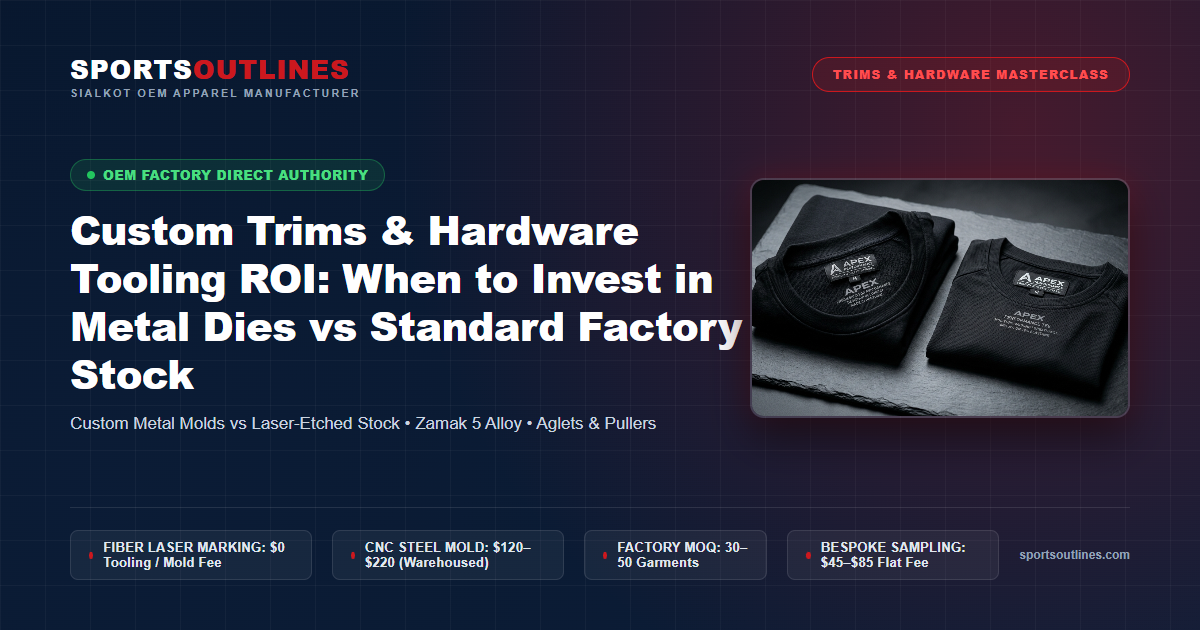
Custom hardware tooling (metal mold dies for zinc alloy zipper pullers, branded aglets, engraved snap buttons, and micro-injection silicone patches) requires an upfront non-recurring engineering (NRE) tooling investment of $120 to $350 per component. For emerging apparel brands producing 30 to 100 units per style, custom metal dies represent an unnecessary capital drain, inflating per-unit production costs by $2.50 to $7.00 per garment. Instead, industrial Sialkot OEM manufacturers provide two commercially superior pathways: 1) Standard Factory Stock Hardware with High-Precision Fiber Laser Engraving (requiring zero mold fees, 30-piece MOQs, and adding only $0.20–$0.40 per garment); and 2) Batch Trim Amortization across 1,000 to 2,000 hardware units stored in factory inventory across multiple seasonal drops, dropping the marginal custom metal trim cost to pennies ($0.12–$0.28 each). Sports Outlines International in Sialkot, Pakistan, provides in-house fiber laser marking, standard luxury stock trims, and CNC custom mold development with 30–50 piece garment MOQs.
Direct WhatsApp: +92 316 7932595
In the ultra-competitive landscape of modern luxury streetwear, technical activewear, and performance combat sports apparel, custom hardware and bespoke trims represent the definitive tactile dividing line between amateur print-on-demand merch and an authentic luxury fashion house. When a consumer unboxes a $110 heavyweight hoodie, their hands instinctively register the cold, substantial heft of custom zinc alloy aglets, the silky mechanical glide of an embossed #8 metal zipper puller, and the sharp three-dimensional relief of a vulcanized silicone hem badge. These micro-interactions build immense perceived brand equity and justify premium retail price points.
However, for startup apparel founders and emerging brand directors, custom hardware represents one of the most treacherous capital traps in garment manufacturing. Developing custom metal dies, injection molds, and proprietary alloy castings requires substantial upfront Non-Recurring Engineering (NRE) tooling expenditures. Misallocating $800 to $1,500 of your working capital into hardware molds on a modest 50-piece capsule drop can instantly inflate your per-unit cost by $15 to $30 per garment, eviscerating your operating cash flow and pushing your break-even point into dangerous territory.
At Sports Outlines in Sialkot, Pakistan, we have engineered thousands of bespoke hardware suites for international athletic brands, fight wear labels, and streetwear designers. We maintain a full fleet of high-precision fiber laser engraving systems, computerized micro-injection silicone presses, and dedicated CNC steel mold die-casting relationships. In this masterclass, we provide the exact mathematical return-on-investment (ROI) formulas, tooling break-even models, material alloy standards, and strategic hybrid workflows required to achieve a flawless luxury hardware aesthetic without bankrupting your initial manufacturing budget.
Executive Engineering & Tooling Breakdown:
- Section 1: The Anatomy of Custom Apparel Trims: Materials, Alloys & Manufacturing Methods
- Section 2: Non-Recurring Engineering (NRE) Tooling Economics: Mold Costs & Minimum Order Quantities
- Section 3: The Hardware Tooling Break-Even ROI Formula: Mathematics of Amortization
- Section 4: Strategy 1: Factory Stock Hardware with Fiber Laser Engraving (The Low MOQ Secret)
- Section 5: Strategy 2: Batch Trim Production & Factory Inventory Warehousing Protocols
- Section 6: Comprehensive Cost Comparison Matrix Across Production Volumes (30, 50, 100, 300, 1,000 Units)
- Section 7: Plating Durability & Wash-Testing Standards: ASTM Salt-Spray & Tumble Audits
- Section 8: Sports Outlines Flexible Manufacturing Protocols & Prototype Engineering
1. The Anatomy of Custom Apparel Trims: Materials, Alloys & Manufacturing Methods
Before committing capital to hardware development, brand procurement directors must understand the structural metallurgy, casting physics, and polymer formulations utilized in modern garment accessories. Apparel hardware must endure severe mechanical torque, exposure to hot water detergents, and the violent kinetic impacts of domestic tumble dryers without cracking, chipping, or oxidizing.
A. Zinc Alloy Die-Casting (Zamak 5 vs Zamak 3)
The overwhelming majority of high-end custom metal trims—including zipper pullers, cord locks, cord aglets, belt buckles, and decorative logo plates—are manufactured via hot-chamber die casting utilizing zinc-aluminum alloys, commercially designated as Zamak.
- Zamak 3: The standard industry alloy (96% zinc, 4% aluminum). It possesses excellent fluidity during casting and takes electroplating well, but has lower tensile strength. Ideal for lightweight decorative badges.
- Zamak 5: The premium industrial benchmark utilized by Sports Outlines (95% zinc, 4% aluminum, 1% copper). The 1% copper addition dramatically boosts tensile strength (to 330 MPa) and hardness. This structural integrity prevents thin zipper pull loops from snapping under violent tension and ensures cord aglets never crush or deform when stepped on.
B. Solid Brass & Stainless Steel (Grade 304 / 316)
For heavy-duty applications—such as marine-grade outerwear snap buttons, denim rivets, and luxury heavy-weight cord aglets—solid brass and stainless steel (Grade 304 or 316) are utilized. Brass is non-magnetic, naturally rustproof, and can be stamped or CNC machined with razor-sharp tolerances. Grade 304 stainless steel provides absolute immunity to sweat corrosion, making it mandatory for fight-wear waist ties and rash guard hardware.
C. Micro-Injection Vulcanized Silicone & Molded TPU
For flexible branding, high-density thermoplastic polyurethane (TPU) and vulcanized silicone have largely displaced traditional flat PVC rubber badges. Silicone is environmentally benign, OEKO-TEX Standard 100 compliant, hypoallergenic, and impervious to temperatures exceeding 250°C. Micro-injection molds allow multi-tiered 3D sculptural topography, matte velvety textures, and embedded micro-text with 0.1mm line fidelity.
D. High-Density Woven Damask & Silicone Heat-Transfers
Brand labeling suites form the internal spine of garment identity:
- 50-Denier High-Density Damask Woven Labels: Woven on high-speed electronic jacquard shuttle looms utilizing ultra-fine 50D polyester threads (over 120 picks per inch). Ultrasonic heat-cutting seals the edges at a molecular level, preventing neck skin abrasion and eliminating fraying entirely.
- 3D Raised Silicone Heat-Transfer Badges: Formed by vulcanizing liquid silicone inside a micro-etched steel matrix directly onto a carrier film with a heat-activated polyurethane adhesive backing. When pressed at 155°C for 14 seconds at 4 bar pressure, the badge permanently fuses to the fabric, yielding an ultra-clean, stitch-free luxury aesthetic.
2. Non-Recurring Engineering (NRE) Tooling Economics: Mold Costs & Minimum Order Quantities
Why does custom hardware require such high upfront fees? The cost is not driven by the raw zinc or silicone itself—raw zinc costs less than $3.50 per kilogram—but rather by the high-precision CNC tooling required to fabricate the master negative mold.
| Trim & Hardware Category | Tooling / Mold Fee (Factory Direct) | Broker / Middleman Retail Quote | Typical Hardware Production MOQ | Per-Unit Trim Cost at MOQ |
|---|---|---|---|---|
| Custom Zinc Alloy Zipper Puller | $140 – $220 (CNC Steel Die) | $350 – $550 | 1,000 – 2,000 pieces | $0.14 – $0.26 / piece |
| Custom Embossed Metal Aglets (Pair) | $120 – $180 (Casting Mold) | $300 – $450 | 1,000 pairs (2,000 pcs) | $0.16 – $0.32 / pair |
| Engraved Brass Snap Buttons (Set) | $160 – $240 (Cap Stamping Die) | $400 – $600 | 2,000 sets (4-part snap) | $0.18 – $0.35 / set |
| 3D Micro-Injection Silicone Patch | $80 – $140 (Aluminum/Copper Mold) | $250 – $380 | 500 – 1,000 pieces | $0.35 – $0.65 / piece |
| 50D Damask Woven Neck Label | $0 Tooling (Digital Loom Punch) | $60 – $100 Setup Fee | 1,000 pieces | $0.06 – $0.11 / piece |
The critical takeaway from this table is the severe divergence between Trim Hardware Production MOQs (1,000 to 2,000 units) and Garment Production MOQs (30 to 100 units). A specialized hardware die-casting foundry will not fire up a 400°C electroplating chemical bath or run a pneumatic die-casting press for 50 zipper pullers. They require a production run of at least 1,000 units.
Audit Your Hardware & Trim Budget with Sialkot Tooling Engineers
Send us your hardware sketches, 3D CAD renders, or tech pack on WhatsApp to compare custom mold costs against factory stock laser-engraved alternatives.
✓ $45–$195 Physical Prototypes •
✓ Worldwide DDP Delivery
3. The Hardware Tooling Break-Even ROI Formula: Mathematics of Amortization
To determine whether developing custom metal hardware makes financial sense for your upcoming production drop, Sports Outlines has formalized the Apparel Tooling Amortization Formula:
Let us model an actual real-world scenario: You are manufacturing a luxury 480 GSM French Terry Zip-Up Hoodie featuring custom branded Zamak 5 zipper pullers ($180 mold fee, $0.22/puller) and custom metal aglets ($140 mold fee, $0.25/pair). Total upfront tooling investment = $320.00. Total marginal hardware cost = $0.47 per hoodie.
- Scenario A: 30-Unit Micro-Batch Launch
Per-Garment Tooling Burden = ($320.00 / 30) + $0.47 = $10.67 + $0.47 = $11.14 per hoodie!
Analysis: Adding $11.14 to your cut-and-sew FOB cost destroys your gross margin. If your blank hoodie costs $16.50, your hardware almost doubles your manufacturing base! - Scenario B: 50-Unit Capsule Drop
Per-Garment Tooling Burden = ($320.00 / 50) + $0.47 = $6.40 + $0.47 = $6.87 per hoodie.
Analysis: Still excessively burdensome unless the retail price is positioned above $120. - Scenario C: 100-Unit Commercial Drop
Per-Garment Tooling Burden = ($320.00 / 100) + $0.47 = $3.20 + $0.47 = $3.67 per hoodie.
Analysis: Viable for high-end boutique streetwear brands commanding 75%+ retail markups. - Scenario D: 300-Unit Scale Drop
Per-Garment Tooling Burden = ($320.00 / 300) + $0.47 = $1.07 + $0.47 = $1.54 per hoodie.
Analysis: The Sweet Spot! The custom hardware burden drops to negligible levels, delivering massive perceived retail value for barely $1.50 per garment. - Scenario E: 1,000-Unit Enterprise Order (or 4 Sequential 250-Unit Drops)
Per-Garment Tooling Burden = ($320.00 / 1,000) + $0.47 = $0.32 + $0.47 = $0.79 per hoodie.
Analysis: Full industrial scale economy achieved.
4. Strategy 1: Factory Stock Hardware with Fiber Laser Engraving (The Low MOQ Secret)
If your brand is producing 30 to 100 garments, how do you achieve custom branded luxury metal hardware without wasting $320+ on custom molds?
The Secret: Factory-Stock Luxury Blanks + In-House High-Precision Fiber Laser Marking.
How Sports Outlines Fiber Laser Marking Operates:
Sports Outlines maintains an extensive, permanent factory inventory of over 150,000 unbranded, pre-plated luxury hardware components—including cylindrical metal aglets, rectangular aglets, matte-black zipper sliders, and gunmetal cord stoppers fabricated from high-grade Zamak 5 and stainless steel. When you order 30, 50, or 75 hoodies, our technicians program our 50W Galvo fiber laser engraving machines with your vector logo. The laser beam vaporizes the surface electroplating with micron-level precision, revealing a crisp, permanent, high-contrast matte engraving of your brand name.
The Economics of Fiber Laser Engraving:
- Mold / Tooling Setup Fee: $0.00 Flat (No physical dies to cast).
- Minimum Order Quantity: 30 Pieces (Matches our flexible garment cell MOQ).
- Per-Garment Cost: Stock Zamak 5 Aglet Pair ($0.35) + Laser Engraving Labor ($0.25) = $0.60 total per garment!
- Comparison: At 50 units, custom casting dies cost $6.87 per garment. Fiber laser marking costs $0.60 per garment. You save $6.27 per hoodie instantly, conserving over $310 in upfront capital!
5. Strategy 2: Batch Trim Production & Factory Inventory Warehousing Protocols
If your design demands complex 3D dimensional relief—such as an embossed spherical metal aglet or a sculptural raised zipper puller that cannot be replicated via surface laser marking—the second professional procurement strategy is Batch Trim Warehousing.
How Sialkot Factory Warehousing Solves the Trim Paradox
Smart apparel founders do not tie their trim purchasing volume directly to a single small garment cut. Instead:
- Order the Industrial Hardware Minimum (1,000 Units): You fund the one-time $160 mold fee and pay $200 for 1,000 custom zipper pullers ($0.20 each). Total capital committed: $360.00.
- Allocate to Initial Capsule Drop: For your initial 50-hoodie production run, Sports Outlines installs 50 of your custom pullers onto custom dyed YKK zippers.
- Factory Warehousing for Replenishment: The remaining 950 pullers are cataloged and stored in our climate-controlled hardware vault in Sialkot at zero monthly warehousing fee.
- Subsequent Production Drops: When you launch your next drop of 100 zip-up hoodies, 75 track jackets, or 150 fight robes, we pull from your existing trim inventory. Your future garment manufacturing orders incur zero mold fees and zero trim delays, instantly accelerating your production turnaround to just 12 business days!
6. Comprehensive Cost Comparison Matrix Across Production Volumes (30, 50, 100, 300, 1,000 Units)
The matrix below contrasts the all-in per-garment cost of our two hardware strategies (Laser-Etched Stock vs Bespoke Mold Tooling) across standard commercial production tiers.
| Production Quantity Tier | Strategy 1: Laser-Etched Stock Hardware | Strategy 2: Bespoke Metal Molds (Single Drop) | Strategy 2: Bespoke Molds (1k Warehoused Batch) | Optimal Strategic Recommendation |
|---|---|---|---|---|
| 1 Piece (Prototype) | $1.50 (In-house laser mark) | $320.47 (Prohibitive tooling) | N/A (Requires batch run) | Always use laser-etched stock or high-resolution 3D resin prints during fit prototyping. |
| 30 Pieces (Micro MOQ) | $0.70 / unit ($21 total) | $11.14 / unit ($334 total) | $0.79 / unit ($360 funded) | Laser-etched stock is the absolute winner for proof-of-concept capital preservation. |
| 50 Pieces (Launch Tier) | $0.60 / unit ($30 total) | $6.87 / unit ($343 total) | $0.79 / unit ($360 funded) | Use laser-etched stock unless funded for multi-drop warehousing. |
| 100 Pieces (Commercial) | $0.55 / unit ($55 total) | $3.67 / unit ($367 total) | $0.79 / unit ($360 funded) | The inflection point where funded bespoke tooling begins delivering strong brand equity. |
| 300 Pieces (Scale Tier) | $0.48 / unit ($144 total) | $1.54 / unit ($462 total) | $0.79 / unit | Bespoke metal casting is fully economically justified. The $1.54 burden is effortlessly absorbed. |
| 1,000 Pieces (Enterprise) | $0.40 / unit ($400 total) | $0.79 / unit ($790 total) | $0.79 / unit | Full industrial bespoke suite executed across automated rotary plating carousels. |
7. Plating Durability & Wash-Testing Standards: ASTM Salt-Spray & Tumble Audits
The ultimate failure of cheap imported apparel hardware occurs in the laundry room. Low-grade zinc pot metals treated with flash-barrel electroplating will chip, flake off, or oxidize into chalky white corrosion after just two or three standard machine washes, completely destroying customer trust.
At Sports Outlines, all custom and stock metal trims adhere strictly to international durability testing protocols:
- ASTM B117 Neutral Salt Spray (NSS) Testing: Hardware samples are suspended in a sealed chamber exposed to a 5% sodium chloride fog atomized at 35°C for a continuous 24- to 48-hour cycle. We require zero blistering, white zinc corrosion, or red copper rust.
- ASTM D4966 Martindale Abrasion & Tumble Test: Hardware-equipped garments undergo 10 consecutive industrial wash-and-tumble cycles (60°C wash with heavy-duty detergent followed by 70°C high-heat tumble drying) inside heavy commercial steel-drum dryers. The electroplated finish and electrophoretic clear-coat lacquer must show zero peeling, flaking, or hairline cracking.
- AATCC 8 / 116 Crock Testing (Colorfastness to Rubbing): Testing ensures that dark electroplated coatings (such as Gunmetal or Matte Black) do not transfer pigment onto light-colored hoodie fabrics when subjected to friction under wet and dry conditions.
8. Sports Outlines Flexible Manufacturing Protocols & Prototype Engineering
Navigating the complex interplay between hardware tooling, minimum order quantities, and garment assembly requires a manufacturing partner who acts as an engineering consultant rather than a transactional order-taker.
Sports Outlines eliminates hardware roadblocks through our integrated Sialkot manufacturing platform:
- True Low MOQ Production: Strictly 30 to 50 pieces per style/colorway across custom cut-and-sew streetwear, athletic sets, and fight wear.
- Bespoke Physical Prototyping: We provide complete pre-production physical prototypes for a transparent $45 to $195 non-creditable engineering fee with a rapid 7 to 10 business day turnaround. We laser-etch your sample hardware directly in-house so you can evaluate the exact weight, balance, and aesthetic before approving bulk production.
- 100% Open-Book Transparency: We separate fabric, cut-and-sew labor, printing, and hardware mold tooling into clear line-item quotes with zero hidden broker markups.
| Production Volume Tier | Est. Unit FOB Cost | Sample Cost & SLA | Bulk Production SLA | Included Specifications | Recommended Buyer Profile |
|---|---|---|---|---|---|
| 30–50 Units (Micro MOQ Launch) | $18.50 – $22.00 / piece (Includes Laser-Etched Stock Hardware + Woven Damask Labels) | $45 – $85 (100% Non-Creditable Engineering Prototype Fee, 7–10 Day Turnaround) | 12–16 Business Days | Stock Zamak 5 zinc alloy aglets and cord locks with bespoke fiber laser logo etching, high-density 50D damask woven neck label, custom silicone wash care label, retail polybag with barcode. | Emerging streetwear labels, capsule drop proof-of-concept, limited edition athlete drops avoiding $500+ mold tooling fees. |
| 100 Units (Commercial Tier Growth) | $14.20 – $16.80 / piece (Hybrid Custom Trims: Dedicated Silicone Badge or Molded Puller) | $45 – $85 (100% Non-Creditable Engineering Prototype Fee) | 16–20 Business Days | Single custom CNC steel/copper mold development (e.g., custom 3D silicone chest patch or custom metal puller), amortized across production, custom dyed YKK zipper tape, premium branded drawcords. | Growing direct-to-consumer apparel brands, e-commerce drops, established martial arts and fitness academies expanding signature product lines. |
| 300 Units (Enterprise Scale Optimization) | $10.80 – $12.90 / piece (Full Bespoke Custom Metal Suite Fully Amortized) | $45 – $85 (100% Non-Creditable Engineering Prototype Fee) | 20–25 Business Days | Complete custom hardware suite (custom embossed zinc alloy aglets, custom engraved YKK #8 metal zipper pullers, branded brass snap buttons, molded TPU hem badges), batch trim inventory warehousing. | Established commercial brands, national fitness franchises, multi-retailer wholesale lines demanding complete bespoke luxury trim packages. |
| Sourcing Feature & Risk Factor | Sports Outlines (Sialkot Direct) | Alibaba Trading Agents | Traditional Chinese Hubs | Print-on-Demand (POD) |
|---|---|---|---|---|
| Custom Hardware Tooling & Mold Fees | Open-Book Factory Molds: $120 – $220 flat, or $0 Mold Fees via stock fiber-laser engraving | $350 – $600 per mold (Trading companies subcontract to third-party jewelry/die-cast mills with heavy markups) | $250 – $450 per mold, but strictly enforce 2,000–5,000 piece minimum trim purchase requirements | Zero custom hardware options, strictly generic plastic unbranded zippers and raw un-agleted shoestrings |
| Trim MOQ Flexibility (Aglets, Pulls, Badges) | 30 – 50 pieces per garment run (Trim buffer inventory safely stored in-factory for subsequent drops) | Strict 1,000 – 3,000 piece trim MOQs (Forces brands to buy $800 in unused metal hardware upfront) | 2,000 piece minimum per colorway/plating bath (Prohibitive for emerging collections) | Non-existent, no physical custom metal hardware or custom silicone badges available |
| Hardware Material & Plating Standards | Zamak 5 Zinc Alloy, Stainless Steel 304, & Solid Brass with eco-friendly PVD electroplating (AATCC salt-spray tested) | Low-grade recycled pot metal (Zamak 2) prone to snapping, cheap barrel plating that tarnishes after 2 washes | High-grade industrial metals, but requires high chemical bath batch minimums for custom matte finishes | Generic low-grade nylon coil zippers with tin pullers that bend under minimal pull tension |
| In-House Prototyping Speed for Custom Trims | 7 – 10 business days for laser-etched stock prototypes; 12–14 days for physical CNC steel mold strike-offs | 30 – 45 days for hardware tooling samples due to multi-layer middleman communications | 21 – 28 days, requiring full upfront mold deposits before 3D CAD engineering begins | Instant digital mockups only, with zero physical custom hardware capability |
| Pre-Production Sample Pricing | $45 – $85 flat non-creditable engineering fee for complete finished cut-and-sew garment with hardware | $200 – $400 hidden sample invoices plus separate $300 mold invoice billed post-contract | $150 – $250 sample fee plus separate non-negotiable mold fee ($300+) | Retail order cost only, zero industrial manufacturing or hardware development capability |
Frequently Asked Sourcing & Manufacturing Questions (Buyer FAQ)
What is the typical tooling mold cost for custom metal apparel hardware like zipper pulls and aglets?
At industrial OEM manufacturing facilities like Sports Outlines in Sialkot, a high-precision CNC steel or copper die-casting mold for a custom zinc alloy (Zamak 5) zipper puller or cord aglet costs between $120 and $220. Micro-injection molds for 3D multi-color silicone or TPU patches cost between $80 and $150. In contrast, retail intermediaries and trading brokers routinely markup these identical molds to $350–$600.
At what garment order volume is investing in a custom metal mold financially justified?
A custom metal mold is generally justified once your total planned production across current and guaranteed subsequent drops reaches 300 to 500 garments, or when your retail price point exceeds $85 (allowing the $180 mold fee to be easily absorbed into your gross margin). Below 100 garments, investing in custom metal molds adds $1.80 to $3.50 per piece in unamortized tooling overhead, making stock hardware with custom fiber-laser etching far more economical.
How does fiber laser engraving on standard factory stock hardware work, and what are its costs?
High-precision fiber laser marking machines focus an amplified 1064nm wavelength laser beam onto pre-plated stock zinc alloy or stainless steel hardware, vaporizing the microscopic surface layer to reveal a sharp, permanent high-contrast brand logo or typography. Because it requires zero physical steel casting dies, setup cost is $0. At Sports Outlines, laser etching stock hardware adds just $0.20 to $0.40 per garment at low 30–50 piece MOQs.
What is Zamak 5, and why is it preferred over cheaper pot metals for custom apparel hardware?
Zamak 5 is an industrial zinc-aluminum alloy containing approximately 4% aluminum, 1% copper, and 0.04% magnesium. The added copper increases tensile strength (up to 330 MPa), hardness, and impact resistance compared to standard Zamak 3, while preventing brittleness and snapping during high-torque zipper pulling or pocket cord snapping. Cheap pot metals (Zamak 2 or recycled scrap zinc) frequently snap under tensile stress and corrode during standard washing cycles.
How does Sports Outlines handle custom trim MOQs when a brand only wants to manufacture 50 hoodies?
While commercial trim mills in Asia produce custom molded hardware in minimum batches of 1,000 to 2,000 pieces (total cost ~$150–$250), Sports Outlines solves this for small brands through our Batch Trim Warehousing Protocol: we produce the 1,000-piece custom trim batch once, apply the required 50 sets to your initial garment run, and store the remaining 950 sets in our secure factory inventory free of charge for your next replenishment drops, preventing stranded cash flow.
What plating finishes are available for custom metal hardware, and how do they resist washing machine damage?
We offer Physical Vapor Deposition (PVD) and electroplated finishes including Matte Black, Gunmetal Anthracite, Brushed Antique Brass, Rose Gold, Shiny Silver Chrome, and 18K Real Gold dipping. All hardware undergoes clear electrophoretic lacquer coating (e-coating) and mandatory 24-hour salt-spray corrosion chamber testing (ASTM B117) to ensure zero tarnishing, chipping, or rust across 50+ domestic wash cycles.
What are the structural differences between screw-in aglets and crimp-on metal aglets for hoodies?
Crimp-on aglets are stamped metal sleeves folded around the cotton drawcord tip using a mechanical pneumatic crimping press; they are lightweight and economical ($0.06–$0.12/pc) but can pull loose if subjected to aggressive machine agitation. Screw-in aglets feature an internal threaded brass micro-screw that anchors mechanically into the cord core, providing an indestructible hold and substantial luxury weight (8–12 grams per pair, cost $0.25–$0.45/pc), creating an unmistakable premium tactile hand-feel.
How do custom silicone rubber patches compare to embroidered chest badges in cost and durability?
Micro-injection silicone and TPU patches offer ultra-sharp 3D architectural relief, waterproof performance, and zero fraying. While the initial mold cost is $80 to $140, the per-unit production cost ($0.45–$0.75) is often lower than high-stitch-count embroidery ($1.20–$2.40). Silicone badges are heat-welded or perimeter-stitched to the garment, making them ideal for high-sweat activewear, waterproof outerwear, and MMA combat fight shorts.
What hidden trim fees should apparel founders watch out for when reviewing factory quotes?
Common hidden trim fees charged by brokers include: 1) Mold storage maintenance fees, 2) Electroplating color-matching surcharges ($30 per shade), 3) Separate mold fees for male vs female snap button dies, and 4) Mandatory disposal fees for unused trim minimums. Sports Outlines guarantees 100% open-book pricing with zero hidden trim maintenance or storage charges.
What CAD or vector files are required to open a custom metal hardware mold?
To machine a precision CNC steel mold, we require a 3D CAD model in STEP (.stp), IGES (.igs), or SolidWorks (.sldprt) format. If 3D files are unavailable, our in-house engineering department can convert a 2D vector file (Adobe Illustrator .AI or vector .PDF) with exact millimeter callouts (length, outer diameter, wall thickness, logo relief depth) into a production-ready 3D tooling file during your bespoke prototyping phase.
Manufacture Luxury Apparel with Precision Custom Branded Trims
Direct Sialkot OEM factory floor • In-house fiber laser engraving • 30–50 piece cut-and-sew MOQs • Transparent $45–$195 physical prototype sampling.
✓ $45–$195 Physical Prototypes •
✓ Worldwide DDP Delivery