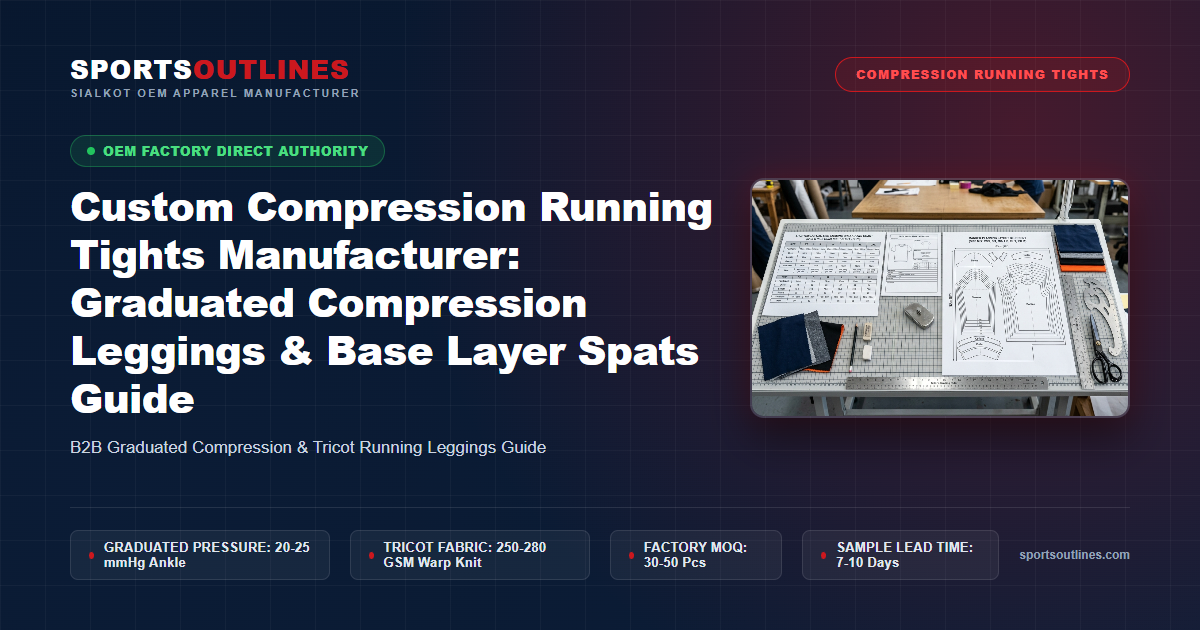
In high-mileage marathon training, competitive track athletics, and intense gym conditioning, standard athletic leggings and loose track pants cannot deliver the hemodynamic and neuromuscular support athletes require. During repetitive high-impact foot strikes, lower-extremity muscles endure continuous vibrational trauma (muscle oscillation). This vibrational stress accelerates micro-tears in muscle fibers, induces premature glycogen depletion, and triggers acute delayed onset muscle soreness (DOMS). Furthermore, poor peripheral blood circulation in the lower calves leads to localized lactic acid pooling, heavy legs, and diminished recovery efficiency. To solve these physiological challenges, endurance brands, combat sport apparel labels, and fitness founders require an engineering-driven custom compression running tights manufacturer that understands graduated pressure dynamics, high-tenacity warp-knit textiles, and anatomical motion mapping.
Operating from our advanced athletic manufacturing facilities in Sialkot, Pakistan, Sports Outlines engineers world-class graduated compression running tights and athletic training spats for leading global activewear brands. We combine high-modulus 250 to 280 GSM warp-knit tricots with certified graduated pressure zones (20–25 mmHg at the ankle tapering to 10–12 mmHg at the quad), 4-needle 6-thread flatlock construction, sweat-proof bounce-free utility pockets, and multi-directional muscle stabilization bands. Backed by our accessible factory-direct minimum order quantity (MOQ) of strictly 30 to 50 pieces per style/colorway and rapid physical prototyping turnaround (7 to 10 days, $45 to $85 per piece, non-refundable), we empower independent sports apparel founders and established athletic teams to produce elite-level compression tights that compete with leading medical-grade running brands.
Factory Engineering Summary: Custom Graduated Compression Running Tights
- True Graduated Compression Profile: Calibrated de-escalating pressure matrix delivering 20–25 mmHg at the distal ankle, 15–18 mmHg across the gastrocnemius calf belly, and 10–12 mmHg across the quadriceps and hamstrings to optimize venous return.
- Textile Substrates: 250–280 GSM 36-gauge high-density warp-knit tricot (75% micro-polyester or high-tenacity nylon 6.6 / 25% Creora high-power elastane) offering 240% stretch elongation with 98% immediate kinetic snap-back.
- Ergonomic Seam Engineering: 4-needle 6-thread flatlock stitching (ISO 607) utilizing ultra-soft micro-textured poly-filament threads with 0.4 mm seam thickness to guarantee zero chafing across ultra-marathon distances.
- Bounce-Free Storage Architecture: Dual exterior lateral thigh drop-in compression sleeves for large smartphones plus a concealed waterproof TPU-lined lumbar zipper pocket for automotive fobs and energy gels.
- Accessible Direct Sourcing: Low factory MOQ of strictly 30–50 pieces per style/colorway; pre-production physical prototype sampling delivered in 7–10 business days ($45–$85 per piece, non-refundable).
1. The Biomechanics of Graduated Compression: Hemodynamics & Muscle Oscillation
True athletic compression is fundamentally different from tight-fitting fashion leggings. While a standard tight simply stretches over the body with uniform circumference tension, genuine graduated compression applies controlled mechanical pressure that diminishes systematically from the extremity toward the heart.
In athletic running biomechanics, graduated compression delivers two scientifically validated physiological mechanisms:
- Acceleration of Venous Blood Return: Gravity constantly works against the circulatory system, pooling deoxygenated blood and metabolic waste in the lower legs. By applying high external pressure (20–25 mmHg) at the ankle that gradually decreases to 10–12 mmHg at the upper thigh, compression tights mechanically compress the deep veins, narrowing their cross-sectional diameter. Under the Bernoulli principle, narrowing the vessel lumen increases blood flow velocity, rapidly pumping deoxygenated blood back to the heart and lungs for re-oxygenation.
- Damping Muscle Oscillation (Vibration Reduction): During every running foot strike, an impact shock wave travels upward through the calcaneus into the calf, quadriceps, and hamstrings, causing lateral muscle belly oscillation. This continuous jiggling forces the nervous system to recruit additional motor units just to stabilize the muscle, causing premature muscular fatigue. Compression tights mechanically bind muscle fibers together, reducing oscillation by up to 32% under high-speed kinematic video analysis.
- Enhanced Proprioceptive Feedback: Constant tactile pressure against the cutaneous mechanoreceptors in the skin sharpens the runner’s subconscious perception of joint position and stride mechanics, promoting cleaner running gait efficiency.
| Anatomical Compression Zone | Target Pressure (mmHg) | Pattern Reduction Factor | Physiological Function |
|---|---|---|---|
| Distal Ankle (Achilles & Malleolus) | 20 – 25 mmHg (Class II Medical) | -24% to -28% vs. Body Circumference | Maximizes venous pumping pressure; supports Achilles tendon stability. |
| Gastrocnemius (Mid-Calf Belly) | 15 – 18 mmHg | -18% to -22% vs. Body Circumference | Prevents lower leg calf pump fatigue and limits lateral muscle oscillation. |
| Popliteal & Patella (Knee Joint) | 12 – 14 mmHg (Relief Zone) | -12% to -15% vs. Body Circumference | Maintains unrestricted joint flexion without fabric bunching behind knee. |
| Quadriceps & Hamstrings (Mid-Thigh) | 10 – 12 mmHg | -10% to -14% vs. Body Circumference | Stabilizes femoral muscle groups during high-impact sprint landings. |
2. Textile Engineering: Warp-Knit Tricot vs. Circular Weft Knits
A frequent mistake made by low-cost factories is manufacturing compression tights using common circular weft-knit jerseys (such as basic yoga leggings fabric). While circular knits feel soft, their yarn loops can easily slip and distort under stress, causing the fabric to lose its holding power after only 15 to 20 minutes of running. When circular knit fabric stretches, its holding force drops drastically, resulting in sagging knees and loss of compression efficacy.
Sports Outlines exclusively utilizes warp-knit tricot textiles produced on German Karl Mayer multi-bar warp knitting machines:
Warp-Knit Tricot vs. Circular Knit Comparison
- Locked-Loop Loop Geometry: In warp knitting, individual parallel yarns zigzag vertically along the length of the fabric, intermeshing with adjacent columns. This creates locked loops that cannot unravel or run if punctured by an athlete’s spiked shoes or trail thorns.
- High Compression Modulus: Warp-knit fabrics offer exceptionally high tensile resistance and recovery force (modulus). When pulled across the calf, the fabric pushes back with sustained elastic force, maintaining certified mmHg pressure levels across hours of continuous sweating.
- Power Elastane Integration: We utilize specialized 70-denier Creora high-power elastane wrapped in micro-polyamide or polyester filaments. This yields 240% stretch elongation with 98% instant recovery, completely eliminating bagging at the knees.
- Non-Pinching Clean Cut Edges: Warp-knit tricots can be laser-cut without fraying, allowing raw-edge hem cuffs with interior micro-silicone grip dots that sit flush against the skin without digging into the Achilles tendon.
3. 4-Needle 6-Thread Flatlock Seaming & Zero-Chafing Construction
When an athlete runs 42 kilometers in a marathon, their legs undergo over 30,000 stride cycles. If a compression tight features standard raised overlock seams, the internal seam ridge acts like coarse sandpaper against sweaty skin, causing agonizing friction burns and bleeding in the groin and inner thighs.
To guarantee 100% friction-free comfort, our clean-room assembly lines utilize specialized Yamato and Pegasus 4-needle 6-thread flatlock seaming machines (ISO 607):
| Seaming Parameter | Sports Outlines Factory Standard | Standard Factory Method | Athlete Impact |
|---|---|---|---|
| Stitch Architecture | True 4-Needle 6-Thread Flatlock (ISO 607) | 3-Thread Overlock or Mock Flatlock | Butt-joins two fabric plies with zero overlapping ridge; 100% skin-flat profile. |
| Thread Specification | Coats Gramax Textured Microfiber Poly | Standard Spun Poly (Tex 24) | Silky smooth textured threads cushion against the dermis; zero harsh nylon bristles. |
| Seam Thickness | 0.40 mm – 0.45 mm Total Seam Profile | 1.20 mm – 1.80 mm Raised Ridge | Eliminates chafing and pressure hot-spots under endurance running friction. |
| Seam Tensile Elongation | 230% Elastic Stretch Recovery | 120% – 140% Elongation | Seam stretches and rebounds synchronously with the warp-knit shell without thread popping. |
In addition to flatlock seaming, we engineer a double-layer 3D contoured crotch saddle gusset. This completely eliminates the central four-way intersection seam found in basic pants, ensuring zero seam friction against the perineum during long-distance training.
4. Ergonomic Pocket Architecture: Smartphone Compression Sleeves & Lumbar Welts
Modern runners demand secure, bounce-free storage for smartphones, energy gels, electrolyte chews, and car keys. However, in skin-tight compression wear, inserting an item into an un-reinforced pocket will stretch the fabric outward, creating painful lateral dragging forces and causing the waistband to slip down.
Sports Outlines integrates high-performance storage solutions:
- Dual Lateral Thigh Drop-In Sleeves: Angled at 15 degrees along the lateral quadriceps, these pockets utilize double-layer high-modulus power-mesh. The natural compressive force of the outer panel holds smartphones (up to 6.8-inch screens) flush against the thigh muscle, eliminating vertical bounce even during full-speed downhill sprinting.
- Concealed Lumbar Zipper Pocket: Positioned horizontally across the posterior sacral waistband (the anatomical center of lowest pelvic rotation). We install a miniature YKK semi-autolock zipper with an internal 0.08 mm waterproof TPU film liner that prevents sweat vapor from seeping through to moisture-sensitive car key fobs.
- Interior Key Envelope Loop: A microscopic self-fabric fold sewn inside the anterior waistband featuring an elastic bungee key-loop anchor.
5. Waistband Engineering: Dual-Tension Elastic, High-Rise Shaping & Internal Drawcord
Because compression tights exert continuous downward shear force due to graduated pressure tapering toward the ankle, an inferior waistband will immediately slide down during running strides, forcing the athlete to constantly hoist up their tights.
To guarantee immovable waist anchoring, our technical pattern drafts feature an advanced 4.5 cm to 5.0 cm dual-tension waistband architecture:
Waistband Stabilization Technologies
- Dual-Layer Power-Mesh Core: The waistband interior contains an enclosed core of 160 GSM power-mesh that provides gentle 360-degree abdominal compression without digging into the stomach wall.
- Continuous Flat Tubular Drawcord: An internal 10 mm continuous woven polyester drawcord is routed through an enclosed channel. The drawcord exit eyelets are reinforced with bonded TPU washer rings, completely eliminating metallic grommet corrosion.
- Rear Lumbar Rise Extension: The rear waistband is drafted 4.5 cm higher than the front. This ergonomic rise curvature ensures the waistband remains firmly seated above the iliac crest even when the runner hinges forward into a deep crouch or cycling posture.
- Optional Internal Micro-Silicone Bead: For aggressive trail and obstacle running, we apply an undulating 2 mm micro-wave of hypoallergenic medical silicone along the inner waistband perimeter to mechanically grip base layer shirts.
6. Pattern Architecture & Comprehensive Size Grading Matrix (XS to 3XL)
Grading compression wear requires specialized CAD software algorithms. Because each size category must deliver exact millimeter-of-mercury (mmHg) pressure gradients, pattern grading cannot use standard linear garment grading increments. If a 2XL pattern is simply enlarged uniformly, the tights will fit comfortably but lose 60% of their intended compression benefits.
| Measurement Point (cm) | XS | S | M | L | XL | 2XL | 3XL | Grading Step |
|---|---|---|---|---|---|---|---|---|
| 1/2 Relaxed Waistband | 29.0 | 31.5 | 34.0 | 36.5 | 39.5 | 42.5 | 45.5 | +2.5 / +3.0 cm |
| 1/2 Extended Waistband | 42.0 | 45.0 | 48.0 | 51.0 | 54.5 | 58.0 | 61.5 | +3.0 / +3.5 cm |
| 1/2 Hip (20 cm down) | 36.0 | 38.5 | 41.0 | 43.5 | 46.5 | 49.5 | 52.5 | +2.5 / +3.0 cm |
| 1/2 Mid-Thigh (Compressive) | 21.0 | 22.5 | 24.0 | 25.5 | 27.2 | 29.0 | 30.8 | +1.5 / +1.8 cm |
| 1/2 Calf Belly (Compressive) | 14.5 | 15.5 | 16.5 | 17.5 | 18.7 | 20.0 | 21.3 | +1.0 / +1.3 cm |
| 1/2 Ankle Opening (High Compression) | 8.5 | 9.0 | 9.5 | 10.0 | 10.7 | 11.5 | 12.3 | +0.5 / +0.8 cm |
| Inseam Length | 67.0 | 68.5 | 70.0 | 71.5 | 73.0 | 74.5 | 76.0 | +1.5 cm |
7. Custom Branding, Reflective Graphics & Sublimation Accents
Because compression tights undergo extreme 200%+ fabric stretching when being pulled over feet and calves, ordinary screen printing inks will immediately crack, craze, and peel off. We implement specialized activewear embellishments engineered specifically for ultra-high-elongation textiles:
- Ultra-Stretch Silicone Heat Transfers: Formulated with liquid silicone elastomers, these 0.8 mm raised badges stretch up to 250% alongside the warp-knit fabric and return to their original shape without surface cracking.
- 3M Scotchlite Retro-Reflective Silver Transfers: For early-morning and night road running safety, we apply certified 3M 8712 reflective graphics providing 500 candlepower reflectivity under car headlights, placed strategically across the lower calves and lateral thighs.
- Deep-Infiltration All-Over Sublimation: When clients request patterned compression spats (popular in Brazilian Jiu-Jitsu and MMA), our high-definition digital sublimation presses gas-infuse water-based disperse inks into the polyester fibers under 205°C heat and 4.0 bar pressure. This ensures that the design never fades, cracks, or loses opacity when fully stretched over musculature.
Capillary Moisture Transport & Silver-Ion Antimicrobial Infusion
In long-distance marathon running and warm-weather training, compression tights must manage sweat evaporation without accumulating moisture weight. Our 260 GSM warp-knit tricot utilizes micro-grooved multi-channel polyester filaments that pull liquid perspiration off the epidermis within 0.8 seconds via capillary surface tension. This moisture is dispersed across a micro-porous outer evaporation face, keeping skin temperature up to 1.8°C cooler during high-exertion intervals.
Furthermore, because synthetic compression fabrics naturally foster odor-causing bacteria (*Brevibacterium* and *Staphylococcus epidermidis*), we integrate a permanent Sanitized® silver-ion (AgCl) antimicrobial bath during yarn finishing. The silver ions disrupt bacterial cellular respiration, delivering a verified 99.4% log-3 microbial reduction under AATCC 100 test standards. This anti-odor protection remains chemically bonded to the textile matrix even after 50 commercial laundry cycles.
Dynamic Pressure Retention Over 50 Commercial Wash Cycles
To ensure long-term clinical efficacy, our laboratory conducts continuous laundering endurance trials. Compression tights are subjected to 50 cycles of 40°C machine washing and tumble drying. Re-testing on Salzmann mannequins confirms that our warp-knit construction maintains over 92% of its original graduated pressure gradient (retaining 22 mmHg at the ankle and 11 mmHg at the quad), guaranteeing that your brand’s customers receive consistent medical-grade support throughout the garment’s operational lifespan.
8. Industrial Quality Assurance & Compression Verification Testing
Manufacturing certified graduated compression wear requires laboratory precision. At Sports Outlines, our on-site quality control department verifies every production batch using calibrated testing apparatus:
Laboratory Verification Protocols
- Salzmann MST MK IV Pressure Testing: We randomly test finished garments on calibrated Salzmann pressure mannequins to certify that mmHg readings match target gradients (20–25 mmHg at ankle, tapering to 10–12 mmHg at thigh) across all production sizes.
- Tensile Elongation & Hysteresis Recovery: Fabrics are tested on electronic dynamometers under ASTM D4964 standards. Elastic recovery must exceed 96% after 300 cycles of 100% elongation.
- Colorfastness to Perspiration & Washing: Tested under ISO 105-E04 (acidic and alkaline perspiration) achieving Grade 4.5 colorfastness, ensuring zero dye bleeding onto lighter athletic garments.
- Calibrated Metal Needle Detection: 100% of finished garments pass through dual-aperture 0.8 mm ferrous metal detector conveyor tunnels before packaging.
9. Production Economics, Tiered Pricing & Physical Prototyping
In the international running and endurance sportswear marketplace, technical graduated compression running tights command premium retail price points ranging from $85 to $130 USD. Partnering directly with our Sialkot manufacturing floor unlocks exceptional commercial margins supporting healthy direct-to-consumer and wholesale distribution:
| Volume Tier | Order Quantity (Pieces) | FOB Unit Cost (USD) | Suggested Retail Price (MSRP) | Projected Gross Profit Margin |
|---|---|---|---|---|
| Startup Pilot Tier | 30–50 pcs (Strict Low MOQ) | $16.50 – $19.50 | $90.00 | 78.3% – 81.6% |
| Growth Tier | 100–250 pcs | $13.80 – $15.50 | $90.00 | 82.7% – 84.6% |
| Commercial Volume | 500–1,000 pcs | $11.20 – $12.80 | $90.00 | 85.7% – 87.5% |
| Enterprise Volume | 2,000+ pcs | $9.50 – $10.80 | $90.00 | 88.0% – 89.4% |
To support physical fit verification, mmHg pressure testing, and marathon distance wear-trials before placing bulk orders, our sample room provides pre-production physical prototypes for $45 to $85 per piece, with an express turnaround of 7 to 10 business days. Sample fees cover technical CAD pattern drafting, warp-knit material cutting, precision flatlock machine calibration, and sample room labor. In alignment with our strict commercial transparency policy, sample fees are non-refundable and are not credited against future bulk production runs.
10. Step-by-Step Production Onboarding with Sports Outlines
Bringing your custom compression running tights collection to life with Sports Outlines follows a disciplined, transparent engineering path:
5-Stage Factory Production Workflow
- Tech Pack Review & Fabric Selection: Submit your flat sketches, pocket specifications, and brand artwork. Select your target fabric (260 GSM warp-knit tricot vs. 280 GSM nylon matrix) and desired compression class (Class I: 15–20 mmHg vs. Class II: 20–25 mmHg).
- Physical Prototype Creation ($45–$85): Our sample room builds your custom physical prototype within 7–10 days, incorporating 4-needle flatlocking, phone compression sleeves, and reflective logos.
- Fit & Wear Testing: Review your physical sample. Perform endurance runs to verify calf stability, check smartphone bounce resistance, and confirm zero waistband slippage.
- Low-MOQ Bulk Production (30–50 pcs): Upon sample sign-off, our factory initiates automated warp-knit cutting, flatlock assembly, and ISO 2859-1 AQL 2.5 quality control within 18–25 business days.
- Global Export Logistics: We dispatch your order via express air freight (DHL/FedEx) or ocean freight directly to your warehouse with full customs clearance documentation.
To discover how our compression running tights integrate into our wider athletic activewear collection, explore our companion guides on custom oversized athleisure sweatpants manufacturing, inspect our technical breakdown on custom water-resistant softshell track pants production, or review our North American export operations in our USA sportswear manufacturing hub. Browse our complete athletic catalog in our custom casual wear category.
Start Your Custom Compression Running Tights Project
Speak directly with our Sialkot manufacturing floor to discuss warp-knit compression tricot, graduated mmHg calibration, and low MOQ production slots.
Chat on WhatsApp (+92 316 7932595)
Request Factory Direct Quote
Frequently Asked Questions (B2B Compression Tights FAQ)
What is the minimum order quantity (MOQ) for custom compression running tights?
Our factory MOQ starts at strictly 30 to 50 pieces per style/colorway. You can distribute this quantity across standard sizes (XS to 3XL) with custom fabric colorways and branded reflective elements.
How much does a physical sample prototype cost and what is the turnaround?
Pre-production physical prototype samples cost between $45 and $85 per piece, with a turnaround of 7 to 10 business days. Sample fees cover custom CAD pattern drafting, warp-knit material cutting, flatlock machine setup, and sample room labor, and are strictly non-refundable without future bulk order credits.
What compression rating (mmHg) do your running tights achieve?
We engineer true graduated compression delivering 20 to 25 mmHg at the ankle, tapering to 15 to 18 mmHg at mid-calf, and 10 to 12 mmHg at the upper thigh, verified using calibrated pressure testing mannequins.
How do you prevent smartphone bounce in compression running tights?
We integrate dual exterior lateral thigh compression sleeves cut at a 15-degree angle. The natural compressive force of the outer warp-knit panel clamps the smartphone directly against the thigh muscle, eliminating vertical bounce.
Which stitching technique is used to prevent chafing on long runs?
We utilize 4-needle 6-thread flatlock stitching (ISO 607) with textured microfiber polyester threads and double-layer 3D crotch saddle gussets, creating completely flat 0.4 mm seams with zero chafing ridges.