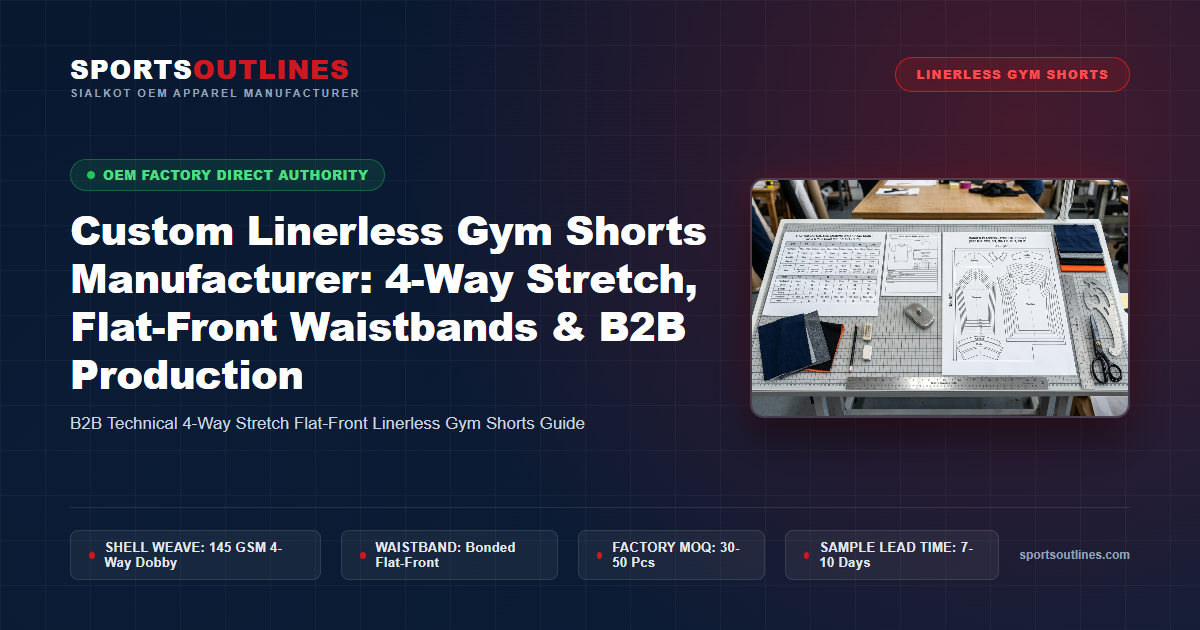
In modern athletic performance apparel and functional fitness merchandising, linerless athletic shorts have emerged as the premier silhouette across boutique gym brands, CrossFit apparel labels, and high-growth direct-to-consumer sportswear collections. While 2-in-1 lined shorts serve road runners requiring integrated compression support, serious strength athletes, powerlifters, bodybuilders, and functional fitness competitors overwhelmingly demand linerless shorts. Linerless construction grants athletes total versatility: it allows lifters to choose their own medical-grade base-layer compression spats or minimalist briefs, eliminates internal chafing caused by generic built-in liner briefs, drastically accelerates laundry turnaround times, and provides a sleek, featherweight handfeel during deep squats, deadlifts, box jumps, and high-velocity sprints. However, manufacturing commercial-grade linerless shorts requires exceptional textile engineering. Without an internal liner to buffer friction and absorb moisture, the outer shell textile must possess superior 4-way mechanical recovery, skin-contact softness, anti-chafing seam engineering, and uncompromised squat-proof opacity. For fitness brand directors, gym merchandising managers, and athletic apparel sourcing teams, partnering with an experienced custom linerless gym shorts manufacturer capable of engineering high-tenacity stretch wovens, bonded flat-front waistbands, bar-tack reinforced pocket architectures, and low-MOQ production is the definitive cornerstone for market dominance.
At Sports Outlines, our specialized manufacturing facility in Sialkot, Pakistan, engineers high-performance cut-and-sew athletic bottoms for global sportswear labels. Operating high-precision laser-guided cutters, automated ultrasonic seam-bonding presses, specialized 4-needle 6-thread flatlock machines, and computer-programmed bartacking stations, we turn custom tech packs into retail-ready athletic apparel. In this comprehensive technical manufacturing guide, we present the fiber physics, 4-way stretch weaving mechanics, flat-front waistband engineering, pocket stabilization methods, POM sizing specifications, and low-MOQ sourcing frameworks required to build commercial-grade custom linerless gym shorts that command premium retail price points.
Factory Direct B2B Production Parameters:
- Primary Shell Textile: 135–165 GSM 4-Way Stretch Micro-Dobby / Micro-Ripstop (86% Micro-Polyester / 14% Spandex or 88% Nylon 6.6 / 12% Elastane).
- Waistband Engineering: Hybrid Bonded Flat-Front Waistband with Internal Elasticized Core, Continuous Drawcord Tunnel & Concealed Eyelets.
- Hardware Specifications: Reversed Semi-Auto Lock YKK #3 Concealed Coil Zippers with Hypalon Pull Tabs & Water-Repellent Polyurethane Coated Tape.
- Seam Technologies: Ultra-Low-Profile 4-Needle Flatlock & Double-Needle Seam-Sealed Fused Hems to Prevent Skin Abrasion.
- Commercial Sourcing MOQ: 30 to 50 pieces per style/colorway across custom size curves (Men’s XS to 3XL).
- Physical Prototype Development: 7 to 10 business days turnaround at $45 to $85 per piece (strictly non-refundable and non-creditable).
1. Technical Textile Matrix: 4-Way Stretch Wovens vs. Micro-Knit Substrates
In a linerless training short, the shell fabric makes direct contact with the athlete’s skin throughout high-friction barbell movements, rowing strokes, lunges, and plyometric jumps. Therefore, standard polyester plain weaves typically utilized in budget boardshorts fail completely in athletic gyms: they create abrasive shear forces across the quadriceps, trap perspiration against bare skin, and restrict explosive hip hinging. A professional custom linerless gym shorts manufacturer operates with high-gauge stretch woven textiles engineered specifically for multi-planar mobility, skin-glide softness, and high moisture vapor transmission.
Our textile testing laboratory evaluates three primary performance textiles engineered for linerless athletic training shorts:
The Physics of Anti-Cling Inner Textures:
When athletes sweat heavily, plain flat-woven fabrics create a surface tension seal against the skin—commonly known as wet-cling. This cling severely restricts knee elevation during box jumps and lunges. To solve this, Sports Outlines weaves a specialized dobby structure featuring a 3D waffle or diamond-textured interior face. This microscopic geometric relief elevates 40% of the fabric surface off the athlete’s skin, creating an open micro-air layer that facilitates continuous air circulation, breaks capillary surface tension, and prevents wet fabric adhesion entirely.
Hydrophilic Chemistry & Moisture Dispersion Dynamics (AATCC 79 & AATCC 195)
Synthetic filaments like nylon and polyester are inherently hydrophobic, meaning raw synthetic yarns do not naturally absorb liquid sweat. To transform them into high-performance training fabrics, our dye house applies a durable hydrophilic copolymer finish (Rudolf Ruco-Pur SLY or Huntsman Ultraphil HWR) during the stenter frame finishing cycle at 165°C. This molecular grafting lowers the water contact angle from 95 degrees down to less than 15 degrees, allowing sweat droplets to instantly collapse, spread across a 500% larger surface area within 1.2 seconds (AATCC 79 drop absorbency test), and evaporate into ambient air within 12 minutes. Under AATCC 195 Liquid Moisture Management testing, our linerless woven shell fabrics consistently score in Grade 5 (Excellent Overall Moisture Management Capability – OMMC > 0.85), guaranteeing that athletes remain dry, cool, and unencumbered during the most grueling training sessions.
Computer-Aided Laser-Cut Micro-Ventilation & Zonal Airflow
To augment passive fabric breathability without compromising structural tensile strength, Sports Outlines offers computerized laser perforation arrays across high-sweat biological zones. Utilizing sealed CO2 industrial laser systems with precision optical galvanometer scanners, we cut micro-perforations (0.8 mm to 1.2 mm diameter) directly into the side outseam panels and rear yoke areas. The thermal laser beam simultaneously cuts and cauterizes the thermoplastic nylon/elastane fibers, creating perfectly sealed, fray-proof apertures that will never fray or unravel across hundreds of wash cycles. These micro-perforations increase kinetic airflow across the quadriceps by up to 300% during running strides, providing natural convective cooling without requiring separate sewn-in mesh inserts.
2. Barbell Knurling Defense & Abrasion Resistance: High-Tenacity Polyamide Engineering
In weightlifting, powerlifting, and CrossFit facilities, gym shorts face an extreme mechanical hazard: the aggressive steel knurling of Olympic barbells. During heavy deadlifts, cleans, and snatches, the knurled steel drags directly across the anterior thighs. Standard activewear shorts made from low-grade polyester yarns suffer immediate fiber shearing, fuzzing, pilling, and thread breakage after just two or three lifting sessions.
To engineer invincible durability, Sports Outlines deploys military-grade fiber technologies:
- Polyamide 6.6 High-Tenacity Filaments: Unlike standard commodity polyester, nylon 6.6 features a highly crystalline molecular structure that delivers up to 300% greater abrasion resistance under high frictional shear. Our 40D x 40D high-tenacity yarns withstand aggressive barbell contact without snagging or surface pilling.
- Martindale & Taber Abrasion Verification: Our fabric batches undergo rigorous Martindale abrasion testing (ISO 12947-2) exceeding 45,000 cycles under a 12 kPa load, as well as Taber rotary abrasion testing (ASTM D3884) with H-18 abrasive wheels, confirming zero yarn breakdown or fiber fraying.
- Micro-Ripstop Grid Reinforcement: For commercial CrossFit and tactical training apparel collections, we weave an ultra-subtle 1 mm x 1 mm micro-ripstop grid into the stretch woven matrix. If a barbell knurl or sharp equipment edge punctures the short, the reinforced grid confines the tear to a single millimeter, completely preventing catastrophic fabric runs.
3. Waistband Architecture: Flat-Front Bonded vs. Full Elastic Channels
The waistband represents the most critical mechanical interface of a linerless athletic short. Traditional gathered athletic waistbands—which use heavy ruched elastic—bunch excessively across the lower abdomen, creating bulk under weightlifting belts and rolling over during abdominal crunches. Conversely, a purely rigid flat-front waistband lacks the kinetic stretch needed during heavy breathing and pelvic expansion.
To eliminate these flaws, our factory manufactures an engineered **Hybrid Flat-Front Waistband**:
- Bonded Flat Front Panel: The front 16–20 cm of the waistband utilizes high-frequency thermal bonding film with lightweight interlining. This creates an ultra-sleek, clean aesthetic that sits completely flat against the lower abdominal wall, preventing pressure hotspots under heavy weight belts.
- Gathered Elastic Rear & Flanks: The side flanks and lumbar zone feature a 40 mm high-modulus natural rubber and elastane knit elastic band that delivers 45% elongation, ensuring the short grips the iliac crest securely without digging.
- Internal Continuous Drawcord Channel: The drawcord is channeled entirely within the interior tunnel of the waistband. We engineer a hidden continuous loop or reinforced interior-facing buttonhole eyelets, allowing the athlete to wear the drawcord internally (for zero external snagging during barbell lifts) or routed outwardly based on brand tech packs.
- Flat Braided Siliconized Drawcord: Drawcords are woven from 10 mm low-friction polyester cord dipped in silicone micro-emulsion or finished with matte heat-shrink aglets, guaranteeing the knot will never slip or unravel under high abdominal pressure.
4. Ergonomic Pattern Grading, Inseam Profiles & Kinetic Gusset Engineering
In linerless shorts, the cut dictates performance. A silhouette that is too wide flares out like a basketball short, catching on kettlebells and barbell knurling. A silhouette that is cut too narrow binds across the hamstrings and glutes during deep barbell squats. Our technical apparel patternmakers utilize CAD 3D morphometric avatar modeling to balance taper and mobility.
The Extended Diamond Crotch Gusset
Conventional shorts join four pattern pieces at a single cross-shaped crotch seam intersection. Under heavy lateral lunge or squat stress, tensile forces converge on this single central point, leading to seam rupture or uncomfortable binding. We integrate an extended 7 cm to 9 cm **Diamond Crotch Gusset** constructed from the same 4-way stretch fabric. By distributing mechanical tension along parallel curved seams, the gusset provides a true 180-degree range of motion while eliminating crotch chafing entirely.
B2B Point of Measurement (POM) Tech Pack Matrix (Men’s 7-Inch Inseam Linerless Short)
5. Inseam Spectrum Analysis: 5-Inch vs. 7-Inch vs. 9-Inch Silhouettes
In modern sportswear retailing, brand founders must strategically configure their inseam offerings to match their target demographic. Offering the wrong inseam length or failing to grade leg circumference proportionally leads to excessive product returns. We guide brands across three primary commercial lengths:
- 5-Inch Inseam (Above-the-Knee Quad Silhouette): The most popular silhouette among competitive CrossFitters, bodybuilders, and younger fitness demographics. The 5-inch length showcases quadriceps hypertrophy, prevents fabric interference during deep Olympic squats, and minimizes overall garment weight. The leg opening is graded slightly narrower with an ergonomic curved side notch.
- 7-Inch Inseam (The Multi-Sport Gold Standard): Accounting for over 60% of all linerless short sales globally, the 7-inch inseam sits approximately 2 inches above the patella. It provides the ideal balance of modest coverage and unrestricted mobility, functioning seamlessly for gym training, HIIT, outdoor running, pickleball, and casual streetwear styling.
- 9-Inch Inseam (Traditional Athletic & Court Length): Favored by taller athletes, commercial health club members, and athletes transitioning between gym workouts and outdoor basketball. Requires careful pattern grading with laser-cut ventilation zones to avoid excess knee drag during high flexion movements.
6. Pocket Stabilization & Hardware Integration Engineering
In linerless training shorts, pocket engineering is one of the highest causes of negative customer reviews. In lightweight shorts without compression liners, placing a modern 200-gram smartphone in a standard slash pocket causes the phone to swing violently against the knee during running, or slip out completely when lying on a bench press.
Our engineering protocol incorporates three specialized stabilization features:
- Internal Power-Mesh Media Sleeve: Inside the right-hand slash pocket, we sew an elasticized micro-mesh sleeve (180 GSM nylon/spandex power mesh). This secondary sleeve locks a smartphone tightly against the lateral hip muscle, completely preventing inertia swing during explosive sprints.
- Concealed YKK Reverse Coil Zippers: For security during inverted gym movements, we install reverse coil YKK #3 zippers concealed beneath clean welt flaps. The zipper pulls feature custom molded silicone or Hypalon tabs designed to lay completely flush, eliminating barbell snags.
- Lumbar Utility Zip Pocket: Across the rear lumbar zone just beneath the waistband, we engineer a horizontal zip pocket with waterproof coated tape. Sited over the sacrum—the body’s center of gravity—this pocket holds keys, cards, or energy gels with zero bouncing sensation.
7. Precision Cut-and-Sew Assembly Line & Thread Physics
The structural integrity of lightweight 4-way stretch wovens relies heavily on sewing thread tension and stitch selection. If an apparel factory uses rigid spun polyester threads on stretch woven fabrics, the seams will snap during high-tensile squat loads. Conversely, if thread tension is too loose, seam slippage and unsightly seam grinning appear.
At Sports Outlines, our production line adheres to strict stitch engineering:
- Continuous Filament Poly-Wrapped Core Yarn: We utilize premium high-tenacity thread (Gütermann Mara 70 / Tera 40) engineered with 100% continuous polyester filaments. This yields extreme tensile strength while maintaining microscopic thread diameter to prevent fabric puckering.
- Texturized Micro-Loopers for Skin Contact: On all interior overlock and flatlock seams, we feed bulked texturized polyester threads into the looper mechanisms. This produces a pillowy, ultra-soft seam envelope that glides across bare thighs with zero abrasive friction.
- Ultrasonic Welded & Bonded Leg Hems: For luxury athletic lines, we replace traditional folded hems with ultrasonic welded edges backed by 12 mm Bemis polyurethane thermoplastic bonding film. This reduces hem bulk by 60%, eliminates needle holes, and creates an immaculate modern activewear drape.
8. Manufacturing Quality Assurance & Defect Prevention Matrix (AQL 2.5)
Linerless shorts endure severe multi-directional shear forces and friction during heavy training sessions. A failure in thread tension, elastane degradation, or bonding temperature ruins brand credibility. At Sports Outlines, every production batch is governed by strict ISO 9001 and AQL 2.5 visual and mechanical inspection standards:
9. B2B Unit Economics, Fabric Yields & Brand Margin Projections
From an apparel brand founder’s financial perspective, linerless athletic shorts offer some of the highest gross profit margins in activewear. Without the fabric consumption, cutting time, and sewing labor required to assemble complex compression liners, production costs remain highly competitive while retail price points can easily match premium activewear giants ($68 to $88 MSRP).
Consider the unit economic breakdown for a production run of 100 units of custom 7-inch linerless shorts with bonded flat-front waistbands:
10. Low-MOQ Sourcing Architecture, Physical Prototyping & Overseas Logistics
For emerging athletic apparel labels, boutique functional fitness gyms, and established sportswear brands expanding into performance shorts, high minimum order quantities represent the greatest barrier to profitability. Overseas factories in East Asia frequently demand 500 to 1,000 units per colorway, forcing brands to tie up tens of thousands of dollars in untested inventory.
Sports Outlines eliminates this barrier through an agile manufacturing ecosystem:
- Accessible Production MOQ: We offer a low factory threshold of **30 to 50 pieces per style/colorway**, allowing brands to test custom silhouettes, unique color palettes, and specific inseam options across complete size ranges (XS to 3XL) with minimal capital risk.
- Physical Prototyping Protocols: Before commencing bulk cutting, we produce tangible physical production samples within **7 to 10 business days** for **$45 to $85 per piece** (strictly non-refundable and non-creditable). This sample allows your design team to stress-test fabric handfeel, zipper glide, waistband stretch, and garment fit in real training conditions.
- Global Export Logistics: From our Sialkot manufacturing hub, we operate direct air express shipping channels via DHL Express, FedEx Priority, and air cargo, delivering finished production lots to commercial doorsteps across major consumer markets:
- Custom Sportswear Manufacturer USA (3–5 business days transit)
- Custom Sportswear Manufacturer UK (3–4 business days transit)
- Custom Sportswear Manufacturer Australia (4–6 business days transit)
- Custom Sportswear Manufacturer Canada (4–5 business days transit)
- Custom Sportswear Manufacturer Germany & EU (3–5 business days transit)
11. Frequently Asked Questions: B2B Sourcing for Custom Linerless Gym Shorts
Q1: Why do functional fitness and strength athletes prefer linerless shorts over 2-in-1 lined shorts?
Linerless shorts grant athletes autonomy over their compression base layers. Many lifters prefer specific medical-grade compression spats, thermal base layers, or minimalist performance briefs that built-in liners cannot replicate. Furthermore, built-in liners often bunch up, trap odors, and degrade faster than the outer shell. Linerless designs are lighter, dry up to 35% faster, and allow versatile multi-sport utility.
Q2: What is the optimal fabric weight and composition for custom linerless training shorts?
The industry benchmark is 135 to 155 GSM 4-way stretch woven dobby or micro-weave, composed of 86% to 88% micro-polyamide (nylon 6.6) or micro-polyester blended with 12% to 14% high-recovery spandex. This provides high tensile strength, 300% multidirectional elastic recovery, and zero skin-cling under heavy sweat conditions.
Q3: How do you prevent phone bounce in linerless gym shorts without a tight compression liner?
We engineer a specialized internal power-mesh media sleeve inside the primary slash pocket, locking the smartphone against the lateral hip muscle. Additionally, we integrate an ergonomic rear lumbar zip pocket with coated waterproof tape directly over the sacrum to hold heavy essentials without bounce.
Q4: What are your factory minimum order quantities and sample turnaround times?
Our factory production MOQ is 30 to 50 pieces per style/colorway across full custom size curves. Physical pre-production prototypes are completed in 7 to 10 business days at $45 to $85 per piece (strictly non-refundable and non-creditable). Bulk production typically ships within 18 to 24 business days from tech pack sign-off.
Scale Your Activewear Brand with Factory-Direct Linerless Shorts
From 4-way stretch micro-wovens and bonded flat-front waistbands to low 30–50 piece MOQs and rapid 7–10 day prototyping, Sports Outlines delivers elite apparel engineering for high-growth athletic brands worldwide.