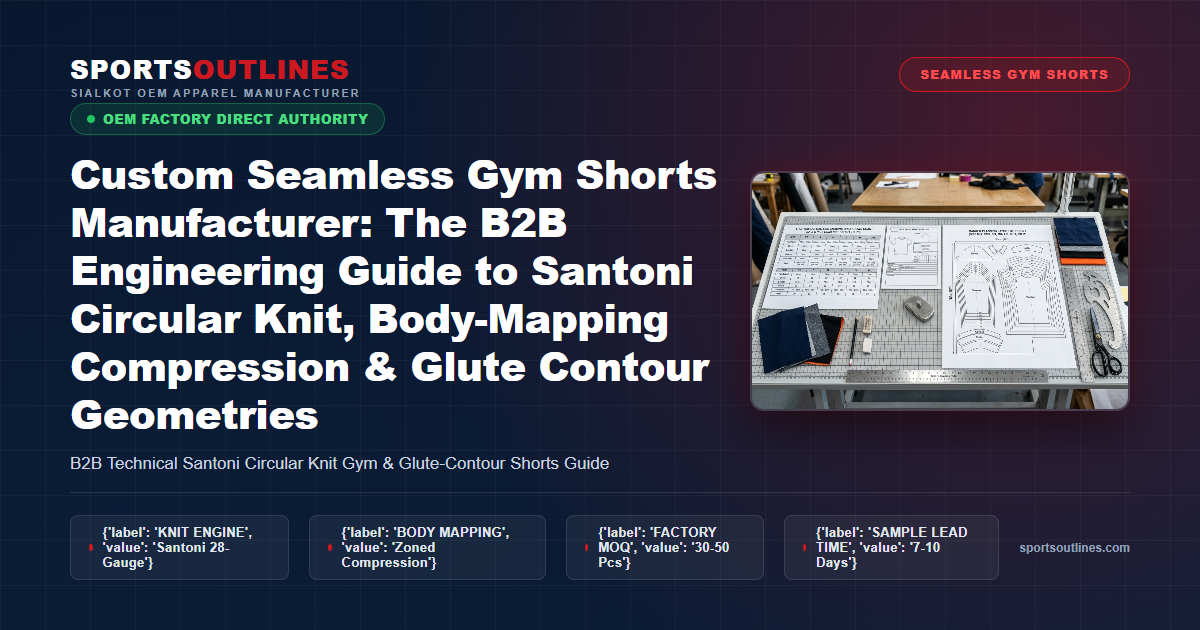
In modern fitness apparel and women’s athleisure, seamless circular knit technology represents the pinnacle of comfort, compression aesthetics, and ergonomic performance. Driven by viral consumer demand for sculpting gym wear, butt-lifting silhouettes, and buttery-soft second-skin fits, gym shorts engineered via seamless circular knitting have transformed activewear brand economics. For activewear founders, athletic directors, and private-label buyers, selecting a specialized custom seamless gym shorts manufacturer is a technical decision that hinges on circular knit machinery capabilities, multi-density yarn tension programming, precision garment dyeing chemistry, and computerized stitch architecture.
At Sports Outlines, we combine Italian Santoni electronic circular knitting machinery with rigorous athletic bottom engineering. Unlike traditional cut-and-sew athletic shorts that require extensive panel cutting and bulky perimeter seams, seamless activewear knits an entire tubular silhouette in a single continuous operation. This eliminates side chafing, reduces fabric cutting waste from 20% down to under 3%, and empowers technical designers to knit varying compression zones, ventilation eyelets, and glute-sculpting geometries directly into the textile matrix. This comprehensive engineering manual breaks down the machinery, yarn thermodynamics, POM grading charts, defect taxonomies, and low-MOQ production protocols necessary to launch commercial-grade seamless gym shorts.
Executive Summary: Seamless Gym Shorts Technical Milestones
- Knitting Engine: 28-gauge Santoni SM8-TOP2V electronic single-jersey circular knitting machines with 8-feed yarn carriers and individual electronic needle selection.
- Yarn Architecture: 90% DTY Micro-Polyamide 6.6 (40/34/2 or 70/68/2 denier) blended with 10% Creora/Lycra high-recovery elastane with 280–310 GSM tube density.
- Body-Mapped Zonation: Computerized graduation from high-modulus abdominal ribbing to micro-perforated inner thigh ventilation eyelets without a single cut seam.
- Glute Sculpting Physics: High-compression under-glute crescent bands and 3D jacquard shadow shading for anatomical lifting and contouring.
- Anti-Roll Waistband: 11cm to 12.5cm double-folded tubular waistband with integrated high-tension elastane inlay ensuring zero slippage during deep squats.
- Aqueous Finishing: High-pressure Flainox rotary piece-dyeing with Oeko-Tex Class I certified acid dyes and steam board heat-setting tunnels.
- Low-MOQ Agility: 30–50 pieces per style/colorway, custom Pantone piece-dyeing, and 7–10 day rapid physical prototype sampling.
1. Santoni Circular Knitting Machine Technology: Electronic Single-Jersey Precision
Traditional activewear manufacturing begins with flat fabric rolls, lays out paper markers, cuts multiple panels via knife or laser, and stitches them together with overlock and flatlock seams. In contrast, seamless garment production is an additive textile engineering process. Sports Outlines deploys Santoni SM8-TOP2V circular knitting machines—the global benchmark in seamless sportswear technology.
The machine operates using a precision rotating cylinder with 8 yarn feeds, where each feed controls multiple electronic yarn fingers. Crucially, each needle is independently actuated by piezoelectric ceramic actuators governed by CAD knitting software. This allows the machine to alter the stitch structure on a needle-by-needle basis during every micro-second of rotation. Our computerized knitting cells control:
- Plain Jersey Knits: Smooth, buttery-soft face fabric for high-stretch thigh and hip regions requiring 4-way unrestricted elasticity.
- 1×1, 2×1, and 3×1 Rib Knits: High-modulus structural ribs that deliver mechanical compression around the waistband, lower abdomen, and under-butt support arches.
- Pique and Eyelet Meshes: Controlled open-stitch drop perforations that allow excess body heat and sweat vapor to vent along high-perspiration zones.
- Float and Tuck Stitch Geometries: Creating 3D contour ridges, textured honeycomb panels, and subtle visual shading effects that define muscle contours.
- Step Motor Stitch Cam Regulation: Independent stepping motors dynamically alter loop lengths on each feed, tightening the knit structure for high compression and loosening it for airy ventilation within a continuous 20cm tube.
2. Microfiber Yarn Compositions & Elastomeric Draft Ratios
In seamless activewear, the yarn is the fabric. Because the garment is knitted directly from raw bobbins, selecting the correct filament denier, polymer chemistry, and elastomeric draft ratio dictates the entire tactile hand feel, recovery modulus, and thermal breathability of the finished gym shorts.
At Sports Outlines, we utilize Draw Textured Yarn (DTY) Micro-Polyamide 6.6 as our core face fiber. Polyamide 6.6 has a higher melting point (255°C vs 215°C for Polyamide 6), superior tensile strength, and lower moisture regain than staple cotton, resulting in ultra-fast moisture evaporation. We plate this yarn with covered elastane (such as Hyosung Creora or Lycra T-902C) to protect the elastic filament from chemical degradation during dyeing.
The pre-draft ratio of the elastane yarn feed is a critical engineering variable. Pre-draft refers to the degree of mechanical elongation applied to the raw elastane thread before it enters the knitting needle latch. A draft ratio of 3.2:1 means the elastane is pre-stretched 320% as it is knitted into the relaxed nylon loops. When the finished tube leaves the cylinder, the elastane snaps back violently, condensing the nylon filaments into a dense, ultra-opaque micro-knit with exceptional modulus and zero sheerness under squatting tension.
3. Body-Mapping Compression & Gradient Pressure Zones
The defining technical advantage of seamless machinery is “body-mapping.” In traditional cut-and-sew apparel, creating a firmer zone requires cutting a new panel of heavier fabric and sewing it in place, which introduces rigid seams that chafe the skin. In seamless knitting, body-mapping is executed by altering the stitch density and elastane yarn feeding rate without creating a single seam.
Sports Outlines engineers seamless gym shorts with three distinct biomechanical zones:
- Zone A: Core Abdominal Stabilization (High Compression: 22–26 mmHg): Knitted using high-tension 2×1 tuck-rib structure with fed elastane, this zone flattens and supports the lower abdominal wall, preventing stomach pooching and stabilizing the core during heavy barbell squats and lunges.
- Zone B: Quadriceps & Hamstring Flex (Moderate Compression: 14–18 mmHg): Knitted in smooth, pliable single jersey. This zone provides mild muscle oscillation dampening without restricting hip hinge extension or knee flexion during sprint intervals.
- Zone C: Thermal & Perspiration Venting (Zero Compression / Eyelet Mesh): Positioned along the lower lumbar spine, inner groin fold, and lower inner thigh. Programmed with computerized drop-stitch eyelets that accelerate evaporative cooling, preventing sweat accumulation and discomfort.
To verify our pressure distributions, production lots are calibrated on Salzmann MST MK IV pressure measuring mannequins. By measuring contact pressure in millimeters of mercury (mmHg) across 12 anatomical coordinates, we guarantee that compression gradients support venous return while preserving full musculoskeletal mobility.
4. Glute Sculpting Geometries: Under-Butt Crescents vs. Micro-Scrunch Ruching
In the commercial activewear market, the aesthetic contouring of the glutes is the number one consumer purchasing driver. Flat compression shorts flatten and compress the buttocks into a monolithic, unshaped silhouette. Seamless knitting solves this problem through 3D structural knit shaping:
5. High-Compression Ribbed Waistbands: Anti-Roll Biomechanics
The most common consumer complaint in lower-tier seamless shorts is waistband rollover: when bending forward into a deadlift or high-knees drill, the waistband flips downward, pinching the waist. In seamless engineering, preventing waistband roll requires strict attention to three physical factors:
- Tubular Double-Fold Construction: The waistband is knitted as an extended tube, folded in half inwardly, and anchored at the bottom edge. This creates two distinct layers of high-recovery fabric, doubling the hoop tension without increasing garment rigidity.
- Elastane Inlay Density: While the body of the short uses 40-denier elastane, the waistband incorporates heavy 70-denier to 140-denier elastane laid in horizontally on every course. This generates 28 N of compressive modulus (ASTM D4964), locking the waistband firmly above the iliac crest.
- Waistband Height Grading: An 11cm to 12.5cm height profile ensures the band bridges the entire distance from the upper hip crest to the narrowest portion of the natural waist, creating a mechanical barrier that resists rolling.
- Differential Rib Compression Gradient: We program a tighter 1×1 rib at the top rim (highest tension) graduating into a softer 2×2 rib at the lower edge, creating an anatomical wedge shape that naturally hugs the female torso.
6. Seamless Gusset Integration & Finishing Operations
While the body tube of a seamless short emerges from the Santoni machine as a continuous cylinder, completing the short requires critical post-knitting finishing operations:
Diamond Gusset Assembly & Inseam Flatlocking:
The bottom of the seamless tube is slit open via automated CNC knife cutting to form the leg openings and crotch junction. To prevent camel-toe discomfort and eliminate 4-way seam intersection stress, Sports Outlines inserts an engineered diamond or triangular gusset. We assemble the inner leg inseams using 4-needle 6-thread flatlock stitching with differential feed calibrated to 1.15:1, matching the tubular stretch.
Aqueous Piece-Dyeing & Heat-Setting Chemistry:
Seamless tubes are knitted in raw greige ecru yarn. Once cut and assembled, the garments undergo automated pressurized aqueous piece-dyeing in Flainox rotary dyeing machines. Utilizing Italian acid dyes, garments are processed at 98°C with specialized leveling agents that achieve deep, vibrant Pantone color uniformity. Subsequently, garments are placed on pneumatic aluminum sizing boards and passed through steam heat-setting tunnels at 125°C for 45 seconds. This thermal memory process locks the finished dimensions, eliminates shrinkage (<1.5%), and imparts a permanent velvety hand feel.
Eco-Friendly OEKO-TEX Standard 100 Compliance:
All textile dyeing, scouring, and softening auxiliaries utilized in our seamless plant comply strictly with OEKO-TEX Standard 100 Class I (safe for prolonged skin contact). Our dye formulations are entirely free from alkylphenol ethoxylates (APEOs), heavy metals, carcinogenic aromatic amines, and formaldehyde, ensuring safety for fitness consumers and hassle-free customs clearance in European and North American retail channels.
7. Master Point of Measure (POM) Grading Specification: XS to 3XL
Because seamless circular knit apparel exhibits remarkable 300% multidirectional stretch, relaxed flat garment measurements are substantially smaller than traditional cut-and-sew garments. Below is the master Point of Measure (POM) specification utilized in Sports Outlines’ CAD Santoni programming for Women’s Sculpt Seamless Gym Shorts (Base Model: 5-Inch Inseam):
8. Seamless Manufacturing Defect Taxonomy & Factory Quality Remediation
Seamless manufacturing requires strict quality control because defects originate deep inside the machine cylinder during knitting. If an operator misses a broken needle latch or yarn tension imbalance, hundreds of tubular garments can be ruined in minutes. Sports Outlines implements an uncompromising defect taxonomy and remediation protocol:
9. Low-MOQ Production Protocols & Factory Quality Assurance
In traditional manufacturing, seamless factories require astronomical order volumes—often 1,000 to 3,000 pieces per style/colorway—because setting up circular knitting machines and garment dye vats involves significant machine downtime. Sports Outlines was founded specifically to democratize high-tech activewear manufacturing by offering flexible low-MOQ production cells for boutique brands:
10. International Export Infrastructure & Regional Sourcing Silos
Sports Outlines powers high-growth seamless activewear brands and fitness creators across global hubs:
- Sports Clothing Manufacturers USA: Express air shipping directly to US logistics warehouses, third-party fulfillment centers, and boutique activewear brands with Section 321 duty-free entry for orders under $800.
- Sports Clothing Manufacturers UK: EORI and UK VAT compliant freight servicing influencer-led athleisure brands and boutique gym studios across London, Manchester, and Birmingham.
- Sports Clothing Manufacturers Australia: High-modulus UPF 50+ buttery-soft studio gym shorts shipping directly to Sydney, Melbourne, and Gold Coast fitness labels.
Explore our complementary specialized athletic manufacturing lines for custom shorts, high-performance custom activewear biker shorts, technical custom cycling shorts, and full-scale gym clothing manufacturing to launch complete, cohesive collections.
Engineer Your Seamless Gym Shorts Line Today
From 28-gauge Santoni circular knitting and body-mapped glute contouring to custom Pantone acid piece-dyeing and accessible 30–50 piece MOQs, Sports Outlines delivers the manufacturing power to bring your seamless vision to market.
Frequently Asked Questions (FAQ) – Seamless Gym Shorts Manufacturing
What machinery is used to produce custom seamless gym shorts?
Sports Outlines utilizes Santoni SM8-TOP2V electronic single-jersey circular knitting machines (typically 13-inch to 15-inch cylinder diameters at 28-gauge). These machines allow computerized multi-density body-mapping, integrated ventilation pin-holes, and engineered glute contour structures knitted directly into continuous seamless tubes.
How does seamless knitting differ from traditional cut-and-sew activewear?
Unlike cut-and-sew apparel assembled from flat rolls of fabric, seamless garments are knitted as continuous cylindrical tubes. Side seams are completely eliminated, reducing friction and chafing, enhancing 360-degree stretch modulus, cutting fabric cutting waste from 20% down to under 3%, and providing a second-skin compressive fit.
What yarn composition is recommended for squat-proof seamless gym shorts?
The optimal commercial yarn specification is 90% Draw Textured Yarn (DTY) Micro-Polyamide 6.6 blended with 10% elastane (Lycra or Creora) in a 280 to 310 GSM equivalent tube weight. This combination provides a buttery-soft hand feel, 100% squat-proof opacity, high thermal regulation, and exceptional elastic recovery.
What is the factory MOQ for custom seamless gym shorts?
Sports Outlines supports premium athleisure startups and boutique gym labels with an accessible low factory MOQ of 30 to 50 pieces per style/colorway, complete with custom garment dyeing, silicone logo printing, and size grading from XS to 3XL.
What is the sampling lead time and cost for physical prototypes?
Physical prototype samples are developed within 7 to 10 business days at $45 to $85 per piece. Under strict factory operating policy, all sample fees are strictly non-refundable and cannot be credited toward subsequent bulk production orders.
Can you engineer custom glute contour and scrunch details in seamless shorts?
Yes. Through computerized Santoni electronic needle selection, we engineer under-glute compression arcs, 3D shadow shading jacquards, and post-knit micro-elastic central ruching that lift and sculpt the glutes without compromising structural durability.