Sub-Cluster 6.2 • Structural Narrow-Fabric Weaving, Elastomer Tension & Seam Reinforcement Blueprint (Blog #447)
Why Narrow-Fabric Jacquard Elastics and Branded Shoulder-to-Shoulder Neck Tapes Separate True Cut-and-Sew Architecture from Print-on-Demand Blanks
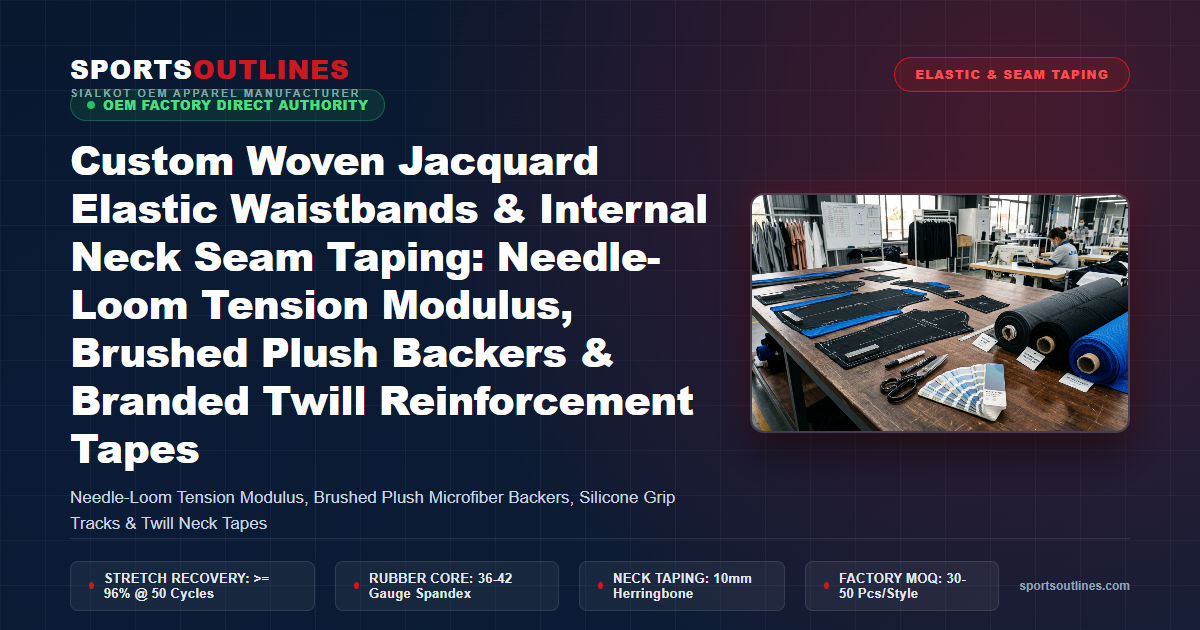
When an athlete or retail buyer picks up a pair of compression shorts, a high-support sports bra, a BJJ rashguard, or a 480 GSM luxury streetwear hoodie, two structural narrow-fabric components immediately signal Tier-1 factory craftsmanship: an exposed 38 mm to 50 mm Custom Woven Jacquard Elastic Waistband with a velvety brushed micro-plush inner face, and a 10 mm to 14 mm Custom-Printed Herringbone Twill or Single-Jersey Internal Neck-to-Shoulder Reinforcement Tape locking down the raw overlock collar seam. Yet poorly specified elastics suffer from elastomeric core slippage (“worming”), bacon-neck edge curling, and horizontal logo distortion at 30% body stretch. This comprehensive narrow-fabric engineering manual details Jakob Müller electronic jacquard needle-loom weaving, 1,120D Creora® HighClo™ spandex vs natural rubber latex core modulus curves, double-needle chainstitch (`ISO 401`) and coverstitch (`ISO 605`) metering folder attachments, and low-MOQ yarn-bank amortization.
Direct Manufacturer Answer: How Are Custom Jacquard Elastic Waistbands and Branded Internal Neck Tapes Engineered for Sportswear?
True custom sportswear waistbands are woven on high-speed computerized narrow-fabric jacquard needle looms using 150D/144f micro-polyester or Tactel® Nylon 6,6 warp yarns wrapped around a 840D–1,120D elastane core (`120%–140%` elongation with `≥ 96%` elastic recovery after 50 washes and a brushed micro-plush skin-contact backer). Simultaneously, internal neck and shoulder seams on T-shirts, polo shirts, and hoodies are reinforced using a 10 mm–12 mm custom screen-printed or woven herringbone cotton/polyester twill tape fed through a synchronized double-needle chainstitch (`ISO 401`) or 3-needle coverstitch (`ISO 605`) folder attachment to eliminate collar stretching and raw-seam neck abrasion.
- Low MOQ Narrow-Fabric Integration: Custom jacquard waistbands and printed internal neck tapes integrated into 30–50 piece per style cut-and-sew production runs via our Sialkot trim-banking program.
- Physical Pre-Production Sampling: Test waistband stretch modulus and neck-tape hand-feel on a physical prototype in 7–10 business days ($45–$85 per piece non-refundable development fee).
- Direct Factory Engineering Desk: WhatsApp +92 316 7932595 or upload your vector logo at sportsoutlines.com/contact-us/.
Throughout Sub-Cluster 6.2, we have systematically engineered every private-label trim component that transforms a garment into a defensible retail asset: Blog #441: Woven Damask vs Heat-Transfer Neck Labels, Blog #442: 600–800 GSM Luxury Hangtags, Blog #443: Global Care & Fiber Labeling Laws, Blog #444: 3D Silicone Badges & Metal Zipper Pullers, Blog #445: 80-Micron Frosted CPE & Compostable Polybags, and Blog #446: GS1 Barcode, Amazon FBA FNSKU & UHF RFID Labeling.
In Blog #447, we examine the two narrow-fabric textiles that actually carry mechanical load on the human body during athletic exertion: Custom Woven/Knitted Jacquard Elastic Webbing (for compression shorts, base-layer tights, sports bras, boxers, and rashguard/cycling hems) and Custom Internal Neck & Shoulder Seam Binding Tapes (for heavyweight hoodies, gym tees, and team jerseys).
1. Narrow-Fabric Elastic Loom Physics: Woven Jacquard vs Knitted Crochet vs Sublimated Microfiber Elastic
Not all branded elastic bands are created equal. When sourcing managers request a “custom logo elastic waistband,” factories choose between three fundamentally different narrow-fabric manufacturing machines, each producing a distinct surface resolution, transverse stiffness (roll-over resistance), and unit cost:
1.1 True Woven Electronic Jacquard Elastic (Jakob Müller `NG3 / NFJK` Narrow-Fabric Needle Looms)
- Yarn-Dyed Jacquard Interlacing: On an electronic jacquard needle loom, individual warp yarns (pre-dyed to your exact Pantone® TCX shades) are lifted and lowered independently by piezoelectric harness cords while a high-speed weft insertion needle passes locking binder threads across the width of the band (`25 mm` to `60 mm` width) at
1,200 to 1,800 picks per minute. Your brand logo is structurally woven into the fabric matrix—it can never crack, peel, or fade because the typography is formed by the yarn itself. - High Transverse Bending Stiffness (Anti-Roll-Over Geometry): Because the weft yarns lock across theelastomeric warp cores at a tight
90°orthogonal angle, woven jacquard elastic possesses high vertical column stiffness. When an athlete performs a deep `120°` squat or abdominal crunch in Custom Gym Wear compression shorts or high-support sports bras, a `40 mm` or `50 mm` woven jacquard band stays flat against the obliques without folding or rolling in half (“waistband roll-over”). - 3D Raised Relief, Matte/Bright Contrast & Metallic Lurex® Options: By alternating 150D Dull Matte Nylon 6,6 background warp yarns with 300D Bright Trilobal Polyester or High-Tenacity Raised Bouclé logo yarns, we engineer tone-on-tone 3D tactile embossing (such as Matte Black-on-Gloss Black logos) that commands an instant luxury aesthetic.
1.2 Warp-Knitted / Crochet Elastic Webbing (Comez® Narrow Warp-Knit Machines)
- Internal Casings & Budget Athleisure: Knitted elastics interlock loops along warp wales around laid-in rubber or spandex threads. While faster and 30% cheaper to produce than woven jacquard, knitted elastic narrows noticeably in width when stretched (`high Poisson’s ratio ν ≈ 0.38`) and lacks crisp diagonal micro-typography edges. We use knitted elastic primarily for enclosed internal jogger/short waistbands where the elastic is encased inside self-fabric and multi-needle chainstitched (`ISO 401`).
1.3 Double-Faced Brushed Microfiber Elastic for Rotary Dye-Sublimation Printing
- Zero Yarn-Minimum Photorealistic Gradients on 30–50 Piece Runs: What if your startup wants a multi-color gradient logo or complex camouflage pattern on an exposed sports bra or boxer waistband at a 30-to-50 piece low MOQ without paying a 500-meter jacquard loom warp-setup fee? We weave a dense, bright-white Double-Faced Brushed Micro-Polyester/Spandex Plush Elastic (`38 mm` or `45 mm` width) in bulk inventory and transfer-sublimate your exact Pantone artwork onto the outer face at `202°C for 35 seconds`. To prevent “white grin-through” when stretched on the body, we pre-tension the elastic webbing by +18% to +22% during rotary calender sublimation so the disperse dye penetrates deep between the relaxed filament bundles!
2. Elastomer Core Physics: Covered 1,120D Creora® Spandex vs Malaysian Natural Rubber Latex & Anti-Worming Lock
Have you ever seen a cheap gym waistband after ten dryer cycles where dozens of tiny white rubbery threads poke out through the surface like miniature worms? In textile engineering, that catastrophic defect is known as Elastomer Core Slippage (“Worming” or “Run-Back”). It occurs when a factory uses bare, uncovered elastomer filaments or fails to lock the elastomer with a double-covered yarn wrap and proper needle-avoidance sewing feed.
2.1 Double-Covered Yarn (`DCY`) Elastane Architecture vs Bare Core Filaments
- How Double-Covering Prevents Worming: Instead of feeding bare spandex into the loom, we specify Double-Covered Elastane Yarn (`DCY`): a heavy 840D to 1,120D Creora® HighClo™ or Lycra® T400® elastane core is spirally wrapped in the
S-twistdirection by an inner 70D nylon filament and counter-wrapped in theZ-twistdirection by an outer 70D polyester/nylon filament at `1,800 twists per meter`. This textured yarn sheath creates high mechanical friction with the surrounding weft binder picks. Even if a sewing machine needle accidentally nicks a single elastomer core during garment assembly, the surrounding spiral wrap locks the filament in place with zero run-back or worming (`ASTM D5278`). - Chlorine-Resistant & High-Heat Elastane (`Creora® HighClo™` / `Lycra® Black`) vs Natural Rubber Latex (`36–42 Gauge`): Natural extruded rubber latex offers high initial snap force (`Modulus at 30% elongation = 18–24 N`), making it popular in traditional boxing trunks, but natural rubber oxidizes, turns brittle, and loses 35% of its tension when exposed to body oils, sweat, chlorine, and tumble-dryer heat above `65°C`. By specifying 840D–1,120D Double-Covered Spandex (`DCY`)—including Solution-Dyed Black Spandex on dark waistbands so zero white elastomer core can ever show through—our waistbands retain ≥ 96.5% tension recovery after 5,000 dynamic extension cycles (`BS EN 14704-2`) and 50 home laundering cycles (`ISO 6330`).
- Aspect-Ratio Pre-Compensation for Logo Geometry at 25% Body Wear-Stretch: When a waistband is worn on an athlete’s hips or ribcage, it operates under a continuous 18% to 28% circumferential extension (`Negative Ease`). If a graphic designer sends a circular brand crest or square font at a `1:1` aspect ratio and the loom weaves it at `1:1` in the relaxed state, the logo will stretch horizontally by `+25%` on the athlete’s body and look squashed and wide! Our CAD jacquard programmers apply an automatic `-18%` Horizontal Width Pre-Compression Ratio (`X-Scale = 0.82`) to the loom bitmap file so that when the athlete pulls the waistband onto their body at `22%` stretch, your logo expands into its exact `1:1` geometric proportions!
2.2 Skin-Contact Ergonomics: Brushed Micro-Plush Backers & Ultrasonic Join Seams
- Textured Micro-Filament Plush Backing: To prevent iliac-crest chafing during marathon runs or 90-minute grappling sessions, the inner skin-facing surface of our jacquard waistband is woven with high-filament 150D/288f DTY Micro-Polyester or Air-Textured Nylon 6,6 and lightly micro-sanded on the back loop floats, creating a suede-like plush cushion that wicks sweat laterally away from the waist.
- Eliminating the Lumpy Back-Waist Join Seam: When a circular waistband is formed by overlapping two cut ends of thick `2.0 mm` elastic, a standard folded seam creates a painful `6.0 mm` thick lump directly over the spine. We eliminate this by cutting the elastic ends with an Ultrasonic Cold-Knife (`28 kHz`), butting the two ends edge-to-edge (`0 mm` overlap) on an automated Zig-Zag Butt-Seam Machine (`ISO 304`), and covering the flat join on the inside with a soft `22 mm` satin or brushed microfiber modesty bridge tab!
3. Custom Branded Internal Neck & Shoulder Seam Taping: Herringbone Twill vs Combed Jersey vs Elastane Tricot
Open the collar of any retail garment from Nike, Lululemon, Gymshark, or Fear of God Essentials and inspect the inside back neck seam where the `2×2` rib collar joins the rear body panel. You will never see an exposed, raw 4-thread overlock (`ISO 514`) seam rubbing against the wearer’s trapezius and cervical spine. Instead, that raw seam allowance is completely encapsulated inside a 10 mm to 14 mm Finished-Width Internal Neck & Shoulder Reinforcement Tape.
3.1 Dual Engineering Purpose of Back-Neck & Shoulder-to-Shoulder Taping
- 1. Structural Load-Bearing Stabilization (Preventing Collar & Shoulder Drop-Out): Knitted fabrics (single jersey, pique, interlock, and French Terry) stretch easily along the bias and course directions when hung on retail coat hangers or pulled over the head. By sewing a non-stretch or controlled-modulus woven herringbone twill tape across the Back Neck Curve (or all the way from Left Armhole Shoulder Point across the Back Neck to Right Armhole Shoulder Point — “Shoulder-to-Shoulder Taping”), the tape acts as an internal suspension cable that locks the neck opening width to within
±0.2 cmpermanently! - 2. High-Visibility Brand Slogan & Repeat-Logo Real Estate: Because the internal back-neck tape sits directly above the main neck label (Blog #441: Custom Apparel Neck Label Engineering), printing your brand wordmark, coordinates, or manifesto slogan (e.g.,
ENGINEERED FOR HEAVY LIFTING • EST. 2026) in a continuous15 mmrepeat along the tape creates an unmistakable bespoke signature inside every Custom Hoodie and gym T-shirt.
3.2 The Three Primary Neck-Tape Substrates & Folder-Attachment Sewing Kinematics
- Substrate A — 100% Combed Cotton or Poly-Cotton Woven Herringbone Twill Tape (`10 mm` or `12 mm` Pre-Folded Edge): Features the classic V-chevron herringbone weave texture (`0.45 mm` thickness). Available yarn-dyed in custom Pantone shades and rotary screen-printed with soft-hand water-based or raised high-density silicone ink. Ideal for `220–300 GSM` heavyweight cotton gym tees, polo shirts, and `380–600 GSM` French Terry hoodies.
- Substrate B — Self-Fabric Combed Cotton / CVC Single-Jersey Bias Binding (`28 mm` Raw Cut -> `10 mm` Double-Folded): Cut from the exact same dye-lot jersey roll as the garment body and fed through a precision stainless-steel Right-Angle Double-Turn Folder Attachment mounted in front of a 2-Needle Chainstitch (`ISO 401`, `1/4″` / `6.4 mm` or `3/8″` / `9.5 mm` needle gauge) or 2-Needle Bottom Coverstitch (`ISO 602`) machine. Guarantees
ΔE = 0.00color match with the garment shell. - Substrate C — Micro-Polyester / Spandex Brushed Tricot Stretch Neck Tape (`10 mm` Finished): On high-stretch sublimated soccer jerseys, cycling tops, and compression shirts (Blog #435: ISO 4915 Stitch Callouts), a rigid woven cotton twill tape would snap stitches when the athlete pulls a tight crew neck over their head. Here, we specify a 35%–50% controlled-stretch sublimated micro-tricot tape sewn with `ISO 401` chainstitch or `ISO 602` coverstitch using `Tex 24` textured polyester looper thread.
4. Differential Feed Metering & Pucker Prevention: How We Sew Jacquard Elastics & Neck Tapes Without Wavy Seams
Even the finest Jakob Müller jacquard waistband or herringbone neck tape will look amateurish if the sewing operator stretches the tape unevenly by hand while feeding it under the presser foot—creating “bacon-wave” puckering around the collar or twisted side seams on shorts.
- Synchronized Electronic Metering Rollers (`MD-1` Top/Rear Tension Puller): On our Sialkot Pegasus `W664P` and Yamato `VG2700` 4-needle flatlock and 3-needle coverstitch stations, the jacquard elastic waistband is fed through a stepper-motor-driven top metering roller above the needle head. We program the exact digital feed ratio (e.g.,
1 : 1.08relaxed gathering ratio across the hip panels) so the machine meters every millimeter of elastic at constant tension—guaranteeing perfectly symmetrical left/right side seams and zero wave distortion. - Pre-Shrinkage Steam Conditioning of Herringbone Neck Tapes (`105°C` Steam Tunnel): If an unshrunk cotton herringbone neck tape shrinks by `-4.5%` in the customer’s first wash while the pre-shrunk hoodie shell shrinks by only `-1.5%`, the neck tape pulls the back collar into permanent tight ripples. Before sewing, 100% of our cotton and poly-cotton neck tapes pass through a continuous 105°C tensionless steam relaxation tunnel to reduce residual shrinkage to `≤ 0.8%`.
5. Frequently Asked Questions (FAQ): Custom Jacquard Waistbands & Internal Neck Seam Taping
Q1: What is the minimum order quantity (MOQ) for custom yarn-dyed woven jacquard elastic waistbands, and how does it work with 30–50 piece garment runs?
Because an electronic jacquard needle loom requires threading 240+ individual warp bobbins, a custom yarn-dyed jacquard loom run produces a minimum roll of 300 to 500 linear meters (enough for roughly 350 to 550 garments at `0.85 m` per waistband) for a one-time webbing batch cost of $160 to $240 total ($0.38–$0.55 per meter). Under our Sialkot Trim-Banking Program, we use `30–50 meters` on your initial 30–50 piece garment launch and store your remaining `450 meters` in our climate-controlled trim vault in a sealed, barcode-indexed bin for your subsequent restocks and future styles—or, if you want zero webbing inventory, we produce Pre-Tensioned Sublimated Brushed Plush Elastic for exact `30–50 piece` quantities!
Q2: Should I choose Nylon 6,6 or Polyester warp yarns for an exposed custom jacquard waistband?
If the waistband is in direct next-to-skin contact (sports bras, compression shorts, women’s leggings, or boxer briefs), Textured Nylon 6,6 (`150D/144f`) offers a noticeably cooler, silkier, and softer hand-feel with superior abrasion resistance (`> 80,000 Martindale cycles`). If the waistband requires neon fluorescent colors, high-contrast white logos against dark backgrounds without dye bleed, or sublimation printing, High-Filament Micro-Polyester (`150D/288f`) with a brushed plush inner face provides superior disperse-dye fastness (`ISO 105-C06 Grade 4.5–5.0`).
Q3: What is the difference between Back-Neck Taping and Full Shoulder-to-Shoulder Taping?
Back-Neck Taping covers only the curved rear collar seam between the left and right shoulder seams (`~18–22 cm` length)—ideal for raglan-sleeve jerseys and hoodies where a 3-needle coverstitch already straddles the raglan seams. Full Shoulder-to-Shoulder Taping runs continuously from the left sleeve armhole seam, up the left shoulder seam, around the back neck collar curve, and down the right shoulder seam (`~58–66 cm` length)—the gold standard for drop-shoulder heavyweight gym tees and luxury streetwear shirts across our USA Sportswear Manufacturer and Germany Sportswear Manufacturer programs.
Q4: How do you prevent silicone gripper beads on rashguard and cycling waistbands from peeling off in the wash?
Cheap screen-printed plastisol “grippers” crack and peel within 10 washes. We extrude 2-part Platinum-Catalyzed Liquid Silicone Rubber (`LSR`, Shore A `35–40`) directly into the inner surface of the narrow elastic webbing and cure it inside a 165°C infrared vulcanizing oven so the silicone cross-links mechanically around the filament loops—surviving `50+ ISO 6330` wash cycles with zero delamination.
Q5: Can I test my custom jacquard waistband and printed neck tape on a $45–$85 pre-production sample before bulk production?
Yes! During our 7–10 business day physical prototyping workflow ($45–$85 per piece non-refundable development fee) (Blog #437: Physical Pre-Production Prototyping Blueprint), we construct your sample with the exact target width/modulus elastic and printed neck tape (paired with a custom jacquard loom strike-off swatch when ordering yarn-dyed jacquard webbing) so you can verify stretch tension and seam flatness on a live fit model prior to cutting your 30–50+ piece bulk order.
Engineer Retail-Grade Jacquard Elastics & Branded Neck Tapes into Your Next Drop
Upgrade your compression shorts, sports bras, BJJ rashguards, and heavyweight hoodies with custom Jakob Müller woven jacquard waistbands, platinum-cured silicone grippers, and branded shoulder-to-shoulder herringbone neck taping. Launch with factory-direct 30–50 piece per style low MOQs and verify every stitch on a physical prototype in 7–10 business days ($45–$85 per piece development fee).