The Pricing Manifesto: Engineering D2C Landed Multipliers, Keystone Wholesale Markups & Protecting 70%+ Gross Margins in Sportswear
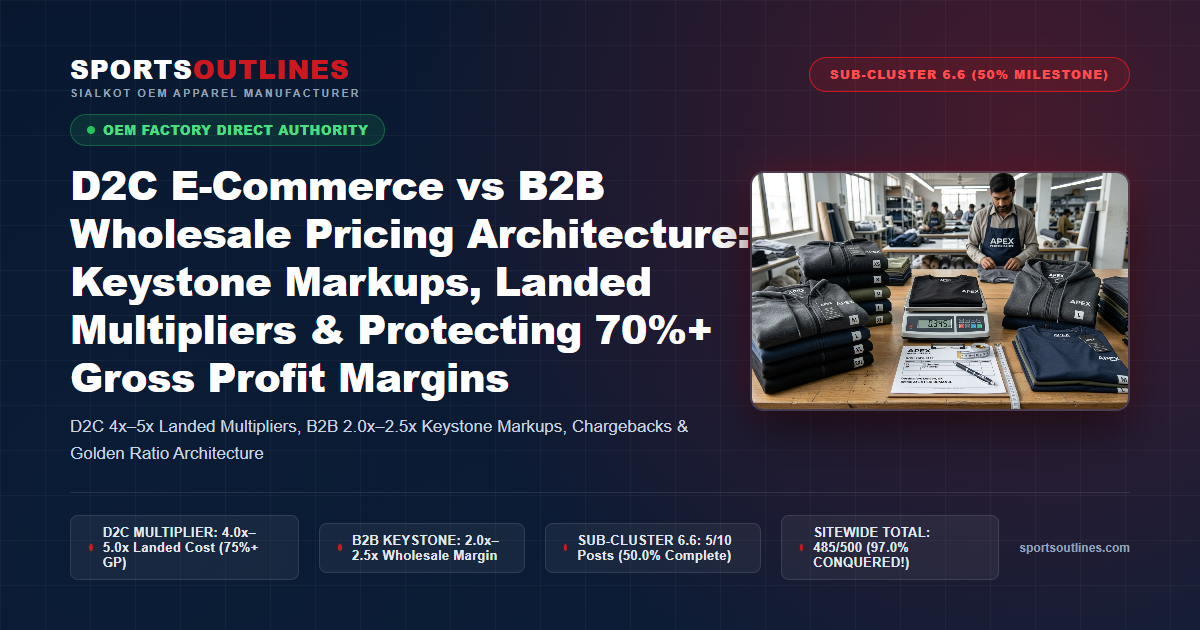
Welcome to the 50.0% Halfway Milestone of Sub-Cluster 6.6: Brand Launch Economics, Cashflow Modeling, Production Financing, Unit Economics & Margin Architecture! With the publication of this 485th master guide, Sports Outlines has conquered 97.0% of the entire 500-Post Topical Hegemony Architecture—leaving only 15 articles remaining to complete our historic sitewide roadmap. In the commercial apparel world, revenue is vanity, profit is sanity, but gross margin percentage is the supreme arbiter of enterprise survival. When emerging activewear and combat gear founders establish their retail pricing, they frequently commit catastrophic errors: setting direct-to-consumer (D2C) prices too low based on naive “cost-plus” formulas, failing to anticipate wholesale retail keystone splits, or underestimating customer acquisition costs (CAC) and seasonal discounting erosion. A brand operating with 50% gross margin will be completely crushed by digital ad auctions, payment fees, and return shipping. Sustainable apparel enterprises require an institutional pricing architecture built on 4x to 5x Landed Multipliers for D2C and Keystone Markups (2.0x–2.4x) for B2B wholesale. This guide provides the complete mathematical framework for engineering invincible margins using direct Sialkot manufacturing.
📐 Keystone Wholesale Mathematics
🛡️ 70%+ Gross Margin Fortress
⚡ Black Friday Discount Stress-Testing
1. The Margin Fortress: Gross Margin vs. Markup % and the 70% Floor Rule
In retail financial modeling, confusion between Markup Percentage and Gross Margin Percentage is a notorious founder mistake that leads to severe underpricing. Let us establish the definitive definitions:
Markup (%) = [(Retail Price − Landed Cost) / Landed Cost] × 100
Gross Margin Percentage Formula:
Gross Margin (%) = [(Retail Price − Landed Cost) / Retail Price] × 100
Example: Landed Cost = $20.00, Retail Price (MSRP) = $40.00:
• Markup = ($20 / $20) × 100 = 100% Markup (Traditional “Keystone”).
• Gross Margin = ($20 / $40) × 100 = 50% Gross Margin.
While a 100% markup sounds impressive to a novice entrepreneur, a 50% gross margin is catastrophic for modern direct-to-consumer athletic brands. In contemporary digital commerce, operating expenses consume the following percentages of retail revenue:
- Blended Customer Acquisition Cost (Paid Media Ads): 25% to 35% of gross revenue.
- Payment Gateway Processing (Shopify / Stripe): 2.9% + $0.30 (~3.2% of net ticket).
- 3PL Fulfillment, Pick/Pack & Outbound Shipping Subsidies: 8% to 12% of retail price.
- Customer Returns, Exchanges & Reverse Freight (Sportswear Avg 12%–18% return rate): 4% to 6% net drag.
- E-Commerce Software Overhead (Shopify Plus, Klaviyo, Gorgias, ERP): 3% to 5% of GMV.
If your gross margin is only 50%, these variable costs total 43% to 61% of your revenue, plunging your brand into immediate net cash burn on every sale. To achieve healthy net profitability (15% to 25% bottom-line net margin), your initial direct-to-consumer pricing must establish an unyielding Gross Margin Floor of 70% to 80%. This requires a retail price calculated as 3.3x to 5.0x your total landed cost.
Table 1: Institutional Margin vs. Markup Calibration Matrix
This table illustrates how landed cost multipliers translate into gross margins and allowable advertising acquisition thresholds.
2. Direct-to-Consumer (D2C) Pricing Architecture: The 4x–5x Landed Multiplier Rule
To implement the 4x–5x Landed Multiplier Rule, a founder must start with the true Fully Landed Cost (FLC) of the garment, not just the factory FOB quote. Fully Landed Cost represents:
Consider an oversized 460 GSM heavyweight French terry gym hoodie manufactured at Sports Outlines at our low-MOQ tier of 50 pieces:
- Factory FOB Cost: $22.50 per hoodie.
- Inbound Air Express DDP Freight (DHL Door-to-Door): $5.40 per hoodie.
- Total Fully Landed Cost (FLC): $27.90 per hoodie.
Applying the 4.0x multiplier yields a recommended retail price of: $27.90 × 4.0 = $111.60 (adjusted psychologically to $108.00 or $110.00 MSRP). At an MSRP of $108.00, your gross margin is ($108.00 − $27.90) / $108.00 = 74.2%.
This 74.2% gross margin creates a robust financial fortress. If your Meta customer acquisition cost is $28.00, shipping/fulfillment is $9.50, and credit card processing is $3.43, your total variable cost is $40.93. You retain $39.17 in net contribution cash (36.3% net margin) on every hoodie sold! Even if you run a 20% off promotional campaign ($86.40 retail), your gross margin remains 67.7%, keeping the transaction comfortably profitable.
Table 2: D2C Landed Cost Multipliers & Contribution Margins Across 5 Categories
This model details the fully landed cost, recommended D2C retail price, and net cash retained per garment across five core sportswear and fightwear pillars.
3. B2B Wholesale Pricing Architecture: Keystone Mathematics (50% Off MSRP)
When an apparel brand begins selling wholesale to commercial stockists—such as boutique fitness studios, martial arts academies, CrossFit boxes, or regional sporting goods retailers—the pricing structure must accommodate the retailer’s margin expectations. In retail commerce, the standard wholesale convention is Keystone Pricing:
Wholesale Price (WS) = Retail Price (MSRP) × 50%
Where:
• The retailer purchases the garment from your brand at the Wholesale Price ($50.00) and marks it up by 100% (2.0x keystone) to sell to consumers at MSRP ($100.00).
• The retailer captures a 50% gross margin to cover their physical commercial rent, sales staff, and store operations.
The Brand’s Wholesale Margin Requirement
If you sell a garment to a retailer at 50% off MSRP, how much gross profit does your brand retain? This is where low direct manufacturing costs in Sialkot become essential. To operate a healthy wholesale division, your Wholesale Gross Margin must remain ≥ 40% to 50%:
Using our $108.00 hoodie example (FLC = $27.90, Wholesale Price = $54.00):
Brand Wholesale Gross Profit = $54.00 − $27.90 = $26.10 per unit (48.3% Wholesale Gross Margin). Notice that because wholesale orders ship in bulk master cartons directly to the retailer’s facility, the brand pays $0 in consumer ad spend (CAC) and $0 in individual pick/pack fulfillment fees. A 48.3% wholesale margin on a 500-unit retail order delivers $13,050 in clean gross profit with zero digital advertising risk!
Table 3: The Complete Omnichannel Pricing Waterfall (Hoodie Case Study)
This waterfall table tracks the exact dollar flow from direct Sialkot factory cost through B2B wholesale and direct-to-consumer retail channels.
4. Promotional Stress-Testing: Protecting Net Margins During Black Friday / Cyber Monday (BFCM)
In modern athletic apparel retail, consumer purchasing is increasingly concentrated around major promotional events: Black Friday / Cyber Monday (BFCM), summer clearance drops, and anniversary sales. Brands that fail to model discount stress-testing find that high sales volume during November and December translates into disastrous financial losses.
When you offer a 30% sitewide discount, your revenue decreases by 30%, but your direct landed cost (FLC) and fulfillment fees remain 100% fixed. Table 4 stress-tests our $108.00 hoodie across four discount scenarios, demonstrating why maintaining a 74%+ base gross margin is mandatory for promotional survival.
Table 4: Promotional Discount Sensitivity Matrix (BFCM Stress-Testing)
This table tracks net cash retained per unit across four promotional pricing tiers, incorporating advertising customer acquisition costs and variable fulfillment.
Notice the vital takeaway: even at a massive 50% off clearance blowout, a brand utilizing our 4.0x pricing architecture clears its inventory at a modest net profit (+$2.74 per unit), completely avoiding capital-destroying clearance losses. If the brand had originally priced the hoodie at $65.00 (a naive 2.3x multiplier), a 30% discount would result in a devastating net loss of -$15.00 on every transaction.
5. Harmonizing Omnichannel Pricing: Preventing Channel Conflict Between Shopify & Gyms
As athletic and combat gear brands scale, they frequently sell simultaneously through three channels: their direct-to-consumer Shopify storefront, wholesale to affiliate gyms and martial arts academies, and through third-party retail marketplaces (e.g., Amazon, wholesale distributors). If pricing across these channels is not synchronized, the brand triggers severe Channel Conflict.
If an athlete sees your hoodie selling on your Shopify store for $68.00 while their local martial arts gym stocks it for $108.00, the gym owner feels betrayed and cancels future wholesale purchase orders. To maintain harmony, high-growth brands enforce strict Minimum Advertised Price (MAP) Policies:
- Strict MAP Policy Enforcement: Every wholesale retail contract includes a mandatory MAP clause requiring stockists to advertise garments at full MSRP ($108.00). Retailers are prohibited from discounting below MAP except during pre-approved seasonal windows.
- Exclusive Colorway Allocation: Prevent direct price comparison by allocating unique colorways to specific channels. Offer Black and Charcoal Heather exclusively on Shopify, while reserving Olive Green and Navy exclusively for wholesale gym partners.
- Bundled Wholesale Value Adds: Provide gym stockists with complimentary point-of-sale display fixtures, branded hangtag stickers, or gym-specific co-branded chest monograms to justify retail MSRP.
The Golden Ratio of Omnichannel Revenue: Balancing D2C vs. Wholesale GMV
Rather than treating D2C e-commerce and B2B wholesale as competing silos, elite sportswear enterprises operate with a deliberate 70/30 Omnichannel Golden Ratio: 70% of gross merchandise value generated through high-margin direct-to-consumer sales on Shopify, and 30% through steady B2B wholesale accounts with martial arts academies, CrossFit boxes, and boutique retailers.
This hybrid model creates mutual operational reinforcement. The 30% wholesale volume provides predictable baseline production batches that easily clear factory fabric knitting and dyeing minimums in Sialkot, unlocking volume tier discounts that lower unit FOB costs across your entire collection. Simultaneously, your high-margin D2C sales (generating 74%+ gross margin) provide the liquid cashflow required to finance digital customer acquisition, brand creative content, and rapid 7–10 day physical prototyping ($45–$85/pc). Calculating your blended portfolio margin ensures your overall enterprise remains resilient:
With a 66.4% blended gross margin and predictable wholesale purchase order cashflow, your brand achieves both high enterprise valuation multiples and exceptional operational liquidity.
Table 5: Omnichannel Distribution Rules & Channel Conflict Matrix
This matrix details pricing governance rules, margin targets, and inventory allocation strategies across the three primary distribution channels.
6. Global Multi-Currency Pricing Architecture: Tax-Inclusive Dynamics Across the US, UK, EU, Canada & Australia
A fatal pitfall when expanding an athletic apparel brand internationally is using a naive currency converter on your Shopify store without engineering local market pricing structures. In cross-border e-commerce, consumer tax expectations, import duties, and price psychological anchors vary dramatically across global territories:
- The United States (USD Market): Retail prices are displayed strictly exclusive of sales tax. A hoodie priced at $108.00 incurs state and local sales tax (typically 6% to 10%) calculated and added at final checkout. Import duties under US CBP Chapter 61 for cotton-rich fleece average 16.5%.
- The United Kingdom (GBP Market): By law under HMRC regulations, all retail prices must be displayed inclusive of 20% Value Added Tax (VAT). A British customer seeing a £95.00 price tag expects £95.00 to be their final charge. If you simply convert $108 USD to £85 GBP without backing out the 20% VAT (£14.17), your net business revenue is severely eroded! Fortunately, imports from Pakistan into the UK enter at 0.0% customs duty under the Developing Countries Trading Scheme (DCTS).
- The European Union (EUR Market): EU consumer protection laws mandate prices displayed inclusive of local VAT (ranging from 19% in Germany to 21% in Spain and the Netherlands). Like the UK, apparel manufactured in Sialkot, Pakistan enters the EU at 0.0% customs duty under the EU GSP+ Registered Exporter (REX) system, saving 12.0% in landed duty compared to Chinese or Vietnamese production.
- Australia (AUD Market): Australian consumer law mandates prices displayed inclusive of 10% Goods and Services Tax (GST). Import duties on activewear under the Australian Border Force (ABF) are capped at 5.0%, with a generous AUD $1,000 de minimis exemption on low-value air shipments.
- Canada (CAD Market): Canadian retail prices are displayed exclusive of GST/PST/HST (added at checkout). CBSA tariffs under the General Preferential Tariff (GPT) average 16.0% to 18.0% unless utilizing Section 321 split-routing or duty relief programs.
Table 6 models the institutional multi-currency pricing matrix for our flagship 460 GSM heavyweight hoodie, showing how to maintain a consistent 72% to 75% net gross margin across all five international jurisdictions.
Table 6: Global Multi-Currency Pricing & Tax Waterfall Matrix (Heavyweight Hoodie)
This matrix maps retail price tags, local tax deductions, net realized revenues, fully landed costs, and retained gross profits across the five major sportswear markets.
7. Partnering Direct with Sports Outlines: Protecting 70%+ Margins Through Factory Economics
In the final analysis, your brand’s pricing power and margin fortress depend entirely on the cost efficiency and precision of your manufacturing source. When you work with intermediaries, domestic screen printers, or brokers, their 40% markup inflates your landed cost and forces you to compromise your retail margins.
By establishing a direct factory relationship with Sports Outlines in Sialkot, Pakistan, you gain structural margin advantages that protect your business across all channels:
True Direct Open-Book FOB Pricing
Eliminate broker markups. We provide transparent line-by-line BOM pricing for fabric yarn, CMT labor, custom trims, and packaging, giving you the lowest possible baseline for your 4x–5x multiplier.
Agile 30–50 Piece Factory Low MOQs
Test your retail price points in the real market without risking tens of thousands of dollars. Validate consumer price elasticity, refine size grading, and scale up reorders deterministically.
Rapid 7–10 Day Prototyping ($45–$85/pc)
Receive master-crafted physical prototypes in 7 to 10 business days for a transparent, non-refundable fee of $45 to $85 per piece. Test hand-feel and retail drape on live athletic models before production.
Duty-Free Export Benefits (0.0% Tariff)
Export duty-free to European Union buyers under EU GSP+ (REX system) and the UK under DCTS, or enjoy competitive US CBP entry rates free from Chinese Section 301 punitive surcharges.
8. Frequently Asked Questions: Sportswear Pricing & Margin Strategy
Why is a 50% gross margin considered dangerous for a D2C sportswear brand?
While a 50% gross margin might suffice for a physical grocery store with low marketing overhead, e-commerce activewear brands face severe variable costs: Meta and TikTok customer acquisition costs (25%–35% of revenue), 3PL fulfillment and shipping ($7–$12/order), payment gateway fees (3%), and return reverse logistics (4%–6%). A 50% gross margin leaves zero cash to cover these expenses, resulting in immediate net losses on paid advertising.
What is the difference between Keystone markup and Landed Multiplier?
A Landed Multiplier is the ratio of your retail price to your total fully landed manufacturing and shipping cost (e.g., $108 MSRP / $27 Landed = 4.0x multiplier). Keystone markup is the traditional wholesale pricing standard where a retailer marks up their wholesale purchase price by exactly 100% (2.0x keystone) to set their retail price, capturing a 50% retail gross margin.
Why do physical prototypes carry a non-refundable $45–$85 fee?
In bulk manufacturing, cutting and sewing operations are amortized across hundreds of pieces. A single physical prototype requires an expert pattern engineer, single-garment manual knife cutting, dedicated setup of multiple specialized sewing machines (flatlock, overlock, lockstitch), ink mixing, and individual tech pack translation. The $45 to $85 fee covers these dedicated craftsmanship hours on a fast 7–10 day turnaround.
How should I price custom apparel for affiliate gyms and academies?
Price affiliate gym merchandise using a modified keystone split: sell to the gym at 45% to 50% of your retail MSRP, allowing the gym owner to make a healthy 40% to 50% profit margin when selling to their members. Because your Sialkot factory FOB cost represents only 20% to 25% of retail MSRP, your brand retains a 45%+ gross profit margin on wholesale gym orders with zero customer acquisition ad spend.
How can I protect my brand value if competitors sell cheaper activewear?
Compete on engineering substance, not price discounting. Budget activewear brands utilize generic 180 GSM single jersey or cheap poly-spandex that pills after three washes. By utilizing premium Sialkot manufacturing (460 GSM combed cotton fleece, ISO 607 6-needle flatlocking, platinum-cured silicone waistbands, high-density 3D silicone branding), your garments deliver immediate tactile luxury that commands 4x–5x retail pricing and builds fierce customer loyalty.
Build an Invincible Pricing Architecture with Direct Sialkot Manufacturing
Protect your gross profit margins from day one. Partner directly with Sports Outlines in Sialkot, Pakistan. Access open-book FOB costing, agile 30–50 piece factory MOQs, rapid 7–10 day physical prototyping ($45–$85/pc), and premium cut-and-sew craftsmanship engineered to support 70%+ retail gross margins.