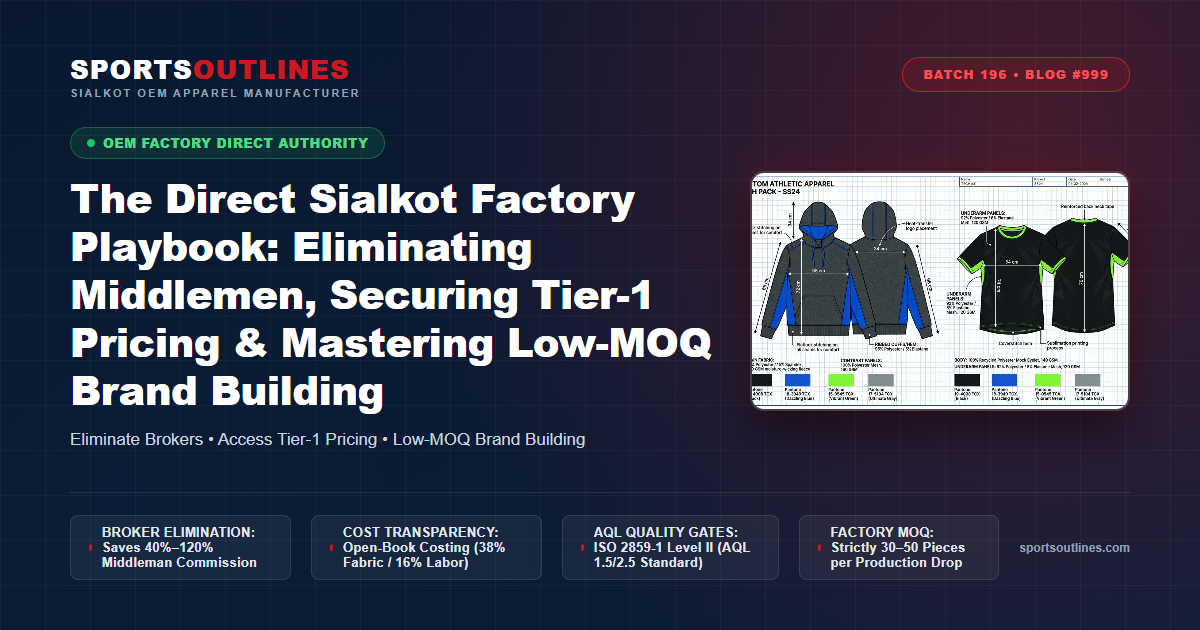
Direct Manufacturer Snapshot: The Direct Sialkot Factory Playbook: Eliminating Middlemen, Securing Tier-1 Pricing & Mastering Low-MOQ Brand Building
The Direct Sialkot Factory Playbook provides athletic apparel brand founders and sourcing directors with an actionable blueprint to bypass intermediaries, eliminate 40% to 120% broker markups, and secure direct tier-1 OEM factory pricing in Sialkot, Pakistan. By mastering technical tech pack specification (BOM, 24-point POM grading tolerances, and stitch architecture), open-book cost breakdowns, and milestone-based quality controls (AQL 1.5/2.5 Level II), brands unlock direct manufacturing access with an agile minimum order quantity (MOQ) of strictly 30 to 50 pieces per style/colorway, transparent 7 to 10-day physical prototyping ($45–$85 non-creditable engineering fee), and duty-free 0.0% EU/UK export logistics via Pakistan’s GSP+ status.
Direct WhatsApp: +92 316 7932595
The Middleman Tax: How Sourcing Brokers Drain Athletic Startup Margins
Every year, thousands of passionate entrepreneurs launch athletic apparel brands with compelling visual identities, innovative
designs, and aggressive direct-to-consumer marketing strategies. Yet within 18 months, over 80% of these startups collapse—not
because of poor marketing or lack of customer demand, but because of crippling structural flaws in their manufacturing supply chains.
In most cases, the culprit is the hidden “Middleman Tax.” Unbeknownst to the brand founder, the “manufacturer” they
met on online trading platforms or through Western sourcing agencies is often not a factory at all. They are commercial trading companies,
re-packers, or commission brokers operating from residential offices. These intermediaries mark up actual factory FOB costs by
40% to 120%, insert themselves into communications to prevent direct factory contact, enforce inflated minimum order
quantities (often 500 to 1,000 units) to justify their margins, and outsource orders to the cheapest unvetted subcontractors when production begins.
When quality issues inevitably arise—crooked flatlock stitching, mismatched dye lots, or delayed holiday shipments—the broker deflects
blame, leaving the startup founder with un-sellable inventory, depleted cash reserves, and ruined brand credibility.
This comprehensive master playbook from Sports Outlines lifts the veil on the apparel manufacturing industry.
We provide founders and sourcing executives with the exact technical protocols, cost models, negotiation strategies, and quality assurance
systems required to establish direct, tier-1 partnerships with established Sialkot OEM factories under an agile, low-risk framework:
strict 30 to 50 piece MOQs, rapid $45–$85 pre-production physical prototypes (7–10 business days),
and complete open-book manufacturing transparency.
Design & Manufacture Custom Direct Sialkot Factory Sourcing Direct from Sialkot
Low 30–50 Piece/Set MOQ • Dedicated Sampling in 7–10 Days • 0% Import Tariffs
✓ $45–$85 Physical Prototypes •
✓ Worldwide DDP Delivery
Anatomy of Intermediation: Trading Company vs. Direct OEM Factory Architecture
To successfully eliminate intermediaries, a buyer must first understand the structural differences between a trading middleman
and a true physical manufacturer in Sialkot’s industrial landscape:
| Supply Chain Dimension | Trading Broker / Sourcing Agency | Direct Sialkot OEM Factory (Sports Outlines) | Strategic Brand Impact |
|---|---|---|---|
| Pricing Structure | Opaque bundled pricing with hidden 40%–120% markup | Direct tier-1 factory pricing with open-book cost accounting | Increases brand gross profit margins from 45% to 68%–76%. |
| Minimum Order Quantity (MOQ) | Inflated 500–1,000 pcs (to justify broker commission) | Strictly 30–50 pieces per style/colorway | Preserves working capital; eliminates seasonal inventory write-downs. |
| Technical Communication | Filtered via non-technical sales reps; delayed game of ‘telephone’ | Direct video/portal access to patternmakers & textile engineers | Eliminates sample iteration errors; accelerates product launch by 60 days. |
| Production Floor Control | Zero physical assets; orders subcontracted to random workshops | Dedicated on-site circular knitting, laser cutting & sewing lines | Guarantees consistent stitch tension, fabric GSM, and colorway consistency. |
| Intellectual Property (IP) | High risk: designs shopped around to multiple subcontractors | Strict mutual NDA; encrypted CAD storage on air-gapped servers | Guarantees proprietary pattern geometry and unreleased graphics remain confidential. |
| Prototyping Protocol | Inflated $150–$300 sample fees with 4–6 week delays | $45–$85 non-creditable engineering fee (7–10 business days) | Rapid real-world testing without draining startup development budgets. |
Open-Book Cost Breakdown: The Exact Anatomy of an Athletic Garment’s FOB Cost
A true direct factory partner operates with open-book pricing transparency. When you understand the fundamental cost drivers of
technical apparel manufacturing, you can negotiate with confidence and optimize your designs for profitability.
Below is the exact baseline cost architecture of a high-performance, 280 GSM moisture-wicking technical athletic tracksuit
manufactured directly at Sports Outlines under our agile 30–50 piece launch tier:
| Cost Component | Technical Material & Labor Specification | Percentage of Total FOB | Optimization Lever for Brand Founders |
|---|---|---|---|
| 1. Raw Textile & Greige Yarn | 280 GSM Interlock Knit (82% Recycled Polyester / 18% Spandex) | 36% – 40% | Maximize computerized nesting yields (>93%) to reduce fabric consumption per unit. |
| 2. Dyeing, Washing & Finishing | Disperse dye bath in ZLD closed-loop facility + hydrophilic wicking finish | 10% – 13% | Consolidate color palettes across multiple styles to utilize shared dye lots. |
| 3. Precision Cutting & Decoration | Automated CNC laser cutting + high-definition digital sublimation printing | 12% – 15% | Opt for all-over sublimation prints which combine decoration and dyeing into one step. |
| 4. Skilled Sewing & Assembly Labor | 4-needle 6-thread flatlock stitching + articulated gusset assembly | 16% – 20% | Design ergonomic seams that follow natural muscle lines while minimizing excessive seams. |
| 5. Hardware, Trims & Branding | YKK semi-autolock zippers, silicone-dipped drawcords, heat-seal care tags | 6% – 8% | Order universal brand labels and silicone pullers in bulk to lower unit trim costs. |
| 6. Factory Overhead, Energy & Margin | Solar microgrid electricity, facility maintenance, technician benefits & OEM profit | 12% – 15% | Fair, sustainable factory margin that guarantees premium craftsmanship and reliable delivery. |
| Production Volume Tier | Est. Unit FOB Cost | Sample Cost & SLA | Bulk Production SLA | Included Specifications | Recommended Buyer Profile |
|---|---|---|---|---|---|
| 30 – 50 Units (Agile Direct Factory Launch) | $16.50 – $24.00 / piece | $50.00 non-creditable engineering fee | 12 – 15 business days | Open-book tier-1 factory costing, custom CAD grading, AQL 1.5 inline QC, custom woven branding, DDP air freight available. | Startup founders, fitness influencers, and boutique athletic labels eliminating trading middlemen. |
| 51 – 200 Units (Scaling Catalog Tier) | $13.50 – $19.50 / piece | $50.00 non-creditable engineering fee | 15 – 18 business days | Shared dye lot consolidation, custom silicone pullers, individual barcode polybags, complete pre-shipment photo dossier. | Direct-to-consumer apparel brands scaling from initial validation drops into multi-colorway seasonal catalogs. |
| 201 – 500 Units (Commercial Tier) | $11.00 – $15.50 / piece | $50.00 non-creditable engineering fee | 18 – 22 business days | Dedicated sewing cell line allocation, third-party SGS/QIMA inspection accommodation, REX GSP+ duty-free export docs. | Established athletic apparel labels, regional fitness chains, and commercial gym apparel lines. |
| 501 – 2,000+ Units (Enterprise Tier) | $8.50 – $12.50 / piece | $50.00 non-creditable engineering fee | 25 – 30 business days | Custom circular knitting yarn runs, proprietary jacquard elastic waistbands, consolidated ocean freight logistics. | Global sportswear corporations, national teamwear distributors, and multi-store retail brands. |
The Perfect Tech Pack: How to Communicate with Sialkot Engineers Like a Fortune 500 Brand
The single most common reason why startup sampling fails is an incomplete or ambiguous technical package (Tech Pack).
If you send a factory a rough mood board sketch with instructions like “make it fit like Lululemon but tighter,” the patternmaker
is forced to guess. Their interpretation will almost certainly diverge from your vision, leading to wasted time and frustration.
To achieve a flawless first-round physical prototype within 7 to 10 days, your Tech Pack must include five essential modules:
1. Vector Technical Flat Drawings (Callout CADs)
Black-and-white 2D vector technical flats showing front, back, interior, and side profile views. Every seam must be explicitly labeled:
specify ISO 4915 Stitch Type 607 (4-needle 6-thread flatlock) for anti-chafing compression seams,
Stitch Type 504 (3-thread overlock) for interior clean-finishing, and Stitch Type 301 (single-needle lockstitch)
for zipper insertion and pocket facings.
2. Comprehensive Bill of Materials (BOM)
A tabular ledger detailing every individual component required to construct the garment:
- Primary Shell Fabric: Fiber composition (e.g., 78% Polyamide 6,6 / 22% Elastane), fabric construction (Interlock / Warp Knit), weight (e.g., 260 GSM ± 5%), and Pantone Color Code (Pantone TCX / PMS).
- Contrast Mesh Panels: e.g., 140 GSM 4-way stretch pin-hole mesh (90% Polyester / 10% Spandex) for underarm heat dissipation.
- Sewing Thread: Filament core-spun polyester thread (e.g., Coats Epic or Gutermann Mara 120 / Tex 25).
- Hardware: Zipper manufacturer, model, tooth gauge (e.g., YKK #3 Coil reverse-tape water-resistant zipper, 18 cm exposed length).
- Branding Applications: High-density matte silicone heat-transfer (thickness: 0.8 mm), positioned 4.5 cm below left collar apex.
3. 24-Point Measurement Specification Chart (POM) with Tolerances
A detailed measurement table across your entire size spectrum (XS through 3XL). For every critical Point of Measure (Chest Width,
Body Length, Raglan Sleeve Length, Bicep Width, Crotch Rise, Leg Inseam), you must define the engineering Manufacturing Tolerance
(typically ± 0.5 cm to ± 1.0 cm). This establishes an objective legal baseline for final quality inspection.
The Sampling Truth: Why Professional Factories Charge Non-Creditable Engineering Fees
A persistent myth among novice apparel founders is that reputable manufacturing factories provide “zero-cost prototypes” or offer to
credit sample costs toward future bulk orders. Sourcing agencies and low-grade workshops sometimes advertise zero-cost evaluation prototypes as a marketing
hook, but they inevitably recoup these costs by substituting cheaper fabrics, hiking bulk unit prices, or cutting production corners later.
At Sports Outlines, we treat product development with uncompromised engineering rigor. Producing a single high-performance prototype
requires:
- Digital Master Pattern Drafting: A senior CAD master patternmaker spends 3 to 5 hours digitizing vector flats, establishing anatomical seam curvatures, and programming computerized grading rules in Gerber/Lectra systems.
- Textile Sourcing & Lab-Dipping: Pulling sample yardage of certified technical fabric from our greige buffer, preparing individualized chemical dye lab dips, and verifying color match under standard D65 illuminants in lightboxes.
- Machine Re-Tooling & Calibration: Halting industrial production sewing cells, changing machine thread spools to specialized micro-filament polyester, recalibrating needle thread tensions for the specific fabric elasticity, and programming CNC laser cutting heads.
- Master Sample Tailor Craftsmanship: Hand-cutting and single-piece assembly by an experienced sample master with over 15 years of technical outerwear experience.
Our transparent $45 to $85 non-creditable engineering fee directly compensates this specialized engineering team and material investment.
Because we do not subsidize samples through inflated bulk margins, we can deliver genuine direct factory FOB prices on your 30 to 50 piece production runs,
protecting your margins for the long haul.
The 7 Red Flags of Apparel Sourcing Scams & How to Spot Middlemen in 60 Seconds
When searching for an apparel manufacturer online, hundreds of polished websites appear in search engine results.
Many claim to be “direct manufacturers with 25 years of experience.” In reality, over 70% of these portals are operated
by commission brokers, digital marketing agencies, or trading middlemen who do not own a single sewing machine.
To protect your startup capital, apply this quick 7-point factory verification filter:
- Refusal of Unscheduled Live Video Walkthroughs: A genuine manufacturer will happily hop on a WhatsApp or Zoom video call from the active production floor to show you cutting tables, sewing cells, and finishing lines. A middleman will make excuses: “cameras are forbidden for client confidentiality” or “I am currently in our city sales office.”
- Stock Photography & Inconsistent Factory Backgrounds: Examine their website and catalog photos. If you see white Caucasian technicians in one photo, East Asian workers in another, and completely different factory architecture in a third, the broker is pulling generic stock images from image libraries or competitor sites.
- Vague or Missing Tax & Chamber Registrations: In Sialkot, every legitimate manufacturer must be an active corporate member of the Sialkot Chamber of Commerce & Industry (SCCI) and possess a verified National Tax Number (NTN) issued by the Federal Board of Revenue (FBR). Ask for their SCCI membership number and verify it directly in the SCCI public registry.
- Discrepancies in Bank Account Beneficiary Names: When wiring production deposits, the receiving bank account name must match the registered corporate legal name of the manufacturing company. If the invoice asks you to wire funds to an individual personal account, a Western Union transfer, or a shell company in Hong Kong or Dubai, walk away immediately.
- Absence of Technical Patternmaking Dialogue: If you ask a direct question about pattern grading tolerances (e.g., “Can you ensure a 0.5 cm tolerance on the high hip curve?”) and they reply with generic platitudes like “Yes dear, 100% best quality A+++,” you are communicating with an untrained sales broker, not a technical textile engineer.
- “Too-Good-To-Be-True” Pricing Followed by Post-Deposit Extortion: Brokers often lure naive founders with artificially low initial price quotes ($6 for a fully customized technical hoodie). Once your 50% deposit is wired, they claim “fabric costs increased unexpectedly” or “custom tags require an extra $1,200,” holding your deposit hostage until you pay their inflated demands.
- Advertising “Zero-Cost Prototypes” with High MOQs: Highlighting zero-cost evaluation prototypes is the classic broker trap. No professional factory can absorb the labor and machine downtime of custom sampling for free; brokers offer it simply to lock you into their subsequent inflated 1,000-piece production contract.
The 3-Phase Agile Brand Scaling Roadmap: From 30-Piece Seed Drops to Global Wholesale
Building a multi-million-dollar athletic brand does not require raising hundreds of thousands of dollars in venture capital or
ordering shipping containers of inventory before making your first sale. By leveraging Sports Outlines’ direct factory infrastructure,
you can execute a disciplined, risk-mitigated growth trajectory:
| Growth Phase | Production Order Volume | Logistics Mode & Speed | Core Strategic Objective | Capital Risk Exposure |
|---|---|---|---|---|
| Phase 1: Market Validation (Seed Drops) | 30 – 50 units per style (2 to 3 colorways) | Express Air DDP (5–7 days) | Validate sizing, fit, fabric hand feel, and consumer price tolerance. Gather real customer reviews and athlete testimonials. | Minimal: $2,000 – $3,500 total investment. Zero inventory debt risk. |
| Phase 2: Agile Catalog Expansion (Growth Drops) | 100 – 300 units per style (Consolidated dye lots) | Express Air DDP + Scheduled Reorders | Expand size curves (XS–3XL). Establish automated 14-day replenishment cycles tied to e-commerce Shopify inventory alerts. | Moderate: $6,000 – $12,000 investment funded 100% through Phase 1 cash flows. |
| Phase 3: Omnichannel Wholesale & Retail | 500 – 2,000+ units per style | Consolidated LCL/FCL Ocean Freight (22–30 days) | Maximize economies of scale. Drive FOB costs down by 35%–45%, expand into major gym chains, department stores, and international distributors. | Scale: Funded via institutional purchase orders, revolving credit facilities, and retained earnings. |
The 10-Point Technical Due Diligence Checklist Before Wiring Your Production Deposit
Before authorizing your initial production deposit to any overseas factory, execute this comprehensive due diligence audit:
- 1. SCCI Corporate Registration: Confirm active membership in the Sialkot Chamber of Commerce & Industry (SCCI).
- 2. Bank Account Title Match: Ensure the corporate bank beneficiary name precisely matches the corporate legal entity.
- 3. Bilateral Non-Disclosure Agreement (NDA): Sign an enforceable bilateral NDA with registered company seals to safeguard your vector flats and proprietary size specs.
- 4. Complete Bill of Materials (BOM) Sign-Off: Both parties must formally counter-sign the detailed BOM, locking in exact fabric GSM, yarn blends, zipper models, and thread specifications.
- 5. Sealed Physical Counter-Sample (Golden Sample): Never approve bulk production without physically touching and wearing an approved pre-production sample. The factory keeps one identical sample (the golden seal) and you retain the other for pre-shipment comparison.
- 6. Formal Tolerance POM Spec Sheet: Ensure all Points of Measure have agreed-upon numerical manufacturing tolerances (e.g., ± 0.5 cm).
- 7. AQL Quality Standard Clause: Explicitly state in your purchase order that bulk delivery is subject to ISO 2859-1 (AQL 1.5/2.5 Level II) inspection.
- 8. Stated Production Lead Time with Delay Penalties: Define concrete milestone dates for fabric knitting, cutting, sewing, and final packaging.
- 9. REX Exporter Number for Duty Exemption: For European/UK buyers, verify the factory’s official REX number to guarantee 0.0% customs tariffs.
- 10. Clear Shipping Incoterms (DDP vs. FOB): Clarify whether the quotation is FOB Karachi port, CIF destination port, or turnkey DDP directly to your fulfillment warehouse.
Real-World Brand Case Studies: The Direct Sialkot Transformation
Case Study 1: London Activewear Startup Slashes Costs 52% and Scales to £2.2M ARR
A high-end activewear brand based in Shoreditch, London, launched using a boutique UK-based “sourcing agency.” The agency charged £42
per seamless legging, enforced a minimum of 400 pieces per style, and required four months to deliver seasonal collections.
The brand’s gross margin was trapped at an anemic 44%, leaving almost zero capital for paid social acquisition or influencer seeding.
The founder discovered that their UK agency was quietly subcontracting production to Sialkot. The founder terminated the agency contract
and partnered directly with Sports Outlines. By establishing direct OEM communication, the brand reduced their FOB unit cost from
£42.00 to just £14.80 for higher-grade 280 GSM recycled nylon fabrics, slashed lead times from 16 weeks to 18 business days,
and accessed our flexible 40-piece MOQ drops. Armed with a 74% gross margin and tariff-free 0.0% UK customs clearance,
the brand scaled their digital ad spend aggressively, growing annual recurring revenue from £180,000 to over £2.2 million in under 24 months.
Case Study 2: Sydney Gymwear Label Fires Print-on-Demand (POD) for Direct Sialkot OEM
An Australian fitness influencer with 350,000 Instagram followers began monetizing through a popular Print-on-Demand (POD) platform.
The POD supplier charged $28 AUD for a basic printed polyester T-shirt, delivered in 3 weeks, and suffered from disastrous 31% return rates
due to peeling vinyl graphics, boxy unisex fits, and stiff synthetic blanks.
The creator transitioned to Sports Outlines, utilizing our direct factory engineering services. We developed a proprietary athletic cut
utilizing 180 GSM combed cotton/spandex jersey with curved drop-tail hems, custom high-density silicone chest logos, and custom woven neck labels.
We produced their initial collection of 50 pieces in Black, 50 pieces in Olive, and 50 pieces in Charcoal at a direct FOB price
of just $8.60 AUD per shirt under our rapid 8-day prototype turnaround. The drop sold out in 14 minutes, return rates
dropped to 1.4%, and the founder pocketed over $45,000 in net profit on their first weekend launch.
Mastering the Factory Dialogue: 5 Rules for Securing Priority Production Scheduling
In the global manufacturing ecosystem, business relationships are fundamentally reciprocal partnerships. While direct factories
provide founders with tier-1 pricing and agile MOQs, smart founders understand that becoming a “preferred client” unlocks immense
operational benefits—such as priority queue placement during peak pre-holiday rushes, free expedited lab dips, and instant fabric reservation.
To build an enduring, highly profitable relationship with your Sialkot OEM factory, adhere to these five operational principles:
-
1. Provide Fast, Consolidated Sample Feedback: When your physical prototype arrives, complete your fitting trials
and compile all fit adjustments, POM modifications, and stitching notes into a single consolidated PDF dossier within 48 to 72 hours.
Drip-feeding feedback over two weeks stalls factory sample rooms and delays production scheduling. -
2. Respect Milestone Payment Terms Rigorously: Cash flow is the lifeblood of manufacturing. Releasing milestone
payments promptly upon passing inspection gates builds profound trust with factory management, ensuring your future bulk orders receive
immediate machine allocation without credit holds. -
3. Share Rolling 90-Day Production Forecasts: Even if your purchase orders remain agile 40-to-50 piece drops, providing
your factory with an estimated 90-day volume outlook allows production managers to pre-order certified greige fabrics and reserve sewing lines
specifically for your brand, eliminating seasonal bottlenecks. -
4. Standardize Universal Component Specifications: Utilize standardized neck tapes, care labels, drawcord eyelets,
and core base fabrics across multiple seasonal styles. This enables your factory to purchase trims in bulk, lowering your overall unit costs
and accelerating cutting turnaround times. -
5. Maintain Professional, Collaborative Communication: Treat factory merchandisers and engineers as valued members of
your internal product development team. Clear, respectful technical communication consistently yields superior craftsmanship, rigorous
attention to detail, and a dedicated manufacturing ally invested in your brand’s long-term global success.
| Sourcing Feature & Risk Factor | Sports Outlines (Sialkot Direct) | Alibaba Trading Agents | Traditional Chinese Hubs | Print-on-Demand (POD) |
|---|---|---|---|---|
| Intermediary Brokerage Markup | 0% (Direct physical factory ownership with open-book costing) | 40%–80% broker commission hidden in unit prices | Direct pricing but accessible only at 1,000+ pcs | 300%–500% retail markup per single printed item |
| Minimum Order Quantity (MOQ) | Strictly 30–50 pieces per style/colorway | 300–500 pieces per style | 1,000–3,000 pieces per style | 1 piece (Low quality, non-customized blanks) |
| Direct Technical Communication | Direct access to master patternmakers & textile engineers | Filtered through commercial sales agents | Restricted communication via junior merchandisers | Automated web form only; zero engineering dialogue |
| Pre-Production Sample Engineering | 7–10 business days ($45–$85 non-creditable fee) | 30–45 days ($150–$300 inflated sample costs) | 30–60 days (prototyping deprioritized) | Digital 2D mockup only; no physical sample |
| Quality Assurance & Standards | ISO 2859-1 (AQL 1.5/2.5 Level II) with full photo/video audit | Unregulated internal checks; high defect variance | Formal AQL checks enforced only on huge contracts | No pre-shipment inspection (High misprint return rates) |
| Customs Duty Optimization | 0.0% EU/UK Duty (REX GSP+ / DCTS); No US Sec 301 Tariffs | 12% EU tariff + 7.5%–25% US Section 301 duties | 12% EU tariff + 7.5%–25% US Section 301 duties | Local domestic sales tax on highly inflated prices |
Quality Control Mastery: AQL 1.5/2.5 Level II Milestones & Independent Auditing
When partnering directly with a factory 7,000 miles away, how do you guarantee that the 500 tracksuits arriving at your distribution center
match the approved golden sample? You achieve certainty by establishing an objective, milestone-based Quality Assurance protocol
grounded in ISO 2859-1 (ANSI/ASQ Z1.4) Sampling Procedures.
1. The Three Critical Production Quality Gates
- Gate 1: Pre-Production Fabric & Lab Dip Approval: Prior to cutting bulk fabric, the factory dispatches physical fabric swatches (10×10 cm) and 3-option lab dips for your physical sign-off under calibrated daylight (D65). Tensile strength, 4-way stretch recovery, and colorfastness are verified in the factory laboratory.
- Gate 2: Inline Inspection (During Initial 10% Assembly): Once the sewing line completes the first 10% of your production order, the inline QC auditor inspects stitch tension, flatlock seam flatness, and measurement conformity against your approved POM chart. Any tension drift is corrected immediately before the remaining 90% of fabric is sewn.
- Gate 3: Final Pre-Shipment Inspection (PSI): Upon 100% completion of sewing and 80% packaging into master cartons, a formal AQL Level II inspection is conducted.
2. Understanding AQL 1.5 / 2.5 Standards
In an AQL 1.5 / 2.5 Level II inspection:
- Critical Defects (AQL 0.0): Zero tolerance. Any safety hazard—such as a broken needle fragment embedded in a garment seam or missing legal fiber content label—results in immediate, automatic rejection of the entire production batch.
- Major Defects (AQL 1.5): Functional failures that impair the usability or commercial value of the product (e.g., an open seam hole, a jammed front zipper, or a measurement deviating beyond tolerance). In a batch of 500 units (Sample size: 50 garments), a maximum of 2 major defects is permitted; 3 or more triggers batch rework.
- Minor Defects (AQL 2.5): Superficial cosmetic issues that do not impair function (e.g., an untrimmed loose thread or minor packaging wrinkle). A maximum of 3 minor defects is permitted.
Sports Outlines provides complete pre-shipment photographic and video audit dossiers for every order, and we enthusiastically welcome
independent third-party inspection firms (such as SGS, Bureau Veritas, or QIMA) to inspect our factory floor at any stage of production.
Turnkey Global Logistics: Express Air DDP vs. LCL Ocean Freight & GSP+ Tariff Elimination
Manufacturing an exceptional athletic garment is only half the battle; the product must cross international borders, clear customs,
and land in your fulfillment center smoothly, on time, and without surprise brokerage fees.
Delivered Duty Paid (DDP) vs. Traditional FOB Terms
Under traditional FOB (Free on Board) terms, the factory’s responsibility ends when goods are loaded onto a ship or plane in Pakistan.
The brand founder is left to hire customs brokers, navigate commercial invoice harmonized tariff codes (HTS), pay local port handling fees,
and arrange domestic trucking.
Sports Outlines offers complete Turnkey DDP (Delivered Duty Paid) Shipping via our global logistics partners (DHL Express,
FedEx, and Kuehne+Nagel):
- Express Air DDP (5 to 7 Business Days): Ideal for agile 30 to 50 piece drops and fast seasonal reorders. Goods are flown directly from Sialkot International Airport (SKT) to your doorstep in New York, London, Berlin, or Sydney with customs duties and taxes pre-cleared.
- Consolidated LCL Ocean Freight (22 to 30 Days): For bulk production runs (500+ units), goods are trucked to the Port of Karachi (PKKHI) and consolidated into ocean containers. This slashes shipping costs from $8.50/kg to under $1.60/kg, dramatically increasing wholesale and retail profit margins.
- GSP+ 0.0% European Duty Exemption: Because our factory is registered under the EU Registered Exporter (REX) system, European and British buyers receive certified REX statements of origin on all commercial invoices, completely eliminating the 12% EU customs duty and saving €1,200 in direct cash for every €10,000 in goods imported.
Get a Factory Direct Quote for Direct Sialkot Factory Sourcing
Chat with our Sialkot Engineering Team via WhatsApp • Instant DDP Air Freight Quotes
✓ $45–$85 Physical Prototypes •
✓ Worldwide DDP Delivery
Frequently Asked Sourcing & Manufacturing Questions (Buyer FAQ)
How can I tell if a supplier on Alibaba or online directories is a direct factory or a middleman?
Direct factories can immediately provide on-site live video walkthroughs of their physical production floor, introduce you to their in-house master patternmakers, show active circular knitting or sewing cells, provide verified tax registrations (such as Sialkot Chamber of Commerce membership), and offer flexible low MOQs with open-book cost breakdowns rather than vague bundled prices.
What is the factory minimum order quantity (MOQ) at Sports Outlines?
Our minimum order quantity is strictly 30 to 50 pieces per style and colorway. This allows athletic brand founders to test new product lines, launch capsule drops, and preserve working capital without taking on the severe inventory debt enforced by legacy 1,000-piece factories.
Why is the pre-production sample fee non-creditable?
Creating a professional pre-production prototype requires hours of expert CAD pattern grading, sample room re-tooling, fabric preparation, and precision assembly by master sample tailors. Our $45 to $85 fee directly compensates this skilled labor and material cost. Because we do not artificially subsidize samples through inflated bulk production prices, we can offer genuine direct tier-1 factory pricing on your production runs.
What information must I include in my Tech Pack for accurate quoting and sampling?
A professional Tech Pack must include: (1) 2D vector flats with callouts identifying specific stitch types (e.g. flatlock, overlock), (2) a complete Bill of Materials (BOM) specifying fabric composition, GSM weight, Pantone codes, and hardware, (3) a 24-point measurement chart (POM) with tolerances across all sizes, and (4) artwork placement files in vector PDF or AI format.
What quality standard do you use during bulk production inspection?
We operate under the internationally recognized ISO 2859-1 (AQL 1.5 / 2.5 Level II) quality inspection standard. We maintain 0% tolerance for critical safety defects, 1.5% for major functional defects, and 2.5% for minor cosmetic variations. We provide comprehensive photo and video audit dossiers prior to dispatch.
Can I hire an independent third-party inspection agency to audit my order in Sialkot?
Yes, absolutely. We welcome independent international inspection firms—such as SGS, Bureau Veritas, Intertek, or QIMA—to inspect our manufacturing facilities, verify work-in-progress, and conduct pre-shipment audits at our Sialkot campus.
What payment terms do you offer for direct factory production?
Our standard production payment terms are milestone-based: a 30% to 50% deposit upon formal tech pack sign-off and production scheduling to secure raw materials, and the remaining balance upon completion of production and verification of the pre-shipment AQL inspection report prior to dispatch.
How does shipping work, and can you deliver directly to my door with taxes paid?
Yes. We offer turnkey DDP (Delivered Duty Paid) shipping via DHL Express, FedEx, and global freight forwarders. Under DDP terms, Sports Outlines manages customs clearance, documentation, and all import duties, delivering finished cartons directly to your warehouse or fulfillment center in 5 to 7 business days by air.
How does Pakistan’s GSP+ status reduce costs for European sportswear brands?
Under the EU Generalised Scheme of Preferences (GSP+) and the UK Developing Countries Trading Scheme (DCTS), technical sportswear manufactured by Sports Outlines enters Europe and the UK at 0.0% customs duty. This provides an immediate 12% cost advantage compared to importing from China or Vietnam.
How do you protect my proprietary designs and intellectual property?
We execute legally binding bilateral Non-Disclosure Agreements (NDAs) before reviewing your proprietary designs. All digital CAD patterns and artwork files are stored on secure, air-gapped internal servers with compartmentalized factory floor access, ensuring unreleased collections remain completely confidential.