
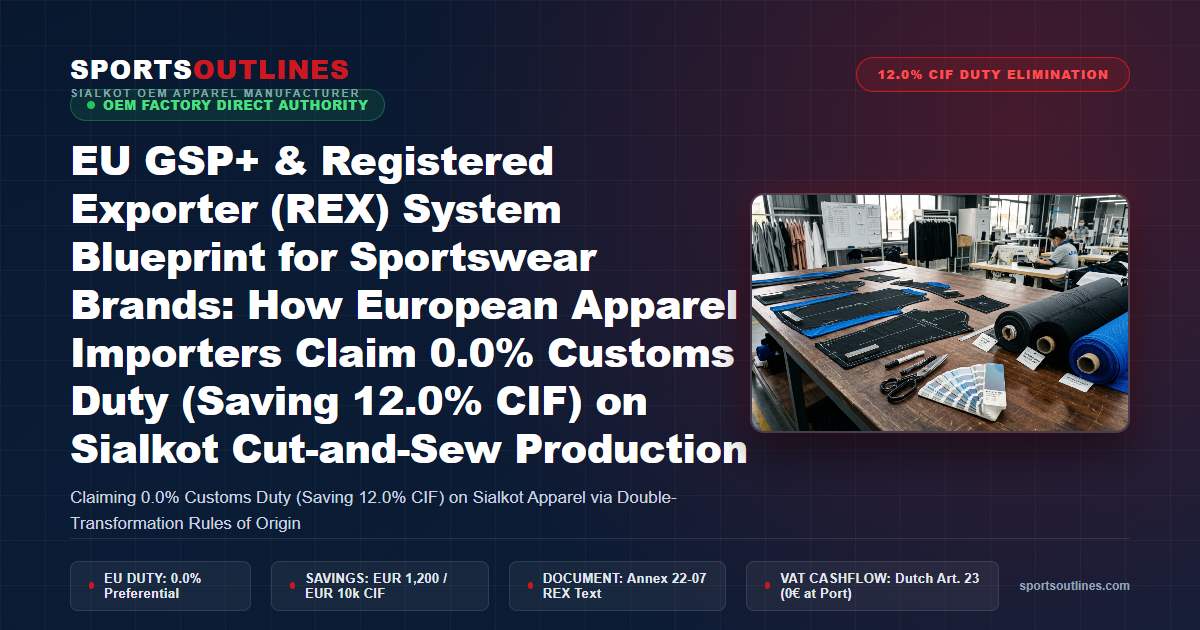
EU GSP+ 0.0% TARIFF & REX SYSTEM
12.0% CIF DUTY ELIMINATION
Executive Trade & Tariff Engineering Summary: Eliminating the 12.0% European Union Third-Country Duty on Custom Sportswear, Streetwear & Combat Gear via EU GSP+ and REX Statement on Origin
When European activewear, streetwear, and martial arts brands import custom apparel from China, Vietnam (without strict double-transformation origin compliance), Turkey (for non-free-circulation inputs), or standard Most-Favored-Nation (MFN) origins into Germany, the Netherlands, France, Spain, Italy, Poland, or Sweden, European Union TARIC customs authorities assess a standard 12.0% Third-Country Duty (`Erga Omnes`) across nearly all Chapter 61 (knitted) and Chapter 62 (woven) apparel items, alongside 7.0% to 9.7% on Chapter 42 leather boxing gloves. However, under the European Union Generalised Scheme of Preferences Plus (`EU GSP+`, Regulation EU No 978/2012 — extended through 2027/2028), custom sportswear, heavyweight fleece streetwear, BJJ gis, and leather combat gear manufactured in Sialkot, Pakistan enter all 27 EU Member States at a 0.0% Preferential Customs Duty rate. By executing a compliant Registered Exporter (`REX`) Statement on Origin on the commercial invoice (under EUR 6,000 threshold or via verified 12-character `PKREX` registration number for shipments exceeding EUR 6,000), European apparel brands immediately strip EUR 1,200 in unrecoverable tariff taxes out of every EUR 10,000 CIF import consignment. This comprehensive customs engineering guide details TARIC Chapter 61/62/42/95 duty differentials, Double-Transformation Rules of Origin (yarn-forward vs fabric-to-garment rules), verbatim REX invoice declaration syntax, EU Customs Trader Portal verification, and Dutch Article 23 (`Artikel 23`) / German Import VAT (`EUSt`) cashflow optimization.
For European Union apparel founders, procurement directors, and supply chain CFOs operating across Germany, the Netherlands, France, Italy, Spain, Scandinavia, and Central Europe, customs duty is frequently treated as an unavoidable cost of doing business. When a Berlin-based fitness apparel brand or an Amsterdam streetwear label sources 1,000 heavyweight 480 GSM French Terry hoodies and 1,000 seamless Nylon/Spandex compression leggings from a factory in Guangdong, China, the European Union Integrated Tariff (TARIC) levies a mandatory 12.0% Third-Country Duty against the CIF (Cost + Insurance + Freight) value of the shipment. Worse still, EU Import VAT (ranging from 19.0% in Germany to 21.0% in the Netherlands and Spain, and 25.0% in Sweden and Denmark) is calculated on top of the Duty-Paid CIF value—creating a compounding tax cascade where European importers pay VAT on their customs duty.
This 12.0% tariff burden disappears completely when European brands engineer their cut-and-sew production through Sialkot, Pakistan under the European Union GSP+ (Special Incentive Arrangement for Sustainable Development and Good Governance) framework. Because Pakistan is a designated EU GSP+ beneficiary nation, virtually 100% of TARIC Chapter 61 (knitted or crocheted apparel), Chapter 62 (woven apparel), Chapter 42 (leather sports gloves and gym belts), Chapter 63 (textile gear bags), and Chapter 95 (martial arts shin guards, headgear, and punch mitts) qualify for 0.0% Preferential Tariff Duty upon entry at Rotterdam, Hamburg, Antwerp, Le Havre, Barcelona, Frankfurt Airport (FRA), or Amsterdam Schiphol (AMS).
In this technical customs and trade engineering blueprint—the third installment in Super-Cluster 6.5 (Global Tariff & Trade Agreement Engineering)—we deconstruct the exact legal, documentary, and manufacturing mechanics required to claim 0.0% EU GSP+ duty without triggering post-clearance customs audits or retroactive tariff assessments. Whether you are launching an agile 30 to 50 piece low-MOQ private-label capsule (following a $45 to $85 non-refundable prototype sample delivered in 7 to 10 business days) or scaling multi-container LCL/FCL ocean shipments into European 3PL hubs, mastering the Registered Exporter (`REX`) system is the highest-ROI margin lever available to EU apparel importers.
1. EU TARIC Third-Country Duty (MFN / China) vs. EU GSP+ Preferential Tariff (Pakistan): The 12.0% CIF Margin Differential
Unlike the United States Harmonized Tariff Schedule (which differentiates heavily between 16.5% cotton knit tariffs and 28.2%–32.0% man-made synthetic knit tariffs, as detailed in our HTS / HS Code Chapter 61 vs Chapter 62 Classification Guide), the European Union’s Combined Nomenclature (CN / TARIC) applies a uniform 12.0% Third-Country (`Erga Omnes`) ad valorem duty rate across almost all finished textile garments in Chapters 61 and 62—regardless of whether the garment is 100% organic cotton or 100% recycled polyester.
While a flat 12.0% rate appears simpler on paper than US tariff schedules, its financial impact on European apparel brands is severe because the European Union calculates customs duty on a CIF (`Cost + Insurance + Freight`) valuation basis rather than an FOB basis. That means when air freight or sea freight rates spike, an importer buying from a non-preferential origin (such as China, Thailand, Taiwan, or the United States) pays an extra 12.0% tax on the freight and marine insurance charges in addition to the factory invoice value.
Under EU GSP+ (Column `GSP+ / PK` in the TARIC database), the European Commission suspends this 12.0% ad valorem tariff down to 0.0% for originating goods exported from Pakistan by a verified Registered Exporter (`REX`). Let us examine the exact 10-digit TARIC classification codes and duty differentials across core sportswear, activewear, streetwear, and combat sports product lines.
| Sportswear / Combat Gear Category | 10-Digit EU TARIC Code | EU Third-Country Duty (China / MFN) | EU Standard GSP (e.g., India / Indonesia) | EU GSP+ Duty Rate (Sialkot, Pakistan) | Net CIF Tariff Saving (PK vs China) |
|---|---|---|---|---|---|
| Heavyweight Cotton Hoodies & Sweatshirts (Knitted) | 6110 20 91 00 / 6110 20 99 00 | 12.0% CIF | 9.6% CIF (or Graduated 12.0%) | 0.0% (Duty-Free) | 12.0% Direct Margin Gain |
| Polyester / Nylon Performance Hoodies & Quarter-Zips | 6110 30 91 00 / 6110 30 99 00 | 12.0% CIF | 9.6% CIF | 0.0% (Duty-Free) | 12.0% Direct Margin Gain |
| Women’s Synthetic Compression Leggings & Gym Tights | 6104 63 00 00 | 12.0% CIF | 9.6% CIF | 0.0% (Duty-Free) | 12.0% Direct Margin Gain |
| Men’s / Unisex Performance Joggers, Track Pants & Shorts | 6103 42 00 00 / 6103 43 00 00 | 12.0% CIF | 9.6% CIF | 0.0% (Duty-Free) | 12.0% Direct Margin Gain |
| Sublimated Polyester Team Jerseys, T-Shirts & Rashguards | 6109 90 20 00 / 6109 10 00 10 | 12.0% CIF | 9.6% CIF | 0.0% (Duty-Free) | 12.0% Direct Margin Gain |
| High-Impact Sports Bras & Compression Crop Tops | 6212 10 90 00 | 6.5% CIF | 5.2% CIF | 0.0% (Duty-Free) | 6.5% Direct Margin Gain |
| Woven Tracksuits, Windbreakers, MMA Shorts & BJJ Gis | 6211 32 90 00 / 6211 33 90 00 | 12.0% CIF | 9.6% CIF | 0.0% (Duty-Free) | 12.0% Direct Margin Gain |
| Genuine Cowhide Leather Boxing Gloves & MMA Sparring Gloves | 4203 21 00 00 | 9.0% CIF | 6.3% CIF | 0.0% (Duty-Free) | 9.0% Direct Margin Gain |
| Synthetic PU / Microfiber Combat Gloves & Shin Guards | 6116 10 80 00 / 9506 99 90 00 | 8.0% – 8.9% CIF / 2.7% CIF | 6.2% CIF / 0.0% | 0.0% (Duty-Free) | Up to 8.9% Margin Gain |
Notice a critical distinction in the table above between Standard EU GSP (applicable to countries like India or Indonesia—where India has frequently been “graduated” out of GSP preferences for textiles altogether, restoring the full 12.0% MFN tariff, or where Standard GSP merely reduces a 12.0% tariff down to 9.6%) and EU GSP+ (`Special Incentive Arrangement`). Because Pakistan holds full EU GSP+ status, textile and leather goods are not merely discounted by 20%; they are 100% duty-suspended to 0.0%.
2. How the Registered Exporter (`REX`) System Replaced Paper Form A Certificates
Historically, European apparel importers had to wait for their overseas supplier to physically apply for a stamped green paper Certificate of Origin Form A from a local government export bureau, and then wait for that original paper document to arrive via courier before their customs broker in Rotterdam or Hamburg could clear the shipment duty-free. If the paper Form A contained a minor typo, or if the courier envelope was delayed, the European importer faced expensive port storage (demurrage) or had to deposit a 12.0% customs bond.
Since 2017–2020, the European Union completely abolished paper Form A certificates for GSP+ trade and replaced them with the digital self-certification Registered Exporter (`REX`) System governed by the Union Customs Code Implementing Act (`UCC IA`, Regulation EU 2015/2447, Articles 78–112). Under the REX architecture:
- Exporter Registration (`PKREX` Number): Verified manufacturers in Sialkot, Pakistan undergo an industrial capacity and origin-traceability audit conducted by the Trade Development Authority of Pakistan (`TDAP`) and are assigned a unique 12-character alphanumeric REX Number formatted as
PKREXfollowed by 7 digits (for example,PKREX1234567). - Public EU Customs Trader Portal Verification: Before wiring a deposit or filing an import SAD (`Single Administrative Document`) / electronic customs declaration (`ATLAS` in Germany, `AGS / DMS` in the Netherlands, `DELTA` in France), the European importer or customs broker can verify the factory’s REX number in real time via the official European Commission Taxation and Customs Union (`TAXUD`) REX Validation Portal (`ec.europa.eu/taxation_customs/dds2/eos/rex_validation.jsp`).
- Consignment Value Thresholds (`EUR 6,000` Rule):
- Consignments ≤ EUR 6,000 (Ex-Works Value): Under Article 92 of Regulation (EU) 2015/2447, any exporter in a GSP+ beneficiary country may issue a valid Statement on Origin on the commercial invoice for shipments whose total originating value does not exceed EUR 6,000—even without inserting a REX number. This is ideal for low-MOQ 30–50 piece brand launches or split air-courier consignments.
- Consignments > EUR 6,000 (Ex-Works Value): Once a consignment’s originating product value exceeds EUR 6,000, the commercial invoice must carry the Statement on Origin containing the manufacturer’s active
PKREXregistration number to claim the 0.0% EU GSP+ preference.
- Zero Paper Delay & Zero Courier Fees: Because the REX Statement on Origin is printed directly onto the commercial invoice (or packing list / delivery note), there is no separate government stamp fee, no Chamber of Commerce legalization delay, and no risk of lost original courier documents holding up air or ocean cargo release.
Verbatim Legal Syntax: Mandatory EU REX Statement on Origin (Annex 22-07 UCC IA)
European customs authorities (`Zoll` in Germany, `Douane` in the Netherlands and France) reject improvised origin notes like “Goods made in Pakistan under GSP+”. To pass automated customs validation and secure TARIC Preference Code 200 / Document Code U164 (`Statement on Origin made out by a Registered Exporter`), the commercial invoice must include the exact wording mandated by Annex 22-07 of Regulation (EU) 2015/2447 (in English, French, or Spanish):
Place and Date: Sialkot, Pakistan — [Invoice Date]
Company Name & Authorized Signatory Details: Sports Outlines Export Division
Note on Origin Criterion Coding: In EU GSP+ apparel trade, "P" designates products wholly obtained in Pakistan, whereas "W" followed by the 4-digit Harmonized System heading (such as W "6110" for hoodies, W "6104" for leggings, or W "4203" for leather boxing gloves) certifies that any non-originating inputs have been sufficiently worked or processed in Pakistan in accordance with the specific Chapter Rules of Origin.
3. EU GSP+ Rules of Origin (Annex 22-03 UCC DA): Double-Transformation (`Knitting/Weaving + Making-Up`) vs. Single-Transformation
The single greatest compliance vulnerability for European apparel brands importing under preferential trade schemes is misunderstanding the Product-Specific Rules of Origin (`PSR`) codified in Annex 22-03 of Commission Delegated Regulation (EU) 2015/2446 (`UCC DA`). Simply sewing a garment in a GSP+ country does not automatically confer preferential origin if the underlying fabric was imported from a non-originating country outside the regional cumulation zone without meeting the required transformation stages.
Because Pakistan is grouped as a Non-LDC (Developing Beneficiary Country holding GSP+ status) rather than a Least Developed Country (LDC), the European Union enforces the “Double-Transformation” Rule (`Two-Stage Processing`) for Chapter 61 (knitted apparel) and Chapter 62 (woven apparel). Let us break down exactly how Double-Transformation works across your manufacturing supply chain and why Sialkot’s vertically integrated textile ecosystem natively satisfies every EU customs audit requirement:
A. Chapter 61 (Knitted Sportswear & Streetwear): Yarn-to-Fabric Knitting + Garment Making-Up
Under Annex 22-03 for HS Chapter 61 (`Articles of apparel and clothing accessories, knitted or crocheted`), the rule for non-LDC GSP+ beneficiaries is ” Spinning of natural and/or man-made staple fibres or extrusion of man-made filament yarn, accompanied by knitting (knitted to shape products) OR Knitting and making-up (including cutting)”. In practical manufacturing terms:
- Stage 1 (Knitting in Pakistan): Raw cotton yarn, polyester filament yarn, or nylon/elastane yarn is knitted into circular jersey, interlock, pique, or 3-end heavyweight French Terry fleece fabric on circular knitting machines inside Pakistan (Faisalabad, Lahore, and Sialkot knitting mills).
- Stage 2 (Making-Up — Cutting, Dyeing, Printing & Sewing in Sialkot): That Pakistani-knitted fabric is reactive-dyed, pre-shrunk, CAD-cut, screen-printed/sublimated/embroidered, and sewn into finished hoodies, joggers, T-shirts, or leggings in Sialkot.
- Audit Compliance Verdict: Even if a specialized high-tenacity filament yarn or elastane (Spandex/Lycra) core yarn was originally extruded outside Pakistan, as long as the knitting into greige fabric (Stage 1) and the cutting and sewing into the finished garment (Stage 2) both occur within Pakistan, the garment 100% satisfies the EU GSP+ Double-Transformation rule (`W “6110”`, `W “6104”`, `W “6109”`). Furthermore, because Pakistan is a world-leading cotton producer and yarn spinner, our cotton and poly-cotton fleece programs achieve Triple-Transformation (fiber → yarn → fabric → garment) entirely inside Pakistan!
B. Chapter 62 (Woven Tracksuits, BJJ Gis, MMA Shorts & Outerwear): Weaving + Making-Up (or Unprinted Fabric Printing + Making-Up)
For HS Chapter 62 (`Articles of apparel and clothing accessories, not knitted or crocheted`), EU GSP+ Annex 22-03 establishes two primary compliance pathways:
- Pathway 1 (Weaving from Yarn + Making-Up): The woven fabric—such as 450 GSM Pearl Weave cotton for Brazilian Jiu-Jitsu (`BJJ`) kimono jackets, 10 oz ripstop cotton for BJJ pants, or mechanical-stretch polyester microfiber for MMA fight shorts—is woven from yarn inside Pakistan (Stage 1) and subsequently cut and sewn into finished garments in Sialkot (Stage 2).
- Pathway 2 (Printing of Unprinted Woven Fabric + Making-Up): Annex 22-03 provides a powerful alternative rule for Chapter 62: “Making-up preceded by printing accompanied by at least two preparatory or finishing operations (such as scouring, bleaching, mercerising, heat setting, raising, calendering, shrink resistance processing, permanent finishing, decatising, impregnating, mending and burling), provided that the value of the unprinted fabric used does not exceed 47.5% of the ex-works price of the product.” For fully sublimated woven MMA fight shorts (`TARIC 6211 33 90 00`) or custom printed windbreakers, heat-transfer sublimation printing combined with heat-setting, DWR water-repellent impregnation, and laser cutting/sewing in Sialkot independently confers valid Pakistan preferential origin as long as the unprinted greige base fabric represents ≤ 47.5% of the garment’s Ex-Works (`EXW`) unit price.
C. Chapter 42 (Leather Boxing Gloves & Weightlifting Belts) & Chapter 95 (Protective Martial Arts Gear): Change of Tariff Heading (`CTH`) / Value-Add Rules
For HS Heading 4203 (`Articles of apparel and clothing accessories, of leather or of composition leather` — including `4203 21 00 00` Leather Boxing & MMA Gloves) and HS Heading 9506 (`Articles and equipment for general physical exercise, gymnastics, athletics` — including shin guards, focus mitts, and groin guards), EU GSP+ rules are even more straightforward:
- Chapter 42 (`4203 21 00`): Manufacture from materials of any heading, except that of the product (`CTH` — Change of Tariff Heading), or where the value of all non-originating materials used does not exceed 70% of the ex-works price of the product. Because Sialkot uses locally tanned Pakistani cowhide and buffalo leather (HS Chapter 41) along with locally molded multi-layer EVA/latex impact foams (HS Chapter 39/40) to stitch finished boxing gloves in Heading 4203, every leather and synthetic boxing glove manufactured in Sialkot effortlessly passes EU origin verification.
| HS / TARIC Chapter | Product Scope | EU GSP+ Origin Rule (Annex 22-03 UCC DA) | REX Origin Criterion Code on Invoice | Factory Audit Documentation Maintained by Sialkot OEM |
|---|---|---|---|---|
| Chapter 61 (Knitted Apparel) | Hoodies, Sweatshirts, Joggers, T-Shirts, Compression Leggings, Rashguards | Double-Transformation: Knitting from yarn in Pakistan + Cutting & Making-Up in Pakistan (8% general tolerance for non-originating textile trims/threads) | W “6110” / W “6104” / W “6109” / W “6103” | Local yarn purchase invoices, circular knitting mill job cards, dyeing batch sheets, cutting & sewing production logs |
| Chapter 62 (Woven Apparel) | BJJ Gis (Kimonos), Woven MMA Shorts, Windbreakers, Tracksuits, Sports Bras | Weaving + Making-Up in Pakistan OR Printing + ≥2 Finishing Steps + Making-Up (where unprinted fabric ≤ 47.5% of EXW price) | W “6211” / W “6201” / W “6203” / W “6212” | Loom weaving tickets (Pearl Weave / Ripstop), or sublimation transfer + heat-setting/DWR finishing logs & BOM cost breakdown |
| Chapter 42 (Leather Goods) | Cowhide Leather Boxing Gloves (`4203 21 00`), MMA Gloves, Powerlifting Belts | Change of Tariff Heading (`CTH`) (from Chapter 41 hides/leather to 4203) OR Max 70% non-originating material value | W “4203” | Sialkot/Kasur tannery drum-dyed leather invoices, multi-layer foam molding sheets, artisan stitching records |
| Chapter 95 (Sports & Protective Gear) | Thai Pads, Focus Mitts, Kickboxing Shin Guards, Headgear (`9506 91 / 9506 99`) | Change of Tariff Heading (`CTH`) OR Max 70% non-originating material value (`EXW` basis) | W “9506” | Microfiber/PU skin invoices, high-density EVA/PE foam cutting logs, assembly QC certificates |
4. Complete EU Landed Cost & Cashflow Simulation: EUR 25,000 CIF Consignment (Sialkot GSP+ vs. China MFN)
To quantify how EU GSP+ 0.0% duty interacts with European Import VAT (`Einfuhrumsatzsteuer / EUSt` in Germany, `BTW bij invoer` in the Netherlands, `TVA à l’importation` in France), let us model a realistic mid-sized production order: 1,500 units of heavyweight 460 GSM cotton/poly streetwear hoodies and 1,000 units of Nylon/Spandex compression leggings imported into Germany (Hamburg / Frankfurt) vs. The Netherlands (Rotterdam / Amsterdam with an Article 23 VAT Deferment License).
Assume the factory FOB value is EUR 22,500, plus EUR 2,350 in consolidated air/sea freight and EUR 150 in ICC (A) All-Risks marine cargo insurance (refer to our Marine & Air Cargo Insurance ICC (A) Guide), yielding a total EU Customs CIF Value of EUR 25,000.00.
| Cost & Tax Component | Scenario A: China MFN into Germany (12% Duty + 19% Cash EUSt) | Scenario B: Sialkot GSP+ into Germany (0% Duty + 19% Cash EUSt) | Scenario C: Sialkot GSP+ into Netherlands (0% Duty + Article 23 VAT Deferment) |
|---|---|---|---|
| 1. FOB Garment Value (2,500 Total Pcs) | EUR 22,500.00 | EUR 22,500.00 | EUR 22,500.00 |
| 2. International Freight + ICC (A) Insurance | EUR 2,500.00 | EUR 2,500.00 | EUR 2,500.00 |
| 3. Total EU Customs CIF Valuation Base | EUR 25,000.00 | EUR 25,000.00 | EUR 25,000.00 |
| 4. EU Customs Duty (12.0% MFN vs 0.0% GSP+ REX) | EUR 3,000.00 (Unrecoverable Sink) | EUR 0.00 (Saved via PKREX) | EUR 0.00 (Saved via PKREX) |
| 5. Import VAT Assessment Base (CIF + Duty + EUR 200 Local Clearance) | EUR 28,200.00 | EUR 25,200.00 | EUR 25,200.00 |
| 6. Upfront Import VAT Outlay at Customs Border | EUR 5,358.00 (19% of EUR 28,200 — includes EUR 570 extra VAT on Duty!) | EUR 4,788.00 (19% of EUR 25,200 — reclaimed later on Vorsteuer return) | EUR 0.00 Cash Outlay (21% BTW Deferred to Quarterly Return via Art. 23) |
| Total Cash Required at Port to Release Cargo (Duty + Upfront VAT + EUR 200 Broker Fee) | EUR 8,558.00 Cash Tied Up | EUR 4,988.00 Cash Tied Up (EUR 3,570 Less Cash Outflow!) | EUR 200.00 Broker Fee Only! (EUR 8,358 Less Cash Outflow at Port!) |
| Permanent Net Bottom-Line Profit Gain (After VAT Input Recovery) | Baseline (–EUR 3,000.00 Duty Loss) | +EUR 3,000.00 Pure Profit Saved (+EUR 1.20 / garment) | +EUR 3,000.00 Pure Profit Saved + 100% Working Capital Preservation |
Look closely at the two separate financial victories revealed in the table above:
- Permanent EBITDA Profit Expansion (`+EUR 3,000.00` per EUR 25k CIF order): Because customs duty is a non-recoverable tax (unlike Import VAT, which VAT-registered EU companies reclaim as input tax), eliminating the 12.0% tariff via Pakistan’s EU GSP+ status adds EUR 3,000.00 directly to net profit on a EUR 25,000 CIF order—equivalent to slashing EUR 1.20 off the landed unit cost of every single garment. Across four quarterly restocks per year (EUR 100,000 annual CIF imports), that equals EUR 12,000.00 in pure retained cash—enough to fund 150+ new custom prototype samples at our $45–$85 development rate or scale paid Meta/TikTok acquisition ads across Europe.
- Working Capital & Cashflow Velocity (`EUR 8,358.00` preserved at port release): When an EU brand combines Sialkot’s 0.0% EU GSP+ REX tariff with Dutch Article 23 (`Artikel 23`) VAT fiscal representation in Rotterdam or Amsterdam (or French mandatory Import VAT reverse-charge `autoliquidation de la TVA à l’importation`), the importer pays EUR 0.00 in Customs Duty AND EUR 0.00 in upfront Import VAT when the plane or vessel lands. Instead of wiring EUR 8,558.00 to DHL/FedEx or an ocean freight forwarder just to get their cartons out of customs bond, the brand clears customs by paying only the standard EUR 150–200 customs brokerage filing fee!
5. Step-by-Step Customs Clearance SOP: EORI, TARIC Document Codes (`U164` / `U165`) & Direct Transport Rules
Even when your garments are 100% manufactured in Sialkot under Double-Transformation rules, automated EU customs declaration systems (`ATLAS` in Germany, `DMS` in the Netherlands, `DELTA G/X` in France, `AIDA` in Italy) will charge the full 12.0% MFN duty if the customs broker keys in the wrong Box 36 Preference Code or Box 44 Document Code on the Single Administrative Document (`SAD`). To guarantee zero-friction 0.0% clearance every time, share this exact 5-point SOP with your European freight forwarder or express courier broker (DHL Express, FedEx, UPS, Kuehne+Nagel, DSV, or DB Schenker):
| EU Customs Declaration Field (SAD / UCC Data Element) | Required Code / Entry Value | Technical Meaning & Compliance Function | Common Broker Error That Causes 12% Duty Assessment |
|---|---|---|---|
| Importer Identification (Box 8 / DE 3/16) | Valid EU EORI Number (e.g., DE123456789 / NL123456789) | Economic Operators Registration and Identification number required for all commercial B2B imports into the EU Customs Union. | Shipping before the brand’s EORI number is activated in the EU EOS database, forcing cargo into bonded storage. |
| Country of Origin & Preferential Origin (Box 34a / DE 5/16) | PK (Pakistan) | Identifies Pakistan as the preferential GSP+ country of origin under Annex 22-03 transformation rules. | Entering the transit hub country (e.g., `AE` for Dubai transshipment or `QA` for Doha air hub) as country of origin instead of `PK`. |
| Preference Code (Box 36 / DE 4/17) | 200 (GSP Duty Rate without Quantitative Limits) | Triggers the TARIC database to apply the 0.0% EU GSP+ preferential tariff for Pakistan instead of the 12.0% Third-Country rate. | Leaving Box 36 defaulted to 100 (`Erga Omnes` Third-Country Duty), which automatically bills 12.0% even if a REX statement is attached! |
| Supporting Document Code — Consignments > EUR 6,000 (Box 44 / DE 2/3) | U164 + [PKREX Number] + [U166 Invoice Ref] | U164 declares a “Statement on Origin made out by a Registered Exporter within the framework of GSP for a total value of originating products consigned exceeding EUR 6,000”. | Omitting document code U164 or mistyping the 12-character PKREX number, causing an automated EOS validation mismatch. |
| Supporting Document Code — Consignments ≤ EUR 6,000 (Box 44 / DE 2/3) | U165 + [Commercial Invoice Number & Date] | U165 declares a “Statement on Origin made out by any exporter within the framework of GSP for a total value of originating products consigned not exceeding EUR 6,000”. | Courier clerks overlooking the Statement on Origin at the bottom of the commercial invoice on fast-track air express shipments. |
The Non-Manipulation / Direct Transport Rule (Article 43 UCC DA)
What happens if your air cargo flies from Sialkot International Airport (`SKT`) to Frankfurt (`FRA`) via a connection in Dubai (`DXB`) or Doha (`DOH`), or if your LCL sea freight container transships via Jebel Ali or Colombo on its way to Rotterdam? Under Article 43 of Delegated Regulation (EU) 2015/2446 (`Non-alteration principle`), transshipment through third countries is 100% permitted under EU GSP+ provided the goods remain under customs supervision in the transit country and do not undergo operations other than unloading, reloading, or splitting of consignments. Because our export logistics desk books every air and ocean shipment on a Single Through Air Waybill (`MAWB / HAWB`) or Through Bill of Lading (`B/L`) showing Sialkot/Karachi, Pakistan as the Port of Loading and the EU port as the Final Destination, non-alteration compliance is preserved automatically.
Post-Clearance Retroactive Duty Refund (`UCC Article 116 / 117` — 3-Year Recovery Window)
What if your courier (such as DHL or FedEx) cleared a Sialkot apparel shipment last month and mistakenly charged you 12.0% customs duty because their data-entry clerk failed to enter Preference Code `200` and Document Code `U164`/`U165`? Under Articles 116 and 117 of the Union Customs Code (Regulation EU No 952/2013) and Article 92(2) of the UCC IA, a Statement on Origin may even be made out retrospectively after exportation, and the European importer has up to 3 years from the date of notification of the customs debt to submit a post-clearance amendment (`Antrag auf Erstattung/Erlass` in Germany or `Verzoek om teruggaaf` in the Netherlands) to recover 100% of the overpaid 12.0% duty directly from EU customs authorities.
6. Integrating Low-MOQ Sampling & Agile Production with EU GSP+ Tariff Engineering
Many emerging European activewear, streetwear, and combat sports brands assume that preferential trade engineering is reserved for multi-container retail chains. At Sports Outlines, we embed full EU GSP+ TARIC classification and REX origin compliance into every order tier—from your very first sample run to full-scale seasonal drops:
- Custom Prototype Sampling ($45–$85 per piece/pair/set, 7–10 Business Days): Every custom apparel or combat gear development starts with a precision-engineered physical prototype priced at $45 to $85 per piece, pair, or set (a dedicated, non-refundable engineering fee covering bespoke CAD pattern drafting, fabric/leather sourcing, sublimation/embroidery setup, and 7 to 10 business days craft turnaround). Prototype commercial invoices are properly coded with accurate 10-digit TARIC headings and origin declarations for seamless European courier delivery.
- Agile 30–50 Piece Low-MOQ Production Runs: Launch new styles or test European market demand with our factory MOQ of 30 to 50 pieces, pairs, or sets per style and colorway. Because most 30–50 piece low-MOQ capsules have an Ex-Works value well below EUR 6,000, they qualify immediately under UCC IA Article 92 (`Document Code U165`) AND carry our full
PKREXStatement on Origin—giving startup brands the exact same 0.0% EU customs duty advantage enjoyed by multinational sportswear giants. - Pre-Clearance Broker Pre-Alert Pack: Before your air courier or LCL ocean shipment departs Pakistan, our export documentation team emails you a complete digital EU Customs Pre-Alert Packet containing the REX-certified Commercial Invoice, Packing List, HAWB/B/L, and an explicit instruction banner instructing DHL/FedEx/your customs broker to declare Box 36 = `200` and Box 44 = `U164` / `U165` so your shipment clears at 0.0% duty on the first pass.
7. Frequently Asked Questions (FAQ): EU GSP+ & REX System for Sportswear Imports
1. Does EU GSP+ apply to all 27 European Union Member States?
Yes. Because the European Union operates as a single unified Customs Union under the Union Customs Code (`UCC`), Pakistan’s EU GSP+ status grants 0.0% preferential import duty across all 27 EU Member States—including Germany, the Netherlands, France, Italy, Spain, Poland, Belgium, Sweden, Denmark, Austria, Ireland, and Portugal. Furthermore, once goods clear customs into “free circulation” in one EU country (for example, at Rotterdam Port or Amsterdam Schiphol in the Netherlands), they can be trucked to fulfillment centers in Germany, France, or Spain with zero internal border tariffs.
2. Is EU GSP+ still valid for imports into the United Kingdom (England, Scotland, Wales)?
Following Brexit, the United Kingdom exited the EU Customs Union and launched its own independent preferential tariff framework: the UK Developing Countries Trading Scheme (`UK DCTS` — Enhanced Preferences). Under the UK DCTS, Pakistan enjoys the exact same 0.0% duty-free access into the UK for Chapters 61, 62, 42, and 95! Refer to our dedicated companion guide, the UK DCTS & HMRC CDS Zero-Duty Sportswear Import Guide, for British customs procedures and Postponed VAT Accounting (`PVA`).
3. Has the European Union extended Pakistan’s GSP+ status beyond 2023?
Yes. In November 2023, the European Parliament and the Council of the European Union adopted Regulation (EU) 2023/2663, formally extending the current EU GSP/GSP+ Regulation (`Regulation EU No 978/2012`) through December 31, 2027 (with ongoing legislative alignment into 2028+), ensuring uninterrupted 0.0% duty-free stability for European apparel and combat gear brands sourcing from Sialkot, Pakistan.
4. What happens if my garments use imported YKK zippers, silicone drawcord tips, or heat-transfer care labels?
Under the General Tolerance Rule (Article 48 of Delegated Regulation EU 2015/2446 and Introductory Note 6 to Annex 22-03), non-originating textile trimmings and accessories do not invalidate Pakistan preferential origin as long as they do not exceed 8.0% of the total weight of all textile materials incorporated in the garment, and non-textile trims (such as metal or molded plastic zipper sliders, eyelets, or silicone aglets) are fully permitted when the primary fabric meets the Chapter 61/62 Double-Transformation rule.
5. How do I stop DHL, FedEx, or UPS from automatically charging 12.0% duty on air express deliveries?
Express couriers clear air cargo rapidly before flight arrival (`Pre-Clearance`). To prevent their automated script from defaulting to MFN `12.0%` duty: (1) ensure our export invoice displays the verbatim Annex 22-07 REX Statement on Origin in bold inside a dedicated compliance box on Page 1; (2) register a standing Direct Customs Representation Mandate (`Zollvollmacht` / `Douanemachtiging`) with DHL/FedEx instructing them to always claim GSP+ Preference `200` and Document Code `U164`/`U165` on shipments originating from Pakistan (`PK`); and (3) request a post-entry correction within 3 years if a courier clerk ever misses the REX statement.
6. Can I combine Delivered Duty Paid (`DDP`) or Delivered at Place (`DAP`) freight with EU GSP+ zero duty?
Yes—and for European VAT-registered businesses (holding an active EORI and VAT ID), importing under DAP (`Delivered at Place`) or FCA / FOB / CIF in your own company’s EORI name is vastly superior to opaque DDP consolidation. When you clear in your own EORI name using our REX Statement on Origin, your customs duty is 0.0% AND you retain the official customs import assessment notice (`Einfuhrabgabenbescheid` in Germany) required to deduct 100% of the Import VAT (`Vorsteuerabzug`), whereas third-party courier DDP consolidators often build hidden tariff markups into their all-in per-kg freight rates.
Ready to Eliminate 12.0% EU Import Tariffs on Your Next Sportswear or Combat Gear Production Run?
Partner with Sports Outlines in Sialkot, Pakistan for vertically integrated, Double-Transformation compliant manufacturing backed by verified EU GSP+ REX certification. Start with a custom prototype sample ($45–$85 per piece/pair/set, delivered in 7–10 business days) and scale with agile 30–50 piece low MOQs into any European Union Member State at 0.0% customs duty.
Pingback: UK Developing Countries Trading Scheme (DCTS) & HMRC CDS Customs Clearance Guide: How British Activewear & Fightwear Brands Import Duty-Free (0.0% Tariff) from Pakistan + Postponed VAT Accounting (PVA) Cashflow Math - Sports Outlines