In the industrial assembly of waterproof-breathable alpine outerwear, hardshell ski jackets, and technical marine gear, the hot-air seam sealing machine is the ultimate gatekeeper of garment integrity. Even if an outerwear shell is crafted from the world’s finest 3-layer membrane laminate and stitched with high-tenacity thread, improper seam taping transforms a high-performance jacket into a sieve. A deviation of just 15°C in nozzle temperature, a misalignment of 5° in hot-air impingement angle, or an imbalance of 0.1 MPa in pneumatic roller nip pressure will cause catastrophic failure: either scorch-burning the delicate microporous membrane or leaving dry, unbonded capillary tunnels that weep moisture in cold, wind-driven rain.
Achieving hermetic, lifetime-durable seam bonds requires treating hot-air taping not as a manual craft, but as a rigorous thermodynamic and rheological engineering discipline. The process involves synchronizing convective heat transfer, transient polymer melt kinetics, viscoelastic wetting, and pneumatic mechanical consolidation in a high-speed continuous nip zone. At Sports Outlines, operating our specialized outerwear technical bonding lines in Sialkot, Pakistan, we deploy digitally calibrated hot-air sealers (including Ardmel, Pfaff 8303, and high-precision CNC rotary seam stations) to engineer expedition-grade alpine garments. We partner with emerging outdoor brands and established labels through transparent commercial terms: physical prototype sampling at $45 to $85 per piece (non-refundable, 7–10 business days turnaround) and scalable factory production starting at strictly 30 to 50 pieces per style/colorway.
Hot-Air Seam Taping Machine Engineering: Technical Directory
- 1. Electromechanical Architecture: Nozzle, Blower & Dual Driven Rollers
- 2. Convective Heat Transfer & Nozzle Impingement Angle (θ = 25°–35°)
- 3. Temperature Profiling Across Tape Chemistries: 2L vs 3L Formulations
- 4. Pneumatic Nip Roller Mechanics: Durometer, Pressure & Drive Sync
- 5. Viscoelastic Wetting Kinetics & Dahlquist Contact Criteria
- 6. Comprehensive Seam Taping Calibration Engineering Matrix
- 7. Troubleshooting Failure Modes: Flagging, Flash, Scorch & Tunnels
- 8. Laboratory Verification: ISO 2411 Peel & ISO 811 Hydrostatic Suter QC
- 9. Outerwear Tech Pack Specifications & Engineering Directives
- 10. Sialkot Technical Shell Bonding Suites & Environmental Control
- 11. Low-MOQ Contract Manufacturing & Prototyping Terms
- 12. Technical Sourcing FAQ
1. Electromechanical Architecture: Nozzle, Blower & Dual Driven Rollers
An industrial hot-air seam sealing machine is a specialized continuous thermomechanical laminator designed to apply thermoplastic adhesive tapes over stitched or welded garment seams. The mechanical architecture consists of four critical sub-assemblies:
- High-Velocity Compressed Air Heating Assembly: Ambient clean, dry compressed air is regulated through an inline filtration unit (removing oil aerosols and moisture to ≤0.01 µm) and pushed across an encased ceramic heating coil. A PID (Proportional-Integral-Derivative) temperature controller continuously monitors thermocouple feedback at the nozzle discharge, regulating air temperature between 150°C and 500°C with a precision of ±1.5°C.
- Articulated Pneumatic Nozzle Arm: The hot air discharges through a precision-shaped copper or stainless steel nozzle orifice (typically 20 mm to 24 mm wide and 1.2 mm to 1.8 mm slot height). The nozzle arm is mounted on a high-speed pneumatic swing arm that pivots directly into the wedge-shaped gap between the incoming tape and the fabric seam milliseconds before the rollers engage, retracting automatically whenever feeding stops to prevent scorch damage.
- Synchronized Upper and Lower Drive Rollers: The machine features two motorized rollers: an upper roller mounted on an articulating pneumatic pivot arm, and a lower post roller (or lower anvil arm). Both rollers are driven by independent brushless servomotors with digital encoder feedback, guaranteeing speed synchronization within Δv ≤ 0.2%.
- Tape Feed Tension Control System: Tape is unwound from a top-mounted reel through a low-friction dancing arm tension compensator. Closed-loop tension control maintains an unwind tension between 0.15 N and 0.40 N, preventing tape stretching before thermal activation.
2. Convective Heat Transfer & Nozzle Impingement Angle (θ = 25°–35°)
The thermal activation of seam tape is governed by forced convective heat transfer. The rate of thermal energy transfer ($\dot{Q}$) from the hot-air jet to the adhesive surface is modeled by Newton’s law of cooling:
Where $A_{\text{wedge}}$ is the effective thermal contact area inside the convergence zone, $T_{\text{air}}$ is the nozzle discharge temperature, and $h_c$ is the convective heat transfer coefficient. Crucially, $h_c$ is a direct function of air discharge velocity ($v_{\text{air}} \approx 18\text{ to }28\text{ m/s}$) and the aerodynamic impingement geometry of the nozzle tip.
The Optimal Impingement Angle (θ = 25° to 35°)
The nozzle tip must be positioned precisely at the entrance of the “nip wedge”—the triangular apex where the downward-moving tape converges with the upward-moving garment seam directly in front of the silicone rollers. The angle of nozzle insertion relative to the horizontal bed must be calibrated strictly between 25° and 35°:
- If the angle is too steep (θ > 40°): The hot-air jet strikes the garment fabric face directly before striking the tape. This overheats and shrinks the face textile, blister-degrades the waterproof membrane, and leaves the adhesive layer under-melted.
- If the angle is too shallow (θ < 20°): The air stream reflects off the tape backing without entering the nip root. Convective turbulence blows hot air laterally across the garment exterior, causing edge curling while the central adhesive boundary remains below activation temperature.
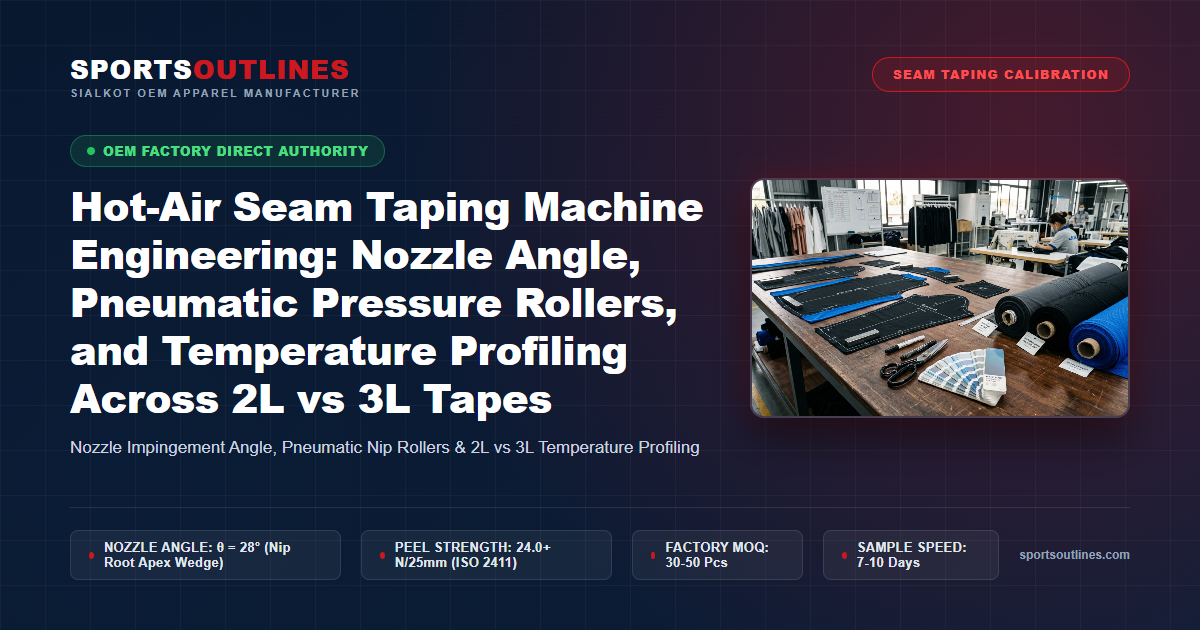
- At the calibrated sweet spot (θ = 28°±2°): The split-orifice nozzle simultaneously bathes both the hot-melt adhesive underside of the incoming tape and the fabric seam allowance in an aerodynamic thermal envelope, raising the adhesive temperature to its exact molten melt-flow point ($T_{\text{flow}}$) exactly 12 to 18 millimeters ahead of the roller nip center.
3. Temperature Profiling Across Tape Chemistries: 2L vs 3L Formulations
A fatal error in contract outerwear manufacturing is applying a single generic temperature setting across different seam tape constructions. Because different tape constructions possess vastly different thermal masses, thermal conductivities, and adhesive polymer chemistries, temperature profiling must be strictly customized:
1. Two-Layer (2L) Seam Tapes (TPU Membrane + TPU Hot-Melt Adhesive)
2-layer tapes (typically 0.08 mm to 0.12 mm thick) consist of a solid polyurethane barrier film coated with a low-melt polyurethane adhesive. Because there is no insulating textile backer, thermal conduction from the hot air through the film is instantaneous. The nozzle temperature must be calibrated strictly between 165°C and 195°C at a line speed of 3.5 to 5.0 m/min:
- Exceeding 205°C causes the outer TPU barrier skin to reach its melting point, resulting in roller sticking, surface melting, and pinholing.
- Under-heating (<155°C) fails to lower melt viscosity, resulting in peel failure during cold-flex stress.
2. Three-Layer (3L) Seam Tapes (Polyamide Tricot Backer + Barrier Film + High-Melt Adhesive)
3-layer tapes (typically 0.28 mm to 0.35 mm thick) feature an ultra-fine 15D or 20D polyamide warp-knit tricot backer laminated to an ePTFE or TPU barrier membrane, followed by a heavy polyurethane or copolyamide hot-melt adhesive layer. The knit textile layer acts as a thermal heat sink that rapidly absorbs thermal energy. To achieve sufficient melt flow through the adhesive layer without overheating the garment face, nozzle temperature must be set significantly higher: 215°C to 245°C at a line speed of 2.8 to 4.2 m/min.
3. Elastic 4-Way Stretch Tapes (Polyether TPU + Spandex Tricot)
For softshell jackets and ergonomic alpine stretch pants, tapes incorporate elastomeric polyurethane cores. These tapes shrink axially if exposed to excessive heat. Nozzle temperature is calibrated to 180°C to 205°C combined with dynamic differential feed tension (<0.20 N) to prevent tape tension necking.
Transient Fourier Conduction & Thermal Residence Time Modeling
To calculate the exact adhesive temperature during machine operation, our materials engineering desk models transient one-dimensional heat conduction through the multi-layer sandwich using Fourier’s governing differential equation:
Where $\alpha$ is thermal diffusivity, $k$ is thermal conductivity ($0.19\text{ W/m}\cdot\text{K}$ for polyurethane, $0.25\text{ W/m}\cdot\text{K}$ for polyamide), $\rho$ is density, and $c_p$ is specific heat capacity. Because the nip dwell time is exceptionally brief—dictated by roller radius ($R \approx 32\text{ mm}$) and line speed ($v \approx 3.0\text{ m/min}$), yielding an active contact width of $L_{\text{nip}} \approx 8\text{ mm}$ and dwell time of:
In these 160 milliseconds, thermal energy must diffuse completely across the 120-micron adhesive thickness without raising the underlying microporous ePTFE or monolithic PU membrane temperature above its thermal degradation threshold ($T_{\text{deg}} \approx 210^\circ\text{C}$ for TPU, $320^\circ\text{C}$ for ePTFE). This rigorous mathematical modeling informs our exact programmable temperature ramp profiles across our Sialkot factory lines.
4. Pneumatic Nip Roller Mechanics: Durometer, Pressure & Drive Sync
Thermal activation liquefies the hot-melt adhesive, but it is pneumatic mechanical consolidation that forces the molten polymer into the microscopic fiber crevices of the seam allowance. The roller assembly is governed by three mechanical parameters:
1. Silicone Roller Hardness (Durometer Rating)
The upper roller must be molded from high-temperature vulcanized (HTV) silicone capable of continuous operation at 260°C without hardening. Roller hardness is selected based on garment structure:
- 50 to 55 Shore A (Soft / Compliant): Used for 3-layer hardshells with heavy topstitching and cross-junctions. The soft silicone elastically deforms around 6-ply seam step-downs, maintaining uniform contact pressure across the entire tape width.
- 65 to 70 Shore A (Medium / Rigid): Used for flat, ultralight 2L fabrics and ultrasonic welded butt-joints. Provides high concentrated contact stress along narrow micro-tapes (8 mm to 12 mm) for maximum adhesive flow.
2. Pneumatic Nip Force Calibration
Pneumatic line pressure delivered to the upper cylinder is calibrated between 0.35 MPa and 0.60 MPa (3.5 to 6.0 bar). Across a standard 25 mm roller contact width, this produces a linear nip force of 140 to 240 N/cm:
- Under-pressured (<0.30 MPa): Molten adhesive fails to penetrate the microscopic inter-yarn voids, resulting in low peel strength and adhesive “skinning”.
- Over-pressured (>0.65 MPa): Excess pressure squashes the molten adhesive laterally out from beneath the tape edges (“glue flash”), leaving a starved central bond line that fails Mullen burst testing.
3. Independent Roller Speed Synchronization
Because the upper roller contacts the smooth tape backing while the lower roller contacts the textured face fabric, friction coefficients differ significantly. Advanced machines feature independent servomotor drive for both rollers. Speed synchronization is maintained within ±0.2%. On tight armhole curves and sleeve caps, the upper roller speed is modulated by +1.5% to differential-feed tape around 3D convex contours without gathering or twisting.
5. Viscoelastic Wetting Kinetics & Dahlquist Contact Criteria
To form a permanent molecular bond, the hot-melt adhesive must satisfy the Dahlquist criterion for instantaneous contact adhesion. Under the dynamic timescale of the roller nip (where contact dwell time is only 0.15 to 0.35 seconds at standard feed speeds), the tensile storage modulus ($G’$) of the molten adhesive must drop below $3 \times 10^5\text{ Pa}$ at the bonding frequency. If the modulus remains above this threshold due to insufficient heating, the adhesive behaves as a rigid elastic solid rather than a viscous liquid, failing to form intermolecular van der Waals bonds.
Once the Dahlquist criterion is satisfied, the liquid adhesive penetrates the pore capillaries between individual yarn filaments. The depth of capillary penetration ($h$) over nip dwell time ($t$) is modeled by the Lucas-Washburn equation:
Where $r$ is the mean hydraulic radius between yarn filaments, $\gamma_{LV}$ is the surface energy of the molten adhesive, $\theta$ is the contact wetting angle, and $\eta$ is dynamic melt viscosity. As temperature rises from 180°C to 225°C, dynamic viscosity ($\eta$) of high-grade polyurethane hot-melts drops from 12,000 mPa·s to 2,500 mPa·s, increasing capillary penetration depth ($h$) by over 210%. This deep mechanical micro-anchoring around the backer yarns is what delivers indestructible peel strength after cooling.
6. Comprehensive Seam Taping Calibration Engineering Matrix
The following industrial engineering matrix details the precise machine calibration parameters enforced across our Sialkot manufacturing lines for different outerwear garment constructions:
| Garment Laminate Class | Seam Tape Specification | Nozzle Temp (±2°C) | Air Pressure / Speed | Nip Roller Pressure | Target Peel Strength |
|---|---|---|---|---|---|
| Ultralight 2.5L Paclite Shells (20D Nylon) | 13 mm 2-Layer TPU Film Tape (0.08 mm thickness) | 175°C – 185°C | Air: 0.18 MPa / Speed: 4.2–5.2 m/min | 0.35 MPa (3.5 bar) / 60 Shore A | 18.5 – 22.0 N/25mm |
| Alpine Expedition 3L Hardshells (70D Nylon) | 20 mm 3-Layer Polyamide Tricot Tape (0.32 mm) | 225°C – 238°C | Air: 0.22 MPa / Speed: 3.0–3.6 m/min | 0.48 MPa (4.8 bar) / 50 Shore A | 24.0 – 28.5 N/25mm |
| Ultrasonic Welded Butt-Joint Shells | 10 mm 3-Layer Micro-Tape (Bemis SRT-10) | 215°C – 225°C | Air: 0.20 MPa / Speed: 3.5–4.2 m/min | 0.42 MPa (4.2 bar) / 55 Shore A | 22.0 – 26.0 N/25mm |
| 4-Way Stretch Alpine Softshell Pants | 22 mm Polyether Elastic TPU Tape (0.20 mm) | 190°C – 202°C | Air: 0.19 MPa / Speed: 3.2–3.8 m/min | 0.40 MPa (4.0 bar) / 50 Shore A | 20.0 – 24.5 N/25mm |
| Marine Offshore Heavy Sailing Drysuits | 24 mm Heavy ePTFE Composite 3L Tape | 235°C – 248°C | Air: 0.24 MPa / Speed: 2.4–2.8 m/min | 0.55 MPa (5.5 bar) / 50 Shore A | 28.0 – 34.0 N/25mm |
7. Troubleshooting Failure Modes: Flagging, Flash, Scorch & Tunnels
Even minor fluctuations in ambient humidity, compressor line pressure, or operator handling can introduce seam sealing defects. Our manufacturing standard operating procedure (SOP) enforces instant corrective action for the four most common taping failure modes:
1. Edge Flagging (Tape Border Lifting)
Root Cause: Nozzle angle too shallow (θ < 22°), or nozzle orifice too narrow, leaving the outer 1.5 mm of tape unheated. Alternatively, operator pauses causing delayed nip contact.
Remedy: Re-align nozzle impingement angle to 28° and verify that nozzle slot width matches tape width (±1 mm). Ensure upper roller pneumatic clamp engages synchronously with nozzle swing.
2. Adhesive Flash (Excessive Glue Squeeze-Out)
Root Cause: Excessive temperature (>245°C) lowering melt viscosity to water-like consistency, combined with excessive nip roller pressure (>0.60 MPa). Squeezed glue soils fabric and stiffens the seam.
Remedy: Reduce nozzle temperature by 15°C, increase linear feed speed by 0.5 m/min, and dial back pneumatic roller pressure to 0.42 MPa.
3. Membrane Scorch & Blistering
Root Cause: Compressed air velocity too low ($v < 15\text{ m/s}$), causing hot air stagnation, or operator stalling the workpiece during tight curved seam navigation.
Remedy: Increase compressed air supply to 0.22 MPa. Calibrate machine auto-retract timer so nozzle swings back within 0.10 seconds of feed hesitation.
4. Cross-Junction Step-Down Tunneling
Root Cause: Roller durometer too hard (75 Shore A), bridging over 6-ply seam intersections and leaving unbonded capillary air gaps on both sides of the step-down.
Remedy: Switch to dual-durometer 45–50 Shore A silicone roller and activate automated pneumatic micro-boost (+1.2 bar pulse) over seam intersections.
8. Laboratory Verification: ISO 2411 Peel & ISO 811 Hydrostatic Suter QC
Visual inspection alone cannot verify whether hot-melt adhesive has achieved true molecular interpenetration. In our Sialkot quality assurance lab, every production roll undergoes destructive and non-destructive laboratory testing:
- 180° Peel Adhesion Testing (ISO 2411 / ASTM D751): A 25 mm wide test strip of taped seam is separated at a constant rate of 100 mm/min on our computerized tensile test bench. Minimum acceptable peel strength is ≥18.0 N/25mm for 2L/2.5L and ≥22.0 N/25mm for 3L tricot tapes. A cohesive failure mode (where adhesive tears internally or fabric backer delaminates before the bond line releases) is required.
- Dynamic Hydrostatic Head Testing (ISO 811 / AATCC 127): The taped seam specimen is clamped face-down over a 100 cm² test well. Deionized water pressure ramps at 60 cmbar/min. Taped seams must maintain a minimum hydrostatic threshold of ≥20,000 mm H2O without weeping along tape margins.
- Static Suter Water Hold Audits: Swatches containing complex 3-way seam junctions are clamped under a static hydrostatic head of 20 kPa (2.0 meters of water pressure) for 3 continuous minutes. Zero water drop penetration is tolerated.
- Industrial Laundering Durability (ISO 6330 4N): Garments undergo 50 accelerated commercial wash and dry cycles at 40°C. Post-wash specimens must exhibit zero tape edge flagging, zero bubbling, and retain ≥80% of original peel strength.
9. Outerwear Tech Pack Specifications & Engineering Directives
When specifying seam sealing in technical tech packs, apparel brands should provide precise engineering callouts rather than vague phrases like “fully taped seams”:
————————————————————-
1. SEAM TAPE REF: Bemis 3-Layer Polyamide Tricot Seam Tape (Ref: 3405)
2. TAPE WIDTH: 20.0 mm ± 0.5 mm (Main Seams) / 13.0 mm (Hood & Collar)
3. TAPE COMPOSITION: Polyamide Warp-Knit Tricot / TPU Barrier / TPU Hot-Melt
4. MACHINE SETTINGS: Hot-Air Sealer, Nozzle Temp 230°C, Speed 3.2 m/min
5. NIP CALIBRATION: Roller Force 0.48 MPa, 50 Shore A Soft Silicone Tire
6. NOZZLE ANGLE: Impingement θ = 28° into nip root wedge
7. CROSS-JUNCTIONS: Automated pneumatic +1.2 bar boost over all 4-way intersections
8. MANDATORY QC: ISO 2411 Peel ≥22 N/25mm | ISO 811 Hydrostatic ≥20,000 mm
9. EXPORT DESTINATIONS: USA, UK, AUS, CAN, GER markets compliant
10. Sialkot Technical Shell Bonding Suites & Environmental Control
Operating from our dedicated manufacturing headquarters in Sialkot, Pakistan, Sports Outlines has engineered specialized cleanroom environments tailored specifically for high-precision technical outerwear assembly:
- Positive-Pressure Climate Suites: Our hot-air seam sealing floor operates under strict environmental controls (temperature maintained at 22°C ± 2°C and relative humidity capped at 50% ± 5%), ensuring that hydrophilic adhesive polymers do not absorb ambient moisture prior to thermal activation.
- Advanced Machinery Fleet: We maintain banks of modern hot-air tape sealers equipped with digital pneumatic feedback, programmable seam-crossing pressure boosts, and laser alignment guides.
- Comprehensive Apparel Portfolios: Our factory provides end-to-end manufacturing across diverse categories, from technical sportswear to insulated fashion jackets and lifestyle apparel.
- Direct Global Distribution: We deliver DDP air and ocean logistics to brand warehouses worldwide, serving primary export destinations across the United States, United Kingdom, Australia, Canada, and Germany.
11. Low-MOQ Contract Manufacturing & Prototyping Terms
We believe that technical innovation in outerwear should not be restricted to multinational conglomerates. We provide startup brands, direct-to-consumer labels, and specialized equipment companies with accessible, low-risk manufacturing terms:
Commercial Prototyping & Bulk Sourcing Invariants:
- Physical Prototype Sampling: Quoted at strictly $45 to $85 per piece (dependent on tape complexity, garment seam meters, and fabric choice). Prototypes are completed and dispatched within 7 to 10 business days. Prototype sampling fees cover specialized technician calibration, CAD pattern adjustment, and machine run time, and are strictly non-refundable.
- Low Factory Production MOQ: Factory bulk production begins at strictly 30 to 50 pieces per style/colorway, allowing emerging outdoor lines to launch fully seam-sealed jackets without excessive inventory liabilities.
- Custom Size Grading: Every production order includes flexible size grading ranging from XS to 3XL, tailored to North American, European, or Australasian athletic sizing charts.
- Direct Engineering Consultation: Connect directly with our Sialkot manufacturing engineering desk via our Contact Us Page or initiate immediate technical inquiries via official WhatsApp at +92 316 7932595.
12. Technical Sourcing FAQ
Why does 3-layer seam tape require a much higher temperature than 2-layer tape?
3-layer seam tape incorporates a dense 15D–20D warp-knit polyamide tricot backer. This textile layer acts as a thermal insulator and heat sink, absorbing a substantial portion of convective heat. To ensure that the underlying hot-melt adhesive reaches its required melt-flow viscosity (2,000–3,000 mPa·s) without blistering the garment shell, nozzle temperature must be increased to 215°C–245°C. In contrast, 2-layer tape has no insulating fabric backer and activates at 165°C–195°C.
What causes seam tape edge lifting (“flagging”) after the jacket is worn or washed?
Edge flagging is almost always caused by an incorrect nozzle impingement angle (shallow angle θ < 22°) or an undersized nozzle orifice that fails to deliver thermal energy to the outer 1.0–1.5 mm of tape margins. As a result, the tape edges are only tack-pressed without achieving capillary polymer interdiffusion into the fabric yarns. When the garment flexes or undergoes laundering, the unbonded edges peel away.
Why is silicone roller durometer so critical for cross-junction sealing?
At 4-way cross-junctions (such as underarm gussets or crotch seams), fabric thickness jumps abruptly from 2–3 layers (~0.8 mm) up to 6–8 layers (~2.5 mm). If a hard silicone roller (70+ Shore A) is used, it bridges stiffly across the thickness peak, leaving an unbonded gap on either side of the seam ridge known as “step-down tunneling.” A soft, compliant roller (50 Shore A) elastically deforms into these step-down valleys, ensuring 100% continuous contact.
What is the minimum acceptable peel strength for taped outerwear seams?
Under ISO 2411 standards, technical outerwear seams must achieve a minimum peel strength of ≥18.0 N per 25 mm width for 2-layer laminates and ≥22.0 N per 25 mm for 3-layer laminates. Furthermore, our Sialkot quality laboratory requires a cohesive failure mode, meaning the adhesive or fabric knit tears before the bond line separates.
What are your prototype sampling costs and production MOQs for seam-sealed jackets?
We develop fully customized physical prototypes—complete with precision hot-air seam sealing, waterproof zippers, and 3L membrane construction—at strictly $45 to $85 per piece under a non-refundable policy with a 7 to 10 business day turnaround. Factory bulk production starts at an accessible low MOQ of strictly 30 to 50 pieces per style/colorway with flexible size grading (XS to 3XL).
Calibrate Expedition-Grade Seam Sealing With Sialkot Engineers
Ensure zero seam leakage across your technical hardshells, alpine jackets, and weatherproofing collections. Access low-MOQ manufacturing starting at 30–50 pieces with rapid 7–10 day prototype sampling.