In severe alpine weather, a waterproof-breathable jacket is only as stormproof as its mechanical entry closures. While 3-layer hardshell laminates can boast hydrostatic ratings exceeding 28,000 mm H2O and fully taped seams can survive hurricane squalls, the center-front zipper and external pocket closures represent the most vulnerable points of catastrophic water ingress. Wind-driven rain strikes a jacket at dynamic pressures exceeding 4.5 kPa, creating powerful fluid water-hammer effects. If a zipper assembly relies on conventional needle stitching without complete hermetic sealing, capillary water tracking along sewing threads and enlarged needle puncture holes will saturate the wearer’s mid-layers in minutes.
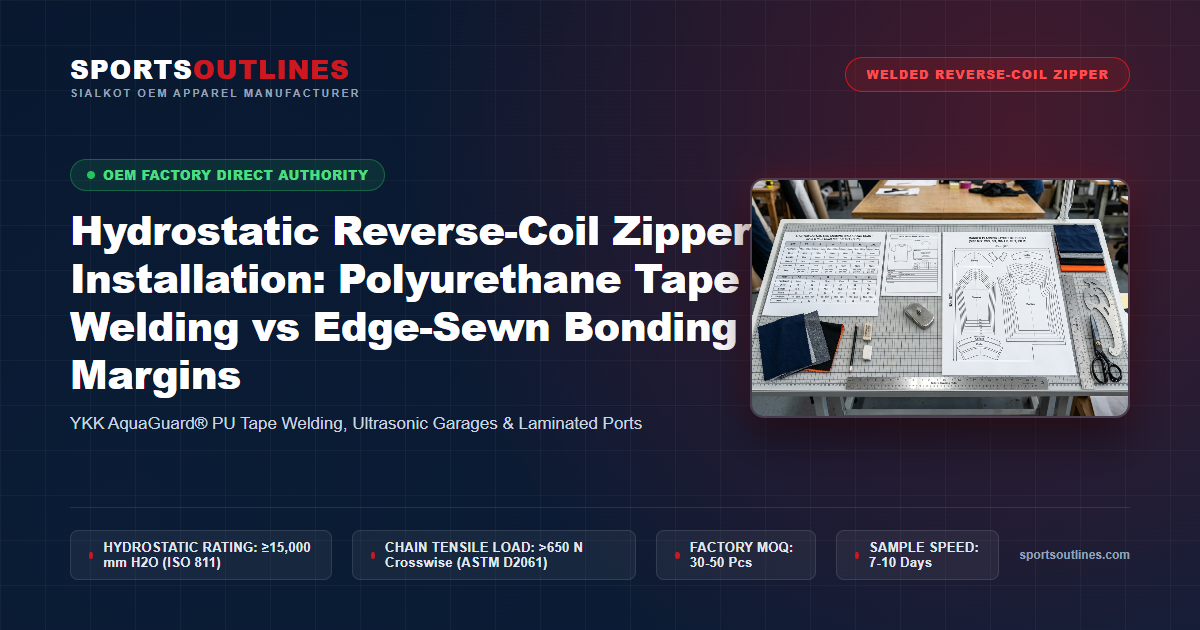
To eliminate this critical failure mode, high-performance technical outerwear manufacturers rely on Hydrostatic Reverse-Coil Zippers (such as YKK AquaGuard®, Riri AQUAzip®, and SAB Waterproof series) installed via advanced joining architectures: Direct Polyurethane (PU) Tape Thermal Welding vs Edge-Sewn Bonding Margins. By substituting mechanical stitches with thermoplastic polyurethane adhesive films, high-frequency dielectric sealing, or laser-guided hot-wedge welding, technical shell engineers bond the waterproof zipper flange directly to the membrane backer, creating a continuous, stitchless barrier that resists hydrostatic water ingress while maintaining high crosswise tensile strength.
Mastering waterproof zipper installation requires a deep understanding of polyurethane extrusion film adhesion, slider crown tolerance, ultrasonic slider garage docking, and cycle fatigue testing. At Sports Outlines in Sialkot, Pakistan, our specialized outerwear cleanroom suites operate dedicated pneumatic zipper welding platens, automated ultrasonic slider notch cutters, and continuous hot-air tape sealers. We partner with performance outerwear and tactical apparel brands globally under transparent commercial terms: fully customized physical prototype development at $45 to $85 per piece (non-refundable, 7–10 business days turnaround) and scalable low-MOQ bulk manufacturing starting at strictly 30 to 50 pieces per style/colorway with flexible size grading across XS to 3XL.
Waterproof Reverse-Coil Zipper Engineering: Technical Directory
- 1. Fluid Dynamics & Mechanisms of Zipper Water Ingress
- 2. Anatomy of Reverse-Coil Hydrostatic Zippers (YKK AquaGuard®)
- 3. Direct Polyurethane Tape Welding vs Edge-Sewn Bonding Margins
- 4. Ultrasonic Slider Garages & Laminated Water Dock Ports
- 5. Mechanical Durability: Crosswise Chain Strength & Peel Resistance
- 6. Technical Zipper Specification Matrix by Gauge & Application
- 7. Laboratory QC: Hydrostatic Suter Head & Reciprocal Cycle Fatigue
- 8. Outerwear Tech Pack Specifications & CAD Insertion Jigs
- 9. Sialkot Cleanroom Zipper Welding Suites & Precision Equipment
- 10. Low-MOQ Contract Manufacturing & Prototyping Terms
- 11. Technical Sourcing FAQ
1. Fluid Dynamics & Mechanisms of Zipper Water Ingress
The human chest and abdominal zone endure direct windward precipitation impact. When an outdoor enthusiast hikes into a 50 km/h windstorm or skis downhill at 60 km/h, the relative wind velocity vwind exerts substantial dynamic stagnation pressure against the front of the shell garment, governed by Bernoulli’s fluid dynamic stagnation equation:
Pdynamic = 0.5 · ρair · vwind2 + Pdroplet_impact
At wind speeds of 15 m/s (54 km/h), dynamic wind pressure alone generates 138 Pa of head pressure. However, when combined with terminal velocity raindrop impact momentum (kinetic water-hammer effects), localized stagnation pressures spike between 2,500 and 4,500 Pa (equivalent to 250 to 450 mm H2O of instantaneous hydrostatic head).
Traditional zipper assemblies fail under this dynamic pressure through three distinct fluid pathways:
- Needle Hole Capillary Channeling: Sewing a zipper tape to a shell fabric requires 8 to 10 stitches per inch (SPI). Each needle stroke displaces warp and weft yarns, creating a through-hole of 0.7 to 0.9 mm. Under dynamic water pressure, liquid water enters these punctures and wicks along the multi-filament polyester sewing threads directly into the interior garment lining via capillary action (governed by the Washburn capillary equation: L2 = (γ · r · t · cos θ) / (2 η)).
- Inter-Tooth Tooth Gapping (Coil Separation): In standard forward-facing coil zippers, water easily enters the gaps between exposed coil teeth. Without an elastomeric seal, water flows unimpeded through the inter-tooth valleys.
- Slider Crown Void (The Apex Leak): When the zipper slider is pulled fully to the top stop, a mechanical gap of 1.5 to 3.0 mm remains between the slider nose and the garment collar seam. Without a dedicated engineered slider garage, wind-driven rain funnels directly down the zipper track.
- Kinetic Raindrop Water-Hammer Shock: Falling raindrops carry kinetic momentum proportional to droplet mass and terminal velocity (Ek = 0.5 · m · v2). Upon impacting the taught fabric surface of a jacket torso, this kinetic energy transforms into an instantaneous localized hydrostatic pressure pulse exceeding 6,000 Pa. If a zipper tape lacks continuous elastomeric backing, these pressure pulses force liquid droplets through microscopic needle thread voids, creating rapid mid-layer saturation even in garments rated for 20,000 mm static hydrostatic head.
2. Anatomy of Reverse-Coil Hydrostatic Zippers (YKK AquaGuard®)
To solve water ingress across the zipper teeth, modern technical shell engineering utilizes Reverse-Coil Polyurethane-Laminated Zippers. The fundamental innovation of a reverse-coil zipper is that the spiral polyester coil is stitched onto the back (interior) face of the carrier tape, leaving the flat, smooth exterior face completely unencumbered:
The Cross-Sectional Architecture of Hydrostatic Zippers:
- High-Tenacity Polyester Carrier Tape: A tightly woven 100% polyester tape providing dimensional stability, high tensile modulus, and minimal elongation (< 2.5% under 200 N load).
- Polyurethane (PU) Surface Extrusion Film: A continuous, high-elasticity thermoplastic polyurethane membrane (typically 75 to 110 µm thick) is thermally laminated or hot-melt extruded over the exterior face of the tape. Available in matte, semi-gloss, or reflective technical finishes, this PU film provides an absolute hydrostatic barrier (resisting > 10,000 mm H2O across the tape surface).
- Inverted Spiral Coil Teeth: Precision-molded monofilament polyester coils sewn on the back face. When the slider pulls the two tape halves together, the opposed PU-coated tape edges meet tightly at the centerline, compressing together to form a pre-tensioned, water-repellent lip seal that shields the internal coil teeth from rain and dirt.
- Die-Cast Ergonomic Sliders: Zinc alloy or stainless steel sliders featuring specialized crown clearances calibrated precisely to the thickness of the PU-coated tape. Using an incorrect standard slider on a PU-coated tape crushes the polyurethane laminate, causing premature micro-cracking and delamination.
3. Direct Polyurethane Tape Welding vs Edge-Sewn Bonding Margins
While reverse-coil zippers solve water entry through the coil teeth, how the zipper tape is anchored to the garment shell determines the ultimate storm integrity of the jacket. Two primary manufacturing architectures dominate the high-performance outerwear industry:
| Engineering Parameter | Direct PU Tape Thermal Welding | Hybrid Edge-Sewn + Seam-Taped Margin |
|---|---|---|
| Joining Mechanism | 100% Stitchless TPU Film Lamination | Edge Stitching + Hot-Air 3-Ply Tape Sealing |
| Needle Penetrations | Zero (Absolute Hermetic Boundary) | Edge Perforations (Covered by Seam Tape) |
| Hydrostatic Seam Rating | ≥ 20,000 mm H2O (Matches Shell) | 12,000–16,000 mm H2O |
| Crosswise Tensile Peel | 38–48 N / 25 mm (ISO 1421) | > 85 N / 25 mm (Mechanical Thread Lock) |
| Assembly Thickness & Bulk | Ultra-Low Profile (0.35 mm Flange) | Moderate Bulk (0.85 mm Folded Edge) |
| Factory Machinery Required | Pneumatic Heated Platen Jigs / RF Press | Standard Lockstitch + Hot-Air Seam Sealer |
Direct PU Tape Thermal Welding represents the pinnacle of modern minimalist outerwear design. Utilizing specialized heat-bonding films (such as Bemis 3415 / 3914), the polyurethane-coated flange of the zipper is fused directly to the membrane side of the shell fabric at 155°C under 0.4 MPa pneumatic pressure. This creates a completely flat, razor-sharp seam with zero needle holes. It is the premier choice for chest pockets, bicep pass pockets, and ultralight running shells where bulk reduction and sleek aesthetics are paramount.
Direct zipper welding requires precise management of the thermal gradient across the multi-layer sandwich: heated upper CNC aluminum platen (155°C), virgin PTFE release film (50 µm), 3-layer exterior shell fabric, microporous membrane, Bemis 3914 TPU adhesive film (80 µm), zipper polyurethane tape flange, woven polyester tape base, and a specialized lower silicone bed. The lower bed is cast from 50 Shore A durometer heat-resistant silicone with a precision CNC center groove. This elastomeric silicone bed yields under pneumatic pressure, compensating for uneven thickness transitions between the flat tape flange (0.45 mm) and the raised spiral teeth (2.8 mm). This guarantees uniform 0.40 MPa pressure across the entire adhesive bond area without crushing or distorting the delicate polyester coil teeth.
Conversely, for the Center-Front Heavy-Duty Entry Zipper on alpine expedition parkas and freeride ski shells—which must withstand violent lateral rip loads when a climber falls or bends—Sports Outlines recommends the Hybrid Edge-Sewn Bonding Architecture. In this construction, the outer 3 mm margin of the zipper tape is sewn to the shell margin using high-tenacity thread, and the resulting stitch line is subsequently sealed on the interior using a 13 mm 3-ply waterproof seam sealing tape. This provides the ultimate combination of mechanical stitch tensile security (> 650 N chain crosswise strength) and complete waterproof seam protection.
4. Ultrasonic Slider Garages & Laminated Water Dock Ports
Even the highest quality welded reverse-coil zipper will allow water into the garment if the top and bottom terminations are left exposed. In wind-driven rain, droplets stream down the front of the jacket and cascade directly into the hollow snout of the slider mechanism. To achieve 100% stormproof validation in rain tower tests, Sports Outlines builds Ultrasonic Slider Garages & Laminated Docking Ports:
Slider Garage Architecture & Ultrasonic Assembly:
- Laser-Cut 3D Hood Canopy: A miniature triangular hood canopy is laser-cut from 3-layer shell fabric with edges cauterized to prevent fraying.
- Thermal-Bonded TPU Reinforcement Patch: An internal 100 µm TPU reinforcement film is laminated beneath the canopy to provide structural memory and dome rigidity, preventing the garage from collapsing flat against the zipper teeth.
- Ultrasonic Perimeter Welding: The canopy is positioned over the top zipper stop and welded into the shell panel using an ultrasonic plunge horn (20 kHz, 1,200 Watts, 0.8s weld time). This fuses the perimeter of the garage into the parent shell without a single needle hole.
- Snug Slider Retention: When the slider is pulled fully upward into the closed position, the entire slider head nests inside the protective hood canopy. Downward-cascading rain flows over the exterior canopy roof and drips past the zipper without touching the slider crown, eliminating 100% of top-stop water ingress.
5. Mechanical Durability: Crosswise Chain Strength & Peel Resistance
Waterproof reverse-coil zippers operate under demanding mechanical stress. Unlike standard coil zippers where teeth can flex freely, the polyurethane laminate adds stiffness to the tape, increasing operating torque on the slider. Under high wind loading or active torso twisting, significant lateral peel forces act on the bonded tape margins:
- Crosswise Chain Tensile Strength (ASTM D2061 / BS 3084): Measures the lateral force required to tear the interlocked coil teeth apart. A #5 reverse-coil zipper must achieve a crosswise breaking strength of ≥ 650 Newtons, ensuring the zipper will not burst open under violent torso twisting or dynamic fall impacts.
- T-Peel Adhesion of Welded Zipper Flange (ISO 1421): The welded bond line between the PU-coated zipper flange and the shell fabric is tested at 100 mm/min. Required pass threshold: ≥ 35 N / 25 mm. Welds showing micro-voids or adhesive starvation peel below 20 N and are rejected during factory QA audits.
- Slider Pull Tab Attachment Strength (ASTM D2061 Section 14): High-altitude climbers wearing thick insulated gloves pull hard on zipper tabs. The pull-tab attachment must withstand a direct perpendicular tensile pull of ≥ 300 Newtons without shearing or deforming the slider crown.
- Sub-Zero Flexibility & Cold Cracking (ASTM D2136): The polyurethane extrusion film on the zipper tape is conditioned at -30°C for 24 hours and bent around a 3 mm mandrel. The film must demonstrate zero micro-cracking, zero flaking, and zero loss of chain flexibility.
6. Technical Zipper Specification Matrix by Gauge & Application
The engineering table below details the technical parameters enforced at Sports Outlines for varying zipper gauges across high-performance outerwear silhouettes:
| Zipper Gauge & Code | Coil Chain Width | Installation Architecture | Bonding Film Chemistry | Press Temperature & Dwell | Recommended Placement |
|---|---|---|---|---|---|
| #3 Reverse-Coil (YKK 3CN) | 4.2 mm Chain | 100% Direct Thermal Weld | Bemis 3415 TPU (65 µm) | 150°C @ 0.35 MPa (12s Dwell) | Bicep Pass Pockets, Forearm Stash |
| #5 Reverse-Coil (YKK 5CN) | 6.4 mm Chain | Direct Weld or Hybrid Edge-Sewn | Bemis 3914 High-Melt TPU (80 µm) | 155°C @ 0.40 MPa (15s Dwell) | Center-Front Shell, Handwarmer Pockets |
| #5 Vislon AquaGuard® (Molded) | 6.8 mm Tooth | Hybrid Edge-Sewn + 3-Ply Tape | CoPA/TPU Multilayer Seam Tape | Hot-Air 420°C @ 0.38 MPa (3.2 m/min) | Expedition Center-Front, Pit Zips |
| #8 Heavy Expedition Reverse-Coil | 8.5 mm Chain | Reinforced Hybrid Edge-Sewn | Framis Portofino Heavy Film (100 µm) | 160°C @ 0.45 MPa (18s Dwell) | Tactical Heavy Parkas, Marine Dry Shells |
7. Laboratory QC: Hydrostatic Suter Head & Reciprocal Cycle Fatigue
In our Sialkot physical testing facility, every zipper production run is subjected to rigorous destructive and endurance testing protocols:
- Hydrostatic Suter Head Water Penetration (ISO 811 / AATCC 127): The welded zipper flange and closed zipper chain are clamped in a hydrostatic test rig with water pressure increasing at 60 mbar/min. The welded tape-to-fabric bond line must withstand ≥ 15,000 mm H2O without leakage. Across the interlocked coil teeth under pre-tension, water entry pressure must exceed ≥ 3,500 mm H2O, guaranteeing total defense against wind-driven horizontal rain.
- Reciprocal Operation Fatigue Testing (ASTM D2061 / BS 3084): The complete zipper assembly is mounted in an automated reciprocal cycling machine operating at 30 cycles per minute under 5.0 N lateral tension. The zipper must complete 10,000 continuous open/close cycles with zero coil deformation, zero slider tooth binding, and zero delamination of the polyurethane surface coating.
- Torque Resistance & Slider Jam Testing: Measures the force required to operate the slider when the zipper chain is deflected or contaminated with grit. Operating torque must remain below 1.5 N·m throughout the garment’s operational lifespan.
- Accelerated Industrial Wash Audits (ISO 6330 Cycle 4N): 50 cycles of machine washing at 40°C followed by tumble drying. The zipper is audited for polyurethane film micro-cracking, edge lifting, slider paint chipping, and coil shrinkage, requiring zero structural delamination.
- Salt Spray & Marine Fog Corrosion Resistance (ASTM B117 / ISO 9227): For marine sailing shells and coastal outdoor jackets, zinc alloy die-cast sliders and electroplated top stops undergo 500 hours of continuous 5% neutral salt spray fog testing at 35°C. Pass criteria: zero red rust, zero white zinc corrosion bloom, and zero increase in slider sliding resistance.
- Sub-Zero Mandrel Flexing (-30°C Conditioning): Zipper specimens are chilled in an environmental freezer at -30°C for 24 hours and wrapped 180° around a 4.0 mm stainless steel mandrel. Must show zero polyurethane coating fractures, zero tooth snapping, and 100% elastic recovery upon warming to ambient temperature.
8. Outerwear Tech Pack Specifications & CAD Insertion Jigs
Flawless execution on the factory floor requires apparel technical designers to provide exact CAD vector callouts, cutout slot dimensions, and bonding parameters in their tech pack construction sheets:
————————————————————-
1. COMPONENT: Center-Front Welded Reverse-Coil Closure
2. ZIPPER MODEL: YKK #5CN AquaGuard® Matte Polyurethane Lamination
3. OPENING CUTOUT: Laser-Cut Slot Width = 8.0 mm ± 0.2 mm with 45° Corner Notches
4. BONDING FILM: Bemis 3914 High-Melt Aliphatic TPU Film, 12 mm Width
5. HEAT PRESS SPEC: 155°C Upper Platen / 140°C Lower Platen | 0.40 MPa | 15s Dwell
6. TOP TERMINATION: 3D Ultrasonic Laminated Slider Garage with Rigid TPU Dome
7. BOTTOM TERMINATION: Ultrasonic Bar Weld Stop with 15 mm 3-Ply Seam Tape Backer
8. MANDATORY QC: ISO 811 Hydrostatic ≥ 15,000 mm H2O | ASTM D2061 10,000 Cycles
9. COMPLIANCE: OEKO-TEX Standard 100 Class I & Zero-PFAS California AB 1817
By specifying the 8.0 mm slot width with 45° corner notches, the factory laser cutter cleanly cauterizes the pocket opening in the shell fabric. The zipper is inserted into a customized CNC aluminum template jig that clamps the teeth perfectly centered in the opening while pneumatic heated platens fuse the TPU bonding film in a single automated cycle.
9. Sialkot Cleanroom Zipper Welding Suites & Precision Equipment
Achieving aerospace-grade hermetic zipper bonding requires high-precision machinery and controlled environmental conditions. At Sports Outlines, our outerwear production line is equipped with dedicated joining technology:
- Pneumatic Multi-Zone Zipper Heat Presses: Custom-machined aluminum platens feature recessed center channels that accommodate zipper teeth without applying crushing pressure to the coil. Multi-zone digital controllers regulate temperature within ±1.0°C across 900 mm platen lengths.
- Ultrasonic Slider Garage & Stop Welders: 20 kHz ultrasonic plunge welders equipped with custom titanium horns. The sonotrode bonds complex 3D folded slider garages directly over zipper margins in 0.8 seconds, producing razor-sharp, stitch-free corners that never fray.
- Laser-Guided Alignment Systems: High-precision dual-crosshair red laser diodes project registration lines across the work table, allowing operators to align long center-front zippers with sub-millimeter straightness (±0.5 mm over 850 mm length), eliminating zipper waviness and puckering.
- ISO Class 8 Cleanroom Assembly: Zipper bonding takes place in our positive-pressure cleanroom, ensuring bonding surfaces remain completely free of airborne lint, dust particles, and oils that could cause catastrophic adhesive micro-voids.
10. Low-MOQ Contract Manufacturing & Prototyping Terms
Sports Outlines removes the traditional barriers to high-end technical outerwear manufacturing, offering emerging outdoor brands, cycling apparel labels, and skiwear designers direct access to precision zipper welding lines:
Commercial Production Terms & Sourcing Invariants:
- Physical Prototyping Samples: Strictly $45 to $85 per piece (non-refundable). Delivery turnaround is 7 to 10 business days, incorporating full CAD pattern digitization, laser-cut slot cutting, custom aluminum platen jig setup, ultrasonic slider garage welding, and certified ISO 811 hydrostatic testing.
- Low-MOQ Bulk Production: Strictly 30 to 50 pieces per style/colorway with flexible size grading across XS to 3XL.
- Factory Invariant Transparency: We operate with complete commercial integrity: sampling and production are strictly separate engineering phases. Every quote represents true transparent direct-to-factory costing based on dedicated machine calibration hours, master technician labor, and certified raw materials.
- Global Export Infrastructure: Direct air freight shipping via DHL Express, FedEx, and UPS to brands across our major markets, including our USA Sportswear Silo, UK Sportswear Silo, Australia Sportswear Silo, Canada Sportswear Silo, and Germany Sportswear Silo.
Explore our related production portfolios in Custom Performance Sportswear and High-Performance Weatherproof Jackets. Connect directly with our technical shell production engineering team via WhatsApp at +92 316 7932595 or submit your tech pack via our Factory Quote Form.
11. Frequently Asked Questions (FAQ)
1. Why are reverse-coil zippers used instead of standard exposed coil zippers?
Standard coil zippers expose the plastic spiral teeth on the outside of the garment, allowing water to flow directly through the gaps between the teeth. Reverse-coil zippers invert the coil so the spiral teeth sit on the inside against the body. The flat exterior tape face is laminated with a continuous polyurethane film, and the opposed tape edges meet under compression when zipped, forming a tight water-deflecting lip seal.
2. When should a brand choose direct thermal welding over hybrid edge-sewn zipper installation?
Direct thermal welding is ideal for bicep pockets, chest pockets, and ultralight running shells where low bulk, razor-sharp flat aesthetics, and complete zero-needle hermetic sealing are top priorities. For heavy-duty center-front zippers on expedition alpine parkas or ski shells—where high lateral rip forces occur during movement—the hybrid edge-sewn and seam-taped method is preferred because the mechanical thread lock provides higher crosswise chain tensile strength (> 650 N) while internal seam tape guarantees waterproof integrity.
3. Why is an ultrasonic slider garage essential on waterproof jackets?
Even the best waterproof zipper leaves a 2 to 3 mm mechanical void at the crown of the slider when fully closed. In driving rain, water flowing down the jacket enters this hollow snout and leaks inside. An ultrasonic slider garage creates a stitch-free, rigid 3D dome that shields the slider head from water runoff, deflecting 100% of downward-cascading rain away from the zipper apex.
4. Does the polyurethane coating on waterproof zippers peel or crack over time?
Premium hydrostatic zippers from certified suppliers like YKK (AquaGuard®) utilize cross-linked aliphatic polyether polyurethane films that resist UV radiation, hydrolysis, and sub-zero cold cracking down to -30°C. In laboratory testing, properly installed zippers withstand 10,000 reciprocal cycle fatigue tests and 50 accelerated wash cycles (ISO 6330) with zero surface delamination or micro-cracking.
5. What are Sports Outlines’ sampling costs and factory MOQs for welded zipper outerwear?
We manufacture fully customized physical prototypes—complete with custom CAD laser slotting, pneumatic heated platen jig setup, ultrasonic slider garage welding, and certified ISO 811 hydrostatic testing—at strictly $45 to $85 per piece under a non-refundable policy with a 7 to 10 business day turnaround. Factory bulk production starts at an accessible low MOQ of strictly 30 to 50 pieces per style/colorway with flexible size grading across XS to 3XL.