
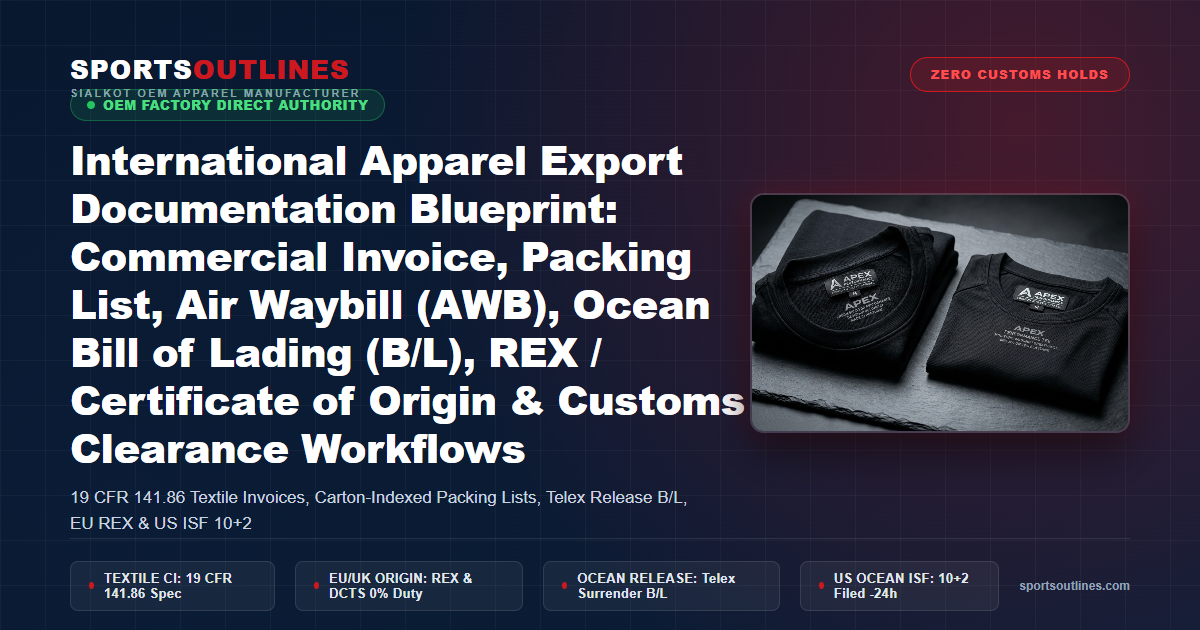
CLUSTER 6.4 TECHNICAL MONOGRAPH • EXPORT DOCUMENTATION & CUSTOMS CLEARANCE
Why Vague Line Items Like “Sportswear – 500 Pcs” Trigger 14-Day Customs Seizures, $5,000 ISF Late Penalties & Lost 0% Duty Preferences—And How Our 6-Document Export Dossier Guarantees Instant Clearance
In international apparel trade, customs authorities—whether US Customs and Border Protection (CBP), UK HM Revenue & Customs (HMRC), German Zoll / EU Customs, Australian Border Force (ABF), or Canada Border Services Agency (CBSA)—do not inspect your garments first; they inspect your digital paperwork packet while your cargo is still mid-air or mid-ocean. A single missing data field on a Commercial Invoice (such as failing to state whether a garment is Circular Knitted Chapter 61 vs. Shuttle Woven Chapter 62, omitting exact fiber composition percentages, or missing the 24-hour ocean ISF 10+2 window) will freeze your shipment in a bonded warehouse at $150/day storage. This engineering blueprint dissects the exact 6-document export architecture generated by Sports Outlines’ Sialkot export compliance desk across every shipment from a 30–50 piece low-MOQ air courier order to a 40-foot ocean container.
Technical Monograph Directory
- Document #1 — The Customs-Grade Textile Commercial Invoice (19 CFR § 141.86 / EU UCC 14-Field Specification)
- Document #2 — The Carton-Indexed Export Packing List (PL): Net/Gross Weight Reconciliation & 3PL ASN Receiving
- Document #3 — Transport Title Instruments: Air Waybill (MAWB/HAWB) vs. Ocean Bill of Lading (Original 3/3, Telex Surrender & Sea Waybill)
- Document #4 — Preferential Certificates of Origin: Unlocking 0.0% Import Duty via EU GSP+ (REX), UK DCTS & ChAFTA
- Document #5 & #6 — Pre-Departure Security & Biosecurity Filings: US CBP ISF 10+2, MID Codes & Australia BICON / ISPM-15
- Frequently Asked Questions (FAQ) on Apparel Export Documentation & Customs Clearance
1. Document #1 — The Customs-Grade Textile Commercial Invoice (19 CFR § 141.86 / EU UCC 14-Field Specification)
Unlike general merchandise, textiles, footwear, and leather combat gear are among the most heavily scrutinized tariff chapters in global trade (`HS Chapters 61, 62, 63, 42, and 64`). Under United States Code of Federal Regulations `19 CFR § 141.86` and `§ 141.89` (Additional Information for Footwear, Wearing Apparel & Textiles) as well as the EU Union Customs Code (`UCC`), a Commercial Invoice that merely states "Custom Gym Hoodies – 200 pcs – $2,800" is legally invalid for formal entry and will automatically trigger a Customs Document Hold (`CBP Form 28 Request for Information` or DHL/FedEx Clearance Delay).
Why do customs brokers require forensic technical specificity on the Commercial Invoice? Because a single word changes the Harmonized System (`HS / HTS`) code and the statutory tariff rate by up to 20%:
- Construction Method (Knitted `Chapter 61` vs. Woven `Chapter 62` vs. Leather/Pad `Chapter 42/95`): A pullover hoodie or T-shirt made from circular-knit French Terry or interlock fabric falls under
HS Chapter 61(`6110` or `6109`), whereas a windbreaker or fight short made from shuttle-loomed woven ripstop or microfiber falls underHS Chapter 62(`6201`, `6203`, or `6211`). - Chief-Weight Fiber Composition Percentage (by Weight): Matching our FTC & EU 1007/2011 Care Label Compliance, the Commercial Invoice must state exact fiber weight percentages (e.g.,
80% Combed Ringspun Cotton / 20% Polyestervs.88% Polyamide Nylon / 12% Elastane Spandex). In the US Harmonized Tariff Schedule, cotton-chief-weight knit pullovers (`6110.20.20`,16.5%duty) carry a completely different tariff rate than man-made synthetic fiber pullovers (`6110.30.30`,32.0%duty). - Gender & Age Division (`Men’s/Boys’` vs. `Women’s/Girls’` vs. `Unisex` vs. `Babies’`): Under international tariff nomenclature, Unisex garments without specific male-only closure orientation are classified under the Women’s/Girls’ subheading—so declaring exact gender classification prevents broker reclassification disputes.
| Commercial Invoice Field | Amateur Factory Error (Causes Customs Hold) | Sports Outlines Compliant Engineering Specification | Statutory Customs Regulation Satisfied |
|---|---|---|---|
| 1. Detailed Textile Line Description | "Activewear Leggings - 100 pcs" | "Women's Knitted Athletic Leggings (78% Polyamide Nylon / 22% Elastane, Circular Knit, 250 GSM) - HS 6104.63.20" | US 19 CFR § 141.86 / EU TARIC 10-Digit Classification |
| 2. Importer of Record (IOR) Tax IDs | Buyer name & street address only | Includes Buyer US EIN, UK/EU EORI + VAT ID, Canada BN15 CARM, or Australia ABN | Instant electronic customs broker matching & VAT reclaim |
| 3. Manufacturer Identification Code (MID) | Omitted or trading company PO box | Full Sialkot Factory Physical Street Address + US CBP MID Code (PK...) & WeBOC NTN | Mandatory for all US CBP Form 3461 / 7501 textile entries |
| 4. Incoterm® 2020 & Freight Split | Single lumped total without Incoterm | Explicitly separates FOB/EXW Goods Value from International Freight & Insurance | Prevents paying US Customs Duty on air freight (US duties apply to FOB value only!) |
| 5. Prototype Sample Marking ($45–$85) | Declared at $1 fake value (triggers fine) | True material/development value declared with "Commercial Evaluation Prototype Sample" HTS notation | Prevents customs undervaluation penalties while clearing in 24h |
Pro Tariff-Saving Tip for US Buyers (`FOB Valuation Rule`): Unlike the EU and UK (which calculate customs duty on the `CIF` value including international freight), the United States (`19 USC § 1401a`) calculates import customs duties strictly on the Transaction Value (`FOB / EXW` garment price), EXCLUDING international air or ocean freight! Because our Commercial Invoices always itemize the `FOB Garment Subtotal` on a separate line from `Prepaid Air/Sea Freight`, US customs brokers deduct the freight line before applying the HTS duty percentage—saving US brands hundreds of dollars in unnecessary duty on every air shipment!
2. Document #2 — The Carton-Indexed Export Packing List (PL): Net/Gross Weight Reconciliation & 3PL ASN Receiving
While the Commercial Invoice establishes financial value and tariff classification, the Export Packing List (PL) is the physical map of your shipment. If a customs officer at Port of Los Angeles, Felixstowe, or Frankfurt Airport selects your consignment for a targeted physical examination (`Tailgate / CET Exam`), they do not want to rip open all 40 master cartons to find a single SKU; they look at the Packing List to see exactly which carton number (`e.g., Carton #14 of 40`) holds that specific item.
Equally important, modern third-party logistics (`3PL`) warehouses (ShipBob, Bergen Logistics, Radial, Amazon FBA) require a Carton-Indexed Packing List to generate their Inbound Advance Shipping Notice (`ASN`). Every Packing List issued by Sports Outlines contains six synchronized data columns for each master carton (`Carton #1 of N` to `Carton #N of N`):
- Sequential Carton Number & GS1-128 / UCC Carton Barcode ID matching the waterproof thermal label affixed to two adjacent outer sides of the box.
- Style Code, Colorway & Size Breakdown Matrix (`XS, S, M, L, XL, 2XL, 3XL`) packed inside that specific carton.
- Total Piece Count per Carton & Cumulative Shipment Piece Count (reconciling 100.0% to the Commercial Invoice total).
- Net Weight (`NW` in kg): Pure weight of the garments and retail polybags inside the carton (`Quantity × Unit Weight`).
- Gross Weight (`GW` in kg): Exact digital floor-scale weight of the sealed carton including the `1.35 kg` 5-ply BC-flute corrugated box tare and PP strapping (reconciling within `±0.1 kg` of the Air Waybill or Bill of Lading gross weight).
- Exact Outer Dimensions (`L × W × H cm`) & Cubic Meter Volume (`CBM`) per carton.
3. Document #3 — Transport Title Instruments: Air Waybill (MAWB/HAWB) vs. Ocean Bill of Lading (Original 3/3, Telex Surrender & Sea Waybill)
Once your cartons pass Pakistan Export Customs (`WeBOC GD`), the carrier issues the legal transport contract. Understanding the legal difference between an Air Waybill (`AWB`) and the three types of Ocean Bills of Lading (`B/L`) prevents costly destination port release delays:
| Transport Document Type | Negotiable Document of Title? | How Cargo Is Released at Destination | Paper Courier Cost & Risk | Recommended B2B Sportswear Scenario |
|---|---|---|---|---|
| 1. Air Waybill (AWB / HAWB / MAWB) | No (Non-negotiable receipt & air carriage contract) | Released automatically to named Consignee upon customs clearance | 100% Electronic (`e-AWB`); $0 paper courier needed | All DHL/FedEx/UPS Air Express & SIAL Airport Air Cargo shipments |
| 2. Original Ocean Bill of Lading (3/3 Full Set Originals) | Yes (Physical legal title to the cargo when consigned “To Order”) | Buyer must physically hand 1 of the 3 stamped paper originals to destination shipping line | $65 DHL Doc Pouch; if lost in mail, requires 200% Bank Guarantee! | Only required when trading via Documentary Letter of Credit (`L/C`) or Cash Against Documents (`CAD`) |
| 3. Telex Release (Surrendered B/L) | Originals surrendered back to carrier at origin in Karachi | Electronic Telex Release message allows instant release to Consignee via PDF copy | Zero physical paper mailing risk; $0–$35 surrender fee | #1 Standard for Ocean LCL & FCL once balance wire payment is settled |
| 4. Express Sea Waybill (SWB) | No (Non-negotiable ocean equivalent of an Air Waybill) | Instant automatic release to named Consignee upon vessel arrival | 100% Digital PDF; zero surrender wait | Repeat brand partners with pre-settled accounts shipping fast ocean lanes |
4. Document #4 — Preferential Certificates of Origin: Unlocking 0.0% Import Duty via EU GSP+ (REX), UK DCTS & ChAFTA
One of Sialkot, Pakistan’s most powerful competitive advantages over China in global sportswear and combat gear manufacturing is Preferential Duty-Free Market Access into the European Union, the United Kingdom, and China—plus MFN status in the United States, Canada, and Australia. However, customs authorities will only grant 0.0% preferential tariff treatment if the exact legally mandated Origin Declaration or Certificate of Origin (`CO`) accompanies your Commercial Invoice:
| Destination Region | Trade Scheme Name | Standard MFN Duty (e.g. China/Vietnam) | Pakistan Preferential Duty Rate | Mandatory Origin Document Issued by Sports Outlines |
|---|---|---|---|---|
| European Union (27 Member States: Germany, NL, FR, ES, IT, etc.) | EU GSP+ (Generalised Scheme of Preferences Plus) | 12.0% on Apparel (Ch. 61/62) 4.0%–9.7% on Sports/Leather Gear | 0.0% DUTY FREE! | EU Registered Exporter (`REX`) Statement on Origin printed directly on the Commercial Invoice (Mandatory for all consignments > €6,000; no paper Form A needed!) |
| United Kingdom (England, Scotland, Wales, NI) | UK DCTS (Developing Countries Trading Scheme — Enhanced Preferences) | 12.0% UK Global Tariff on Apparel | 0.0% DUTY FREE! | UK DCTS Origin Declaration on Commercial Invoice (or Form A) certifying wholly obtained / double-transformation qualifying manufacture in Pakistan |
| United States (USA) | Normal Trade Relations (NTR / MFN) + GSP (Select Sports Goods) | China carries +7.5% to +25% Section 301 Punitive Tariffs! | 0% Section 301 Penalty (Standard HTS MFN Rate Only) | Sialkot Chamber of Commerce (`SCCI`) Certificate of Origin + CBP Manufacturer ID (`MID`) + Textile Country-of-Origin Declaration |
| Australia & Canada | ABF MFN ($1,000 AUD De Minimis) / CBSA GPT & MFN | 5% AU Duty (>$1,000 AUD) / 16%–18% CA Apparel Duty | 0% AU Duty/GST ≤$1,000 AUD; Standard MFN/GPT above | SCCI Certificate of Origin + Australian BICON Non-Wooden/ISPM-15 Packing Declaration |
5. Document #5 & #6 — Pre-Departure Security & Biosecurity Filings: US CBP ISF 10+2, MID Codes & Australia BICON / ISPM-15
Two region-specific compliance filings must be executed before your ocean vessel even departs Karachi Port:
- 1. United States Ocean Imports — Mandatory `ISF 10+2` (Importer Security Filing) 24 Hours Prior to Vessel Loading: For every ocean LCL or FCL shipment bound for a US seaport (note: ISF does not apply to air freight), US Customs and Border Protection enforces the 10+2 Rule. At least 24 hours before the container is loaded onto the mother vessel at Karachi Port, your US customs broker (or our DDP desk) must transmit 10 data elements to CBP: (1) Manufacturer Name & Address (`Sports Outlines, Sialkot`); (2) Seller Name & Address; (3) Buyer Name & Address; (4) Ship-To Name & Address; (5) Container Stuffing Location (`Sialkot Dry Port` or `Karachi CFS`); (6) Consolidator (`Stuffer`) Name & Address; (7) Importer of Record (`EIN / IRS Number`); (8) Consignee Number; (9) Country of Origin (`PK`); and (10) Commodity 6-to-10 Digit `HTSUS` Numbers—plus the Automated Manifest System (`AMS`) House Bill of Lading number. Filing an ISF late or inaccurately triggers an automatic $5,000.00 liquidated damages penalty per violation (`19 CFR § 149.2`)! Our export desk emails your pre-completed ISF 10+2 Data Sheet 72 hours before Karachi vessel cutoff so your broker always files on time.
- 2. Australia & New Zealand Ocean Imports — BICON Annual/Consignment Packing Declaration, ISPM-15 Heat-Treated Pallets & BMSB Rules: The Australian Department of Agriculture, Fisheries and Forestry (`DAFF / BICON`) strictly audits ocean containers for timber pests and bark contamination. Every sea shipment we dispatch to Sydney, Melbourne, Brisbane, or Fremantle includes a signed DAFF-Compliant Packing Declaration certifying: (a) ZERO prohibited packaging materials (straw, rice husks, peat, or soil); (b) FCL container interior cleanliness inspection prior to loading; and (c) if wooden pallets are used instead of floor-loading or slip-sheets, valid ISPM-15 Heat-Treatment (`HT`) IPPC stamps.
| Milestone Timing | Air Express Courier (DHL / FedEx / UPS) | Hard Air Cargo (SIAL Airport) | Ocean LCL / FCL (Karachi Port) |
|---|---|---|---|
| 72 Hours Before Dispatch / Cutoff | AQL 2.5 QC Report + Draft Commercial Invoice & Packing List verified | Draft CI, PL & Consignee Customs Broker details locked | US ISF 10+2 Data Sheet + Draft B/L sent to Buyer/Broker (Filed ≥24h pre-load!) |
| Day of Factory Dispatch (Day 0) | Paperless Trade (`PLT`) e-Invoice, PL, REX/DCTS & WeBOC GD uploaded to DHL/FedEx | Cartons delivered to SIAL Airport; WeBOC GD cleared; Master/House AWB issued | Bonded truck departs Sialkot for Karachi CFS / Terminal; WeBOC Export GD cleared |
| 24–48 Hours Post-Departure | Pre-alert clearance completed in transit while aircraft is over Dubai/Europe | Full Digital PDF Document Dossier (`CI + PL + HAWB + CO/REX`) emailed to Buyer | Onboard Ocean Bill of Lading issued; Telex Surrender / Sea Waybill + REX/CO + BICON PDF sent |
| Arrival & Final Delivery | Delivered to Buyer Door on Day 3–5 with Zero Customs Hold | Cleared on arrival Day 5–7; delivered to door Day 7–10 | Pre-cleared 5 days prior to vessel docking; immediate port release without storage |
5.1 Inside Pakistan’s WeBOC Customs Portal & State Bank Electronic `Form-E` Export Clearance
Why do orders placed with unverified middlemen or informal workshops in South Asia frequently suffer 5-to-10 day origin delays at the airport before the tracking number ever goes “Active”? Because every commercial export shipment departing Pakistan must clear two mandatory sovereign regulatory systems before an aircraft or container vessel is legally permitted to load the cartons:
- State Bank of Pakistan (`SBP`) Electronic Form-E (`EFE`) Certification: Under Pakistan Foreign Exchange Regulations, a registered manufacturer must generate an electronic
Form-Ethrough its commercial bank (`Authorized Dealer`) linked to the buyer’s wire transfer, Letter of Credit, or contract CAD registration, certifying the export value and HS codes. Because Sports Outlines holds direct Tier-1 Exporter standing with automated SBP banking integration, ourEFEapproval is issued electronically in under 15 minutes. - Pakistan Customs `WeBOC` (Web Based One Customs) Goods Declaration (`GD`) & Anti-Narcotics Force (`ANF`) Scanning: Once the `EFE` is linked, our in-house customs license files the electronic Export Goods Declaration (`GD`) on the federal `WeBOC` portal, matching the exact carton weights, piece counts, and 8-digit Pakistan Customs Tariff (`PCT`) codes against your Commercial Invoice and Packing List. At Sialkot International Airport (`SIAL`), Sialkot Dry Port (`SDPT`), or Karachi Port (`KICT/SAPT`), the consignment passes through dual-energy X-ray scanning, ANF verification, and customs examination—generating the stamped Out-of-Charge Export GD required for immediate flight uplift.
5.2 Bovine Cowhide Leather Declarations (Non-CITES / US Fish & Wildlife Avoidance) for Combat Gear & Varsity Jackets
When your shipment includes genuine leather varsity bomber jackets, motorcycle racing suits, or cowhide boxing gloves (`HS 4203.10` / `4203.21`), customs wildlife inspectors in the United States (`US Fish & Wildlife Service — USFWS`), the European Union, and Australia check the Commercial Invoice to ensure the leather is not derived from endangered exotic species regulated under CITES (Convention on International Trade in Endangered Species).
If an invoice simply says "100% Genuine Leather Boxing Gloves" without naming the exact domesticated animal species and scientific Latin binomial, USFWS or EU border control can place an automatic Wildlife Species Hold on the shipment. To guarantee zero wildlife inspection delays, every Sports Outlines Commercial Invoice for leather goods explicitly declares the scientific taxonomy: "100% Domesticated Bovine Cowhide Leather (Bos taurus) or Water Buffalo Hide (Bubalus bubalis) — Non-CITES Domesticated Livestock Origin, Chrome/Vegetable Tanned in Sialkot, Pakistan".
5.3 DHL Paperless Trade (`PLT`) & FedEx Electronic Trade Documents (`ETD`) vs. Waterproof Carton Pouch Redundancy
Even though our export desk transmits 100% of your customs dossier digitally via DHL Paperless Trade (`PLT`) and FedEx Electronic Trade Documents (`ETD`) the moment the Air Waybill is created—allowing destination customs brokers in Memphis, Cincinnati, Leipzig, Stansted, and Sydney to pre-clear your shipment while the plane is still in the air—physical document redundancy remains mandatory. Every lead master carton (`Carton #1 of N`) leaving our facility carries a sealed, waterproof “DOCUMENTS ENCLOSED” red polyethylene pouch on its top panel containing three ink-signed, company-stamped copies of the Commercial Invoice, Carton-Indexed Packing List, and REX / Certificate of Origin so ramp agents can clear the parcel instantly even during airline IT outages.
ZERO-HOLD EXPORT COMPLIANCE ENGINEERING
Import Custom Sportswear with 100% Bulletproof Customs Documentation & 0% EU/UK Preferential Duty
From your first $45–$85 physical prototype sample (7–10 business days turnaround) and 30–50 piece low-MOQ launch run to multi-container wholesale programs, our Sialkot export compliance team prepares your complete 19 CFR § 141.86 Commercial Invoice, Carton-Indexed Packing List, EU GSP+ REX / UK DCTS origin statements, and ISF 10+2 sheets automatically.
6. Frequently Asked Questions (FAQ) on Apparel Export Documentation & Customs Clearance
1. Why must an apparel Commercial Invoice specify “Knitted” vs. “Woven” and exact fiber percentages?
Global customs schedules split apparel into HS Chapter 61 (Knitted or Crocheted) and HS Chapter 62 (Woven), and further subdivide tariff rates by chief-weight fiber (`Cotton` vs. `Man-Made Synthetic Polyester/Nylon`). Under US 19 CFR § 141.86 and EU UCC rules, omitting knit/woven construction or exact fiber percentages causes an immediate customs clearance hold until a revised textile invoice is submitted.
2. How do UK and European Union buyers claim 0.0% import duty on custom sportswear from Sialkot, Pakistan?
Pakistan enjoys duty-free access to the EU under GSP+ and to the UK under the Developing Countries Trading Scheme (`DCTS` Enhanced Preferences). We include our official EU Registered Exporter (`REX`) Statement on Origin or UK DCTS Origin Declaration directly on your Commercial Invoice so your shipment clears with 0.0% customs duty (saving 12% compared to Chinese imports).
3. What is the difference between an Original Ocean Bill of Lading and a Telex Release (Surrendered B/L)?
An Original Bill of Lading (`3/3 Originals`) requires mailing physical stamped paper across the world via courier before the destination port will release your container. With a Telex Release (`Surrendered B/L`) or Express Sea Waybill (`SWB`), we surrender the originals in Pakistan so your cargo is released electronically at destination using a digital PDF copy with zero paper mailing risk.
4. Does the US ISF 10+2 filing requirement apply to 30–50 piece air courier orders?
No. The US CBP ISF `10+2` (Importer Security Filing) applies strictly to ocean vessel shipments arriving at US seaports (and must be filed at least 24 hours before vessel loading at Karachi Port). Air Express (`DHL/FedEx/UPS`) and Air Cargo shipments are exempt from ISF 10+2.
5. Why does Sports Outlines itemize FOB garment value separately from Prepaid Air Freight on US Commercial Invoices?
Because under US Customs Valuation Law (`19 USC § 1401a`), ad valorem import tariffs are assessed strictly on the FOB origin price of the merchandise, excluding international freight and marine insurance. Separating the freight line ensures US customs brokers never accidentally charge you textile duty on your air or ocean shipping cost.
6. What species declaration is required when importing genuine leather boxing gloves or varsity jackets into the USA, EU, or Australia?
To prevent CITES wildlife holds by US Fish & Wildlife or EU border control, our Commercial Invoices explicitly state the domesticated scientific binomial: "100% Domesticated Bovine Cowhide Leather (Bos taurus) — Non-CITES Livestock Origin".
Pingback: Harmonized Tariff Schedule (HTS / HS Code) Classification Engineering for Custom Sportswear: Chapter 61 (Knitted) vs Chapter 62 (Woven), Cotton (16.5%) vs Man-Made Synthetic (28.2%–32.0%) Duty Rates & Chief-Weight Fiber Rules - Sports Outlines