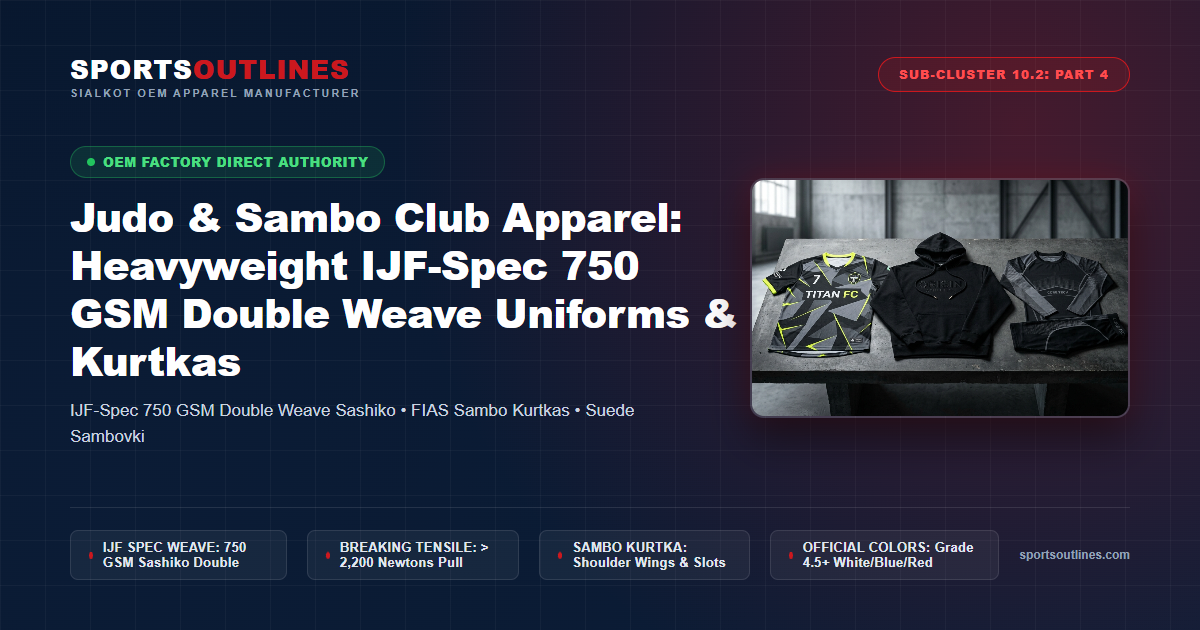
Direct Manufacturer Snapshot: Judo & Sambo Club Apparel: Heavyweight IJF-Spec 750 GSM Double Weave Uniforms & Kurtkas
Outfitting competitive Judo clubs, Olympic training centers, and international Sambo federations requires extreme tensile textile engineering compliant with International Judo Federation (IJF) and International Sambo Federation (FIAS) regulations: 1) IJF-Standard Judo Gi Jacket: Heavyweight 750 GSM (700–800 GSM tolerance) double-weave cotton-polyester composite fabric (75% bleached/optical white or royal blue cotton / 25% high-tenacity polyester reinforcement), incorporating a classical Sashiko rice-grain upper weave and Hishizashi diamond lower skirt, with 4-line reinforced lapel collars capable of withstanding over 2,200 Newtons of explosive gripping pull force without seam failure. 2) Sambo Kurtka & Uniform Architecture: 500–550 GSM dense herringbone or grain-weave 100% heavy cotton jacket in competition Red or Blue, featuring integrated shoulder wings (epaulettes) for throw gripping, reinforced waist pass-through slots for belt stabilization, paired with 4-way stretch poly-cotton Sambo wrestling shorts and suede grappling shoes. 3) Heavy Reinforced Grappling Pants: 10oz to 12oz combed cotton twill or micro-ripstop featuring continuous dual-layer knee-to-ankle padding, reinforced cross-stitched crotch gussets, and traditional Japanese wrap drawstrings. 4) Direct OEM Factory Margins: Sourcing directly from Sports Outlines International in Sialkot, Pakistan, bypasses European brand distributors ($180–$280 retail per IJF Gi), delivering direct factory FOB pricing of $34.50–$46.50 for 750 GSM double-weave Judo Gis, $22.50–$28.50 for FIAS-spec Sambo Kurtkas, and $8.50–$11.50 for competition Sambo shorts at accessible 30–50 set MOQs. This empowers club directors and national associations to achieve 70% to 76% pro shop gross margins with rapid $45–$85 physical prototype sampling (7–10 days turnaround) and pre-cleared DDP global logistics.
Direct WhatsApp: +92 316 7932595

1. The High-Tensile Grappling Landscape: Engineering for Extreme Pull Forces
Among all combat sports, Judo and Sambo place the single greatest structural tensile demand on athletic textiles. When an Olympic-level judoka executes an explosive hip throw (Harai Goshi) or shoulder throw (Seoi Nage), or when a Sambo competitor locks into an aggressive grip fight to execute an over-the-back lateral drop (Khvareli), the jacket lapels, sleeves, and back panels endure sudden multi-directional kinetic pull forces exceeding 2,200 Newtons (over 500 lbs of focal force).
Under these violent mechanical conditions, standard martial arts uniforms simply disintegrate: lightweight single weaves rip at the armpits, lapels stretch out of shape, and seams burst at the waist split. For competitive Judo dojos, national training centers, and regional Sambo clubs, outfitting athletes requires specialized, certified double-weave kimonos and reinforced Kurtkas.
Traditionally, dojo senseis have been forced to source uniforms through European or Japanese legacy brands (Mizuno, Fighting Films, Kusakura, Green Hill). While prestigious, the commercial reality for club operators is financially punishing:
- Extreme Retail Markups: An IJF-compliant 750 GSM double-weave Judogi from legacy European brands retails for $180.00 to $280.00, with wholesale club prices rarely dropping below $120.00. This high financial barrier discourages new student enrollment and limits the club’s pro shop profit margins to barely 20% to 30%.
- Sambo Equipment Scarcity: Sambo remains a specialized combat discipline. Most martial arts distributors carry zero inventory of FIAS-compliant Sambo Kurtkas with authentic shoulder epaulettes and belt slots, forcing clubs to navigate unreliable single-item imports from Eastern Europe with months of shipping delays.
- Zero Custom Dojo Identity: Purchasing off-the-rack uniforms leaves zero room for custom club embroidery, custom shoulder tapes, or dojo backpatches that build school pride and team cohesion.
Sports Outlines International resolves this dilemma by delivering direct factory access to Sialkot, Pakistan’s master heavy-weaving textile infrastructure. Manufacturing authentic 750 GSM double-weave Judogis starting at just $34.50 to $42.50 and FIAS-compliant Sambo Kurtkas at $22.50 to $26.50 on accessible 30 to 50 set MOQs, we empower dojo owners and combat wrestling directors to capture 70% to 76% pro shop gross profit margins while providing athletes with competition-grade armor engineered to withstand years of intense grappling.
Engineer IJF-Spec Judo Gis & Sambo Kurtkas with Sialkot Heavy Weave Specialists
Direct Factory OEM • 750 GSM Double Weave Sashiko • FIAS Sambo Kurtkas • Low 30 Set MOQ • 7-10 Day Prototypes
✓ $45–$85 Physical Prototypes •
✓ Worldwide DDP Delivery
2. IJF-Standard Judo Gi Engineering: 750 GSM Sashiko & Hishizashi Textile Physics
The International Judo Federation (IJF) strictly enforces technical parameters governing uniform construction to maintain fairness and safety during international competitions. A competition-legal Judogi is a masterpiece of two-part weaving geometry:
- Upper Jacket Sashiko Weave (Rice-Grain Architecture): From the neck collar down to the waist belt line, the jacket is woven with a heavy, multi-layered Sashiko double weave. This architecture utilizes thick, high-twist combed cotton yarns interlaced with reinforcement polyester threads. The resulting surface features a raised ‘rice-grain’ texture that provides incredible structural stiffness, making it exceptionally difficult for an opponent to establish deep, dominant collar and sleeve grips (Kumi-kata). The 75/25 cotton-polyester blend ensures high tensile breaking strength (>2,200 N) while reducing sweat absorption weight by 30% compared to vintage 100% cotton uniforms.
- Lower Skirt Hishizashi Weave (Diamond Pattern): Below the belt line, the weave transitions seamlessly into a single-layer diamond-pattern Hishizashi weave. This reduces bulk around the hips and thighs, allowing the jacket skirt to drape cleanly beneath the belt and permitting uninhibited hip articulation during deep leg sweeps and hip pivots.
- Lapel Core & Precision Dimensions: IJF regulations mandate that the collar lapel must measure exactly 4.0 to 4.5 cm in width and no more than 1.0 cm in thickness, reinforced with 4 to 5 parallel rows of heavy-duty machine topstitching. Sports Outlines inserts a high-density, multi-layered canvas core inside the lapel that maintains permanent firmness without exceeding legal thickness gauges.
- Reactive Vat Colorfastness (Optical White & Royal Blue): In modern competition, competitors are designated White or Blue. Our royal blue fabrics undergo pressurized high-temperature vat dyeing, achieving Grade 4.5+ colorfastness under ISO 105 testing, guaranteeing that blue kimonos will never bleed color onto opponents’ white Gis or mat surfaces during sweat-drenched matches.
Technical Specifications: Judo & Sambo Institutional Grappling Uniforms
| Uniform Type | Fabric Blend & Weave | Target Weight (GSM) | Tensile Strength | Key Functional Feature | Regulatory Standard |
|---|---|---|---|---|---|
| Competition Judogi (Jacket) | 75/25 Cotton-Poly Sashiko/Hishizashi | 750 GSM (±50) | 2,250 N | 4.5cm Lapel, 4-Row Topstitch | IJF Competition Compliant |
| Club Training Judogi | 100% Combed Cotton Double Weave | 550–600 GSM | 1,850 N | Soft Brushed Interior, Elastic Pants | Dojo Student & Youth Training |
| FIAS Sambo Kurtka | 100% Cotton Dense Grain Weave | 500–550 GSM | 1,950 N | Shoulder Epaulettes & Belt Slots | FIAS Sambo Competition Specs |
| Sambo Competition Shorts | Heavy Stretch Poly-Spandex Knit | 250 GSM | 1,200 N | High Thigh Cut, Non-Slip Waist | FIAS Color-Matched Red/Blue |
3. Sambo Kurtka Architecture: Epaulettes, Belt Slots & Combat Wrestling Dynamics
Sambo (Samozashchita Bez Oruzhiya—Self-Defense Without Weapons) is a high-octane martial art blending elements of folk wrestling, judo throws, and brutal leg submissions. The official uniform—the Kurtka—is engineered specifically for fast-paced, high-amplitude throws:
- Shoulder Epaulettes (Wings): Stitched directly into the outer shoulder seams, these reinforced fabric ridges provide opponents with a dedicated handhold. During close-range clinch wrestling, fighters hook their fingers under the epaulettes to execute explosive shoulder throws (such as Mel’nitsa / the Fireman’s Carry) without the fabric slipping out of their grasp. We reinforce these wings with 6-needle perimeter stitching and heavy canvas stabilizers.
- Integrated Belt Pass-Through Slots: In Judo, jackets frequently come untucked from the belt, pausing the match. In Sambo, the Kurtka incorporates two vertical reinforced buttonholes on each side of the waist. The rank belt passes through the jacket fabric itself, permanently locking the lower skirt tight to the torso and preventing the jacket from riding up during ground scrambles and rolling leg locks.
- Dense 500–550 GSM Cotton Grain Weave: The Kurtka is constructed from a rugged, dense herringbone or twill weave cotton that resists tearing while providing a softer, more flexible drape than a 750 GSM Judo Gi, facilitating rapid upper-body pummeling and throw setups.
- Color-Matched Red & Blue Sets: Sambo athletes must own matching sets in competition Red and Blue. Sports Outlines manufactures complete color-matched kits comprising the Kurtka, matching 250 GSM 4-way stretch shorts, and matching soft suede wrestling shoes (Sambovki) with reinforced leather ankle pads.

4. Pants Engineering: Double-Layer Knee-to-Ankle Reinforcement
In competitive Judo and Sambo, the knees endure continuous punishing contact against tatami mats during drop-knee throws (such as Drop Seoi Nage) and ground transition battles (Ne-waza). Standard martial arts pants with thin single-layer knees wear through within 3 to 6 months of intense training.
Sports Outlines constructs grappling pants from heavy 10oz to 12oz combed cotton twill or micro-ripstop, engineered with three vital durability features:
- Full Shin-to-Knee Dual-Layer Padding: We extend the interior knee reinforcement panel continuously from mid-thigh all the way down to the bottom ankle hem. Multiple rows of horizontal channel stitching lock the inner fabric layer to the outer shell, preventing fabric shifting and providing critical impact cushioning against hard mat impacts.
- Diamond Crotch Gusset: An oversized multi-panel crotch gusset redistributes tensile strain away from the central seam, allowing athletes to drop into deep, wide stances for counter-throws without seam failure.
- Traditional Japanese Wrap Drawstring: For senior judokas, we provide authentic unbleached flat canvas drawstrings routed through four heavy-duty belt loops, ensuring a rock-solid waist lock that never slips during matches. For youth and beginner classes, we offer hybrid elasticated-drawstring waists for easy student dressing.
5. Commercial Economics: Sialkot Direct Factory vs. European Importers
Operating an active Judo dojo or wrestling club with 100 competitive members requires constant uniform replenishment. Consider the annual savings unlocked by transitioning to direct factory sourcing:
Purchasing 60 competition Judogis per year from European brand wholesalers at $130.00 each costs the club $7,800.00. Selling them to students at $175.00 earns $2,700.00 in profit (a modest 25% margin).
By sourcing directly from Sports Outlines International at $38.50 per 750 GSM custom-embroidered Judogi set, those exact same 60 uniforms cost just $2,310.00. Reselling the custom dojo-crested kimonos for $165.00 generates $7,590.00 in net profit—an immediate $4,890.00 annual profit increase for the club. In addition, every student steps onto the competition tatami wearing a unified, professionally embroidered dojo uniform that reinforces club prestige.
| Sourcing Feature & Risk Factor | Sports Outlines (Sialkot Direct) | Alibaba Trading Agents | Traditional Chinese Hubs | Print-on-Demand (POD) |
|---|---|---|---|---|
| Weave Architecture & GSM Density | Genuine 750 GSM Sashiko rice-grain upper weave + Hishizashi diamond skirt; 75/25 cotton-poly high-tensile core | Lightweight 450–550 GSM single weave mislabeled as ‘heavy double weave’; tears easily under seoi-nage throws | Focus on lightweight polyester karate fabrics; lacks heavy shuttle loom capacity for authentic 750 GSM judo cloth | N/A (Print-on-demand suppliers have zero industrial double-weave textile weaving capabilities) |
| Lapel & Seam Breaking Strength | Reinforced 4-line heavy lapel with multi-layer canvas core; engineered to withstand >2,200 Newtons tensile grip pulling | Thin cotton core with single stitching that pulls out at the armpit and collar seams during aggressive kumi-kata battles | Generic poly-core lapels that deform and stretch permanently after minimal grip fighting drills | N/A |
| Sambo Kurtka Federation Requirements | Authentic FIAS-pattern shoulder wings (epaulettes) and reinforced side belt pass-through slots in competition Red & Blue | Basic judo jacket dyed red/blue without functional shoulder wings or belt slots, violating official competition rules | Flimsy twill jackets with decorative wings that tear off during basic lateral throws and rolling kneebars | N/A |
| Minimum Order Quantity (MOQ) | Agile 30–50 Sets per style with mixed adult and youth sizing (150cm to 210cm) and mixed Blue/White or Red/Blue sets | 150–250 sets per single colorway with rigid sizing breakdowns and high sample charges | 300–500 sets minimum; requires container-volume commitments impractical for independent clubs | Single unit available only for sublimated rashguards; zero authentic judogi or kurtka production |
| Prototyping SLA & Cost | $45–$85 non-creditable engineering fee; precision physical sample delivered in 7–10 business days | $120–$250 sample fee + high courier costs; 4–6 week sample turnaround with high communication friction | $180–$300 custom sample fee; requires 6–8 weeks tooling time for heavy double-weave loom setup | Digital mockups only; physical tensile strength and lapel thickness impossible to test prior to purchase |
| Club Pro Shop Gross Profit Margin | 70% to 76% Profit Margin ($34.50–$42.50 factory FOB vs $140.00–$180.00 club retail price) | 35% to 45% Margin after unexpected import tariffs, customs clearance delays, and seam repair costs | 40% to 50% Margin with long ocean transit times freezing club capital for 60+ days | 15% to 20% Margin with fragile garments that rip during basic throws, causing member dissatisfaction |
6. Factory Volume Pricing & MOQ Tier Breakdown
Sports Outlines provides flexible, low-barrier wholesale ordering structures designed to support independent dojos, university teams, and national martial arts federations:
| Production Volume Tier | Est. Unit FOB Cost | Sample Cost & SLA | Bulk Production SLA | Included Specifications | Recommended Buyer Profile |
|---|---|---|---|---|---|
| 30–49 Sets | $42.50 – $46.50 (Judo 750 GSM) / $26.50 – $28.50 (Sambo Kurtka) | $65 / set | 18–22 Days | 750 GSM Sashiko Double Weave, 10oz Reinforced Twill Pants, Direct Dojo Shoulder Embroidery, Official Blue/White Colors | Independent Judo Dojos, Sambo Academies & Competition Team Travel Squads |
| 50–99 Sets | $38.50 – $42.00 (Judo 750 GSM) / $24.50 – $26.50 (Sambo Kurtka) | $50 / set | 20–25 Days | Custom Federation Back Patches, FIAS Belt Slots & Wings, Dual-Layer Padded Knee Pants, Custom Woven Brand Labels | Established Martial Arts Clubs, Regional Championship Hosts & Annual Student Stocking |
| 100–299 Sets | $34.50 – $37.50 (Judo 750 GSM) / $22.50 – $24.00 (Sambo Kurtka) | Engineering Prototype Included | 25–30 Days | Precision IJF Collar Dimensions (4cm width / 1cm thickness), Custom Woven Interior Seam Tapes, Matching Sambo Shorts & Belts | National Judo Federations, University Wrestling Programs & Private Label Brands |
| 300+ Sets | $31.50 – $34.00 (Judo 750 GSM) / $19.50 – $21.50 (Sambo Kurtka) | Master Golden Seal Included | 30–35 Days | Complete Institutional Ecosystem: 750 GSM Gis, Sambo Kurtkas, Wrestling Shorts, Suede Shoes, Heavy Gear Bags, DDP Express Freight | International Olympic Training Centers, Continental Sambo Associations & Commercial Wholesalers |
Request Bulk Factory Pricing for Your Grappling Dojo or Federation
Direct Manufacturer • Official Colorfast White/Blue • Custom Dojo Embroidery • Full DDP Global Shipping
✓ $45–$85 Physical Prototypes •
✓ Worldwide DDP Delivery
7. Complete Technical FAQ: Judo & Sambo Uniform Manufacturing
Explore detailed technical answers to key questions regarding IJF compliance, Sambo Kurtka regulations, fabric weaves, and wholesale ordering:
Frequently Asked Sourcing & Manufacturing Questions (Buyer FAQ)
What are the official International Judo Federation (IJF) uniform rules for Judogis?
Current International Judo Federation (IJF) regulations enforce strict physical and dimensional standards for international competition: 1) Fabric Weight: The jacket must weigh between 700 and 800 GSM (commonly standardized at 750 GSM), manufactured from a blend of cotton (minimum 70%) and polyester (maximum 30%) to prevent excessive stretching while ensuring rapid drying; 2) Weave Structure: The upper jacket must feature a double-weave Sashiko (rice-grain) pattern, while the lower skirt must feature a diamond-pattern Hishizashi weave; 3) Collar Dimensions: Lapels must measure exactly 4.0 cm to 4.5 cm in width and not exceed 1.0 cm in thickness, with 4 to 5 parallel rows of straight stitching; 4) Dimensional Fit: When arms are extended horizontally, the sleeve must cover the entire arm down to the wrist bone (maximum 5 cm from wrist), with at least 10 to 15 cm of clearance between the arm and sleeve fabric.
Why does the International Judo Federation mandate a 750 GSM limit on Gi weight?
Prior to modern regulation changes, competitors wore excessively heavy, rigid double-weave Gis exceeding 900 to 1,000 GSM. These ‘bulletproof’ armor-like kimonos were virtually impossible for opponents to grip, leading to stalled, defensive matches dominated by penalties rather than dynamic throwing action. The IJF standardized fabric weight to 750 GSM (with a ±50 GSM tolerance) to restore the dynamic balance of grip fighting (Kumi-kata), ensuring that practitioners can establish effective collar and sleeve grips while maintaining structural jacket integrity under violent explosive throws.
What is a Sambo Kurtka, and how does it differ from a traditional Judo Gi?
A Sambo Kurtka is the official competition jacket for Russian Combat Sambo and Sport Sambo, governed by the International Sambo Federation (FIAS). While influenced by the Judogi, the Kurtka has three crucial functional differences: 1) Shoulder Wings (Epaulettes): Reinforced horizontal fabric wings stitched over the outer shoulder seams to give opponents a secure, dedicated gripping anchor for dynamic hip throws; 2) Belt Pass-Through Slots: Two reinforced vertical reinforced buttonholes on each side of the waist through which the rank belt threads, locking the jacket tightly to the wrestler’s torso so it never pulls out of the belt during scrambles; and 3) Color Codes: Sambo uniforms are strictly manufactured in solid Red or solid Blue, paired with matching color-coordinated wrestling shorts and soft suede Sambo wrestling shoes (Sambovki).
What is the difference between Sashiko and Hishizashi weaves in a Judogi?
A traditional heavyweight Judogi jacket is divided into two distinct weaving zones: 1) Sashiko (Upper Body): A heavy, multi-layered double weave characterized by a dense rice-grain texture. It covers the shoulders, chest, back, and upper arms where maximum grip tension occurs, providing immense tensile breaking strength (>2,200 Newtons); 2) Hishizashi (Lower Skirt): A diamond-pattern single-layer weave covering the skirt below the belt line. The diamond geometry provides enhanced flexibility, reduces overall garment weight, and allows the skirt to tuck cleanly beneath the belt without creating bulky bunches that restrict hip mobility.
How does Sports Outlines reinforce stress points on Judo and Sambo uniforms?
Explosive grappling throws—such as Osoto-gari, Seoi-nage, and Uchi-mata—exert extreme multi-directional shock loads on garment seams. We reinforce our uniforms at six critical failure junctions: 1) Triple-needle flat-felled armhole and shoulder seams using high-tenacity bonded nylon thread (Tex 90); 2) Dual-layer inner chest reinforcement panels; 3) 42-stitch automated bar-tacking at the top of the side skirt vents; 4) Double-layered knee panels extending continuously from mid-thigh down to the ankle cuff on all grappling pants; 5) Multi-stitched crotch gusset reinforcement that distributes leg abduction stress; and 6) High-density cotton canvas tape binding along all raw interior seam edges.
What fabric is used for Sambo competition shorts, and how are they sized?
Official Sambo competition shorts are constructed from a heavy 240–260 GSM 4-way stretch poly-cotton or elastane-polyester knit. They are cut short on the thigh (ending well above the knee) to allow unrestricted movement for leg locks, throws, and sprawling. The shorts feature a wide elastic waistband with an internal heavy drawstring, reinforced flatlock seams, and must be color-coordinated to match the athlete’s Red or Blue Kurtka. We manufacture shorts in sizes ranging from XS to 3XL.
Can Judo clubs and Sambo teams customize their uniforms with custom embroidery and patches?
Yes. Sports Outlines provides complete custom branding for dojos and federations: 1) High-density direct Japanese Tajima embroidery on the upper shoulders (maximum 25cm x 5cm according to IJF rules) and left chest; 2) Custom back identification patches (backnumbers) featuring the athlete’s surname, national flag, and club logo printed on heavy canvas; 3) Custom woven damask club crests on the lower front skirt; and 4) Custom woven seam tape emblazoned with your academy name along the inner hem.
What size range is available for custom Judo Gis and Sambo Kurtkas?
Our sizing system follows international standard martial arts height metrics based on centimeter increments: Size 0 (130cm / 4’3″), Size 1 (140cm / 4’7″), Size 2 (150cm / 4’11”), Size 3 (160cm / 5’3″), Size 4 (170cm / 5’7″), Size 5 (180cm / 5’11”), Size 6 (190cm / 6’3″), and Size 7 (200cm / 6’7″). We also offer half-sizes (e.g., 3.5, 4.5) and specialized slim-fit or broad-fit cuts for elite competitive athletes. Clubs can freely mix sizes within a 30–50 set minimum order.
How does Sports Outlines ensure colorfastness on Blue Judo Gis and Red/Blue Sambo Kurtkas?
Vibrant colored grappling uniforms face intense friction and high-temperature washing, which can cause cheap dyes to bleed onto opponents’ white Gis or mat surfaces. Sports Outlines utilizes reactive vat dyeing under pressurized high-temperature dye vessels. This chemical bond fuses the dye molecules deep inside the cotton cellulose fibers, achieving Grade 4.5+ colorfastness under ISO 105-C06 wash testing and ISO 105-E04 perspiration testing, ensuring colors remain deep and vibrant without staining mats.
What is the sampling cost and production timeline for bulk Judo and Sambo orders?
Physical pre-production prototype samples—manufactured to your exact club embroidery, dimensions, and fabric specs—are produced and dispatched within 7 to 10 business days for a flat $45–$85 non-creditable engineering fee. Once approved, bulk production for 30 to 100 sets takes 20 to 25 business days. Express door-to-door global air freight via DHL or FedEx delivers directly to your dojo within 4 to 6 business days with all import duties pre-cleared under DDP terms.