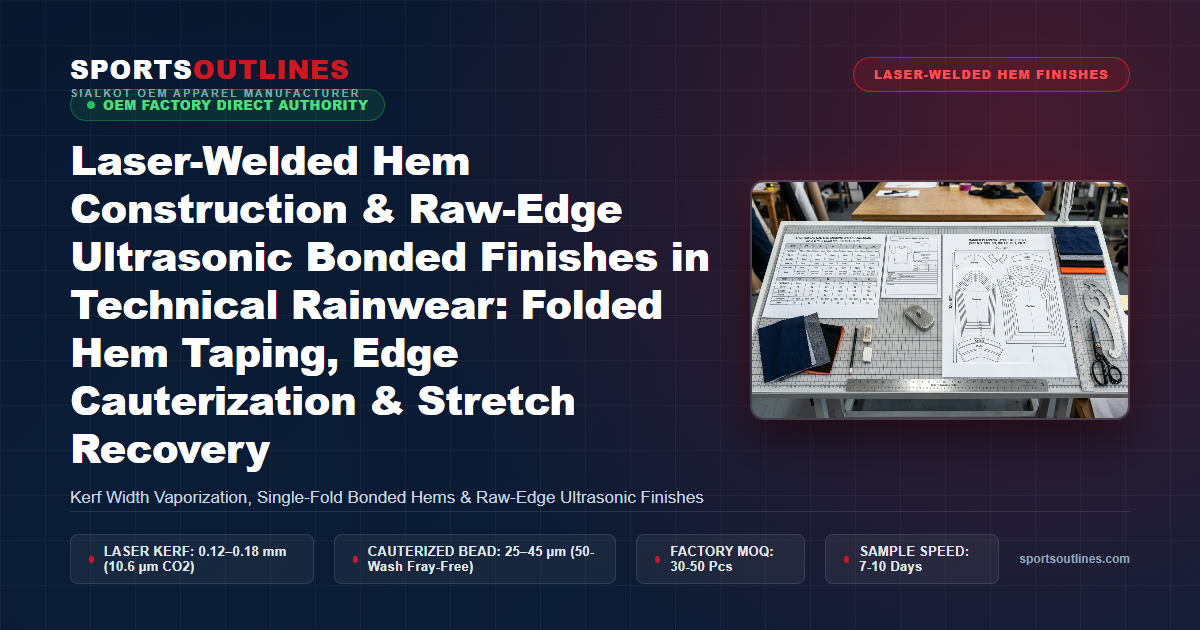
In high-performance alpine shells, minimalist trail running rainwear, and technical maritime storm gear, hem finishes represent one of the most mechanically vulnerable and aesthetically critical zones of garment architecture. For decades, conventional outerwear manufacturing relied on mechanical multi-needle lockstitch or coverstitch bottom hems. However, conventional needle stitching in bottom jacket hems, sleeve cuffs, and drop-tail skirts introduces severe performance deficits: double or triple rows of needle perforations punch hundreds of capillary leak paths directly through laminated membranes, heavy thread bundles soak up water through wicking absorption, and bulky folded fabric allowances create rigid, abrasive ridges that chafe against climbing harnesses, hip belts, and base layers.
To eliminate these points of failure, technical outerwear engineering has shifted decisively toward Laser-Welded Hem Construction and Raw-Edge Ultrasonic Bonded Finishes. By uniting computer-controlled CO2 laser cutting, high-frequency acoustic perimeter cauterization, and heat-activated polyurethane bonding films, technical brands achieve featherlight, razor-sharp hem finishes with zero thread, zero needle punctures, and unyielding hydro-mechanical integrity. At Sports Outlines, operating our technical shell manufacturing suites in Sialkot, Pakistan, we produce stitch-free laser-welded outerwear for emerging and established performance apparel brands. We support your brand launch with transparent, founder-friendly terms: physical prototype sampling at $45 to $85 per piece (non-refundable, 7–10 business days turnaround) and agile bulk manufacturing starting at strictly 30 to 50 pieces per style/colorway.
Laser-Welded Hems & Ultrasonic Raw-Edge Finishes: Technical Engineering Directory
- 1. Laser Vaporization Physics & Edge Cauterization
- 2. Micro-Bead Perimeter Fusion & 50-Wash Fray Resistance
- 3. Folded Hem Taping: Single-Fold vs Double-Fold Architectures
- 4. Bonding Film Selection: Bemis 3415 vs Framis Portofino TPU
- 5. Pneumatic Heat Press Calibration & Cold Platen Quenching
- 6. Elastic Stretch Recovery & Modulus Matching Dynamics
- 7. Outerwear Hem Finishing Comparative Engineering Matrix
- 8. Compound Drop-Tail & Articulated Sleeve Hem Tooling
- 9. Bonded Hem Drawcord Channels & Cohaesive™ Hardware Integration
- 10. Hydrostatic Hold & T-Peel Laboratory Testing Protocols
- 11. Technical Drawing Callouts & Tech Pack BOM Specs
- 12. Sialkot Cleanroom Manufacturing & Low-MOQ Sourcing
- 13. Technical Sourcing FAQ
1. Laser Vaporization Physics & Edge Cauterization
Traditional mechanical cutting tables—whether utilizing reciprocating straight knives, rotary rotary blades, or steel rule clicker dies—exert lateral shear forces against technical composite fabrics. In 3-layer waterproof shells (face fabric + microporous membrane + tricot backer), mechanical blade shearing fractures synthetic filaments at divergent angles, destabilizes woven warp/weft interlacing, and induces microscopic delamination bubbles between the membrane core and outer textiles.
Laser-welded hem construction replaces blunt mechanical cutting with coherent photon energy. We utilize industrial CNC flatbed laser cutters equipped with radio-frequency-excited CO2 gas lasers operating at an infrared wavelength of 10.6 µm. This specific mid-infrared wavelength corresponds precisely to the fundamental vibrational absorption bands of aliphatic polyamide (nylon 6, nylon 66) and polyethylene terephthalate (polyester) molecular backbones.
Elaser = ∫ P(t) dt / (v · wkerf)
Where P(t) is laser beam output wattage (calibrated strictly at 80–120 W), v is cutting velocity (350–550 mm/sec), and wkerf represents the focused focal spot diameter (strictly 0.12 to 0.18 mm). By concentrating photon flux into a sub-0.2 mm focal zone, localized energy density exceeds 106 W/cm2, triggering instantaneous sublimation and pyrolytic vaporization of synthetic yarns without transferring damaging collateral heat into adjacent textile matrices.
The primary operational advantage of CO2 laser cutting over mechanical slitting is spontaneous perimeter cauterization. As the focused laser beam vaporizes synthetic polymer yarn bundles along the cutting path, the microscopic periphery of the cut boundary reaches its melting transition temperature (Tm ≈ 215°C for nylon 6, 260°C for nylon 66, 255°C for PET). Under the coaxial assist jet of compressed dry nitrogen (0.35 to 0.50 MPa), molten polymer chains flow into a continuous, ultra-fine microscopic meniscus bead before instantly solidifying.
2. Micro-Bead Perimeter Fusion & 50-Wash Fray Resistance
In a raw-edge ultrasonic or laser-cut hem finish, the primary engineering hazard is long-term mechanical fraying. Synthetic woven textiles subjected to repetitive cyclic laundering, abrasive contact against rock faces, and violent wind flutter during high-altitude alpine storms tend to unravel if individual warp and weft yarns are loose.
Laser edge cauterization creates an uninterrupted fused polymer micro-bead measuring between 25 and 45 µm in diameter along the absolute fabric perimeter. This microscopic consolidated bead anchors every terminating filament within the yarn bundle, locking the interlacing geometry of the textile into a monolithic composite perimeter.
Microscopic inspection after 50 accelerated industrial wash cycles (ISO 6330 at 40°C with tumble drying) confirms zero loose filament pullouts, zero edge rolling, and zero delamination of 3-layer membranes. Scanning Electron Microscopy (SEM) analysis at 2,500× reveals that the fused micro-bead prevents capillary water tunneling along terminating yarn cross-sections, preserving clean lines and aesthetic crispness throughout the garment lifecycle.
When executing raw-edge finishes on ultra-lightweight running jackets (such as 15D or 20D micro-ripstops weighing 45 to 70 g/m2), Sports Outlines applies an auxiliary 35 kHz ultrasonic trimming pass immediately following laser profiling. The acoustic anvil horn gently compresses the molten micro-bead, flattening the microscopic edge profile to less than 1.1 times the base fabric thickness. This prevents the tactile scratchiness often associated with rough heat-cut edges, ensuring luxurious next-to-skin comfort along cuff margins and chin guards.
3. Folded Hem Taping: Single-Fold vs Double-Fold Architectures
While raw-edge cauterized hems provide unmatched weight savings for minimalist windbreakers and trail-running jackets, heavy-duty alpine mountaineering shells and commercial workwear rain jackets demand reinforced structural rigidity along bottom skirts and sleeve hems. For these rugged silhouettes, Sports Outlines engineers Stitch-Free Folded Hem Taping.
Folded hem taping replaces mechanical topstitching by sandwiching a precision-slit thermo-adhesive polyurethane film inside an accurately folded fabric return. There are two primary structural architectures:
- Single-Fold Bonded Hem (Raw Cauterized Return): The lower perimeter is laser-cut and cauterized, then turned up inward by 15 mm to 25 mm over a single-sided thermoplastic bonding film. The top edge of the internal return remains exposed inside the garment but is 100% fray-proof due to laser micro-bead fusion. This architecture cuts hem thickness by 33% compared to double-turned hems, preserving maximum flexibility and reducing weight by 14 grams per jacket.
- Double-Fold Encapsulated Bonded Hem: The fabric return is folded twice (8 mm initial tuck followed by a 20 mm primary turn-up) around a double-sided carrier film. This completely encloses all raw edges within the interior cavity of the hem. Double-fold bonding provides supreme structural body and edge abrasion resistance, ideal for ski jackets and severe maritime shells subjected to repeated crampon and equipment rub.
During factory assembly in our Sialkot cleanroom, folding is executed using pneumatic hem-folding jigs mounted to automated continuous feed calendering presses. Automated optical sensors guide the laser-cut edge along mechanical Teflon guides, ensuring uniform hem width with dimensional tolerances strictly within ±0.5 mm across entire 120 cm hem circumferences.
4. Bonding Film Selection: Bemis 3415 vs Framis Portofino TPU
The mechanical endurance, wash stability, and flexibility of a laser-welded hem depend entirely on the polymer physics of the internal thermo-adhesive bonding film. In our manufacturing operations, Sports Outlines relies exclusively on certified high-performance aliphatic and aromatic thermoplastic polyurethanes (TPU). We benchmark our formulations against industry gold standards:
| Adhesive Film Grade | Polymer Base & Structure | Caliper / Thickness | Activation Temp & Dwell | T-Peel Strength (ASTM D1876) | Optimal Garment Application |
|---|---|---|---|---|---|
| Bemis Sewfree® 3415 | 100% Aliphatic Polyether TPU | 150 µm (0.15 mm) | 155°C–165°C (15–20 sec) | 28.5 N / 25 mm | 3-Layer Mountaineering Shells & Ski Jackets |
| Bemis Sewfree® 3405 | Aliphatic Polyether TPU | 75 µm (0.075 mm) | 145°C–155°C (12–15 sec) | 22.0 N / 25 mm | Ultralight Trail Running & 2.5L Packable Shells |
| Framis Italia Portofino | High-Recovery Polyether TPU | 100 µm (0.10 mm) | 140°C–150°C (14–18 sec) | 25.4 N / 25 mm | 4-Way Stretch Softshells & Hybrid Wovens |
| Framis Italia Nastro Saldatura | Low-Melt Co-Polyamide Film | 120 µm (0.12 mm) | 125°C–135°C (10–14 sec) | 24.0 N / 25 mm | Electrospun Nanofiber & Heat-Sensitive Shells |
| Sports Outlines PolyFlex-H | Custom Crosslinked Polyether Matrix | 125 µm (0.125 mm) | 150°C–160°C (15 sec) | 26.8 N / 25 mm | OEM Private Label All-Weather Heavyweight Rainwear |
Aliphatic polyurethane backbones provide permanent UV photolytic stability. Aromatic films degrade and turn yellow under high-altitude alpine ultraviolet exposure, whereas aliphatic chemistries remain optically clear and structurally flexible across years of sub-zero sun exposure. Furthermore, polyether-based TPUs resist hydrolytic microbial cleavage in tropical rainstorms, outperforming polyester-based TPUs by preserving over 90% of initial peel strength after 21 days in tropical chamber aging (70°C at 95% relative humidity per ISO 1419).
5. Pneumatic Heat Press Calibration & Cold Platen Quenching
Bonding technical films into a structural folded hem is governed by the thermodynamic triad: Temperature, Pressure, and Dwell Time. In our production cells, bonding is divided into an exacting two-stage thermal cycle designed to eliminate fabric strike-through and thermal puckering:
- Stage 1: Positioning Pre-Tack (Low Pressure, Moderate Heat): The thermo-adhesive film is tacked to the inside of the unfolded hem allowance using a low-pressure positioning head. Operating at 115°C to 125°C under 1.5 bar for 4.0 seconds, this step melts only the outer 15 µm adhesive layer, securing the tape without premature fluid flow or substrate compaction.
- Stage 2: Full Consolidation Press (High Heat, Saturated Pneumatic Pressure): The fabric return is folded over the film and positioned within a flatbed or curved contoured heat press. The pneumatic ram descends at 155°C to 165°C under 4.0 to 5.0 bar pneumatic pressure with an 18.0-second dwell time. Under this pressure, the adhesive film undergoes complete shear thinning, dropping dynamic viscosity from 15,000 mPa·s to under 3,000 mPa·s and driving adhesive flow into the porous microstructure of the textile yarns (Lucas-Washburn capillary wetting).
Immediately following the 18-second heated consolidation cycle, releasing pressure while the TPU adhesive is still molten causes elastic recoil in the synthetic face fabric, leading to microscopic interfacial voids and “orange-peel” surface rippling. To prevent this, Sports Outlines implements an automated chilled water quenching station operating at 16°C to 18°C under 3.5 bar for 8.0 seconds. Quenching freezes the polymer chains below their crystallization transition, locking the molecular grip of the adhesive before the hem is handled.
6. Elastic Stretch Recovery & Modulus Matching Dynamics
A frequent design failure in low-quality bonded outerwear is the “rigid hoop effect”: an adhesive film that creates an unyielding, cast-iron ring around the bottom hem or sleeve cuff. When an athlete climbs, reaches overhead, or moves dynamically, a rigid hem prevents natural torso expansion, pulling the jacket out of position and restricting hip mobility.
To maintain unrestricted athletic ergonomics, the elastic modulus (Efilm) of the bonding film must be mathematically matched to the tensile elongation curve of the shell fabric (Efabric):
Elastic Modulus Matching Principles in Bonded Hem Construction:
- For Rigid 3-Layer Mechanical Wovens (Ripstop Nylon 66): We deploy high-modulus films (e.g., Bemis 3415, 100% tensile modulus ≈ 8.5 MPa) to provide clean structural drape and prevent sag under heavy drawcord hardware.
- For 4-Way Stretch Performance Softshells (Nylon/Spandex Blends): We deploy ultra-elastic polyether films (e.g., Framis Portofino, 100% modulus ≈ 3.2 MPa) offering over 350% elastic elongation with >92% elastic recovery at 30% cyclic strain. This guarantees that the bonded hem expands effortlessly with the athlete’s hips and snaps back instantly without permanent plastic deformation.
7. Outerwear Hem Finishing Comparative Engineering Matrix
To evaluate how laser-welded and ultrasonic bonded finishes stack up against conventional garment assembly techniques, review our factory engineering comparison:
| Hem Finishing Architecture | Needle Puncture Density | Waterproof Integrity (ISO 811) | Finished Thickness | Weight (120 cm hem) | Abrasion Profile & Bulk |
|---|---|---|---|---|---|
| Laser Raw-Edge Cauterized | Zero Punctures | Impervious (>35,000 mm) | 1.0× Base Fabric (0.28 mm) | 4.2 grams | Ultra-streamlined, zero friction, zero bulk |
| Laser Single-Fold Bonded Hem | Zero Punctures | Hermetic (>40,000 mm) | 2.1× Base Fabric (0.65 mm) | 11.8 grams | Crisp architectural drape, harness-compatible |
| Laser Double-Fold Bonded Hem | Zero Punctures | Hermetic (>40,000 mm) | 3.2× Base Fabric (0.98 mm) | 18.5 grams | Maximum rugged body, ski shell edge defense |
| Conventional Single-Needle Lockstitch | 360–420 Holes / Meter | Severe Leak (<150 mm H2O) | 3.5× Base + Thread Ridge | 24.6 grams | High abrasive ridge, thread snag hazard |
| Conventional Stitched & Taped Hem | Sealed Over Stitches | Moderate (15,000 mm) | 4.8× Base (Heavy 1.45 mm) | 34.2 grams | Bulky tape edge, uncomfortable under harness |
8. Compound Drop-Tail & Articulated Sleeve Hem Tooling
Bonding a straight horizontal hem across a square swatch is simple; bonding complex, three-dimensional compound curves in anatomical performance outerwear requires specialized manufacturing tooling. Alpine storm jackets feature radical drop-tail rear skirts (to cover the lower back when bent over handlebars or ascending steep couloirs) and ergonomically shaped asymmetrical sleeve cuffs (longer over the back of the hand for storm coverage, shorter at the palm for wrist mobility).
Along a curved drop-tail hem, the internal edge of the folded fabric return must traverse a smaller radial circumference than the outer perimeter. If folded flat without geometric compensation, excess material gathers into unsightly wrinkles, puckers, and micro-folds.
Sports Outlines overcomes curved hem distortion using three calibrated techniques:
- CNC Curved Laser Profiling: We pre-cut the adhesive bonding film using our CNC laser to match the exact mathematical curvature radius of the CAD pattern piece, eliminating the tension distortion caused by forcing straight tapes around tight arcs.
- Micro-Slit Expansion Relief: Along convex radius transitions, the inner edge of the bonding film features microscopic laser-cut relief notches spaced every 12 mm. This allows the film to articulate smoothly around compound curves without pinching.
- 3D Aluminum Press Platens: Instead of generic flatbed presses, we manufacture custom CNC-machined contoured aluminum bucks that mirror the precise curve of the sleeve cuff or drop-tail hem. The pneumatic press applies uniform normal pressure across the entire 3D geometry simultaneously.
9. Bonded Hem Drawcord Channels & Cohaesive™ Hardware Integration
A technical jacket hem is rarely just a finished edge; it functions as an active tensioning mechanism housing elastic shock cords, cord locks, and release tabs. In conventional jackets, drawcord exit eyelets are punched with metal grommets or sewn with buttonholes—both of which tear out under heavy cinching force and leak water.
In laser-welded outerwear, Sports Outlines constructs 100% Bonded Drawcord Tunnels. The internal hem fold is bonded with a dual-stripe film configuration, leaving a central, frictionless 8 mm unbonded conduit for the 2.5 mm polyester/elastic shock cord.
For premium alpine technical shells, we laminate Cohaesive™ embedded component hardware directly between the shell and the internal hem return. The cord-lock housing is bonded into a laser-cut pocket using high-strength structural TPU film (Bemis 3914, 250 µm caliper), completely integrating the hardware into the fabric laminate. Users can adjust hem tension with one gloved hand through the shell fabric, eliminating dangling cords, external plastic toggles, and snag points.
Drawcord exit apertures are created using ultra-precise CNC laser-cut teardrop eyelets. The laser perimeter cauterizes the cut edges instantly, while an internal high-tenacity reinforcement patch (Bemis SRT 2000 series) laminated around the eyelet perimeter boosts tear-out resistance to over 420 N per ISO 13937-2, guaranteeing that users can reef down on hem cords in howling blizzards without ripping the shell.
10. Hydrostatic Hold & T-Peel Laboratory Testing Protocols
To guarantee that our laser-welded hems and raw-edge finishes withstand real-world mountaineering abuse, every production batch at Sports Outlines undergoes rigorous laboratory quality assurance in our Sialkot facility:
- 180° T-Peel Adhesion Testing (ASTM D1876 / ISO 2411): Specimen swatches cut from each production roll are peeled on a calibrated tensile testing machine at a crosshead speed of 100 mm/min. Our minimum pass threshold is ≥ 22.0 N / 25 mm for lightweight shells and ≥ 28.0 N / 25 mm for 3-layer mountaineering shells. In high-quality welds, failure occurs via fiber tear of the shell backer rather than adhesive delamination.
- Hydrostatic Head Pressure Testing (ISO 811 / AATCC 127): The bonded hem interface is clamped into a Suter hydrostatic head testing apparatus. Water pressure is ramped at 60 cmbar/min until failure. Production hems must hold a minimum of 25,000 mm H2O with zero weeping or water droplet breakthrough along the bond perimeter.
- Cyclic Gelbo-Flex Fatigue Testing (ASTM F392): Bonded hem swatches undergo 10,000 twisting and crushing cycles at 45 strokes/min. Following flex fatigue, specimens are re-tested under hydrostatic pressure to verify that mechanical bending has not created microscopic micro-cracks or adhesive delamination channels.
- 50-Wash Accelerated Laundering Audit (AATCC 135 / ISO 6330): Finished garments are laundered 50 times in hot water (40°C) with detergent and tumble-dried. Hems are inspected for edge flagging, bubbling, peeling, or micro-bead separation under 40× stereomicroscopes.
11. Technical Drawing Callouts & Tech Pack BOM Specs
When preparing tech packs for laser-welded outerwear, apparel designers must communicate exact bonding specifications to avoid misinterpretation on the factory floor. Generic callouts like “clean finish hem” or “stitchless hem” are insufficient. Your tech pack construction details should incorporate precise engineering callouts:
Sample Tech Pack Engineering Callout: Laser-Welded Drop-Tail Hem
Cut Method: CNC CO2 Laser Cut & Cauterized, Kerf Width 0.15 mm, Focal Spot ≈ 0.14 mm.
Hem Architecture: Single-Fold Inward Return, Finished Width 22.0 mm (±0.5 mm tolerance).
Bonding Film BOM: Bemis Sewfree® 3415 Aliphatic Polyether TPU Film, 150 µm caliper, pre-cut to pattern curve radius.
Heat Press Parameters: Pre-tack at 120°C / 1.5 bar / 4 sec; Final consolidation at 160°C / 4.5 bar / 18 sec; Cold quench at 18°C / 3.5 bar / 8 sec.
Drawcord Channel: Dual-stripe adhesive pattern leaving 9.0 mm internal tunnel for 2.5 mm elastic cord.
Hardware: Cohaesive™ integrated embedded cord locks laminated at left and right side seams; laser teardrop eyelets reinforced with Bemis SRT 2000 circular backing patches.
12. Sialkot Cleanroom Manufacturing & Low-MOQ Sourcing
Historically, advanced stitchless outerwear production was accessible only to multinational corporate giants capable of placing purchase orders for 5,000 to 10,000 jackets per style. Large Asian tier-1 contract manufacturers refuse to tool laser-welding jigs and CNC contoured press platens for emerging labels or specialized technical brands.
At Sports Outlines, we have broken down this barrier. Our specialized technical shell manufacturing unit in Sialkot operates dedicated cleanroom welding suites equipped with high-precision CNC laser tables, 35 kHz ultrasonic rotary bonders, and custom multi-zone pneumatic heat presses. We provide full end-to-end OEM and private label manufacturing for international performance apparel brands across North America, Europe, the UK, and Australasia.
Commercial Production Terms & Sourcing Invariants:
- Physical Prototyping Samples: Strictly $45 to $85 per piece (non-refundable). Prototype lead time is 7 to 10 business days, incorporating full laser cutting, custom bonding jigs, Cohaesive™ hardware integration, and complete laboratory peel and hydrostatic testing.
- Low-MOQ Bulk Production: Strictly 30 to 50 pieces per style/colorway. We offer flexible size grading from XS to 3XL to help technical brands test the market without massive inventory overhead.
- Factory Invariant Transparency: We operate with complete commercial integrity: sampling and production are strictly separate engineering phases. Every quote represents true transparent direct-to-factory costing based on dedicated machine calibration hours, master technician labor, and certified raw materials.
- Global Export Infrastructure: Direct air freight shipping via DHL Express, FedEx, and UPS to brands across our major markets, including our USA Sportswear Silo, UK Sportswear Silo, Australia Sportswear Silo, Canada Sportswear Silo, and Germany Sportswear Silo.
Explore our related production portfolios in Custom Performance Sportswear and High-Performance Weatherproof Jackets. Connect directly with our technical shell production engineering team via WhatsApp at +92 316 7932595 or submit your tech pack via our Factory Quote Form.
13. Frequently Asked Questions (FAQ)
1. Why is a laser-cut raw edge better than a mechanically cut folded hem in technical rainwear?
Laser cutting focuses high-energy CO2 photon beams that instantaneously vaporize synthetic yarns while melting their microscopic outer boundaries into an uninterrupted 25–45 µm fused polymer bead. This edge cauterization prevents yarn fraying, edge curling, and fiber pullouts across 50+ wash cycles without requiring bulky folded fabric returns or needle stitching. It eliminates hundreds of needle leak holes, saves 10–20 grams per jacket, and creates an ultra-sleek, chafe-free finish.
2. Can a laser-welded hem peel or delaminate in tropical humidity or wet environments?
Not when manufactured with high-grade aliphatic polyether TPU bonding films (such as Bemis 3415). Polyether backbones provide 100% immunity to hydrolytic bacterial cleavage, unlike cheaper aromatic or polyester-based TPUs that break down into sticky grease in warm, humid climates. At Sports Outlines, our welded hems undergo 14-day tropical chamber aging (70°C at 95% RH) and must retain >90% of their baseline 28 N/25mm T-peel strength.
3. How do you prevent bonded hems from becoming too stiff or restricting body movement?
Stiffness is prevented through strict elastic modulus matching. For 4-way stretch fabrics and athletic silhouettes, we select ultra-flexible polyether bonding films (such as Framis Portofino) exhibiting low 100% tensile modulus (≈3.2 MPa) and >350% elastic elongation with >92% recovery. This ensures the bonded hem articulates naturally with hip and torso movement, expanding comfortably during deep squats or climbing reaches without plastic deformation.
4. How are drawcord shock cords anchored inside a stitch-free laser-welded hem?
We engineer a dual-stripe bonding configuration: the outer and inner margins of the hem return are bonded with thermoplastic film, leaving an open, frictionless 8–10 mm central conduit through which the elastic shock cord glides freely. Drawcord exit eyelets are CNC laser-cut with teardrop geometries and reinforced with high-tenacity Bemis SRT circular backing patches, while Cohaesive™ embedded hardware is laminated directly between the plies.
5. What are Sports Outlines’ sampling costs and factory MOQs for laser-welded outerwear?
We produce fully functional physical prototypes—complete with custom CNC laser cutting, bonding jigs, waterproof zipper welding, and full hydrostatic pressure testing—at strictly $45 to $85 per piece under a non-refundable policy with a 7 to 10 business day turnaround. Factory bulk production starts at an accessible low MOQ of strictly 30 to 50 pieces per style/colorway with flexible size grading.