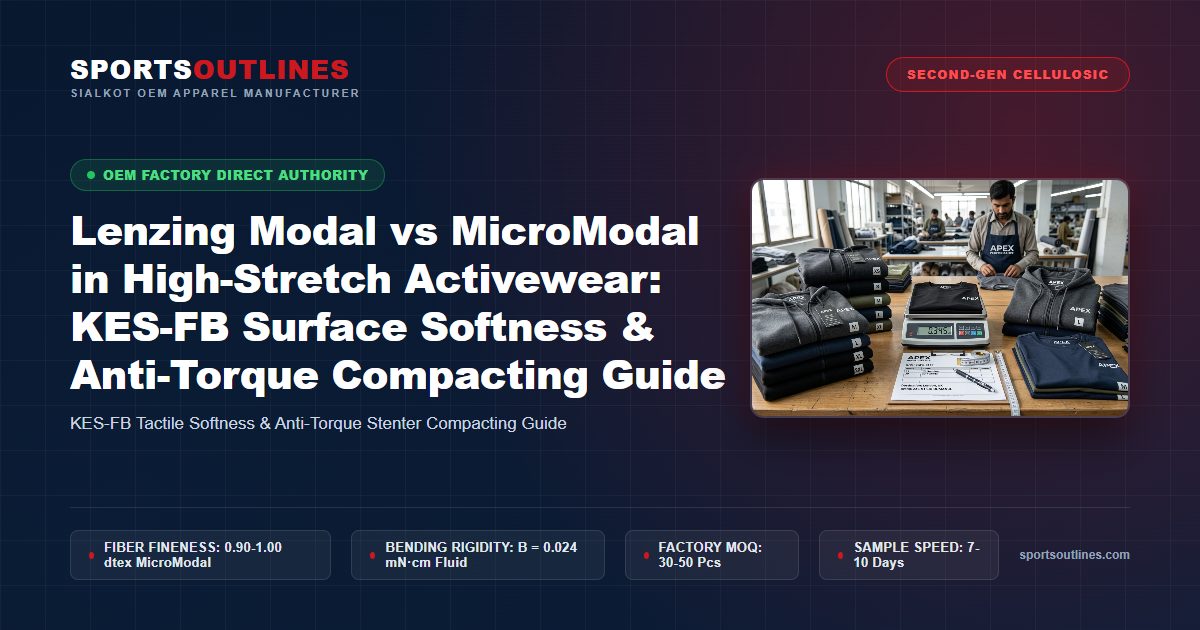
In the fast-evolving landscape of high-performance athleisure, luxury yoga apparel, and second-skin base layers, consumer expectations for tactile softness have reached unprecedented heights. While traditional synthetic activewear made from virgin polyester and polyamide delivers technical compression and abrasion resistance, it often lacks the fluid drape, breathability, and luxurious hand-feel required for premium studio collections. Conversely, standard viscose rayon degrades severely under wet tensile stress and pills excessively after repeated laundering. To solve this engineering dilemma, premium sportswear designers increasingly turn to second-generation regenerated cellulosic fibers: lenzing modal vs micromodal activewear knits intimately blended with high-recovery elastane.
Both Lenzing Modal and MicroModal are produced from sustainably harvested European beechwood (Fagus sylvatica) using an environmentally integrated, closed-loop Edelweiss chemical recovery process. However, the critical engineering difference lies in fiber linear density: while standard Lenzing Modal measures approximately 1.30 to 1.33 dtex, MicroModal achieves an ultra-fine 0.90 to 1.00 dtex (and MicroModal Air reaches a gossamer 0.80 dtex). This reduction in denier per filament fundamentally alters the physical mechanics of the knitted textile, transforming flexural rigidity, shear resistance, surface friction, and moisture vapor sorption kinetics.
At Sports Outlines, an agile OEM/ODM custom performance apparel manufacturer based in Sialkot, Pakistan, we specialize in knitting, dyeing, and assembling high-stretch cellulosic activewear. This technical guide provides brand founders, materials engineers, and sourcing directors with an exhaustive operational blueprint for engineering modal and micromodal athletic apparel. We explore beechwood forestry and high wet modulus chemistry, quantify tactile softness using the Kawabata Evaluation System (KES-FB), dissect circular knitting protocols with Creora elastane, solve severe fabric torque with stenter compacting, examine reactive dyeing and wet fibrillation control, provide complete factory FOB cost breakdowns, and detail our rapid physical prototype sampling program.
1. Second-Generation Regenerated Cellulose: Beechwood Forestry & Edelweiss Processing
To understand why Lenzing Modal and MicroModal outperform conventional viscose rayon in activewear applications, one must examine the molecular and chemical manufacturing foundation. Conventional viscose (invented in the late 19th century) involves treating dissolving wood pulp with carbon disulfide and caustic soda, followed by regeneration in an acid coagulation bath. This historic method yields fibers with irregular serrated cross-sections, low orientation, and poor wet tensile strength (dropping by up to 50% when wet).
In contrast, Lenzing Modal represents a certified High Wet Modulus (HWM) regenerated cellulosic fiber engineered through the proprietary Edelweiss closed-loop process:
- Sustainably Managed Beechwood Sourcing: The cellulose raw material is sourced exclusively from naturally regenerating European beechwood forests certified under PEFC (Programme for the Endorsement of Forest Certification) and FSC (Forest Stewardship Council). Beech trees propagate through root shoots without requiring artificial irrigation, chemical fertilizers, or agricultural pesticides.
- Edelweiss Eco-Technology: Lenzing’s integrated pulp-and-fiber biorefinery in Austria operates with an energy self-sufficient, closed-loop chemical cycle. Over 95% of recovery chemicals (including sodium hydroxide and sulfur compounds) are continuously captured and recycled back into the production stream. Bleaching is carried out using a completely chlorine-free (TCF) oxygen and ozone sequence, eliminating hazardous dioxin byproducts.
- High Wet Modulus (HWM) Molecular Architecture: During the wet-spinning extrusion process, the zinc-free spin bath and specialized stretching draw ratios orient the cellulose polymer chains into long, highly oriented microfibrils. Standard modal achieves a dry tenacity of 3.2 to 3.6 cN/dtex and a wet tenacity of 1.9 to 2.4 cN/dtex—more than 60% stronger than conventional viscose. Most importantly, its wet modulus at 5% elongation exceeds 0.5 cN/dtex, preventing the severe fiber swelling, ballooning, and dimensional distortion that plague cheap rayon garments.
| Cellulosic Fiber Attribute | Lenzing MicroModal | Standard Lenzing Modal | Conventional Viscose Rayon | Combed Organic Cotton |
|---|---|---|---|---|
| Linear Density (Fineness) | 0.90 – 1.00 dtex (Microfiber) | 1.30 – 1.33 dtex | 1.70 – 2.20 dtex | 1.50 – 1.85 dtex |
| Dry Tensile Tenacity | 3.4 – 3.8 cN/dtex | 3.2 – 3.6 cN/dtex | 2.0 – 2.4 cN/dtex | 2.8 – 3.5 cN/dtex |
| Wet Tensile Tenacity | 2.0 – 2.4 cN/dtex (HWM) | 1.9 – 2.2 cN/dtex | 1.0 – 1.3 cN/dtex (Drops 50%) | 3.0 – 3.8 cN/dtex (Gains 10%) |
| Moisture Regain (%) | 12.5% – 13.5% | 12.0% – 13.0% | 11.5% – 12.5% | 8.0% – 8.5% |
| Water Retention Value (WRV) | 65% – 72% | 68% – 75% | 90% – 110% (Massive Swell) | 45% – 52% |
| Cross-Section Morphology | Circular, Smooth Uniform | Circular, Smooth Uniform | Irregular, Highly Serrated | Kidney-Bean / Lumen |
2. Modal (1.3 dtex) vs MicroModal (1.0 dtex): Denier per Filament Physics
In textile physics, the tactile perception of softness is governed primarily by fiber fineness. The resistance of an individual fiber to bending (its flexural rigidity, $EI$) is proportional to the fourth power of its diameter:
\[ EI = \frac{\pi \cdot E \cdot d^4}{64} \]
Where \(E\) is Young’s modulus of elasticity, and \(d\) is the equivalent circular fiber diameter.
Because bending rigidity scales with $d^4$, even a microscopic reduction in fiber diameter produces an exponential decrease in resistance to bending. When comparing Lenzing Modal to MicroModal:
- Standard Modal (1.33 dtex / ~11.5 μm): Possesses an individual fiber bending resistance that provides a soft, flowing hand-feel comparable to luxury long-staple Egyptian cotton. In knitted structures (such as a 200 GSM jersey), standard modal provides adequate body and drape for casual athletic tees, lounge pants, and light pullovers.
- MicroModal (1.00 dtex / ~9.8 μm): By reducing the linear density to 1.00 dtex, individual fiber bending rigidity drops by over 40% compared to standard modal. Furthermore, for a given yarn count (e.g., Ne 40/1s or Ne 50/1s), a yarn spun from MicroModal contains approximately 33% more individual fibers in the yarn cross-section. This massive increase in packing density creates a smoother yarn envelope with smaller interstitial voids, resulting in an exceptionally supple, liquid-silk drape.
- MicroModal Air (0.80 dtex / ~8.7 μm): Engineered for ultra-lightweight, high-end intimates and featherweight running base layers, MicroModal Air reduces bending rigidity by 62% compared to standard modal. When knitted into fine single jerseys (120 to 140 GSM), the fabric behaves like a fluid membrane that floats over the skin without tactile pressure points.
3. Kawabata Evaluation System (KES-FB) Surface Softness & Tactile Dynamics
Apparel brands frequently describe fabrics using subjective marketing terms like “butter-soft,” “cloud-like,” or “peach-skin touch.” However, at Sports Outlines, our engineering methodology relies on objective, repeatable physical instrumentation: the Kawabata Evaluation System for Fabrics (KES-FB). KES-FB measures low-stress mechanical and surface properties that directly correlate with human sensory neuro-receptors:
- KES-FB2 Bending Rigidity (\(B\), mN⋅cm²/cm): Quantifies the force required to bend the fabric under pure curvature (\(K = -2.5\) to \(+2.5\text{ cm}^{-1}\)). Lower values represent greater fabric flexibility. Standard modal registers \(B = 0.042\text{ mN}\cdot\text{cm}\), whereas MicroModal jersey registers \(B = 0.024\text{ mN}\cdot\text{cm}\)—a 43% reduction in stiffness, explaining its effortless body contouring in yoga apparel.
- KES-FB2 Bending Hysteresis (\(2HB\), mN⋅cm/cm): Measures the energy lost during bending recovery, indicating fabric springiness. MicroModal achieves \(2HB = 0.019\text{ mN}\cdot\text{cm/cm}\), indicating that the fabric recovers smoothly without creasing or bunching under joints during athletic movement.
- KES-FB4 Surface Roughness (\(SMD\), μm): Measured using a contact sensor traversing the fabric surface under 10 grams-force contact load. Standard cotton knits exhibit \(SMD\) values of 2.8 to 4.2 μm due to surface fiber ends. MicroModal achieves an ultra-smooth \(SMD\) of 0.85 to 1.15 μm, creating a completely non-abrasive interface that eliminates runner’s nipple and underarm chafing during high-mileage marathons.
- KES-FB4 Coefficient of Friction (\(MIU\)) & Friction Fluctuation (\(MMD\)): The mean friction coefficient (\(MIU\)) of MicroModal is calibrated at 0.165 to 0.185 with an ultra-low fluctuation (\(MMD = 0.010\) to \(0.014\)), delivering a luxurious glide across sensory cutaneous receptors.
| KES-FB Mechanical Parameter | Physical Metric & Unit | MicroModal / Spandex (90/10) | Standard Modal / Spandex (90/10) | Organic Cotton / Spandex (90/10) |
|---|---|---|---|---|
| Bending Rigidity (\(B\)) | Flexibility (\(\text{mN}\cdot\text{cm}^2/\text{cm}\)) | 0.024 – 0.028 (Ultra-Fluid) | 0.040 – 0.046 | 0.075 – 0.088 (Stiff) |
| Bending Hysteresis (\(2HB\)) | Crease Resistance (\(\text{mN}\cdot\text{cm/cm}\)) | 0.019 – 0.022 | 0.032 – 0.038 | 0.065 – 0.075 |
| Mean Surface Roughness (\(SMD\)) | Tactile Micro-Profile (μm) | 0.85 – 1.15 (Glass-Smooth) | 1.45 – 1.80 | 2.80 – 3.60 (Fuzzy) |
| Mean Coefficient of Friction (\(MIU\)) | Skin Contact Glide | 0.165 – 0.185 (Low Drag) | 0.210 – 0.235 | 0.280 – 0.320 (High Drag) |
| Tensile Linearity (\(LT\)) | Extension Uniformity | 0.62 – 0.68 (Second-Skin) | 0.58 – 0.64 | 0.52 – 0.56 |
4. Intimate Blending & Circular Knitting with Creora® Spandex
While MicroModal fibers provide unmatched softness and moisture absorption, regenerated cellulosic knits without elastane lack the dynamic elasticity, recovery modulus, and shape retention demanded by athletic activewear. To engineer high-performance studio and yoga garments, Sports Outlines utilizes precision plating knitting technology combining MicroModal with premium high-modulus elastane (Creora® or Lycra®):
- 90% MicroModal / 10% Creora® Spandex (Second-Skin Studio Tees & Bralettes): Spun as a Ne 50/1s Siro-Compact MicroModal face yarn plated with 30-denier high-power Creora elastane. Knitted on ultra-fine 32-gauge (32G) to 36-gauge (36G) circular knitting machines at 180 to 200 GSM. The elastane core is locked securely beneath the MicroModal loops, ensuring that only the cloud-soft cellulosic fibers contact the athlete’s skin while delivering 180% multidirectional stretch and >96% immediate recovery.
- 85% Lenzing Modal / 15% Creora® Spandex (Compression Yoga Leggings & Bike Shorts): Knitted as a dense 24-gauge or 28-gauge double-knit interlock at 240 to 260 GSM using Ne 40/1s modal and 40-denier elastane. The interlock structure provides complete squat-proof opacity (Grade 5.0 opacity test), firm abdominal compression (18 to 22 mmHg), and a cool, matte exterior.
- Memminger-IRO MPF Positive Storage Feeders: Micro-denier yarns are vulnerable to tension spikes during circular knitting. We equip all knitting cylinders with Memminger-IRO MPF positive storage feeders. Feeders deliver yarn at a constant, synchronized tension of 2.0 to 2.5 cN, completely eliminating loop distortion, tight picks, and needle breaks.
5. Anti-Torque Stenter Compacting & Spirality Elimination Guide
One of the most persistent and devastating defects in single jersey modal activewear is spirality (fabric torque). Because single jersey is knitted on circular machines with rotating cylinders and high yarn twist multipliers, the internal torsional energy stored within the spun yarns causes the knitted loops to tilt off-axis after washing. In an uncorrected garment, this defect manifests as side seams that twist violently across the athlete’s belly or back, rendering the garment unwearable.
At Sports Outlines, we eliminate fabric torque through a comprehensive mechanical and thermofixation protocol:
- Siro-Compact Spinning with Balanced Twist Multipliers: We spin MicroModal using Siro-compact ring spinning frames. Two roving strands are drafted in parallel and twisted together at the delivery nip, creating a composite yarn with a balanced internal torque distribution. We calibrate the twist multiplier to an optimal \(\alpha_e = 3.1\) to \(3.3\), balancing tensile tenacity against residual torsional moment.
- Open-Width Slitting & Pin Stenter Thermofixation: Circular-knitted tubular modal-spandex must never be processed in rope form through dry heat. Immediately after jet dyeing, the tubular fabric is opened along the drop-stitch line using precision rotary slitters. The flat fabric sheet enters an 8-chamber Bruckner pin stenter. Fabric width is expanded by 3% to 5% while applying an overfeed of +18% to +22% at 185°C for 45 seconds. This thermal exposure heat-sets the Creora elastane core, locking the knit loops into their permanent rectangular geometry and neutralizing yarn twist energy.
- Rubber-Belt Compacting (Sanforizing): The heat-set fabric passes through a dual-cylinder rubber-belt compacting calendar under 2.8 bar steam pressure. Compacting mechanically packs the loop courses closer together, achieving total residual shrinkage under ±2.0% (AATCC 135) and holding skewness / spirality strictly below 1.5% (AATCC 179 Method 1) across 50 domestic wash cycles.
| Process Stage | Machine & Parameter Setting | Anti-Torque Mechanism | Certified Tolerance Threshold |
|---|---|---|---|
| Yarn Spinning | Siro-Compact Ring (\(\alpha_e = 3.2\)) | Neutralizes residual torque via twin-strand twist pairing | Yarn snarl turns ≤ 18 turns/m |
| Circular Knitting | 32G / 36G with MPF Positive Feeders | Even stitch loop formation under synchronized 2.2 cN tension | Course density ±1.5% uniformity |
| Stenter Thermofixation | 185°C, 45s dwell, +20% overfeed | Heat-sets elastane matrix, eliminates residual fabric skew | Spirality ≤ 1.5% (AATCC 179) |
| Sanforizing Calendar | Rubber-belt compactor, 2.8 bar steam | Locks loop pitch and interlock geometry against laundry agitation | Shrinkage ≤ ±2.0% length/width |
6. Reactive Dyeing Kinetics & Wet Fibrillation Prevention
Regenerated cellulosic fibers display high chemical reactivity with water and reactive dyestuffs. Due to their amorphous internal regions, modal and micro-modal fibers absorb dyestuffs more rapidly than upland cotton. If dyeing kinetics are not precisely controlled, fabrics suffer from unlevelness, color streaks, and surface frosting (micro-fibril abrasion):
- Controlled-Salt Low-Temperature Reactive Dyeing: We employ bifunctional vinyl sulfone and monochlorotriazine reactive dyestuffs (such as Huntsman Novacron). Because modal has high dye affinity, electrolyte concentration (Glauber’s salt, \(Na_2SO_4\)) is reduced by 25% to 30% compared to cotton dyeing (calibrated to 40 to 50 g/L). Dyeing is conducted at 60°C with a controlled linear temperature ramp of 1.2°C/min, ensuring uniform dye migration into the fiber core before alkali dosing.
- Alkaline Cross-Linking Finishes: While modal has far higher wet abrasion resistance than lyocell, excessive friction during mechanical tumbling can cause micro-fibrillar hairiness. Sports Outlines applies an eco-friendly polycarboxylic cross-linking resin during final finishing. This establishes covalent cross-links between adjacent cellulose polymer chains, locking the fiber cuticle and imparting Grade 4.0 wet abrasion resistance (ISO 105-X12).
- Acid Cellulase Bio-Polishing: To guarantee an immaculate, pill-free surface, dyed goods undergo an enzymatic wash using endo-cellulase at pH 4.8 at 50°C. The enzyme selectively hydrolyzes protruding surface micro-hairs without degrading fabric tensile strength, holding enzymatic weight loss within a precise 2.8% to 3.5% window.
7. Precision Cut & Sew: Needle Selection & Seam Reinforcement
Sewing micro-denier modal knits requires specialized cut-and-sew engineering. Because MicroModal fibers are ultra-fine (0.9 to 1.0 dtex), standard industrial sewing needles can pierce or sever the filaments, causing needle holes, ladder runs, and puckering:
- Extra-Light Ballpoint Needles (Groz-Beckert SES Nm 65/9 to 70/10): We utilize titanium-coated SES extra-light ballpoint needles. The rounded ball tip deflects gently between micro-fibers without slicing filaments or cutting the elastane core. Sewing machines operate with ceramic thread guides and lubricated thread tensions.
- Flatlock 4-Needle 6-Thread Active Seaming: Garments are assembled using Yamato and Pegasus 4-needle 6-thread flatlock machines. The lower looper is threaded with textured micro-polyester or bulked nylon filament, creating an ultra-flat, flexible seam with 130% elongation capacity that prevents chafing across delicate anatomical friction zones.
- Differential Feed Calibration (1.15:1 to 1.20:1): Because modal-spandex single jersey naturally stretches under presser foot drag, overlock and coverstitch machines are calibrated with a positive differential feed of 1.15:1 to 1.20:1. This gathers the fabric slightly during sewing, preventing stretched, wavy hemlines and lettuce-edge distortion.
8. Direct Factory Cost Transparency & DTC Profit Architecture
Sourcing custom Lenzing Modal and MicroModal activewear directly from Sports Outlines’ manufacturing facility in Sialkot, Pakistan, provides emerging DTC athleisure brands with outstanding margin architecture:
| Production Cost Element | Technical Component Breakdown | Cost (USD) | Share of FOB |
|---|---|---|---|
| Lenzing MicroModal / Spandex Knit | 190 GSM 90% MicroModal / 10% Creora (0.35 kg/tee) | $3.25 – $3.80 | 47% – 49% |
| Low-Tension Reactive Dyeing & Finish | Airflow jet dyeing + stenter thermofixation + rubber compacting | $1.05 – $1.30 | 15% – 16% |
| Precision CMT Assembly | 4-needle flatlock seams, bonded neckline, twin-needle coverstitch | $1.65 – $2.05 | 24% – 25% |
| Luxury Trims & Tagless Branding | Silicone heat-seal transfer, satin care label, luxury polybag | $0.55 – $0.75 | 8% – 9% |
| Quality Audit & Packaging | AQL 2.5 final inspection, individual moisture-proof pack, carton | $0.30 – $0.40 | 4% – 5% |
| Total Direct FOB Production Cost | Finished pro-grade MicroModal yoga / athleisure tee | $6.80 – $8.30 | 100% |
In premium athleisure retail boutiques (such as Lululemon, Alo Yoga, and Beyond Yoga), micro-modal studio tops and buttery-soft leggings retail between $68.00 and $98.00. At a direct FOB factory cost of $6.80 to $8.30, brand founders achieve gross margins of 88% to 91%, providing the financial runway needed to invest in high-converting creator partnerships and paid acquisition.
9. Laboratory Performance Testing & Quality Certifications
Every batch of Lenzing Modal and MicroModal activewear manufactured at Sports Outlines undergoes comprehensive laboratory verification:
| Testing Standard | Test Parameter | Certified Factory Threshold | Quality Guarantee |
|---|---|---|---|
| AATCC 179 (Method 1) | Skewness / spirality after 5x 40°C wash cycles | ≤1.5% spirality angle | Zero side seam twisting or garment torque |
| AATCC 135 / ISO 6330 | Dimensional stability after 5x home laundering | ±2.0% length & width | Permanent shape lock, zero shrinkage |
| ISO 12945-2 (Martindale) | Surface pilling resistance under 9 kPa load | Grade 4.0 at 5,000 rubs | Resists pilling from yoga mats and athletic straps |
| ISO 105-C06 (A2S) | Colorfastness to accelerated domestic washing | Grade 4.5 color change & staining | Deep, rich shades retain brilliance over 50+ washes |
| ASTM D2594 | Stretch & growth of low-power knits | >160% stretch, ≤2.5% growth | Instantaneous elastic snap-back without bagging |
10. Thermoregulation & Cool-Touch Tactile Dynamics
Athletes training in heated yoga studios or humid outdoor environments experience immediate sensory relief when wearing MicroModal garments. This physiological cooling sensation is driven by thermal contact kinetics:
- Maximum Heat Flux Density (\(Q_{max} \ge 0.24\text{ W/cm}^2\)): Measured using the Thermo-Labo II instrument, \(Q_{max}\) quantifies the instantaneous rate of heat transfer from warm human skin (32°C) to the cooler textile surface (20°C). Because MicroModal fibers are smooth, round, and highly uniform, the effective contact area between the skin and fabric is significantly higher than carded cotton or texturized polyester. MicroModal knits register \(Q_{max} = 0.24\) to \(0.28\text{ W/cm}^2\) (compared to 0.14 for cotton and 0.12 for polyester), triggering cutaneous thermoreceptors that produce an immediate cool-touch sensation.
- Moisture Sorption Enthalpy: When sweat vapor enters the amorphous cellulose structure of modal fibers, the high moisture regain (12.5% to 13.5%) allows the fabric to continuously buffer humidity spikes. During active evaporation, the high capillary wicking surface area pulls latent heat away from the athlete’s body, stabilizing core temperature during high-intensity training.
Manufacture Custom Modal Activewear with Sports Outlines
Deliver buttery-soft, second-skin performance. Sports Outlines offers an agile factory production Minimum Order Quantity (MOQ) of strictly 30 to 50 pieces per style/colorway with complete size grading from XS to 3XL. Experience our Lenzing Modal and MicroModal hand-feel first-hand with physical prototype samples completed within 7 to 10 business days for $45 to $85 per piece (strictly non-refundable with zero bulk credits, reflecting true labor, yarn setup, and materials allocation).
Explore Related Technical Manufacturing Silos & Fabric Guides
Explore Sports Outlines’ specialized technical manufacturing silos and international sportswear export infrastructure:
- International Export Silos: Discover our dedicated export programs for Custom Sportswear Manufacturer USA, Custom Sportswear Manufacturer UK, Custom Sportswear Manufacturer Australia, Custom Sportswear Manufacturer Canada, and Custom Sportswear Manufacturer Germany.
- Product Category Hubs: Explore our OEM/ODM manufacturing across Custom Sportswear & Activewear, Fitness & Gym Apparel, and Athletic Casual Wear.
- Related Technical Guides: Read our in-depth manufacturing guides on TENCEL™ Lyocell & Modal Activewear Blends Guide, Bamboo Viscose Activewear Textiles Guide, and Hemp-Organic Cotton Activewear Blends Guide.