In competitive team sports—from ninety-minute professional soccer fixtures under humid summer heat to four-quarter high-intensity basketball tournaments—an athlete’s physiological stamina is directly tied to their garment’s rate of thermoregulation. When an athletic jersey becomes saturated with sweat, it gains up to 40% in dead weight, clings to the chest and back, restricts ventilation, and induces rapid core body overheating. For performance apparel founders, technical directors, and private label procurement heads, conquering this biophysical challenge requires mastering Micro-Denier Polyester Yarns and Capillary Moisture Management. Relying on generic, coarse polyester jersey fabrics results in severe brand failure: athletes experience heavy sweat clamminess, skin abrasion across the chest, and garments that develop stubborn post-wash odors.
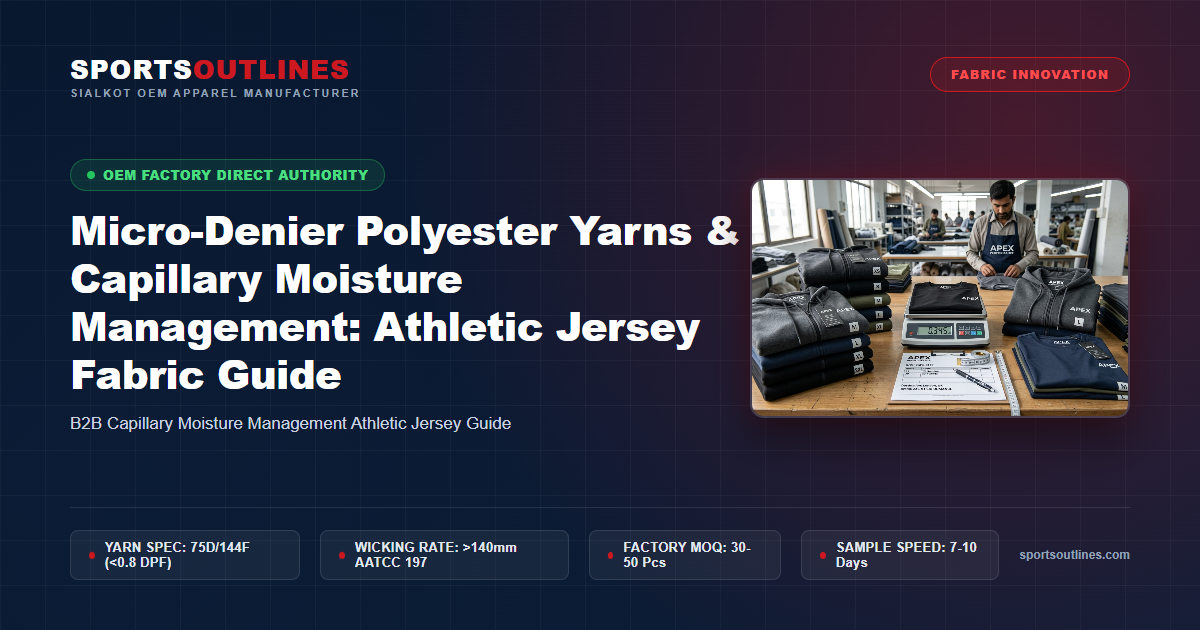
At Sports Outlines in Sialkot, Pakistan, our vertical performance milling facility engineers specialized micro-denier polyester athletic jersey knits for international sports brands and collegiate athletic programs. We mill 130 to 190 GSM technical jersey textiles utilizing micro-filament yarns with a denier per filament (DPF) rating below 0.8 DPF—including 50D/72F and 75D/144F configurations—knitted on 28-gauge to 32-gauge circular machinery in birdseye jacquard, pinhole mini-mesh, and interlock structures. Incorporating non-circular cross-sectional fiber geometries (tetralobal, cruciform, and scalloped-groove filaments), our fabrics exploit Laplace capillary pressure to transport liquid sweat away from the athlete’s skin to the outer fabric face for instantaneous flash evaporation. Backed by our accessible factory minimum order quantity (MOQ) of strictly 30 to 50 pieces per style/colorway and rapid physical prototyping turnaround (7 to 10 days, $45 to $85 per piece, non-refundable), Sports Outlines empowers sportswear brands to engineer elite, world-class athletic jerseys with direct factory transparency.
Executive Sourcing Summary: Micro-Denier Moisture Management Knits
- Micro-Denier Filament Architecture: Engineered with a Denier Per Filament (DPF) < 1.0 (such as 75 Denier / 144 Filaments = 0.52 DPF). Packing 4x more filaments per yarn bundle than standard industrial yarns, micro-denier polyester drastically multiplies interstitial micro-channels, elevating capillary pressure and surface area for ultra-rapid evaporation.
- Modified Cross-Sectional Capillary Physics: Utilizing cruciform, clover-leaf, and tetralobal channel fibers (similar to Coolmax® technology) that create permanent physical micro-grooves along the length of each filament. Unlike chemical topical finishes that wash out after 15 domestic launderings, fiber-geometry capillary wicking remains permanent for the life of the jersey.
- Hydrophilic vs. Hydrophobic Dual-Sided Knitting: Dual-layer push-pull knitting structures featuring a hydrophobic interior mesh that repels liquid against the skin, pushing it toward a hydrophilic micro-denier outer face where it spreads across a 300% wider surface area for instantaneous flash drying.
- All-Over Sublimation & Color Clarity: 100% micro-denier polyester accepts high-density disperse sublimation printing at 210°C with razor-sharp graphic resolution, zero dye bleed, and high color fastness (Grade 4-5 per ISO 105-C06).
- Direct Sourcing Accessibility: Accessible production MOQ of strictly 30–50 pieces per style/colorway with custom pantone matching; pre-production physical prototypes delivered in 7–10 business days ($45–$85 per piece, non-refundable).
1. The Physics of Micro-Denier Yarns: Denier per Filament (DPF) Calculations
In textile engineering, “denier” measures linear mass density, defined as the mass in grams per 9,000 meters of yarn length. However, evaluating fabric solely by total yarn denier (e.g., 75D or 100D) fails to capture its physical softness, bending rigidity, and moisture-transport mechanics. The decisive metric is Denier per Filament (DPF), calculated as total yarn denier divided by the number of individual filaments:
DPF = Total Yarn Denier / Total Number of Filaments
Standard Industrial Polyester vs. Micro-Denier Polyester:
- Standard Coarse Polyester (75D / 36F): A 75-denier yarn composed of only 36 filaments yields a DPF of 2.08. Filaments with a DPF > 2.0 exhibit high bending stiffness. When rubbed across the athlete’s chest during high-cadence running, these coarse fibers feel abrasive and scratchy, often causing runner’s nipple and skin irritation.
- Fine Filament Polyester (75D / 72F): A 75-denier yarn containing 72 filaments yields a DPF of 1.04. This is the entry-level baseline for standard performance soccer jerseys.
- True Micro-Denier Polyester (75D / 144F): A 75-denier yarn containing 144 individual micro-filaments yields an ultra-fine DPF of 0.52. Because bending rigidity decreases with the fourth power of fiber diameter, micro-denier filaments bend effortlessly under contact forces, producing a featherlight, silk-like hand-feel that glides frictionlessly across the athlete’s skin.
- Super-Micro Polyester (50D / 144F): At a DPF of 0.35, this yarn represents the pinnacle of professional lightweight racing singlets and pro-tier soccer match jerseys (130–145 GSM).
| Yarn Specification | DPF Rating | Total Filaments per Bundle | Specific Surface Area | Tactile & Performance Grade |
|---|---|---|---|---|
| Standard 75D / 36F | 2.08 DPF | 36 filaments | Baseline (1.0x) | Budget sports tees, stiff hand-feel, chafe risk |
| Fine 75D / 72F | 1.04 DPF | 72 filaments | 1.41x surface area | Commercial soccer jerseys, good flexibility |
| Micro-Denier 75D / 144F | 0.52 DPF | 144 filaments | 2.00x surface area | Elite pro-match jerseys, ultra-soft, rapid wicking |
| Super-Micro 50D / 144F | 0.35 DPF | 144 filaments | 2.40x surface area | Marathon singlets, Olympic lightweight match kits |
| Heavy Jacquard 100D / 192F | 0.52 DPF | 192 filaments | 2.00x surface area | Pro basketball jerseys, structured drape with soft hand |
2. Laplace Capillary Pressure & Modified Fiber Cross-Sections
Why does water move spontaneously through synthetic fabrics against gravity? Because polyester fibers are hydrophobic (inherent moisture regain of only 0.4%), moisture cannot dissolve inside the fiber. Instead, moisture transport is driven by Capillary Action governed by the Young-Laplace equation:
ΔP = (2 γ cos θ) / r
Where:
ΔP= Capillary pressure pulling liquid along the fiber.γ= Surface tension of human sweat (~0.072 N/m).θ= Contact angle between liquid and fiber surface.r= Effective radius of the micro-capillary channel.
Notice the decisive mathematical relationship: capillary pressure is inversely proportional to capillary radius (r). When yarn is spun with micro-denier filaments, the void spaces between adjacent filaments shrink dramatically, creating microscopic capillaries with tiny radii. This generates immense capillary suction force, pulling liquid sweat off the skin with extreme velocity.
Engineered Fiber Cross-Sections (Beyond Round Fibers): Standard budget polyester filaments are extruded through round spinneret holes, producing simple cylindrical rods. In contrast, Sports Outlines utilizes specialized spinnerets that extrude non-circular cross-sections:
- Tetralobal / Four-Channel Filaments (Coolmax® Type): Each filament features four longitudinal grooves running along its length. These micro-troughs act like open aqueducts, channeling liquid along the fiber bundle via surface tension even when the fabric is under zero external pressure.
- Cruciform (Cross-Shaped) Filaments: Cross-shaped cross-sections prevent adjacent filaments from packing too tightly, maintaining open air channels for continuous convective ventilation while multiplying liquid transport paths.
- Scalloped Oval Cross-Sections: Oval profiles provide directional stiffness, allowing the jersey fabric to float off the skin rather than collapsing against damp flesh during intense perspiration.
| Cross-Section Type | Capillary Transport Rate | Skin Contact Area (Anti-Cling) | Durability / Wash Permanence |
|---|---|---|---|
| Standard Round Filament | Slow (Inter-yarn voids only) | High cling (Collapses on skin) | Permanent fiber shape, but relies on chemical wash |
| Four-Channel (Tetralobal) | 3.5x Faster than round | Low cling (Micro-points of contact) | 100% Permanent (Physical fiber geometry) |
| Cruciform (Cross) | 3.2x Faster than round | Minimal cling (High breathability) | 100% Permanent (Never washes out) |
| Scalloped Oval | 2.8x Faster than round | Structured stand-off from skin | 100% Permanent (Superior tensile recovery) |
3. Circular Knitting Structures for Athletic Jerseys
Even the finest micro-denier yarn will underperform if knitted into an unsuitable loop structure. In team sports, fabric architecture must balance three competing requirements: ventilation, opacity, and snag resistance against velcro, turf, and opponent fingernails.
Sports Outlines mills four primary performance jersey architectures:
- Birdseye Jacquard (145–165 GSM): Knitted with micro-tuck stitches that create a diamond or circular pin-dot pattern on the surface. These recessed dots reduce skin contact area by 35%, ensuring the jersey never clings to sweaty skin. This is the dominant architecture for professional soccer and rugby jerseys.
- Pinhole Mini-Mesh (130–150 GSM): Features controlled circular eyelets knitted on 30-gauge electronic jacquard machines. The micro-eyelets provide high air permeability (85–120 CFM), exhausting convective body heat during continuous aerobic running while maintaining total light opacity.
- Double-Knit Interlock Micro-Mesh (160–185 GSM): Provides a dual-faced construction with a silky micro-denier interior against the athlete’s skin and a durable, snag-resistant exterior. Preferred for collegiate basketball jerseys and lacrosse uniforms requiring substantial drape and structural weight.
- Square Waffle / Grid Mesh (150–175 GSM): Engineered with raised 3D grid structures that create micro-climatic air channels between the skin and jersey face, delivering rapid convective cooling for endurance distance running and cycling jerseys.
4. Permanent Yarn Geometry vs. Chemical Topical Finishes
A pervasive trap in the private label sportswear supply chain is sourcing low-grade round polyester treated with a topical hydrophilic chemical finish (often silicone- or polyether-based surfactant washes). While these chemical treatments initially pass laboratory water-drop tests (AATCC 79) in pre-production swatches, they are water-soluble surfactants.
After 10 to 15 domestic wash cycles, the topical chemical wash strips off. The jersey reverts to its native hydrophobic state: sweat beads into droplets on the skin, refuses to wick into the fabric, and runs down the athlete’s torso, creating unbearable discomfort.
The Sports Outlines Permanent Wicking Protocol: We mandate that all moisture-management performance jerseys achieve wicking via inherent fiber geometry (micro-denier multi-channel yarns). When topical hydrophilic softeners are applied during our wet-processing stenter runs, they serve exclusively to optimize initial tactile drape, not as the primary engine of moisture transport. Even after 50 industrial wash cycles, our jerseys maintain vertical wicking heights exceeding 130 mm per AATCC 197 testing.
5. Dye Sublimation Printing Chemistry & Optical Clarity
In modern custom sportswear, all-over dye sublimation is the dominant embellishment methodology for team uniforms. Micro-denier polyester delivers profound advantages in sublimation graphic reproduction compared to standard coarse polyester:
- Ink Droplet Dot Gain & Resolution: Because micro-denier yarns pack twice as many filaments per square millimeter, the printed surface acts like high-resolution photographic paper. Sublimation disperse inks vaporize into dense, continuous color fields rather than pixelating across coarse yarn ridges, reproducing intricate gradients, sponsor crests, and vector typography with razor sharpness.
- Optical Color Vibrancy: The massive surface area of micro-filaments scatters light evenly, producing richer, deeper color saturation across high-contrast hues (fluorescent neons, deep navies, and jet blacks).
- Thermal Shrinkage Resistance: Our fabrics are pre-heat-set on Bruckner stenter frames at 195°C. When subjected to commercial calendar roll-to-roll or flatbed sublimation presses at 210°C for 35 seconds, dimensional shrinkage is strictly held below 1.2%, ensuring that cut panels match digital pattern dimensions with sub-millimeter precision.
| Sport Discipline | Recommended Fabric Spec | Yarn Configuration | Weight & Finishing Attributes |
|---|---|---|---|
| Soccer / Association Football | Birdseye Micro-Jacquard | 75D / 144F Four-Channel Poly | 145 GSM, Anti-cling surface, SILVADUR® silver ion antibacterial |
| Basketball Game Jerseys | Interlock Micro-Pinhole Mesh | 100D / 192F Micro Poly | 175 GSM, Heavy fluid drape, high tear strength per ASTM D2261 |
| Marathon & Track Singlets | Ultralight Open Eyelet Mesh | 50D / 144F Super-Micro Poly | 115 GSM, Zero-chafe flat seams, 110 CFM air permeability |
| Volleyball & Team Handball | Micro-Interlock with 8% Spandex | 75D / 144F Poly + 40D Spandex | 180 GSM, 4-way stretch for overhead spikes, floor dive abrasion resistant |
| Cricket & Tennis Polos | Mini-Pique Technical Knit | 75D / 72F Cruciform Poly | 160 GSM, UPF 50+ ultraviolet protection (AS/NZS 4399 certified) |
6. Thermophysiology of High-Output Sweating: Latent Heat & Evaporative Cooling
During intensive aerobic athletics, the human body functions as a biochemical heat engine converting metabolic energy into mechanical work at approximately 20% to 25% efficiency. The remaining 75% to 80% of generated energy manifests as heat energy (up to 800–1,200 Watts in sprinting athletes). To prevent core body temperature from rising past the dangerous threshold of 39.5°C (inducing heat exhaustion and central nervous fatigue), the autonomic nervous system triggers eccrine sweat glands to secrete liquid moisture.
Sweating cools the human body exclusively through the Latent Heat of Vaporization (approximately 2,427 Joules per gram of sweat evaporated at skin surface temperature). However, liquid sweat that merely drips off the skin or remains trapped in a soaked garment provides zero evaporative cooling: it represents lost hydration and unnecessary physiological strain.
By deploying micro-denier polyester with multi-channel filament geometries, Sports Outlines jerseys maximize the effective surface area of moisture dispersion by over 300%. Liquid sweat is lifted away from the epidermis within milliseconds, spreading into ultra-thin liquid films across the outer face of the jersey. In this exposed position, ambient convective wind currents and body motion drive rapid phase transition from liquid to water vapor, extracting maximum latent heat and keeping the athlete’s microclimate comfortably cool and dry.
7. Bacterial Sebum Colonization & Advanced Anti-Odor Chemistries
A persistent vulnerability of standard polyester sportswear is its susceptibility to bacterial odor entrapment, colloquially known as “permastink.” Freshly secreted eccrine sweat is completely odorless, consisting of 99% water and minor traces of minerals and amino acids. However, apocrine sweat glands and sebaceous glands co-secrete long-chain fatty acids, triglycerides, and squalene oils.
Because polyester is intrinsically non-polar and lipophilic, these greasy sebum molecules adhere stubbornly to the polymer surface. Cutaneous bacteria (principally Corynebacterium, Staphylococcus epidermidis, and Micrococcus luteus) metabolize these lipids into pungent volatile organic compounds, including 3-methyl-2-hexenoic acid and thioalcohols. Because standard domestic wash cycles use lukewarm water (30°C–40°C), these oils are not emulsified, allowing bacterial biofilms to establish permanent colonies inside the yarn bundles.
To eradicate permastink in our custom teamwear collections, Sports Outlines implements multi-tiered antimicrobial defenses:
- SILVADUR® Polymer-Bonded Silver Ions: During the wet-stenter finishing process, silver ions are complexed directly with the polyester micro-filaments. When sweat activates the ions, they bind to bacterial cell membranes and disrupt essential enzyme metabolism, achieving a certified 99.4% reduction in bacterial proliferation (tested via AATCC 100 after 50 wash cycles).
- Zinc Pyrithione Exhaust Infusion: For heavy-wear collegiate team sports, we utilize bath-exhausted zinc pyrithione agents during high-pressure jet dyeing at 130°C. The antibacterial compound penetrates deep into the fiber matrix, providing durable protection against odor-causing bacteria and fungi.
- Soil-Release Hydrophilic Modifiers: We incorporate fluorocarbon-free ethoxylated polyester block copolymers into the finishing bath. This creates a microscopic water-attracting shield on the fiber face, enabling household laundry detergents to easily displace and wash away body oils during cold-water washing.
8. Precision Jersey Seaming: ISO 514 Micro-Overlock & Ultrasonic Bonding
A world-class technical fabric can be completely undermined if the garment assembly introduces stiff, abrasive seams that rub against an athlete’s skin over 90 minutes of vigorous sprinting. Lightweight micro-denier jersey fabrics (130–160 GSM) require specialized sewing machine setups to ensure seam elasticity and prevent puckering.
ISO 514 Four-Thread Ultra-Fine Overlock: For side seams and raglan sleeve junctions, we utilize high-speed Pegasus four-thread overlock machines calibrated with ultra-fine ballpoint needles (Organ 65/9) to prevent filament piercing and yarn ladders. We thread the lower and upper loopers with 100% microfilament textured polyester yarn (Coats Gramax 160), creating a soft, plush seam edge that feels completely non-abrasive against bare skin.
Ultrasonic Laser Cut & Bonded Sleeve Cuffs: In our elite pro-match jersey tier, we replace traditional folded cuffs with ultrasonic cut-and-bond technology using Bemis thermoplastic polyurethane adhesive films. This eliminates bulk at the sleeve openings, reducing aerodynamic drag and providing a clean, contemporary silhouette favored by elite athletes.
9. Laboratory Testing Standards for Moisture Transport
To prove technical marketing claims, high-performance sportswear brands must provide quantitative data from certified testing bodies. Sports Outlines subjects every production lot to rigorous American and international textile standards:
| Test Standard | Metric Measured | Sports Outlines Benchmark | Commercial Industry Average |
|---|---|---|---|
| AATCC 197 | Vertical Wicking Height (10 min) | > 140 mm | 60 mm – 80 mm |
| AATCC 79 | Absorbency (Water Drop) | < 1.0 second (Instantaneous) | 3.0 – 5.0 seconds |
| AATCC 201 | Drying Rate of Fabrics | > 4.2 mL / hour | 2.0 – 2.5 mL / hour |
| AATCC 195 | Liquid Moisture Management (MMT) | OMMC Rating > 0.85 (Grade 5 Excellent) | OMMC 0.40 – 0.60 (Grade 3) |
| ASTM D3786 | Hydraulic Bursting Strength | > 420 kPa (> 60 PSI) | 300 – 350 kPa |
10. Factory Direct Manufacturing: Low MOQ & Prototype Protocol
Building a competitive teamwear or private label sportswear brand shouldn’t require risking hundreds of thousands of dollars on unverified overseas mill minimums. Sports Outlines provides high-tech manufacturing tailored for growing brands:
- Accessible Factory Production MOQ (30–50 Pieces): Launch custom cut-and-sew jersey programs starting at strictly 30 to 50 pieces per style/colorway across full size curves (Youth XS to Adult 4XL).
- Pre-Production Physical Prototyping: We manufacture complete physical prototype jerseys within 7 to 10 business days for $45 to $85 per piece (non-refundable). Each prototype is delivered with exact all-over sublimation prints, ribbed or self-fabric neck bands, and lab-certified moisture wicking test data.
- Zero Refund & Zero Credit Policy: We enforce an unbending policy: sample fees are strictly non-refundable and cannot be credited toward subsequent bulk orders. This ensures our dedicated technical patternmakers and sampling lines are fairly compensated while keeping bulk FOB manufacturing pricing exceptionally competitive.
Technical Jersey Sourcing Triad
Connect your teamwear sourcing strategy across our vertical manufacturing framework: Review our export logistics in the sportswear manufacturer USA guide, explore complete custom kits in our casual wear & teamwear catalog, and compare jersey knits with compression leggings in the warp knit tricot vs circular knit activewear guide.
Launch Your Custom High-Capillary Teamwear Line
From 145 GSM birdseye soccer jerseys to 175 GSM pro-basketball interlocks, Sports Outlines delivers genuine micro-denier capillary moisture management, vibrant sublimation, and factory-direct low MOQs.
Frequently Asked Questions (Micro-Denier Jersey Sourcing)
Q1: What is a micro-denier yarn and how does it benefit athletic jerseys?
A micro-denier yarn is defined as having a Denier Per Filament (DPF) of less than 1.0 (such as 75D/144F which equals 0.52 DPF). Because each yarn bundle contains hundreds of microscopic filaments rather than dozens of coarse ones, the fabric is significantly softer, bends with zero chafing against the skin, and creates thousands of interstitial capillary channels that rapidly draw liquid sweat away from the body.
Q2: Why do cheap polyester jerseys stop wicking sweat after several washes?
Budget jerseys typically use cheap round polyester treated with a temporary topical hydrophilic surfactant bath. After 10 to 15 home washes, this chemical layer washes away, returning the fabric to its naturally hydrophobic plastic state. Sports Outlines uses inherent cross-sectional yarn geometries (such as tetralobal and cruciform Coolmax-style channels) that physically wick moisture forever, regardless of how many times the jersey is laundered.
Q3: How does micro-denier polyester improve dye sublimation print quality?
Because micro-denier knits have a much higher filament density per square inch, ink droplets are captured on a smoother, tighter surface plane similar to photographic paper. This results in razor-sharp vector line definition, vibrant color gradients, and deep solid tones without the pixelation or white graininess common in coarse knits.
Q4: What is the optimal fabric weight for high-performance soccer jerseys?
For modern professional soccer match jerseys, the optimal weight is 140 to 155 GSM in a birdseye micro-jacquard or pinhole mini-mesh construction. This weight provides complete opacity and snag resistance while remaining featherlight, breathable, and fast-drying during intense ninety-minute matches.
Q5: What are your factory order minimums and sample lead times?
Sports Outlines operates with a founder-friendly low MOQ of strictly 30 to 50 pieces per style/colorway across custom size ranges. Physical pre-production prototypes are developed and dispatched in 7 to 10 business days for $45 to $85 per piece (non-refundable). We maintain zero-refund and zero-sample-credit policies to protect dedicated engineering labor while maintaining direct factory manufacturing margins for our client brands.