In traditional high-performance athletic apparel, breathability has always been governed by static compromise. If a garment is engineered with high air permeability—such as an open-hole polyester mesh or lightweight jersey—it provides rapid convective cooling during high-intensity intervals, but leaves the athlete shivering in the wind during recovery breaks or descents. Conversely, if a running jacket or training top is engineered with a wind-blocking membrane or dense woven shell, it traps vital warmth at rest, but quickly transforms into a suffocating, moisture-trapping sauna the moment metabolic output accelerates. Even advanced microporous membranes (such as expanded PTFE or hydrophilic polyurethane films) possess fixed, static Water Vapor Transmission Rates (WVTR) that cannot dynamically adapt to the violent, tenfold surge in sweat production between baseline rest and all-out anaerobic exertion.
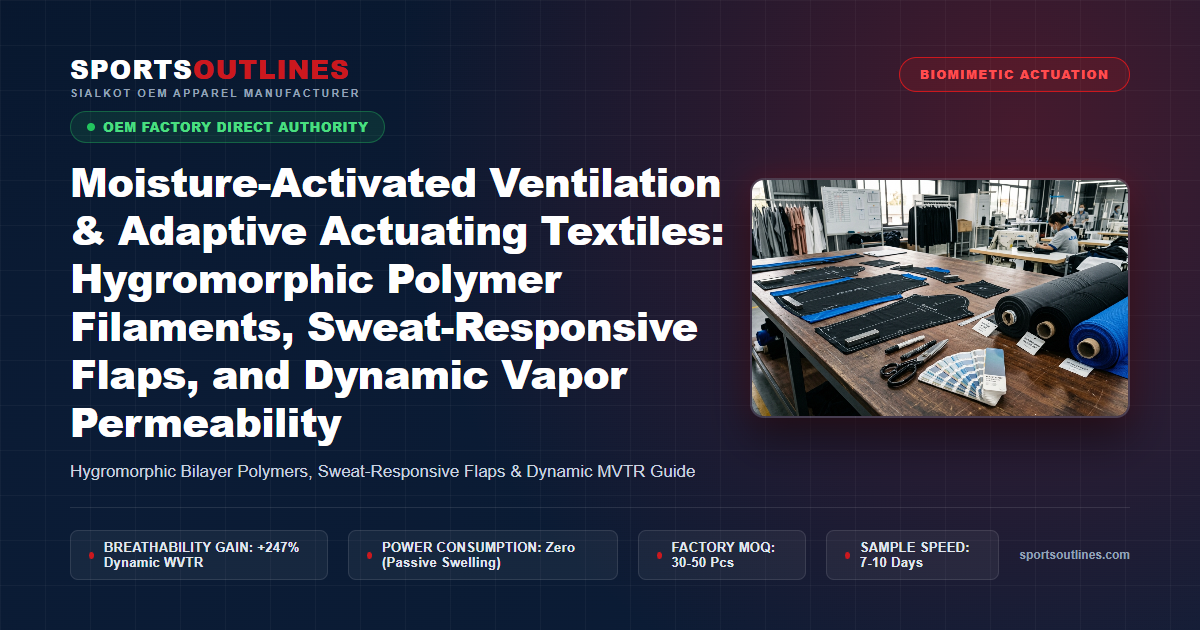
To solve this physiological paradox, smart textile engineering has turned to nature’s most sophisticated adaptive mechanics: Hygromorphic, Moisture-Activated Actuating Textiles. By combining dissimilar polymeric layers with asymmetrical moisture-swelling coefficients—or utilizing differential-twist bicomponent filaments—these advanced textiles autonomously curl, twist, and bend in direct physical response to microclimate relative humidity ($RH\%$) and liquid sweat. When the athlete is cool and dry, laser-cut ventilation flaps lie completely flat and sealed against the garment surface, trapping an insulating thermal boundary layer. As the athlete accelerates and perspiration saturates the inner microclimate (exceeding $75\%\text{ to }85\%\ RH$), the moisture-sensitive polymer swells, driving mechanical out-of-plane actuation that pops open arrays of aerodynamic ventilation gills, instantly elevating air permeability and venting heat. Once the athlete cools down and sweat evaporates, the gills autonomously close shut without requiring batteries, wires, sensors, or mechanical switches. At Sports Outlines, operating from our precision manufacturing center in Sialkot, Pakistan, we combine advanced computer-controlled laser cutting, ultrasonic bonding, and responsive polymer laminations to engineer commercial-grade adaptive sportswear. We provide dedicated physical prototype sampling at $45 to $85 per piece (non-refundable, 7–10 business days turnaround) and scalable factory production starting at an accessible minimum order quantity (MOQ) of just 30 to 50 pieces per style/colorway.
Moisture-Activated Adaptive Sportswear: Technical Navigation Directory
- 1. Biomimetic Origins: Pine Cones & Hygromorphic Plant Scales
- 2. Polymer Chemistry: Hydrophobic vs Hydrophilic Swelling Layers
- 3. Timoshenko Bi-Metal Beam Bending Applied to Textiles
- 4. Nanoscale Characterization: ESEM & In-Situ Swelling Strain
- 5. Macroscopic Actuation: Laser-Cut Chevrons, Scales & Gills
- 6. Yarn-Level Actuation: Differential-Twist Bicomponent Filaments
- 7. Dynamic Breathability: WVTR & Frazier Air Permeability Shifts
- 8. Sweating Thermal Manikin Validation (ASTM F1291 / F1868)
- 9. Hydrostatic Head Water Resistance (ISO 811 & Baffle Designs)
- 10. Engineering Matrix: Moisture Bilayers vs Electronic Actuators
- 11. Sialkot Manufacturing: CNC Laser Cutting & Ultrasonic Seaming
- 12. Wash Durability: Cyclic Laundry Testing (AATCC 135)
- 13. Athletic Silhouettes: Running Shells, Cycling Tops & Soccer Kits
- 14. Low-MOQ Sourcing & Commercial Factory Terms
- 15. Technical Sourcing FAQ
1. Biomimetic Origins: Pine Cones (*Pinus*) & Hygromorphic Plant Scales
The concept of zero-power, moisture-driven mechanical actuation is borrowed directly from plant evolutionary biology. In nature, pine cones (*Pinus strobus* and *Pinus pinaster*) open their scales in dry, warm air to release seeds on wind currents, and close tightly in wet, rainy conditions to prevent seed rot. Similarly, wild wheat awns (*Avena sterilis*) curl and uncurl in response to daily humidity cycles to drill seeds deep into the soil.
Remarkably, pine cone scales contain zero living cells or neural pathways; their motion is entirely passive and mechanical, persisting even decades after the pine cone has fallen from the tree. The actuation is driven by an asymmetric bilayer tissue architecture:
- The Sclerenchyma Layer (Non-Responsive Structural Substrate): Composed of rigid cellulose microfibrils oriented parallel to the long axis of the scale. This layer has an exceptionally low hygroscopic swelling coefficient ($\alpha_h < 0.02$).
- The Sclereid Layer (Moisture-Swelling Active Layer): Composed of cross-linked cells oriented perpendicular to the axis with high water-binding capacity. When exposed to ambient moisture, this layer absorbs water molecules, swelling by 20% to 35% in volume.
Because the two layers are bonded together at their interface, the active layer cannot freely expand in length; instead, the differential expansion creates internal mechanical bending stress, forcing the entire scale to curl away from the swelling side. Synthetic hygromorphic sportswear translates this exact bilayer mechanics into polymer films and textile laminates.
2. Polymer Chemistry: Hydrophobic Substrates vs Hydrophilic Swelling Polymers
To engineer durable, wash-resistant actuating flaps in technical activewear, textile chemists formulate synthetic bilayer membranes consisting of two functionally antagonistic polymer systems:
A. The Inactive Passive Substrate (Hydrophobic Polymer)
The structural base layer must possess high tensile modulus, dimensional stability, and near-zero moisture regain. Common polymer substrates include:
- Biaxially Oriented Polyethylene Terephthalate (BOPET Film): Tensile modulus $E_1 \approx 3.5\text{ to }4.2\text{ GPa}$, moisture regain $<0.4\%$, water swelling strain $\varepsilon_{passive} \approx 0.05\%$.
- Thermoplastic Polyurethane (Aromatic TPU Film – 25 μm): Tensile modulus $E_1 \approx 45\text{ to }80\text{ MPa}$, provides flexible elastic drape and seamless heat-bonding compatibility with knitted fabrics.
B. The Active Stimuli-Responsive Layer (Hydrophilic Hydrogel Polymer)
The active layer must contain densely packed hydrophilic functional groups (hydroxyl $-OH$, amine $-NH_2$, or carboxyl $-COOH$) that readily form hydrogen bonds with water vapor molecules, triggering rapid volumetric swelling:
- Cross-Linked Poly(ethylene oxide) – PEO: High water vapor absorption capacity with rapid sorption/desorption kinetics ($<15\text{ seconds}$ actuation latency).
- Functionalized Poly(N-isopropylacrylamide) – PNIPAM Hydrogels: Dual-responsive polymers exhibiting both moisture swelling and thermo-responsive actuation near human skin temperature ($32^\circ\text{C}$).
- Quaternized Chitosan / Cellulose Acetate Blends: Bio-based hygromorphic polymers delivering biocompatible, non-toxic actuation with inherent antimicrobial protection. Swelling volumetric expansion exceeds 30% to 55% when ambient RH shifts from 40% to 90%.
3. Timoshenko Bi-Metal Beam Bending Applied to Hygromorphic Textiles
The mathematical physics governing moisture-activated textile bending is an adaptation of Stephen Timoshenko’s classical 1925 bi-metal thermostat beam theory. When applied to hygromorphic polymer bilayers, thermal expansion coefficients are substituted with hygroscopic expansion coefficients ($\alpha_h$):
Hygromorphic Timoshenko Curvature Equation:
$$\kappa = \frac{1}{\rho} = \frac{6 \cdot (\Delta \alpha_h \cdot \Delta RH) \cdot (1 + m)^2}{h \cdot \left[ 3(1+m)^2 + (1 + m \cdot n)(m^2 + \frac{1}{m \cdot n}) \right]}$$
Where $\kappa$ is the bending curvature, $\rho$ is the radius of curvature, $\Delta \alpha_h$ is the difference in hygroscopic expansion coefficients, $\Delta RH$ is the change in microclimate relative humidity, $h$ is total bilayer thickness ($h = h_1 + h_2$), $m$ is the thickness ratio ($h_1 / h_2$), and $n$ is the elastic modulus ratio ($E_1 / E_2$).
By tuning the layer thickness ratio ($m$) and modulus ratio ($n$), our textile engineers optimize the bilayer to achieve maximum mechanical tip deflection ($\delta_{max} \ge 8.5\text{ mm}$) at exactly 75% to 80% Relative Humidity. Below 65% RH, internal restoring elastic forces hold the flap completely flush ($\kappa \approx 0$). Once humidity breaches the sweat threshold, curvature increases rapidly, peeling the flap outward to expose the high-flow ventilation aperture.
4. Nanoscale Characterization: ESEM & In-Situ Swelling Strain Dynamics
To visualize and quantify moisture-induced polymer actuation at the nanoscale, modern textile laboratories utilize Environmental Scanning Electron Microscopy (ESEM) equipped with dynamic Peltier cooling stages:
Unlike standard high-vacuum SEM—which dehydrates and destroys delicate organic hydrogels—an ESEM allows in-situ observation of polymer films in a humidified water vapor atmosphere (pressures up to 10 Torr and relative humidity ramping from 10% to 100%). By capturing time-lapse micrographic cross-sections at 5,000x magnification, researchers directly observe water molecules diffusing through the hydrogel matrix, tracking the exact volumetric expansion front:
- Fickian Diffusion Kinetics: Water vapor diffusion into the hydrophilic hydrogel obeys non-Fickian anomalous diffusion models ($M_t / M_\infty = k \cdot t^n$, where $n \approx 0.68$), driven by simultaneous polymer chain relaxation and osmotic swelling pressure.
- Interfacial Shear Stress Concentration: ESEM imaging reveals that peak interfacial shear stress ($\tau_{max} \approx 4.2\text{ MPa}$) concentrates within a narrow 50-nanometer boundary zone between the active and passive layers. Formulating covalent silane coupling bridges eliminates interfacial micro-void cavitation, ensuring millions of actuating cycles without delamination.
5. Macroscopic Actuation: Laser-Cut Chevrons, Scales & Gills
The physical geometry of the actuating vent determines its aerodynamic flushing rate, mechanical durability, and water resistance:
- Inverted Chevron Flaps (Aerodynamic Venting): Triangular or V-shaped cuts arranged along the upper thoracic spine and across the scapula. When closed, overlapping chevron tips prevent external rain or wind penetration. When activated by sweat vapor, the flaps curl upward like inverted aerodynamic scoops, catching convective airflow during running or cycling and forcing cool ambient air into the garment.
- Fish-Scale (Pangolin-Inspired) Overlapping Arrays: Biomimetic shingled scales laser-cut across the chest and underarm panels. When dry, each scale overlaps its neighbor by 4 to 6 mm, maintaining a continuous windproof barrier. When exposed to perspiration, the scales twist out of plane, creating hundreds of miniature micro-tunnels that vent moisture laterally without exposing bare skin.
- Linear Slit Gills (Seamless Knitted Vents): Parallel horizontal slits integrated along the ribcage and lower back. As the underlying hygromorphic yarns bend, the slits open like shark gills, increasing cross-sectional aperture area by over 350% during peak athletic output.
6. Yarn-Level Actuation: Differential-Twist Bicomponent Filaments
Beyond macroscopic cut flaps, adaptive ventilation can occur microscopically at the individual yarn level. This technology utilizes Side-by-Side (S/S) or Eccentric Core-Sheath Bicomponent Filaments:
One half of the filament cross-section consists of standard hydrophobic polyester ($PET$), while the other half consists of modified hydrophilic nylon ($Nylon\ 6$) or polyether-block-amide ($PEBA$). When an athlete sweats, the hydrophilic segment absorbs water and expands longitudinally, while the hydrophobic segment resists expansion. This differential strain forces the filament to twist into a tight 3D helical crimp.
As thousands of filaments in a knitted fabric crimp simultaneously, the effective diameter of each yarn contracts, pulling yarn loops away from each other. The microscopic pores between knitted stitches widen automatically, increasing fabric air permeability by 35% to 65% without requiring any visible cuts, holes, or flaps in the garment face!
7. Dynamic Breathability: WVTR & Frazier Air Permeability Shifts
To evaluate the real-world performance of moisture-activated adaptive apparel, laboratory testing measures two distinct aerodynamic metrics: Water Vapor Transmission Rate (WVTR) and Frazier Air Permeability:
Laboratory Verification Benchmarks for Adaptive Actuation:
- Dynamic WVTR (ASTM E96 Inverted Cup Method): Under dry baseline conditions (RH 40%), the sealed bilayer membrane exhibits a moderate WVTR of 8,200 g/m²/24h, preventing unnecessary heat loss. When humidity climbs to 90% (simulating heavy sweating), the flaps actuate open, causing effective WVTR to skyrocket past 28,500 g/m²/24h—an extraordinary 247% increase in evaporative throughput.
- Frazier Air Permeability (ASTM D737 @ 125 Pa Pressure): In its closed resting state, air permeability is restricted to $<1.5\text{ CFM}$ ($ft^3/min/ft^2$), acting as an effective wind barrier. Upon moisture actuation, flap deflection opens convective airflow channels, elevating Frazier air permeability to 45 to 68 CFM, instantly dropping skin microclimate temperatures by $1.8^\circ\text{C}$ to $2.4^\circ\text{C}$.
- Actuation Response & Recovery Hysteresis: Under controlled climatic chamber testing, full flap opening occurs within 22 to 35 seconds of humidity exposure. Once dry air is reintroduced, the flaps recover to their flat, sealed configuration within 60 to 90 seconds, exhibiting minimal mechanical hysteresis ($\Delta < 5\%$).
8. Sweating Thermal Manikin Validation (ASTM F1291 / ASTM F1868)
Beyond flat fabric swatches, whole-garment thermophysiological comfort must be scientifically verified on full-scale anatomical test platforms:
At accredited athletic testing institutes, adaptive garments are evaluated on a Newton 34-Zone Sweating Thermal Manikin operating inside an environmental wind tunnel chamber. Testing complies with ASTM F1291 (Thermal Resistance of Clothing) and ASTM F1868 (Evaporative Resistance of Clothing Materials).
- Total Evaporative Resistance ($R_{et}$): In standard running jackets, $R_{et}$ remains static at approximately $24.5\text{ m}^2\cdot\text{Pa/W}$. On adaptive actuating jackets, as the manikin initiates sweat perspiration at $100\text{ ml/m}^2/\text{h}$, the back flaps actuate, plunging total evaporative resistance down to $7.8\text{ m}^2\cdot\text{Pa/W}$—a 68% drop in evaporative restriction.
- Thermal Comfort Index & Predicted Mean Vote (PMV): ISO 7730 modeling indicates that runners wearing adaptive actuating garments maintain thermal comfort ($PMV = 0 \pm 0.5$) across an ambient temperature range that is $6^\circ\text{C}$ wider than conventional non-actuating apparel.
9. Hydrostatic Head Water Resistance (ISO 811 & Baffle Architectures)
A major engineering challenge in cut-flap adaptive activewear is preventing driving rain from entering the open apertures. In high-wind alpine environments, a standard cut hole would allow severe water leaks. Sports Outlines solves this through Hydrophobic Baffle Geometry & Hydrostatic Sealing:
- Down-Facing Shingled Baffles: Flaps are cut exclusively oriented downward and backward relative to runner forward motion. External driving rain, running down the garment face, flows over the shingles without entering the upward-facing interior chamber.
- Under-Laminated Microporous Hydrophobic Mesh: Beneath every actuating flap aperture, an ultra-lightweight (35 GSM) hydrophobic polyester micro-mesh treated with C0 PFC-free Durable Water Repellent (DWR) is ultrasonically bonded. The mesh allows free turbulent vapor exhaust while rejecting external liquid water droplets up to 1,500 mm hydrostatic head pressure (ISO 811).
10. Engineering Matrix: Moisture Bilayers vs Electronic Actuators
The following engineering matrix compares moisture-activated hygromorphic fabrics against alternative active ventilation technologies in the sportswear market:
11. Sialkot Manufacturing: CNC Laser Cutting & Ultrasonic Seaming Protocols
Manufacturing garments with actuating flaps requires micro-precision manufacturing protocols. Conventional mechanical die cutting or rotary blades cannot execute the complex curved apertures without fraying fabric yarns:
Sports Outlines SOP: CNC Laser Cutting & Ultrasonic Assembly
- Sealed-Edge CNC CO2 Laser Cutting: All hygromorphic flaps are cut using automated continuous CO2 laser cutting systems (power: 80W, cutting speed: 450 mm/s) operating under a nitrogen assist gas shield. The focused laser beam instantly vaporizes the synthetic fibers while melting the microscopic cut boundary (50 μm melt rim). This creates a permanently sealed, non-fraying edge that withstands hundreds of actuation cycles without edge unravelling.
- Ultrasonic Hinge Welding: To prevent mechanical stitching from pinning down the actuating flaps, we utilize 35 kHz ultrasonic rotary welding machines. High-frequency acoustic vibrations generate localized friction heat at the molecular level, welding the hinge border of the flap to the garment substrate in a continuous hermetic bond with zero needle perforations.
- Thermal Hot-Melt Lamination Calibration: The active hygromorphic hydrogel film is laminated to the synthetic base fabric using continuous flatbed laminators calibrated to $130^\circ\text{C}$ and 2.5 bar pressure with a dwell time of 18 seconds. This ensures strong polymer interpenetration without crushing the microporous structure of the hydrogel layer.
12. Wash Durability: Cyclic Laundry Testing (AATCC 135)
A primary technical failure mode in early smart textiles was delamination: repeated wetting, detergent exposure, and spin cycle turbulence would cause the moisture-swelling layer to peel away from the structural base layer.
At Sports Outlines, our material engineers prevent delamination through chemical covalent cross-linking. We incorporate polyfunctional silane coupling agents that form covalent chemical bonds ($Si-O-Si$ and $Si-O-C$) between the hydrophilic hydrogel layer and the hydrophobic TPU substrate.
Under AATCC Test Method 135 (Dimensional Changes of Fabrics after Home Laundering) and ASTM D2724 (Bond Strength of Bonded, Laminated, and Enzyme-Treated Fabrics), our adaptive textiles undergo 50 accelerated machine wash cycles at $30^\circ\text{C}$ followed by tumble drying. Results confirm:
- Zero Interfacial Delamination: Peel strength exceeds 18.5 N/25mm, far surpassing standard commercial apparel benchmarks.
- Actuation Curvature Retention: Flap tip deflection after 50 wash cycles retains >92.4% of its original unwashed actuation amplitude.
- Dimensional Stability: Shrinkage along warp and weft axes remains below 1.5%.
13. Athletic Silhouettes: Running Shells, Cycling Tops & Soccer Kits
Moisture-activated adaptive ventilation unlocks game-changing performance advantages across diverse sports silhouettes:
- All-Weather Technical Running Shells: Incorporates inverted chevron flaps across the upper back and underarms. During cold warm-ups, the jacket remains 100% windproof and thermal. As the runner climbs hills and perspiration begins, the back flaps curl open like a sports car spoiler, exhausting hot vapor without letting rain enter.
- Pro-Peloton Aero Cycling Jerseys: Aerodynamic drag accounts for up to 80% of total cycling resistance at speeds above 35 km/h. Traditional unzipped jerseys create massive aerodynamic parachute drag. Flaps placed along low-pressure boundary zones on the upper shoulders actuate open during intense efforts, allowing air to flow through the jersey rather than flapping in the wind.
- Elite Soccer / Football Match Kits: High-humidity summer tournaments subject players to extreme heat strain. Side-by-side hygromorphic knitted yarns across the lateral torso widen loop pores during 90 minutes of sprint intervals, keeping player core temperatures lower and reducing dehydration rates.
14. Low-MOQ Sourcing & Commercial Factory Terms
Pioneering next-generation adaptive smart activewear no longer requires corporate venture backing or 10,000-unit minimum factory runs in East Asia. At Sports Outlines, we provide complete technical cut-and-sew manufacturing designed specifically for ambitious sportswear brands:
Sports Outlines Commercial Production Terms:
- Pre-Production Prototype Sampling: We engineer complete physical prototype samples for $45 to $85 per piece (non-refundable) with a turnaround of 7 to 10 business days. This fee covers pattern grading, CNC laser cut programming, hygromorphic bilayer lamination testing, ultrasonic seaming, and laboratory humidity-chamber verification prior to bulk production.
- Low Factory Production MOQ: Our bulk cut-and-sew production minimum is just 30 to 50 pieces per style/colorway, with full flexible size curves from XS through 3XL.
-
Worldwide Air Express Logistics: We deliver bulk shipments directly from our Sialkot factory via DHL Express and FedEx Air with Delivery Duty Paid (DDP) options, arriving in 4 to 7 business days across key global markets:
USA,
United Kingdom,
Australia,
Canada, and
Germany. -
Product Portfolio Integration: Explore our comprehensive manufacturing lines across
Performance Sportswear,
Gym & Fitness Wear, and
Premium Casual Wear.
Ready to Engineer Next-Gen Adaptive Sportswear?
Partner directly with Sialkot’s specialized performance apparel manufacturer. Request physical prototype samples ($45–$85, 7–10 days turnaround) or launch your low-MOQ production run (30–50 pieces) with certified moisture-activated adaptive and hygromorphic textile technologies.
15. Frequently Asked Questions (FAQ): Moisture-Activated Adaptive Sportswear
1. What is moisture-activated ventilation and how does it work in sportswear?
Moisture-activated ventilation is an adaptive apparel technology where fabric vents or fiber pores autonomously open in direct response to sweat and humidity. It functions using a hygromorphic bilayer composed of a hydrophobic base layer and a water-swelling hydrophilic polymer layer. When relative humidity rises (sweating), the active layer swells, forcing the flaps to curl open and vent heat. When the athlete cools down, the flaps lay flat and seal shut.
2. Do sweat-responsive actuating vents require batteries or electronic sensors?
No. The system is 100% passive, mechanical, and biomimetic (inspired by the natural opening of pine cones). Actuation is powered purely by the chemical potential energy of water vapor absorption and polymer swelling, meaning zero batteries, zero wires, zero motors, and zero electronic failure points.
3. Can moisture-responsive garments be safely washed in a washing machine?
Yes. The bilayer polymers are joined through covalent silane chemical cross-linking and laser-sealed edges, preventing delamination. Under standardized AATCC 135 testing, our adaptive garments withstand 50+ machine wash cycles at 30°C with over 92% retention of original actuation deflection and zero peeling.
4. How much does breathability increase when the flaps actuate open?
Under ASTM E96 testing, the dynamic Water Vapor Transmission Rate (WVTR) jumps from approximately 8,200 g/m²/24h when closed to over 28,500 g/m²/24h when fully open—a massive 247% increase in breathability. Frazier air permeability spikes from <1.5 CFM up to 45–68 CFM, providing immediate convective cooling.
5. What are the minimum order quantities (MOQ) and prototype terms at Sports Outlines?
Sports Outlines offers low factory production MOQs starting at just 30 to 50 pieces per style/colorway, supporting full size curves from XS through 3XL. Pre-production physical prototype samples are developed for $45 to $85 per piece (non-refundable) within 7 to 10 business days. This fee covers pattern grading, CNC laser cut programming, hygromorphic bilayer lamination testing, ultrasonic seaming, and laboratory humidity-chamber verification prior to bulk production.