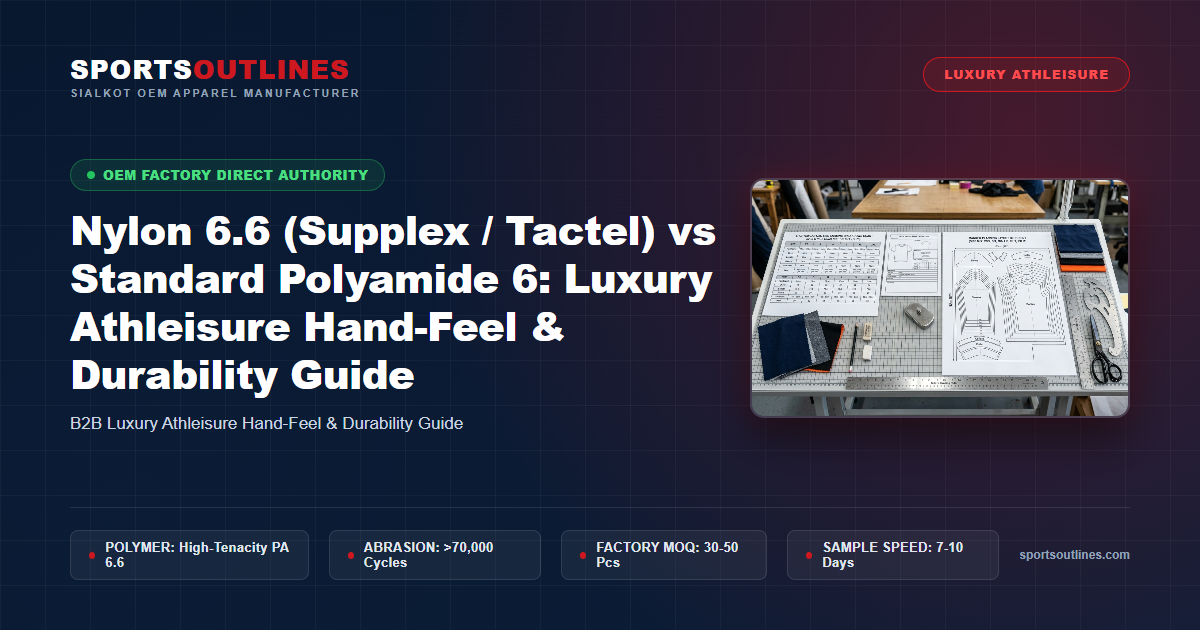
In the tier of luxury athleisure and high-end studio performance wear, consumer purchasing decisions are made within three seconds of physical contact on the retail display rack. Discerning consumers purchasing $98 to $138 athletic tights, sports bras, and studio pullovers intuitively demand a fabric that feels impossibly soft, matte, and organic—resembling combed Egyptian cotton or fine silk—yet performs with the indestructible durability, squat-proof opacity, and shape recovery of military-grade synthetics. For sportswear brand founders, technical directors, and private label procurement heads, achieving this commercial holy grail requires mastering the industrial distinction between Nylon 6.6 (engineered through technologies like Invista Supplex® and Tactel®) versus standard Polyamide 6 (Nylon 6).
While both fibers belong to the polyamide family, their macromolecular symmetry, hydrogen-bonding density, crystalline melting points, and yarn-texturing mechanics diverge substantially. Specifying generic Nylon 6 when targeting the luxury athleisure consumer results in costly brand dilution: standard Nylon 6 fabrics exhibit a lower melting point, higher pilling propensity under thigh-rub friction, and an unwanted synthetic sheen that cheapens the perceived value of premium garments. Conversely, precision-engineered Nylon 6.6 delivers unparalleled tensile tenacity, silky drape, and permanent shape retention across hundreds of wash cycles.
At Sports Outlines in Sialkot, Pakistan, our vertical performance milling and cut-and-sew operations engineer premium Nylon 6.6 technical textiles for leading international activewear houses. We mill 200 to 320 GSM air-textured Supplex-style knits and ultra-fine Tactel-style micro-filament interlocks utilizing authentic high-tenacity Polyamide 6.6 chips. Knitted on 32-gauge to 36-gauge German circular knitting machinery and integrated with premium Creora® or Lycra® elastanes, our fabrics deliver the coveted “cottony-soft touch with high-tech performance.” Supported by our founder-empowering minimum order quantity (MOQ) of strictly 30 to 50 pieces per style/colorway and rapid physical prototyping turnaround (7 to 10 days, $45 to $85 per piece, non-refundable), Sports Outlines provides the textile science, craftsmanship, and direct factory transparency required to command top-tier retail margins.
Executive Sourcing Summary: Nylon 6.6 vs. Standard Polyamide 6
- Macromolecular Polymer Physics: Nylon 6.6 is synthesized from two 6-carbon monomers (hexamethylenediamine and adipic acid), creating an alternating, highly symmetrical polymer chain with dense inter-chain hydrogen bonding. Standard Nylon 6 is formed from a single monomer (caprolactam), resulting in slightly lower crystalline order, lower melting temperature (215°C vs 260°C), and higher moisture sensitivity.
- Supplex® Air-Jet Texturing Technology: Invista Supplex® technology utilizes compressed-air texturing jets to create tangled micro-filament loops on the yarn surface. This imparts the dry, matte, natural hand-feel of long-staple combed cotton while retaining the abrasion resistance, lightweight strength, and rapid drying of high-tenacity nylon.
- Tactel® Micro-Filament Fluidity: Engineered with ultra-fine filaments (DPF < 0.8), Tactel® delivers extreme drape, breathability, and a featherlight “second-skin” or “nude” tactile sensation, making it the premier choice for luxury yoga bras, crop tops, and studio layering pieces.
- Abrasion & Pilling Resilience: Nylon 6.6 withstands over 70,000 Martindale abrasion cycles (ISO 12947-2) without fiber pill formation or surface fuzzing, outperforming standard Nylon 6 by 40% in high-friction inner thigh and underarm zones.
- Direct Factory Sourcing: Low production MOQ of strictly 30–50 pieces per style/colorway; pre-production physical prototypes delivered in 7–10 business days ($45–$85 per piece, non-refundable).
1. Macromolecular Chemistry: Polyamide 6.6 vs. Polyamide 6
To understand why Nylon 6.6 commands a 20% to 35% raw material price premium over standard Nylon 6, product developers must examine their chemical synthesis and crystalline packing structures.
Nylon 6 (Polycaprolactam): Produced via ring-opening polymerization of a single monomer, ε-caprolactam, containing six carbon atoms. In its polymer chain, all amide groups (-CO-NH-) point in the same direction. When the chains align during fiber spinning, the hydrogen bonds between adjacent chains do not line up perfectly in every crystalline plane. As a result, Nylon 6 has a lower degree of crystallinity, a melting point of approximately 215°C to 220°C, and a glass transition temperature ($T_g$) around 47°C. Under repeated stretching, the less-ordered amorphous zones deform more easily, leading to higher permanent elongation (creep).
Nylon 6.6 (Polyhexamethylene Adipamide): Formed through polycondensation of two distinct six-carbon components: hexamethylenediamine and adipic acid. This alternating copolymer structure produces perfect mirror symmetry across adjacent chains. When drawn through spinnerets, 100% of the amide groups align precisely with carbonyl oxygen atoms on neighboring chains, forming an exceptionally dense, rigid network of inter-chain hydrogen bonds. This superior crystalline packing raises the melting point to 255°C–260°C and increases the glass transition temperature to ~55°C. The result is a fiber with higher tensile modulus, superior elastic recovery, and remarkable thermal stability.
| Physical / Chemical Property | Nylon 6.6 (Supplex / Tactel Base) | Standard Polyamide 6 (Nylon 6) | Performance Consequence |
|---|---|---|---|
| Melting Temperature (Tm) | 255°C – 260°C | 215°C – 220°C | Nylon 6.6 resists heat-setting distortion and hot-ironing damage |
| Tenacity (Tensile Strength) | 5.5 – 7.2 g/denier | 4.2 – 5.2 g/denier | 30% higher burst strength; thinner yarns achieve same durability |
| Elastic Recovery (at 8% stretch) | 96% – 98% | 88% – 92% | Nylon 6.6 prevents knee bagging and waistband sagging |
| Martindale Abrasion (Cycles) | > 70,000 cycles | 45,000 – 50,000 cycles | Zero pilling across high-friction inner thigh seams |
| Moisture Regain (ASTM D1909) | 4.0% – 4.2% | 4.5% – 5.0% | Nylon 6.6 dries faster and swells less in humid environments |
| Raw Material Cost Differential | Premium ($9.80 – $13.50 / kg) | Standard ($6.50 – $8.20 / kg) | Justified by luxury retail price points ($98–$138 MSRP) |
2. Air-Jet Texturing: How Supplex® Mimics Long-Staple Combed Cotton
Consumers love the comfort, breathability, and natural matte aesthetic of organic cotton. However, pure cotton is notoriously ill-suited for performance athletics: it absorbs up to 8% of its dry weight in sweat, becomes heavy and sodden, dries at an agonizingly slow rate, stretches out of shape permanently, and fades rapidly under sun and washing.
In the late 1980s, DuPont (later Invista) revolutionized activewear by developing Supplex®, an air-jet textured Nylon 6.6 yarn that provides the tactile hand-feel of fine cotton combined with the extreme physical performance of synthetic polyamides.
The Mechanical Air-Jet Texturing Process (ATY): Unlike standard false-twist draw texturing (DTY), which imparts a simple zigzag crimp to yarn filaments, air-jet texturing feeds multiple continuous Nylon 6.6 micro-filaments through a supersonic compressed-air nozzle at room temperature. The turbulent air vortex violently blows the filaments apart, bending individual filament ends into millions of tiny, randomized loops, tangles, and convolutions around a central core bundle.
This physical yarn architecture produces four transformative properties:
- Cottony Hand-Feel with Zero Synthetic Slickness: The random micro-loops on the yarn surface disrupt specular light reflection, creating a rich, fully matte surface. Against the fingertips, it feels dry, soft, and organic, virtually indistinguishable from 40s combed cotton.
- 36% Lighter Than Natural Cotton: At identical yarn counts, Nylon 6.6 has a specific gravity of 1.14 g/cm³ compared to cotton’s dense 1.54 g/cm³. Supplex garments deliver full, opaque coverage while feeling noticeably lighter on the body.
- Rapid Drying Kinetics: While cotton traps water inside its hollow lumen, air-textured Nylon 6.6 holds moisture only in open surface air pockets, drying up to 3.5 times faster than natural cotton (AATCC 201).
- Immunity to Shrinkage and Wrinkling: Unlike cotton, which experiences severe wash-cycle shrinkage (often 5%–10%), Supplex knits pre-stabilized on stenter frames exhibit less than 2% dimensional change over their entire lifespan.
3. Tactel® Micro-Filament Technology: The “Second-Skin” Sensation
While Supplex® was developed to mimic the dry, natural texture of cotton, Tactel® was engineered to push synthetic softness, lightweight drape, and skin sensuality to its physical limits.
Tactel® utilizes micro-denier Nylon 6.6 filaments with individual filament diameters measuring less than 10 micrometers (significantly finer than a human hair or natural silk strand). A typical Tactel yarn might pack 68 to 144 micro-filaments into a 40-denier to 70-denier bundle (DPF 0.45 to 0.58).
In our knitting mill at Sports Outlines, we deploy Tactel-style micro-filament polyamides in specialized configurations:
- Tactel® Aquator (Dual-Phase Comfort): Engineered with micro-porous filament channels that pull moisture off the skin and transfer it to the exterior face, keeping athletes dry in hot yoga and Pilates studios.
- Tactel® Micro (Featherlight Drape): Used in 180–220 GSM double-knit interlocks to create sports bras and yoga tops that feel weightless, fluid, and completely unrestrictive.
- Tactel® Diabolo (Lustrous Micro-Prism): Features tri-lobal cross-sections that gently refract light, providing a subtle, luminous sheen for high-fashion activewear lines without looking synthetic.
| Attribute | Air-Textured Supplex® Style | Micro-Filament Tactel® Style | Standard Nylon 6 DTY |
|---|---|---|---|
| Tactile Hand-Feel | Cottony, dry, matte, natural | Silky, buttery, fluid, second-skin | Smooth, slightly synthetic, slick |
| Optical Lustre | 100% Full Matte (Zero Shine) | Soft Semi-Matte or Luminous Glow | Moderate Synthetic Sheen |
| Typical GSM Weight | 240 – 320 GSM (Substantial) | 180 – 240 GSM (Featherlight) | 220 – 280 GSM (Standard) |
| Primary Garment Application | Heavyweight sculpting leggings, joggers, shorts | Studio yoga tights, bralettes, crop tops | Commercial gym tights, track jackets |
| Retail Target Price Point | $98.00 – $138.00 | $88.00 – $128.00 | $48.00 – $78.00 |
4. Dyeing Chemistry: Acid Dyes, Ozone Yellowing & Color Fastness
Dyeing polyamide knits requires sophisticated wet-chemistry controls. Because polyamides contain terminal amine groups (-NH&sub2;), they possess a strong chemical affinity for anionic acid dyes and 1:2 metal-complex dyes applied at boiling temperatures (98°C–102°C) under acidic pH conditions (pH 4.5–5.5).
Nylon 6.6 vs. Nylon 6 Dyeing Kinetics: Due to its denser crystalline lattice, Nylon 6.6 has a slower initial dye uptake rate than Nylon 6. While this requires longer dyeing cycles and precise dosing of leveling agents (such as amphoteric sulfonates) to avoid uneven barre streaks, the resulting dye fixation is significantly deeper and more uniform. Once the acid dye anions bond to the protonated amine groups in Nylon 6.6, they are locked tightly within the crystalline matrix. Color fastness to washing (AATCC 61 2A) consistently achieves Grade 4-5.
Preventing Phenolic and Ozone Yellowing: A frequent catastrophe in white or pastel luxury activewear is phenolic yellowing—the formation of yellow nitro-compounds when atmospheric nitrogen oxides (NOx) react with butylated hydroxytoluene (BHT) antioxidants present in cardboard packaging and plastic polybags. Standard Nylon 6 is highly susceptible to this degradation. Sports Outlines applies specialized non-ionic anti-phenolic yellowing chemicals during the final bath rinse and packages all finished garments in BHT-free virgin polybags, ensuring your whites stay brilliant under warehouse storage.
5. Mechanical Durability & Martindale Abrasion Physics
The inner thigh seam (the crotch junction) is the ultimate proving ground for activewear leggings. During a 10,000-meter run or an intense gym workout, the inner thigh panels rub together over 12,000 times under continuous friction and sweat moisture. Low-grade fabrics suffer fiber breakage, surface pilling, and eventual blowouts within weeks of purchase.
Because Nylon 6.6 has high polymer chain tenacity (5.5–7.2 g/denier) and tight crystalline cohesion, individual filaments resist transverse shear stress with exceptional vigor. When tested on standard Martindale Abrasion Testers (ISO 12947-2) under a 9 kPa pressure load, our 32-gauge Nylon 6.6 / Lycra knits surpass 70,000 continuous rubs with zero yarn rupture and zero pilling (achieving Grade 5 on the photographic assessment scale per ASTM D3512).
6. Cost Engineering & Retail Margin Optimization
For founders building an activewear business, investing in genuine Nylon 6.6 raw materials provides superior return on investment (ROI). While the raw material cost is approximately $2.50 to $3.50 higher per garment compared to generic polyester or basic Nylon 6, the resulting tactile difference allows you to position your brand in the premium $98–$138 tier rather than competing in the discount $45–$65 category.
| Economic Parameter | Nylon 6.6 Supplex / Tactel (260 GSM) | Standard Nylon 6 Interlock (260 GSM) |
|---|---|---|
| FOB Manufacturing Cost (Sialkot) | $12.50 – $15.50 / piece | $9.20 – $11.50 / piece |
| Landed Duty-Paid (LDP USA / EU) | $15.50 – $19.00 / piece | $11.80 – $14.50 / piece |
| Consumer Retail Price (MSRP) | $98.00 – $128.00 | $58.00 – $78.00 |
| Gross Profit Dollar per Unit | $82.50 – $109.00 / unit | $46.20 – $63.50 / unit |
| Consumer Return Rate (Pilling / Bagging) | < 0.8% (Exceptional Satisfaction) | 3.5% – 6.0% (Moderate Risk) |
7. Dope-Dyeing vs. Piece-Dyeing in Polyamides: Carbon Footprint & Color Uniformity
In modern high-performance athleisure manufacturing, color application methodology directly impacts both ecological compliance and physical fabric performance. Traditional piece-dyeing (batch jet dyeing of knitted greige fabric) consumes approximately 80 to 110 liters of fresh water per kilogram of fabric, requiring massive quantities of auxiliary leveling chemicals, acid fixing agents, and subsequent hot rinsing baths.
To elevate sustainability and color consistency for our private label partners, Sports Outlines provides Dope-Dyed (Solution-Dyed) Nylon 6.6. In dope-dyeing, high-purity masterbatch color pigments (such as carbon black, titanium dioxide, or organic mineral pigments) are blended directly into the molten polyamide polymer before it is extruded through spinneret micro-holes.
This upstream coloration delivers three profound manufacturing benefits:
- Permanent Color Penetration: The pigment is encapsulated homogeneously throughout the entire cross-section of every filament, rather than adhering as a thin molecular shell on the fiber exterior. Color fastness to washing, chlorine, sea water, and light achieves a flawless Grade 5 (AATCC 16 / ISO 105).
- Zero Metamerism: Dope-dyed fabrics eliminate metameric color shifting under varied retail illumination (such as shifting from natural daylight to fluorescent retail display bulbs), ensuring matching sets look cohesive under all conditions.
- Dramatic Resource Conservation: Dope-dyeing reduces freshwater consumption by 84%, decreases thermal chemical energy usage by 62%, and eliminates toxic dyehouse wastewater discharge, empowering your brand to earn stringent OEKO-TEX® Standard 100 and bluesign® certifications.
8. Sustainable Recycled Nylon 6.6: Post-Industrial Recovery & GRS Compliance
The modern luxury activewear consumer demands rigorous environmental accountability without sacrificing mechanical performance. While recycled polyester (rPET from discarded beverage bottles) is widely available across the sportswear supply chain, recycled nylon has traditionally been more complex and scarce.
Most commercial recycled nylon on the market (such as Econyl®) is derived from recycled Nylon 6 (recovered fishing nets and industrial carpet fluff), which can be depolymerized back into caprolactam monomer via chemical recycling. However, recovering Nylon 6.6 requires specialized post-industrial mechanical and solvent-purification recycling systems that preserve its symmetrical copolymer chain.
At Sports Outlines, we source certified Global Recycled Standard (GRS) post-industrial recycled Nylon 6.6 yarns collected from clean manufacturing yarn spin-waste and automotive airbag trimmings. These pre-consumer streams are re-extruded into high-tenacity filament yarns that retain over 96% of virgin Nylon 6.6’s original tensile burst strength and abrasion resistance. By offering certified GRS hangtags on our custom cut-and-sew collections, we enable your brand to market genuine eco-luxury activewear that stands up to the most demanding technical scrutiny.
9. Precision Cut-and-Sew Assembly at Sports Outlines
Sourcing an elite Nylon 6.6 textile requires equally disciplined garment manufacturing. In our Sialkot facility, every production order is executed under medical-grade clean room standards:
- CNC Automated Laser Cutting: High-spandex Nylon 6.6 rolls are relaxed on vacuum tables for 24 hours prior to cutting to eliminate residual roll tension. Computer-controlled laser cutters cut panels with ±0.5 mm precision, automatically sealing edge filaments to prevent micro-fraying.
- Yamato & Pegasus Flatlock Workstations: Our seamstresses operate 4-needle 6-thread machines equipped with suction edge trimmers and differential feed controllers. Seams are sewn with Coats Gramax texturized micro-threads tensioned to 16–18 stitches per inch, creating completely flat, elastic seams that withstand 120% elongation without popping.
- Custom Silicone Branding & Heat Transfers: We apply matte and high-density 3D silicone logos using pneumatically calibrated digital heat presses (135°C, 12 seconds, 4 bar pressure), ensuring permanent adhesion that will not crack or peel after 50 washes.
10. Sports Outlines Prototyping & Factory Minimums Protocol
Sports Outlines eliminates traditional industry barriers by offering direct factory access for boutique brands and scaling technical apparel companies:
- Low Factory Production MOQ (30–50 Pieces): Order custom cut-and-sew collections starting at strictly 30 to 50 pieces per style/colorway across flexible size curves (XS to 3XL).
- Pre-Production Physical Prototyping: We manufacture fully finished physical prototype samples in 7 to 10 business days for $45 to $85 per piece (non-refundable). Each prototype is delivered with exact fabric hand-feel swatches, custom silicone logos, and lab-certified test documentation.
- Strict Zero-Refund Policy: Sample fees are strictly non-refundable and cannot be credited toward bulk purchase orders. This policy protects our dedicated master patternmakers while guaranteeing the lowest direct factory production pricing on bulk runs.
Technical Athleisure Sourcing Triad
Synthesize your brand’s luxury positioning across our manufacturing ecosystem: Review our North American export workflows in the sportswear manufacturer USA portal, browse high-waisted silhouettes in our gym fitness apparel collection, and explore knitting mechanics in our companion guide on warp knit tricot vs circular knit activewear guide.
Build Your Luxury Athleisure Collection with Nylon 6.6
From 260 GSM cottony-matte Supplex-style tights to 200 GSM buttery Tactel yoga bras, Sports Outlines delivers genuine European-grade Nylon 6.6 knits, custom lab-dips, and direct factory low MOQs.
Frequently Asked Questions (Nylon 6.6 vs. Polyamide 6 Sourcing)
Q1: What is the main difference between Nylon 6.6 and standard Nylon 6 in activewear?
Nylon 6.6 is synthesized from two symmetrical monomers (hexamethylenediamine and adipic acid), creating a denser, highly ordered crystalline polymer lattice with a higher melting point (260°C vs 220°C for Nylon 6). This delivers superior elastic recovery (zero knee bagging), 30% higher tensile strength, and 40% higher Martindale abrasion resistance, making it the industry benchmark for luxury athleisure brands.
Q2: What is Supplex® and how does it achieve a cotton-like hand-feel?
Supplex® is an air-jet textured (ATY) Nylon 6.6 yarn. Compressed-air nozzles blast micro-filaments into millions of tiny, randomized loops on the yarn surface. These tangled loops eliminate synthetic shine and deliver the dry, soft, natural touch of combed Egyptian cotton while drying 3.5 times faster and resisting shrinkage and pilling.
Q3: What makes Tactel® ideal for yoga and second-skin athletic tops?
Tactel® utilizes ultra-fine micro-filaments (DPF < 0.6) that are significantly thinner than natural silk. This ultra-fine geometry gives the fabric extreme flexibility, a buttery soft touch, and weightless drape, allowing yoga tops and bralettes to glide frictionlessly across the skin without restriction.
Q4: How do you prevent white and pastel nylon garments from yellowing in storage?
Phenolic yellowing occurs when atmospheric nitrogen oxides react with BHT antioxidants commonly found in plastic polybags and cardboard. Sports Outlines applies specialized anti-phenolic yellowing finishes during wet processing and packages all garments exclusively in BHT-free virgin polyethylene polybags.
Q5: What are your minimum order quantities and sample development policies?
Sports Outlines operates with a founder-friendly low MOQ of strictly 30 to 50 pieces per style/colorway across standard size ranges. Physical pre-production prototypes are developed and dispatched in 7 to 10 business days for $45 to $85 per piece (non-refundable). We maintain zero-refund and zero-sample-credit policies to protect dedicated engineering labor while maintaining direct factory manufacturing margins for our client brands.