B2B Sourcing Strategy & Apparel Intellectual Property Law
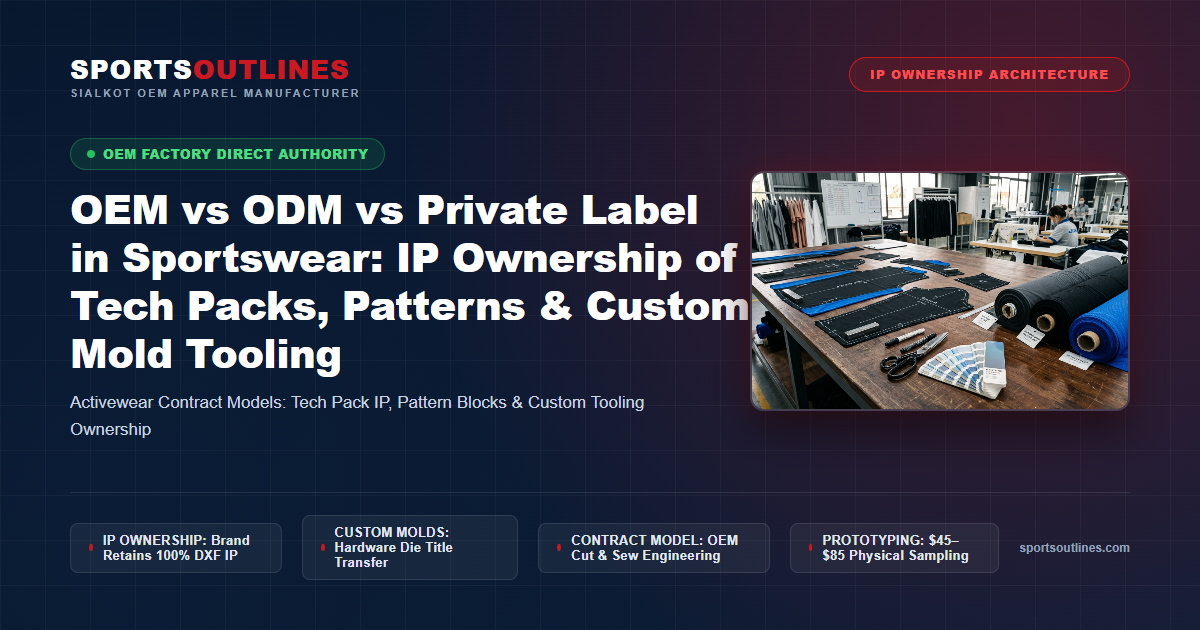
In international athletic apparel manufacturing, founders frequently conflate Original Equipment Manufacturing (OEM), Original Design Manufacturing (ODM), and Private Label production. This conceptual confusion creates catastrophic intellectual property (IP) disputes: who legally owns the graded CAD pattern blocks, the bespoke tech pack dimensions, the custom compression fabric blends, and the expensive metal injection molds for aglets and silicone logos? This master guide analyzes the legal, commercial, and operational mechanics of apparel manufacturing models, detailing work-for-hire assignment agreements, tooling amortization contracts, and practical IP protection when sourcing from Sialkot, Pakistan.
1. The Core Taxonomy: OEM vs. ODM vs. Private Label vs. White Label in Sportswear
Navigating overseas apparel sourcing requires precise legal and technical vocabulary. Each manufacturing tier shifts the distribution of design responsibility, development capital, production lead times, and—most crucially—proprietary asset ownership.
In the global sports apparel market, brands operate across four distinct production relationships:
- Original Equipment Manufacturer (OEM): The buyer provides 100% of the technical specifications, digital CAD pattern files, bills of materials (BOM), tolerance POMs, and fabric GSM composition. The factory acts purely as a contract cut-and-sew assembly facility. The brand retains absolute, unequivocal intellectual property ownership over the garment geometry.
- Original Design Manufacturer (ODM): The factory designs, engineers, and creates the patterns and garment silhouettes internally, offering an existing catalog of pre-developed activewear. The brand selects pre-existing catalog styles and applies its branded neck labels and heat transfers. The factory retains ownership of the base CAD patterns, while the brand only owns its trademark logo.
- Private Label Manufacturing: A hybrid commercial model where a brand partners with an agile manufacturer like Sports Outlines to create bespoke, custom-tailored collections. The manufacturer provides technical grading, pattern digitizing, and fabric sourcing assistance, but executes a formal Work-for-Hire Assignment conveying complete pattern and design ownership to the brand.
- White Label Sourcing: The factory mass-produces generic off-the-shelf blanks (such as basic tubular cotton tees). Multiple competing brands buy identical inventory and print graphics on the front. Zero proprietary fit or silhouette differentiation exists.
Table 1: Technical & Legal Comparison: OEM vs. ODM vs. Private Label vs. White Label
| Evaluation Criteria | OEM (Contract Assembly) | ODM (Factory Catalog) | Private Label (Custom Cut & Sew) | White Label (Stock Blanks) |
|---|---|---|---|---|
| Design Origin | 100% Brand-created Tech Pack | 100% Factory Catalog Library | Co-developed bespoke silhouettes | Generic stock blank catalog |
| Pattern & CAD Ownership | Exclusively owned by Brand | Retained by Factory | Transferred to Brand via Contract | Public / Stock standard |
| Tooling & Mold Ownership | Brand owns custom tooling | Factory owns tooling | Brand owns custom dies & molds | No custom tooling possible |
| Exclusivity of Fit | 100% Proprietary to Brand | Zero (Competitors buy same fit) | 100% Proprietary brand fit | Zero (Generic fit) |
| Prototyping Fee | $45–$85/piece (7–10 days) | $20–$40/piece (Existing block) | $45–$85/piece (7–10 days) | $15–$25 sample blank purchase |
| Factory Low MOQ | 30–50 pcs / style / color | 50–100 pcs / style | 30–50 pcs / style / color | 10–25 pcs (Stock blanks) |
| Development Lead Time | 4–6 weeks sampling cycle | 1–2 weeks fast turnaround | 3–4 weeks sampling cycle | Immediate off-the-shelf |
2. Intellectual Property (IP) Dynamics: Who Truly Owns What in Apparel?
In apparel manufacturing law, physical clothing items cannot be copyrighted under United States copyright law (17 U.S.C. § 101) because garments are classified as “useful articles.” This fundamental legal reality shocks many emerging activewear entrepreneurs. You cannot copyright the cut of a sports bra neckline or the inseam arc of a pair of joggers.
However, you can legally protect four distinct layers of intellectual property in sportswear:
- Original Two-Dimensional Artwork & Textile Prints: Bespoke sublimation patterns, repeating camouflage prints, engineered jacquard knit motifs, and vector screen print graphics are fully copyrightable as pictorial, graphic, or sculptural works.
- Trademarks & Brand Identifiers: Your brand name, wordmarks, silicone chest emblems, heat transfer logos, and signature woven labels registered with the USPTO, UKIPO, or WIPO.
- Proprietary CAD Pattern Files & Tech Packs: The digital source code of your garment (DXF/AAMA files, Gerber AccuMark, Lectra, or Clo3D projects) are protectable under trade secret law and contractual covenant.
- Custom Hardware & Utility Tooling: Custom-machined zipper pulls, silicone aglets, magnetic waistband closures, and specialized athletic compression pad molds, which can be protected by design patents or contractual exclusivity covenants.
Table 2: Sportswear Intellectual Property Ownership & Protection Matrix
| Garment Asset Layer | Legal Classification | Primary Protection Mechanism | Default Ownership (No Contract) | Ownership Under Sports Outlines Agreement |
|---|---|---|---|---|
| Digital CAD Pattern Blocks (.DXF) | Trade Secret / Proprietary Data | Work-for-Hire Assignment Clause | Pattern maker / Factory owns files | 100% Brand owns CAD source data |
| Tech Pack Specifications & BOM | Confidential Business Information | Bilateral Non-Disclosure Agreement | Public / Free for factory to reuse | Strictly confidential brand property |
| Custom Sublimation & Camo Artwork | Visual Artistic Work | Statutory Copyright Registration | Illustrator / Graphic artist owns copyright | Full copyright assignment to Brand |
| Custom Hardware Molds & Dies | Physical Tooling / Chattel Property | Tooling Ownership & Bailment Agreement | Factory claims mold as shop tooling | Brand owns mold; factory holds as bailee |
| Custom Fabric Knit Formulation | Proprietary Process / Trade Secret | Non-Use & Exclusivity Covenant | Knitting mill sells yarn blend to anyone | Exclusive knitting runs for Brand |
3. Tech Packs, CAD Vector Files & Grading Rule Blocks: The Work-for-Hire Trap
The most common IP conflict in private label activewear occurs when a brand decides to switch manufacturers. An emerging sportswear brand spends two years perfecting the fit of its seamless compression tights or oversized French terry hoodies with Factory A in Sialkot. When the brand requests its graded digital pattern files (DXF or Gerber format) to quote production with Factory B, Factory A refuses:
The Factory’s Common Defense:
“You only paid for garment samples and finished production units. We developed the CAD grading blocks, seam allowances, and marker layouts using our internal master pattern makers. Those CAD files are our proprietary shop tools. If you leave our factory, you cannot have the digital files.”
Without a signed contract containing an express Work-for-Hire Assignment, the factory is legally correct under international commercial law. Paying a factory to produce a sample does not automatically grant you copyright or ownership over the underlying pattern geometry created by the factory’s technical staff.
To prevent this lock-in trap, your manufacturing contract must contain the following language:
Work-for-Hire & Pattern Assignment Provision
“All patterns, grading rules, CAD vector blocks, marker layouts, 3D simulation files, tech packs, and production specifications developed, modified, or digitized by Manufacturer in connection with Buyer’s purchase orders shall be deemed ‘work made for hire.’ To the extent such assets do not qualify as work made for hire, Manufacturer hereby irrevocably assigns, transfers, and conveys to Buyer all worldwide right, title, and interest, including all copyright and trade secret rights. Upon Buyer’s written request, Manufacturer shall immediately deliver native digital CAD files (.DXF, .RUL, .AAMA) to Buyer without delay or supplemental ransom fees.”
At Sports Outlines, we maintain an open-architecture policy. When you partner with us for private label or OEM cut-and-sew manufacturing, all digital CAD blocks engineered during our physical prototyping phase ($45–$85/piece) belong 100% to your brand.
4. Custom Mold Tooling, Embossing Dies & Hardware: Bailment Architecture
High-end athletic wear and combat gear require customized physical hardware: CNC-machined steel injection molds for TPU aglets, zinc alloy debossed zipper pulls, silicone chest patches, high-frequency embossing plates for boxing gloves, or customized EVA foam injection molds.
These physical molds represent significant capital investment, ranging from $150 for a multi-cavity silicone badge mold to $1,500+ for complex injection footwear or protective guard tooling. Brands must structure these assets under legal Bailment Contracts.
Table 3: Custom Tooling, Mold & Die Governance Standards
| Tooling Type | Average Development Cost | Legal Ownership Status | Storage & Custody Protocol | End-of-Life Destruction Clause |
|---|---|---|---|---|
| High-Density Silicone Badge Molds | $120–$250 | Brand Owned (100% paid upfront) | Tagged with Brand Asset ID; secured in fireproof die room | Crushed / defaced on video upon contract termination |
| Custom Embossed Metal Zipper Pulls | $180–$350 | Brand Owned | Dedicated trim warehouse shelf; audited annually | Returned via DHL courier or certified melted down |
| Boxing Glove High-Frequency Embossing Die | $250–$500 | Brand Owned | Sialkot tooling vault; strict prohibition of third-party use | Mandatory physical defacing with angle grinder witnessed |
| Compression Molded EVA Knee / Shin Pads | $800–$2,000 | Brand Owned | Foam molding facility; logged per production batch cycles | Shipped back to Brand or scrapped under third-party audit |
| Rotary Screen Printing Cylinders | $200–$400 / color screen | Brand Owned | Print house inventory log; emulsion stripped after run | Stripped clean; engraving data permanently erased from RIP servers |
Direct Tooling Capitalization vs. Factory Amortization Traps
Some overseas suppliers propose “waiving” or “absorbing” initial mold tooling costs by amortizing the tooling expense across your first 5,000 units (adding $0.15 to each garment’s FOB price). Never agree to this arrangement.
When a factory amortizes mold costs, they retain legal title to the physical tooling. If production delays occur or quality drops on subsequent runs, you cannot legally seize or repossess the molds. At Sports Outlines, we require 100% direct upfront capitalization of custom dies ($120–$350). You receive an explicit bill of sale and immediate chattel ownership, ensuring you maintain complete leverage over your physical production tooling.
5. White Label Pitfalls vs. True Private Label Custom Cut-and-Sew Architecture
In the competitive landscape of gym apparel and combat athletics, fit is your primary moat. If your brand relies on generic white-label blanks purchased from domestic distributors, your customers will instantly notice that your $75 hoodie fits identically to a $25 competitor’s hoodie.
Athletic consumers build extreme brand loyalty based on how a compression tight sits on their iliac crest or how a drop-armhole tank reveals their posterior deltoids without sagging at the chest. When you source generic blanks, you rent customer attention; when you engineer custom patterns, you own defensible brand equity.
True private label manufacturing allows you to engineer proprietary ergonomic fit architecture:
- Drop-Tail Hemline & Articulated Raglan Sleeves: Eliminating overhead shoulder bunching during barbell snatches and bench presses.
- High-Rise Gusseted Crotch Seaming: Utilizing four-needle six-thread flatlock stitching to guarantee zero transparency and zero blowout during deep squats.
- Bespoke Fabric Composition: Custom yarn spinning (e.g., 75% Polyamide / 25% Spandex brushed interlock at 240 GSM) offering non-sheer stretch recovery unmatched by catalog polyester.
6. Reverse Engineering & Factory Copying Defense: The Non-Use Covenant
The greatest fear of Western activewear founders sourcing overseas is the “Ghost Shift”—the factory running an extra 500 units of your bespoke cut-and-sew leggings at night and liquidating them on regional marketplaces or selling your exact pattern block to another client.
A standard American Non-Disclosure Agreement (NDA) is completely inadequate to protect against this practice. A traditional NDA only prevents the factory from disclosing your confidential information to third parties. It does not explicitly forbid the factory from using your confidential designs for their own commercial benefit!
To neutralize this risk, your contract must contain an enforceable Non-Use and Anti-Circumvention Covenant:
Strict Non-Use & Anti-Circumvention Covenant
“Manufacturer covenants and agrees that it shall not, directly or indirectly, use Buyer’s proprietary patterns, tech packs, CAD files, fabric blends, trim tooling, or artwork for any purpose other than manufacturing finished goods exclusively for Buyer. Manufacturer shall not manufacture, market, distribute, or sell any garments substantially similar in fit, cut, or graphic design to any third party, nor shall Manufacturer disclose or provide Buyer’s sizing blocks or vendor supply sources to any competitor. Any unauthorized production, factory overruns, or third-party sales shall constitute willful copyright and trade secret infringement, entitling Buyer to immediate injunctive relief and liquidated damages equal to three times (3x) the gross retail value of all unauthorized units produced.”
7. Brand Asset Registry: Woven Labels, Heat Transfers & Packaging IP
Branding trims are the physical manifestation of your trademark. In unregulated manufacturing facilities, unused branded heat transfers, woven care tags, and matte black frosted zipper bags are often carelessly tossed into open bins where unauthorized workers can salvage them.
Table 4: Trim & Branding Asset Custody Reconciliation Protocol
| Trim / Accessory Component | Yield Allowance Overrun | Custody Tracking Standard | Defective Trim Destruction Rule | Brand Protection Audit Gateway |
|---|---|---|---|---|
| High-Density Silicone Heat Transfers | +3% application scrap buffer | Barcoded roll count logged at heat-press station | Melted & scraped under supervisor sign-off | Exact balance reconciliation on final PO invoice |
| Damask Woven Neck & Care Labels | +2% sewing scrap buffer | Issued by master trim storekeeper per bundle tag | Cut in half through logo with fabric shears | Pre-pack inline inspection audit verification |
| Custom Debossed Hangtags & Cords | +1% handling scrap buffer | Packed in sealed 500-count bundles in finishing hall | Cross-cut shredded in industrial paper shredder | Carton count vs. garment pack-out audit |
| Biodegradable Frosted Zip Poly Bags | +1% packaging damage buffer | Logged per final bagging line operator station | Slit lengthwise across printed logo bar | Master carton packing slip sign-off |
8. Prototype Sampling Commercial Governance: Non-Refundable Engineering Fees
In private label athletic apparel, the prototype sampling phase is a high-skill engineering service. Pattern cutters must manually digitize tech packs, draft bespoke grading rules, configure single-ply laser cutters, and hand-stitch individual garments with specialized technicians.
At Sports Outlines, we maintain strict commercial discipline regarding physical prototyping:
Sports Outlines Sampling Invariant Policy
Physical Prototyping Fee: Strictly $45 to $85 per piece, pair, or set depending on technical complexity (e.g., $45 for high-stretch technical gym tees; $65 for multi-panel fleece hoodies; $85 for complex lined technical outerwear or MMA fight shorts).
Development Turnaround: Strictly 7 to 10 business days from technical pack sign-off and lab dip approval.
Non-Refundable Engineering Baseline: This physical prototype fee covers true material consumption, specialized machine calibration, and pattern cutter labor. It is a standalone engineering fee that guarantees priority factory scheduling and dedicated craft precision.
9. Minimum Order Quantity (MOQ) Economics Across OEM vs ODM Tiers
Massive conglomerate apparel factories in Bangladesh or Vietnam enforce minimum order quantities of 1,000 to 3,000 pieces per style. For high-growth boutique sportswear brands, absorbing that level of inventory carrying cost (ICC) is financially fatal.
Our factory-direct infrastructure in Sialkot, Pakistan, provides agile, low-MOQ contract manufacturing: strictly 30 to 50 pieces per style or colorway.
Table 5: Production Tier MOQ, Unit Cost & IP Protection Profile
| Production Volume Tier | MOQ per Style/Colorway | Manufacturing Model | Unit FOB Economics | IP Exclusivity & Ownership |
|---|---|---|---|---|
| Agile Brand Launch Tier | 30–50 pcs | Private Label Custom Cut & Sew | Moderate unit cost; lowest total cash risk | 100% Brand owns CAD blocks & tech packs |
| Growth Scale Tier | 100–300 pcs | OEM Dedicated Production Line | 15%–22% unit FOB cost reduction | Dedicated line exclusivity & custom trims |
| Enterprise Sourcing Tier | 500–1,000+ pcs | Full Industrial OEM Automation | Maximum unit margin; volume yarn discounts | Full patent, bespoke fabric knit exclusivity |
| Catalog Fast-Fashion Tier | 50–100 pcs | Factory ODM Catalog | Low unit cost; zero development fee | Zero IP ownership; factory sells to others |
10. Sialkot Legal Reality: Enforcing IP Protection in Pakistan
International brands frequently ask whether intellectual property contracts are practically enforceable in Pakistan. The legal framework in Pakistan is robust for commercial export contracts:
- Intellectual Property Organisation of Pakistan (IPO-Pakistan): Established under the IPO-Pakistan Act 2012, this federal apex body consolidates the Trade Marks Registry, Copyright Office, and Patent Office. Foreign trademarks registered under the Madrid Protocol or directly with IPO-Pakistan receive full statutory protection.
- Specialized IP Tribunals: Pakistan maintains dedicated IP Tribunals in Lahore, Karachi, and Islamabad with exclusive civil and criminal jurisdiction over trademark counterfeiting, design infringement, and copyright theft.
- Sialkot Chamber of Commerce & Industry (SCCI) Arbitration: The SCCI maintains an expedited commercial arbitration tribunal. Export-licensed manufacturers risk immediate cancellation of their federal export licenses and bank tax registrations if they default on an arbitral award or engage in unauthorized piracy of a client’s registered trademarks.
- PRGMEA Regulatory Compliance: The Pakistan Readymade Garments Manufacturers & Exporters Association (PRGMEA) enforces strict business ethics codes among member facilities. Verified IP misappropriation complaints result in immediate expulsion, revoking duty-free export facilitation privileges under Pakistan customs regulations.
11. Tech Pack Asset Dissection: Which Technical Exhibits Constitute Protectable IP?
A comprehensive apparel tech pack contains multiple distinct data modules, each with varying degrees of legal protectability. Understanding which portions of your technical document constitute proprietary trade secrets versus generic manufacturing instructions ensures you safeguard your competitive advantage.
Table 6: Complete Tech Pack IP Breakdown & Trade Secret Enforceability
| Tech Pack Module | Technical Content Included | IP Protection Level | Legal Protection Basis | Sports Outlines Factory Policy |
|---|---|---|---|---|
| Graded Measurement Spec Sheet | Base size POMs, multi-size grading increments (XS to 3XL) | High (Trade Secret) | Proprietary fit formula; protected by NDA and non-use covenants | Strictly partitioned; never shared across client accounts |
| Bill of Materials (BOM) | Yarn supplier references, fabric weight, zipper codes, thread spec | Medium-High (Proprietary) | Commercial sourcing strategy; confidential business data | Protected supply chain transparency |
| Artwork Placement & Callout Maps | Exact millimeter placement coordinates, Pantone TCX matches | Highest (Copyright + Trademark) | Original graphic artwork; statutory copyright assignment | Dedicated digital screen archiving; zero third-party reuse |
| Stitch Construction Diagram | ISO 4915 stitch types (e.g., Stitch 607 Flatlock, 504 Overlock, SPI) | Low (Standard Industrial) | Public industrial manufacturing standards; general knowledge | Executed with precision German needle equipment |
| Packaging & Folding Architecture | Individual polybag dimensions, barcode placement, master carton pack-out | Medium (Confidential) | E-commerce logistics efficiency; protected under umbrella NDA | Amazon FBA & D2C retail compliance guaranteed |
12. Frequently Asked Questions: OEM vs ODM vs Private Label IP Governance
Q1: What is the main difference between OEM and ODM in sports apparel manufacturing?
In OEM manufacturing, the buyer provides 100% of the tech pack specifications and retains total IP ownership over the CAD patterns. In ODM manufacturing, the factory creates the designs and owns the base pattern blocks, allowing the buyer only to brand an existing catalog garment.
Q2: Can an overseas factory legally sell my custom CAD pattern blocks to my competitors?
If your contract includes a Work-for-Hire Assignment and Non-Use Covenant, the factory is legally barred from sharing or utilizing your patterns. Without such a contract, the factory may claim proprietary ownership over the grading blocks developed by their technicians.
Q3: How much does physical prototype sampling cost at Sports Outlines?
We charge a transparent physical prototyping fee of $45 to $85 per piece, pair, or set, delivered within 7 to 10 business days. This pre-production engineering fee covers pattern creation, grading calibration, and sample machine setup.
Q4: What is the factory minimum order quantity (MOQ) at Sports Outlines?
Our low MOQ is strictly 30 to 50 pieces per style or colorway. This allows independent activewear and combat gear brands to produce custom cut-and-sew collections without excessive capital exposure.
Q5: Who owns custom injection molds for silicone logos and metal zipper pulls?
Under a tooling bailment agreement, the brand owns 100% of custom tooling once the initial tooling fee is paid. The factory acts merely as a bailee holding the mold in custody, and must destroy or return it upon contract termination.
Q6: Why is a standard American NDA often ineffective with overseas suppliers?
Standard NDAs only prohibit disclosing secrets to third parties, failing to prevent the factory from manufacturing and selling your designs themselves. You need an enforceable Non-Use, Non-Circumvention, and IP Assignment agreement.
Q7: What is the difference between private label apparel and white label apparel?
White label apparel uses mass-market generic blanks that any brand can buy and print on. Private label apparel involves custom cut-and-sew engineering, bespoke silhouettes, customized fabric knitting, and proprietary fit.
Q8: Can physical garment cuts or silhouettes be copyrighted in the United States?
No. Garments are classified as “useful articles” under US copyright law. Protection is achieved through trademark registration, copyright on 2D prints, trade secret protection for CAD files, and contractual covenants.
Q9: How does Sports Outlines handle leftover branded trims and labels?
We maintain an exact trim reconciliation system. Excess or damaged heat transfers, labels, and hangtags are securely accounted for, shredded or destroyed under supervision, and never released to the market.
Q10: How can I protect my activewear designs when beginning production in Sialkot?
Partner with an established export-licensed manufacturer like Sports Outlines, execute a bilateral IP Assignment and Manufacturing Agreement, and establish an official record of your CAD files during initial prototyping ($45–$85/piece).
Secure 100% IP Ownership with Factory-Direct Manufacturing
Build your brand on proprietary fit, exclusive CAD grading blocks, and institutional contract security. Partner directly with Sports Outlines in Sialkot, Pakistan. Enjoy low 30–50 piece minimums, precision prototyping ($45–$85/piece), and guaranteed IP protection.
International desks: USA Sourcing Desk | UK Sourcing Desk | Australia Sourcing Desk | Sportswear Catalog.