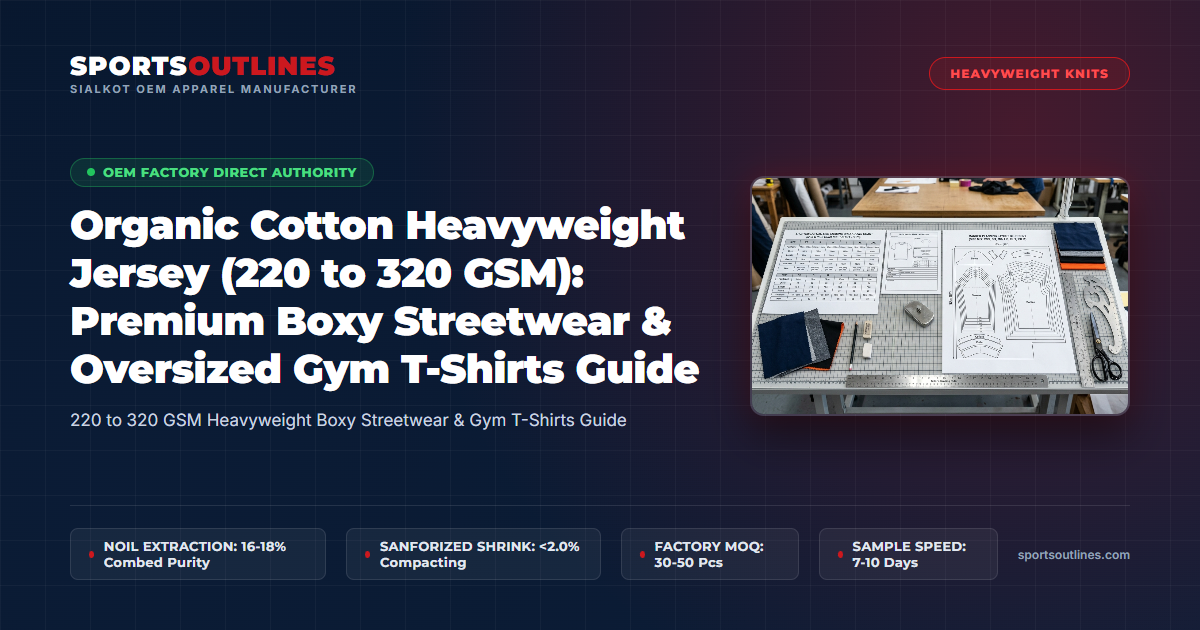
Across the global fitness, streetwear, and athletic lifestyle apparel landscape, a massive structural shift has revolutionized the humble workout shirt. Where paper-thin, clingy 140 GSM polyester shirts once dominated fitness apparel racks, modern fitness enthusiasts and streetwear connoisseurs now overwhelmingly prefer substantial, architectural silhouettes: organic cotton heavyweight jersey gym t-shirts engineered between 220 and 320 GSM. These garments serve as the quintessential “pump cover” and lifestyle gym shirt—offering an exaggerated, drop-shoulder drape that flatters an athletic physique without clinging to the midsection, while delivering the breathable, skin-friendly tactile luxury of certified long-staple organic cotton.
However, manufacturing pro-grade heavyweight cotton tees is vastly more complex than simply substituting lightweight yarn with heavier yarn. As fabric weight climbs past 240 GSM, circular knits become vulnerable to severe torque and spiral twisting, collar ribbing collapses or stretches out into a sloppy neckline, and heavyweight seams pucker under improper sewing machine tension. At Sports Outlines, an agile OEM/ODM custom performance apparel manufacturer based in Sialkot, Pakistan, we combine rigorous textile science with precision cut-and-sew craftsmanship. This technical manual provides apparel founders, sourcing directors, and streetwear designers with a comprehensive blueprint for engineering heavyweight organic cotton gym tees. We explore GOTS certified fiber sourcing, yarn spinning counts (16/1s to 24/1s), GSM weight tiers, anti-sag collar ribbing geometry, open-width stenter torque control, printing parameters, full direct factory cost transparency, and our rapid physical prototype sampling program.
1. GOTS Certified Organic Cotton: Agronomy, Fiber Length & Combing Physics
The structural integrity and surface smoothness of a heavyweight gym t-shirt are determined before circular knitting machines ever touch the yarn. The quality foundation begins at the agricultural and ginning stages:
- Global Organic Textile Standard (GOTS) Certification: Sports Outlines sources organic cotton certified under GOTS Version 7.0. GOTS certification guarantees that the cotton is grown from non-genetically modified (non-GMO) seeds without synthetic pesticides, defoliants, or petroleum-based nitrogen fertilizers. Sustainable crop rotation preserves soil organic matter and reduces agricultural water consumption by up to 91% compared to conventional cotton farming. GOTS also enforces strict social criteria covering fair labor wages, safe working environments, and the complete prohibition of child labor across ginning and spinning mills.
- Long-Staple Length (Upper Half Mean Length ≥29.5 mm): Coarse, low-grade cotton relies on short fibers (length <24 mm) that require excessive twist to hold together, resulting in stiff, scratchy yarns with high surface hairiness. For our heavyweight jersey, we utilize long-staple upland and combed organic cotton with an Upper Half Mean Length (UHML) of 29.5 to 32.0 mm. Longer staple fibers produce stronger yarns with fewer exposed fiber ends per meter, yielding superior tensile strength and an exceptionally soft, clean surface.
- Precision Combing & Noil Extraction (16% to 18%): Raw carded cotton contains microscopic debris, immature fibers, and short “noil” fibers. We process our cotton slivers through high-speed mechanical combers (e.g., Rieter E 86 combers) that extract 16% to 18% of short fibers. Combing aligns the remaining long cellulose fibers into parallel orientation, slashing Zweigle S3 yarn hairiness by over 75%. This produces compact, lustrous yarns that resist pilling under abrasive gym bench contact (ISO 12945-2 Grade 4.0).
- Siro-Spun & Compact Ring Spinning: For our premium 260 to 320 GSM single jersey, we spin yarns using compact ring-spinning technology. Pneumatic suction aprons condense the drafted fiber strand before twist insertion, pulling loose fiber ends into the yarn core. This produces a dense, round yarn profile with a 20% higher tenacity and virtually zero surface fuzz, ensuring razor-sharp screen print and DTF definition.
| Fiber / Yarn Attribute | GOTS Compact Combed Cotton | Standard Carded Open-End Cotton | CVC 60/40 Poly-Cotton Blend | Synthetic Polyester Jersey |
|---|---|---|---|---|
| Staple Fiber Length (UHML) | 29.5 – 32.0 mm (Long-Staple) | 22.0 – 24.5 mm (Short) | 28.0 mm cotton / 38 mm poly | Continuous micro-filament |
| Zweigle S3 Hairiness (>3mm) | ≤45 ends / 100m (Ultra-Clean) | >320 ends / 100m (Fuzzy) | 95 ends / 100m | 0 ends (Continuous) |
| Standard Moisture Regain (%) | 8.0% – 8.5% (High Comfort) | 7.5% – 8.0% | 5.5% – 5.8% | 0.4% – 0.8% (Hydrophobic) |
| Martindale Pilling (ISO 12945-2) | Grade 4.0 – 4.5 (5,000 rubs) | Grade 2.5 (Severe Pills) | Grade 3.5 – 4.0 | Grade 4.0 – 4.5 |
| Skin Hypoallergenic Profile | 100% Non-irritating, pH 5.5-6.5 | Prone to micro-lint irritation | Good | Static cling, traps sebum odor |
2. GSM Weight Engineering: 220 to 320 GSM Structural Classifications
In modern activewear and luxury streetwear manufacturing, Grams per Square Meter (GSM) defines the physical drape, silhouette structure, and thermal performance of the t-shirt. At Sports Outlines, we engineer three specialized heavyweight weight tiers:
| GSM Tier | Yarn Count (Ne) & Gauge | Knit Architecture | Bending Rigidity (KES-FB2) | Optimal Athletic Application |
|---|---|---|---|---|
| 220 – 240 GSM (Mid-Heavy) | 24/1s or 26/1s Compact + 24G | Single Jersey (Tight Loop) | 0.048 mN⋅cm (Supple) | All-season gym training, summer pump covers, standard streetwear |
| 260 – 280 GSM (Heavy Pro) | 20/1s or 21/1s Combed + 20G/22G | High-Density Single Jersey | 0.075 mN⋅cm (Structured) | The industry standard boxy gym tee, heavy drop-shoulder bodybuilding fit |
| 300 – 320 GSM (Super-Heavy Luxury) | 16/1s Compact or 32/2s Plied + 18G | Heavy Single Jersey / Double Knit | 0.115 mN⋅cm (Architectural) | Ultra-luxury architectural streetwear ($65–$95 retail), winter warmups |
At 260 to 280 GSM, the fabric hits the “sweet spot” for athletic bodybuilding pump covers. The fabric has enough mass to maintain clean, crisp architectural shoulder lines and resist perspiration bleed-through during warmups, yet breathes freely enough for high-volume deadlifts, squats, and bench presses.
3. The Boxy Oversized Silhouette: Pattern Engineering & Size Grading
A common design mistake made by emerging fitness brands is simply buying a standard commercial t-shirt two sizes larger to achieve an “oversized” look. Standard sizing merely increases the torso length, creating a baggy, dress-like shirt that gathers awkwardly at the hips. Sports Outlines engineers dedicated boxy oversized athletic blocks designed from the ground up for muscular physiques:
- Exaggerated Drop-Shoulder Seam Geometry: The shoulder seam is shifted 6.0 to 9.0 cm past the natural acromion bone down onto the upper triceps. The armhole curve is scooped deeper with a wider bicep circumference (+4.5 cm over regular tees), allowing full range of shoulder flexion and abduction without pulling the bottom hem upward during overhead presses.
- Wider Chest Box with Truncated Torso Length: The chest and waist widths are cut on a true rectangular box profile (chest width: +8.0 to 10.0 cm over standard athletic cuts). Crucially, the total body length is truncated by 4.0 to 5.0 cm compared to regular sizing. This ensures the t-shirt rests neatly at the upper waistband of the athlete’s shorts or sweatpants, completely eliminating the “t-shirt dress” appearance.
- Elbow-Length Sleeve Extension: Sleeves are lengthened to finish 1.5 to 2.5 cm above the elbow joint, featuring a wide, structured sleeve opening that drapes cleanly around the triceps without flaring outward like wings.
- Size Grading Proportions (XS to 3XL): When grading across sizes, we apply non-linear grading: while chest width scales at +5.0 cm per size step, body length scales conservatively at only +1.5 cm per step. This preserves the distinct boxy architectural proportion across every size from XS up to 3XL.
4. Anti-Sag Collar Engineering: 1×1 Heavy Ribbing & Elastane Recovery
Nothing ruins a premium heavyweight t-shirt faster than a stretched-out, wavy neckline (the notorious “bacon neck” defect) after three wash cycles. Lightweight self-fabric collars or flimsy 1×1 cotton ribbing cannot support the heavy 260+ GSM body fabric pulling down on the neck opening. Sports Outlines solves collar sag through reinforced engineering:
- Dedicated 380 to 420 GSM 1×1 Heavy Rib Knit: We knit specialized heavy collar ribbing spun from fine 30/2s combed organic cotton intimately blended with 5% high-modulus Creora® elastane. The high GSM weight ensures the collar matches the substantial visual weight of the body jersey, while the elastane core provides instant 98.5% elastic snap-back recovery after stretching over the head.
- Tight 2.5 to 3.0 cm High-Neck Rib Profile: The collar band height is set at a bold 2.5 to 3.0 cm (1.0 to 1.2 inches) with a tight, ergonomic neck radius. This creates the classic high-neck streetwear look that frames the trapezius muscles and collarbones crisply.
- Self-Fabric Herringbone Neck-to-Shoulder Taping: We reinforce the back neck seam and extend continuous 12 mm herringbone twill tape across both shoulder seams down to the sleeve caps. This structural bridge absorbs the weight of the heavy garment on hangers and prevents shoulder seam elongation during wear.
- Twin-Needle Topstitching with Chainstitch Foundation: The collar rib is joined to the body using a 4-thread overlock followed by twin-needle 6 mm topstitching. This locks the seam allowance flat against the inside body, preventing the collar from flipping outward or curling upward after laundering.
5. Finishing Dynamics: Anti-Torque Stenters & Rubber-Belt Sanforizing
Because heavyweight single jersey utilizes heavy yarns (16/1s to 20/1s) knitted on high-torque circular cylinders, un-stabilized fabric will suffer severe spiral skewing. At Sports Outlines, we eliminate dimensional instability through advanced wet finishing:
- Open-Width Slitting & Optoelectronic Weft Straightening: Circular knitted fabric rolls are slit open longitudinally and guided through an 8-chamber Bruckner stenter frame equipped with Mahlo optoelectronic weft-straightening sensors. The sensors detect loop angle skew in real time and automatically adjust pin-chain speeds to align yarn courses perpendicular to fabric selvedges, permanently locking spirality torque strictly under ≤1.5%.
- Rubber-Belt Compactive Sanforizing (Shrinkage Lock): Heavy cotton knits naturally shrink 8% to 12% in hot water washing if untreated. We pass all jersey through heavy-duty rubber-belt sanforizing compactors applying 18% to 22% mechanical overfeed under 2.5 bar saturated steam at 135°C. This mechanically condenses the knitted loop height, holding post-wash domestic laundry shrinkage (AATCC 135) strictly within ±2.0% length and width.
- Enzymatic Bio-Polishing with Acid Cellulase: To achieve an ultra-smooth, butter-soft hand-feel without using temporary chemical softeners that wash out, our fabrics undergo gentle bio-polishing. Purified cellulase enzymes hydrolyze protruding surface micro-fibrils, eliminating future fuzz and pill nucleation sites.
6. Printing & Dyeing: Discharge, High-Density Silicone & Vintage Washes
Heavyweight organic cotton jersey provides the ultimate premium canvas for high-end streetwear and gym graphics:
- Water-Based Discharge Screen Printing: For massive full-back illustrations and oversized chest graphics, standard plastisol ink creates a heavy, rubbery “sweat patch” that blocks breathability. We formulate water-based discharge inks that chemically replace the fabric dye with pigment. The print becomes an integrated part of the cellulose fiber, leaving zero tactile hand-feel and maintaining 100% natural breathability during heavy workouts.
- High-Density (HD) 3D Silicone Printing: For crisp, architectural front chest branding, we apply multi-pass silicone inks through 300 to 400 μm capillary stencils. Cured at 140°C, these 3D logos feature sharp vertical edges and a matte finish that stretches with the cotton knit without cracking or peeling.
- Suede Puff & Raised 3D Athletic Inks: For bold vintage collegiate typography and athletic branding, we formulate expanding puff additives into screen inks. Passing through curing tunnels at 155°C expands the ink into a soft, velvety 3D relief texture that complements the heavy cotton substrate without flaking off.
- Industrial Direct-to-Film (DTF) with Low-Melt TPU: For intricate, full-color illustrative artworks, we apply industrial cold-peel DTF transfers backed by fine thermoplastic polyurethane adhesive powder. Pressed at 135°C for 14 seconds at 4.0 bar pressure, the graphic embeds into the combed cotton surface, delivering vibrant color brilliance that survives 50+ commercial laundry washes (AATCC 61 4A Grade 4.5).
- Garment Pigment Dyeing & Vintage Acid Wash: For 90s vintage gym aesthetics, shirts are sewn from prepared-for-dye (PFD) raw cotton jersey using 100% cotton threads. Garments are dyed in rotary drum washers using pigment dyes, followed by heavy cellulase stone washing. This selectively abrades high-contact seams, neck ribbing, and pocket edges, producing a weathered, authentic washed patina and broken-in softness.
7. Direct Factory Cost Transparency & Brand Profit Architecture
Direct factory cost transparency enables emerging streetwear and gymwear founders to build exceptional gross profit margins while maintaining accessible retail price points:
| Cost Driver | Technical Component Breakdown | Cost Range (USD) | Share of FOB |
|---|---|---|---|
| Heavyweight Organic Cotton Jersey | 280 GSM GOTS Compact Combed Cotton (0.42 kg per shirt) | $2.40 – $2.85 | 48% – 50% |
| Heavy Collar Ribbing (400 GSM) | 1×1 30/2s Cotton / 5% Elastane heavy rib knit collar | $0.40 – $0.55 | 8% – 9% |
| Precision CMT Assembly | Drop-shoulder cut, herringbone neck tape, twin-needle topstitching | $1.20 – $1.50 | 24% – 26% |
| Eco-Branding & Trims | Tagless heat-seal neck label, organic cotton hangtag, woven side tab | $0.45 – $0.60 | 9% – 10% |
| Packaging & Final AQL 2.5 Inspection | Steam pressing, individual biodegradable polybag, carton packing | $0.25 – $0.35 | 5% – 6% |
| Total Direct FOB Production Cost | Finished pro-grade 280 GSM heavyweight organic cotton gym tee | $4.70 – $5.85 | 100% |
In premium streetwear and boutique gymwear retail markets, 260 to 300 GSM heavyweight organic cotton tees retail between $45.00 and $68.00. At a direct FOB factory cost of $4.70 to $5.85, brand owners achieve gross margins of 86% to 91%, empowering founders to scale their brand sustainably.
8. Laboratory Testing Protocols for Heavyweight Cotton Certification
Every production lot of heavyweight organic cotton t-shirts manufactured at Sports Outlines undergoes rigorous laboratory testing to verify dimensional stability, seam pull strength, and colorfastness before shipment:
| Testing Standard | Test Parameter | Certified Factory Threshold | Performance Guarantee |
|---|---|---|---|
| AATCC 135 / ISO 6330 | Dimensional stability after 5x 40°C wash & tumble dry | ±2.0% length & width | Zero post-purchase shrinkage or torso shortening |
| AATCC 179 / ISO 16322 | Spirality and side seam torque skewness | <1.5% maximum torque | Side seams remain dead vertical down garment flanks |
| ISO 12945-2 (Martindale) | Face pilling resistance under 9 kPa pressure | Grade 4.0 at 5,000 cycles | Pill immunity against gym bench friction and bar knurling |
| ASTM D3786 (Diaphragm) | Hydraulic bursting strength on 280 GSM jersey | >480 kPa | Eliminates blowout tears at armholes and neckline seams |
| ISO 105-C06 | Colorfastness to domestic laundering (40°C) | Grade 4-5 (Change & Staining) | Zero color fading or dye bleeding onto lighter garments |
9. Cutting Room Protocols & Tension-Free Static Spreading for Heavyweight Jersey
In apparel manufacturing, cutting heavyweight 240 to 320 GSM single jersey presents unique physical challenges that differ entirely from lightweight activewear fabrics. Heavyweight cotton jersey possesses substantial mass and significant internal elasticity. If fabric rolls are fed straight from the compactor directly into automated cutting knives, residual winding stretch will cause immediate pattern shrinkage:
- Mandatory 24-Hour Static Relaxation Protocol: Freshly unrolled rolls of heavyweight single jersey retain substantial longitudinal roll-winding tension. Sports Outlines mandates that every roll be unrolled into loose, tension-free accordion folds on air-flotation spreading tables for a full 24 hours inside our climate-controlled cutting department (21°C ±2°C, 65% ±3% RH). This static relaxation period allows the knitted cotton loops to contract fully to their natural equilibrium geometry before cutting knives make a single incision.
- Restricted Lay Height (≤30 Plies): A common mistake in commercial production is stacking 60 to 80 plies of heavyweight jersey to maximize cutting speed. In heavy knits, the immense vertical weight of the upper plies compresses the lower plies, causing lower pattern pieces to cut wider than top pieces. We restrict lay height to a maximum of 24 to 30 plies, ensuring laser-precise pattern conformity across all cut bundles.
- Chilled Oscillating CNC Knives: High-density cotton generates extreme friction heat when sliced with high-speed automated reciprocating blades. We utilize computerized CNC cutting tables equipped with continuous vortex cold-air jet chilling systems. The chilled air prevents blade friction heat from scorching cellulose fibers or dulling knife edges, maintaining razor-sharp, exact pattern tolerances of ±0.8 mm across all size gradings from XS to 3XL.
10. Precision CMT Sewing Line Calibration & Needle Heat Dissipation
Assembling heavyweight cotton t-shirts requires specialized machine settings to eliminate needle cuts, broken stitches, and wavy seam edges:
- Light Ball-Point Needle Selection (Groz-Beckert SES Nm 70/10): Standard sharp needles slice through tightly packed cotton yarns in heavyweight jersey, causing microscopic runs and needle puncture holes along seam lines. We exclusively mandate SES light ball-point needles (Nm 70/10 or 75/11). The rounded needle point slides smoothly between the dense knit loops without severing individual cellulose filaments. Machine operating speeds are governed strictly under ≤4,200 RPM to prevent needle overheating and synthetic thread glazing.
- Positive Differential Feed Calibration (1.15:1): Heavyweight jersey tends to stretch forward under the presser foot during sewing, causing wavy, rippled hem seams (the infamous “lettuce-edge” defect). Overlock and coverstitch machines are adjusted with a positive differential feed ratio of 1.12:1 to 1.18:1, slightly condensing the fabric into the feed dogs to maintain dead-flat, clean hems.
- Twin-Needle Bottom Hem & Sleeve Coverstitching: Bottom hems and sleeve openings are finished with Yamato 2-needle 4-thread coverstitch machines utilizing 6 mm needle gauge spacing with 12 to 14 stitches per inch (SPI). We thread lower loopers with premium textured filament polyester, producing an ultra-flexible hem that stretches effortlessly during explosive gym movements without popping threads.
11. Quality Control Checklist & AQL 2.5 Inspection Matrix for Boxy Tees
To guarantee flawless retail-ready execution for our global brand clients, Sports Outlines enforces a multi-tier quality inspection protocol in accordance with ANSI/ASQ Z1.4 (ISO 2859-1) Level II standards:
- 100% In-Line Needle Detection: Before final polybag packaging, every finished t-shirt passes through calibrated conveyorized multi-head metal detectors (sensitivities: Fe ≥1.0mm, Non-Fe ≥1.2mm, Sus ≥1.5mm) to verify complete freedom from broken needle fragments, ensuring 100% athlete safety.
- Dimensional Spec Sheet Verification: Finished garments are measured across 14 critical points of measure (chest width, body length, drop-shoulder slope, sleeve length, collar opening, neck rib height) with critical tolerances held strictly within ±0.8 cm.
- Pull Test Strength Verification: Neck collar joints, shoulder twill taping, and side seams are subjected to calibrated mechanical pull-gauge testing (ASTM D5034) withstanding forces exceeding >220 Newtons without stitch breakage.
- Eco-Friendly Packaging & Barcode Labeling: Finished garments are steam-ironed on vacuum pressing tables, individually folded with acid-free tissue paper, packed in 100% biodegradable cornstarch polybags, and labeled with high-contrast GS1 barcode stickers for immediate DTC fulfillment.
Manufacture Custom Heavyweight Organic Cotton Gym Tees with Sports Outlines
Bring your custom boxy streetwear and fitness visions to life with Pakistan’s premier athletic apparel manufacturer. We offer an agile low factory Minimum Order Quantity (MOQ) of strictly 30 to 50 pieces per style/colorway with full size grading from XS to 3XL. Experience our fabric weight and construction precision first-hand with dedicated physical prototype samples completed within 7 to 10 business days for $45 to $85 per piece (strictly non-refundable with zero bulk credits, reflecting true labor, yarn setup, and materials allocation).
Explore Related Technical Manufacturing Silos & Fabric Guides
Explore Sports Outlines’ specialized technical manufacturing silos and international sportswear export infrastructure:
- International Export Silos: Discover our dedicated export programs for Custom Sportswear Manufacturer USA, Custom Sportswear Manufacturer UK, Custom Sportswear Manufacturer Australia, Custom Sportswear Manufacturer Canada, and Custom Sportswear Manufacturer Germany.
- Product Category Hubs: Explore our OEM/ODM manufacturing across Custom Sportswear & Activewear, Fitness & Gym Apparel, and Athletic Casual Wear.
- Related Technical Guides: Read our in-depth manufacturing guides on Combed Cotton vs Poly-Cotton Blends (60/40 vs 50/50), Loopback French Terry vs Brushed Fleece GSM Engineering, and Bamboo Viscose Activewear Textiles Guide.
You Might Also Like
Custom Apparel Branding: The B2B Guide to Woven Labels, Heat Transfers, Hangtags & Polybags
Seaweed-Derived Biopolymers & Kelp Yarns (Keel Labs / Kelsun™) in Activewear: Alginate Wet Spinning, Carbon-Negative Marine Biomass, and Breathable Technical Knits