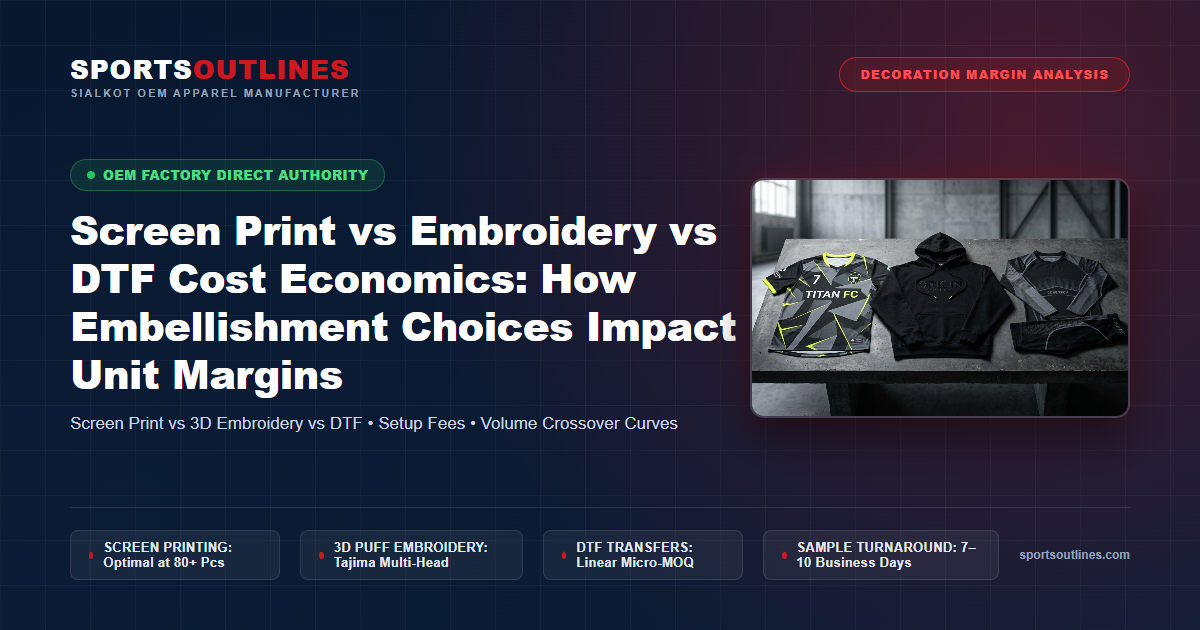
Direct Manufacturer Snapshot: Screen Print vs Embroidery vs DTF Cost Economics: How Embellishment Choices Impact Unit Margins
Apparel embellishment choice directly dictates unit Gross Margins and production break-even economics. 1) Screen Printing involves fixed initial tooling ($15–$25 per screen mesh burn plus color separations) but achieves lowest variable run costs ($0.12–$0.25 per color stroke), making it the undisputed margin leader above 80–100 units for 1- to 4-color graphics. 2) Commercial Multi-Head Embroidery incurs minimal fixed digitizing fees ($25–$35 one-time Wilcom punch) but linear variable run costs dictated purely by stitch count ($0.14–$0.20 per 1,000 stitches on Tajima/Barudan carousels), making it optimal for left-chest badges, structured headwear, and high-perceived-value luxury branding. 3) Direct-to-Film (DTF) digital transfers require zero screen burns or digitizing, charging linear consumable costs ($0.0035–$0.0055 per square inch of PET film/TPU adhesive), making it the most economical method for photorealistic multi-color artwork below 60–80 units. Sports Outlines International in Sialkot, Pakistan, provides in-house screen printing, automated 20-head embroidery, and industrial DTF across 30–50 piece factory MOQ tiers.
Direct WhatsApp: +92 316 7932595
In commercial apparel manufacturing, the choice of embellishment is not merely an aesthetic creative direction—it is the single most volatile variable determining your product’s Gross Margin, Cost of Goods Sold (COGS), perceived retail value, and long-term brand equity. Emerging streetwear founders, sportswear coordinators, and athletic brand managers frequently commit catastrophic budgetary errors during initial production planning by treating screen printing, commercial embroidery, and Direct-to-Film (DTF) digital transfers as interchangeable graphic application methods. Selecting the wrong embellishment architecture for your specific volume tier, fabric substrate, and graphic geometry can instantly destroy 18% to 35% of your unit profitability through unamortized setup fees, excessive machine cycle times, or devastating post-wash customer returns.
At Sports Outlines, our direct industrial manufacturing complex in Sialkot, Pakistan, operates multi-head computerized Tajima and Barudan embroidery carousels alongside automated Roq silk-screen presses and industrial roll-to-roll DTF systems. By analyzing real factory-floor time studies, consumable chemistry costs, operator labor allocation, and machine depreciations across thousands of production runs, we have engineered this definitive B2B economic guide. Below, we break down the exact mathematics of screen print screen-burn amortizations, embroidery stitch count calculation formulas, DTF polymer consumption curves, and the unit economics of decorating on flat cut-panels versus fully constructed garments.
Executive Engineering & Cost Breakdown:
- Section 1: The Three Embellishment Technologies: Physical Chemistry & Mechanical Principles
- Section 2: Screen Printing Economics: Mesh Counts, Screen Charges, and Color Separation Curves
- Section 3: Commercial Embroidery Mathematics: Stitch Counts, Needle Sequencing, and 3D Puff Tooling
- Section 4: Direct-to-Film (DTF) Transfer Realities: Consumables, Wash-Fastness, and Crossover Thresholds
- Section 5: Unit Cost Comparison Matrix Across Production Volumes (30, 50, 100, 300, 1,000 Units)
- Section 6: Cut-Panel Decorating vs Pre-Assembled Garment Application: The Sialkot Industrial Advantage
- Section 7: Wash-Fastness & Quality Standards: AATCC Durability Benchmarks and Defect Audits
- Section 8: Sports Outlines Low MOQ Manufacturing Protocol & Prototype Engineering
1. The Three Embellishment Technologies: Physical Chemistry & Mechanical Principles
To master embellishment costing, brand procurement teams must understand the physical mechanics and consumable chemistry governing each decoration modality. Apparel decoration is not simply “putting ink or thread on fabric”—it is an engineering interface between polymer chemistry, mechanical tension, thermal curing dynamics, and textile fiber morphology.
A. Industrial Screen Printing (Silkscreening)
Screen printing operates via stencil-based direct liquid ink deposition. A synthetic woven polyester mesh is stretched across an aluminum frame under high pneumatic tension (typically 20 to 35 Newtons/cm). The mesh is coated with a light-sensitive photosensitive emulsion, exposed to ultraviolet light through a high-density black film positive, and washed with pressurized water to open the unexposed image areas. During production, a polyurethane squeegee blade moving across the screen forces liquid ink through the open mesh apertures directly into the textile fibers.
The chemistry varies dramatically based on formulation:
- Plastisol Ink: A dispersion of polyvinyl chloride (PVC) suspension resin inside a liquid plasticizer. Plastisol does not chemically dye the fiber; instead, it wraps around the yarns and mechanically bonds upon heating to full gelation and cure temperature (typically 320°F / 160°C). It offers opaque color brilliance on dark textiles but leaves a noticeable plastic hand-feel (ink deposit layer).
- Water-Based & Discharge Inks: Formulated with water-soluble resin binders that penetrate deep into porous cellulose cotton fibers. Discharge inks incorporate a zinc formaldehyde sulfoxylate activator that bleaches out the factory cotton dye at high oven temperatures (360°F / 182°C), replacing it with the desired pigment. The result is a completely breathable, zero-hand feel (the fabric feels soft with no surface barrier), mandatory for premium streetwear luxury collections.
- High-Density & Specialty Silicone Inks: Formulated with high-viscosity silicone polymers pressed through thick capillary film stencils (200 to 400 microns), producing sharp, rubberized 3D architectural profiles with extreme thermal and wash resistance.
B. Multi-Head Computerized Embroidery
Commercial embroidery utilizes automated multi-needle stitching heads (such as our Tajima TFMX and Barudan BEKT series) operating at 750 to 1,000 stitches per minute (SPM). Vector artwork is converted through specialized software (such as Wilcom EmbroideryStudio) into a digital coordinate stitch file (DST or EMB format). This process—known as digitizing or punching—maps every needle penetration point, stitch angle, stitch length (typically 1.5mm to 7mm), underlay stabilization grid, and pull-compensation value.
The machine executes designs utilizing continuous filament polyester or rayon embroidery thread (typically 40-weight / 120-denier) fed through tension disks and reciprocating needles, interlocking beneath the fabric throat plate with a continuous bobbin thread (60-weight spun polyester). For structured garments, tear-away or cut-away non-woven backing stabilizers (ranging from 2.0 to 3.5 ounces per square yard) are hooped beneath the textile to resist puckering caused by stitch tension pulling against the fabric grain.
C. Direct-to-Film (DTF) Digital Transfers
Direct-to-Film represents the latest digital transfer innovation, replacing outdated Direct-to-Garment (DTG) wet-on-wet printing and heavy vinyl plotter plotting. In an industrial DTF setup, piezoelectric printheads (such as dual or quad Epson i3200-A1 heads) print mirrored digital artwork directly onto a clear polyethylene terephthalate (PET) release film coated with a microscopic release agent. The printer first deposits four-color CMYK water-based pigmented inks, followed immediately by an opaque, high-density white ink underbase over the entire wet print.
The printed wet film passes continuously through an automated powder shaker machine, which dusts a thermoplastic polyurethane (TPU) hot-melt adhesive powder (granular size 80 to 170 microns) across the wet white ink. An infrared conveyor drying tunnel melts the TPU powder into a continuous, flexible adhesive layer at 260°F (125°C). The finished transfer film is subsequently positioned on the cut fabric panel and pressed under high pneumatic thermal pressure (150°C–160°C for 12 to 15 seconds at 4 to 5 bar), causing the melted TPU resin to cross-link with the garment yarns before the PET carrier film is peeled away.
2. Screen Printing Economics: Mesh Counts, Screen Charges, and Color Separation Curves
Screen printing embodies the purest definition of industrial scale economies in manufacturing: exceptionally high fixed initial setup costs coupled with extremely low variable marginal unit costs.
| Screen Printing Cost Component | Industrial Benchmark (Sialkot Factory) | Retail Broker / Trading Co. Charge | Impact on Low MOQ Runs (30–50 Units) |
|---|---|---|---|
| Color Separation & Film Positives | $5.00 per separation plate | $15.00 – $25.00 per plate | Adds $0.30–$0.50 per unit on small runs |
| Aluminum Screen Tensioning & Mesh Burn | $15.00 flat per screen (Mesh 110–305) | $35.00 – $60.00 per screen | Critical Surcharge: A 4-color print requires 5 screens (incl. white underbase) = $75.00 fixed fee. At 30 units, this adds $2.50/unit! |
| Press Setup & Color Registration (Per Screen) | $3.00 machine setup labor | $10.00 – $15.00 setup penalty | Micro-run downtime penalty amortized across volume |
| Marginal Ink & Squeegee Stroke Run Fee | $0.12 – $0.25 per color stroke | $0.75 – $1.50 per color stroke | Extremely cheap marginal variable cost once machine runs |
| Dark Garment Flash Cure Station | $0.08 per flash index cycle | $0.35 – $0.50 dark garment surcharge | Requires quartz intermediate flash heating between passes |
The Screen Printing Unit Cost Formula
The exact cost per unit (C_sp) for silk screen printing on an order is expressed mathematically as:
Where:
- N_colors = Number of individual spot colors in the artwork
- N_underbase = 1 if printing on dark/colored textiles (requiring an opaque white base barrier), 0 if printing on white/natural fabrics
- F_film = Cost of film positive separation ($5.00)
- S_burn = Screen exposure and chemical wash cost ($15.00)
- M_setup = Roq automatic carousel press setup and pin registration labor ($3.00)
- Q = Total production batch quantity (units)
- R_ink = Marginal ink and squeegee labor run charge per color ($0.18 average)
- P_flash = Quartz intermediate flash-curing energy and dwell time fee ($0.08 on dark textiles)
Case Example: 3-Color Front Graphic on Black Heavyweight 480 GSM French Terry Hoodies
Because the garment is dyed jet black, it requires an underbase screen. Total screens required = 3 colors + 1 white underbase = 4 screens.
Total Fixed Setup Tooling = 4 screens * ($5.00 + $15.00 + $3.00) = 4 * $23.00 = $92.00.
Marginal Print Run Cost per Hoodie = (4 * $0.18) + $0.08 = $0.72 + $0.08 = $0.80.
- At 30 Units (Micro-Batch): Unit Cost = ($92.00 / 30) + $0.80 = $3.07 + $0.80 = $3.87 per hoodie.
- At 50 Units (Brand Launch Tier): Unit Cost = ($92.00 / 50) + $0.80 = $1.84 + $0.80 = $2.64 per hoodie (32% cost drop!).
- At 100 Units (Commercial Tier): Unit Cost = ($92.00 / 100) + $0.80 = $0.92 + $0.80 = $1.72 per hoodie (55% cost drop!).
- At 300 Units (Volume Tier): Unit Cost = ($92.00 / 300) + $0.80 = $0.31 + $0.80 = $1.11 per hoodie (71% cost drop!).
Notice how fixed screen amortization collapses as volume scales. At 300 units, a luxury 3-color chest graphic costs barely over one dollar in total factory embellishment expenditure.
Review Your Apparel Embellishment Specs with Sialkot Production Engineers
Send us your artwork, stitch counts, or tech pack on WhatsApp for open-book embellishment cost breakdowns and factory-direct pricing.
✓ $45–$85 Physical Prototypes •
✓ Worldwide DDP Delivery
3. Commercial Embroidery Mathematics: Stitch Counts, Needle Sequencing, and 3D Puff Tooling
Unlike screen printing, commercial embroidery exhibits minimal initial fixed tooling costs combined with relatively high, linear variable machine operating costs. The primary cost driver in embroidery is not the number of thread colors (a 15-needle Tajima head can cycle between 12 distinct Madeira thread cones with zero manual ink washing), but rather Total Stitch Count and Machine Operating Time (Takt Time).
A. The Mechanics of Machine Takt Time
Commercial embroidery carousels operate at an average running speed of 700 to 850 stitches per minute (SPM). However, machine velocity is not constant:
- Short Stitches (under 2mm): Slow the machine down to prevent thread friction burning and needle heating.
- Long Satin Stitches (over 7mm): Require the machine to execute jump stitches or frame-motion deceleration, reducing net output speed.
- Thread Trims & Needle Changes: Each automatic thread trim and pantograph needle switch consumes approximately 5 to 7 seconds of dead cycle time. A design with 18 color switches will take 2 minutes longer to sew than a design with 2 color switches, even if both possess exactly 8,000 total stitches!
B. Sialkot Industrial Embroidery Cost Formula
The real manufacturing cost per embroidered garment (C_emb) is determined by:
Where:
- D_wilcom = One-time precision Wilcom digitizing tape fee ($25.00 for chest badges, $40.00 for oversized jacket backings). This is paid once; reorders carry zero digitizing fees.
- Q = Production run quantity (units).
- S_total = Total audited stitch count of the artwork.
- R_1k = Factory rate per 1,000 stitches (benchmark: $0.14 – $0.18 at Sports Outlines).
- H_hoop = Labor and backing stabilization cost ($0.25 to $0.40 for framing with double 2.5 oz cut-away stabilizer).
- F_puff = 3D Puff surcharge ($0.60 to $1.20) if incorporating high-density EVA foam beneath satin column stitches.
| Embroidery Design Classification | Typical Stitch Count Range | Machine Run Time (800 SPM) | Unit Production Cost (at 100 Units) | Recommended Applications |
|---|---|---|---|---|
| Left Chest Minimalist Wordmark | 3,500 – 5,500 stitches | 4.5 – 6.5 minutes | $1.10 – $1.45 / unit | Polo shirts, gym performance tees, track jackets |
| Standard Center-Chest Brand Shield | 8,000 – 12,000 stitches | 10 – 15 minutes | $1.75 – $2.40 / unit | Midweight hoodies, crewneck sweatshirts, bomber jackets |
| 3D High-Density Puff Headwear/Chest Logo | 12,000 – 18,000 stitches (Dense satin caps) | 16 – 24 minutes (Slow 600 SPM speed) | $2.65 – $3.75 / unit | Structured snapbacks, dad hats, luxury heavyweight fleece |
| Oversized Full Jacket Back Mural | 45,000 – 85,000 stitches (Tatami fill) | 55 – 105 minutes | $7.80 – $14.50 / unit | Varsity wool jackets, motorsport outerwear, satin fight robes |
The Hidden Cost Trap: Oversized Tatami Fills
A frequent rookie design mistake is taking a large graphic intended for screen printing (such as an 11-inch circular illustration across the back of a hoodie) and requesting it as full embroidery. A solid 11-inch design filled with Tatami underlay and top stitching easily exceeds 65,000 stitches! Even at industrial factory rates, a 65,000-stitch design incurs over $10.00 in sewing labor alone and ties up a 20-head Tajima machine for more than an hour per cycle.
The Smart Hybrid Solution: For large back graphics, Sports Outlines recommends a hybrid approach: execute the massive background illustration using water-based screen printing or DTF (cost: ~$1.20), then embroider high-impact accent badges or typographic titles over top using an 8,000-stitch 3D puff treatment (cost: ~$1.80). Total embellishment cost: $3.00—achieving a luxury multi-textural aesthetic at 70% lower cost than full embroidery.
4. Direct-to-Film (DTF) Transfer Realities: Consumables, Wash-Fastness, and Crossover Thresholds
Direct-to-Film (DTF) has fundamentally revolutionized short-run apparel prototyping and full-color photorealistic graphic production. Unlike screen printing, DTF requires zero screen burns, zero color separations, and zero press setup time. Unlike Direct-to-Garment (DTG), DTF requires zero fabric pre-treatment chemical spraying, eliminating staining halos on sensitive colored fabrics.
A. The Chemistry of DTF Consumables & Square-Inch Pricing
DTF is priced almost purely on physical consumable usage—specifically, the linear square inches of PET film, aqueous pigmented ink, and TPU adhesive powder consumed:
- Consumable Base Cost: High-grade industrial Korean/Japanese PET release film combined with DuPont Artistri pigment inks and Bayer TPU hot-melt powder costs approximately $0.0035 to $0.0055 per square inch in raw materials.
- Small Chest Logo (3.5″ x 3.5″ = 12.25 sq inches): Raw material cost = $0.05. Factory printed, powdered, cured, and pneumatically heat-pressed onto cut panel = $0.45 – $0.65 total unit cost.
- Standard Front Graphic (10″ x 12″ = 120 sq inches): Raw material cost = $0.54. Total applied factory cost = $1.65 – $2.10 total unit cost.
- Oversized Streetwear Back Print (14″ x 18″ = 252 sq inches): Raw material cost = $1.15. Total applied factory cost = $3.40 – $4.20 total unit cost.
B. The Crossover Threshold Analysis
Because DTF cost is virtually flat (there are no screens to amortize), the cost curve is linear. In contrast, screen printing starts high (due to screen fees) but plummets steeply as order volume grows.
The Golden Crossover Rules for Apparel Brands:
- Photorealistic & Multi-Color Designs (6+ Colors or Continuous Tonal Gradients): DTF is virtually ALWAYS cheaper than screen printing up to 150–200 units, because burning 7 to 8 individual screens ($140–$160 fixed cost) wipes out any marginal ink savings on short runs.
- 1-to-2 Color Solid Graphics: Screen printing becomes cheaper than DTF at just 45 to 60 units. Once you cross 75 units, 1-color screen printing drops below $0.70/unit, whereas DTF remains fixed at $1.60+.
- 3-to-4 Color Standard Artwork: The exact crossover point sits between 80 and 110 units. Below 80 units, use DTF. Above 110 units, transition to automated screen printing.
5. Unit Cost Comparison Matrix Across Production Volumes (30, 50, 100, 300, 1,000 Units)
To give brand directors absolute clarity when building production budgets, the matrix below models the total embellishment cost per unit for a standard 10″ x 10″ 3-Color Graphic (or 10,000-Stitch Equivalent Shield) applied to a midweight garment.
| Order Quantity Tier | Screen Printing (3-Color + Underbase) | Commercial Embroidery (10k Stitches) | Direct-to-Film (DTF 10″x10″ Full Color) | Optimal Engineering Recommendation |
|---|---|---|---|---|
| 1 Piece (Prototype) | $92.80 (Prohibitive screen setup) | $27.00 ($25 Wilcom tape + $2 sewing) | $2.50 (Ultra-low sample cost) | Use DTF for fit/aesthetic mockups; use Embroidery if production requires stitch texture. Screen print only if strike-off sample fee ($45–$85) is approved. |
| 30 Pieces (Micro MOQ) | $3.87 / unit | $2.73 / unit ($0.83 digitizing + $1.90 run) | $2.10 / unit | DTF wins on price and speed for multi-color graphics. Embroidery wins for corporate badges and structured caps. |
| 50 Pieces (Launch Tier) | $2.64 / unit | $2.40 / unit ($0.50 digitizing + $1.90 run) | $2.00 / unit | Three-way parity threshold. Embellishment choice now dictated by fabric texture, breathability, and retail aesthetic rather than cost. |
| 100 Pieces (Commercial) | $1.72 / unit (Sharp efficiency inflection) | $2.15 / unit ($0.25 digitizing + $1.90 run) | $1.90 / unit | Screen Printing becomes the margin leader! Superior breathability, soft water-based hand, and lowest unit cost. |
| 300 Pieces (Scale Tier) | $1.11 / unit | $1.98 / unit ($0.08 digitizing + $1.90 run) | $1.75 / unit | Screen printing dominates gross margins. Run on automated Roq carousels for maximum color consistency. |
| 1,000 Pieces (Enterprise) | $0.89 / unit (Maximum amortization) | $1.85 / unit (Linear machine limit) | $1.55 / unit | Screen printing achieves maximum profitability. Embroidery remains steady due to physical machine run-time constraints. |
6. Cut-Panel Decorating vs Pre-Assembled Garment Application: The Sialkot Industrial Advantage
One of the most consequential structural advantages of manufacturing directly with an integrated OEM factory like Sports Outlines in Sialkot—as opposed to buying wholesale blanks from domestic distributors and sending them to local print shops—is the capability to execute Cut-Panel Embellishment.
Why Printing on Pre-Assembled Blanks Destroys Design Quality
When a decorator receives a pre-sewn hoodie or t-shirt, the garment is already a 3D tubular structure. When laid flat on a print platen:
- Seams Create Thickness Ridges: The raised seams of armholes, collars, and kangaroo pockets elevate the squeegee or DTF heat press platen. This causes uneven pressure distribution, resulting in blurred print edges, ink bleed, and inadequate thermal bonding adjacent to seams.
- Restricted Placement Zones: A print shop cannot print over shoulder seams, across side panels, or close to the bottom hem without risking broken embroidery needles or crushed zipper teeth.
- Distortion Around Pockets: Decorating across a hoodie kangaroo pocket is virtually impossible on pre-sewn blanks without awkward gaps and ink pooling in the crevice.
The OEM Cut-Panel Sequence
At our Sialkot manufacturing plant, embellishment is integrated directly into the assembly sequence:
- CNC Precision Fabric Cutting: Fabric plies are precision cut into flat pattern pieces (front body, back body, left sleeve, right sleeve, hood panels, pockets).
- Flatbed Embellishment Application: While completely flat, the unsewn pattern panels are loaded onto screen printing pallets, hooped directly into Tajima embroidery frames, or positioned on industrial flatbed pneumatic presses for DTF bonding. The squeegee and embroidery needles operate with 100% uniform pressure across completely smooth, flat fabric with zero seam obstructions.
- Edge-to-Edge & Seam Crossing Precision: Graphics can extend seamlessly off the edge of the panel or align precisely across multiple adjacent pieces with millimetric registration marks.
- Final Garment Assembly: After the embellishment is cured, inspected, and quality-cleared, the panels proceed to the sewing floor for 4-thread overlock, flatlock, and coverstitch assembly. The result is a flawless retail-grade finish indistinguishable from luxury fashion house garments.
7. Wash-Fastness & Quality Standards: AATCC Durability Benchmarks and Defect Audits
A garment may look immaculate upon unboxing, but if the graphic cracks, peels, or fades after three household wash cycles, customer chargebacks and brand abandonment will follow. At Sports Outlines, all embellishment chemistries undergo rigorous laboratory testing adhering to AATCC (American Association of Textile Chemists and Colorists) international standards.
| Embellishment Type | AATCC 61 Wash Fastness Rating | Expected Lifecycle (Home Laundering) | Primary Failure Mode to Audit |
|---|---|---|---|
| Plastisol Screen Print | Grade 4.5 – 5.0 (Excellent) | 60 – 100+ wash cycles | Under-curing in conveyor oven (cured under 320°F causes ink to crack and flake off after 2 washes). Audit: Stretch test and wash test. |
| Water-Based Discharge Print | Grade 4.5 – 5.0 (Permanent) | Lifetime of garment (Dyes fibers) | Incomplete pigment fixation or fiber fibrillation. Extremely durable because ink has zero plastic film layer. |
| Polyester Embroidery | Grade 5.0 (Indestructible) | Lifetime of garment (150+ washes) | Thread snagging, backing stabilizer degradation, loose loop tension. Impervious to household bleach and high dryer heat. |
| Industrial DTF Transfer | Grade 3.5 – 4.0 (Good) | 40 – 55 wash cycles (Cold wash recommended) | Adhesive delamination at sharp geometric corners, micro-fissure surface cracking under high heat tumble drying (above 60°C). |
8. Sports Outlines Low MOQ Manufacturing Protocol & Prototype Engineering
Most industrial apparel factories capable of running automated 14-color Roq screen printing presses or 20-head Tajima embroidery carousels impose rigid 500- to 1,000-piece minimum order quantities per colorway. On the opposite extreme, retail Print-on-Demand (POD) platforms offer 1-piece runs but charge extortionate $18–$28 base blank prices with flimsy DTF films and rigid print templates.
Sports Outlines eliminates this binary compromise. We operate our Sialkot factory with a dedicated flexible cell architecture specifically optimized for emerging and scaling B2B apparel brands:
- Low Industrial MOQ: Strictly 30 to 50 pieces per style/colorway across custom cut-and-sew apparel, headwear, and combat sportswear.
- Bespoke Pre-Production Prototyping: We provide full physical pre-production engineering samples for a flat $45 to $85 non-creditable engineering fee with a rapid 7 to 10 business day turnaround. This fee covers dedicated master pattern drafting, film separation output, screen mesh burning, Wilcom digitizing, strike-off swatch calibration, and custom assembly.
- 100% Open-Book Costing: We provide line-item quotes itemizing exact fabric consumption, yarn gauge, screen setup fees, digitizing charges, stitch counts, and FOB shipping parameters with zero hidden broker surcharges.
| Production Volume Tier | Est. Unit FOB Cost | Sample Cost & SLA | Bulk Production SLA | Included Specifications | Recommended Buyer Profile |
|---|---|---|---|---|---|
| 30–50 Units (Micro MOQ Sampling) | $12.80 – $15.50 / piece (Includes 2-color Screen Print or 12k Stitch Embroidery) | $45 – $85 (100% Non-Creditable Engineering Prototype Fee, 7–10 Day Turnaround) | 12–16 Business Days | Open-book screen setup/digitizing file validation, strike-off swatch calibration, premium 380 GSM fleece or 240 GSM combed cotton blank, custom woven neck label, single unit polybagging with barcode. | Emerging streetwear labels, capsule drop validations, limited edition artist collaborations, boutique athletic releases. |
| 100 Units (Commercial Tier Growth) | $9.40 – $11.80 / piece (Amortized Tooling, High-Density 3D Puff or Multi-Color Screen) | $45 – $85 (100% Non-Creditable Engineering Prototype Fee) | 16–20 Business Days | Full automated carousel screen printing or 20-head Tajima embroidery run, custom dyed ribbing accents, branded silicone care tags, custom branded polybags, master export carton packaging. | Scaling direct-to-consumer apparel brands, e-commerce drops, established martial arts and fitness academies. |
| 300 Units (Industrial Volume Optimization) | $7.20 – $8.90 / piece (Maximum Amortization, Negligible Setup Surcharge / Unit) | $45 – $85 (100% Non-Creditable Engineering Prototype Fee) | 20–25 Business Days | Dedicated dye-lot matching, automated multi-head high-speed rotary execution, heavy-duty 4-point fabric inspection, consolidated split-air/ocean freight logistics support, customized branded hardware. | National athletic leagues, major collegiate apparel programs, multi-retailer wholesale distributors, flagship brand seasonal collections. |
| Sourcing Feature & Risk Factor | Sports Outlines (Sialkot Direct) | Alibaba Trading Agents | Traditional Chinese Hubs | Print-on-Demand (POD) |
|---|---|---|---|---|
| Per-Unit Embellishment Cost (at 100 Units) | $0.80 – $1.85 / unit (Direct factory floor amortization, no retail broker markup) | $2.20 – $4.00 / unit (Trading companies add 35-50% markups on third-party printing mills) | $1.50 – $2.60 / unit (Competitive only at 500+ units, prohibitive surcharges below 300 units) | $8.50 – $14.00 / unit (Massive per-print retail platform margins crushing profitability) |
| Screen Setup & Digitizing Transparency | Flat $15/screen, $25 flat embroidery digitization, full open-source vector & DST tape release | Hidden $40-$80 setup fees billed post-deposit, proprietary embroidery tapes withheld | Strict high minimum tooling fees, often rejecting complex multi-placement garments under 500 pcs | Hidden inside exorbitant base blank fees, no physical screens, zero brand asset ownership |
| Embellishment Precision & Wash Durability | AATCC Level 4-5 Wash Fastness (50+ hot cycles), automatic Roq carousels & Tajima precision heads | Inconsistent manual carousel printing, cracking plastisol after 10-15 cycles, loose thread tension | High automated quality, but rigid refusal of custom thread shade mixes for low runs | Thin DTG/DTF films, rapid fading, peeling edges, sticky hand-feel after 5-8 wash cycles |
| Multi-Placement Capability (Chest, Sleeve, Hood, Back) | Seamless multi-placement coordination on cut panels before garment assembly for zero distortion | Printed post-assembly, causing distorted seams, crooked prints near zippers and pocket borders | Cut-panel printing standard, but only available if ordering 1,000+ total garment units | Extremely rigid print zones, strictly forbidden across seams, collars, or custom curved panels |
| Bespoke Pre-Production Physical Prototype | $45 – $85 flat non-creditable engineering fee, 7–10 days with exact finished embellishments | Misleading sample promises requiring $250+ deposit or delivering unembellished blanks | $150–$300 sampling fees with 3-4 week lead times before tooling approval | Digital mockups only, or full retail sample order with zero industrial manufacturing capability |
Frequently Asked Sourcing & Manufacturing Questions (Buyer FAQ)
What is the primary cost driver difference between screen printing and embroidery for apparel?
Screen printing costs are driven by the number of individual ink colors (requiring separate mesh screens, color separations, film positives, and machine setup/flash cure stations), making it cost-prohibitive for low-volume complex gradients but ultra-economical at scale. Embroidery costs are driven by total stitch count and machine run time (e.g., a 15,000-stitch chest badge takes significantly longer on a Tajima embroidery head than a 4,000-stitch text logo), regardless of how many thread colors are utilized within the 9- to 15-needle carousel.
At what order volume does screen printing become cheaper than Direct-to-Film (DTF) transfers?
Screen printing typically crosses over to become more economical than DTF at approximately 50 to 72 units for 1-to-2 color designs, and around 100 to 120 units for 3-to-4 color graphics. Below 50 units, the fixed screen setup costs ($15 to $20 per screen) inflate the per-unit screen print cost above the linear film/ink consumable cost of DTF. Beyond 100 units, the rapid stroke speed of automated Roq carousels drops the marginal print labor to pennies, easily outperforming DTF transfer consumables.
How does Sports Outlines charge for pre-production embellishment prototypes?
We charge a transparent $45 to $85 non-creditable engineering prototype fee with a 7 to 10 business day turnaround. This engineering fee covers precision master film output, screen burning, Wilcom stitch digitization, strike-off swatch calibrations, single-unit cutting, and dedicated machine setup. We maintain 100% open-book pricing and do not offer speculative sample rebates or unvetted promotional sample gimmicks that inflate bulk manufacturing FOB quotations.
What is the industry standard formula for calculating commercial embroidery production cost?
Commercial embroidery pricing follows the formula: Unit Cost = (Stitch Count / 1,000) * (Rate per 1,000 Stitches) + Handling/Hooping Surcharge + Amortized Digitizing Fee. In industrial Sialkot production, rates per 1,000 stitches typically range from $0.12 to $0.22 depending on order volume and thread type (e.g., standard Madeira polyester vs metallic or 3D puff EVA foam), with one-time Wilcom punch digitizing fees averaging $25 to $35.
Why is cut-panel printing superior to printing on fully assembled garments?
Printing on flat, pre-cut fabric panels before stitching allows screen printers and DTF applicators to achieve flawless edge-to-edge coverage, seamless seam transitions, and zero distortion near armholes, zippers, and kangaroo pockets. Printing on pre-sewn garments (the standard method for POD and retail decorators) forces print heads to avoid seam ridges, creating uneven ink deposits, misregistrations, and restricted 10×12 inch print boundaries.
What are the wash-durability limitations of Direct-to-Film (DTF) compared to plastisol and water-based screen printing?
High-grade industrial plastisol and discharged water-based screen printing achieve AATCC Level 4-5 wash fastness, easily enduring 50 to 100 commercial wash cycles without peeling or blistering because the ink chemically bonds or penetrates deep within the textile fibers. DTF utilizes a polyurethane (TPU) hot-melt adhesive powder backing; while modern industrial DTF achieves 40 to 50 domestic wash cycles under cold-water gentle care, high-temperature industrial drying (above 60°C/140°F) can cause the adhesive layer to delaminate, crack, or develop an uncomfortable rubbery hand-feel.
When is 3D Puff Embroidery financially justified for a streetwear headwear or hoodie line?
3D Puff embroidery is commercially viable when the design features bold, block typography or geometric badges with stitch path widths between 4mm and 10mm. Because 3D puff requires dense satin cap stitching over 2.5mm–3.0mm high-density EVA foam and slower machine speeds to prevent needle deflection, it adds approximately 40% to 60% more stitches and $0.75 to $1.50 per garment compared to flat embroidery. At our 30–50 piece minimums, this investment yields high-perceived retail value, allowing brands to command $75–$120 retail pricing.
What hidden fees do middleman apparel brokers charge on garment embellishments?
Brokers and trading intermediaries routinely conceal up to four distinct embellishment surcharges: 1) Overcharged digitizing fees ($80-$120 for basic vector tracings), 2) Color change surcharges ($15-$25 per machine stop for swapping thread or ink pans), 3) Underbase screen penalties billed twice on dark garments, and 4) Mandatory minimum run penalties (charging a flat 300-piece rate on a 75-piece order). Sports Outlines provides line-item open-book quotes itemizing exact mesh, thread, and labor costs.
Can you combine multiple embellishment techniques (e.g., Screen Print + 3D Embroidery) on a single garment at Sports Outlines?
Yes. Our integrated factory floor in Sialkot allows multi-technique hybrid embellishments on our 30–50 piece minimum production runs. Common luxury streetwear configurations include a soft-hand discharged water-based screen print for oversized background graphics paired with a dense 3D puff embroidered logo on the chest or hood peak, executed with precise registration cross-hairs on cut panels prior to assembly.
What digital vector file formats are required in an apparel tech pack for embellishment tooling?
For screen printing and DTF, we require production-ready 300+ DPI vector assets in Adobe Illustrator (.AI), vector PDF, or encapsulated PostScript (.EPS) format with all text paths converted to outlines and pantone colors assigned using the Pantone Matching System (PMS Formula Guide Coated/Uncoated). For embroidery, original vector assets or production Wilcom EMB / Tajima DST stitch files are required to program needle sequencing and tie-in stitches.
Manufacture Premium Cut-and-Sew Apparel with Factory Embellishments
Direct Sialkot factory floor execution • In-house Roq screen printing & Tajima embroidery • 30–50 unit MOQs • $45–$85 bespoke prototyping.
✓ $45–$85 Physical Prototypes •
✓ Worldwide DDP Delivery