Global Industrial Cluster Economics & Sporting Goods Hegemony
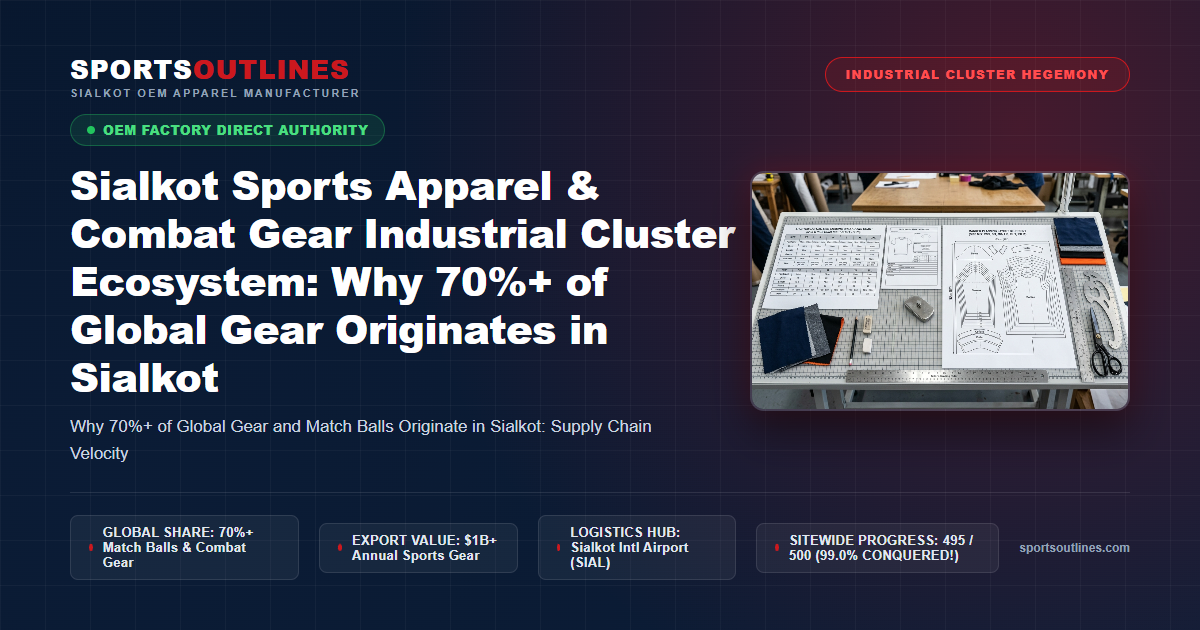
More than 70% of the world’s hand-stitched and thermally bonded soccer balls, over 60% of professional boxing and mixed martial arts (MMA) combat gear, and a massive portion of private label technical activewear originate from a single industrial city in northeastern Pakistan: Sialkot. This export powerhouse has engineered an unmatched industrial cluster ecosystem where specialized leather tanneries, circular synthetic knitting mills, computerized laser-cutting facilities, and precision tool-and-die mold workshops operate within a 15-mile radius. This institutional monograph analyzes why top sports brands, UFC fighters, and emerging gym apparel labels manufacture in Sialkot, detailing the city’s unique supply chain synergy, private airport logistics, agile cut-and-sew economics, and global export advantages.
1. The Global Epicenter of Athletic Gear: History, Craftsmanship & Industrial Dominance
Sialkot’s emergence as the sporting goods capital of the world is a masterclass in industrial cluster economics (as modeled by Harvard economist Michael Porter). The city’s manufacturing lineage began over a century ago in the late 19th century, initially repairing British colonial cricket bats and tennis racquets, before evolving into industrial leather tanning, surgical instrument forging, and soccer ball engineering.
Today, Sialkot is not just a manufacturing town—it is an economic anomaly. The city generates over $3.5 billion in annual export revenue, driven entirely by locally owned private enterprises. When you watch the FIFA World Cup, the official match balls (from the legendary Tango to the modern Al Rihla and beyond) are manufactured in Sialkot. When you step into a professional boxing gym or an MMA cage in Las Vegas, London, or Sydney, the leather gloves, shin guards, and fight shorts were engineered by Sialkot craftsmen.
At Sports Outlines, we are proud to operate at the center of this industrial cluster, combining generational artisanal skill with modern digital automation to serve private label brands across the USA, UK, Australia, and worldwide.
Table 1: Global Market Share & Export Volume of the Sialkot Sporting Goods Cluster
| Product Category | Estimated Global Market Share | Key International Buyers & End Users | Competitive Manufacturing Advantage |
|---|---|---|---|
| Hand-Stitched & Thermally Bonded Match Balls | 70% – 75% | FIFA World Cup, UEFA Champions League, Adidas, Puma | Patented thermal bonding automation and aerodynamic surface texturing |
| Combat Sports Gear (Boxing Gloves, MMA Pads, Shin Guards) | 60% – 65% | UFC, Bellator, Venum, Everlast, Fairtex, Hayabusa | Generational leather tanning, anatomical multi-layer EVA/IMF mold injection |
| Motorcycle Protective Apparel (Cordura / Leather Suits) | 50% – 55% | Dainese, Alpinestars, Rev’It, European Moto GP Brands | CE Level 2 armor integration, Kevlar seam reinforcement, top-grain cowhide |
| Performance Activewear & Gym Apparel | Rapidly Growing (Top 5 Export) | D2C Gymwear Brands, CrossFit Gyms, Boutique Private Labels | Agile low MOQ (30–50 pcs), seamless flatlocking, heavy French terry fleece |
| Martial Arts Uniforms (BJJ Gis, Karate, Taekwondo) | 55% – 60% | IBJJF Competitions, Kingz, Tatami, Shoyoroll | Pre-shrunk Pearl Weave / Gold Weave 450–550 GSM cotton with ripstop pants |
2. The Integrated Industrial Cluster Architecture: Synergy Within a 15-Mile Radius
What makes Sialkot virtually impossible for other countries to replicate is its dense spatial concentration of specialized micro-industries. In fragmented manufacturing countries, an apparel brand might buy fabric in one province, send it 300 miles away for dyeing, ship it across the country for screen printing, and source zipper pulls from an overseas supplier.
In Sialkot, every link in the technical athletic value chain exists within a compact 15-mile geographical radius:
Table 2: Spatial Anatomy of the Sialkot Sporting Goods Value Chain
| Ecosystem Node | Industrial Process Performed | Local Proximity & Turnaround | Impact on Sourcing Lead Times |
|---|---|---|---|
| Sialkot Tannery Zone | Top-grain cowhide, drum-dyed aniline leather, synthetic PU/microfiber casting | Within 8 miles; 24-48 hr custom dye batch matching | Instant access to premium combat sports raw materials |
| Circular Knitting & Weaving Mills | Cotton/poly French terry (350–500 GSM), nylon/spandex interlock, BJJ Pearl Weave | Within 12 miles; 48-72 hr yarn knitting cycles | Custom GSM and fabric composition without offshore delays |
| Tool, Die & Mold Machining Hubs | CNC machining of steel molds for silicone patches, injection foam dies, metal pulls | Within 5 miles; 3-5 days rapid tool cutting | Low-cost bespoke hardware tooling ($120–$350) |
| Sublimation & Print Houses | High-speed Japanese digital sublimation printers, high-density screen printing | Within 6 miles; same-day strike-off sample proofs | Zero lead-time penalty for multi-color intricate artwork |
| Sports Outlines Cut-and-Sew Plant | Precision laser cutting, flatlock assembly, QA inspection, and export packing | Kharota Syedan Road, Sialkot-51310 | Seamless end-to-end manufacturing oversight |
3. Sialkot’s Combat Sports Supremacy: Boxing Gloves, MMA Gear & BJJ Engineering
In combat athletics, athlete safety and hand protection are non-negotiable. A substandard boxing glove with irregular foam density causes knuckle fractures, wrist hyperextension, and fighter injury. Sialkot has dominated the global combat sports market for over 50 years because of its mastery of anatomic ergonomics and multi-layer shock dissipation.
Table 3: Technical Engineering Specifications of Sialkot-Manufactured Combat Gear
| Combat Gear Category | Outer Material Engineering | Internal Padding Architecture | Structural Reinforcement & Closure |
|---|---|---|---|
| Pro Sparring Boxing Gloves (12oz–16oz) | Full-grain 1.2 mm cowhide leather or Japanese microfiber PU | Quad-layer composite: High-density EVA + Gel-infused shock layer + Soft sponge + Horsehair | Anatomical thumb lock, dual-wrist splint support, heavy nylon stitching |
| Competition MMA Shin Guards | Matte synthetic leather / 4-way neoprene calf sleeve | Injection Molded Foam (IMF) with elevated tibial crest reinforcement | Dual hook-and-loop velcro closures with industrial buckle loop |
| Brazilian Jiu-Jitsu (BJJ) Competition Gis | 450 GSM Pearl Weave jacket + 10oz cotton ripstop pants | EVA foam rubber collar core (anti-bacterial, rapid drying, grip resistant) | Triple-reinforced stress points, woven seam tape, knee panel double-layering |
| MMA Grappling & Fight Shorts | 160 GSM 4-way stretch microfiber with DWR coating | Reinforced lycra/spandex crotch gusset for 180-degree kicking flexibility | Internal drawstring, dual velcro closure, 4-needle flatlock seams |
The 14-Step Craftsmanship Cycle of a Professional Sialkot Boxing Glove
Building an elite 16oz sparring glove is a multi-disciplinary craft requiring up to 3.5 hours of dedicated hand labor:
- Die Clicking: Hydraulic clicker presses punch 14 individual leather panels from drum-dyed A-grade cowhide.
- Skiving: Edge-skiving machines taper leather seams to prevent bulky, abrasive interior ridges.
- Artwork Embossing: High-frequency heat presses deboss brand logos into the leather wrist strap.
- Core Lamination: Multi-layer shock foams (EVA, closed-cell sponge, latex gel) are hand-glued with water-based adhesive.
- Upper Stitching: Heavy-duty compound-feed cylinder bed machines stitch the palm and backhand shell.
- Thumb Lock Attachment: Reinforced nylon webbing binds the thumb securely to the main fist body to prevent eye pokes.
- Core Inversion & Stuffing: Craftsmen reverse the leather shell and insert the molded foam core without tearing fibers.
- Wrist Cuff Binding & Closure: Dual-layer EVA splints are inserted into the wrist cuff and sealed with piped piping edges.
4. Performance Activewear Evolution: Sialkot’s Modern Technical Transition
While Sialkot’s historic fame was built on leather and soccer balls, the last decade has seen a massive industrial transition into high-performance athletic apparel and athleisure.
Modern Sialkot facilities have invested heavily in automated German and Japanese technology:
- Four-Needle Six-Thread Flatlock Stitching: Yamato and Pegasus machines running at 4,200 RPM, producing ultra-flat, friction-free seams designed for high-abrasion grappling and running.
- CO2 Laser Fabric Cutters: Computer-guided laser tables that cut synthetic polyester and nylon panels with sealed, fray-resistant edges.
- Bonded Seamless Ultrasonic Welding: Framis Italia tape bonding machines creating seamless hems and water-resistant bonded pocket zippers.
- Continuous Calender Sublimation: Oil-heated continuous calender presses operating at 205°C with 35-second dwell times, fusing disperse dyes directly into the molecular structure of polyester fibers for permanent, fade-free graphics that never peel or crack under sweat.
Table 4: Technical Activewear Construction Standards in Sialkot Export Manufacturing
| Garment Construction Method | Technical Machine Specification | Stitches Per Inch (SPI) Standard | Target Activewear Apparel Products |
|---|---|---|---|
| ISO 607 Flatlock Coverstitch | Yamato FD-62SD 4-needle 6-thread with differential feed | 14 – 16 SPI | Compression tights, rash guards, sports bras |
| ISO 504 Three-Thread Overlock | Juki MO-6814S high-speed differential feed | 12 – 14 SPI | Running tees, gym shorts, performance tanks |
| Heavyweight Double-Needle Topstitch | Brother T-8422C twin-needle direct-drive lockstitch | 10 – 12 SPI | 450 GSM French terry hoodies, heavyweight sweatpants |
| Ultrasonic Seam Bonding | Framis Italia hot-melt polyurethane heat press bonding | Zero-stitch bonded tape | Laser-cut running shorts hems, waterproof zipper pockets |
5. Infrastructure Innovations: Sialkot International Airport (SIAL) & Logistics
In most developing nations, major infrastructure is built by the federal government. Sialkot, however, is famous in global economic history for building its own critical infrastructure through private business initiative:
- Sialkot International Airport (SIAL): Built entirely with private capital funded by Sialkot’s manufacturing exporters, SIAL features a 3,600-meter runway capable of handling Boeing 777 and 747 freighter aircraft. Export cargo can fly directly from Sialkot to logistics hubs in Dubai, Doha, London, and New York.
- Sialkot Dry Port Trust (SDPT): Established in Sambrial in 1984 as the first private dry port in Asia, allowing export containers to clear customs inland and transit directly by bonded rail and road to Port Qasim and Karachi Port for ocean export.
Table 5: Sialkot International Export Logistics Corridors & Freight Lead Times
| Logistics Route & Mode | Departure Gateway | Destination Port / Airport | Transit Time to Door | Typical Shipment Use Case |
|---|---|---|---|---|
| Direct Express Air Courier | SIAL (DHL / FedEx / UPS Hub) | USA (JFK/ORD/LAX) / UK (LHR) | 3 – 5 business days | Pre-production prototypes ($45–$195) & urgent low-MOQ runs |
| Consolidated Air Cargo | SIAL / LHE via Emirates/Qatar Cargo | Major global airport hubs | 6 – 9 business days | Medium bulk seasonal drops (100–500 pcs) |
| Ocean FCL / LCL Freight | SDPT Sambrial to Port Qasim (Karachi) | Port of LA / Long Beach / Felixstowe | 26 – 32 calendar days | Full container load volume restocking (1,000+ pcs) |
6. Commercial Prototype Sampling Governance: Dedicated Craftsmanship Fees
In Sialkot’s industrial ecosystem, prototype sampling is treated as a master engineering discipline rather than an afterthought. Pattern cutters manually draft grading blocks, specialized machinists hand-build individual garments, and print technicians calibrate lab dips.
At Sports Outlines, our commercial terms for prototype sampling reflect this professional discipline:
Sports Outlines Sampling Invariant Policy
Physical Prototyping Fee: Strictly $45 to $195 per piece, pair, or set based on garment complexity.
Turnaround Time: Strictly 7 to 10 business days from technical pack confirmation and lab dip approval.
Non-Refundable Engineering Baseline: We do not provide complimentary prototypes or marketing discounts against bulk orders. This standalone fee covers authentic material consumption, pattern digitizing, and sample master labor, ensuring your designs receive top priority.
7. Factory Low MOQ Advantage: Sialkot vs. Far East Conglomerates
Massive conglomerate factories in Vietnam, Bangladesh, and China are engineered exclusively for mega-corporations (Nike, Under Armour, Adidas), enforcing rigid MOQs of 1,000 to 3,000 units per style. For emerging activewear brands and combat sports gyms, such capital requirements are impossible.
Sialkot’s cluster structure enables agile, modular manufacturing. Sports Outlines provides custom cut-and-sew manufacturing with a factory low MOQ of strictly 30 to 50 pieces per style or colorway. This focused production strategy protects emerging brand owners from obsolete inventory liquidation discounts, maintaining full-price brand equity across all retail channels.
Table 6: Sourcing Comparison: Sialkot Agile Sourcing vs. Far East Mass Conglomerates
| Sourcing Parameter | Sialkot, Pakistan (Sports Outlines) | Far East Conglomerates (Vietnam / China / Bangladesh) |
|---|---|---|
| Minimum Order Quantity (MOQ) | 30–50 pieces per style/colorway | 1,000–3,000 pieces per style |
| Initial Capital Required to Launch | $1,500 – $3,500 across full collection | $25,000 – $60,000+ per collection |
| Prototyping Turnaround Time | 7–10 business days ($45–$195/piece) | 4–8 weeks standard sample queue |
| Combat Sports & Martial Arts Specialization | World-class undisputed global center | Limited combat expertise; primarily generic apparel |
| Custom Mold Tooling Costs | $120 – $350 per mold (100% brand owned) | $800 – $2,500+ per custom tooling set |
8. Environmental, Social & Labor Governance: Sialkot’s Ethical Transformation
International brands holding ESG mandates require strict workplace compliance. Sialkot’s manufacturing industry is globally celebrated for the landmark Atlanta Agreement of 1997, executed between the Sialkot Chamber of Commerce, the International Labour Organization (ILO), and UNICEF, which systematically eliminated child labor from soccer ball and sports production through independent third-party monitoring.
Table 7: International Social Compliance Certifications in Sialkot Export Manufacturing
| Certification Standard | Governing International Body | Operational Scope Audited | Value to Western Retailers |
|---|---|---|---|
| WRAP (Worldwide Responsible Accredited Production) | WRAP Compliance Board (USA) | Labor laws, workplace safety, environmental regulations, fair wages | Mandatory vendor credential for major US department stores |
| BSCI (Business Social Compliance Initiative) | amfori (Brussels, Europe) | Freedom of association, ethical business behavior, occupational health | Gold standard compliance for European retail stockists |
| OEKO-TEX Standard 100 | International OEKO-TEX Association | Testing for toxic dyes, heavy metals, formaldehyde, skin allergens | Guarantees skin-safe athletic wear for direct consumer contact |
| SEDEX / SMETA 4-Pillar | Supplier Ethical Data Exchange (UK) | Labor standards, health & safety, business ethics, environment | Universal audit protocol recognized across UK & Commonwealth markets |
9. The Sialkot Tannery Zone: Sustainable Leather Working Group (LWG) Standards
For decades, combat sports gear relied on traditional chrome tanning methods that raised environmental concerns. Today, the Sialkot leather tanning sector has undergone an industrial green revolution centered around the dedicated Sialkot Tannery Zone (STZ)—a 400-acre master-planned industrial estate equipped with centralized effluent treatment plants (CETP).
Table 8: Sustainable Leather Engineering & Environmental Quality Protocols in Sialkot
| Leather Engineering Dimension | Chemical & Processing Standard | Environmental Compliance Metric | End-Product Benefit in Combat Sports |
|---|---|---|---|
| LWG Gold/Silver Certification | Leather Working Group environmental audit protocol | 100% water recycling & chromium recovery | Guarantees fully audited ESG compliance for Western retail shelves |
| Vegetable-Tanned Aniline Hides | Natural mimosa and chestnut bark tannin extraction | Zero hexavalent chromium (Cr VI < 3 ppm) | Hypoallergenic contact for fighter facial sparring gear |
| Drum-Dyed Color Penetration | Deep aniline penetration through cross-section fibers | REACH Regulation Annex XVII compliant | Eliminates surface scuff discoloration during heavy bag strikes |
| Water-Based PU Synthetic Casting | Solvent-free polyurethane resin on micro-fiber backing | Zero DMF (dimethylformamide) VOC emissions | Vegan-certified high-tensile fight gear with zero chemical odor |
10. Digital Pattern CAD Engineering & 3D Prototyping Innovation
The historic image of Sialkot as purely a hand-crafting district has been superseded by digital engineering. Leading export facilities operate computerized 3D apparel simulation suites that allow international brand partners to visualize garment tension maps, fit draped fabric on digital avatars, and approve pattern revisions prior to physical fabric cutting.
Table 9: Advanced Digital Prototyping & CAD Grading Systems in Sialkot
| Software Suite | Technical Function Performed | Export File Formats Supported | Customer Development Advantage |
|---|---|---|---|
| CLO 3D / Browzwear V-Stitcher | Photorealistic 3D avatar fit simulation, fabric drape stress testing | .ZPRJ, .GLTF, .OBJ, High-Res MP4 turntables | Reduces physical sampling iterations from 4 cycles to 1 |
| Gerber AccuMark / Lectra Modaris | High-speed computerized pattern grading and automated marker nesting | .DXF-AAMA, .ASTM, .RUL, .HPGL plot files | Optimizes fabric consumption yields, reducing bulk FOB unit costs |
| SolidWorks / Rhino 3D | Parametric tool-and-die modeling for injection foam and silicone molds | .STEP, .IGES, CNC G-code toolpaths | Fast 72-hour CNC machining of custom glove foam cores |
11. The Triple Helix Model: Sialkot’s Institutional Synergy
The sustained competitive advantage of Sialkot over decades is rooted in what sociologists define as the Triple Helix Model—the institutional interaction between organized industry associations, specialized technical universities, and municipal development bodies:
- Sialkot Chamber of Commerce & Industry (SCCI): The democratic governance center of the city’s private sector, managing international trade delegations, standardizing export documentation, and settling bilateral buyer disputes.
- Leather Products Development Institute (LPDI) & Metal Industry Development Centre (MIDC): Dedicated government-industry technical training academies providing continuous vocational education for CNC machinists, pattern digitizers, and leather technicians.
- Independent Sialkot Dry Port Trust & Airport: Self-taxation models created by local exporters that reinvest corporate revenue directly into regional logistics infrastructure.
12. Retail-Ready Custom Packaging & Barcode Infrastructure
Modern activewear brands selling through Shopify D2C and Amazon FBA cannot afford to receive plain bulk cartons requiring manual polybagging and labeling. Sialkot’s paper converting and packaging district provides full turnkey retail packaging:
Garments arrive from Sports Outlines 100% retail-ready: custom-printed biodegradable frosted zipper polybags, FSC-certified matte-laminated hangtags with debossed UV spot varnishing, scannable EAN/UPC barcode stickers matching your warehouse SKU database, and reinforced 5-ply corrugated master cartons strapped for international ocean transit.
13. Inflatable Bladder & Core Vulcanization: The Hidden Science of Sialkot Balls
The aerodynamic performance of a FIFA-certified match ball depends entirely on the chemical composition and balance of its internal inflatable bladder. Sialkot manufactures over 40 million bladders annually across specialized rubber vulcanization plants, supplying both local ball factories and international sports conglomerates.
Table 10: Internal Core Bladder Material Engineering Specifications
| Bladder Chemical Base | Air Retention Performance | Rebound & Elastic Velocity | Target Competition Level |
|---|---|---|---|
| High-Grade Synthetic Butyl (80/20) | Superior (Maintains pressure for 30+ days) | Moderate rebound; predictable flight path | Official retail training and institutional league balls |
| Natural Latex Rubber Core | Requires weekly inflation top-off | Maximum softness, explosive foot touch, high speed | FIFA Quality Pro World Cup & Champions League match balls |
| Multi-Ply Fabric Wound Bladder | Excellent spherical circumference lock | Polyester filament wrapping guarantees zero shape distortion | High-abrasion outdoor turf and indoor futsal balls |
14. Direct Sourcing Strategic Playbook: 5 Golden Rules for Sialkot Sourcing
To maximize the immense cost and speed advantages of the Sialkot manufacturing cluster while protecting brand equity, international founders should execute this five-step sourcing framework:
- Source Factory-Direct: Verify physical plant ownership, SCCI credentials, and sewing line machinery via live video walkthroughs. Never route orders through unregulated commission brokers.
- Leverage Agile Low MOQs: Start collections at 30–50 pieces per style/colorway to validate consumer demand, refine fit blocks, and preserve working capital.
- Compensate Master Prototyping: Pay the non-refundable physical prototyping engineering fee ($45–$195/piece) to ensure priority line scheduling, single-ply laser precision, and dedicated pattern craftsmanship.
- Execute Bilateral NNN Agreements: Enforce Non-Disclosure, Non-Use, and Non-Circumvention covenants with international arbitration clauses (SIAC/SCCI) under the 1958 New York Convention.
- Enforce ISO 2859-1 AQL 2.5 QC: Mandate pre-shipment random audits covering Points of Measure (POM) dimensional tolerances and metal needle detection prior to final balance release.
15. Frequently Asked Questions: Sialkot Sporting Goods & Apparel Manufacturing
Q1: Why does more than 70% of the world’s soccer gear originate from Sialkot?
Sialkot has over a century of specialized hand-crafting and thermal bonding engineering experience, supported by a dense localized supply chain of synthetic leather casting, bladder molding, and aerodynamic testing.
Q2: What makes Sialkot the global leader in combat sports equipment?
The city combines locally tanned top-grain cowhide leather with proprietary multi-layer foam injection molds, delivering superior hand protection and durability for elite boxing, MMA, and Muay Thai brands.
Q3: How much does prototype sampling cost at Sports Outlines?
Our physical prototype sampling fee is strictly $45 to $195 per piece, pair, or set, completed within 7 to 10 business days. This fee covers pattern making, single-ply laser cutting, and technician setup.
Q4: What is the factory minimum order quantity (MOQ) at Sports Outlines?
Our factory low MOQ is strictly 30 to 50 pieces per style or colorway, allowing independent sportswear brands to launch custom cut-and-sew lines with low capital risk.
Q5: How does Sialkot’s private airport (SIAL) benefit international buyers?
Sialkot International Airport (SIAL) allows air freight shipments to depart directly to international transit hubs (Dubai, Doha, London) via DHL, FedEx, and commercial cargo, eliminating domestic transit bottlenecks.
Q6: What is the Atlanta Agreement of 1997?
The Atlanta Agreement was an international accord between Sialkot manufacturers, the ILO, and UNICEF that successfully eradicated child labor from Sialkot’s sporting goods industry through strict workplace monitoring.
Q7: How fast can ocean freight ship from Sialkot to the United States or Europe?
Containers transit from the Sialkot Dry Port Trust (SDPT) in Sambrial to Port Qasim in Karachi in 48 hours, reaching European ports in 18–22 days and US ports in 26–32 days.
Q8: Can Sialkot factories produce technical performance activewear like compression tights and hoodies?
Yes. Sialkot features state-of-the-art four-needle six-thread flatlock stitching, continuous sublimation presses, and custom circular knit milling for heavyweight fleece and compression fabrics.
Q9: How do Sialkot manufacturing costs compare to China or Vietnam?
Sialkot provides 25%–35% lower labor costs while offering significantly lower MOQs (30–50 pcs vs. 1,000+ pcs) and faster sampling cycles, offering superior unit economics for emerging brands.
Q10: How can an international brand start manufacturing with Sports Outlines in Sialkot?
Connect with our technical export desk on WhatsApp at +92 316 7932595 or submit your tech pack online. We will provide an open-book BOM quotation, initiate physical prototyping ($45–$195/piece), and handle export logistics.
Harness the Power of Sialkot’s Manufacturing Ecosystem
Partner directly with Sports Outlines in Sialkot, Pakistan. Leverage century-old craftsmanship, agile 30–50 piece minimums, and rapid 7–10 day prototyping ($45–$195/piece) backed by our owned industrial cut-and-sew facility.
International export desks: USA Sourcing Desk | UK Sourcing Desk | Australia Sourcing Desk | Sportswear Catalog.