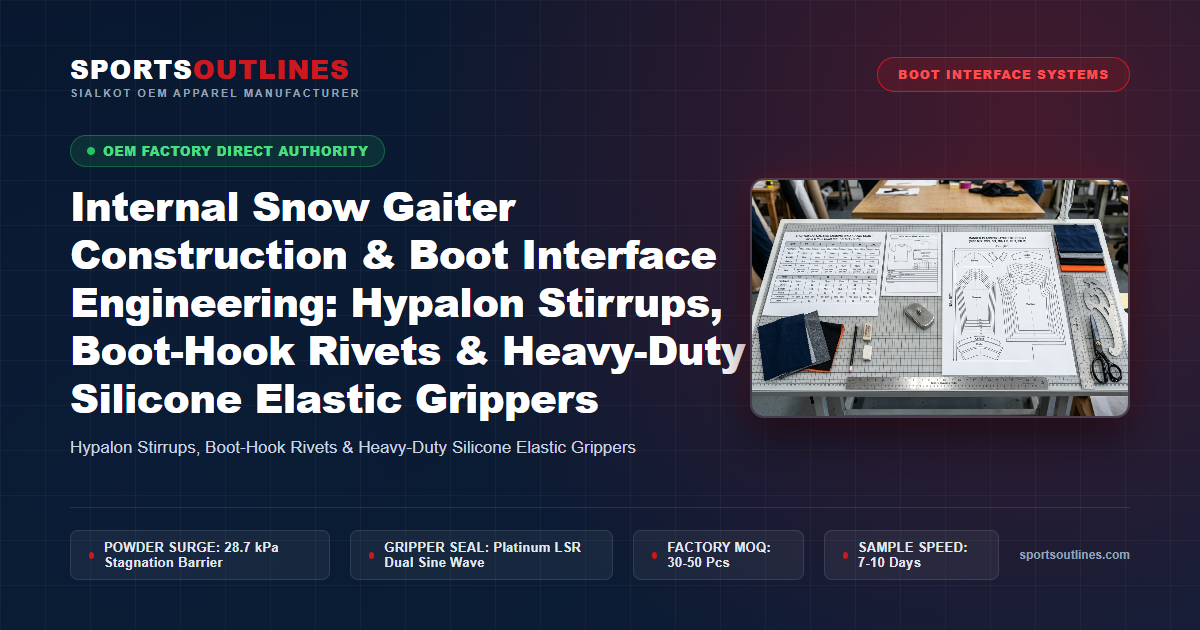
In technical alpine ski, freeride snowboard, and ski-mountaineering apparel, the interface between the lower trouser leg and the rigid plastic ski boot cuff represents the most hydraulically vulnerable barrier of the entire lower body. During high-speed powder descents, deep trench-carving, or bootpacking through waist-deep snowpacks, the skier’s lower kinetic chain forces tons of displaced snow upward against the pant hem. If this snow breaks past the outer shell, it packs tightly against the boot buckles, melts against body heat, and wicks freezing moisture directly into ski socks and boot liners, inducing severe foot numbness and frostbite risk.
Engineering an impenetrable snow barrier requires precision lower kinetic engineering: internal snow gaiter sleeves cut from waterproof 210D Oxford or high-density 70D ripstop nylon with PU barrier coatings; heavy-duty 38 mm to 45 mm knit gripper elastics featuring dual continuous sinusoidal waves of platinum-cured liquid silicone rubber (LSR) that adhere Tenaciously to frozen polyurethane boot shells down to $-50^\circ\text{C}$; reinforced Hypalon (CSPE) under-boot stirrups with low-profile anti-snag adjustment buckles; and chemically passivated brass or polyacetal (POM) boot-hook rivets anchored via multi-directional box-X bar-tacked webbing that anchor the gaiter against extreme upward hydrodynamic surge pressures.
At Sports Outlines in Sialkot, Pakistan, our performance outerwear facility specializes in technical ski pant manufacturing, automated laser cutting, programmable bar-tacking, and custom silicone elastic integration. We support emerging technical outerwear labels and established mountain brands through accessible B2B parameters: full physical prototype sampling at $45 to $85 per piece (non-refundable, 7–10 business days turnaround) and low factory production runs starting at strictly 30 to 50 pieces per style/colorway with complete CAD size grading from XS to 3XL.
Ski Boot Snow Gaiter Architecture & Interface Engineering: Technical Directory
- 1. Hydrodynamic Powder Snow Surge Physics & Interface Kinematics
- 2. Gaiter Substrate Textiles: 210D Oxford vs 70D Ripstop PU Barrier Coatings
- 3. Liquid Silicone Rubber (LSR) Gripper Elastic: Sinusoidal Extrusion & Sub-Zero Adhesion
- 4. Hypalon Under-Boot Stirrup Systems: Tension Dynamics & Buckle Hardware
- 5. Boot-Lace Hook Anchoring: Rivet Metallurgy, Box-X Webbing & Pull Tensile QA
- 6. Lateral Access Closures: Hook-and-Loop Plackets, POM Snaps & Step-In Ergonomics
- 7. Alpine Snow Gaiter Construction Comparison Matrix
- 8. CAD Pattern Drafting: Boot Perimeter Circumference Grading (XS to 3XL)
- 9. Manufacturing SAM Allocation & Factory Assembly Sequence
- 10. Sialkot Manufacturing Infrastructure & Commercial Terms
- 11. Technical Ski Boot Snow Gaiter FAQ
1. Hydrodynamic Powder Snow Surge Physics & Interface Kinematics
When an alpine skier or snowboarder travels through unpacked powder snow at speeds ranging from $35\text{ to }75\text{ km/h}$ ($9.7\text{ to }20.8\text{ m/s}$), the snowpack cannot be treated as a static solid. Instead, the displacement of cold low-density snow behaves as a compressible non-Newtonian granular fluid exhibiting high dynamic stagnation pressure:
Where $\rho_{\text{snow}}$ is the packed snow density ($\approx 80\text{ to }250\text{ kg/m}^3$), $v_{\text{skier}}$ is velocity, and $C_d$ is the geometric drag coefficient of the boot and pant leg ($C_d \approx 1.05\text{–}1.25$). At $60\text{ km/h}$ ($16.67\text{ m/s}$), dynamic stagnation pressure against the front ankle cuff reaches:
This continuous hydraulic pulse exerts severe upward shear force ($F_{\text{shear}} \ge 85\text{ N}$) on the lower pant hem. Simultaneously, the skier’s lower kinetic chain undergoes extreme sagittal and coronal plane ankle articulation:
- Ankle Dorsiflexion Kinematics: In an athletic forward carving stance, the skier flexes forward into the boot tongue, rotating the tibia through an ankle angle of $15^\circ\text{ to }28^\circ$. This movement elongates the posterior Achilles tendon zone by $+12\%\text{ to }+16\%$ while compressing the anterior boot cuff.
- Lateral Inversion & Eversion: Aggressive edge angle creation ($45^\circ\text{ to }65^\circ$ ski tilt) forces dynamic lateral canting, creating asymmetric shear displacement across the medial and lateral margins of the boot cuff.
- The Critical Decoupling Mandate: If the snow gaiter is rigidly sewn to the outer pant shell along its bottom hem, the movement of the outer pant pulls the gaiter upward, breaking the seal over the boot. Therefore, the internal snow gaiter must be decoupled: anchored high up on the inner trouser leg lining (180 mm to 240 mm above the hem) via an articulated bellows suspension, allowing the outer pant leg to flex freely while the internal gaiter remains immovably clamped to the boot.
2. Gaiter Substrate Textiles: 210D Oxford vs 70D Ripstop PU Barrier Coatings
The internal snow gaiter sleeve operates in a severe mechanical micro-environment. It is trapped between the rigid, abrasive textured plastic of alpine ski boot buckles and the inner face of the trouser shell, while being exposed to melted slush and freezing powder. Selecting the proper substrate textile is vital for balancing weight, cold-flex endurance, and hydrostatic impermeability.
Substrate Textile Engineering Comparison
- 210D Oxford Nylon (135–150 GSM) — The All-Mountain Workhorse: Woven in a basket-weave construction from continuous filament Polyamide 6.6 yarns. The plain Oxford weave provides superior resistance to mechanical puncturing from sharp boot buckle levers and ski edges ($>280\text{ N}$ puncture resistance per ASTM D751). The technical back is coated with an ether-based polyurethane (PU) formulation (caliper $25\text{–}35\ \mu\text{m}$) yielding a hydrostatic head $>3,000\text{ mm } H_2O$. Ether-based PU is strictly required over ester-based coatings because it provides complete immunity to hydrolytic degradation from prolonged damp storage.
- 70D High-Tenacity Micro-Ripstop Nylon (75–85 GSM) — Ultralight Ski-Touring & Mountaineering: For backcountry touring and ski-mountaineering bibs where every gram matters, we deploy a lightweight 70D ripstop nylon reinforced with a $4\times 4\text{ mm}$ cross-hatch grid. Coated with a microporous 0.02 mm PU membrane, it delivers $>5,000\text{ mm } H_2O$ waterproofness while weighing 45% less than Oxford, providing effortless compressibility during uphill skinning strides.
- Cold-Crack Flexibility (ISO 4675 / ASTM D2136): Conventional cheap PVC or acrylic coatings turn brittle and fracture like glass when flexed at sub-zero temperatures. At Sports Outlines, all gaiter coating formulations undergo cold-bend chamber testing down to $-40^\circ\text{C}$ across 10,000 flex cycles, guaranteeing zero micro-cracking, crazing, or delamination.
3. Liquid Silicone Rubber (LSR) Gripper Elastic: Sinusoidal Extrusion & Sub-Zero Adhesion
The lower perimeter cuff of the internal snow gaiter must maintain an airtight, snow-tight frictional clamp around the upper plastic shell of the ski boot. Standard woven or knitted elastic bands rely entirely on circumferential hoop tension:
However, smooth polyurethane and Grilamid® ski boot plastics possess a low static friction coefficient ($\mu_s \approx 0.15\text{–}0.22$) when coated with frost. Hoop tension alone is completely insufficient to resist the $85\text{ N}$ upward hydrodynamic snow surge pressure, causing non-silicone gaiters to slip upward off the boot within minutes of skiing.
Platinum-Cured Liquid Silicone Rubber (LSR) Extrusion Architecture
- High-Tack Low-Temperature Elasticity: We engineer a heavy-duty 38 mm to 45 mm high-modulus knitted elastic band (65% Polyester / 35% Rubber/Spandex core) extruded with platinum-cured liquid silicone rubber. Platinum-cure organosiloxane polymers maintain their elastomeric glass transition temperature ($T_g \approx -120^\circ\text{C}$), retaining high tackiness and a static friction coefficient $\mu_s \ge 0.75$ against cold boot plastic at $-50^\circ\text{C}$. Under dynamic shear testing (ASTM D903), the bond demonstrates an interfacial peel tenacity $>24\text{ N/25mm}$, preventing rolling or peeling away from the woven elastic base.
- Dual Sinusoidal Wave vs Solid Ribbon Profiles: Extruding silicone as a solid continuous flat ribbon creates a rigid, non-breathable band that impairs elastic elongation and puckers the hem. Instead, our automated computerized extrusion heads apply dual parallel sinusoidal wave beads (amplitude $8.0\text{ mm}$, wavelength $22.0\text{ mm}$, bead width $2.5\text{ mm}$, height $1.2\text{ mm}$). The sinusoidal geometry expands and contracts in harmony with the knit substrate without stress risers, providing multidirectional shear anchoring while permitting 110% elastic elongation.
- Thermal Curing & Wash-Fast Interlocking: The extruded silicone is cured in a high-temperature infrared heating tunnel at $165^\circ\text{C}$, achieving deep mechanical interlocking into the polyester knit loops. It survives over 50 commercial wash and dry cycles without peeling or micro-cracking.
- Surface Energy & Plastic Substrate Adhesion: Rigid ski boot shells composed of polyurethane (PU), polyether-block-amide (Pebax®), or Grilamid® have surface free energies ranging from $32\text{ to }38\text{ mN/m}$. The low surface tension of polydimethylsiloxane in our LSR formulation ensures complete microscopic wetting across cold, textured shell contours, maximizing effective contact area and eliminating micro-channels through which powdered snow crystals could migrate.
4. Hypalon Under-Boot Stirrup Systems: Tension Dynamics & Buckle Hardware
In extreme backcountry powder, ski mountaineering, and glacial travel, even silicone gripper elastic can be subjected to violent upward forces when post-holing through wind-crusted snow. To guarantee 100% mechanical retention, professional mountaineering ski pants incorporate an Under-Boot Stirrup Strap System that anchors the gaiter beneath the boot arch.
Hypalon (CSPE) Material Selection & Geometry
- Chlorosulfonated Polyethylene (Hypalon / CSM): Standard nylon webbing wears through in hours when walked across sharp granite moraines and frozen ice crust. We manufacture stirrup straps from 1.2 mm thick high-density Hypalon composite (woven polyester core encapsulated in chlorosulfonated polyethylene rubber). Hypalon exhibits virtually zero cut propagation, extraordinary abrasion resistance ($>200,000$ Martindale cycles), and complete chemical immunity to ski wax, road salt, and UV radiation. Tensile rupture strength exceeds $1,400\text{ N}$ per ASTM D638.
- Arch Recess Geometry: The strap width is calibrated to 20 mm to 25 mm, designed to nest neatly inside the molded arch recess between the front sole lug and rear heel heel block of standard ISO 5355 alpine and ISO 9523 touring ski boot soles. This prevents the strap from making point contact with rock surfaces during flat walking.
- Low-Profile Roller Buckle & Cam-Lock Hardware: The stirrup connects to lateral gaiter attachment patches via marine-grade 316 stainless steel or nickel-plated brass mini roller buckles with passivated copper rivets. To prevent loose strap ends from flapping or snagging on ski bindings, excess strap length feeds into an integrated Hypalon keeper loop.
- Modular Detachability: Because resort skiers who stay on groomed terrain may not require stirrups, the straps are engineered with detachable stainless steel spring-gate wire hooks, allowing the user to remove or replace worn stirrups in the field in under 30 seconds without tools.
5. Boot-Lace Hook Anchoring: Rivet Metallurgy, Box-X Webbing & Pull Tensile QA
At the anterior (front center) of the snow gaiter, a downward-facing hook connects directly to the lower buckle wire of an alpine ski boot or the lower laces of a snowboard boot. This hook serves as the primary forward anchor resisting upward snow displacement.
Hardware Metallurgy & Structural Anchoring
- Corrosion-Proof Passivated Brass vs POM Hooks: Cheap stamped steel hooks rust rapidly when exposed to road salt and snowmelt. Sports Outlines deploys heavy-gauge blackened solid brass or high-impact polyacetal (POM) molded hooks with a 3.0 mm wire-diameter throat opening that clips effortlessly over ski boot buckle cables. Brass hooks are finished with an electro-deposited black cathodic lacquer passing 120-hour ASTM B117 salt spray testing.
- Automated Rivet Clinching: Rather than relying solely on thread stitches that can abrade and shear, the hook is mechanically clinched through high-tenacity nylon webbing using a dual-component brass rivet with a 9.0 mm wide flanged backing washer. The tubular rivet barrel is curled under calibrated pneumatic force ($2.2\text{ kN}$), delivering permanent clamping without fiber shearing.
- Box-X Bar-Tack Structural Reinforcement: The 20 mm high-tenacity seatbelt webbing tab carrying the hook is stitched to the gaiter body using an automated CNC 42-stitch Box-X bar-tack configuration with Bonded Nylon V-69 thread. Under ASTM D5034 grab tensile testing, this assembly withstands $>450\text{ N}$ of vertical pulling force before seam rupture, easily resisting high-speed snow impact.
- Cyclic Fatigue Endurance Testing: In our automated quality control laboratory, gaiter hook assemblies are subjected to 2,000 cycles of dynamic pull tension (200 N per stroke at 1.0 Hz). Post-test inspection requires zero loosening of the rivet flange, zero webbing distortion, and zero stitch pullout, ensuring multi-season alpine durability.
6. Lateral Access Closures: Hook-and-Loop Plackets, POM Snaps & Step-In Ergonomics
Putting on technical ski pants while already wearing bulky, unbuckled alpine ski boots is an ergonomic nightmare if the gaiter is a closed, non-opening tube. Professional ski pants must incorporate a lateral step-in access split that allows the gaiter to be wrapped around the boot cuff and securely fastened with heavy gloves on:
- 160 mm Vertical Access Placket: The lateral (outer) seam of the gaiter features a vertical split extending from the bottom hem 160 mm upward. When opened, the gaiter circumference expands by 120 mm, allowing effortless wrapping around bulky ski boot buckles.
- 25 mm Heavy-Duty Hook-and-Loop Placket: The placket is secured by a continuous 25 mm wide woven polyamide hook-and-loop closure strip (Velcro® / Paiho®). The hook face is oriented outward away from the leg to prevent snagging on thermal base layers, and features shear tenacity $>12\text{ N/cm}^2$.
- Dual High-Retention POM Snap Buttons: Because ice and packed snow can degrade hook-and-loop adhesion during multi-hour powder skiing, the bottom and top of the placket are reinforced with heavy-duty 14 mm polyacetal (POM) press studs. POM snaps provide positive tactile click engagement that will not freeze open or seize in sub-zero blizzard environments.
- Hypalon Pull Tabs for Glove Operation: The outer edge of the placket integrates a die-cut Hypalon grip tab (15 mm x 30 mm), enabling the skier to pull the placket open effortlessly while wearing bulky sub-zero mittens.
7. Alpine Snow Gaiter Construction Comparison Matrix
The following technical comparison matrix outlines the engineering specifications, fabric grades, and hardware across specialized snow gaiter systems built at Sports Outlines:
| Gaiter Category | Substrate Textile | Elastic Gripper Spec | Forward Boot Anchor | Under-Boot Stirrups | Lateral Placket Closure |
|---|---|---|---|---|---|
| 1. All-Mountain Resort Gaiter | 210D Oxford Nylon + 3K PU Coating | 38 mm knit elastic + dual sinusoidal LSR beads | Blackened Brass Hook + Riveted Washer | Optional internal webbing loops only | 25 mm Hook-and-Loop + 1x POM snap |
| 2. Freeride & Deep Powder Bib Gaiter | 210D Oxford + 4-Way Stretch Power Mesh Bellows | 45 mm high-modulus elastic + 3x sinusoidal LSR | Heavy POM Boot Hook + 42-stitch Box-X | Laser-cut Hypalon stirrup anchor loops | Full 160 mm split + dual POM snaps + Hypalon tab |
| 3. Ski Mountaineering & Glacial Gaiter | 70D High-Tenacity Ripstop + 5K PU Barrier | 38 mm elastic + multi-wave LSR + drawcord cinch | Spring-loaded stainless steel wire gate hook | Integrated 1.2 mm Hypalon stirrup + roller buckle | Hook-and-loop placket + top and bottom POM snaps |
| 4. Snowboard Park & Freestyle Gaiter | 300D Heavy Cordura® Oxford | 50 mm extra-wide gripper band + double silicone wave | Deep-throat lace hook for fat snowboard laces | Not applicable (clears high-back bindings) | Zippered expansion gusset + hook-and-loop tab |
8. CAD Pattern Drafting: Boot Perimeter Circumference Grading (XS to 3XL)
Ski boots do not scale at the same rate as human hip or waist circumference. A skier wearing Size XS ski pants might have a Mondo 24.5 boot (external cuff perimeter $\approx 410\text{ mm}$), while an athlete in Size 2XL or 3XL wears a Mondo 30.5 boot (cuff perimeter $\approx 475\text{ mm}$). If gaiter bottom circumferences are graded with fixed proportional jumps linked to waist size, smaller sizes choke the boot while larger sizes gap open.
-
Non-Linear Circumference Grading Rules: In our Gerber AccuMark pattern systems, gaiter hem circumferences are graded independently from the outer pant hem:
- Size XS to S: Bottom hem relaxed circumference = 360 mm (stretching under elastic tension to 440 mm).
- Size M to L: Bottom hem relaxed circumference = 385 mm (stretching to 475 mm).
- Size XL to 3XL: Bottom hem relaxed circumference = 410 mm (stretching to 510 mm).
- Vertical Bellows Drop Height: The finished height of the gaiter sleeve measures 210 mm to 240 mm. When the trouser leg is straight, this creates a 35 mm intentional vertical fabric slack loop. When the skier bends into a deep downhill tuck, this slack absorbs pant hem lift with zero upward pull on the boot seal.
9. Manufacturing SAM Allocation & Factory Assembly Sequence
Constructing a pair of technical decoupled snow gaiters adds 10.5 to 14.0 Standard Allowed Minutes (SAM) to technical ski pant production:
-
Operational Breakdown (12.2 SAM Benchmark):
- Operation 1: Automated CNC laser cutting of 210D Oxford gaiter sleeves and Hypalon stirrups (1.2 SAM).
- Operation 2: Ultrasonic perimeter overlocking of gaiter panels (1.8 SAM).
- Operation 3: Multi-needle tension-metered stitching of 38 mm silicone gripper elastic to bottom hem (3.1 SAM).
- Operation 4: Pneumatic clinching of brass boot-hook rivet and 42-stitch Box-X bar-tack (1.9 SAM).
- Operation 5: Installing lateral hook-and-loop split placket and attaching POM snap buttons (2.4 SAM).
- Operation 6: Joining finished gaiter assembly to internal pant lining via 4-way stretch mesh bellows (1.8 SAM).
- Quality Control Tolerances: Relaxed bottom hem elastic circumference must adhere to $\pm 4\text{ mm}$. Hook placement alignment tolerance is strictly $\pm 2\text{ mm}$ from center front crease. Rivet clinch retention force must withstand $>400\text{ N}$ pull test.
10. Sialkot Manufacturing Infrastructure & Commercial Terms
Operating in the global sports manufacturing capital of Sialkot, Pakistan, Sports Outlines operates modern cleanroom apparel cells equipped with multi-needle elastic tension metering units, computerized hot-air seam tapers, automated rivet presses, and laser-cutting tables. We supply export-grade alpine ski pants, snowboard bibs, and mountaineering outerwear to premium brands worldwide.
Direct Sialkot B2B Manufacturing Partnership Parameters:
- Physical Prototype Sampling: Full physical prototype development available at $45 to $85 per piece (non-refundable) with an expedited 7–10 business days turnaround. Covers custom 210D Oxford gaiters, liquid silicone wave elastics, Hypalon stirrups, and brass boot hook rivets.
- Low Factory Production MOQ: Scalable bulk production starting at strictly 30 to 50 pieces per style/colorway, enabling boutique and technical mountain apparel brands to launch without crippling inventory overhead.
- Complete Size Grading: Comprehensive pattern grading from XS to 3XL with independent boot circumference scaling.
- Premium Component Sourcing: Genuine Hypalon composites, platinum-cured LSR elastics, passivated brass rivets, YKK hardware, and OEKO-TEX® / bluesign® certified shell laminates.
- Factory-Direct Global Logistics: Direct air cargo dispatch via DHL / FedEx to the USA, UK, Canada, Germany, and Australia with complete customs export documentation.
11. Technical Ski Boot Snow Gaiter FAQ
Q1: Why must the snow gaiter be decoupled from the outer pant leg hem?
During athletic skiing and deep knee flexion, the outer pant leg retracts upward by 45 mm to 75 mm. If the gaiter were stitched directly to the bottom hem of the shell, this upward movement would yank the gaiter off the boot cuff, destroying the snow seal. By anchoring the gaiter high up on the inner lining via a flexible bellows suspension, the outer pant moves freely while the gaiter remains firmly clamped around the boot.
Q2: Why is liquid silicone rubber (LSR) superior to standard woven elastic for ski boots?
Standard woven elastic relies purely on hoop tension and has a low friction coefficient against cold, frosted plastic ($0.15\text{–}0.22$). Platinum-cured liquid silicone rubber retains high tackiness and an extraordinary friction coefficient ($\mu_s \ge 0.75$) even at $-50^\circ\text{C}$, preventing the gaiter from slipping upward under severe hydrodynamic powder surge pressure ($P_{\text{snow}} \approx 28.7\text{ kPa}$).
Q3: What makes Hypalon the ideal material for under-boot stirrup straps?
Hypalon (chlorosulfonated polyethylene) offers extreme cut resistance, zero tear propagation, and over 200,000 cycles of Martindale abrasion resistance. Unlike standard nylon webbing which rapidly frays when dragged across jagged alpine rocks and ice crust, Hypalon withstands heavy rock contact, sub-zero flexing, and chemical exposure to ski waxes without deteriorating.
Q4: Why are rivet anchors preferred over simple stitching for boot lace hooks?
Ski boot hooks endure sudden shock loads exceeding 350 N when snow packs into the gaiter or when snagged on boot buckles. Thread stitches can be abraded or cut by the sharp metal edge of the hook eyelet. Pneumatically clinched brass rivets distribute mechanical pull stress across a 9.0 mm backing flange, withstanding $>450\text{ N}$ of vertical pulling force without failure.
Q5: What are your factory minimums and sample lead times for custom ski pants?
Sports Outlines provides complete physical prototype development at $45 to $85 per piece (non-refundable) with an expedited turnaround of 7–10 business days. Following sample approval, our bulk production minimum order quantity (MOQ) is strictly 30 to 50 pieces per style/colorway across sizes XS to 3XL.
Engineer High-Performance Alpine Outerwear with Sports Outlines
From decoupled silicone snow gaiters and Hypalon stirrups to riveted boot hooks and articulated knee darts, partner with Sialkot’s premier technical outerwear manufacturer. Launch your collection with transparent $45–$85 sampling and low 30–50 piece factory MOQs.
Explore Our Global Technical Sourcing Hubs:
USA Skiwear Manufacturing |
UK Alpine Outerwear Sourcing |
Canada Cold-Weather Apparel |
Germany Ski Outerwear Production |
Australia Snowwear Sourcing
Related Technical Outerwear Engineering Guides:
Articulated Knee Ergonomics & Cordura Kick Patches (#340) |
Integrated Powder Skirt Engineering (#336) |
Sports Outlines Technical Outerwear Catalog