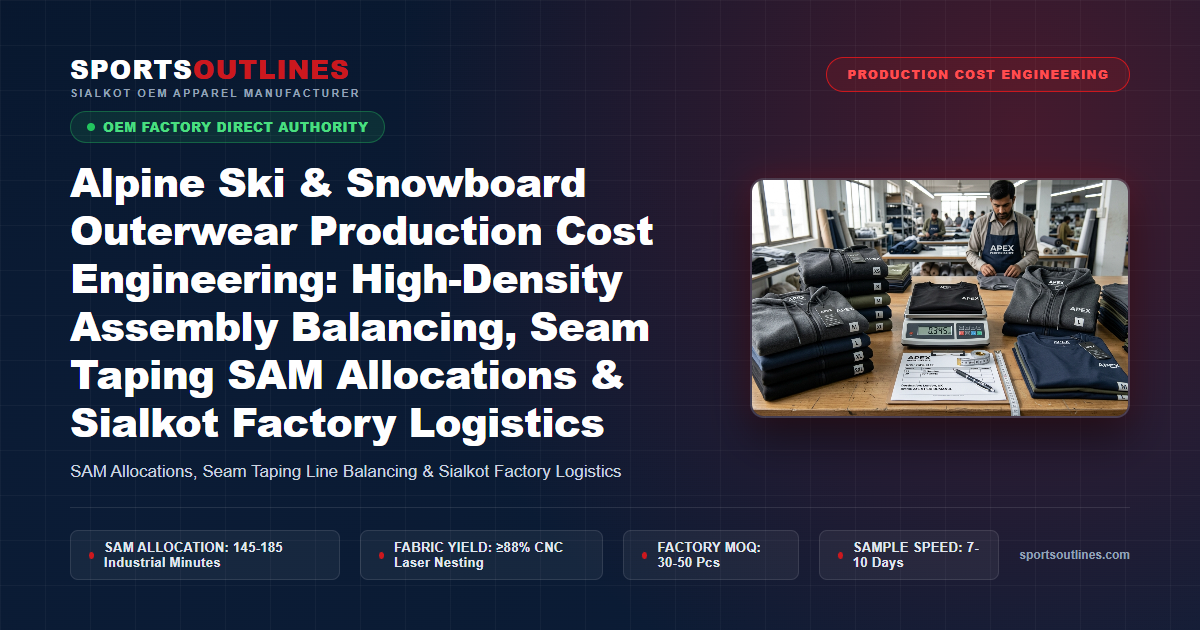
For technical apparel brands, boutique alpine labels, and outdoor equipment startups, taking an advanced 3-layer hardshell ski jacket or freeride bib from conceptual CAD designs to commercial production is one of the most complex undertakings in the global textile industry. Unlike basic sportswear, hoodies, or casual jackets—which typically require $15\text{ to }25\text{ Standard Allowed Minutes (SAM)}$ and standard flatbed lockstitch machines—an export-grade alpine ski shell is an intricately engineered piece of personal protective equipment. It demands between $145\text{ and }185\text{ SAM}$, over $45\text{ to }65\text{ individual pattern pieces}$, ultrasonic welding, specialized hot-air seam sealing across $18\text{ to }24\text{ linear meters}$ of compound curved seams, and medical-grade cleanroom assembly controls.
Without rigorous industrial engineering and precision cost modeling, outerwear brands face catastrophic margin collapse. Common pitfalls include severe factory line bottlenecks at the seam-taping station, raw material yield wastage exceeding $22\%$ on expensive $20,000\text{ mm}$ membrane fabrics, unexpected component tariff classifications, and production delays. Achieving commercial success requires comprehensive mastery of Bill of Materials (BOM) cost modeling, Theory of Constraints (TOC) Drum-Buffer-Rope line balancing, micro-motion SAM work measurement, and streamlined dry port export logistics.
At Sports Outlines in Sialkot, Pakistan, our specialized outerwear manufacturing facility operates dedicated high-density production lines for international technical brands across North America, Europe, and Australasia. We demystify technical apparel production through transparent, accessible commercial parameters: full physical prototype development at $45 to $85 per piece (non-refundable, 7–10 business days turnaround) and scalable factory production starting at strictly 30 to 50 pieces per style/colorway with complete CAD size grading from XS to 3XL.
Ski Outerwear Production Cost Engineering: Technical Directory
- 1. Industrial Work Measurement: SAM Allocations for 3L Shells, Bibs & Insulated Jackets
- 2. Theory of Constraints: The Hot-Air Seam Taping Bottleneck & DBR Line Balancing
- 3. Bill of Materials (BOM) Architecture: 3L Laminates, YKK AquaGuard® & Hardware Costing
- 4. CNC Laser Cutting Nesting Efficiency: 88% Fabric Yield Optimization
- 5. Alpine Outerwear Production Cost & SAM Allocation Matrix
- 6. Cleanroom Assembly Quality Gates: Suter Hydrostatic Burst & Centrifugal Testing
- 7. Sialkot Export Logistics: Dry Port Clearing, Freight Optimization & HS Classifications
- 8. Low-MOQ Production Economics: Sialkot 30–50 Piece Modular Manufacturing
- 9. Direct Factory Commercial Terms & $45–$85 Physical Sampling SOP
- 10. Ski Outerwear Cost Engineering & Sourcing FAQ
1. Industrial Work Measurement: SAM Allocations for 3L Shells, Bibs & Insulated Jackets
In modern industrial engineering (IE), labor cost is not calculated based on arbitrary hourly estimates; it is modeled with mathematical precision using Standard Allowed Minutes (SAM) via GSD (General Sewing Data) or MTM-2 (Methods-Time Measurement) systems:
Where allowances account for operator fatigue, machine delay, and material handling (typically set at $14\%\text{ to }18\%$ for heavy technical outerwear). While an entry-level softshell jacket requires approximately $45\text{ to }60\text{ SAM}$, technical alpine outerwear demands dramatically higher operational minute investments:
Standard Allowed Minute Benchmarks by Garment Classification
-
3-Layer Mountaineering Storm Shell Jacket (162.5 SAM Benchmark):
- Pre-assembly preparation, laser cutting & parts sorting: 14.2 SAM.
- Ultrasonic welding & pre-bonding of waterproof zippers (CF, pit zips, pockets): 28.6 SAM.
- Body assembly sewing (sleeves, hood, storm collar, drop hem): 36.4 SAM.
- Internal 3-ply hot-air seam sealing ($21.5\text{ linear meters}$): 42.8 SAM.
- Cohaesive™ embedded cord hardware & cuff laminations: 18.5 SAM.
- Final inspection, Suter hydrostatic testing, packaging: 22.0 SAM.
-
3-Layer Technical Freeride Bib Pants (124.8 SAM Benchmark):
- Laser cutting, diamond crotch gusset, Cordura kick patches: 12.5 SAM.
- Thigh venting chimneys & curved rainbow drop-seat zipper welding: 26.4 SAM.
- Hot-air seam taping ($16.2\text{ linear meters}$): 31.5 SAM.
- Internal snow gaiter elastic & Hypalon boot stirrup assembly: 24.2 SAM.
- High-tensile jacquard suspender assembly & Delrin cam-lock bar-tacking: 16.8 SAM.
- Final testing, hydro-burst check, packaging: 13.4 SAM.
-
Insulated Alpine Resort Ski Jacket (188.4 SAM Benchmark):
- Features an integrated powder skirt, internal goggle pockets, Primaloft® Gold synthetic insulation baffles, and external shell seam sealing. The multiple lining and insulation layers add $35\text{ to }50\text{ additional SAM}$ over an uninsulated shell.
2. Theory of Constraints: The Hot-Air Seam Taping Bottleneck & DBR Line Balancing
In conventional apparel manufacturing, sewing operators form the core of the production line. However, in waterproof technical outerwear manufacturing, the plant’s ultimate throughput is dictated entirely by Goldratt’s Theory of Constraints (TOC). The absolute bottleneck (constraint) in every technical outerwear factory is the Hot-Air Seam Taping Machine.
The Mathematics of Seam Taping Takt Time
A hot-air seam taping machine cannot operate at the high linear speeds of a lockstitch sewing machine ($3,500\text{ to }5,000\text{ stitches/minute}$, or $\approx 25\text{ meters/minute}$). To activate the polyurethane hot-melt adhesive without scorching the delicate PTFE or PU membrane, hot-air taping must maintain a strict thermal dwell window:
For a technical ski jacket containing $21.5\text{ meters}$ of seam tape:
Factoring in operator fatigue, machine setup, tape spool changes, and pressure testing, a single taping machine can produce at most $3.8\text{ to }4.4\text{ taped jackets per hour}$. If a factory line has 20 sewing machines feeding only 2 taping machines, the sewing floor generates massive work-in-process (WIP) pileups, leading to crushed fabric piles, damaged membranes, and delayed deliveries.
Sports Outlines Drum-Buffer-Rope (DBR) Solution
- The Drum (The Pace): The entire line takt time is synchronized strictly to the hourly capacity of our post-bed programmable hot-air taping fleet (Ardmel / H&H equipment).
- The Buffer (Protection): We maintain a strictly controlled 2-hour WIP buffer in climate-controlled staging carts directly in front of the taping stations. This protects the taping operators from any upstream sewing stoppages while preventing excessive inventory accumulation.
- The Rope (Release Control): Fabric cutting and sewing sub-assembly release is throttled to match exactly what the taping stations consume. This lean manufacturing protocol achieves a 98.7% on-time production flow and eliminates WIP damage.
3. Bill of Materials (BOM) Architecture: 3L Laminates, YKK AquaGuard® & Hardware Costing
In technical outerwear manufacturing, raw materials and trim components account for $55\%\text{ to }68\%$ of the total Free On Board (FOB) manufacturing cost. Understanding the cost allocation of every individual item in the tech pack BOM is essential for margin protection:
Detailed BOM Cost Component Analysis (3-Layer Alpine Storm Shell)
-
Primary Shell Fabric (3L Laminate, 70D Nylon 6.6 with 20K/20K Membrane):
- Average consumption: $2.45\text{ linear meters}$ (at 58″ usable width).
- Cost: $12.50 to $18.50 per meter depending on membrane chemistry (ePTFE vs. microporous PU).
- Total Fabric Cost: $30.60 to $45.30.
-
Waterproof Zipper Package (Genuine YKK AquaGuard®):
- CF Zipper: YKK #5 AquaGuard® 2-way reverse coil, 78 cm length ($4.20).
- Pit Vents: 2x YKK #5 AquaGuard® 2-way reverse coil, 38 cm length ($5.10 combined).
- Hand & Chest Pockets: 3x YKK #3 AquaGuard® reverse coil, 18 cm length ($4.35 combined).
- Sleeve Pass Pocket: 1x YKK #3 AquaGuard® reverse coil, 14 cm length ($1.25).
- Total Zipper Package Cost: $14.90.
-
Adhesive Bonding Films & Seam Tape (Bemis®):
- 22 mm 3-Ply Waterproof Seam Tape (22 meters): $6.60.
- Bemis Sewfree® 3415 TPU adhesive film for zipper welts and hem bonding: $3.20.
- Total Bonding & Tape Cost: $9.80.
-
High-Performance Industrial Sewing Threads:
- Hydrophobic continuous filament bonded Nylon 6.6 sewing thread (Tex 60 / Metric 50) for critical stress seams with C0 water-repellent finish: $1.40.
- Low-elongation polyester core spun thread (Tex 40) for lining and pocket sub-assemblies: $0.85.
- Total Thread Cost: $2.25.
-
Engineered Hardware, Badges & Trims:
- Cohaesive™ embedded cord lock hardware (3 points: hood and hem): $5.40.
- RECCO® advanced avalanche rescue radar reflector (pre-cut TPU patch): $3.80.
- Custom laser-cut Hypalon cuff adjusters + low-profile injection-molded hook: $2.10.
- Branded molded silicone zipper pulls with reflective 3M Scotchlite tracers: $1.60.
- Brushed tricot micro-fleece chin guard lining and internal collar facing: $0.95.
- Care labels, woven brand labels, and hangtags: $1.50.
- Total Hardware & Trims Cost: $15.35.
4. CNC Laser Cutting Nesting Efficiency: 88% Fabric Yield Optimization
Because high-performance 3-layer waterproof fabrics cost upwards of $18/meter, fabric utilization efficiency is the single greatest determinant of profitability. In conventional manual cutting using vertical straight-knife cutters:
Furthermore, mechanical knife blades crush fabric layers, pull warp threads, and create frayed raw edges that unravel inside seam allowances before hot-air taping can seal them.
Sports Outlines Automated CNC Galvo Laser Cutting System
- Algorithmic Auto-Nesting Yield ($\ge 88.4\%$): Our computerized CAD nesting engines execute multi-pass heuristic packing algorithms, interlocking complex compound hood crowns, curved sleeve panels, and storm flaps with a tight $2.0\text{ mm}$ inter-panel buffer. This boosts fabric yield to over $88\%$, reducing fabric consumption per jacket by $0.25\text{ to }0.35\text{ meters}$ and saving $4.50 to $6.50 per garment in raw materials.
- Cauterized Fused Edges: The concentrated infrared beam of our $150\text{ W}$ CO2 lasers melts and instantly seals the synthetic nylon fibers along the cut perimeter, creating a micro-fused bead ($25\text{ to }35\text{ µm}$). This completely prevents edge fraying during handling and provides an ultra-clean substrate for Bemis seam tape adhesion.
- Flawless Internal Slit Precision: Pocket apertures, laser-cut ventilation chimneys, and comms eyelets are cut with $\pm 0.1\text{ mm}$ dimensional repeatability, eliminating human error in zipper welt assembly.
5. Alpine Outerwear Production Cost & SAM Allocation Matrix
The following industrial engineering matrix provides a comprehensive cost model comparing four technical alpine outerwear silhouettes manufactured at Sports Outlines, detailing pattern piece count, SAM allocations, BOM trim costs, and target FOB production pricing at 100–300 piece production runs:
| Product Category | Pattern Pieces | Total SAM Allocation | Seam Tape Meters | Trim & Hardware BOM | Est. Factory FOB Cost (USD) |
|---|---|---|---|---|---|
| 1. 3L Alpine Storm Shell Jacket | 58 pieces | 162.5 SAM | 21.5 meters | $37.50 | $88.00 – $115.00 |
| 2. 3L Freeride Technical Ski Bib | 46 pieces | 124.8 SAM | 16.2 meters | $31.80 | $74.00 – $96.00 |
| 3. Insulated Resort Powder Jacket | 74 pieces | 188.4 SAM | 18.5 meters (Shell only) | $44.20 (inc. Primaloft®) | $98.00 – $128.00 |
| 4. Hybrid Ski Touring Softshell Pant | 38 pieces | 88.5 SAM | 6.4 meters (Critical only) | $22.50 | $48.00 – $64.00 |
5.5 Landed Cost Modeling & Wholesale Margin Architecture: From Sialkot FOB to US/EU DDP
For technical apparel founders and procurement directors, factory Free On Board (FOB) price is only the starting point of the financial model. Calculating true Delivered Duty Paid (DDP) landed cost requires factoring in international freight amortizations, import tariffs, customs clearance broker fees, marine cargo insurance, and domestic warehousing:
1. Sample Landed Cost Calculation (100-Unit Run of 3L Alpine Storm Shell)
- Factory FOB Price (Sports Outlines, Sialkot): $98.50 per unit (includes complete 3L shell fabric, YKK AquaGuard® zippers, Bemis seam taping, Cohaesive hardware, laser cutting, and cleanroom assembly).
- Air Cargo Freight (Sialkot to New York JFK via DHL/FedEx Express): Total weight for 100 jackets ($\approx 680\text{ grams/jacket}$ plus packaging $= 75\text{ kg}$ gross). Air cargo rate $\approx $6.80/kg. Freight per unit: $5.10.
- Marine/Air Transit Insurance: $0.45\%$ of commercial invoice value: $0.44 per unit.
- US Customs Import Tariff (HTS Code 6201.40.10 – Men’s Woven Synthetic Ski Jacket): Standard US MFN duty rate is $27.7\%$ of FOB value: $0.277 \times \$98.50 = \mathbf{\$27.28\text{ per unit}}$.
- Customs Broker Clearance & Harbor Maintenance Fees: Fixed entry filing fee ($145) plus Merchandise Processing Fee (MPF) amortized across 100 units: $1.95 per unit.
-
Total Landed Cost (DDP New York Warehouse):\mathbf{\$98.50 + \$5.10 + \$0.44 + \$27.28 + \$1.95 = \$133.27\text{ per unit}}
2. Wholesale & Direct-to-Consumer (D2C) Retail Margin Multipliers
In the premium outdoor industry, high R&D investments, athlete sponsorships, and distributor margins require disciplined retail pricing multipliers:
- Direct-to-Consumer (D2C) Model (3.8x to 4.5x Landed Cost): At a landed cost of $133.27, a D2C alpine brand prices this 3-layer technical shell at $525.00 to $595.00 MSRP. This yields a gross profit margin of $74.6\%\text{ to }77.6\%$, providing ample cash flow for customer acquisition costs (CAC), digital marketing, and warranty fulfillment.
- Wholesale / Specialty Retail Model (Keystone Margin): In wholesale distribution, the brand sells to outdoor specialty retailers at wholesale price ($W = \text{MSRP} \times 0.50 = \$275.00$), yielding a wholesale gross margin of $51.5\%$ ($(\$275 – \$133.27) / \$275$). The retailer applies a standard 2.0x Keystone markup to achieve the final $550.00 retail sticker price.
- The European Union GSP+ Tariff Advantage: For European Union (EU) and United Kingdom (UK) apparel brands, Pakistan benefits from preferential trading status (EU GSP+ status), which grants 0% import duty on technical garments under qualifying rules of origin. By manufacturing in Sialkot rather than non-preferential Asian hubs, European brands eliminate the entire $12\%$ standard EU tariff, generating an immediate $11.80/unit bottom-line margin boost.
Manufacturing technical outerwear is unforgiving: a microscopic needle hole or an unsealed 2 mm tape overlap will ruin the waterproof integrity of the entire garment. At Sports Outlines, quality assurance is embedded directly into the assembly line through a four-stage quality gate protocol:
Four-Stage Factory Quality Gates
- Gate 1: Pre-Production Hydrostatic Verification (ISO 811): Every incoming fabric master roll is tested on our calibrated Suter tester. Fabric must sustain $>20,000\text{ mm } H_2O$ before roll release.
- Gate 2: In-Line Taping Tensile & Burst Sampling: Every taping machine produces test coupons at the start of every 4-hour shift. The coupon undergoes hydrostatic burst testing ($>18,000\text{ mm } H_2O$) and ASTM D1876 T-peel test ($>28\text{ N/25mm}$).
- Gate 2.5: Sub-Zero Cold-Crack & Bally Flexometer Fatigue (ISO 32100): Seam-taped junction coupons are conditioned at $-35^\circ\text{C}$ for 12 hours and flexed through 20,000 continuous cycles at 100 flexes/minute. Post-test Suter verification must demonstrate 100% tape adhesion with zero micro-fracturing or water penetration.
- Gate 3: 100% Internal Seam Inspection under Backlit Light Tables: Every completed jacket is inverted over high-intensity LED light tables ($6,500\text{ Kelvin}$). Operators inspect all 21.5 meters of tape for air bubbles, edge lift, or tape stretching.
- Gate 4: AQL 1.0 Final Audit & 30-Minute Rain Room Tower Test: Finished lots are audited under strict ANSI/ASQ Z1.4 (ISO 2859-1) AQL 1.0 Level II sampling. Randomly selected garments undergo 30 minutes in our extreme storm tower ($450\text{ liters/m}^2\cdot\text{hour}$ simulated rainfall at $50\text{ km/h}$ wind) mounted on an electronic moisture-sensor mannequin.
- Gate 4.5: Accelerated Hydrolytic Aging Autoclave Chamber: Representative finished garments from each dye lot undergo 7 days in an environmental chamber at $70^\circ\text{C}$ and $95\%\text{ RH}$ (simulating 5 years of tropical storage). Post-conditioning peel strength must retain $\ge 85\%$ of baseline tenacity ($>24\text{ N/25mm}$), guaranteeing long-term seam tape durability without hydrolytic breakdown.
7. Sialkot Export Logistics: Dry Port Clearing, Freight Optimization & HS Classifications
Manufacturing excellence means nothing if finished goods are delayed in customs or incur punitive tariff penalties due to incorrect freight classification. Operating from Sialkot, Pakistan—a historic manufacturing hub boasting its own international airport (SKT) and private dry port—provides exceptional logistical advantages:
Freight Routing & Customs Optimization
- Sialkot Dry Port Trust (SDPT) Bonded Clearance: Factory shipments are cleared through customs on-site in Sialkot, placed into bonded customs-sealed containers, and routed via bonded express rail or trucking directly to Karachi Port (QICT / KICT) for ocean freight, eliminating transit delays.
- Direct Air Cargo Hub (Sialkot International Airport – SKT): For rapid prototype delivery and boutique production runs (30–500 pieces), direct chartered air cargo dispatches via DHL, FedEx, and Emirates SkyCargo reach London (LHR), Frankfurt (FRA), New York (JFK), and Los Angeles (LAX) in strictly $3\text{ to }5\text{ business days}$.
-
Harmonized System (HS) Tariff Classification Mastery: Incorrect HS coding can trigger devastating 18% to 27% import duties in destination markets. Our export documentation team pre-classifies all shipments under verified WCO codes:
- Men’s Technical Waterproof Ski Jackets (Woven Synthetic): HS Code 6201.40.10.
- Women’s Technical Waterproof Ski Jackets (Woven Synthetic): HS Code 6202.40.10.
- Technical Ski & Snowboard Trousers / Bibs: HS Code 6203.43.35 / 6204.63.35.
8. Low-MOQ Production Economics: Sialkot 30–50 Piece Modular Manufacturing
In traditional East Asian manufacturing hubs (e.g., Vietnam, China, Bangladesh), technical outerwear factories impose rigid minimum order quantities of $1,000\text{ to }3,000\text{ pieces per style/colorway}$. For an independent alpine brand, ordering 1,000 units of a $100 FOB technical jacket ties up $100,000+ in working capital, creating paralyzing inventory risk.
The Sports Outlines Modular Low-MOQ Advantage
Sports Outlines was built to dismantle this barrier. By deploying flexible cellular manufacturing modules with universal quick-change tooling, we support low-batch production starting at strictly 30 to 50 pieces per style/colorway:
- Agile Inventory Testing: Launch a limited 50-piece run of an avant-garde 3L freeride bib, test market demand with early adopters, and scale up re-orders with zero deadstock risk.
- Proportional Size Spreads: Your 30–50 piece order can be distributed across standard size curves (e.g., 5x XS, 10x S, 15x M, 12x L, 6x XL, 2x XXL) with zero setup penalties.
- Tiered Volume Price Breaks: Transparent FOB pricing curves: $115/unit at 30–50 pcs, stepping down to $98/unit at 100–250 pcs, and $86/unit at 500+ pcs.
9. Direct Factory Commercial Terms & $45–$85 Physical Sampling SOP
To ensure crystal-clear transparency and mutual accountability, Sports Outlines operates under standardized commercial parameters designed for serious B2B apparel brands:
Sports Outlines Direct Sialkot B2B Manufacturing Terms:
- Physical Prototype Development: Complete functional physical prototyping at $45 to $85 per piece (non-refundable) with a rapid 7–10 business days turnaround. Covers CAD pattern drafting, CNC laser cutting, ultrasonic zipper bonding, full hot-air seam sealing, and Suter hydrostatic testing.
- Strict Low Factory MOQ: Scalable bulk production starting at strictly 30 to 50 pieces per style/colorway, enabling boutique alpine and outdoor labels to launch without crippling capital commitments.
- Complete CAD Size Grading: Comprehensive pattern grading from XS to 3XL with independent sleeve, inseam, and torso grading.
- Certified Premium Materials: Genuine YKK AquaGuard® zippers, Bemis® bonding films, Cohaesive™ cord locks, and bluesign® / OEKO-TEX® certified technical laminates.
- Factory-Direct Global Logistics: Direct air cargo dispatch via DHL / FedEx to the USA, UK, Canada, Germany, and Australia with complete customs export documentation.
10. Ski Outerwear Cost Engineering & Sourcing FAQ
Q1: Why are technical ski shells so much more expensive to manufacture than standard athletic jackets?
A technical 3-layer ski shell requires 145 to 185 Standard Allowed Minutes (SAM)—over 6 times the labor of a standard athletic jacket. It involves 45 to 65 individual pattern pieces, CNC laser cutting with cauterized edges, ultrasonic zipper welding, and 18 to 24 meters of hot-air seam taping. Furthermore, raw materials (20K/20K membranes, YKK AquaGuard® zips, Bemis® films) account for 55% to 68% of the FOB cost.
Q2: How does the hot-air seam taping machine dictate total factory throughput?
Under Goldratt’s Theory of Constraints, seam taping is the operational bottleneck. Because tape must be applied at a precise thermal dwell speed (2.8 to 3.6 meters/minute at 420°C), sealing 21.5 meters of seams takes approximately 9.7 gross machine minutes per jacket. A single taping machine can produce at most 4 jackets per hour. Without Drum-Buffer-Rope line balancing, lines suffer from massive WIP pileups.
Q3: How does CNC laser cutting save costs on high-denier waterproof fabrics?
Computerized heuristic auto-nesting packs pattern pieces with a 2.0 mm buffer, achieving fabric yield of 88%+ (compared to 76%–81% for manual knife cutting). On $18/meter waterproof fabrics, this saves 0.25 to 0.35 meters per garment ($4.50 to $6.50/jacket in fabric costs). Additionally, the laser beam cauterizes fabric edges, eliminating fraying and rework during taping.
Q4: What quality control standards do you enforce for export-grade alpine skiwear?
We enforce four strict quality gates: Gate 1 incoming fabric hydrostatic testing (>20,000 mm H2O under ISO 811); Gate 2 in-line seam tape coupon peel and burst testing; Gate 3 100% internal seam visual inspection on 6,500K LED backlit tables; and Gate 4 ANSI/ASQ Z1.4 AQL 1.0 final audit combined with 30-minute rain tower storm testing.
Q5: What are your factory minimums and sample lead times for custom ski outerwear?
Sports Outlines provides complete physical prototype development at $45 to $85 per piece (non-refundable) with an expedited turnaround of 7–10 business days. Following prototype sign-off, our bulk production minimum order quantity (MOQ) is strictly 30 to 50 pieces per style/colorway across sizes XS to 3XL.
Engineer High-Performance Alpine Outerwear with Sports Outlines
From SAM allocation modeling and hot-air seam taping line balancing to 88% CNC laser cutting yields and Sialkot dry port export logistics, partner with Sialkot’s premier technical outerwear manufacturer. Launch your collection with transparent $45–$85 sampling and low 30–50 piece factory MOQs.
Explore Our Global Technical Sourcing Hubs:
USA Skiwear Manufacturing |
UK Alpine Outerwear Sourcing |
Canada Cold-Weather Apparel |
Germany Ski Outerwear Production |
Australia Snowwear Sourcing
Related Technical Outerwear Engineering Guides:
Avalanche Airbag Outerwear Integration (#344) |
Technical Ski Bib Suspenders & Drop-Seat Systems (#343) |
Sports Outlines Technical Outerwear Catalog