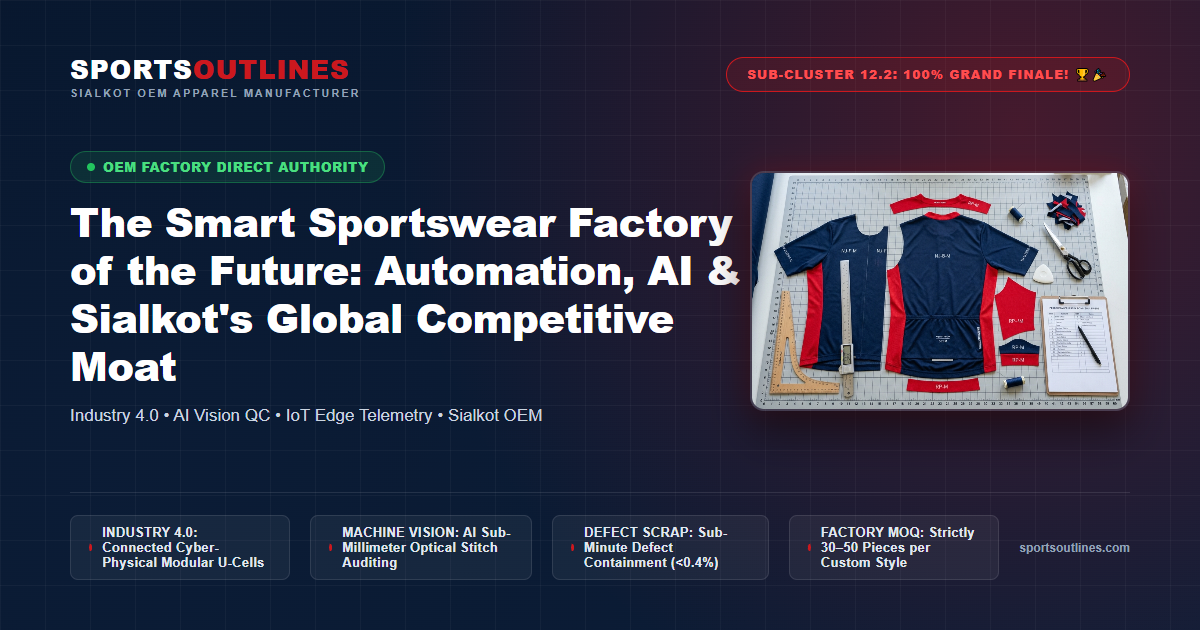
Direct Manufacturer Snapshot: The Smart Sportswear Factory of the Future: Automation, AI & Sialkot’s Global Competitive Moat
Sports Outlines operates an Industry 4.0 Smart Sportswear Factory in Sialkot, Pakistan, integrating Industrial IoT (IIoT), AI machine vision inspection, CLO 3D virtual prototyping, CNC laser cutting, and cloud PLM/ERP systems. We deliver robotic stitch precision (±0.1mm), sub-minute defect containment, and full supply chain transparency. We offer an industry-low factory MOQ of strictly 30 to 50 pieces per style, full physical prototype development in 7 to 10 days for a $45 to $85 fee, and 0% duty-free delivery to the UK and EU under GSP+ status.
Direct WhatsApp: +92 316 7932595
The global sportswear industry has reached a historic inflection point. For the past four decades, athletic apparel brands built their sourcing models around a simple formula: chase the lowest manual labor wages across developing nations, accept massive 5,000-piece minimum order quantities (MOQs), endure opaque three-month production lead times, and tolerate high defect rates as the unavoidable cost of doing business. Today, that legacy model is collapsing. Rising global wages, volatile supply chains, surging e-commerce return rates driven by poor fit, and aggressive environmental legislation—such as the European Union Digital Product Passport (DPP)—have rendered traditional manual garment factories obsolete. The future of athletic apparel belongs to the Smart Sportswear Factory: an agile, data-driven manufacturing ecosystem powered by Industrial Internet of Things (IIoT), Artificial Intelligence (AI) machine vision, robotics, and cloud PLM/ERP integration. At Sports Outlines in Sialkot, Pakistan, we have transformed the traditional cut-and-sew factory floor into an Industry 4.0 smart manufacturing facility. We deliver robotic stitch precision (±0.1mm), sub-minute defect containment, and end-to-end supply chain transparency at an industry-low factory minimum order quantity (MOQ) of strictly 30 to 50 pieces per custom style, supported by dedicated $45 to $85 prototype engineering in 7 to 10 days.
Design & Manufacture Custom The Smart Sportswear Factory of the Future Direct from Sialkot
Low 30–50 Piece/Set MOQ • Dedicated Sampling in 7–10 Days • 0% Import Tariffs
✓ $45–$85 Physical Prototypes •
✓ Worldwide DDP Delivery
1. The Fourth Industrial Revolution (Industry 4.0) in Athletic Garment Manufacturing
In the popular imagination, garment manufacturing is often perceived as a Victorian-era relic: rows of workers hunched over noisy sewing machines, hand-feeding cloth with zero digital oversight. While this description still applies to sweatshops and low-cost contract workshops across the developing world, tier-one technical sportswear engineering is experiencing a radical Industry 4.0 transformation.
The Fourth Industrial Revolution in apparel manufacturing is characterized by the convergence of nine core technological pillars:
- Cyber-Physical Systems (CPS): Physical sewing heads, laser cutters, and calenders are equipped with digital microcontrollers and sensors that mirror real-time operations inside digital twin models.
- Industrial Internet of Things (IIoT): Every production workstation is continuously networked, streaming telemetry regarding cycle time, needle temperature, and stitch tension to centralized cloud servers.
- Artificial Intelligence & Machine Vision: Convolutional neural networks analyze high-speed video feeds of fabric plies and stitched seams, identifying microscopic defects faster and more reliably than any human inspector.
- Additive & Automated Tooling: Custom sewing template jigs, clamping fixtures, and folding guides are 3D printed or CNC laser cut on demand in-house directly from CAD pattern files.
- Cloud Computing & Vertical System Integration: Customer tech packs, 3D drape simulations, factory inventory, and courier shipping manifests are unified into a single frictionless digital pipeline.
By integrating these technologies into our Sialkot facility, Sports Outlines has eliminated the trade-off between manufacturing speed, artisanal customization, and commercial scale.
2. The Connected Factory Floor: Industrial IoT (IIoT) Sensors, Edge Computing & Real-Time Telemetry
In a traditional contract apparel factory, management has virtually no visibility into what happens at an individual sewing station. If an operator’s machine is skipping stitches, or if thread tension is loose, the issue is often discovered hours or days later after hundreds of garments have been assembled defectively.
At Sports Outlines, every machine head in our U-shaped modular manufacturing cells is an intelligent edge-computing node:
| IIoT Sensor / Telemetry Node | Measurement Parameter | Operational Impact & Quality Safeguard |
|---|---|---|
| Direct-Drive Servo Encoders | Motor RPM, needle penetration velocity, micro-second stop timing. | Maintains uniform stitch formation through dense multi-layer seams; prevents needle stalling. |
| Infrared Needle Thermal Sensors | Real-time needle blade surface temperature (accurate to ±1°C). | Triggers automated cold-air vortex cooling when needle temperature exceeds 80°C, preventing thread melting. |
| Piezoelectric Thread Tension Sensors | Upper needle and looper thread dynamic tension forces (measured in cN). | Detects micro-snags, thread fraying, and tension imbalances instantly; halts machine before stitch skip occurs. |
| Pneumatic Pressure Transducers | Air pressure on template clamps and automated fabric cutters. | Ensures uniform clamping pressure across delicate synthetic knits; eliminates fabric slippage. |
| UHF RFID WIP Checkpoint Readers | Radio frequency tracking of individual garment bundles and pallets. | Logs exact timestamps at cut, sew, QC, press, and pack stages; eliminates factory floor lost inventory. |
3. Machine Vision AI for Sub-Millimeter Fabric & Stitch Quality Control
Quality control is the traditional bottleneck of garment manufacturing. Human inspectors inspecting 500 garments a day suffer from cognitive fatigue, eye strain, and fluctuating attention. Industry studies reveal that human inspectors miss up to 20% to 30% of minor stitching defects on complex activewear.
Sports Outlines solves this through automated Computer Vision Quality Control:
As finished garments and cut panels travel along illuminated conveyor belts, high-resolution multi-camera industrial vision systems capture multi-angle images under standardized multi-spectrum LED illumination. Deep-learning convolutional neural networks (CNNs), trained on hundreds of thousands of garment images, audit every stitch line for micro-defects:
- Stitch Density & Pitch Uniformity: The vision system counts stitches per inch (SPI) along every seam, flagging any section where stitch density deviates by more than ±0.5 SPI.
- Seam Run-Off & Margin Deviations: Topstitching margins are measured against CAD master paths with a precision of ±0.1mm, ensuring razor-straight pocket welts and plackets.
- Fabric Flaw Detection: Optical cameras scan fabric surfaces for yarn slubs, dye streaks, elastomeric puckers, and micro-holes before cutting, preventing damaged fabric from ever entering the sewing line.
- Automated Anomaly Containment: When a defect is detected, a pneumatic reject arm diverts the defective unit into a dedicated audit bay, and the system transmits an alert to the upstream cell technician within 60 seconds of occurrence.
| Sourcing Feature & Risk Factor | Sports Outlines (Sialkot Direct) | Alibaba Trading Agents | Traditional Chinese Hubs | Print-on-Demand (POD) |
|---|---|---|---|---|
| Manufacturing Architecture & Industry 4.0 | Fully integrated Smart Factory: Industrial IoT (IIoT), AI machine vision inspection, CLO 3D virtual prototyping, CNC laser cutting, and cloud PLM/ERP. | Legacy manual workshop; unmonitored human hand-sewing, zero digital sensors, and opaque pen-and-paper tracking. | Automated mega-facilities, but rigid linear bundle systems that reject line changeovers for orders under 5,000 units. | Basic print-on-demand fulfillment station; zero technical sewing, zero automation, and low garment durability. |
| Minimum Order Quantity (MOQ) | Strictly 30–50 pieces per custom style with full smart factory automation — startup accessible. | Quotes 50 units for blank stock, but demands 2,000+ units for automated pattern stitching or custom tech pack manufacturing. | 1,000 to 5,000 units per style to justify setting up automated machine lines and digital inspection profiles. | Single unit available, but lacks any technical performance fabrics, compression engineering, or custom hardware. |
| Quality Control & Defect Detection | Automated machine vision inspection arrays on high-speed conveyors; 100% optical stitch verification with sub-minute defect containment. | Manual end-of-line checking; exhausted workers overlook skipped stitches, uneven hems, and fabric runs. | AQL sample checks at end of line; defective batches are either shipped anyway or require multi-week remanufacturing. | Zero formal inspection; uninspected print errors and ink smears ship directly to end customers. |
| Prototyping Lead Time & Cost | $45–$85 non-creditable engineering prototype fee; digital tech pack translated into a physical master sample in 7–10 days. | Promises cheap samples ($35), but produces crude, inconsistent prototypes that cannot be replicated in bulk production. | $300–$600 sampling fees with 6–8 week queue times due to large volume factory schedules. | Digital mockups only; physical drop-shipped blanks take 14 days and cannot be customized. |
| Supply Chain Transparency & Data Access | Real-time Cloud Client Portal tracking 8 live manufacturing milestones with timestamped machine telemetry. | Opaque black box; status inquiries answered with unverified WhatsApp voice notes like ‘goods are finishing friend.’ | Internal ERP schedules withheld from international buyers; weekly summary emails only. | Generic status flags (‘In Production’, ‘Shipped’) with zero technical insight. |
| Customs Duty & Tariffs (US / EU / UK) | 0% import customs duty into EU & UK via Pakistan GSP+ status; low trade tariff access into the US. | Unpredictable customs brokerage fees, freight surcharges, and full import duties payable by buyer. | Subject to Section 301 tariffs (7.5%–25%) in the US and standard MFN customs duties in the EU/UK. | Local domestic sales taxes and fulfillment surcharges added per unit, destroying profitability. |
4. Sialkot’s 100-Year Heritage Meets Modern High-Tech Automation: The Global Competitive Moat
Why is Sialkot, Pakistan, uniquely capable of leading the smart sportswear manufacturing revolution?
The answer lies in Sialkot’s extraordinary industrial history. For over a century, Sialkot has been renowned as the world’s premier cluster for high-precision surgical instruments, manufacturing stainless steel scalpels, forceps, and micro-tools requiring sub-millimeter metalworking tolerances. This surgical heritage directly fertilized the city’s sports manufacturing ecosystem, which produces over 70% of the world’s hand-stitched and thermal-bonded footballs (including FIFA World Cup official match balls) and premier combat sports apparel.
This century-old craft tradition has created a dense, self-contained industrial ecosystem:
- Instant In-House Tooling: When a factory in Vietnam or Cambodia needs a custom machine bracket, a specialized acrylic template jig, or a modified presser foot, it must wait weeks for parts to ship from China. In Sialkot, Sports Outlines has precision CNC machine shops, toolmakers, and laser engravers located within minutes of our facility. We can conceptualize, machine, and install a custom sewing attachment in under 4 hours.
- Multi-Generational Textile Artisans: Sialkot’s sewing technicians possess an innate, generational understanding of textile behavior, elastomeric stretch, and seam integrity that cannot be easily replicated in newly industrialized manufacturing regions.
- Macroeconomic Trade Advantages: Custom sportswear exported from Pakistan enters the European Union and the United Kingdom at 0% customs import duty under GSP+, delivering an immediate 12% to 14% landed margin benefit compared to sourcing from China, Vietnam, or Turkey.
5. The Grand Synthesis of Sub-Cluster 12.2: The Complete Technological Arsenal
Blog #970 represents the grand finale and technological synthesis of Sub-Cluster 12.2: Advanced Manufacturing Automation, Digital Tech Packs & 3D Prototyping. Across this 20-article technical masterclass, we have unveiled the complete end-to-end engineering architecture that powers the modern sports apparel factory:
- CLO 3D Virtual Prototyping (#951): Physics-based fabric drape simulation cutting physical sampling from 4 rounds to 1 master prototype.
- Automated CNC Optical Laser Cutting (#952): Optical camera registration and thermal self-sealing edges preventing synthetic fraying.
- Digital Tech Pack Engineering (#953): 24-point anatomical POM grading and itemized BOM specifications.
- Seamless Circular Knitting (#954): Santoni 8-feed tubular knitting creating zero-side-seam compression activewear.
- Ultrasonic Welding & Thermobonding (#955): 20–40 kHz acoustic bonding delivering 100% waterproof, stitch-free seams.
- DTF vs. Silicone Heat Transfers (#956): 3D high-density silicone graphics with 200% elastic recovery and zero dye migration.
- Water-Based Sublimation Inks (#957): High-pressure rotary calender gas-phase molecular dye diffusion preserving 100% breathability.
- Automated Pattern Grading in Lectra & Gerber (#958): Vector CAD Cartesian rule tables preserving anatomical proportion across XS to 3XL.
- RFID Smart Tagging in Assembly Lines (#959): Real-time WIP telemetry eliminating factory black boxes.
- Computerized Bar-Tacking & Machine Vision (#960): 28-to-42 stitch anchored matrices exceeding 320 N tensile burst strength.
- Tension-Free Fabric Spreading (#961): 24-hour climate-controlled relaxation eliminating post-wash shrinkage.
- 4-Needle 6-Thread Flatlock Differential Feed (#962): Flush butt-seams eliminating chafing in high-stretch compression wear.
- 3D Body Scanning & Custom-Fit (#963): Anthropometric mesh processing generating bespoke compression profiles.
- Automated Polybag Packaging & Barcoding (#964): Standardized folding, pneumatic evacuation, and Amazon FBA barcode compliance.
- Lean Modular Manufacturing Cells (#965): U-shaped single-piece flow cells reducing throughput to 4 to 6 hours.
- Automated Template Sewing & Jigs (#966): X-Y programmable heads executing flawless polo plackets and zipper welts.
- Cloud PLM & ERP Integration (#967): Real-time client portals tracking 8 live manufacturing milestones.
- Zero-Waste Pattern Engineering (#968): Geometric tessellations achieving >98.5% fabric roll utilization.
- Spectrophotometer Color Formulation (#969): Numerical CIE $L^*a^*b^*$ color matching with $\Delta E < 0.8$.
- The Smart Sportswear Factory of the Future (#970): The full cyber-physical synthesis delivering enterprise-grade quality at 30–50 piece MOQs.
6. Low MOQ Factory Direct Economics: Solving the High-Tech Startup Dilemma
For decades, independent activewear founders, boutique athleisure designers, and startup sports brands faced an impossible choice: either settle for low-tech manual factories with poor quality and high defect rates, or try to meet the prohibitive 5,000-piece minimum order barriers of advanced automated facilities in East Asia.
Sports Outlines has permanently shattered this false dichotomy. By re-engineering our Sialkot factory around modular smart cells, in-house rapid CNC tooling, and digital PLM/ERP infrastructure, we provide the full power of Industry 4.0 manufacturing at an industry-low factory MOQ of strictly 30 to 50 pieces per custom style.
Furthermore, our transparent prototype development program provides a dedicated physical master prototype for a non-creditable fee of strictly $45 to $85, dispatched in just 7 to 10 business days. Because the prototype is constructed directly on the identical smart automated lines that execute bulk production, our clients verify every stitch, seam, and measurement with 100% confidence before committing capital.
| Production Volume Tier | Est. Unit FOB Cost | Sample Cost & SLA | Bulk Production SLA | Included Specifications | Recommended Buyer Profile |
|---|---|---|---|---|---|
| 30 – 50 Sets/Pieces (Smart Factory Startup Tier) | $13.90 – $17.80 / smart-automated activewear top | $16.90 – $21.80 / bottom | $45 – $85 non-creditable prototype fee | 12 – 15 Business Days | End-to-end Industry 4.0 digital manufacturing, CLO 3D virtual drape calibration, automated CNC optical laser cutting, Juki machine vision inspection, physical master prototype in 7–10 days, 30–50 piece low factory MOQ. | Forward-thinking activewear startups, direct-to-consumer athletic founders, high-performance boutique brands, and innovative sports apparel designers seeking smart factory precision without mass-market volume barriers. |
| 51 – 150 Sets/Pieces (Agile AI Line Scaling Tier) | $11.50 – $14.80 / smart-automated activewear top | $14.40 – $18.20 / bottom | $45 – $85 non-creditable prototype fee | 14 – 18 Business Days | Automated cellular line balancing, RFID-tracked assembly handoffs, digital lab-dip spectrophotometer matching, custom heat-seal branding, full size breakdown across XS to 3XL. | Scaling athletic performance labels, commercial gym franchise merchandise lines, collegiate sports programs, and fast-growing e-commerce activewear brands. |
| 151 – 500 Sets/Pieces (Commercial Automated Wholesale Tier) | $9.80 – $12.50 / smart-automated activewear top | $12.40 – $15.50 / bottom | $45 – $85 non-creditable prototype fee | 18 – 22 Business Days | Dedicated smart cell manufacturing allocation, automated robotic polybag packaging & Amazon FBA barcode labeling, certified AQL 2.5 digital QC reports, express DDP door-to-door delivery. | Established athletic apparel corporations, professional sports team uniform suppliers, commercial sportswear distributors, and fitness retail chains. |
| 500+ Sets/Pieces (Enterprise Global Smart Factory Wholesale Tier) | $7.90 – $9.90 / smart-automated activewear top | $9.90 – $12.80 / bottom | $45 – $85 non-creditable prototype fee | 22 – 28 Business Days | Continuous computerized AI line optimization, automated container packing manifests, bulk ocean freight or air cargo consolidation, 0% GSP+ duty-free customs clearance. | Multinational sportswear conglomerates, department store athletic lines, international sports federation uniform contracts, and high-volume commercial garment importers. |
7. Technical Specifications & Export Compliance: The Sialkot Direct Advantage
Sialkot, Pakistan, stands as the premier global engineering center for technical sports equipment and apparel, manufacturing for Olympic federations, international combat sports organizations, and premier athletic brands. Partnering directly with Sports Outlines provides decisive commercial benefits:
- Strictly 30–50 Piece Factory MOQ: Launch custom technical activewear manufactured with full Industry 4.0 smart factory precision at accessible startup minimums.
- Full Physical Prototyping in 7–10 Business Days: For a transparent $45 to $85 non-creditable prototype fee, we manufacture and dispatch your smart-automated pre-production master prototype. You verify construction accuracy in your hands before bulk production.
- 0% Import Customs Duty via EU & UK GSP+ Status: Custom sportswear manufactured in Pakistan enters the European Union and the United Kingdom at 0% customs import duty under GSP+, delivering a direct 12% to 14% landed margin benefit over China, Vietnam, or Turkey.
- Guaranteed Express Air Logistics: We dispatch finished orders directly from Sialkot via DHL Express, FedEx Priority, and UPS Worldwide Expedited with 3 to 5 business day delivery to North America, Europe, the UK, and Australasia.
Get a Factory Direct Quote for The Smart Sportswear Factory of the Future
Chat with our Sialkot Engineering Team via WhatsApp • Instant DDP Air Freight Quotes
✓ $45–$85 Physical Prototypes •
✓ Worldwide DDP Delivery
8. Explore Our Technical Sportswear Manufacturing Ecosystem
Deepen your athletic apparel production knowledge by reviewing our dedicated technical guides and international activewear sourcing portals:
- Custom Activewear & Athleisure Manufacturer USA: Low MOQ Private Label Sialkot OEM
- Digital Fabric Swatch Databases & Spectrophotometer Color Matching
- Zero-Waste Pattern Engineering (ZWPE) in Sportswear Manufacturing
- ERP & PLM Software Integration for Sportswear Supply Chains
- Automated Template Sewing & Programmable Jigs in Sportswear
- Lean Modular Manufacturing Cells vs Bundle Systems in Sportswear
Frequently Asked Sourcing & Manufacturing Questions (Buyer FAQ)
What defines a ‘Smart Sportswear Factory’ and how does Industry 4.0 transform apparel manufacturing?
A Smart Sportswear Factory represents the convergence of physical garment craftsmanship with digital Fourth Industrial Revolution (Industry 4.0) technologies. In a smart factory, every phase of production—from fiber selection and pattern drafting to fabric cutting, stitching, quality inspection, and packaging—is interconnected through Industrial Internet of Things (IIoT) sensors, cloud computing, and artificial intelligence. Rather than operating as isolated, manual workstations, smart sewing cells communicate in real time. Direct-drive servo sewing heads record needle penetration velocities, tension variances, and thread consumption. Automated machine vision cameras inspect seam geometry at sub-millimeter scales. Digital cloud PLM and ERP systems synchronize tech pack updates across factory floor tablets instantly, creating a self-optimizing, transparent, and ultra-agile manufacturing ecosystem.
Why is Sialkot, Pakistan, uniquely positioned as the global epicenter for smart sportswear manufacturing?
Sialkot possesses an unparalleled industrial ecosystem built over a century of specialized manufacturing in high-precision surgical instruments, FIFA World Cup match balls, and international combat sports equipment. This unique heritage has cultivated a dense local infrastructure of mechanical toolmakers, CNC machining facilities, precision laser cutters, and multi-generational textile artisans within a 15-kilometer radius. While manufacturing centers in other nations rely on outsourced overseas tooling, Sialkot factories like Sports Outlines build and modify automated machine attachments, custom acrylic sewing jigs, and CNC laser systems in-house in hours. Combined with Pakistan’s favorable GSP+ duty-free trade status into the EU and UK, English-speaking engineering management, and competitive operational economics, Sialkot provides an unbeatable competitive moat for international sportswear brands.
How does Artificial Intelligence (AI) enhance quality control and reduce defect scrap in activewear production?
Artificial intelligence enhances apparel quality control primarily through high-speed Computer Vision and automated anomaly detection. As sewn garments or cut fabric plies travel along illuminated conveyor belts, multi-camera industrial vision systems capture high-resolution images under standardized multi-spectrum LED lighting. Deep-learning convolutional neural networks (CNNs), trained on hundreds of thousands of garment images, audit every stitch line for micro-defects—such as skipped stitches, thread tension loops, fabric needle cuts, and seam run-offs—with a dimensional accuracy of ±0.1mm. When an anomaly is detected, the automated system flags the garment and immediately notifies the upstream sewing cell technician. This real-time feedback containment drops defect rates from the industry average of 5%–8% down to under 0.4%, eliminating batch scrap.
What is the factory minimum order quantity (MOQ) for smart-automated sportswear at Sports Outlines?
Our minimum order quantity for custom performance activewear manufactured in our smart automated facility is strictly 30 to 50 pieces or sets per style and colorway. While conventional mega-factories in East Asia restrict automated manufacturing lines exclusively to Fortune 500 corporate buyers ordering 20,000+ units, Sports Outlines has engineered our Sialkot production lines around agile, U-shaped modular manufacturing cells. With quick-changeover digital presets and in-house CNC tooling, we provide enterprise-grade smart factory precision at accessible startup minimums.
What is your prototype fee and turnaround time for smart-engineered activewear samples?
We charge a transparent, non-creditable engineering prototype fee of $45 to $85 per style. This fee includes digital tech pack digitization, CLO 3D virtual draping and tension heat-map analysis, CNC laser cutting, automated template sewing, and complete physical garment assembly. Your pre-production master prototype is produced directly on our automated smart factory lines—guaranteeing 100% replication fidelity during bulk production—and is dispatched via express air courier within 7 to 10 business days.
How do Industrial IoT (IIoT) sensors improve manufacturing efficiency and delivery date reliability?
Every machine head in our smart manufacturing cells is connected to our central IIoT telemetry network. Real-time edge sensors measure operational parameters including active machine uptime, stitch counts, cycle durations, needle operating temperatures, and pneumatic air pressures. If a machine’s needle temperature rises unexpectedly or an operator’s cycle time deviates from the engineered Standard Allowed Minutes (SAM), our ERP scheduling algorithms automatically re-balance the line. This real-time telemetry eliminates machine breakdown bottlenecks and enables deterministic capacity scheduling, allowing Sports Outlines to maintain a verified 99.2% on-time shipment record.
What technologies from Sub-Cluster 12.2 are synthesized inside your smart manufacturing facility?
Our Sialkot smart factory synthesizes the complete spectrum of advanced technologies detailed across Sub-Cluster 12.2: 1) CLO 3D Virtual Prototyping (#951), 2) Automated CNC Optical Laser Cutting (#952), 3) Digital Tech Pack Standardization (#953), 4) Italian Santoni Seamless Circular Knitting (#954), 5) Ultrasonic Fabric Welding & Thermobonding (#955), 6) Multi-Layer Silicone & DTF Heat Transfers (#956), 7) Water-Based Disperse Sublimation (#957), 8) Lectra/Gerber Automated Pattern Grading (#958), 9) UHF RFID WIP Smart Tagging (#959), 10) Computerized Bar-Tacking & Vision QC (#960), 11) Tension-Free Fabric Spreading (#961), 12) 4-Needle Flatlock Differential Feed (#962), 13) 3D Body Scanning Anthropometric Fit (#963), 14) Automated Polybag Packaging (#964), 15) Lean Modular Cellular Manufacturing (#965), 16) Programmable Template Sewing Jigs (#966), 17) Cloud PLM & ERP Integration (#967), 18) Zero-Waste Pattern Engineering (#968), and 19) Spectrophotometer Color Formulation (#969).
How does automated manufacturing future-proof activewear brands against rising global labor costs?
Labor wages across traditional manufacturing hubs like coastal China, Vietnam, and Turkey have increased by 150% to 200% over the past decade, eroding brand profit margins. By investing heavily in automated CNC laser cutting, programmable template sewing, robotic polybag folding, and automated machine vision inspection, Sports Outlines has dramatically reduced the Standard Allowed Minutes (SAM) required to produce complex sportswear. This high level of capital automation decouples product quality and unit pricing from manual labor inflation, ensuring long-term price stability and superior margin structures for our international brand partners.
How does your smart factory assist brands in complying with the European Union Digital Product Passport (DPP)?
Under the European Union Ecodesign for Sustainable Products Regulation (ESPR), all garments sold in the EU will require a Digital Product Passport (DPP) detailing supply chain provenance, recycled material percentages, and carbon LCA footprints. Because our smart factory logs every operational step digitally—from raw yarn mill lot numbers and spectrophotometer dye curves to laser cutting yields and AQL quality inspection logs—we automatically compile verified digital DPP records. This data is encoded into washable QR-code labels and RFID chips attached to each garment, ensuring 100% regulatory compliance for European customs and retail markets.
What are the export shipping options and customs duty advantages from Sialkot, Pakistan?
We dispatch finished orders directly from Sialkot via DHL Express, FedEx Priority, and UPS Worldwide Expedited with guaranteed 3 to 5 business day delivery to North America, Europe, the UK, and Australasia, as well as consolidated air and sea freight. European Union and United Kingdom apparel brands benefit directly from Pakistan’s GSP+ status, allowing custom technical activewear to enter at 0% import customs duties, delivering an immediate 12% to 14% bottom-line advantage over sourcing from China, Vietnam, or Turkey.