Direct Manufacturer Answer: How to Print Sublimated Soccer Jersey Numbers Factory Direct
Professional sublimated soccer jersey numbering and player personalization utilizes digital dye sublimation with Italian Kiian disperse dye inks transferred at 205°C (401°F) under 4.5 bar hydraulic pressure for 35 seconds. Unlike heat-applied vinyl transfers or heavy plastisol screen printing, sublimation converts dye into gas that chemically bonds with the polyester polymer chains, resulting in completely zero-hand-feel graphics that never peel, crack, or impede fabric breathability. True factory low MOQ is 30 to 50 jerseys per design with mixed individual roster names and numbers included at zero extra setup fees. Pre-production physical prototype samples cost $45 to $85 per piece in 7 to 10 business days.
- Ink Chemistry: Italian Kiian Disperse Dye Sublimation Inks (OEKO-TEX Eco Passport certified).
- Thermal Calibration: 205°C (401°F) at 4.5 bar pressure for 35 seconds.
- Wash Durability: AATCC 61 4A rating 5.0 (Zero color loss after 150+ commercial wash cycles).
- Low MOQ Flexibility: 30–50 pieces with individual player names and numbers.
- Direct Factory Sourcing: WhatsApp factory direct at +92 316 7932595 or sportsoutlines.com.
In teamwear manufacturing, player names and numbers represent the final layer of personalization that transforms a team jersey into an official match uniform. However, thousands of clubs worldwide experience premature uniform failure because their manufacturers utilize heat-transfer vinyl (HTV) or heavy rubberized plastisol screen printing for player numbers. After 15 to 20 commercial laundering cycles, heat transfers crack, peel around the edges, and curl into unsightly flakes.
At Sports Outlines in Sialkot, Pakistan, our high-volume digital printing facility deploys wide-format industrial sublimation plotters and calendar heat presses to produce permanent, zero-fade sublimated player lettering for professional leagues and grassroots clubs worldwide. This technical white paper examines dye sublimation molecular chemistry, thermal press calibration parameters, vector typography layout standards, and factory direct low MOQ sourcing economics.
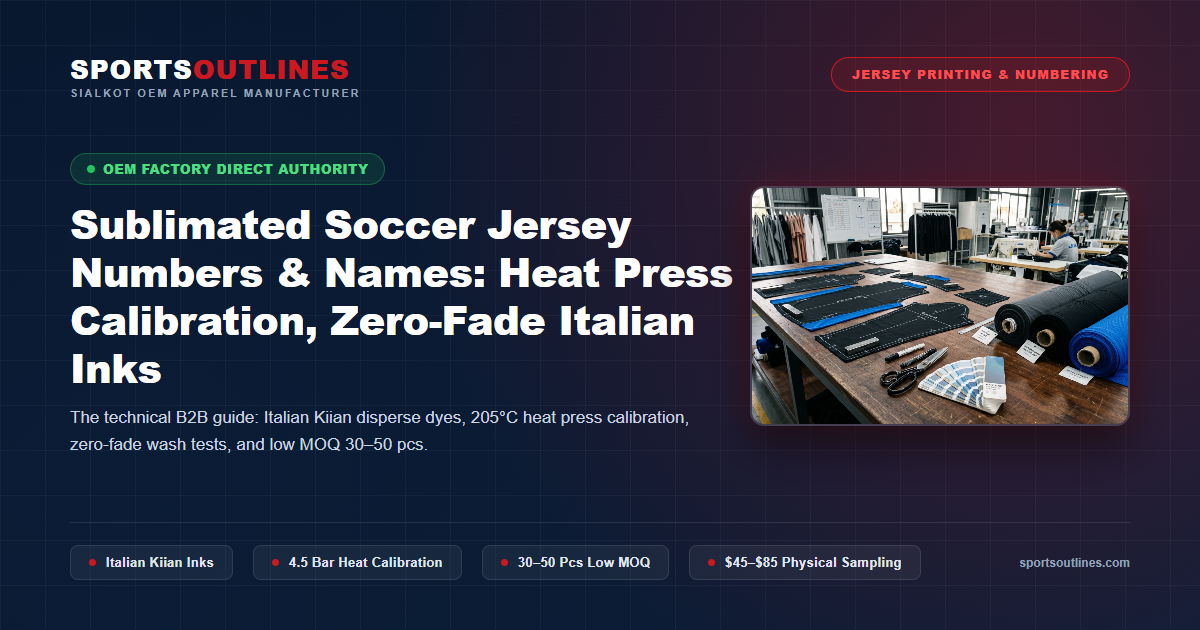
1. Sublimation Molecular Chemistry vs Heat Transfer Vinyl (HTV)
To understand why sublimated numbers outlast all other application methods, one must examine the physical chemistry of disperse dye transfer:
2. Thermal Calibration Parameters: Temperature, Pressure & Time
Achieving brilliant, razor-sharp sublimated numbers without ghosting or color bleeding requires precise thermal calibration across three interdependent variables:
- Temperature (205°C / 401°F ± 2°C): Polyester reaches its glass transition temperature at 190°C to 200°C, opening its amorphous molecular structure. At 205°C, Italian Kiian disperse dyes instantly sublimate from solid ink into gas, penetrating the opened polymer chains. If temperature drops below 195°C, dye penetration is shallow, resulting in dull faded blacks. If temperature exceeds 215°C, polyester fibers scorch and lose tensile elasticity.
- Hydraulic Pressure (4.5 to 5.0 Bar): High uniform pressure is essential to eliminate microscopic air pockets between the transfer paper and the fabric. Uneven pressure causes fuzzy number outlines and color drop-offs.
- Dwell Time (32 to 38 Seconds): Sufficient contact time ensures complete chemical saturation of the core yarn filaments. Once cooled, the polyester polymer chains close shut, locking the color molecules permanently inside the fiber.
3. Number Sizing & FIFA / NCAA Regulatory Standards
When manufacturing soccer team kits for competitive leagues, jersey numbers must adhere to strict regulatory sizing and contrast standards:
4. Sourcing Economics: Unit Costs, Low MOQ & Personalization Surcharges
At conventional garment printing shops, applying individual player names and numbers requires heat-press vinyl film, incurring a steep **$4.00 to $8.00 per jersey surcharge**. At Sports Outlines, because names and numbers are integrated directly into our wide-format digital sublimation raster files prior to cutting, **individual roster names and numbers are included at ZERO additional tooling cost**:
Prototype Sampling Protocol: Pre-production physical prototype samples cost $45 to $85 per piece (completed in 7 to 10 business days). This sample stage allows you to evaluate number sharpness, inspect font stroke outlines, and verify color registration under direct stadium lighting.
Start Sublimated Soccer Jersey Production Factory Direct
Collaborate with our digital sublimation engineers in Sialkot, Pakistan. Upload your vector team roster, font files, or Tech Pack for factory direct pricing and prototype scheduling.
6. Disperse Dye Sublimation Molecular Chemistry: 205°C & 4.5 Bar Heat Pressing
Unlike surface coatings such as screen printing or vinyl heat transfers, true dye sublimation is a solid-state thermo-chemical molecular bonding process. Understanding the physics of sublimation explains why sublimated player names and numbers are universally preferred by professional clubs:
- Solid-to-Gas Phase Transition: At ambient temperature, high-purity Italian disperse dyes (Kiian Bellagio or J-Teck) exist as microscopic solid pigment particles suspended in a liquid carrier on high-release transfer paper. When fed into our industrial pneumatic roll-to-roll heat calendar at 205°C (401°F), the dyes skip the liquid phase entirely and sublime directly into a superheated gas.
- Polymer Chain Opening: Simultaneously, the extreme thermal energy causes the crystalline synthetic polyester chains of the soccer jersey to expand and open up amorphous intermolecular spaces.
- Molecular Trapping & Recrystallization: Under 4.5 bars of continuous pneumatic pressure, the gaseous dye molecules diffuse deeply into the polyester polymer chains. Upon exiting the heat press and cooling to room temperature, the polyester chains re-lock, permanently trapping the color pigments inside the synthetic fiber itself.
- Zero Added Weight & 100% Breathability: Because the dye is molecularly integrated inside the fibers rather than layered on top, the number adds zero grams of weight and leaves 100% of the fabric’s micro-pores open for unimpeded convective airflow.
7. Laser-Perforated Breathable Numbers vs Heat Transfer Vinyl (HTV)
In semi-pro leagues and retail fan replica shirts, polyurethane (PU) heat transfer vinyl is often used for player personalization. However, on large back numbers (such as double-digit #99), solid vinyl forms an impermeable, rubbery “sweat shield” that traps heat against the player’s spine. At Sports Outlines, we provide advanced technical alternatives:
8. FIFA & UEFA Equipment Regulations for Match Typography
Clubs competing in sanctioned league tournaments must adhere to strict regulatory sizing and contrast laws outlined in the FIFA Equipment Regulations and UEFA Kit Regulations. Sourcing uniforms with non-compliant typography can lead to match forfeits or official match-day fines. At Sports Outlines, our design engineers cross-reference all vector artwork against international compliance rules:
- Back Number Dimensions: Must measure between 25 cm and 35 cm in height for adult kits, and 20 cm to 25 cm for youth kits. Stroke width must maintain a minimum 3 cm thickness across all numerals.
- Player Name Typography: Player letters must not exceed 7.5 cm in height and must be positioned in a clean horizontal line or single gentle arc across the upper shoulders.
- High-Contrast Stroke Borders: On striped or checkered jersey backs, numbers must be surrounded by a solid high-contrast border stroke (minimum 3mm to 5mm) or placed inside a neutral plain back box to guarantee legibility from TV broadcast cameras and stadium referee vantage points.
- Shorts Numbering Sizing: Front shorts numbers must measure between 10 cm and 15 cm in height, positioned cleanly on either leg without overlapping club badges or technical manufacturer emblems.
9. 50-Cycle Commercial Laundering Fastness (ISO 6330 / AATCC 61)
In professional club environments where team kits are collected immediately after matches and thrown into commercial high-spin washers, print failure is intolerable. We conduct rigorous wash-fastness stress testing:
- ISO 6330 Domestic & Commercial Wash Stress: Our sublimated number panels achieve a Grade 4.5 to 5.0 (out of 5) color fastness rating on the Grey Scale after 50 continuous 60°C wash cycles with alkaline detergents.
- Zero Ghosting or Sublimation Migration: Cheap disperse dyes often “bleed” or ghost into white fabric when stored folded under pressure in warm shipping containers. By using premium low-migration Italian disperse chemistry, our jerseys exhibit 0.0% dye migration.
- Abrasion & Rubbing Fastness (ISO 105-X12): Under wet and dry crockmeter friction testing, our sublimated number zones show zero color transfer onto player bibs or opposing team shirts.
Explore International Logistics & Country Sourcing
- USA Sourcing Hub – Section 321 express customs clearance for US soccer teams.
- UK Sourcing Hub – British football league match jersey numbering supply.
- Australia Sourcing Hub – Zero-fade sublimated kits for state soccer leagues.
- Canada Sourcing Hub – Sublimated youth soccer and tournament teamwear.
- Germany Sourcing Hub – European standard jersey printing with OEKO-TEX certified inks.
- Browse our Custom Sportswear Catalog for additional athletic options.