In modern alpine mountaineering hardshells, stormproof ski jackets, and high-performance tactical outerwear, the conventional needle-and-thread pocket has become an engineering anachronism. A traditional stitched external chest pocket requires topstitching around its perimeter, punching over 400 needle perforations directly through the jacket’s waterproof face. Because mechanical stitching creates raised seam ridges, water collects in the stitch furrow, eventually siphoning past the sewing thread into the pocket interior. Furthermore, sewing seam allowances add unnecessary weight, stiffen the jacket chest, and create bulky interior ridges that abrade against the wearer’s mid-layers.
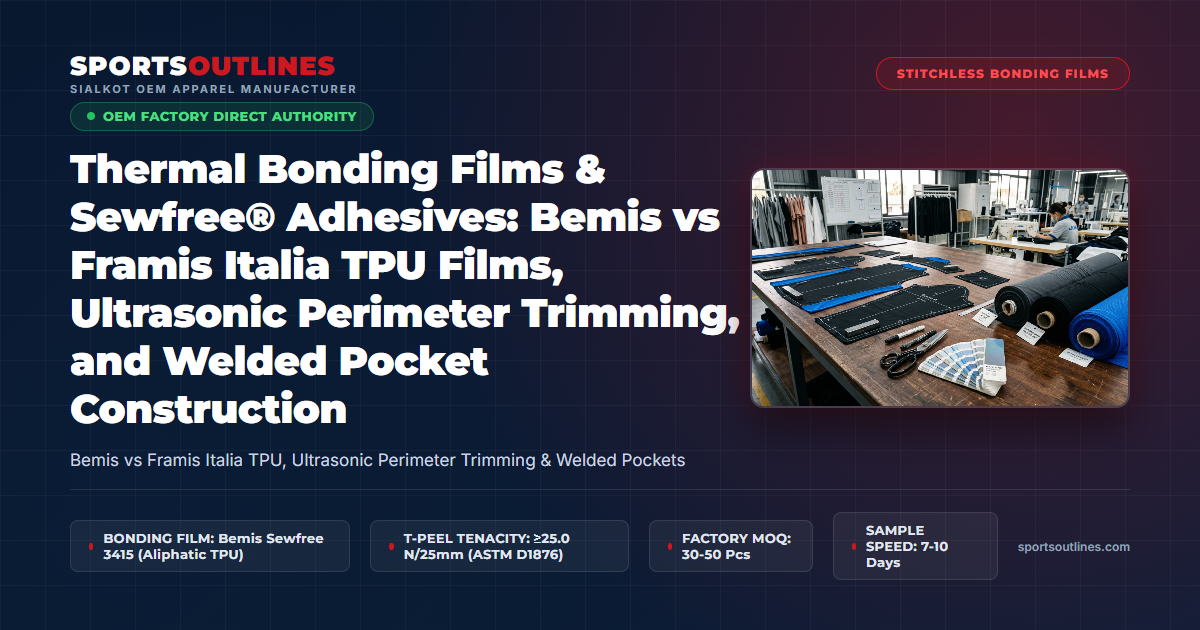
To achieve clean, zero-leak, weight-optimized outerwear construction, leading apparel brands deploy Stitchless Thermal Bonding Films and Ultrasonic Perimeter Trimming. By replacing thread stitching with engineered thermoplastic polyurethane (TPU) bonding films—such as Bemis Sewfree® and Framis Italia Noso® systems—manufacturers create monolithic, welded pocket apertures, laser-bonded zipper garages, and laminated storm flaps with zero needle punctures. At Sports Outlines, operating our technical shell manufacturing facility in Sialkot, Pakistan, we combine CNC CO2 laser cutting, automated ultrasonic perimeter trimming, and two-stage pneumatic flatbed heat presses to manufacture tournament-grade bonded outerwear. We empower emerging performance brands with accessible contract terms: physical prototype sampling at $45 to $85 per piece (non-refundable, 7–10 business days turnaround) and scalable factory production starting at strictly 30 to 50 pieces per style/colorway.
Thermal Bonding Films & Welded Pocket Construction: Technical Directory
- 1. Stitchless Bonding Fundamentals: Supported vs Unsupported TPU Films
- 2. Polymer Formulation: Bemis Sewfree® vs Framis Italia Noso®
- 3. Ultrasonic Perimeter Trimming vs Mechanical Knife Slitting
- 4. Industrial 4-Step Welded Pocket Construction Workflow
- 5. Pneumatic Flatbed Heat Press Thermodynamic Calibration
- 6. Thermal Bonding Films Comparative Engineering Matrix
- 7. Mechanical Adhesion Physics & ASTM D1876 T-Peel Fracture Hold
- 8. Environmental Testing: 50-Wash Laundering & Dry-Cleaning Fastness
- 9. Outerwear Tech Pack Specifications & Stitchless Callouts
- 10. Sialkot Technical Outerwear Bonding Suites & Laser Cleanroom
- 11. Low-MOQ Contract Manufacturing & Prototyping Terms
- 12. Technical Sourcing FAQ
1. Stitchless Bonding Fundamentals: Supported vs Unsupported TPU Films
Thermal bonding films are solid, 100% solvent-free thermoplastic adhesive sheets supplied on siliconized release paper or polyester carrier liners. When exposed to heat and pneumatic pressure, the film melts, flows into the microscopic fiber crevices of adjacent fabric panels, and re-solidifies upon cooling, creating an unbreakable mechanical and chemical bond. In technical outerwear manufacturing, bonding films are classified into two structural architectures:
1. Unsupported TPU Adhesive Films
Unsupported films consist purely of a single homogenous layer of thermoplastic polyurethane (typically 50 to 150 µm thick). Because there is no internal structural carrier, unsupported films offer maximum elasticity (elongation at break >400%), soft drape, and zero added bulk. They are deployed primarily for fabric-to-fabric laminations, hem turn-ups, sleeve cuff wraps, and bonding lightweight stretch pocket bags to jacket interiors.
2. Supported / Multi-Layer Composite Films
Supported films incorporate an internal high-modulus carrier core—such as an ultra-thin nonwoven web, an oriented polyamide scrim, or a dual-temperature co-extruded barrier layer:
- Differential Melt Co-Extrusions: Feature an upper layer that melts at a high temperature (e.g., 185°C) and a lower adhesive layer that melts at a lower temperature (e.g., 125°C). During heat pressing, only the adhesive side liquefies, preventing glue from striking through to the face platen.
- Seam Reinforcement Tapes (SRT): Feature an internal cross-ply scrim that limits elongation to ≤15%, providing high dimensional stability along pocket opening perimeters, zipper insertions, and pocket bag hang points that must support heavy smart phones and radios without sagging.
2. Polymer Formulation: Bemis Sewfree® vs Framis Italia Noso®
The two global titans of technical outerwear bonding films are Bemis Associates (USA) and Framis Italia (Italy). While both supply certified, expedition-grade adhesives, their polymer formulations and rheological characteristics cater to distinct manufacturing requirements:
Bemis Sewfree® Adhesives (e.g., 3415, 3218, 3914, Flowfree™)
Bemis Sewfree® films are renowned for their rugged shear strength and industrial durability. Key formulations utilized in our Sialkot factory include:
- Bemis 3415 (Aliphatic TPU Film, 150 µm): The global gold standard for alpine hardshell welded pockets. Being 100% aliphatic, it exhibits zero UV yellowing over years of high-altitude alpine sun exposure. Activation temperature is 150°C to 165°C. Once cured, it delivers an indestructible 180° peel strength exceeding 28.0 N/25mm on 3L nylon shell fabrics.
- Bemis 3218 (Polyether TPU Film, 100 µm): Synthesized specifically for hydrolytic immunity in wet environments. Provides excellent low-temperature flexibility ($T_g \approx -40^\circ\text{C}$), making it ideal for sub-zero mountaineering and ski touring shells.
- Bemis Flowfree™: A perforated adhesive film featuring micro-apertures that preserve localized water vapor breathability ($Ret \le 6.0\text{ m}^2\text{Pa/W}$) across broad laminated chest panels and pocket bags.
Framis Italia Noso® Technology (e.g., Portofino, Dream, Rete, Bi-Elastic)
Framis Italia is celebrated for Italian sartorial finesse, ultra-soft hand feel, and low-temperature activation:
- Framis Dream Film (Low-Melt TPU, 80 µm): Formulated with a depressed melting temperature of 105°C to 125°C. This low thermal threshold is crucial when bonding heat-sensitive electrospun nanofiber membranes, ultralight 10D face fabrics, or bio-based TPU membranes that would otherwise suffer thermal pinholing at 160°C.
- Framis Bi-Elastic PU Films: Engineered for 4-way dynamic stretch softshells and athletic activewear. Provides an elastic recovery exceeding 92% after 100% elongation, ensuring welded pockets stretch symmetrically with the body without buckling or wrinkling.
3. Ultrasonic Perimeter Trimming vs Mechanical Knife Slitting
When creating bonded pocket apertures and raw-edge pocket flaps, the method used to cut the fabric and film is as critical as the adhesive itself. Traditional mechanical blade slitting (rotary knives or drag knives) merely slices through the woven yarns mechanically. Under dynamic laundering and abrasion, the severed yarn filaments unravel, creating unsightly edge fraying, fuzz, and eventual adhesive peel initiation.
In our Sialkot cleanrooms, pocket borders are finished using High-Frequency Ultrasonic Perimeter Trimming (35 kHz):
As the 35 kHz ultrasonic horn vibrates against a sharp-beveled carbide anvil wheel, acoustic friction cuts the fabric and adhesive film while simultaneously melting and cauterizing the individual synthetic fiber ends into a microscopic fused bead (Ø ≈ 0.15 mm).
This fused edge completely encapsulates the woven warp and weft yarns, guaranteeing 100% fray-proof edge stability across 50+ commercial wash cycles. Furthermore, ultrasonic trimming eliminates the need for folded seam allowances around pocket openings, reducing edge thickness from 1.8 mm down to a razor-thin 0.45 mm.
4. Industrial 4-Step Welded Pocket Construction Workflow
Constructing a flawless, waterproof external chest pocket on a 3-layer hardshell jacket requires an unyielding, standardized four-step manufacturing protocol:
Step 1: CNC Laser Cutting of Aperture & Zipper Garages
The garment front panel is loaded onto a computerized CO2 laser cutting flatbed. The laser cuts the precise pocket slit aperture (typically 160 mm to 180 mm long by 4 mm wide) along with an integrated top zipper garage teardrop with zero dimensional tolerance (±0.1 mm). The laser beam’s focused thermal energy cauterizes the raw fabric edges instantly, preventing fraying.
Step 2: Pre-Tack Lamination of Bonding Film to Zipper Flanges
A waterproof reverse-coil zipper (e.g., YKK AquaGuard® #3 or #5) is fed through a continuous roll-to-roll flatbed calender. Strips of Bemis 3415 TPU film (12 mm width) are applied directly onto the front face of the polyurethane zipper tape flanges under low heat (115°C, 1.5 bar, 4 seconds). The release paper is peeled away, leaving the heat-activated adhesive film perfectly anchored to the zipper tape.
Step 3: Ultrasonic Trimming & Pocket Bag Assembly
The internal pocket bag fabric (crafted from ultralight 40 GSM warp-knit stretch mesh or 30D ripstop) is ultrasonically cut and framed with Bemis Seam Reinforcement Tape (SRT). The pocket bag perimeter is sealed with a continuous 10 mm bonded hem, eliminating all interior stitching threads.
Step 4: Two-Stage Pneumatic Heat Press Consolidation & Quenching
The pre-assembled zipper and pocket bag are precisely aligned beneath the laser-cut jacket aperture using optical laser crosshairs. The assembly is placed inside a computerized pneumatic flatbed heat press (such as Macpi or Framis heat press stations):
- Stage 1 (Low-Pressure Thermal Tack): Upper platen descends at 120°C, 1.8 bar pressure for 5 seconds. This tacks the zipper in place without lateral resin displacement.
- Stage 2 (High-Pressure Consolidation Dwell): Heated platen engages at 160°C, 4.5 bar pressure for 20 seconds. The TPU film liquefies to 3,000 mPa·s, penetrating deep into the fabric yarns.
- Automated Chilled Quenching: The garment shifts immediately to an adjacent chilled aluminum platen held at 18°C under 3.5 bar pressure for 10 seconds. Rapid quenching freezes the polymer morphology, locking in peak crystallinity and preventing bond shrinkage.
5. Pneumatic Flatbed Heat Press Thermodynamic Calibration
Operating flatbed heat presses for stitchless bonding is governed by the Thermodynamic Triad: Temperature, Pressure, and Dwell Time. Any imbalance across this triad results in bonding failure:
Where $k_{\text{platen}}$ is thermal conductivity, $\Delta z$ is total stack thickness, and $t_{\text{dwell}}$ is dwell time. Our Sialkot engineering lines enforce the following parameter control boundaries:
- Platen Temperature Uniformity: Multi-zone PID heating elements ensure temperature across the entire 400 x 500 mm platen varies by no more than ±1.0°C. Cold platen corners causing under-melt delamination are strictly eliminated.
- Pneumatic Force Uniformity: Dual pneumatic cylinders apply balanced clamping forces of 4.0 to 5.0 bar (0.40 to 0.50 MPa), monitored via digital load cells.
- Teflon & Silicone Protective Cushions: Platens are shielded with 0.15 mm virgin PTFE sheets and 3 mm compliant silicone foam beds to distribute pressure evenly over the zipper teeth without crushing the plastic slider.
Thermal Contact Resistance & Multi-Layer Cushion Heat Flux Modeling
Because the heated platen must transfer thermal energy through an intermediate stack comprising a virgin PTFE Teflon barrier sheet, the outer face fabric, the waterproof-breathable membrane, and the TPU film, conductive heat transfer is governed by the composite thermal resistance equation:
Where $R_{\text{contact}}$ is the thermal contact resistance between plies, which drops exponentially with increasing pneumatic clamping pressure ($R_{\text{contact}} \propto P^{-0.65}$). At our baseline line pressure of 4.5 bar (0.45 MPa), interfacial air gaps collapse completely, elevating the conductive heat flux:
This rapid thermal flux brings the Bemis 3415 adhesive core to its target 160°C melt plateau within 6.5 seconds of platen contact, leaving 13.5 seconds of sustained liquid melt flow to achieve deep mechanical yarn entrapment before the platen retracts.
6. Thermal Bonding Films Comparative Engineering Matrix
The following engineering matrix outlines the technical specifications of primary bonding film formulations utilized across Sports Outlines contract manufacturing lines:
| Bonding Film Grade | Polymer Chemistry | Film Thickness | Press Temperature | Dwell / Pressure | Target Peel Tenacity |
|---|---|---|---|---|---|
| Bemis Sewfree® 3415 | 100% Aliphatic Polyurethane | 150 µm (0.15 mm) | 155°C – 165°C | 18–22 sec / 4.5 bar | 26.0 – 32.0 N/25mm (High Hold) |
| Bemis Sewfree® 3218 | Polyether TPU (PTMEG) | 100 µm (0.10 mm) | 145°C – 155°C | 15–18 sec / 4.0 bar | 22.0 – 26.0 N/25mm |
| Framis Italia Dream Film | Low-Melt Modified TPU | 80 µm (0.08 mm) | 115°C – 128°C | 12–15 sec / 3.5 bar | 18.0 – 22.0 N/25mm |
| Framis Italia Bi-Elastic Noso® | High-Elastic Elastomeric PU | 120 µm (0.12 mm) | 135°C – 145°C | 16–20 sec / 3.8 bar | 20.0 – 25.0 N/25mm |
| Bemis Seam Reinforcement (SRT) | Cross-Ply Polyamide Scrim TPU | 200 µm (0.20 mm) | 160°C – 170°C | 20–25 sec / 4.8 bar | 30.0 – 38.0 N/25mm |
7. Mechanical Adhesion Physics & ASTM D1876 T-Peel Fracture Hold
In fracture mechanics, the bond strength between an adhesive film and a fabric substrate is evaluated by measuring the critical strain energy release rate (interfacial fracture toughness, $G_c$). When peeling a bonded pocket flange away from the shell fabric, the energy dissipated per unit crack area ($G$) must exceed the material’s fracture energy for delamination to propagate:
Where $P$ is the tensile peeling force, $b$ is the bond width (25 mm), and $\theta$ is the peeling angle (180° for ASTM D903, 90° for T-peel ASTM D1876).
In our Sialkot mechanical testing suites, bonded test swatches are audited on an Instron 3345 tensile tester at a constant displacement rate of 100 mm/min. Compliant bonded pockets must achieve a minimum fracture hold of ≥25.0 N per 25 mm. Crucially, the failure mode must be 100% cohesive (where the textile fibers fracture or the adhesive film tears internally), proving that the adhesive-to-fiber bond interface is stronger than the base materials themselves.
Viscoelastic Peel Rate Sensitivity & Master Curve Construction
Because thermoplastic polyurethane adhesives are intrinsically viscoelastic, the measured fracture energy ($G_c$) is not a static constant; it is strongly dependent on peeling rate ($v$) and temperature ($T$). According to the Gent-Schultz adhesion dissipation framework:
Where $G_0$ is the intrinsic thermodynamic work of adhesion ($\approx 0.05\text{ to }0.15\text{ J/m}^2$) and $\Phi(a_T \cdot v)$ is the viscoelastic dissipation function representing bulk energy absorbed in the plastic deformation zone ahead of the peeling crack tip. Under high-speed impact or abrupt pocket snagging, energy dissipation surges exponentially, elevating dynamic peel resistance to over 45 N/25mm and preventing sudden catastrophic pocket detachment.
8. Environmental Testing: 50-Wash Laundering & Dry-Cleaning Fastness
Welded outerwear pockets must endure years of machine laundering, sweat exposure, and sub-zero temperature cycling without bond failure. In our Sialkot QA laboratory, every production batch is qualified against three environmental audit protocols:
- 50-Cycle Commercial Laundering Audits (ISO 6330 Method 4N): Jackets are washed 50 consecutive times at 40°C using standardized detergent and tumble dried at 60°C. Bonded pockets must exhibit zero edge lift, zero bubbling, and retain ≥85% of initial baseline peel strength.
- Perchloroethylene Dry-Cleaning Solvent Resistance (ISO 3175): Bonded tactical and ski uniform specimens undergo 5 commercial dry-cleaning cycles in perchloroethylene. CoPA and crosslinked TPU films must demonstrate zero adhesive softening or chemical plasticization.
- Low-Temperature Dynamic Cold-Flex Testing (ASTM D1052): Bonded pocket specimens are chilled to -30°C inside a cryogenic test chamber and subjected to 20,000 Ross flex cycles. The bond must endure dynamic flexing without brittle adhesive cracking or micro-fracturing.
- Hydrostatic Pocket Suter Hold (ISO 811): The bonded zipper garage perimeter is clamped under 20 kPa hydrostatic pressure for 2 minutes. Zero water seepage past the welded bonding film margin is tolerated.
- Taber Rotary Platform Abrasion Resistance (ASTM D3389 / ISO 5470-1): Bonded raw-edge pocket flaps are subjected to 5,000 cycles with H-18 abrasive wheels under 1,000 g load. Tested borders must show zero edge delamination, zero fiber fluffing, and maintain intact cauterized beads.
9. Outerwear Tech Pack Specifications & Stitchless Callouts
When creating outerwear tech packs featuring welded pockets, designers should incorporate precise bonding callouts rather than generic drawing notes:
————————————————————-
1. APERTURE: CNC Laser-Cut Slit (170 x 4 mm) with Ø 14 mm Teardrop Garage
2. EDGE FINISH: Ultrasonic Perimeter Trimming (35 kHz, Zero-Fray Melted Bead)
3. BONDING FILM: Bemis Sewfree® 3415 Aliphatic TPU Film (Thickness 150 µm)
4. ZIPPER HARDWARE: YKK AquaGuard® #3 Reverse Coil Matte Waterproof Zipper
5. HEAT PRESS STAGE 1: Pre-Tack 120°C at 1.8 bar for 5 seconds
6. HEAT PRESS STAGE 2: Full Dwell 160°C at 4.5 bar for 20 seconds
7. CHILL PLATEN QUENCH: 18°C at 3.5 bar for 10 seconds immediately post-press
8. MANDATORY QC: ASTM D1876 T-Peel ≥25 N/25mm | ISO 811 Hydrostatic ≥20,000 mm
9. COMPLIANCE: Formulated for USA, UK, AUS, CAN, GER markets
10. Sialkot Technical Outerwear Bonding Suites & Laser Cleanroom
At Sports Outlines in Sialkot, Pakistan, our stitchless bonding floor is designed for high-precision, contaminant-free assembly:
- Climate-Controlled Positive-Pressure Cleanrooms: Laser cutting, ultrasonic perimeter trimming, and pneumatic heat pressing operate in sealed environments held at 22°C ± 2°C and 50% relative humidity, preventing airborne particulate contamination that causes bond peeling.
- Advanced Automated Presses: We operate banks of multi-zone pneumatic flatbed presses equipped with digital time-temperature-pressure datalogging and automated dual-shuttle platen beds.
- Automated Optical Inspection (AOI) & Infrared Thermal Imaging: Every bonded pocket assembly is scanned via high-resolution machine vision cameras to verify margin symmetry (±0.2 mm) and inspected with calibrated FLIR thermal sensors immediately after heat pressing to verify uniform heat distribution across the entire zipper flange.
- Comprehensive Apparel Capabilities: Beyond high-performance welded jackets, our facility produces complete lines across athletic sportswear, premium fashion & varsity jackets, and lifestyle apparel.
- Global Logistics & Export: We manage end-to-end export documentation and DDP express delivery into core retail markets across the United States, United Kingdom, Australia, Canada, and Germany.
11. Low-MOQ Contract Manufacturing & Prototyping Terms
Sports Outlines bridges the gap between high-end technical craftsmanship and accessible contract manufacturing for growing brands:
Commercial Prototyping & Bulk Sourcing Invariants:
- Physical Prototype Sampling: Quoted at strictly $45 to $85 per piece (dependent on garment pattern complexity, welded pocket count, and membrane selection). Prototypes are completed and dispatched within a rapid 7 to 10 business day turnaround. Prototype sampling fees cover specialized technician calibration, CAD pattern adjustment, and machine run time, and are strictly non-refundable.
- Low Factory Production MOQ: Factory bulk production starts at strictly 30 to 50 pieces per style/colorway, enabling brands to produce commercial-grade seam-sealed jackets without excessive inventory liabilities.
- Flexible Size Grading: Every production order includes flexible size grading ranging from XS to 3XL, tailored to North American, European, or Australasian athletic sizing charts.
- Direct Engineering Consultation: Connect directly with our Sialkot manufacturing engineering desk via our Contact Us Page or initiate immediate technical inquiries via official WhatsApp at +92 316 7932595.
12. Technical Sourcing FAQ
Why is Bemis Sewfree® 3415 preferred over aromatic TPU films for alpine shells?
Bemis Sewfree® 3415 is formulated from 100% aliphatic polyurethane. Aromatic polyurethanes contain benzene rings that degrade under solar ultraviolet radiation, causing the adhesive to turn yellow, brittle, and peel after exposure to high-altitude alpine sunlight. Aliphatic TPU contains zero aromatic rings, maintaining pristine optical clarity, high elasticity, and superior peel tenacity (>26 N/25mm) throughout years of intense UV exposure.
What is the benefit of ultrasonic perimeter trimming over mechanical knife slitting?
Mechanical knives cut through woven yarns cleanly at first, but severed fiber ends unravel during machine laundering and abrasive wear, causing edge fraying and bond peeling. High-frequency ultrasonic perimeter trimming (35 kHz) uses acoustic friction to cut while simultaneously melting and cauterizing the individual synthetic fiber ends into a continuous, microscopic fused bead that is 100% fray-proof across 50+ wash cycles.
Why is a two-stage heat pressing process necessary for welded pockets?
If full consolidation temperature and pressure (160°C and 4.5 bar) are applied immediately, the waterproof zipper tape can shift or distort before the glue sets, causing misaligned pocket apertures. A low-pressure pre-tack stage (120°C at 1.8 bar for 5 seconds) locks the zipper tape into perfect alignment without squeezing adhesive. The second stage then applies full heat and pressure to achieve complete capillary interdiffusion into the fabric yarns.
How does Sports Outlines test welded pockets for water leakage?
We verify welded pocket integrity through four quality control stages: ASTM D1876 T-peel adhesion testing (must exceed 25 N/25mm), ISO 811 hydrostatic pressure testing around the bonded zipper frame (>20,000 mm H2O), 50-cycle commercial laundering audits per ISO 6330, and full-garment rain tower audits under torrential artificial downpours per EN 14360.
What are your prototype sampling costs and production MOQs for stitchless outerwear?
We develop fully customized physical prototypes—complete with CNC laser-cut apertures, Bemis Sewfree® 3415 bonding films, YKK AquaGuard® waterproof zippers, and chill platen quenching—at strictly $45 to $85 per piece under a non-refundable policy with a 7 to 10 business day turnaround. Factory bulk production begins at an accessible low MOQ of strictly 30 to 50 pieces per style/colorway with flexible size grading (XS to 3XL).
Manufacture Stitchless Welded Outerwear With Sialkot Engineers
Elevate your technical alpine jackets, ski shells, and stormproof activewear with stitchless thermal bonding films and welded pockets. Access low-MOQ manufacturing starting at 30–50 pieces with rapid 7–10 day prototype sampling.