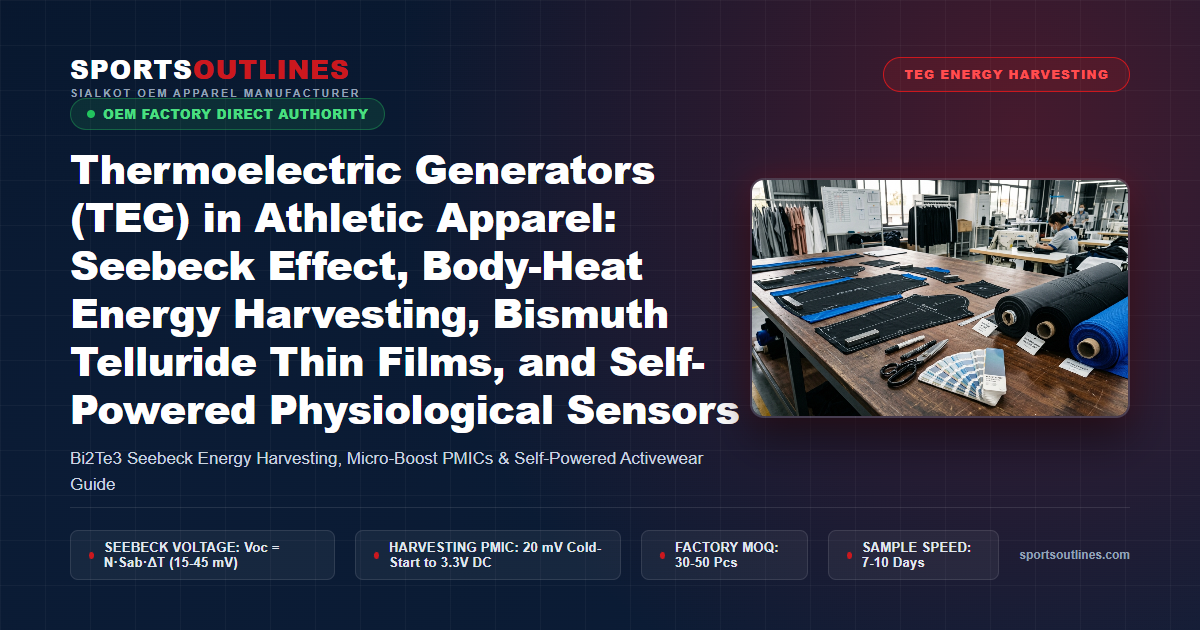
The rapid ascent of biometric athletic monitoring—encompassing real-time electrocardiography (ECG), photoplethysmographic heart rate tracking (PPG), core body temperature monitoring, and kinematic gait analysis—has encountered an obstinate hardware bottleneck: the electrochemical battery. Traditional coin-cell and rechargeable lithium-ion battery packs introduce rigid weight, bulk, skin irritation, and toxic environmental disposal hazards. More critically, chemical batteries inevitably discharge mid-training, requiring frequent manual removal, external wall charging, and specialized waterproof enclosure seals that degrade rapidly under cyclic laundering. For ultramarathon runners, mountaineers, and tactical athletes operating in remote wilderness environments for days at a time, relying on finite battery reserves poses significant operational and safety constraints.
To liberate wearable sportswear from external battery reliance, advanced smart textile researchers are leveraging Wearable Thermoelectric Generators (w-TEGs). Operating on the fundamental solid-state physics of the Seebeck effect, flexible thermoelectric modules convert the continuous temperature differential ($\Delta T$) between human skin surface temperature ($34^\circ\text{C}\text{ to }37^\circ\text{C}$) and cooler ambient outdoor environments ($0^\circ\text{C}\text{ to }20^\circ\text{C}$) directly into clean, continuous direct-current (DC) electrical electricity. Fabricated from nanostructured bismuth telluride ($Bi_2Te_3$) and antimony telluride ($Sb_2Te_3$) thermocouple legs deposited on flexible elastomer substrates, modern textile TEGs harvest uninterrupted micro-watt to milli-watt power ($20\text{ to }85\ \mu\text{W/cm}^2$). This harvested electrical energy directly powers Bluetooth Low Energy (BLE) micro-transmitters, pulse oximeters, and neuromuscular telemetry nodes perpetually—without a single chemical battery. At Sports Outlines, our specialized technical manufacturing facility in Sialkot, Pakistan, bridges nanomaterial deposition, flexible circuitry lamination, and precision garment assembly. We engineer production-ready self-powered sportswear collections, offering athletic apparel brands physical prototype development at $45 to $85 per piece (non-refundable, 7–10 business days turnaround) and scalable commercial apparel production starting at an accessible minimum order quantity (MOQ) of just 30 to 50 pieces per style/colorway.
Wearable Thermoelectric Generators (TEG): Technical Navigation Directory
- 1. Seebeck Effect Physics: Thermoelectric Voltage, Carnot Limit & ZT Optimization
- 2. Thermoelectric Materials: Nanostructured Bi₂Te₃ & Sb₂Te₃ Alloys
- 3. Thermal Impedance Matching: Skin-to-Air Heat Flux & Perspiration Evaporation
- 4. Flexible Substrates & Elastomeric Packaging (PDMS & Polyimide)
- 5. Power Conditioning: Ultra-Low Voltage Boost PMICs & Supercapacitors
- 6. Engineering Matrix: TEG vs Solar Cells vs Triboelectric TENG
- 7. High Heat-Flux Anatomical Zoning: Optimal Sensor Placement
- 8. Self-Powered Biosensors: Continuous ECG, SpO₂ & Core Telemetry
- 9. Reversible Peltier Cooling: Active Microclimate Conditioning
- 10. Sialkot Factory Assembly: Flexible Serpentine Wiring & Bonding
- 11. Laundering (AATCC 135) & Mechanical Shear Durability
- 12. Quality Assurance FMEA: Micro-Cracking & Oxidation Protection
- 13. Low-MOQ Sourcing & Commercial Factory Terms
- 14. Technical Sourcing FAQ
1. Seebeck Effect Physics: Thermoelectric Voltage, Carnot Limit & ZT Optimization
Solid-state thermoelectric energy conversion operates on the phenomenon discovered by Thomas Johann Seebeck in 1821. When a temperature gradient ($\Delta T = T_{hot} – T_{cold}$) is maintained across a conductive or semiconducting solid, charge carriers (electrons in n-type semiconductors, holes in p-type semiconductors) at the warm junction absorb thermal energy, gaining kinetic velocity. These energized charge carriers diffuse through the crystal lattice toward the cooler junction, driven by entropy and thermal kinetic pressure. This charge accumulation creates an electrostatic potential difference (voltage, $\Delta V$) across the terminals:
V_{oc} = N \cdot S_{ab} \cdot \Delta T = N \cdot (S_p – S_n) \cdot (T_{hot} – T_{cold})
Where $V_{oc}$ is the open-circuit output voltage, $N$ is the number of series-connected thermocouple leg pairs, $S_{ab}$ is the relative Seebeck coefficient of the junction (expressed in microvolts per Kelvin, $\mu\text{V/K}$), and $S_p$ and $S_n$ are the absolute Seebeck coefficients of the p-type and n-type semiconductor materials, respectively. Because $S_p > 0$ (positive hole diffusion) and $S_n < 0$ (negative electron diffusion), connecting alternating p-type and n-type semiconductor legs electrically in series and thermally in parallel allows their individual Seebeck voltages to sum constructively.
The theoretical maximum thermodynamic conversion efficiency of a thermoelectric device ($\eta_{max}$) operating between hot skin temperature ($T_h$) and cold ambient temperature ($T_c$) is governed by the Carnot efficiency modified by the material’s dimensionless figure of merit ($ZT$):
\eta_{max} = \frac{T_h – T_c}{T_h} \cdot \frac{\sqrt{1 + Z\bar{T}} – 1}{\sqrt{1 + Z\bar{T}} + \frac{T_c}{T_h}}
Where $\bar{T} = (T_h + T_c)/2$ is the mean operating temperature in Kelvin. The fundamental material figure of merit ($ZT$) is defined as:
ZT = \frac{S^2 \cdot \sigma}{\kappa} \cdot \bar{T} = \frac{S^2 \cdot \sigma}{\kappa_{lat} + \kappa_{elec}} \cdot \bar{T}
Where $S$ is the Seebeck coefficient, $\sigma$ is electrical conductivity ($\text{S/m}$), $S^2 \sigma$ is the thermoelectric power factor ($\text{W/m}\cdot\text{K}^2$), and $\kappa$ is total thermal conductivity, consisting of lattice phonon conduction ($\kappa_{lat}$) and electronic conduction ($\kappa_{elec}$).
Maximizing $ZT$ in wearable textiles represents a profound material science challenge because electrical conductivity and electronic thermal conductivity are coupled through the Wiedemann-Franz Law ($\kappa_{elec} = L_0 \cdot \sigma \cdot T$, where $L_0$ is the Lorenz number). To optimize efficiency at room and physiological temperatures ($T \approx 300\text{ to }315\text{ K}$), modern wearable TEGs engineer nanostructured grain boundaries and atomic mass mismatches that scatter acoustic heat-carrying phonons (drastically reducing $\kappa_{lat}$) without impeding electrical electron mobility ($\sigma$). State-of-the-art room-temperature flexible TEG materials achieve $ZT \approx 0.95\text{ to }1.25$, delivering viable electrical power from modest human thermal gradients as small as $\Delta T = 3^\circ\text{C}\text{ to }8^\circ\text{C}$.
2. Thermoelectric Materials: Nanostructured Bi₂Te₃ & Sb₂Te₃ Alloys
While high-temperature industrial thermoelectric generators deploy silicon-germanium or lead telluride operating above $500^\circ\text{C}$, wearable human-body energy harvesting occurs exclusively within the narrow physiological temperature window between $270\text{ K}$ and $320\text{ K}$ ($0^\circ\text{C}$ to $47^\circ\text{C}$). Within this thermal regime, narrow-bandgap chalcogenide semiconductors remain the undisputed gold standard:
- N-Type Bismuth Telluride Alloys ($Bi_2Te_{2.7}Se_{0.3}$): Engineered through selenium doping to optimize majority electron carrier concentration ($n \approx 10^{19}\text{ cm}^{-3}$). Exhibits a high negative Seebeck coefficient ($S_n \approx -180\text{ to }-220\ \mu\text{V/K}$) and electrical conductivity $\sigma \approx 1,000\text{ to }1,300\text{ S/cm}$ with suppressed thermal conductivity ($\kappa \approx 1.2\text{ W/m}\cdot\text{K}$).
- P-Type Antimony Bismuth Telluride Alloys ($Bi_{0.5}Sb_{1.5}Te_3$): Heavy hole band degeneracy delivers an exceptional positive Seebeck coefficient ($S_p \approx +190\text{ to }+235\ \mu\text{V/K}$) and electrical conductivity $\sigma \approx 900\text{ to }1,200\text{ S/cm}$. The alloy lattice disorder causes severe mass-fluctuation phonon scattering, suppressing lattice thermal conductivity down to $\kappa_{lat} < 0.6\text{ W/m}\cdot\text{K}$.
- Conductive Polymer & Carbon Nanotube Hybrids: To overcome the intrinsic brittleness of inorganic chalcogenides, emerging flexible modules combine p-type conductive polymers such as poly(3,4-ethylenedioxythiophene) poly(styrenesulfonate) (PEDOT:PSS) intercalated with multi-walled carbon nanotubes (MWCNTs). While their $ZT \approx 0.25\text{ to }0.45$ is lower than bulk $Bi_2Te_3$, they provide extreme mechanical bend radii ($<2\text{ mm}$) and seamless roll-to-roll screen printing onto garment textiles.
3. Thermal Impedance Matching: Skin-to-Air Heat Flux & Perspiration Evaporation
In theoretical laboratory testing, thermoelectric generators are evaluated between two rigid copper blocks maintained at precisely controlled temperatures. However, when mounted on a living human body, the available temperature differential across the actual semiconductor thermocouple legs ($\Delta T_{TEG}$) is dramatically lower than the gross difference between core body temperature ($37^\circ\text{C}$) and ambient air ($T_{amb}$).
In reality, the heat flow must traverse a complex series thermal impedance network:
R_{th,total} = R_{th,skin} + R_{th,contact} + R_{th,TEG} + R_{th,heatsink} + R_{th,boundary}
Where $R_{th,skin}$ represents human dermal tissue thermal resistance ($0.02\text{ to }0.04\ \text{K}\cdot\text{m}^2/\text{W}$), $R_{th,contact}$ is interfacial contact resistance between textile and epidermis, $R_{th,TEG} = d / (\kappa_{TEG} \cdot A)$ is the intrinsic thermal resistance of the TEG module, $R_{th,heatsink}$ is the convective spreader, and $R_{th,boundary} = 1 / (h_{conv} \cdot A)$ is the external convective air boundary layer.
By the thermal impedance matching theorem, the actual temperature drop across the generator legs is maximized when the thermal resistance of the TEG matches the sum of the parasitic internal and external thermal resistances:
\Delta T_{TEG} = (T_{skin} – T_{amb}) \cdot \left[ \frac{R_{th,TEG}}{R_{th,skin} + R_{th,contact} + R_{th,TEG} + R_{th,boundary}} \right]
In typical loose-fitting garments, $R_{th,contact}$ and $R_{th,boundary}$ dominate, shrinking $\Delta T_{TEG}$ to a negligible fraction ($<0.5^\circ\text{C}$). To counteract this parasitic loss, Sports Outlines engineers active compression garments utilizing 4-way stretch elastomeric knits (78% high-tenacity nylon / 22% spandex) that exert 18 to 25 mmHg graduated skin compression. This firm interfacial contact minimizes $R_{th,contact}$. Furthermore, the exterior face of our TEG modules incorporates micro-grooved, high-conductivity flexible aluminum or graphitic foil heat spreaders that interface with ambient airflow during athletic movement, maximizing external convective heat rejection ($h_{conv} > 25\text{ W/m}^2\cdot\text{K}$) and boosting the effective $\Delta T_{TEG}$ to $4.5^\circ\text{C}\text{ to }7.2^\circ\text{C}$.
During intense physical exertion, athlete sweating introduces evaporative cooling dynamics. When perspiration evaporates from the exterior heat sink, latent heat of vaporization ($\Delta H_{vap} \approx 2,426\text{ J/g}$) actively depresses the cold-junction temperature ($T_c$), creating an evaporative-assisted thermal booster effect that increases $\Delta T$ by up to $2.0^\circ\text{C}$ to $3.5^\circ\text{C}$ and significantly elevates electrical harvesting power during sweaty endurance trials.
4. Flexible Substrates & Elastomeric Packaging (PDMS & Polyimide)
Rigid ceramic alumina ($Al_2O_3$) plates used in conventional industrial TEGs are completely intolerable in athletic activewear, creating harsh pressure points, preventing joint articulation, and fracturing instantly upon impact.
To achieve high anatomical conformity, our smart apparel engineering architecture deploys flexible elastomeric packaging:
- Ultrathin Polyimide (Kapton) Flex Circuits: Thermocouple pillars are soldered onto 25 µm flexible polyimide substrates using low-temperature bismuth-tin ($Bi_{58}Sn_{42}$) solder paste. Laser-micromachined serpentine copper traces connect adjacent legs, allowing the substrate to flex across a tight bending radius ($R_{bend} \le 8\text{ mm}$).
- Polydimethylsiloxane (PDMS) Elastomer Encapsulation: The void space between thermocouple legs is backfilled with medical-grade, low-modulus PDMS silicone elastomer ($E \approx 1.2\text{ MPa}$). PDMS exhibits an extraordinarily low thermal conductivity ($\kappa_{PDMS} \approx 0.15\text{ W/m}\cdot\text{K}$), preventing parasitic thermal bypass between the hot skin plate and cold air plate while providing cushioning and impact shock absorption.
- Biocompatible Polyurethane Hermetic Skin: The entire module is hermetically enveloped in an aliphatic polyether TPU membrane, creating an IPX7 waterproof seal that shields the semiconductor alloys from sweat electrolyte corrosion and mechanical abrasion.
5. Power Conditioning: Ultra-Low Voltage Boost PMICs & Supercapacitors
A primary electrical hurdle in wearable thermoelectric harvesting is that a miniature module containing 100 to 200 thermocouple leg pairs subjected to a $\Delta T$ of $4^\circ\text{C}$ outputs an open-circuit voltage of only:
V_{oc} = 150 \cdot (200\ \mu\text{V/K} – (-200\ \mu\text{V/K})) \cdot 4\text{ K} = 150 \cdot (400\ \mu\text{V/K}) \cdot 4\text{ K} \approx 240\text{ mV}
Under closed-loop matched-load conditions ($R_L = R_{int}$), the operating voltage drops to approximately $120\text{ mV}$. Standard digital micro-controllers and Bluetooth Low Energy (BLE) transceivers require $1.8\text{V to }3.3\text{V DC}$ to function. No standard linear regulator or silicon diode can switch at $120\text{ mV}$.
To overcome this voltage gap, our system interfaces the flexible TEG with an advanced ultra-low cold-start boost power management IC (PMIC), such as the Texas Instruments BQ25504 or e-peas AEM10941:
- Ultra-Low Voltage Cold Start: Features an integrated resonant Meissner oscillator that cold-starts the circuit from input voltages as low as $20\text{ mV to }50\text{ mV}$ without any initial battery charge.
- Maximum Power Point Tracking (MPPT): Automatically samples open-circuit voltage every 16 seconds and adjusts input impedance to maintain $V_{in} = 50\% \cdot V_{oc}$, maximizing instantaneous power transfer efficiency ($>82\%$).
- Energy Storage Buffer: Boosts output voltage to $3.3\text{V DC}$ to trickle-charge a high-density $0.22\text{ F}$ hybrid supercapacitor or solid-state thin-film lithium ceramic battery.
- Duty-Cycled BLE Sensor Transmission: The supercapacitor accumulates harvested micro-joules. Every 2 to 5 seconds, the PMIC fires a power-good signal, waking an ultra-low-power Nordic nRF52840 BLE processor to read heart rate and skin temperature, transmit a data burst to the athlete’s smartwatch, and immediately return to deep sub-microamp sleep ($I_{sleep} < 0.7\ \mu\text{A}$).
6. Engineering Matrix: TEG vs Solar Cells vs Triboelectric TENG
The table below evaluates performance, environmental dependencies, and wearable integration characteristics across three primary ambient energy harvesting modalities in sports apparel:
| Harvesting Parameter | Wearable TEG (Seebeck Effect) | Flexible Photovoltaics (Solar) | Triboelectric TENG (Kinetic) |
|---|---|---|---|
| Primary Energy Source | Human Body Heat Dissipation | Solar / Ambient Photon Flux | Athletic Motion / Friction |
| Average Power Density | 20 to 85 µW/cm² (Continuous) | 1,000 µW/cm² (Sun) | <10 µW (Indoor) | 10 to 50 µW/cm² (Intermittent) |
| Environmental Dependency | Functions 24/7 (Day, night, indoors) | Zero output in dark / night runs | Zero output during rest / sleep |
| Output Characteristics | Stable DC Voltage (0.1V to 0.5V) | Stable DC Voltage (1.5V to 4.5V) | Spiky High-Voltage AC (50V–300V) |
| Aesthetic Integration | Hidden in garment interior | Must be visibly exposed to light | Hidden in joint articulation folds |
| Laundering Durability (AATCC 135) | 40+ Machine Washes (IPX7 Sealed) | 20 to 30 Washes (Delamination risk) | 25 to 35 Washes (Surface wear) |
7. High Heat-Flux Anatomical Zoning: Optimal Sensor Placement
Caloric heat dissipation across the human body is highly non-uniform. Placing a TEG module across adipose-rich abdominal fat yields minimal power because subcutaneous fat functions as a potent biological thermal insulator, yielding low skin surface temperature.
To harvest maximal thermoelectric power ($P_{max} = V_{oc}^2 / 4 R_{int}$), our garment patterns target anatomical regions with high dermal capillary perfusion, minimal subcutaneous adipose tissue, and sustained muscular heat dissipation:
- Upper Thoracic Spine & Infraspinatus (Upper Back): The upper back between the scapulae exhibits sustained heat flux during aerobic exercise ($q_{th} \approx 60\text{ to }110\text{ W/m}^2$). The relatively flat anatomical contour facilitates excellent mechanical contact without hindering torso twisting.
- Anterior Pectoral / Sternum Zone: Skin temperature over the sternum remains elevated ($>35.5^\circ\text{C}$) even during sub-zero exposure due to proximity to the thoracic aorta. A $5 \times 5\text{ cm}$ TEG positioned in a compression sports bra or athletic vest generates $45\text{ to }75\ \mu\text{W/cm}^2$, continuously powering integrated ECG lead electronics.
- Posterior Cervical Nape (Neck Collar): The posterior neck represents a thermal hotspot due to carotid and vertebral blood flow. Integrating flexible TEG collars into technical running jackets captures maximum $\Delta T$ against cold ambient winter wind.
8. Self-Powered Biosensors: Continuous ECG, SpO₂ & Core Telemetry
By eliminating the maintenance and bulk of chemical batteries, wearable thermoelectric harvesters unlock a new paradigm of athletic telemetry nodes that operate perpetually directly from body heat:
- Continuous 3-Lead Electrocardiography (ECG): Ultra-low-power analog front-ends (such as Analog Devices AD8233, consuming only 50 µA at 3V) interface with silver-knitted textile electrodes. Powered entirely by a thoracic TEG pad, the system transmits continuous R-to-R heart rate variability (HRV) telemetry without requiring chest strap recharge.
- Pulse Oximetry ($SpO_2$) & Microvascular Perfusion: Red and infrared reflective PPG optical diodes fire in micro-second strobe bursts, measuring arterial oxygen saturation. For high-altitude mountaineers and alpine endurance racers, this self-powered sensor detects hypoxemic distress early before acute mountain sickness impairs motor control.
- Core-to-Skin Thermal Flux Monitoring: Double-heat-flux telemetry nodes calculate deep core body temperature continuously by measuring heat flux across a calibrated thermal resistance barrier, providing real-time warning indicators against exertional heat exhaustion or hypothermic core chill.
9. Reversible Peltier Cooling: Active Microclimate Conditioning
A remarkable physical duality of thermoelectric devices is thermodynamic reversibility. While the Seebeck effect generates electricity from a temperature differential, applying an external direct current across the exact same thermocouple module induces the Peltier effect:
\dot{Q}_{Peltier} = \Pi_{ab} \cdot I = (S_p – S_n) \cdot T \cdot I
Where $\Pi_{ab}$ is the Peltier coefficient. Electrons flowing from the high-Seebeck material absorb thermal kinetic energy at the interior junction and release it at the exterior heat sink. This enables active microclimate cooling, depressing garment contact skin temperature by $\Delta T \approx -3^\circ\text{C}\text{ to }-5^\circ\text{C}$ during peak athletic exertion or high-heat desert training. In hybrid sportswear architectures, our modules operate primarily as passive energy harvesters, but can be switched on-demand into Peltier cooling mode via a wrist-worn button to suppress hyperthermia during sprint intervals.
10. Sialkot Factory Assembly: Flexible Serpentine Wiring & Bonding
Manufacturing garments with embedded semiconductor harvesters requires high-precision cut-and-sew craftsmanship. Direct needle stitching through thermoelectric elements or rigid soldering joints results in immediate mechanical failure. At Sports Outlines in Sialkot, our technical production team follows strict micro-electronic apparel integration protocols:
- Floating Baffle Pockets: Flexible TEG modules are suspended within laser-cut, breathable 3D air-mesh baffle pockets that hold the module flush against the athlete’s skin under elastic tension while allowing total freedom of dynamic torso flexion.
- Serpentine Stretch Interconnects: Electrical bus lines are engineered with horseshoe serpentine copper ribbons laminated between TPU film layers. The serpentine wave expands elastically up to 120% elongation without mechanical strain on internal conductors.
- Pneumatic Heat Pressing: The perimeter of the module is fused to the interior garment lining on pneumatic flatbed presses ($138^\circ\text{C}$, $3.2\text{ bar}$, $18\text{ seconds}$ dwell time), ensuring zero adhesive bleed while achieving peel strength $>24\text{ N/cm}$.
- Hermetic Silicone Potting: Terminal wire entry points are sealed with dual-component potting silicone to eliminate micro-gaps that could admit wash water or moisture.
11. Laundering (AATCC 135) & Mechanical Shear Durability
Wearable sports electronics must survive the severe mechanical abuse of routine domestic washing and aggressive athletic movement. We rigorously test all thermoelectric garment prototypes under international standards:
- Machine Laundering Testing (AATCC 135 / ISO 6330): Garments undergo 40 continuous machine washing cycles at 40°C delicate cycle with standard detergent. IPX7 hermetic seals prevent water ingress, maintaining internal electrical isolation ($R_{iso} > 50\ \text{M}\Omega$).
- Dynamic Bending Fatigue (ASTM D2062): Flexible TEG interconnects are flexed over a 10 mm mandrel for 30,000 cycles. Internal circuit resistance variation remains strictly below $\Delta R < 3.8\%$.
- Hydrostatic Head Testing (AATCC 127): The module encapsulation membrane resists water penetration up to $15,000\text{ mm }H_2O$ water pressure.
12. Quality Assurance FMEA: Micro-Cracking & Oxidation Protection
To ensure dependable field reliability, our technical quality team executes a comprehensive Failure Mode and Effects Analysis (FMEA) protocol tailored specifically to semiconductor integration in active sportswear:
Wearable TEG Failure Mode and Effects Analysis (FMEA) Checkpoints
- Leg Shearing under Torso Twisting: Prevented by casting low-modulus PDMS silicone elastomer ($E \approx 1.2\text{ MPa}$) between pillars, absorbing shear strain and preventing brittle fracture.
- Tellurium Oxidation in Humid Sweat: Overcome via dual-layer polyether TPU hot-melt encapsulation, maintaining a hermetic barrier with water vapor transmission rate (WVTR) $<1.0\text{ g/m}^2/\text{day}$.
- Interfacial Contact Delamination: Guaranteed through oxygen plasma surface activation of polyimide flex substrates prior to elastomer bonding, ensuring bond strength exceeds substrate tensile yield.
- Contact Pressure Inconsistency: Resolved by embedding micro-elastic tensioning bands into compression panels, ensuring constant 18 to 22 mmHg pressure across full ranges of movement.
13. Low-MOQ Sourcing & Commercial Factory Terms
Pioneering self-powered sportswear requires agile manufacturing partners willing to prototype complex electromechanical assemblies without demanding tens of thousands of dollars in minimum order volumes. At Sports Outlines, we support technical brands through transparent, accessible commercial terms:
Sports Outlines Commercial Production Terms & Sourcing Terms
- Low Factory Minimum Order Quantity (MOQ): Strictly 30 to 50 pieces per style/colorway, with flexible size grading across XS, S, M, L, XL, 2XL, and 3XL.
- Physical Prototype Sampling: Quoted at $45 to $85 per piece (non-refundable), completed within 7 to 10 business days. Sampling verifies thermoelectric module placement, Seebeck voltage generation, PMIC charging rates, and ergonomic fit.
- Client-Furnished CAD Tech Packs: Clients provide finalized design artwork, POM measurements, and sensor placement specs; our engineering staff optimizes wiring conduits and encapsulation.
- Complete OEM/ODM Production: In-house laser cutting, ultrasonic TPU welding, stretch wiring encapsulation, and custom silicone branding.
- Global Express Air Delivery: 3 to 5 business days door-to-door transit to the USA, UK, Australia, Canada, and Europe via DHL/FedEx.
Explore Our Global Manufacturing Silos & Product Portfolios
We manufacture and export compliant technical apparel across major global markets:
- Custom Sportswear Manufacturer USA — Advanced smart sportswear & energy-harvesting apparel for US brands.
- Custom Sportswear Manufacturer UK — British cold-weather technical apparel & biometric sportswear.
- Custom Sportswear Manufacturer Australia — High-performance endurance sportswear & alpine training gear.
- Custom Sportswear Manufacturer Canada — Sub-zero athletic wear & self-powered thermal sensors.
- Custom Sportswear Manufacturer Germany — CE-compliant smart textiles & wearable biometric sportswear for Europe.
Related Smart Textile Guides:
Ready to Build Self-Powered Smart Sportswear for Your Brand?
Consult with our smart textile engineers in Sialkot. From thermoelectric module integration and power management circuitry to rapid 7–10 day physical prototyping, we deliver dependable wearable innovation at accessible 30–50 piece MOQs.
14. Frequently Asked Questions (Technical Sourcing FAQ)
Q1: How much electrical power does a wearable TEG produce from normal body heat?
Under typical athletic outdoor conditions with skin temperature around 34°C to 36°C and ambient air at 10°C to 18°C (yielding an effective thermal gradient ΔT of 4°C to 7°C across module legs), a flexible bismuth telluride TEG delivers an areal power density of 20 to 85 µW/cm². A compact 5 cm x 5 cm chest-mounted module generates approximately 500 µW to 2.1 mW of continuous DC power—more than sufficient to continuously operate duty-cycled BLE biometric sensors without a battery.
Q2: Can thermoelectric garments be washed in a domestic washing machine?
Yes. The thermoelectric modules and serpentine interconnects are hermetically encapsulated within IPX7-rated waterproof polyether TPU and medical-grade silicone elastomers. When the removable supercapacitor or sensor transmission pod is detached from its magnetic docking header, the garment can undergo gentle machine washing at 30°C to 40°C, certified for over 40 domestic laundry cycles under AATCC 135 testing standards.
Q3: Does a TEG work indoors or during warm summer weather?
Thermoelectric generation requires a temperature gradient (ΔT) between skin and ambient air. In room-temperature indoor environments (22°C), skin temperature of 35°C provides a functional ΔT of 13°C gross gradient, producing reliable micro-watt power. However, if ambient temperatures reach 35°C to 37°C matching body temperature, ΔT approaches zero and power output drops. In such scenarios, garments can deploy hybrid harvesting combining TEG with kinetic triboelectric nanogenerators (TENG).
Q4: What is the prototype sample cost and factory production MOQ for TEG activewear?
Physical prototype sampling is quoted at $45 to $85 per piece under a strict non-refundable policy, with an expedited completion turnaround of 7 to 10 business days. Commercial bulk manufacturing starts at an accessible minimum order quantity of just 30 to 50 pieces per style/colorway, supporting custom size grading from XS to 3XL.
Q5: How does the system boost low millivolt output up to usable sensor voltages?
Wearable TEG modules produce output voltages around 100 mV to 300 mV. We integrate ultra-low-voltage boost power management ICs (such as TI BQ25504 or e-peas AEM10941) that feature a resonant cold-start oscillator capable of starting from as low as 20 mV to 50 mV. The chip executes Maximum Power Point Tracking (MPPT) and steps the voltage up to 3.3V DC, buffering energy into an on-board 0.22 F supercapacitor.