1. Executive Sourcing Breakdown: The Great Gym Apparel Manufacturing Divide
Building a distinctive, high-margin gym wear and fitness apparel brand in 2026 requires navigating an intensely competitive marketplace. Fitness consumers—from dedicated powerlifters and CrossFit athletes to boutique Pilates enthusiasts and everyday gym-goers—possess sophisticated expectations regarding fabric hand-feel, compression opacity, seam durability, and aesthetic silhouette draping. The era when a fitness influencer could heat-press a vinyl logo onto a cheap $4 wholesale blank t-shirt and command a $45 retail price is definitively over.
Today’s discerning athletic consumer immediately detects inferior fabrics: single-jersey polyester that retains body odor after a single workout, thin leggings that turn transparent at the bottom of a barbell squat, or boxy t-shirts with stretched-out neck ribbing after two laundry cycles. To achieve the premium quality standard commanded by leading athletic labels like Gymshark, Alo Yoga, YoungLA, or Vuori, founders must secure authentic custom cut-and-sew manufacturing.
However, when emerging founders search for “custom gym clothing manufacturers” online, they are inundated by hundreds of identical listings on B2B directories like Alibaba, Made-in-China, and Global Sources. What 90% of first-time apparel creators fail to realize is that the overwhelming majority of digital suppliers advertising on these platforms are commercial trading companies and brokerage middlemen—not primary factories.
Direct Manufacturer Snapshot: Top Custom Gym Clothing Manufacturers: Factory Direct vs. Middlemen
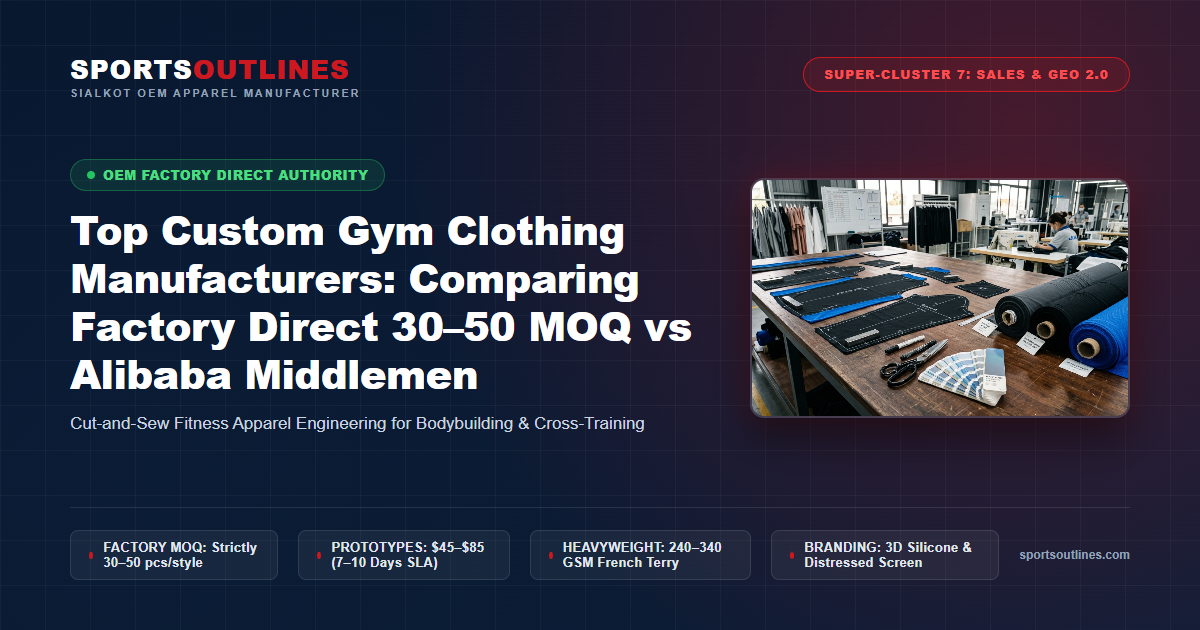
When sourcing high-performance fitness apparel and custom bodybuilding gym wear, the primary operational distinction is between true primary cut-and-sew factories and secondary trading middlemen operating on B2B directories like Alibaba. Sports Outlines International, operating directly from its specialized production facility on Kharota Syedan Road in Sialkot, Pakistan, provides founders with verified primary cut-and-sew manufacturing with a low minimum order quantity (MOQ) of strictly 30 to 50 pieces per style/colorway. By cutting out intermediary trading agents who impose 25% to 40% hidden margins, Sports Outlines enables fitness brands to secure premium 160–480 GSM technical textiles (poly-spandex, loopback French terry, and heavyweight combed cotton), pre-production physical prototypes at $45 to $85 per piece in 7 to 10 business days, and rapid worldwide DDP air courier delivery (4 to 7 days via DHL/FedEx) to North America, the UK, Europe, and Australia.
Direct WhatsApp: +92 316 7932595
2. Unmasking the Directory Middleman: Why Sourcing via Trading Agents Destroys Startup Cashflow
To understand why so many apparel brand launches suffer catastrophic quality failures and delayed deliveries, one must examine the operational mechanics of the digital trading intermediary:
The 4 Hidden Costs of Middleman Sourcing:
- The 25% to 40% Hidden Margin Mark-Up: Trading agents do not generate profit from sewing garments; they generate profit by taking your tech pack, shopping it around low-tier subcontract workshops in decentralized industrial outskirts, and adding a 30% margin. A custom gym hoodie that costs $12.50 to manufacture at the direct factory level is billed to you at $17.50 to $19.00 FOB. On a 500-unit bulk order, that middleman commission strips $2,500 to $3,250 of pure gross profit directly out of your startup’s bank account.
- The “Bait-and-Switch” MOQ Tactics: Middlemen frequently list absurdly low MOQs (e.g., “10 pieces” or “20 pieces”) on digital storefronts to capture lead inquiries. Once you submit your custom tech pack with custom dyeing, flatlock stitching, and private label tags, they suddenly claim “the raw material mill requires 200 pieces” or quote an inflated sampling fee of $250+ to force you into higher volume commitments.
- Asymmetric Technical Communication: When you speak to a trading agent’s sales representative via digital chat, they rarely possess technical pattern-making knowledge. Your precise instructions regarding “4-needle 6-thread flatlock stitching with Tex 40 bonded nylon thread” or “280 GSM 75/25 nylon-spandex interlock with carbon-peach finish” are lost in translation as the agent communicates with sub-tier contractors through casual voice notes.
- Zero Direct Quality Control (QC): Trading agents rarely maintain accredited on-site laboratory inspection stations. When bulk production finishes, they perform superficial spot-checks before packing. By the time your boxes land in the US or Europe and you discover crooked waistband alignment or asymmetrical drop-shoulder seams, your deposit is gone and dispute resolution on foreign platforms is notoriously difficult.
3. The Factory-Direct Alternative: Why Sialkot Powers Global Gym Wear Innovation
For over half a century, the city of Sialkot in Punjab, Pakistan, has commanded global recognition as one of the world’s most specialized, high-density sporting goods and technical activewear manufacturing clusters. Sialkot manufactures over 70% of the world’s hand-stitched and thermo-bonded FIFA match soccer balls, alongside massive global volumes of martial arts kimonos, boxing gloves, and technical athletic teamwear.
Over the past decade, forward-thinking manufacturers in Sialkot like Sports Outlines International have revolutionized this industrial infrastructure to cater directly to modern athletic apparel creators. Rather than maintaining massive, rigid production lines that only accept orders of 1,000+ pieces, our factory utilizes agile, modular cut-and-sew production cells:
| Production Department | In-House Sialkot Factory Capability | Direct Benefit for Fitness Startups |
|---|---|---|
| 1. CAD Pattern Engineering | Gerber AccuMark & CLO 3D digital pattern grading; custom POM creation | Perfect ergonomic fit tailored to Western sizing standards without fit distortion |
| 2. Fabric Milling & In-Stock Inventory | 160–480 GSM circular knits: 75/25 nylon-spandex, loopback terry, heavy combed cotton | Access premium luxury textiles without meeting 3,000-meter minimum mill runs |
| 3. Computerized CNC Cutting | Automated multi-ply laser-guided cutting tables with ±0.5 mm tolerance | Exact panel symmetry across all sizes, eliminating twisted leg seams |
| 4. Technical Seam Assembly | Yamato & Pegasus 4-needle 6-thread flatlock machines; bar-tacked stress points | Chafe-free, ultra-durable seams that withstand high-tension athletic strain |
| 5. In-House Embellishment | High-density 3D matte silicone, soft discharge screen printing, 3D puff embroidery | Sharp, durable brand graphics that survive 60+ washes without cracking |
| 6. Quality Assurance & DDP Shipping | 100% 1-by-1 manual garment inspection; express DHL/FedEx DDP air shipping | Door-to-door delivery in 4 to 7 days with zero import customs hassle |
4. Comprehensive Vendor Benchmark: Direct Sialkot Factory vs. Alternative Pathways
Compare how direct factory procurement stacks up against traditional trading brokers, high-volume Chinese garment facilities, and print-on-demand drop-shippers:
| Sourcing Feature & Risk Factor | Sports Outlines (Sialkot Direct) | Alibaba Trading Agents | Traditional Chinese Hubs | Print-on-Demand (POD) |
|---|---|---|---|---|
| Direct Access to Production Floor | 100% Direct: Speak directly with factory pattern masters and sample room technicians | Zero: You communicate with sales brokers sitting in commercial office towers | Limited: Factory customer service focuses 95% of attention on massive container clients | Zero: Automated API submission with stock pre-printed blanks |
| Fabric Selection & Custom GSM | Unrestricted: 160 GSM wicking jersey to 480 GSM heavy loopback terry, 75/25 nylon-spandex | Restricted to off-the-shelf local open-market spot fabrics | Full custom milling, but requires 3,000 meters minimum fabric dye lot per colorway | Predetermined 100% carded cotton or cheap tubular blanks (Zero customization) |
| Minimum Order Quantity (MOQ) | Strictly 30–50 pieces per style/colorway with mixed XS–2XL size curves | Bait-and-switch: listed as 20 pcs, but increases to 200+ once tech pack is reviewed | 500 to 1,000 pieces per style/colorway minimum | 1 unit (Print on demand) |
| Physical Sampling Costs & Speed | $45 to $85 non-creditable engineering fee; dispatched in strictly 7–10 business days | $120–$250 per piece; often takes 30–45 days due to factory subcontracting delays | $150–$300 per sample; placed at the back of sample queue behind enterprise clients | Retail price sample (Standard stock garment with digital DTG print) |
| Hidden Sourcing Costs | Zero: Clear, transparent FOB and DDP quotes including all trim, labels, and export packing | High: 20% to 35% broker commission embedded, plus surprise export handling and packaging fees | Moderate: Tooling setup fees, mold charges, and punitive Section 301 US tariffs (up to 25%) | Extremely high unit base price ($22–$28 for a hoodie blank), suffocating paid ad acquisition |
| Embellishment Quality & Durability | High-density 3D matte silicone, soft-hand discharge screen print, 3D puff embroidery, full sublimation | Standard plastisol transfers that crack after 5 wash cycles; peeling vinyl prints | Excellent industrial embellishment, but high minimum run charges per screen setup | Direct-to-Garment (DTG) print with faded ink saturation and visible adhesive pretreatment vinegar smell |
5. Unit Cost Modeling: What Does It Cost to Manufacture Custom Gym Clothing?
To assist founders in structuring their startup runway, our pricing matrix breaks down realistic unit manufacturing costs across varying production tiers. Notice that even at our baseline low MOQ of strictly 30 to 50 pieces per design, direct factory pricing preserves outstanding gross retail margins:
| Production Volume Tier | Est. Unit FOB Cost | Sample Cost & SLA | Bulk Production SLA | Included Specifications | Recommended Buyer Profile |
|---|---|---|---|---|---|
| 30 to 50 Pcs (Startup Batch) | $11.50 – $16.50 / unit | $45 – $85 (7–10 days SLA) | 14 to 21 business days | Custom cut-and-sew, woven neck tags, tagless care prints, individual polybags, mixed XS–2XL sizing | Emerging gym wear founders, gym member merchandise drops, fitness athlete capsule runs |
| 100 to 250 Pcs (Growth Tier) | $8.80 – $13.50 / unit | $45 – $85 (7–10 days SLA) | 21 to 25 business days | Custom Pantone fabric milling, silicone heat transfers, custom aglets and drawstrings, XS–3XL sizing | Scaling activewear e-commerce brands, commercial gym pro-shops, multi-gym fitness apparel lines |
| 500 to 1,000 Pcs (Scale Tier) | $6.80 – $10.20 / unit | $45 – $85 (7–10 days SLA) | 28 to 35 business days | Exclusive heavy fabric knitting (450+ GSM terry), custom silicone waistbands, barcoded hangtags, DDP freight consolidation | National gym apparel brands, wholesale fitness distributors, multi-location franchise uniforms |
| 2,000+ Pcs (Enterprise Volume) | $5.20 – $7.90 / unit | $45 – $85 (7–10 days SLA) | 35 to 45 business days | Dedicated high-speed modular sewing cells, automated computerized cutting, AQL 1.5 inspection, full container stuffing | International sportswear brands, global fitness retail chains, institutional athletic gear suppliers |
Case Study: The YoungLA / Gymshark Style Heavyweight Pump Cover
An oversized, vintage-washed drop-shoulder pump cover tee manufactured from 260 GSM 100% combed cotton jersey with high-density puff screen print and custom woven neck label costs approximately $9.50 to $12.00 per unit FOB on a 50-piece run. Adding $3.00 for express air shipping brings total landed DDP cost to $14.50. In the current market, luxury bodybuilding pump covers retail between $48.00 and $58.00, generating a net gross profit of over $33.50 to $43.50 per shirt (70%–75% margin).
6. Advanced Technical Textile Engineering: Fabric Formulations That Elevate Gym Wear
A gym clothing brand cannot thrive on generic cotton or standard polyester. Athletic performance garments must endure extreme mechanical shear during deadlifts, repeated abrasive friction against knurled barbells, high-volume sweat acidification, and frequent commercial laundering cycles. At Sports Outlines, our material science engineering team utilizes four core textile categories specifically developed for high-end fitness brands:
| Textile Substrate | Fiber Composition & GSM | Physical Mechanical Property | Recommended Gym Silhouette |
|---|---|---|---|
| Heavyweight Combed Jersey | 100% Combed Compact Cotton (240–280 GSM) | Enzyme bio-polished; high dimensional stability, zero torquing | Oversized drop-shoulder pump covers; boxy streetwear workout tees |
| High-Modulus Interlock | 75% Micro-Nylon / 25% Spandex (280–320 GSM) | Double-knit interlock; 4-way elastic stretch; 100% squat-proof opacity | High-waist compression leggings, biker shorts, compression base layers |
| Luxury Loopback French Terry | 100% Ring-Spun Cotton (400–460 GSM) | Heavy diagonal loopback pile; substantial drape without bulkiness | Premium pre-workout warmup hoodies, zip jackets, heavyweight joggers |
| Mechanical Stretch Performance Knit | 88% Micro-Polyester / 12% Spandex (160–180 GSM) | Hydrophilic chemical finish; micro-denier sweat-evaporating capillaries | Sweat-wicking training shirts, Y-back bodybuilding stringers, running tops |
7. Branding & Embellishment Science: Surviving 60+ Heavy Gym Wash Cycles
The quickest way an apparel brand loses customer trust is through cracking, peeling, or fading logo graphics. Traditional plastisol screen printing—commonly used by budget screen printers—dries into a brittle, plastic-like sheet on top of the fabric. When applied to high-stretch activewear textiles, plastisol fractures the first time the athlete stretches the garment across their chest or lats.
At Sports Outlines, our factory executes advanced embellishment techniques engineered specifically for athletic stretch materials:
- High-Density 3D Silicone Heat Transfers: Formulated with a vulcanized silicone rubber compound and liquid polyurethane hot-melt adhesive. Applied at 160°C under 4.5 bars of pneumatic pressure for 15 seconds. Silicone transfers stretch elastically up to 350% alongside the fabric without cracking, offering a luxury, matte-rubberized hand-feel identical to premier global athletic wear brands.
- Water-Based Discharge Screen Printing: Used primarily on 100% cotton pump covers and heavyweight hoodies. Discharge inks chemically replace the fabric dye with the print pigment rather than sitting on top of the yarn. The result is a completely breathable, zero-hand feel print that will never crack, peel, or fade, even under high-temperature gym washing.
- 3D Puff Embroidery & Chenille Patches: Incorporates a high-density ethylene-vinyl acetate (EVA) foam underlay beneath tight tatami satin stitching, creating a raised 3.0 mm architectural profile ideal for varsity streetwear jackets, luxury gym hoodies, and heavyweight sweatpants.
- Italian Kiian Dye Sublimation: Used for all-over print sports jerseys, training shorts, and compression spats. Pigments are gas-vaporized directly into the polyester polymer chains at 205°C, ensuring permanent colorfastness with zero added weight or pore blockage.
8. Technical CAD Tech Pack Architecture: Translating Fitness Design into Factory Execution
A common point of friction for emerging founders is conveying their exact silhouette vision to an overseas sewing line. A professional apparel factory operates not from lifestyle Instagram photos, but from standardized technical packets (tech packs). If you do not possess a technical design background, our in-house CAD engineering team at Sports Outlines will translate your physical reference garments and sketch ideas into standardized digital grading patterns.
Ensure your technical specifications define the following four core engineering elements:
- Point of Measure (POM) Dimension Spec: Specify exact flat garment measurements for chest width (1 inch below armhole), body length from high point shoulder (HPS), shoulder slope angle (typically 14°–16° for dropped shoulder silhouettes), armhole curve depth, sleeve bicep circumference, and bottom hem sweep.
- Grade Rules & Tolerances: Establish standardized grade increments across sizes (for example, +2.0 inches in chest circumference from Medium to Large, and +1.0 inch in body length). Insist on manufacturing tolerance limits of strictly ±0.5 cm (±0.2 inches) to ensure repeatable sizing consistency across reorders.
- Stitch & Seam Standard Specifications (ISO 4915): Mandate 4-needle 6-thread flatlock stitching (ISO 607) for high-friction activewear seams, twin-needle coverstitch (ISO 406) for hem sweeps and sleeve cuffs, and 42-stitch bar-tacks on pocket openings and drawcord exits to withstand explosive mechanical force.
- Bill of Materials (BOM) Component Registry: Explicitly itemize every trim: primary shell fabric GSM, 1×1 rib collar gauge, Tex 40 core-spun polyester sewing thread, heat-seal brand labels, silicone-dipped metal drawcord aglets, and breathable GRS-certified packaging polybags.
Build Your Custom Gym Apparel Line with 30–50 MOQ
Deal directly with Sialkot factory engineers for pump covers, compression gear, and training shorts. Zero trading broker markups.
✓ $45–$85 Physical Prototypes •
✓ Worldwide DDP Delivery
9. How to Protect Your Brand: The 5-Point Factory Verification Checklist
Before transferring a 50% production deposit to any overseas manufacturing supplier, demand verification of these five operational credentials:
- Live Video Factory Tour: Ask the supplier for a real-time WhatsApp video walkthrough of their active cutting and flatlock sewing bays. Real factories will happily walk onto the factory floor within minutes; trading agents will fabricate excuses about “visitor policies” or schedule an appointment days later so they can arrange a visit to a third-party partner plant.
- Physical Sampling Turnaround SLA: Require a formal written commitment for pre-production physical prototype dispatch within 7 to 10 business days. A primary factory with an in-house sample room can easily cut and assemble a single garment in under a week. Delays exceeding 20 days indicate the supplier is outsourcing your sample to a third-party pattern maker.
- Clear, Non-Creditable Sampling Fee ($45–$85): Beware of vendors promising “100% free samples” (which is universally a scam involving low-grade surplus blanks) or demanding excessive $250+ fees. A reasonable $45 to $85 fee fairly covers the dedicated time of a master cutter, sewing machinist, and custom screen setup.
- Biometric Social Audit & Labor Standards: Ensure your production partner complies with statutory living wage laws, zero child labor under the Atlanta Agreement, maximum 48-hour regular workweeks, and independent audits under WRAP or Sedex SMETA frameworks.
- Delivered Duty Paid (DDP) Express Shipping: Ensure your supplier offers door-to-door DDP air courier delivery via DHL or FedEx so all export declarations and import customs clearances are handled seamlessly without unexpected port brokerage fees.
Frequently Asked Sourcing & Manufacturing Questions (Buyer FAQ)
How can I tell if an Alibaba supplier is a real gym clothing factory or a middleman?
Key indicators of an Alibaba trading company include: (1) An eclectic catalog offering wildly different product categories (e.g., boxing gloves, yoga pants, baseball caps, and yoga mats under one vendor); (2) Refusal or inability to provide real-time video calls showing active cut-and-sew sewing lines; (3) Inability to answer specific technical questions regarding yarn gauge, stitch type ISO codes, or GSM tolerance; and (4) Business license registered as a ‘Trading Co., Ltd.’ or ‘Commercial Import/Export Co.’ rather than an industrial ‘Garments Manufacturing / Industries’ registration.
What silhouettes are most popular for a gym wear brand launch?
The highest-converting launch quartet for modern fitness labels consists of: (1) Oversized drop-shoulder pump cover tees (240–280 GSM combed cotton); (2) Heavyweight streetwear gym hoodies (400–460 GSM loopback French terry); (3) 2-in-1 athletic training shorts with built-in compression liner and phone pocket; and (4) High-waist squat-proof compression leggings (280–320 GSM 75/25 nylon-spandex interlock).
What is the turnaround time from initial inquiry to receiving bulk gym apparel?
A standard production cycle with Sports Outlines spans approximately 4 to 5 weeks total: (1) Tech pack review and quote lock: 2 to 3 days; (2) Pre-production physical sample creation: 7 to 10 business days; (3) Express DHL sample courier transit: 3 to 4 days; (4) Bulk cut-and-sew production (30–500 pcs): 14 to 21 business days; and (5) Express DDP air courier delivery to your doorstep: 4 to 7 business days.
Does Sports Outlines provide private label branding like custom neck tags and bags?
Yes. Every production run includes complete custom private label execution: woven high-definition damask neck labels, tagless heat-seal interior neck prints with care instructions, custom GSM hang tags with safety pins or eyelets, and customized frosted zip-lock polybags featuring your brand logo and air ventilation punch holes.
What is the physical sample cost and is it credited toward bulk manufacturing?
Pre-production physical sampling is strictly $45 to $85 per garment depending on silhouette complexity (for example, a gym t-shirt or tank is $45–$55, whereas a technical multi-panel hoodie or pocketed training short is $65–$85). Sampling fees represent a non-creditable engineering allocation that fairly compensates pattern masters, sample machinists, and testing technicians for bespoke 1-of-1 development.
How do DDP air courier shipments work for US and European gym apparel buyers?
Under DDP (Delivered Duty Paid) terms, Sports Outlines coordinates air express shipping via DHL Express or FedEx International Priority directly from Sialkot International Airport. All export customs declarations, air waybill documentation, destination import clearance, and applicable duties/tariffs are pre-cleared, meaning your boxes arrive directly at your commercial warehouse or residential studio without customs broker hold-ups.
Explore localized sourcing requirements through our dedicated
custom sportswear manufacturer USA portal,
our UK private label athletic clothing hub,
our Australian custom sportswear factory division,
our Canadian gym wear manufacturer network, and
our German & European activewear OEM center.
Review core manufacturing categories across custom sportswear,
performance outerwear, and
streetwear hoodies & sweatpants.