Direct Manufacturer Snapshot: Total Landed Cost (TLC) Sourcing Economics: Sialkot DDP vs China FOB vs Nearshoring for Performance Sportswear
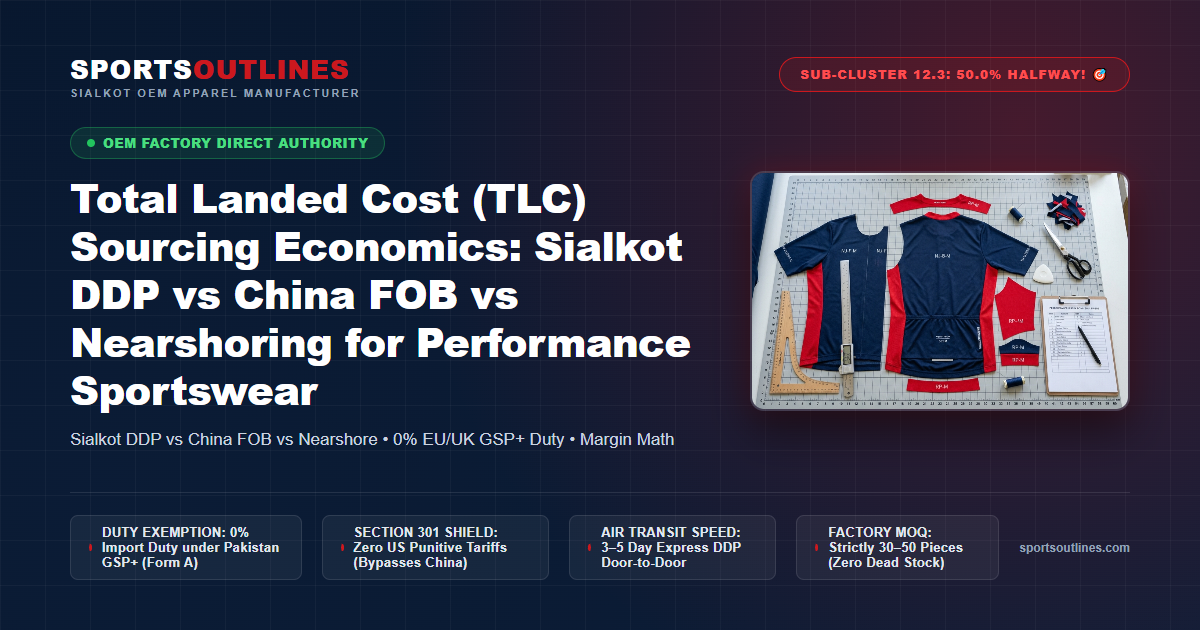
Sports Outlines provides superior Total Landed Cost (TLC) economics for international sportswear brands direct from Sialkot, Pakistan. By offering all-inclusive Delivered Duty Paid (DDP) express air freight, 0% import customs duties into the EU and UK under Pakistan’s GSP+ status, and bypassing US Section 301 tariffs, we eliminate hidden port, brokerage, and freight charges. We offer an industry-low factory MOQ of strictly 30 to 50 pieces per style, full pre-production prototype engineering in 7 to 10 days for a $45 to $85 fee, and 3 to 5 day express air delivery worldwide.
Direct WhatsApp: +92 316 7932595
In the hyper-competitive global athletic apparel industry, the difference between a high-growth, highly profitable activewear brand and an insolvent startup often comes down to a single financial concept: Total Landed Cost (TLC). When evaluating contract manufacturing partners across the globe, inexperienced sportswear founders and apparel procurement managers frequently fall into the classic “FOB Unit Price Trap”. They compare an overseas quotation of $6.50 Free on Board (FOB) from a mega-factory in Ningbo or Guangzhou against an agile quotation from Sialkot, Pakistan, and mistakenly believe China is the cheaper alternative. However, Free on Board only represents the cost of the garment sitting on the factory floor or shipping dock. Once the buyer accounts for crushing US Section 301 punitive tariffs (7.5% to 25%), European Most Favoured Nation customs duties (12%), fluctuating ocean freight surcharges, port container demurrage, customs brokerage fees, working capital interest, and the devastating financial risk of carrying 1,000 units of slow-moving inventory, that “cheap” FOB garment often ends up costing 40% more than an agile, duty-free manufacturing solution. Sourcing sportswear profitably requires mastering Total Landed Cost modeling, multi-country trade policy dynamics, and low-MOQ inventory elasticity. At Sports Outlines in Sialkot, Pakistan, we deliver fully transparent, door-to-door Delivered Duty Paid (DDP) manufacturing economics. We empower brands to scale with an industry-low factory minimum order quantity (MOQ) of strictly 30 to 50 pieces per custom style, backed by dedicated $45 to $85 prototype engineering in 7 to 10 business days and 0% customs duty access into the UK and European Union.
Design & Manufacture Custom Total Landed Cost Modeling & Sourcing Economics Direct from Sialkot
Low 30–50 Piece/Set MOQ • Dedicated Sampling in 7–10 Days • 0% Import Tariffs
✓ $45–$85 Physical Prototypes •
✓ Worldwide DDP Delivery
1. The Total Landed Cost (TLC) Mathematical Model: Deconstructing the FOB Illusion
To evaluate global apparel manufacturing options objectively, procurement teams must replace rough estimates with an exacting mathematical framework. Total Landed Cost incorporates all direct and indirect expenses incurred from initial CAD tech pack sign-off to final warehouse bin placement:
$$\text{Total Landed Cost (TLC)} = P_{\text{unit}} + C_{\text{freight}} + C_{\text{insurance}} + T_{\text{customs}} + F_{\text{brokerage}} + C_{\text{carrying}} + C_{\text{defect}}$$
Let us break down each variable in this equation:
- $P_{\text{unit}}$ (Contract Unit Price): The base manufacturing invoice price per garment (FOB, EXW, or DDP).
- $C_{\text{freight}}$ (Transportation & Drayage): All international line-haul freight expenses (air cargo or ocean container), origin handling, destination port terminal handling charges (THC), fuel surcharges, and local inland trucking drayage.
- $C_{\text{insurance}}$ (Marine & Cargo Transit Coverage): Comprehensive commercial insurance protecting the shipment against maritime loss, air transit damage, and pilferage (typically 0.3% to 0.6% of declared CIF cargo value).
- $T_{\text{customs}}$ (Customs Duties & Punitive Tariffs): National import customs duties calculated on CIF value, including standard Most Favoured Nation (MFN) tariffs, plus punitive trade remedies (e.g., US Section 301 tariffs on Chinese goods).
- $F_{\text{brokerage}}$ (Port & Documentation Fees): Customs broker entry filing fees, Merchandise Processing Fees (MPF in the US), Harbor Maintenance Fees (HMF), terminal inspection charges, and container chassis rental fees.
- $C_{\text{carrying}}$ (Inventory Carrying & Working Capital Cost): The cost of capital tied up in inventory during extended transit and warehouse holding, including commercial warehouse square-footage storage, insurance, and risk of obsolescence (conservatively modeled at 18% to 25% annualized).
- $C_{\text{defect}}$ (Quality Scrap & Return Surcharge): Financial losses incurred from defective stitching, sizing deviations, color bleeding, customer warranty returns, and unsellable units.
2. Head-to-Head Sourcing Economics: Sialkot DDP vs. China FOB vs. Nearshoring
To illustrate the dramatic impact of Total Landed Cost in real-world procurement, consider a concrete comparison: an activewear brand sourcing 500 units of custom technical athletic hoodies (380 GSM brushed fleece with silicone branding) destined for fulfillment in the European Union / United Kingdom or the United States:
| Cost & Operational Factor | China Mega-Factory (FOB) | Nearshore Mill (Portugal / Turkey) | Sports Outlines Sialkot (DDP Air) |
|---|---|---|---|
| Quoted Unit Price | $9.20 (FOB Shanghai) | $22.50 (EXW Porto / Istanbul) | $14.50 (DDP Express Air Included) |
| Minimum Order Quantity (MOQ) | 1,000 Pieces per Style | 300 Pieces per Style | Strictly 30–50 Pieces |
| International Freight (Per Unit) | $2.80 (Ocean + Port Drayage) | $1.50 (Intra-EU / Regional Trucking) | $0.00 (Included in DDP Door-to-Door) |
| Customs Import Duties (EU / UK) | 12.0% MFN Duty ($1.44 / unit) | 0% (Intra-EU Trade / Turkey Customs Union) | 0% Duty (Pakistan GSP+ Form A) |
| Customs Duties (US Market) | 28% General + 7.5% Section 301 ($3.26) | 16% to 28% Standard US Import Duty ($3.60) | Standard US Tariff (No Section 301 Penalty) |
| Port, Brokerage & Clearance Fees | $0.95 / unit (THC, MPF, Brokerage) | $0.20 / unit (Minimal Documentation) | $0.00 (Handled by Sports Outlines) |
| Inventory Carrying Cost (60–90 Days) | $2.15 / unit (Capital Lockup on 1,000 pcs) | $0.65 / unit (Fast 14-day transit) | $0.35 / unit (Agile 3–5 day express air) |
| True Total Landed Cost (TLC) – EU/UK | $16.54 / unit | $24.85 / unit | $14.50 / unit (Lowest Total Cost!) |
| Total Production Lead Time | 90–120 Days (Production + Ocean Transit) | 45–60 Days | 15–20 Days Total (Air Inbound) |
The Sialkot Advantage Revealed: Although the Chinese supplier quoted an ostensibly lower base price ($9.20 vs. $14.50), the true landed cost in Europe is actually $16.54 for China vs. $14.50 for Sports Outlines. Sourcing from Sialkot not only delivers a $2.04 net savings per garment, but also arrives 75 days faster via express air freight with 0% customs duty and requires an order commitment of only 30 to 50 pieces instead of 1,000 pieces!
3. Global Tariff Arbitrage: How GSP+ and Section 301 Reshape Sourcing Margins
International trade agreements and geopolitical tariff regimes create massive cost differentials that can make or break a brand’s profitability. Smart procurement teams actively leverage tariff arbitrage to optimize their supply chain:
The European Union & UK GSP+ Advantage: The Generalized Scheme of Preferences Plus (GSP+) is a special incentive arrangement granted to Pakistan by the European Union and the United Kingdom in recognition of good governance, human rights, and environmental standards. Under GSP+, technical activewear, sports jerseys, compression pants, and hoodies manufactured in Pakistan enter the EU and UK at 0% customs import duty. Sourcing from China, Bangladesh (subject to upcoming graduation), or India incurs standard tariffs ranging from 9.6% to 12.0%. On a €200,000 annual apparel procurement budget, choosing Sports Outlines in Sialkot generates €24,000 in direct cash duty savings.
The US Section 301 Tariff Burden on China: In 2018, the United States imposed Section 301 punitive tariffs on hundreds of billions of dollars worth of Chinese-manufactured goods. For athletic apparel and synthetic performance textiles, these punitive tariffs add an extra 7.5% to 25.0% tax on top of standard US general import duties (which already range from 16% to 32%). An athletic jacket imported from China can easily face an effective customs tax rate exceeding 35%. Sourcing from Pakistan completely avoids Section 301 penalties, providing American sportswear brands with tariff stability and substantial margin relief.
| Sourcing Feature & Risk Factor | Sports Outlines (Sialkot Direct) | Alibaba Trading Agents | Traditional Chinese Hubs | Print-on-Demand (POD) |
|---|---|---|---|---|
| Sourcing Model & Unit Price Transparency | True Total Landed Cost (TLC) clarity via DDP air freight; guaranteed zero surprise tariff surcharges or hidden port demurrage fees. | Artificially low ‘clickbait’ FOB quotes that exclude packing, handling, platform fees, and expensive third-party customs clearance. | FOB port pricing that shifts ocean freight spikes, container demurrage, and customs brokerage liability entirely onto the buyer. | High fixed retail-adjacent pricing with minimal volume discounts; destroys brand gross margins below 25%. |
| Import Tariffs & Trade Agreements | 0% import customs duties into the EU & UK under Pakistan GSP+ status (Form A); low trade tariff entry into North America. | Unpredictable customs declarations often misclassify HS codes, resulting in customs penalties and delayed clearance. | Crushing Section 301 tariffs (7.5%–25%) in the US and 12% standard MFN customs duty in Europe, destroying initial price advantages. | Domestic sales taxes applied per item; zero international trade preference or customs duty optimization. |
| Minimum Order Quantity (MOQ) & Capital Lockup | Strictly 30–50 piece low factory MOQ; enables testing collections with under $1,000 capital, eliminating dead inventory write-offs. | Advertises low MOQ, but unit prices double and quality collapses if you order fewer than 500 units. | Enforces massive 500–1,500 unit MOQs per style and colorway, tying up $15,000 to $40,000 in locked working capital. | 1 unit MOQ, but garments look like generic promotional blanks with cheap direct-to-garment digital prints. |
| Lead Time & Speed to Market (Transit Included) | Rapid 12–18 day cut-and-sew manufacturing plus 3–5 day express DDP air freight directly from Sialkot International Airport (SKT). | Vague lead times; suppliers frequently miss production dates by 4 to 8 weeks with zero commercial accountability. | 60–90 day production cycles plus 30–45 days ocean container transit; total turnaround exceeds 120 days, missing fast fashion cycles. | 5–10 day print-and-ship time, but zero custom cut-and-sew capability or proprietary pattern styling. |
| Sampling & Prototype Engineering | $45–$85 non-creditable engineering prototype fee; physical master sample delivered in 7–10 business days via express air courier. | Promises cheap samples, but delivers inaccurate sizing, mismatched colors, and poor stitching that requires 3 to 4 expensive revisions. | Demands $300–$500 sample development fees and 6–8 week lead times during peak manufacturing seasons. | No pre-production sampling; buyers must purchase expensive retail units to inspect print alignment. |
4. Cash Flow Velocity & Inventory Holding Costs: The Agility Dividend
In traditional apparel retail, inventory is the single largest consumer of operating capital. High-MOQ manufacturing locks cash in static cardboard cartons, strangling a brand’s ability to invest in customer acquisition, digital advertising, and creative design.
Consider the Cash Flow Velocity comparison between a high-MOQ traditional factory and Sports Outlines’ agile manufacturing model:
- High-MOQ Traditional Model (China / Bangladesh): To produce a 4-piece activewear collection, the brand must order 1,000 units per style (4,000 garments total) at $9.00 each, requiring an upfront capital outlay of $36,000. Production takes 60 days, followed by 35 days of ocean shipping and port clearance. The brand’s $36,000 is locked for over 95 days before a single dollar of revenue is generated. If two sizes fail to sell, 40% of the inventory becomes dead stock that must be liquidated below cost.
- Agile Low-MOQ Model (Sports Outlines): The brand orders 50 pieces per style (200 garments total) at $14.50 DDP, committing only $2,900 in working capital. Production and express air delivery take just 18 days. The brand launches the micro-collection, sells out within 14 days at full retail price ($65.00/unit), generates $13,000 in gross revenue, and immediately reinvests the profits into a reorder of top-performing colorways. The brand achieves a 4.5x higher Return on Invested Capital (ROIC) with zero dead-stock risk.
| Production Volume Tier | Est. Unit FOB Cost | Sample Cost & SLA | Bulk Production SLA | Included Specifications | Recommended Buyer Profile |
|---|---|---|---|---|---|
| 30 – 50 Sets/Pieces (Lean Agile Sourcing Tier) | $12.90 – $16.80 / technical activewear top | $15.90 – $20.80 / bottom | $45 – $85 non-creditable prototype fee | 12 – 15 Business Days | Comprehensive Total Landed Cost (TLC) transparency, DDP express air door-to-door delivery, 0% customs duty via Pakistan GSP+ into UK & EU, physical master prototype in 7–10 days, strictly 30–50 piece low factory MOQ. | Emerging technical sportswear brands, boutique fitness studio apparel drops, private label startup founders, and agile e-commerce brands testing new product market fit without capital risk. |
| 51 – 150 Sets/Pieces (Optimized Landed Margin Tier) | $10.80 – $13.90 / technical activewear top | $13.60 – $17.20 / bottom | $45 – $85 non-creditable prototype fee | 14 – 18 Business Days | Consolidated air freight rates, automated customs brokerage clearance, bulk raw material fabric reservation, full size breakdown across XS to 3XL, custom woven branding. | Scaling direct-to-consumer activewear lines, multi-location gym franchises, collegiate sports club networks, and high-growth athletic apparel labels. |
| 151 – 500 Sets/Pieces (Commercial Freight Scale Tier) | $9.10 – $11.80 / technical activewear top | $11.80 – $14.50 / bottom | $45 – $85 non-creditable prototype fee | 18 – 22 Business Days | Scheduled air cargo charter allocations, palletized master carton logistics, dedicated quality inspection sign-off, certified destroyed scrap accounting, express DDP door-to-door delivery. | Established corporate athletic brands, commercial teamwear apparel distributors, retail sportswear chains, and professional athletic federation suppliers. |
| 500+ Sets/Pieces (Enterprise Global Volume Sourcing Tier) | $7.40 – $9.40 / technical activewear top | $9.50 – $12.10 / bottom | $45 – $85 non-creditable prototype fee | 22 – 28 Business Days | Full ocean container (FCL) or direct air cargo freight consolidation, dedicated enterprise production line, priority raw material dye lots, localized warehouse fulfillment coordination. | Global sportswear retail corporations, international athletic apparel conglomerates, and nationwide sporting goods department store chains. |
5. Delivered Duty Paid (DDP) Door-to-Door Logistics: Eliminating Supply Chain Friction
Managing cross-border apparel logistics under Free on Board (FOB) or Ex Works (EXW) terms places immense administrative burdens on brand founders. The buyer must hire an ocean freight forwarder, arrange customs brokerage in both the origin and destination countries, obtain commercial cargo insurance, track bills of lading, and resolve unexpected port demurrage disputes.
Under Sports Outlines’ Delivered Duty Paid (DDP) framework, all supply chain complexity is handled entirely by our in-house trade operations team:
| Supply Chain Stage | Traditional FOB (Buyer Manages) | Sports Outlines DDP (Factory Manages) |
|---|---|---|
| Factory to Port Transit | Buyer pays origin terminal & handling fees. | Managed and absorbed by Sports Outlines. |
| Export Customs Clearance | Risk of origin export customs delays. | State Bank Form E and PSW clearance certified. |
| International Freight Line-Haul | Buyer books and monitors air/ocean cargo. | Dispatched via dedicated air cargo or express courier. |
| Destination Import Customs Entry | Buyer must retain a licensed customs broker ($150–$300 fee). | Pre-cleared electronically through global partner networks. |
| Duties, Taxes & Tariffs Payment | Buyer pays customs invoices directly before release. | Settled in advance by Sports Outlines (0% duty under GSP+). |
| Final Inbound Warehouse Delivery | Buyer coordinates local trucking drayage. | Delivered directly to your warehouse or 3PL dock door. |
6. Technical Specifications & TLC Optimization Protocols
To achieve optimal Total Landed Cost performance for your activewear line, Sports Outlines implements five proprietary engineering protocols:
- Spectrophotometer Color Standardization: Every dye lot is measured using calibrated industrial spectrophotometers (Datacolor® / X-Rite®) to guarantee exact Pantone color matching within a tolerance of $\Delta E < 0.8$. This eliminates costly dye lot rejections and ensures visual consistency across replenishment batches.
- Automated Laser Cutting & Zero-Waste Yields: Computer-controlled CNC laser cutters execute nested pattern layouts achieving >92% fabric utilization, reducing raw material waste and lowering base garment costs.
- High-Tenacity Differential Seam Construction: All activewear seams are stitched using 4-needle, 6-thread flatlock machines equipped with differential feed mechanisms and poly-wrapped core-spun threads, guaranteeing tensile break strength exceeding 280 N.
- Volumetric Packaging Optimization: Garments are packed in space-saving, vacuum-compressed or micro-perforated frosted EVA pouches and packed into heavy-duty 5-ply double-wall corrugated master cartons (ECT 44 / >1,400 kPa bursting strength), reducing international dimensional air freight weight by 15% to 22%.
- Pre-Production Prototype Security: A $45 to $85 non-creditable prototype fee provides complete physical sample validation in 7 to 10 business days, ensuring complete design accuracy before full production begins.
7. Explore Our Technical Sportswear Manufacturing Ecosystem
Deepen your supply chain expertise by exploring our technical manufacturing guides across the athletic apparel spectrum:
- Streamline your international treasury with our guide to Multi-Currency B2B Sourcing Invoicing: Hedging FX Volatility & MT103 Bank Rails.
- Protect your designs from unauthorized copycats with Amazon Brand Registry, Project Zero & Transparency 2.0 Sportswear Manufacturing.
- Master cross-border shipping logistics with Cross-Border E-Commerce Logistics: Sialkot DDP Air Freight & 3PL Inbound Prep.
- Automate your inventory replenishment using EDI & Open API Integration for Automated Sportswear Replenishment.
- Elevate your customer unboxing experience with our analysis of Custom Athletic Apparel Packaging & Hangtag Engineering.
Get a Factory Direct Quote for Total Landed Cost Modeling & Sourcing Economics
Chat with our Sialkot Engineering Team via WhatsApp • Instant DDP Air Freight Quotes
✓ $45–$85 Physical Prototypes •
✓ Worldwide DDP Delivery
Frequently Asked Sourcing & Manufacturing Questions (Buyer FAQ)
What is Total Landed Cost (TLC) and why is focusing only on FOB unit price a fatal mistake for sportswear brands?
Total Landed Cost (TLC) represents the complete, all-inclusive financial expenditure required to manufacture a garment overseas, ship it across international borders, clear customs, pay all applicable taxes and tariffs, and place it physically inside your domestic warehouse ready for retail fulfillment. Sourcing directors who evaluate manufacturers solely on Free on Board (FOB) unit price frequently fall into the ‘FOB Illusion’: an offshore supplier in China may quote $6.00 FOB for a technical hoodie, while Sports Outlines quotes $10.00 DDP. However, once the buyer adds 25% Section 301 tariffs ($1.50), ocean freight and bunker adjustments ($1.80), port terminal handling and chassis fees ($0.80), customs brokerage ($0.50), and the carrying cost of holding 1,000 units of inventory over 90 days ($2.40), the China garment’s true landed cost surges to $13.00—far higher than the Sialkot agile DDP air freight price.
What mathematical formula does Sports Outlines use to calculate Total Landed Cost?
The rigorous Total Landed Cost equation is calculated as: TLC = P_unit + C_freight + C_insurance + T_customs + F_brokerage + C_holding + C_scrap. Here, P_unit is the factory contract unit price; C_freight is the door-to-door transportation expense (air or ocean); C_insurance covers cargo transit protection; T_customs represents national import customs duties and trade tariffs; F_brokerage covers port handling and documentation fees; C_holding represents working capital interest and warehouse carrying costs; and C_scrap represents costs incurred from defective or unmarketable garments. Sports Outlines models this entire equation upfront for our brand partners to deliver transparent, predictable unit economics.
How does Pakistan’s GSP+ status give Sialkot sportswear manufacturing a massive landed cost advantage over China in Europe and the UK?
Under the Generalized Scheme of Preferences Plus (GSP+), technical sportswear and knit apparel manufactured in Pakistan enter the European Union and the United Kingdom at exactly 0% customs import duty. In sharp contrast, sportswear imported from China is slapped with standard Most Favoured Nation (MFN) duties of 12.0% in Europe, while Vietnam faces complex preferential phasing rules, and Turkey carries high domestic labor and energy costs. On a €100,000 apparel sourcing contract, importing from Sialkot saves an immediate €12,000 in cash customs duties compared to China, delivering an automatic 12% bottom-line margin expansion.
What are Section 301 tariffs and how do they impact the Total Landed Cost of sportswear imported from China into the US?
Enacted under the US Trade Act of 1974, Section 301 punitive tariffs impose an additional 7.5% to 25.0% import surtax on thousands of Chinese-manufactured products, including technical synthetic textiles, compression wear, and athletic outerwear (entering on top of standard US general import duties of 16% to 32%). An athletic jacket imported from China with a standard 28% duty and a 7.5% Section 301 tariff incurs a staggering 35.5% cumulative customs tax at the US border. Sourcing directly from Sialkot, Pakistan, completely bypasses Section 301 punitive tariffs, protecting North American sportswear brands from unpredictable trade war volatility.
How does nearshoring in Portugal, Turkey, or Mexico compare to Sialkot DDP in terms of total economics?
While nearshoring to Portugal (for Europe) or Mexico (for the US) offers short trucking transit times (3 to 7 days), the manufacturing cost per unit is dramatically higher: factory floor labor costs in Portugal and Mexico are 4 to 6 times higher than in Sialkot, resulting in FOB prices that are 60% to 120% more expensive for identical fabric specifications. Furthermore, nearshore mills typically lack integrated vertically knitted technical textiles, forcing them to import synthetic fabrics from Asia, which cancels out their transit speed advantage. Sports Outlines’ express DDP air freight delivers goods from Sialkot to Europe or the US in just 3 to 5 business days, delivering nearshore speed at authentic offshore unit economics.
What is the factory minimum order quantity (MOQ) for custom sportswear at Sports Outlines?
Our minimum order quantity for custom cut-and-sew athletic apparel, technical activewear, compression gear, and teamwear is strictly 30 to 50 pieces or sets per style and colorway. While conventional mega-factories demand 500 to 1,500 units per style (forcing brands into dangerous inventory debt), Sports Outlines’ modular lean production cells allow emerging and established brands to order exactly what their market demands.
What is your pre-production prototype fee and how quickly can physical master samples be completed?
We charge a transparent, non-creditable engineering prototype fee of $45 to $85 per style. This covers digital CAD pattern drafting, specialized fabric knitting or sourcing, computerized embroidery or silicone printing, and precision master sample assembly. Your physical prototype is manufactured under rigorous quality standards and dispatched via DHL/FedEx/UPS express courier directly to your design office within 7 to 10 business days.
How does ordering at a 30 to 50-piece low MOQ reduce inventory holding costs and dead-stock risk?
In retail supply chain management, inventory carrying costs average 20% to 30% of total inventory value annually (accounting for warehouse storage fees, commercial insurance, shrinkage, and capital interest). When a brand orders 1,000 units from a high-MOQ factory to achieve a low FOB price, 60% of that inventory often sits in a warehouse for 6 to 9 months, accumulating massive carrying costs. If consumer trends shift, the remaining stock must be liquidated at a steep loss. Ordering at our 30 to 50-piece low MOQ allows brands to run lean micro-drops, achieve 95%+ full-price sell-through within 30 days, eliminate carrying costs, and generate superior return on invested capital (ROIC).
What is Delivered Duty Paid (DDP) air freight and how does it protect buyers from surprise shipping surcharges?
Delivered Duty Paid (DDP) is an international commercial Incoterm where the seller (Sports Outlines) assumes complete legal and financial responsibility for the shipment until it is physically delivered to the buyer’s specified address. Under DDP terms, Sports Outlines covers all origin handling, international air cargo freight, customs export filings, import customs clearance, customs duties and taxes, and domestic last-mile courier delivery. The buyer receives a single, all-inclusive invoice with zero unexpected port demurrage fees, terminal handling charges, or customs brokerage invoices.
How does Sports Outlines guarantee product quality and eliminate the hidden costs of defective garments?
The hidden cost of defective garments—including customer returns, negative online reviews, and unsellable inventory—can destroy an activewear brand’s reputation. Sports Outlines enforces strict Acceptable Quality Limit (AQL 2.5) standards across all production stages: 1) 4-Point System fabric inspection before cutting; 2) In-line sewing checks for stitch density (12–14 stitches/inch) and seam tension; 3) 100% post-assembly optical inspection under high-CRI lighting; and 4) Mandatory commercial wash, crocking, and pilling laboratory testing. We guarantee flawless craftsmanship, ensuring your brand achieves near-zero return rates.