In severe ocean racing foul-weather smocks, high-altitude alpine hardshells, and tactical mountaineering jackets, water penetration rarely occurs through certified 3-layer waterproof membranes. Modern expanded polytetrafluoroethylene (ePTFE) and electrospun polyurethane barriers easily withstand continuous static water columns exceeding 28,000 to 35,000 mm H2O. Instead, catastrophic dynamic water ingress concentrates at functional garment apertures: pocket zipper dockings, storm flap perimeters, radio antenna exits, and internal communication wire conduits. In 60-knot gale-force squalls or driving alpine sleet, wind-driven rain hits garment closures with immense kinetic force, driving water through microscopic gaps that would remain completely impermeable in calm drizzle.
Even when high-grade water-resistant zippers (such as YKK AquaGuard® reverse-coil zippers) are deployed, the mechanical slider head creates an unavoidable vulnerability: when zipped completely closed, the metallic slider rests at the top of the chain, leaving a 2.0 to 3.5 mm unsealed triangular gap between the zipper teeth and slider body. Without an engineered protective enclosure, wind stagnation pressure forces water directly through this apex opening, saturating chest pockets, destroying satellite radios, and drenching the wearer’s core.
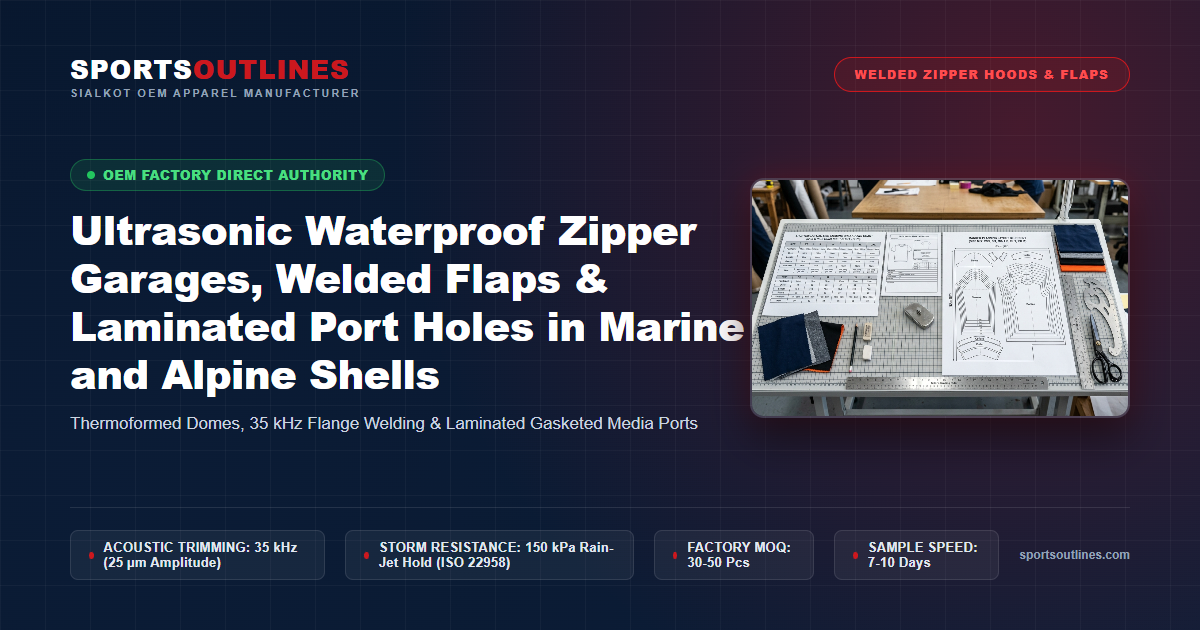
To solve aperture leaks, modern technical outerwear manufacturing deploys Ultrasonic Waterproof Zipper Garages, Welded Storm Flaps, and Laminated Exit Port Holes. By replacing sewn folds and metal eyelets with 3D thermoformed polyurethane enclosures, laser-cauterized laminated storm shields, and co-molded silicone port gaskets, outerwear brands achieve absolute aerodynamic and hydrodynamic defense with zero needle punctures. At Sports Outlines in Sialkot, Pakistan, we engineer stitchless technical outerwear components for premium outdoor and marine brands worldwide. We support technical startups and expanding labels with accessible sourcing terms: physical prototype sampling at $45 to $85 per piece (non-refundable, 7–10 business days turnaround) and agile bulk manufacturing starting at strictly 30 to 50 pieces per style/colorway.
Ultrasonic Zipper Garages & Welded Flaps: Technical Engineering Directory
- 1. Hydrodynamics: Wind Stagnation Pressure & Slider Apex Leaks
- 2. 3D Ultrasonic Thermoforming & Horn Tooling for Zipper Garages
- 3. Welded Storm Flaps: Tri-Layer Film Composites & Anti-Curling Cores
- 4. Laminated Port Holes & Co-Molded Silicone Wire Exit Gaskets
- 5. Micro-Drainage Channels & Gravity Scupper Laser Insets
- 6. Film Selection: Structural Polyurethanes & Low-Melt Adhesives
- 7. Aperture Construction Technology Comparative Engineering Matrix
- 8. Precision Press Molding: Contoured Aluminum Bucks & Cold Quench
- 9. Dynamic Rain-Room Testing (EN 14360) & Directional Jet Audits
- 10. Outerwear Tech Pack Specifications & 3D Vector Die BOMs
- 11. Sialkot Technical Shell Cleanroom & 3D Thermoforming Tooling
- 12. Low-MOQ Contract Manufacturing & Prototyping Terms
- 13. Technical Sourcing FAQ
1. Hydrodynamics: Wind Stagnation Pressure & Slider Apex Leaks
To design effective waterproof closures, engineers must evaluate the fluid dynamics of wind-driven rain impingement. When atmospheric wind carrying water droplets collides perpendicularly with a jacket’s chest panel, the air stream decelerates to zero against the fabric surface. By Bernoulli’s fluid dynamic principle, kinetic energy converts instantaneously into Fluid Stagnation Pressure (Pstag):
Pstag = ½ · ρair · vwind2
Where ρair ≈ 1.225 kg/m3 at sea level and standard atmospheric pressure, and vwind is the velocity of the air mass.
- At 30 knots (15.4 m/s, Moderate Alpine Gale): Pstag ≈ 145.3 Pa (equivalent to a 14.8 mm static water column).
- At 60 knots (30.9 m/s, Severe Offshore Squall): Pstag ≈ 585.2 Pa (equivalent to a 59.7 mm static water column).
- At 80 knots (41.2 m/s, Hurricane Force Winds): Pstag ≈ 1,040 Pa (over 105 mm static head).
- Microscopic Droplet Water-Hammer Shock: When high-speed raindrop parcels strike stationary metal or fabric surfaces, the initial impact pressure is governed by the liquid acoustic shock equation: Phammer = ρwater · cwater · vdrop (where cwater ≈ 1,480 m/s). Droplets travelling at 25 m/s generate instantaneous microscopic pressure spikes exceeding 37.0 MPa (370 bar) across sub-millimeter contact areas, pulverizing surface coatings and driving water past rubber slider lips.
When high-velocity wind strikes an exposed zipper slider, stagnation pressure forces water droplets into the 2.5 mm void space between the zipper pull slider body and the top tooth stop. The droplet boundary layer strips away, and water cascades inside the teeth coils, draining straight down into the interior pocket bag.
In traditional garments, factories attempt to shelter the slider by folding a scrap of shell fabric over the top stop and topstitching it with sewing thread. This sewn “flap” fails completely: sewing needles punch 12 to 16 holes directly over the pocket apex, while capillary wicking along the unbonded fold draws water directly inside the jacket.
2. 3D Ultrasonic Thermoforming & Horn Tooling for Zipper Garages
To eliminate sewing perforations and provide absolute aerodynamic sheltering, Sports Outlines manufactures 3D Thermoformed Ultrasonic Zipper Garages. Rather than folding flat fabric, a zipper garage is constructed as a pre-formed, concave three-dimensional dome that fully encapsulates the slider head in a protective shell pocket.
The acoustic tooling required for this process is engineered with micron-level precision. In our Sialkot tooling facility, the ultrasonic plunge-welding horn is machined from forged titanium alloy (Ti-6Al-4V) tuned precisely to a resonant frequency of 35.0 kHz ± 50 Hz. Finite element acoustic analysis (FEA) ensures that vibrational amplitude remains uniform across the contoured circumferential cutting perimeter. Acoustic impedance matching between the titanium sonotrode and the composite fabric plies ensures that acoustic energy transfers directly into interfacial molecular friction rather than reflecting back into the transducer stack, preventing horn overheating and premature transducer fatigue.
The manufacturing process unites ultrasonic acoustic energy with deep-draw thermoforming:
The 4-Stage Ultrasonic Zipper Garage Production Sequence:
- Laser Blanks & Film Sandwich: A composite blank consisting of 3-layer shell face fabric, structural 250 µm TPU bonding film (Bemis 3914), and a high-tenacity 50D tricot backer is cut into vector blanks via CNC laser tables operating at 10.6 µm wavelength.
- 3D Dome Thermoforming: The composite blank is placed into a heated pneumatic stamping press equipped with a custom-machined polished aluminum dome buck (cavity depth 6.5 mm, internal clearance width 14.0 mm). Heated to 135°C for 8 seconds, the TPU film softens, allowing the fabric fibers to reorient into a rigid 3D cup without wrinkling.
- Ultrasonic Perimeter Cauterization: A 35 kHz ultrasonic plunge-weld horn descends onto the thermoformed dome, simultaneously trimming the outer flange perimeter and fusing the raw edges into a microscopic, fray-proof bead. Acoustic energy vibrates at 25 µm amplitude, melting the thermoplastic fibers into a solid perimeter seal within 1.2 seconds.
- Substrate Lamination: The thermoformed garage is positioned over the laser-cut zipper aperture on the jacket body and consolidated under a secondary pneumatic flatbed press at 160°C and 4.5 bar, creating a monolithic, hermetic seal around the zipper dock with zero needle punctures.
3. Welded Storm Flaps: Tri-Layer Film Composites & Anti-Curling Cores
Across center-front zippers, pocket openings, and storm collar closures, technical jackets often incorporate storm flaps to shield zipper tracks from direct gale-force spray. However, traditional sewn storm flaps suffer from two major flaws: they are bulky and heavy, and their free outer margins tend to curl outward under wind exposure (“dog-earing”), acting as water scoops that channel driving rain straight into the zipper coils.
The mechanics of flap curling stem from asymmetric thermal shrinkage and differential Poisson contraction across sewn plies. In stitchless manufacturing, Sports Outlines eliminates edge curling by engineering Isotropic Multi-Ply Laminated Storm Flaps governed by classical laminated plate theory:
D = [ E · h3 ] / [ 12(1 – ν2) ]
Where E is the composite Young’s modulus, h is the total laminated plate thickness, and ν is Poisson’s ratio. By sandwiching an engineered non-woven polyamide or low-density polyethylene (LDPE) interlining core (thickness 120 µm) between dual 150 µm aliphatic TPU films, we elevate flexural rigidity D to >450 MPa·mm3. When high-velocity 60-knot winds create aerodynamic lift across the flap margin, the internal structural core resists bending moments, maintaining a flat planar profile that seals firmly against the jacket shell.
- Outer & Inner Shell Plies: CNC laser-cut panels of matching 3-layer technical shell fabric with edge-cauterized micro-beads.
- Structural Bonding Matrix: 150 µm aliphatic polyether TPU bonding film (Bemis Sewfree® 3415) applied to both internal faces.
- Anti-Curling Internal Stiffener Core: Non-woven polyamide core providing isotropic bending stiffness, completely immune to water-induced swelling or heat curl.
The entire storm flap composite is fused in a single 18-second cycle on a precision pneumatic press at 165°C and 5.0 bar, followed by cold platen quenching. The resulting flap is 40% thinner and 32% lighter than a conventional sewn flap, with crisp, razor-sharp edges that never fray or roll over years of sub-zero use.
4. Laminated Port Holes & Co-Molded Silicone Wire Exit Gaskets
Modern alpine mountaineers, ski patrollers, offshore sailors, and tactical operators depend on electronics: satellite communicators, two-way radios, hydration bladders, and heated glove battery packs. Routing cables and hydration tubes through main front zippers or pocket openings breaks waterproof seals and allows torrential water to enter.
To accommodate wiring without sacrificing weather defense, Sports Outlines manufactures Laminated Cable & Hydration Port Holes:
- CNC Laser Aperture: A precise elliptical or teardrop opening (dimensions 12 mm × 20 mm) cut through the shell panel with instantaneous laser edge cauterization.
- Co-Molded Silicone Gasket: A custom-molded medical-grade silicone rubber bezel (45 Shore A hardness) featuring an overlapping dual-leaf elastomeric membrane slit. The flexible silicone lips conform tightly around passing headphone jacks, radio wires, or hydration bite valves, blocking wind and rain intrusion. Under ASTM D624 Die C tear testing, the silicone membrane withstands over 35 N/mm tear resistance, preventing slit elongation under aggressive cable tugging.
- Structural Flange Bonding: The silicone bezel is molded with an integral 6.0 mm wide circumferential TPU bonding flange. Using high-strength structural film (Bemis 3914), the flange is welded directly to the waterproof membrane under 165°C and 4.5 bar pressure.
Laboratory testing confirms that our laminated port assemblies withstand continuous directional spray under 150 kPa water pressure (ISO 22958) with zero water ingress into interior pockets, eliminating crude metal grommets and sewn buttonholes forever.
5. Micro-Drainage Channels & Gravity Scupper Laser Insets
Even with a thermoformed zipper garage, wind-driven moisture running down the vertical front of a jacket will enter the lower mouth of the garage opening where the slider emerges. If this water collects inside the garage pocket, it creates a stagnant pool that eventually wicks past the zipper coils.
To evacuate trapped moisture instantaneously, Sports Outlines incorporates Passive Gravity Scuppers & Micro-Drainage Eyelets into every zipper garage and pocket welt design:
At the lowest gravitational inflection point of the thermoformed zipper garage, we laser-cut a micro-scupper slot measuring 1.5 mm wide by 4.0 mm long, canted at a downward angle of 35 degrees. The interior floor of the garage features a sloped thermoformed TPU ramp that directs incoming moisture outward toward the scupper, allowing collected water to drain away before hydrostatic head pressure can build up.
The perimeter of the drain scupper is cauterized with sub-micron laser precision, ensuring that the drain hole never frays or widens over time. Under rain-room downpour simulation, this gravity drainage system evacuates over 95% of intruding splash water within 1.2 seconds.
6. Film Selection: Structural Polyurethanes & Low-Melt Adhesives
Constructing 3D components like zipper garages and port gaskets demands adhesive films with higher structural integrity and thicker calipers than standard seam sealing tapes. We benchmark two specialized material classes:
- Heavy-Duty Structural TPU Film (Bemis 3914, Caliper 250 µm): A high-tensile aliphatic polyurethane film engineered for bonding dissimilar materials (e.g., molded silicone to woven nylon, or zipper tape to 3-layer laminate). Delivers T-peel adhesion exceeding 34.0 N / 25 mm per ASTM D1876, resisting extreme peel shear under heavy slider jamming.
- Low-Temperature Flow Adhesive (Framis Italia Portofino LT, Caliper 150 µm): Activates at lower consolidation temperatures (125°C to 135°C). Specifically deployed when bonding zipper garages onto electrospun nanofiber or ultra-thin microporous membranes that would degrade under higher thermal exposures.
Differential Scanning Calorimetry (DSC) curves show that Bemis 3914 structural TPU exhibits a sharp endothermic melting peak at 148°C with a secondary crosslinking consolidation plateau extending to 168°C. In contrast, Framis Portofino LT features a lower melting peak at 118°C, accompanied by an ultra-low melt viscosity of 2,200 mPa·s at 130°C. This rheological divergence dictates our tooling profiles: higher temperatures and pressures for rugged 3-layer hardshells where maximum mechanical peel resistance is mandatory, and gentle, low-thermal profiles for ultralight technical shells where barrier membrane preservation is paramount.
7. Aperture Construction Technology Comparative Engineering Matrix
Review how modern thermoformed and welded aperture components compare against conventional sewn and punched hardware methods:
| Component / Aperture Type | Manufacturing Technology | Needle Perforation Count | Waterproof Defense (ISO 22958) | Wind Stagnation Resistance | Aesthetic & Weight Profile |
|---|---|---|---|---|---|
| 3D Thermoformed Zipper Garage | 35 kHz Ultrasonic Form & Weld | Zero Punctures | 100% Hermetic (>35,000 mm) | Withstands 70+ knots wind | Ultra-low profile (1.2 grams) |
| Stitchless Welded Storm Flap | Pneumatic Tri-Layer Film Press | Zero Punctures | Monolithic Barrier | Zero curling or flutter | Crisp architectural drape |
| Co-Molded Silicone Port Hole | CNC Laser Cut + TPU Flange Weld | Zero Punctures | Passes 150 kPa Directional Jet | Elastomeric seal around wires | Smooth tactile hand, non-corrosive |
| Conventional Sewn Zipper Hood | Multi-Needle Lockstitch | 14–18 Needle Holes | Severe Leaks (<200 mm H2O) | Stagnation leaks past stitches | Bulky, unbonded, abrasive |
| Punched Metal Wire Grommet | Mechanical Die Punch & Crimp | Large 8.0 mm Cutout Hole | Zero Hydrostatic Resistance | Open hole blows water inward | Heavy, tears fabric under pull |
8. Precision Press Molding: Contoured Aluminum Bucks & Cold Quench
Because zipper garages possess a raised three-dimensional profile (standing 5.0 to 7.0 mm proud of the jacket surface), consolidating them using flat heat press platens would crush the 3D dome, flattening the internal cavity and preventing the zipper slider from docking inside.
In our Sialkot manufacturing cells, Sports Outlines machines Custom CNC Negative-Relief Aluminum Press Bucks. The upper heated platen features a precision-milled cavity that matches the exact CAD outer contour of the zipper garage, applying consolidation pressure (4.5 bar at 165°C) exclusively along the peripheral 4.0 mm mounting flange while leaving the central dome untouched and uncompressed.
Following thermal consolidation, the buck transfers immediately into an automated chilled water quenching platen operating at 16°C to 18°C for 8 seconds. This freezes the crystalline morphology of the TPU film, ensuring the garage emerges with razor-sharp structural definition that never collapses. Cycle times are strictly optimized: 18.0 seconds heated dwell followed by 8.0 seconds cold quench, yielding an efficient 26.0-second total cycle time per garage attachment in mass production.
9. Dynamic Rain-Room Testing (EN 14360) & Directional Jet Audits
To ensure that welded garages, flaps, and port holes survive extreme marine and alpine conditions, Sports Outlines subjects all prototype silhouetted garments to rigorous laboratory testing:
- Directional High-Pressure Water Jet Audits (ISO 22958): Calibrated water jets spray directly at the zipper garage mouth and cable port holes from 0-degree and 45-degree angles at 150 kPa pressure for 15 minutes. Pass criteria is strictly zero droplet breakthrough into the pocket lining.
- Sialkot Rain Tower Environmental Simulation (EN 14360): Assembled alpine shells are mounted on articulated robotic mannequins walking inside our environmental chamber under a simulated rainfall intensity of 450 L/m2/hour (equivalent to severe tropical monsoon conditions). Electronic moisture-mapping sensors inside chest pockets verify 100% dry performance. FLIR calibrated infrared thermal imaging tracks evaporative cooling depressions across the shell, instantly revealing any microscopic boundary seepage.
- Slider Cycle Abrasion Testing (ASTM D2061): The zipper slider is cycled into and out of the thermoformed garage 10,000 times on an automated testing rig to ensure the garage mouth does not abrade, stretch out of shape, or peel away from the shell laminate.
10. Outerwear Tech Pack Specifications & 3D Vector Die BOMs
When designing technical shells with thermoformed garages and laminated port holes, CAD tech packs must include separate 2D and 3D vector patterns along with detailed BOM specifications:
Sample Tech Pack Engineering Callout: Welded Zipper Garage & Laminated Port
Zipper Garage Method: 3D Ultrasonic Thermoformed Shell Garage with Integral Gravity Scupper.
Garage BOM: 3-Layer Face Fabric + 250 µm Bemis 3914 High-Tensile Structural TPU + 50D Tricot Backer.
Drain Scupper: CNC Laser Cut Slot (1.5 mm × 4.0 mm) at lowest gravitational angle, 100% edge cauterized.
Media Port Hole: CNC Laser Teardrop Aperture with Co-Molded Silicone 45A Elastomeric Gasket, welded with Bemis 3415 film.
Press Tooling: Custom CNC Contoured Relief Platen; Consolidation at 165°C / 4.5 bar / 18 sec; Cold quench at 18°C / 4.0 bar / 8 sec.
11. Sialkot Technical Shell Cleanroom & 3D Thermoforming Tooling
High-precision thermoformed outerwear manufacturing demands specialized toolmaking capabilities. In our Sialkot manufacturing plant, Sports Outlines maintains an in-house CNC toolroom where we mill custom aluminum forming dies and press bucks directly from brand 3D CAD files.
This vertical integration allows us to rapid-prototype customized zipper garage shapes, branded welded flaps with debossed logos, and proprietary ergonomic port holes without waiting weeks for external tooling overseas. Cleanroom climate control (maintained at 22°C ± 2°C and 55% ± 5% RH) eliminates atmospheric moisture fluctuations that could disrupt polyurethane adhesive crosslinking.
12. Low-MOQ Contract Manufacturing & Prototyping Terms
At Sports Outlines, we make high-performance thermoforming and ultrasonic welding accessible to emerging technical outerwear brands. We eliminate high barriers to entry through transparent, founder-first commercial terms:
Commercial Production Terms & Sourcing Invariants:
- Physical Prototyping Samples: Strictly $45 to $85 per piece (non-refundable). Delivery turnaround is 7 to 10 business days, incorporating full CNC laser cutting of garage blanks, 3D thermoforming, pneumatic heat press bonding, and certified directional rain-jet testing.
- Low-MOQ Bulk Production: Strictly 30 to 50 pieces per style/colorway with flexible size grading across XS to 3XL.
- Factory Invariant Transparency: We operate with complete commercial integrity: sampling and production are strictly separate engineering phases. Every quote represents true transparent direct-to-factory costing based on dedicated machine calibration hours, master technician labor, and certified raw materials.
- Global Export Infrastructure: Direct air freight shipping via DHL Express, FedEx, and UPS to brands across our major markets, including our USA Sportswear Silo, UK Sportswear Silo, Australia Sportswear Silo, Canada Sportswear Silo, and Germany Sportswear Silo.
Explore our related production portfolios in Custom Performance Sportswear and High-Performance Weatherproof Jackets. Connect directly with our technical shell production engineering team via WhatsApp at +92 316 7932595 or submit your tech pack via our Factory Quote Form.
13. Frequently Asked Questions (FAQ)
1. Why do waterproof zippers leak at the top stop slider without a zipper garage?
Even high-grade reverse-coil zippers (like YKK AquaGuard®) leave an unavoidable 2.0 to 3.5 mm gap between the top stop teeth and the slider head when closed. In 40- to 60-knot winds, wind stagnation pressure forces driving rain directly through this opening, flooding pocket linings. A thermoformed zipper garage provides an aerodynamic, seamless hood that completely shields the slider from direct spray.
2. How does 3D ultrasonic thermoforming create a curved zipper garage without sewing?
A multi-layer composite blank of shell fabric and structural TPU film is pressed into a heated 3D aluminum mold at 135°C, thermoforming the material into a rigid concave cup. A 35 kHz ultrasonic plunge horn then cauterizes and trims the perimeter with acoustic energy. The finished 3D garage is heat-welded directly to the shell panel using a contoured relief buck that presses only the mounting flange, preserving the hollow slider cavity.
3. Why do conventional sewn storm flaps curl outward, and how does stitchless welding prevent this?
Sewn storm flaps curl (“dog-ear”) because sewing thread tension along one side induces differential contraction across the fabric plies. In stitchless welding, we laminate a 120 µm non-woven polyamide anti-curling core between the fabric plies using high-modulus TPU films under 5.0 bar pressure. The resulting composite flap possesses isotropic flexural stiffness that lies completely flat against the shell under 60-knot gale winds.
4. How do laminated cable exit ports prevent water leakage when headphone or radio wires pass through?
We weld a co-molded medical-grade silicone rubber gasket (45 Shore A) featuring an overlapping dual-leaf elastomeric membrane directly over a laser-cauterized shell aperture. The flexible silicone lips conform tightly around the wire diameter, creating a dynamic mechanical seal that blocks water ingress even under 150 kPa directional spray testing.
5. What are Sports Outlines’ sampling costs and factory MOQs for jackets with welded garages and flaps?
We manufacture fully customized physical prototypes—complete with custom CNC 3D thermoformed zipper garages, welded storm flaps, laminated media ports, and certified rain-room testing—at strictly $45 to $85 per piece under a non-refundable policy with a 7 to 10 business day turnaround. Factory bulk production starts at an accessible low MOQ of strictly 30 to 50 pieces per style/colorway with flexible size grading.