
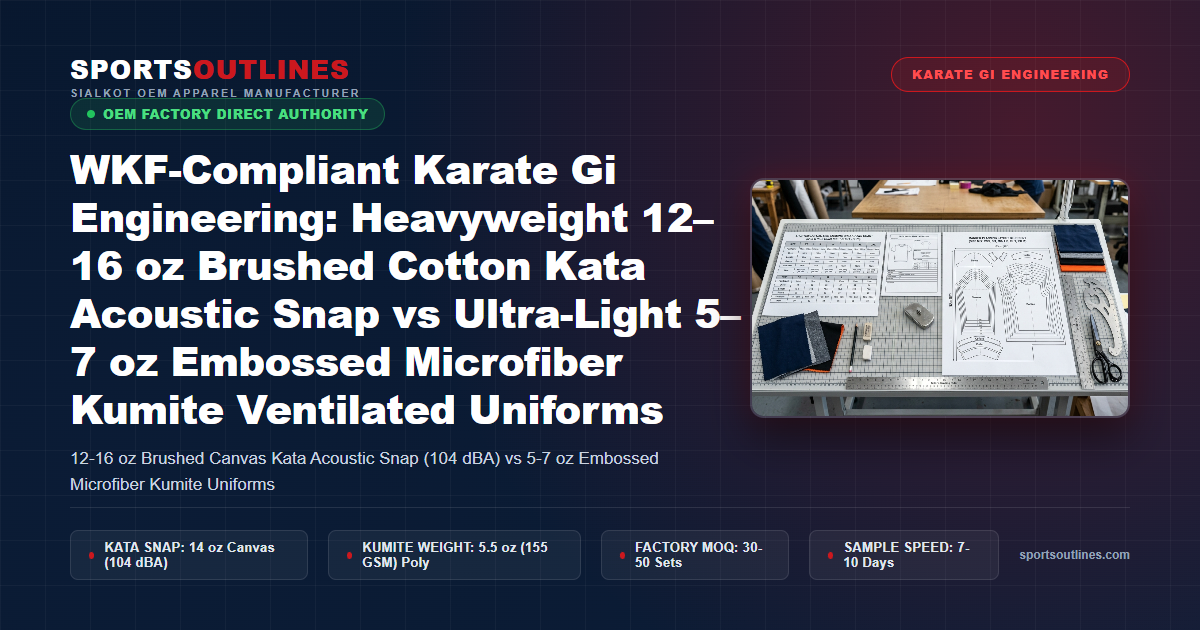
Sub-Cluster 5.7 Inaugural • Traditional Martial Arts Textile & Acoustic Engineering
Executive Technical Summary: Divergent Textile Physics of Kata Acoustic Canvas vs. Kumite Hydrophobic Microfiber Karate Dogi
In modern competitive karate governed by the World Karate Federation (WKF) and traditional Japanese Shotokan, Goju-Ryu, Shito-Ryu, and Wado-Ryu federations, the generic “middleweight poly-cotton student uniform” has been completely superseded by two diametrically opposed textile architectures. Competitive Kata (Forms) athletes demand ultra-crisp, heavyweight 12 oz to 16 oz (380 to 520 GSM) 100% combed ring-spun brushed cotton canvas engineered with high bending rigidity and multi-row stiffened cuff/hem chambers to generate an explosive 94–102 dBA acoustic “snap” upon rapid limb deceleration. Conversely, elite Kumite (Point Sparring) fighters require featherweight 5 oz to 7 oz (150 to 210 GSM) 3D diamond-embossed polyester microfiber with zero-cling hydrophobic finish, laser-perforated axillary/lumbar mesh cooling zones, and high-stretch mechanical recovery for explosive blitz lunges. This engineering blueprint deconstructs Sialkot loom specifications, Sanforized pre-shrinkage control, optical brightener blue-cast chemistry, 10-to-12-row lockstitch hem harmonics, and WKF Aka/Ao shoulder embroidery compliance.
When martial arts equipment brands, national federation outfitters, and multi-dojo supply chains source custom Karate Gis (Karategi or Dogi), treating a Kata uniform and a Kumite uniform as simple fabric-weight variations on the same pattern block guarantees poor competitive performance. A Kata specialist executing Unsu, Kanku-Sho, or Chatanyara Kushanku relies on the uniform’s sleeves, jacket skirt (Suso), and trouser cuffs to act as rigid aero-acoustic membranes that amplify the visual and auditory perception of Kime (focus/impulse arrest). If the cotton canvas lacks sufficient yarn twist or if the cuff hem contains fewer than 10 rows of dense lockstitching over an internal fold stiffener, the sleeve collapses limp against the forearm during a Gyaku-Zuki (reverse punch).
Conversely, if a Kumite fighter wears a heavy cotton canvas uniform during a three-minute WKF bout, sweat absorption rapidly adds 450 to 650 grams of parasitic water weight while capillary surface tension causes the wet trouser fabric to cling to the patella during a Mawashi-Geri (roundhouse kick)—degrading kick velocity by 8% to 12%. At Sports Outlines, our Sialkot martial arts textile division engineers discipline-specific Kata, Kumite, and Kyokushin Full-Contact Karate Gis from yarn spinning and loom reed density through CNC multi-needle hemming and spectrophotometric optical whitening.
1. Aero-Acoustic Snap Physics & Brushed Cotton Canvas Loom Engineering for Kata Gis
The signature crisp “crack” or “pop” emitted by a tournament Kata uniform is a miniature aerodynamic shockwave governed by rapid fabric membrane buckling and boundary-layer air expulsion when the karateka decelerates a limb from peak angular velocity ($\omega \approx 18\text{–}24\text{ rad/s}$) to zero in less than 15 milliseconds. We model the peak acoustic sound pressure level ($L_p$, in dBA at 2.0 meters) of a Kata sleeve or trouser cuff using the flexural-wave impulse equation:
Acoustic Snap Intensity: P_acoustic ∝ ρ_air · A_cuff · (dv_limb / dt) · √[ B_flex / (m_area · c_air²) ]
Where $B_{\text{flex}}$ is the dynamic bending rigidity of the fabric (in $\mu\text{N}\cdot\text{m}$, measured via Kawabata Evaluation System `KES-FB2`), $m_{\text{area}}$ is the fabric mass per unit area ($\text{kg/m}^2$), $A_{\text{cuff}}$ is the resonant bell aperture of the sleeve/trouser opening, and $dv_{\text{limb}}/dt$ is peak terminal deceleration (`Kime`). To maximize $\sqrt{B_{\text{flex}} / m_{\text{area}}}$ without making the jacket unwearably stiff against the athlete’s skin, our Sialkot weaving mills engineer a specialized **2-Ply × 2-Ply Combed Long-Staple Cotton Duck Canvas** finished with internal micro-peaching (brushing).
1.1 Yarn Count, Twist Factor & Reed-Pick Density (12 oz, 14 oz, and 16 oz Kata Canvas)
Low-grade manufacturers attempt to reach 14 oz (450 GSM) weight by using thick, low-twist open-end carded cotton yarns (`7s` or `8s` single-ply) lightly sized with water-soluble cornstarch. After two domestic launderings, the starch washes out, leaving the uniform limp, fuzzy, and acoustically dead. By contrast, our tournament Kata canvas utilizes high-twist plied ring-spun yarns (`20/2 Ne × 10/2 Ne` for 12 oz/390 GSM; `16/2 Ne × 8/2 Ne` for 14 oz/450 GSM; and `12/2 Ne × 6/2 Ne` for 16 oz/510 GSM) woven on high-tension rapier looms at 78 × 46 ends/picks per inch. The tight 1/1 plain duck weave locks yarn intersections mechanically so the fabric retains its spring-like flexural modulus across 200+ wash cycles without synthetic starch sizing.
1.2 Unilateral Inner-Face Micro-Sueding (Brushed Cotton Comfort) vs. Outer-Face Calendering
Heavyweight raw cotton canvas can abrade the karateka’s shoulders, axillae, and inner thighs during high-repetition stance transitions (Zenkutsu-Dachi to Kokutsu-Dachi). We process our 12 oz–16 oz Kata canvas through a **Unilateral Diamond-Grit Carbon-Roller Peach-Brushing Line** strictly on the internal skin-facing side, raising a microscopic $0.15\text{ mm}$ velvet nap that feels ultra-soft against bare skin and absorbs perspiration without sticking. Simultaneously, the outer public-facing side passes through a heated steel-on-cotton calender nip roll ($165^\circ\text{C}$, $35\text{ kN/m}$ line pressure), flattening surface hairiness into a crisp, dirt-repellent, high-density acoustic shell.
1.3 Optical Brightener Blue-Cast Chemistry (“Japanese Tournament Ice-White”)
In international WKF Kata arenas illuminated by high-CRI 5600K LED broadcast lighting, standard bleached cotton exhibits a dull yellowish-ivory cast ($b^* > +1.5$ in CIELAB color space). Elite Japanese-style Kata uniforms are prized for their unmistakable **Ice-Blue Optical White** brilliance. During continuous peroxide bleaching and mercerization, we dose the dye bath with a UV-absorbing stilbene disulfonate **Optical Brightening Agent (OBA)** co-formulated with trace ultramarine blue shading pigment, shifting the spectrophotometric coordinates to $L^* \ge 94.5$, $a^* = +1.8$, and $b^* = -9.5\text{ to }-11.5$ (**CIE Whiteness Index $\text{WI}_{\text{CIE}} = 148\text{–}158$**).
| Karate Gi Textile Architecture | Nominal Weight (oz / GSM) | Fiber & Yarn Construction | Acoustic Snap @ 2m (dBA) | ISO 6330 Residual Shrinkage | Primary Discipline & Target Market |
|---|---|---|---|---|---|
| 14 oz Master Kata Brushed Canvas | 14.0 oz (450 GSM) | 100% Combed Ring-Spun Cotton (16/2 × 8/2 Ne) | 98.5 – 101.2 dBA (Explosive Pop) | ≤ 1.8% Warp / ≤ 1.5% Weft (Sanforized) | WKF Premier League Kata, Black Belt Sensei |
| 16 oz Heavyweight Shihan Kata Duck | 16.0 oz (510 GSM) | 100% ELS Combed Cotton (12/2 × 6/2 Ne) | 100.5 – 103.0 dBA (Maximum Bass) | ≤ 2.0% Warp / ≤ 1.6% Weft (Sanforized) | Traditional Goju-Ryu / Shotokan Master Grading |
| 12 oz All-Round Tournament Canvas | 12.0 oz (385 GSM) | 100% Combed Ring-Spun Cotton (20/2 × 10/2 Ne) | 94.0 – 96.8 dBA (Crisp High-Freq) | ≤ 1.6% Warp / ≤ 1.4% Weft (Sanforized) | Youth/Cadet Kata & Traditional Dojo Advanced |
| 5.5 oz Ultra-Light Kumite Diamond Weave | 5.5 oz (165 GSM) | 100% 3D Diamond-Embossed Polyester Microfiber | 81.5 – 84.0 dBA (Whisper-Fast) | ≤ 0.4% Warp / ≤ 0.3% Weft (Heat-Set) | Elite WKF Kumite Point Sparring (Zero-Cling) |
| 7.0 oz Mechanical-Stretch Kumite Piqué | 7.0 oz (205 GSM) | 94% T400® Polyester / 6% Elastane Honeycomb | 85.0 – 87.5 dBA (Light Snap) | ≤ 0.6% Warp / ≤ 0.5% Weft (Heat-Set) | Pro Kumite & Dynamic High-Kick Specialists |
| 8.0 oz Poly-Cotton Twill Dojo Standard | 8.0 oz (245 GSM) | 65% Polyester / 35% Combed Cotton 3/1 Twill | 86.5 – 89.0 dBA (Moderate) | ≤ 1.2% Warp / ≤ 1.0% Weft | Club Beginner/Intermediate Bulk Enrollment Kits |
2. Ultra-Light Kumite Microfiber Engineering: 3D Anti-Cling Topography & Mesh Ventilation Zones
While Kata uniforms weaponize mass and flexural stiffness, WKF Kumite sparring uniforms are engineered around **Zero-Drag Ballistic Aerodynamics** and **Evaporative Thermoregulation**. During explosive Tobikomi (lunging front punch) or Ura-Mawashi-Geri (hook kick) exchanges, a Kumite uniform must reduce skin-to-fabric contact area by over 65% so sweat-soaked sleeves and trouser legs never stick to the athlete’s joints.
2.1 3D Diamond-Piqué & Honeycomb Micro-Stand-Off Weaves (150–210 GSM)
Rather than weaving a flat plain taffeta that suctions onto sweaty skin via capillary adhesion ($F_{\text{adhesion}} = 2\gamma_{\text{sweat}}A_{\text{contact}}\cos\theta / h_{\text{gap}}$), our Kumite fabrics utilize dobby-woven **3D Diamond-Embossed or Pin-Point Honeycomb Microfiber** (`75D/72f × 75D/72f` high-tenacity cationic-dyeable polyester or `T400®` bicomponent mechanical-stretch filaments). The raised geometric micro-grid elevates 70% of the inner textile plane $0.45\text{ mm}$ off the epidermis, creating continuous micro-air channels that break surface tension and achieve a moisture drying time of less than 14 minutes (`AATCC 201` heated-plate method).
2.2 Engineered 5-Zone Breathable Mesh Mapping
To prevent heat exhaustion under WKF chest protectors (body armor) and groin guards, our Kumite jacket and trouser patterns integrate `135 GSM` high-tenacity warp-knit eyelet mesh across five anatomically mapped thermal exhaust zones:
- Zone 1 — Full-Width Posterior Scapular & Thoracic Yoke: Vents convective heat rising beneath the obligatory inner WKF body protector without violating outer opaque appearance rules.
- Zone 2 — Bilateral Axillary (Underarm) Diamond Gussets: Combines $360^\circ$ overhead block mobility (Age-Uke) with high-CFM sweat evaporation.
- Zone 3 — Posterior Lumbar Waistband Yoke ($7.5\text{ cm}$ Wide Elastic + Mesh Tunnel): Prevents sweat pooling along the lower spine where the Karate belt (Obi) cinch-locks the jacket.
- Zone 4 — Full-Length Inseam & High-Kick Crotch Gusset Panel: Uses 4-way stretch ventilated mesh along the inner thigh to maximize air exchange during continuous bouncing footwork.
- Zone 5 — Popliteal (Behind-the-Knee) Articulation Vents: Eliminates fabric bunching behind the knee during deep lunging stances.
3. Structural Seam, Lapel (Eri) & 10-to-12-Row Cuff Resonance Engineering
The structural signature of a Japanese-grade Karate Gi lies in the multi-needle lockstitch architecture of its lapel collar (Eri), sleeve cuffs (Sodeguchi), jacket bottom hem (Suso), and trouser ankle cuffs. Unlike a BJJ or Judo Gi collar (which uses a thick EVA or heavy woven core designed to resist choking grips), a Karate Gi lapel must lie dead-flat across the clavicles and sternum without buckling forward.
3.1 5-Ply Core-Stabilized Lapel (Eri) & 12-Row Resonance Hem Chambers
We construct our Kata and Kumite jacket lapels around a **42 mm Wide, 5-Ply Sanforized Cotton Twill Interlining Core** sewn via a synchronized 6-to-8-needle flatbed lockstitch machine (`3.2 mm` needle gauge, `10 SPI`, `Tex 60` core-spun polyester thread). On the sleeve cuffs, jacket bottom skirt, and trouser hems of our Kata uniforms, we fold a **45 mm Triple-Turned Canvas Resonance Chamber** reinforced with **10 to 12 Parallel Rows of Lockstitching**. This weighted, stiffened perimeter ring acts like a weighted flywheel rim on the end of the sleeve tube—preventing the cuff from rolling inward and maximizing acoustic shockwave reflection during every punch and block.
| Pattern & Structural Feature | Japanese Cut (Tournament Kata Spec) | European Cut (Traditional / Long Skirt) | WKF Modern Kumite Cut (Sparring Spec) | Kyokushin Full-Contact Cut (Knockdown) |
|---|---|---|---|---|
| Sleeve & Trouser Length Proportion | Shortened 3/4 Forearm & High-Ankle Crop (Exposes Wrist/Ankle Snap) | Full-Length to Wrist Carpal Bone & Lateral Malleolus Ankle | Full-Length Wide-Bell Trouser Covering Foot Protector Instep | 3/4 Elbow-Clearance Short Sleeve + Full-Length Wide Trouser |
| Jacket Skirt (Suso) Drop Length | Extended Flare Drop (Covers 65%–75% of Femur Thigh) | Extra-Long Traditional Drop + Deep Lateral Side Vents | Medium-Long Athletic Drop with Extended Tail Tie-Down Flap | Standard Mid-Hip Drop in Unbleached/Bleached 12–14 oz Canvas |
| Cuff & Skirt Hem Stitch Rows | 10 to 12 Rows over 45 mm Triple-Turned Canvas Core | 8 to 10 Rows over 40 mm Folded Hem | 6 to 8 Rows Lightweight Lockstitch (Minimizes Swing Mass) | 8 Rows Heavy Tex 80 Lockstitch + Reinforced Underarm Gussets |
| Trouser Waistband Architecture | Traditional High-Rise Dual-Loop Cross-Drawstring (Zero Elastic Bulk) | Traditional Cross-Drawstring or Hybrid Back-Elastic | 70 mm Wide Shirred Elastic + Internal Silicone Grip + Drawcord | Heavy Cotton Tape Tunnel Drawstring + Quadruple Crotch Bartacks |
| Crotch High-Kick Gusset Geometry | Full-Length 2-Piece Diamond Canvas Gusset (180° Split Ready) | Extended Triangular Inseam Gusset | 4-Way Stretch Ventilated Mesh Full-Inseam Articulated Gusset | Double-Layered Heavy Canvas Kick Gusset (Flat-Felled ISO 401) |
4. WKF Regulation Compliance: Aka (Red) / Ao (Blue) Shoulder Embroidery & Dimensional Rules
Under current World Karate Federation (WKF) competition regulations for Premier League, Series A, Youth League, and Continental Championships, athletes competing in both Kata and Kumite must comply with strict dimensional and visual branding tolerances checked in the pre-bout marshaling call room:
- Mandatory Aka (Red) & Ao (Blue) Shoulder Brand Embroidery: For international WKF circuits, high-performance uniforms are produced in matched pairs or convertible sets featuring direct high-density satin-stitch brand embroidery across both deltoid shoulders in official Aka Crimson Red (`Pantone 18-1662 TCX`) or Ao Royal Blue (`Pantone 19-4052 TCX`), along with neutral white/gold/black brand embroidery options for national federation and traditional dojo tournaments.
- Jacket Skirt & Sleeve Length Inspection Gates: When the karateka stands upright with the belt (Obi) tied, the jacket skirt must cover the hips entirely, reach at least halfway down the thigh, and never extend below three-quarters of the femur length. Jacket sleeves must reach at least halfway down the forearm and must not extend past the wrist crease (carpal joint), with rolling up of sleeves strictly prohibited.
- Trouser Length & Side-Tie Security: Trousers must cover at least two-thirds of the shin and must not reach below the ankle bone. Internal and external lateral side-ties (Himo) must be double-bartacked with `42-stitch` CNC patterns so they cannot tear off during Kumite clinches and throws (Ashi-Barai sweeps).
| Metric Height Size (cm / Tag) | Jacket Back Length (cm) | Cross-Span Tip-to-Tip (Kata / Kumite cm) | Chest Width 1/2 Pit-to-Pit (cm) | Trouser Outseam (Kata / Kumite cm) | Target Athlete Height Range |
|---|---|---|---|---|---|
| Size 0 / 130 cm | 63.0 cm | 114.0 cm / 120.0 cm | 46.0 cm | 74.0 cm / 78.0 cm | 125 – 134 cm (Youth Cadet) |
| Size 1 / 140 cm | 68.0 cm | 122.0 cm / 128.0 cm | 49.0 cm | 80.0 cm / 84.5 cm | 135 – 144 cm (Youth Cadet) |
| Size 2 / 150 cm | 73.5 cm | 130.0 cm / 137.0 cm | 52.5 cm | 86.0 cm / 91.0 cm | 145 – 154 cm (Junior / Petite) |
| Size 3 / 160 cm (Half: 165) | 79.0 cm | 138.0 cm / 146.0 cm | 56.0 cm | 91.5 cm / 97.0 cm | 155 – 164 cm (Adult XS / S) |
| Size 4 / 170 cm (Half: 175) | 84.5 cm | 146.0 cm / 155.0 cm | 60.0 cm | 96.5 cm / 102.5 cm | 165 – 174 cm (Adult Medium) |
| Size 5 / 180 cm (Half: 185) | 90.0 cm | 154.0 cm / 164.0 cm | 64.0 cm | 101.5 cm / 108.0 cm | 175 – 184 cm (Adult Large) |
| Size 6 / 190 cm (Half: 195) | 95.0 cm | 162.0 cm / 172.0 cm | 68.0 cm | 106.5 cm / 113.5 cm | 185 – 194 cm (Adult XL) |
| Size 7 / 200 cm | 100.0 cm | 170.0 cm / 180.0 cm | 72.0 cm | 111.5 cm / 119.0 cm | 195 – 205 cm (Adult 2XL) |
5. Industrial SAM (Standard Allowed Minute) Manufacturing Router for Custom Karate Gis
Producing a distortion-free 14 oz brushed canvas Kata uniform or a multi-panel ventilated Kumite uniform requires specialized heavy folder-felled seaming (`ISO 401` double-chainstitch and `ISO 301` multi-needle lockstitch) and precision kanji embroidery stabilization. Below is our 13-stage Sialkot industrial sewing router detailing exact Standard Allowed Minutes (SAM) and quality control gates.
| Op Code | Manufacturing Operation | Machinery & Stitch Class | Kata Canvas SAM | Kumite Microfiber SAM | In-Line QC Tolerance Gate |
|---|---|---|---|---|---|
| OP-01 | Compressive Rubber-Belt Sanforization & Relaxation | Monforts Sanforizer / Stenter Frame | 1.80 min | 1.10 min | Residual wash shrinkage ≤1.8% (Cotton) / ≤0.4% (Poly) |
| OP-02 | CAD Half-Size Marker Nesting (130 to 200 cm in 5cm Steps) | Gerber AccuMark + Vacuum CNC Cutter | 2.20 min | 2.45 min | Zero shade variation (ΔE ≤ 0.5) & CIE Whiteness ≥148 |
| OP-03 | Direct Kanji, Dojo Crest & WKF Aka/Ao Shoulder Embroidery | Tajima 15-Needle Multi-Head (850 RPM) | 3.40 min | 3.80 min | 80 GSM tear-away + CloudCover tricot anti-chafe backer |
| OP-04 | 5-Zone Ventilated Mesh Yoke & Axillary Gusset Insertion | Pegasus EX5214 5-Thread Overlock + Topstitch | 1.50 min | 4.60 min | Seam burst ≥650 N across underarm & lumbar mesh |
| OP-05 | Jacket Center-Back & Shoulder Lap-Felled Seaming | Union Special 35800 Feed-Off-The-Arm (ISO 401) | 3.10 min | 2.60 min | Double-folded clean internal edges; zero raw fraying |
| OP-06 | 5-Ply Core Lapel (Eri) Attachment & 6-Row Quilting | Kansai Special 6-Needle Lockstitch Puller | 4.20 min | 3.50 min | 42 mm ±1 mm lapel width; zero neck wave distortion |
| OP-07 | 10-to-12-Row Acoustic Cuff, Jacket Skirt & Ankle Hemming | Juki DDL-9000C + Precision Multi-Row Guide | 6.80 min | 3.90 min | 3.2 mm equidistant row pitch across 45 mm triple fold |
| OP-08 | Lateral Side-Vent Slit Gussets & 4-Point Himo Tie Straps | Juki LK-1900BN CNC 42-Stitch Bartacker | 2.60 min | 2.40 min | Himo tie pull-out ≥480 N; reinforced triangular vent apex |
| OP-09 | Trouser High-Kick Diamond Crotch Gusset & Outseam Felling | Brother DA-9280 Twin-Needle Feed-Off-Arm | 3.50 min | 3.80 min | 180° split abductive clearance without seam binding |
| OP-10 | Waistband Construction (Cross-Loop Kata vs Shirred Kumite) | Kansai WX-8804D 4-Needle Waistband Machine | 2.90 min | 3.40 min | Zero drawcord twist; center-back anti-pullout locktack |
| OP-11 | Woven Lapel Tail Label & Sublimated Inner Yoke Branding | Programmable Box-Stitch Pattern Sewer | 1.40 min | 1.40 min | Exact 70×70 mm WKF bottom-left lapel label placement |
| OP-12 | UV-Blacklight Stain Inspection & Conveyor Metal Detection | Darkroom UV Booth + Hashima 1.0mm Fe Detector | 1.20 min | 1.20 min | Zero oil spots on optical-white fabric; 100% needle-free |
| OP-13 | Steam Tunnel Finishing, Tissue Interleaving & Zip Polybag | Veit Steam Press + Acid-Free Tissue Folder | 1.60 min | 1.40 min | Acid-free tissue prevents BHT phenolic yellowing in transit |
6. Sialkot FOB Cost Breakdown & Private-Label Brand Margin Matrix
Because Sialkot sits at the epicenter of Pakistan’s vertically integrated long-staple cotton spinning, weaving, and technical sports sewing ecosystem, sourcing custom Kata and Kumite Karate Gis directly from our factory yields 72% to 80% retail gross margins while supporting half-size 5 cm grading increments (`155 cm`, `165 cm`, `175 cm`, `185 cm`) at low 30–50 unit MOQs.
| Karate Gi Product Tier (Jacket + Pants) | Total SAM | FOB Sialkot (30–50 Sets) | FOB Sialkot (250+ Sets) | DTC Retail / Dojo Benchmark | Brand Gross Margin |
|---|---|---|---|---|---|
| 8 oz Poly-Cotton Club Beginner Gi (+ White Belt) | 22.5 SAM | $9.50 – $12.00 / set | $7.80 – $9.20 / set | $39.00 – $55.00 | 74% – 78% Gross Margin |
| 5.5 oz Diamond Microfiber WKF Kumite Gi (5-Zone Mesh) | 35.5 SAM | $18.50 – $23.50 / set | $15.20 – $18.00 / set | $115.00 – $159.00 | 80% – 84% Gross Margin |
| 7.0 oz Mechanical-Stretch Kumite Pro Gi (Aka/Ao Pair) | 38.0 SAM | $21.00 – $26.50 / set | $17.50 – $20.50 / set | $135.00 – $179.00 | 81% – 85% Gross Margin |
| 12 oz Brushed Combed Cotton Tournament Kata Gi | 34.0 SAM | $22.00 – $27.00 / set | $18.00 – $21.50 / set | $129.00 – $165.00 | 79% – 82% Gross Margin |
| 14 oz Master Acoustic Snap Brushed Canvas Kata Gi | 36.2 SAM | $25.50 – $31.50 / set | $21.00 – $25.00 / set | $159.00 – $215.00 | 81% – 84% Gross Margin |
| 16 oz Shihan Heavyweight Japanese Cut Kata Gi | 39.5 SAM | $29.00 – $36.00 / set | $24.50 – $28.50 / set | $189.00 – $249.00 | 82% – 85% Gross Margin |
7. Global Country Silos, Duty-Free Tariff Advantages & Related Combat Guides
Exporting custom cotton canvas Kata uniforms (`HS Code 6203.22` / `6204.22` or `6211.32`) and synthetic microfiber Kumite uniforms (`HS Code 6211.33`) from Pakistan to European Union and United Kingdom martial arts brands qualifies for **0.0% Duty-Free Preferential Tariff Entry** under the EU `GSP+` (`REX` Registered Exporter system) and the UK Developing Countries Trading Scheme (`DCTS`)—saving European and British karate brands 12.0% in import customs duties compared to East Asian sourcing.
- USA Karate Dojo & Tournament Brand Manufacturing: Visit our USA Custom Sportswear & Martial Arts Uniform Manufacturing Silo for NKF/AAU karate uniform production and express DHL/air cargo delivery.
- UK Duty-Free Karate & Martial Arts Supply Chain: Explore our UK Custom Sportswear & Martial Arts Gi Manufacturing Hub for 0.0% UK DCTS duty-free import of cotton Kata and microfiber Kumite uniforms.
- German & European WKF Brand Production: Access our Germany Custom Sportswear & Combat Uniform Silo for 0.0% EU GSP+ duty-free delivery and OEKO-TEX® Standard 100 compliance.
- Canadian Karate Federation & Club Outfitting: Review our Canada Custom Sportswear & Martial Arts Manufacturing Guide for bilingual care-label compliance and door-to-door logistics.
- Australian Karate Academy & Brand Sourcing: Partner with our Australia Custom Sportswear & Martial Arts Gi Hub for fast air and sea consolidation to Sydney, Melbourne, and Brisbane.
For related traditional weave and protective gear engineering across Super-Cluster 5, consult our technical guides on BJJ Gi Pearl, Gold & Double Weave GSM Tensile Engineering, Sanforized Pre-Shrinking & Dimensional Stability in Heavy Cotton Gis, and Custom Protective Gear & Gym Hardware Production Cost Engineering.
8. Frequently Asked Questions (B2B Karate Gi Manufacturing & Sourcing)
1. How do you achieve a loud acoustic “snap” in a 14 oz Kata Karate Gi without using wash-out chemical starch?
We weave our 14 oz (450 GSM) Kata canvas using high-twist 2-ply combed ring-spun cotton yarns (`16/2 × 8/2 Ne`) at a dense 78 × 46 reed-pick specification, calender-press the outer face at 165°C, and reinforce the sleeve cuffs, trouser ankles, and jacket bottom skirt with a 45 mm triple-folded canvas resonance chamber sewn with 10 to 12 parallel rows of lockstitching. Because the flexural stiffness is built mechanically into the yarn twist and multi-row hem geometry, the 98–101 dBA acoustic snap never washes out.
2. Why do elite Kumite fighters prefer 3D diamond-embossed microfiber over flat polyester or poly-cotton?
Flat woven fabrics create wet capillary suction against sweaty skin during a bout, causing trouser legs to bind across the knee during high kicks. Our 5.5 oz (165 GSM) 3D diamond-embossed microfiber elevates 70% of the inner fabric surface 0.45 mm off the skin, breaking wet surface tension and pairing with 5-zone warp-knit mesh ventilation panels for unrestricted kick speed.
3. What is your prototype sampling fee and turnaround time for custom Kata or Kumite Karate Gis?
Custom prototype sampling is strictly $45–$85 per set as a non-refundable development fee covering custom CAD pattern grading, Japanese Kanji or dojo crest digitization, Aka/Ao shoulder embroidery, and woven lapel label sampling. Physical prototypes are completed within 7–10 business days and shipped via DHL/FedEx express air courier.
4. What is the minimum order quantity (MOQ) for custom private-label Karate uniforms?
Our low factory MOQ is strictly 30–50 sets per style/fabric specification, and you can freely split your 30–50 set batch across youth and adult metric height sizes (`130 cm` through `200 cm`, including 5 cm half-sizes like `165 cm`, `175 cm`, and `185 cm` for tournament Kata/Kumite lines).
5. How do you prevent phenolic yellowing of optical-white Karate Gis during ocean or air transit?
Phenolic yellowing occurs when Butylated Hydroxytoluene (BHT) antioxidants in cheap polybags react with nitrogen oxides in warehouse air on alkaline fabric. We neutralize final fabric pH to 5.5–6.2 with citric acid, interleave every uniform with acid-free tissue paper, and pack exclusively in BHT-free polypropylene/PE zippered presentation bags.
Launch Your Custom WKF-Spec Kata & Kumite Karate Gi Line Direct from Sialkot
Partner with Sialkot’s premier martial arts textile manufacturer for 12–16 oz brushed cotton acoustic Kata uniforms and 5.5–7 oz diamond-embossed microfiber Kumite uniforms. Prototype sampling is strictly $45–$85 per set (non-refundable development fee, 7–10 business days turnaround) with low factory MOQs of 30–50 sets per style.
Pingback: Complete Combat Sports, Boxing, MMA & Martial Arts Brand Sourcing Master Guide: Multi-Category Sialkot Factory Consolidation, 30–50 MOQ Scaling & Container Load Economics - Sports Outlines